Adventure Kings Domin8r Xtreme manual
Unknown · 10 Q&As

Adventure Kings Domin8r Xtreme

Ask AI

— answers from the official manual

Answers from the official manual.

Common questions

Common Questions

10 total
Show 4 more questions

Full Manual

8 pages
Page 1

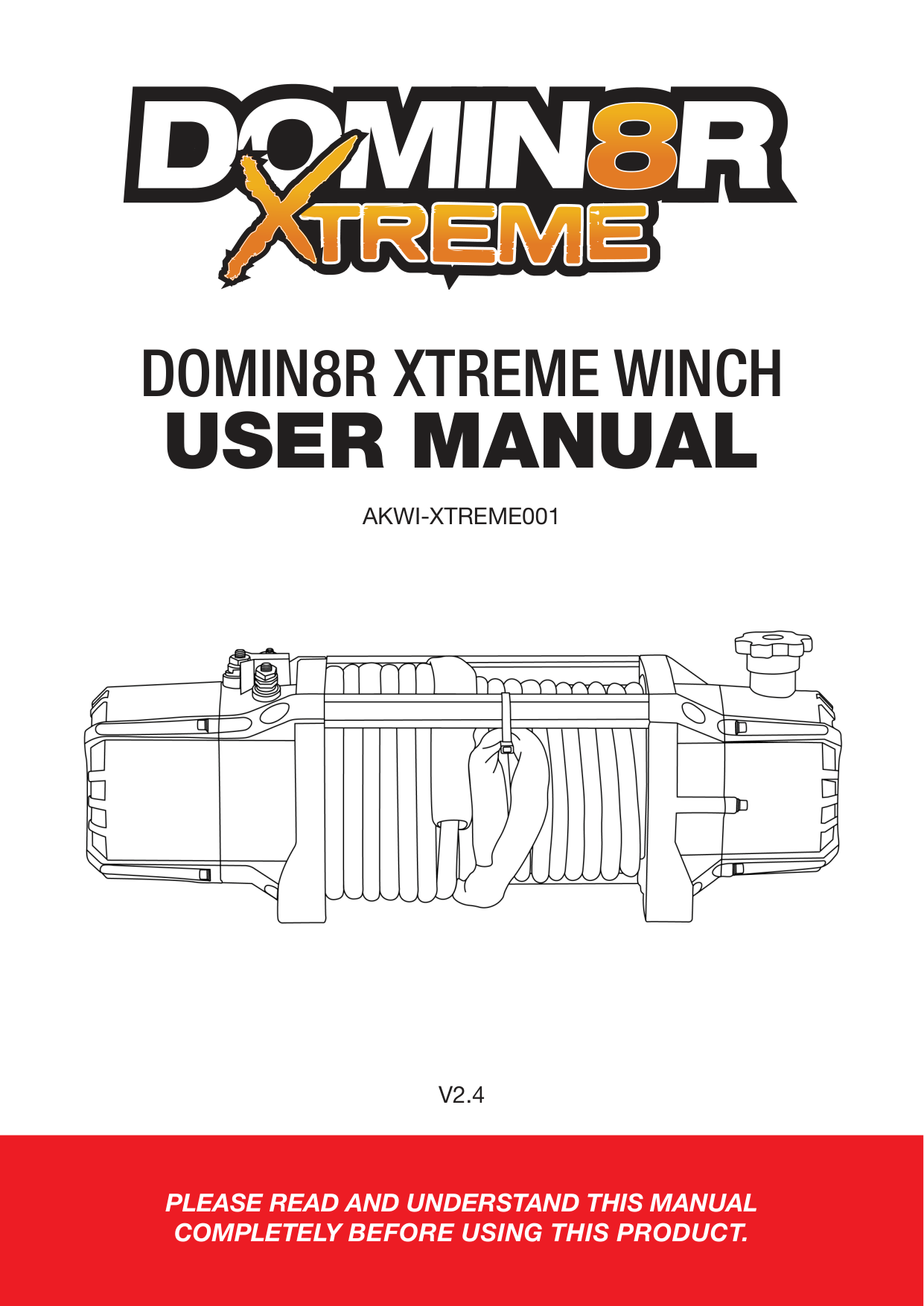
DOMIN8R XTREME WINCH

USER MANUAL

AKWI-XTREME001

![image 1](Domin8r_20Xtreme_20Winch_images/imageFile1.png)

V2.4

PLEASE READ AND UNDERSTAND THIS MANUAL COMPLETELY BEFORE USING THIS PRODUCT.

CONTENTS

  • 1. Safety Precautions 3
  • 2. Winch Operation Warnings 4-5
  • 3. Installation 6
  • Mounting Your Winch 6 Lubrication Installation 6 Rope Installation 6 Electrical Connection 6

  • 4. Winch Operation 8
  • Control Box 8 Winch Maintenance 8

    Page 2

  • 5. Operating 9-10
  • 6. Winch Exploded Diagram 10
  • 7. Winch Parts List 11
  • 8. Winch Specifications 12
  • Winch Features 12 Line Pull and Cable Capacity 12 Line Speed and Amp Draw (First Layer) 12

  • 9. Instruction for Cut Off Switch 13
  • 1. SAFETY PRECAUTIONS

    Warning! Observe safety precautions for personal safety and the safety of others. Improper equipment operation may cause personal injury and equipment damage. Read the following carefully before attempting to operate your winch and keep the instructions for future reference.

    #### 1. DRESS PROPERLY
  • • Don’t wear loose clothing or jewellery. They can be caught in moving parts.
  • • Wear leather gloves when handling winch rope. Do not handle rope with bare hands as it can cause injuries.
  • • Non-skid footwear is recommended,
  • • Wear protective hair covering to contain long hair.
  • Page 3

    #### 2. KEEP A SAFE DISTANCE

  • • Ensure that all persons stand well clear of winch rope and load during winch operation, 1.5 times the rope length recommended. If a rope breaks under load it can lash back and cause serious personal injury or death.
  • • Don’t step over the rope.
  • • All visitors and onlookers should be kept away from the work area.
  • • Keep proper footing and balance at all times.
  • #### 3. DON’T ABUSE THE CORD

  • • Never carry your winch by the cord or yank it to disconnect it from the receptacle.
  • • Keep cord from heat, oil and sharp edges.
  • #### 4. DON’T OVERWORK THE WINCH

  • • If the motor becomes uncomfortably hot to touch, stop and let it cool for 15 minutes.
  • • Don’t maintain power to the winch if the motor stalls.
  • • Don’t exceed maximum line pull ratings shown in tables. Shock loads must not exceed these ratings.
  • #### 5. AVOID UNINTENTIONAL STARTING

    Page 4

    • Winch clutch should be disengaged when not in use and fully engaged when in use.

    #### 6. CHECK DAMAGED PARTS

    • Before using, you should check your winch carefully. Any part that is damaged should be properly repaired or replaced by an authorized service centre.

    #### 7. REPAIR YOUR WINCH

    • When repairing use only identical replacement parts or it may cause considerable danger for the user.

    #### 8. RESPOOL THE CABLE

  • • Leather gloves must be worn while respooling. To respool correctly, it is necessary to keep a slight load on the rope. Hold the rope with one hand and the remote control switch with the other. Start as far back and in the centre as you can. Keep at least 150kg on the rope as the winch is powered in. Winching on a flat surface is one method. Winching until all the cable except 1m is in.
  • • Disconnect the remote control switch and finish spooling in cable by rotating the drum by hand with clutch disengaged.
  • • On hidden winches, spool in cable under power but keep hands clear.
  • ##### Warning: The use of any other accessory or attachment other than those recommended in the instruction manual may present a risk of personal injury.

    2. WINCH OPERATION WARNINGS

    Read the following carefully before attempting to operate your winch and keep the instructions for future reference.
    Page 5

  • • The uneven spooling of rope, while pulling a load, is not a problem, unless there is a rope pile up on one section of the drum which can damage the winch. If this happens reverse the winch to relieve the load and move your anchor point further to the centre of the vehicle. After the job is done you can unspool and rewind for a neat lay of the rope.
  • • Store the remote control switch inside your vehicle where it will not become damaged, inspect it before you plug it in.
  • • When ready to begin spooling in, plug in remote control switch with clutch disengaged, do not engage clutch with motor running.
  • • Never connect the hook back to the rope. This causes rope damage. Always use a sling of suitable strength.
  • • Observe your winch while winching, if possible while standing at a safe distance. Stop the winching process every metre or so to assure the rope is not pulling up in one corner. Jamming the rope can break your winch.
  • • Do not attach tow hooks to winch mounting apparatus. They must be attached to vehicle frame.
  • • The use of a snatch block will aid recovery operations by providing a doubling of the winch capacity and a halving of the winching speed, and the means to maintain a direct line pull to the centre of the fairlead. When using a double line pull loading during stationary winching, the winch hook should be attached to the chassis of the vehicle. It is recommended to use a snatch block double line pull when loads exceed 70% of the winch rating.
  • • Ensure rated bow shackles are used in conjunction with an approved tree trunk protector to provide a safe anchor point.
  • • When extending winch rope, ensure that at least 8 wraps of rope remain on drum at all times. Failure to do this could result in the rope parting from the drum under load. Serious personal injury or property damage may result.
  • • Since the greatest pulling power is achieved on the innermost layer of your winch, it is desirable to pull off as much line as you can for heavy pulls (you must leave at least 8 wraps minimum on the drum). If this is not practical use a snatch block and double line arrangement.
  • • Draping a heavy blanket or similar object over the extended winch rope is recommended as it helps dampen any back lash should a failure occur.
  • • Neat, tight spooling avoids rope binding, which is caused when a load is applied and the rope is pinched between the others. If this happens, alternatively power the winch in and out. Do not attempt to work a bound rope under load, free by hand when unloaded.
  • • Apply blocks to wheels when vehicles are on an incline.
  • 2. WINCH OPERATION WARNINGS (CONT’D)

    #### BATTERY
  • • Be sure that the battery is in good condition. Avoid contact with battery acid or other contaminants.
  • • Always wear eye protection when working around a battery.
  • • Have the engine running when using the winch, to avoid flattening the battery. Use a minimum 650CCA battery.
  • Page 6

    #### WINCH ROPE

  • • Be sure that the rope is in good condition and is attached properly. Check rope for wear or damage after each use. If worn or damaged it must be replaced.
  • • Do not use the winch if rope is frayed or damaged.
  • • The life of the rope is directly related to the use and care it receives. It must be wound on to the drum under a load at approx. (150kg) or the outer wraps will draw into the inner wraps and severely damage the rope during winching. The first winch use should be a familiarization run while in a relaxed, non-recovery situation. Spool out the rope until 8 wraps left on the drum, then rewind the rope on to the drum under a load of (150kg) or more. This will slightly tension and stretch the new rope and create a tight rope wrap around the drum. Failure to do so may result in rope damage and reduced rope life.
  • • When the rope is replaced, be sure to apply Loctite, or an equal compound, to the rope clamp thread. Tighten the clamp screw properly but do not over tighten. The Loctite will help prevent loosening of the screw in arduous conditions.
  • • Loctite 7471 Primer and 222 Thread locker are recommended.
  • • Inspect the rope after each use. If the rope becomes worn or damaged it must be replaced.
  • • DO NOT attempt to exceed the pulling limits of this winch.
  • • DO NOT drive your vehicle to assist the winch in any way. Vehicle movement in combination with winch operation may overload the rope, the winch itself or cause damaging shock loads.
  • • Shock loads when winching are dangerous! A shock load occurs when an increased force is suddenly applied to the rope. A vehicle rolling back on a slack rope may induce a damaging shock load.
  • • The winches shown in this manual are solely for vehicle and boat mounted, non-industrial applications.
  • • Do not use winch in hoisting or lifting applications.
  • • Do not use the winch to lift, support or otherwise transport people.
  • 4. WINCH OPERATION

    #### SUGGESTION

    The best way to get acquainted with how your winch operates is to make a few test runs before you actually need to use it. Plan your test in advance. Remember you can hear your winch as well as you can see it operate.
    Page 7

    Get to recognize the sound of a light steady pull, a heavy pull, and sounds caused by load jerking or shifting. Soon you will gain confidence in operating your winch and its use will become second nature to you.

    CONTROL BOX Ensure the control box components are cleaned inside after exposure to mud and dirty water.

    WINCH MAINTENANCE We recommend at least once a month to operate your winch. If operating your winch in an environment where it may get wet, we recommend that you re-run your winch at the end of the day. The Domin8r Xtreme Winch motor has twin lip seals which are very efficient at preventing water ingress into the motor but are not guaranteed to be 100% waterproof. Water is unlikely to damage the motor at the point of use but will over time if the winch is not properly maintained.

    5. OPERATING

  • • Ensure the vehicle is secure by applying the parking brake or chocking the wheels
  • • Pull out the winch rope the desired length and connect to an anchor point.
  • • Disengaging the winch clutch allows rapid uncoiling of the rope for hooking onto the load or anchor point.
  • • The shifter tab located on the gear housing of the winch operates the clutch as follows:
  • • To disengage the clutch, move the clutch shifter tab to the “FREESPOOL” position. Rope could be free spooled off the drum.
  • • To engage the clutch, move the clutch shifter tab into the “ENGAGED” position. The winch is now ready for pulling.
  • • Recheck all cable rigging before proceeding.
  • • Plug in the winch hand control. It is recommended that the winching operation takes place from the driver’s position to ensure safe operation.
  • • To commence winching operation, start vehicle engine, select neutral in transmission, maintain engine speed at idle.
  • • Operate the hand control or the wireless remote control until the vehicle has been retrieved.
  • • Regularly check the winch to ensure rope is winding onto the drum evenly.
  • • Always use a winch cable blanket to minimise rope recoil.
  • #### NOTE:

    Page 8

  • • Never winch with your vehicle in gear or in park, which would damage your vehicle’s transmission.
  • • Never wrap the rope around the object and hook onto the rope itself. This can cause damage to the object being pulled, and kink or fray the rope.
  • • Keep hands, clothing, hair and jewellery clear of the drum area and rope when winching.
  • • Never use the winch if the rope is frayed, kinked or damaged.
  • • Never allow anyone to stand near the rope or in line with the rope behind the winch while it is under power. If the rope should slip or brake, it can suddenly whip back towards the winch, causing a hazard for anyone in the area. Always stand well to the side while winching.
  • • Don’t leave the switch plugged in when winch is not in use.
  • CHECK THE WINCH CAREFULLY AND THOROUGHLY BEFORE OPERATING!

    #### MAINTENANCE

    It is highly recommended that the winch be used regularly (once a month). Simply power the rope out 15m, free spool 5m and then power back in. This helps keep all components in good working condition so that the winch can be relied on when needed. Contact your authorized outlet for technical assistance and repairs.

    5. OPERATING (CONT’D)

    #### SPARE PARTS:

    A comprehensive range of spare parts is available. Please kindly contact the distributor or the local retailer.

    #### WINCHING CAPACITY

  • • Pulling capacity is reduced as the incline increases.
  • • Winch is not intended as a load securing device.
  • NOTE: The safety precautions and instructions discussed in this manual can’t cover all possible conditions and situations that may occur. It must be understood by the operator that common sense and caution are factors, which cannot be built into this product, but must be applied by the operator.

    Similar Unknown