Ask AI
— answers from the official manualAI-powered answers from the official manual. Verify critical info.
Common questions
Common Questions
45 totalWhat is the operating temperature range for the HP Z420 Workstation?
The operating temperature range is 5°C to 35°C (40°F to 95°F). Note that the upper limit of 35°C applies only up to 1,524 m (5,000 ft) elevation, and the limit must be derated by 1°C for every 305 m (1,000 ft) above that altitude. (Page 13)
How do I restore Windows 7 on the HP Z420 Workstation using HP Recovery Manager?
Boot from disc 1 of the HP Recovery Manager set and follow the prompts to restore the operating system. Be aware that this process deletes all information on the primary hard drive, including all partitions, so you should back up your data before proceeding. Some applications may not be restored and will need to be reinstalled separately. (Page 27)
What safety precautions should I follow when plugging in the HP Z420 Workstation?
Plug the power cord into an easily accessible AC outlet and always disconnect power by unplugging the cord from the AC outlet, not from the computer. You must use a grounded (earthed) three-pin outlet and must not disable the grounding pin, for example by attaching a two-pin adapter, as it is an important safety feature. (Page 16)
What should I do if the HP Z420 Workstation monitor display is blank during operation?
Try plugging the monitor into a different video port on the computer if one is available, or replace the monitor with one you know is working. Also verify that both the computer and monitor are plugged into a working electrical outlet, that the monitor is powered on with its green light showing, and that brightness and contrast controls are turned up if the display appears dim. (Page 46)
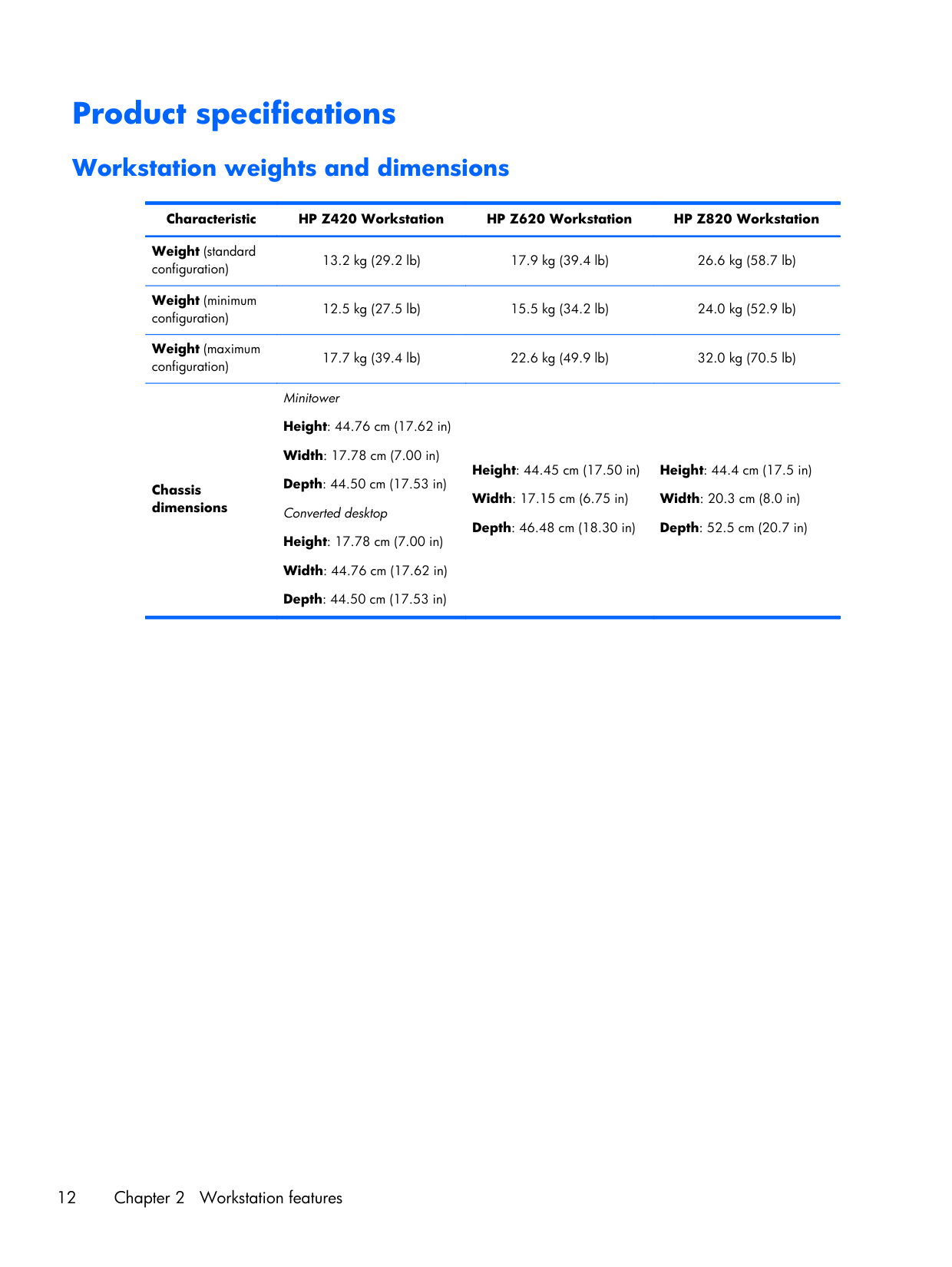
What are the weight and dimensions of the HP Z420 Workstation in standard configuration?
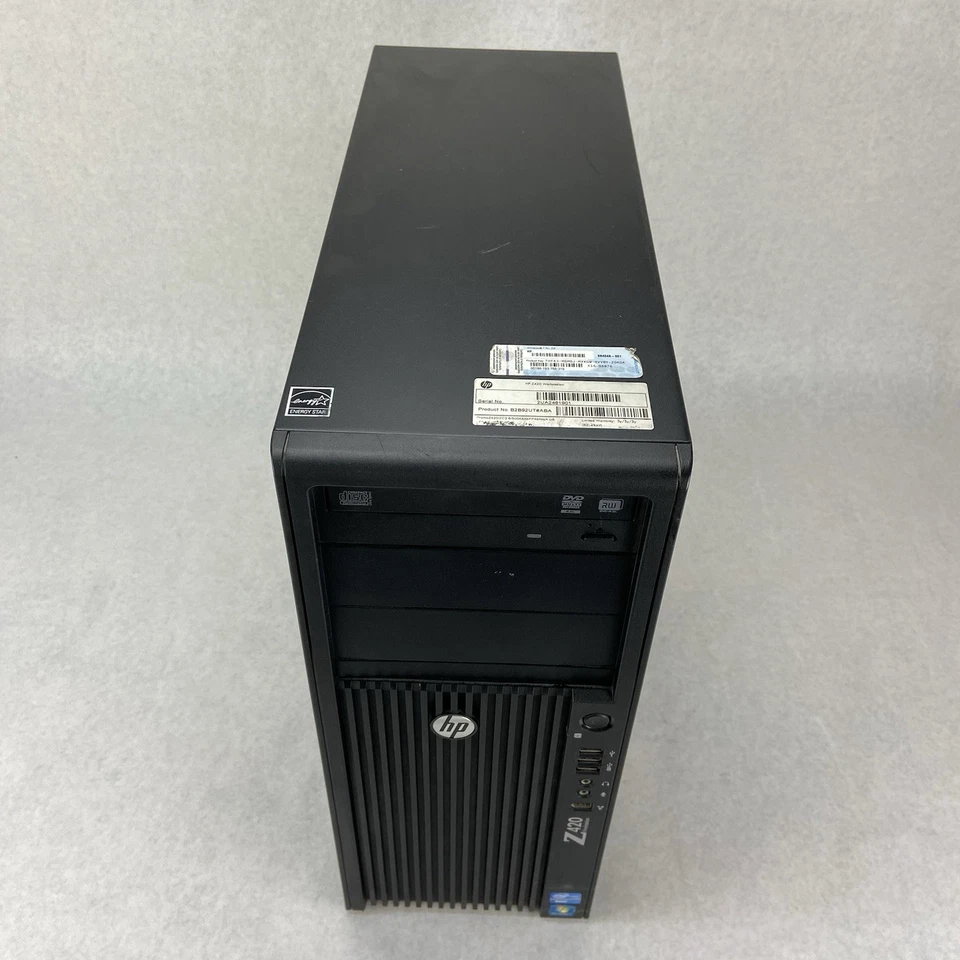
The HP Z420 Workstation weighs 13.2 kg (29.2 lb) in standard configuration. In minitower configuration, it measures 44.76 cm (17.62 in) high, 17.78 cm (7.00 in) wide, and 44.50 cm (17.53 in) deep. (Page 12)
What cleaning products are safe to use on the HP Z420 Workstation chassis?
For light stains or dirt, use plain water with a clean, lint-free cloth or swab. For stronger stains, use mild dish washing liquid diluted with water and rinse by wiping with a water-dampened cloth. For stubborn stains, isopropyl (rubbing) alcohol can be used, and no rinsing is required as it evaporates quickly. Never use solvents or flammable solutions to clean the computer. (Page 39)
Show 39 more questions
What are the basic steps to set up the HP Z420 Workstation for the first time?
How much clearance does the HP Z420 Workstation need for proper ventilation?
What are the operating temperature limits for the HP Z420 Workstation?
How do I check the current BIOS version on the HP Z420 Workstation?
How do I restore the Windows 7 operating system on the HP Z420 Workstation?
What safety precautions should I follow when cleaning the HP Z420 Workstation?
Where can I find the serial number and product number on the HP Z420 Workstation?
What should I do if the workstation gets stuck in suspend mode and won't wake up?
Can the HP Z420 Workstation be converted from a tower to a desktop configuration?
What are the weight and dimensions of the HP Z420 Workstation?
What are the proper ventilation requirements for setting up the Z420 Workstation?
How do I set up multiple monitors on the Z420 Workstation?
What should I do before calling HP technical support?
How do I convert the Z420 from tower to desktop configuration?
What are the safety precautions for cleaning the workstation?
How do I restore the Microsoft Windows operating system using HP Recovery Manager?
What operating systems are supported on the Z420 Workstation?
How do I find supported graphics cards for the Z420?
What should I check if my monitor appears blank during operation?
How do I clean the keyboard properly?
What should I know about ventilation before setting up my HP Z420 Workstation?
How do I restore my operating system if something goes wrong?
Can I convert my HP Z420 to a desktop configuration?
Where can I find installation videos for HP Z420 components?
Where should I look if I need detailed technical specifications for my Z420?
Is the information in this manual proprietary or can I share it?
Can I use my HP Z420 Workstation with multiple monitors?
What should I do for routine care and maintenance of my workstation?
What are the warranty terms for the HP Z420 Workstation?
How can I troubleshoot problems with my HP Z420?
What should I do to ensure my HP Z420 Workstation operates safely?
What topics are covered in the HP Z420 User Guide?
Can I use this guide for other HP Z Workstation models?
Where can I find the workstation specifications like weight and dimensions?
Where can I find technical details beyond what's in the user guide?
What should I do if I need to troubleshoot problems with my Z420?
What warranty does HP provide with the Z420 Workstation?
Can I convert my Z420 Workstation to a desktop configuration?
What should I do for routine maintenance of my Z420 Workstation?
Full Manual
48 pages
Copyright Information First Edition: March 2012 Part number: 669529-001 Warranty Hewlett-Packard Company shall not be liable for technical or editorial errors or omissions contained herein or for incidental or consequential damages in connection with the furnishing, performance, or use of this material. The information in this document is provided “as is” without warranty of any kind, including, but not limited to, the implied warranties of merchantability and fitness for a particular purpose, and is subject to change without notice. The warranties for HP products are set forth in the express limited warranty statements accompanying such products. Nothing herein should be construed as constituting an additional warranty. This document contains proprietary information that is protected by copyright. No part of this document may be photocopied, reproduced, or translated to another language without the prior written consent of Hewlett-Packard Company. Trademark Credits The HP logo is a trademark of Hewlett- Packard Company in the U.S. and other countries. Microsoft and Windows are U.S. registered trademarks of Microsoft Corporation. Intel is a trademark of Intel Corporation in the U.S. and other countries and is used under license. Acrobat is a trademark of Adobe Systems Incorporated. ENERGY STAR is a U.S. registered mark of the United States Environmental Protection Agency.
About this guide This guide provides setup and troubleshooting information for the HP Z Workstation series. It includes these topics: Guide topics Locating HP resources on page 1 Workstation features on page 6 Setting up the workstation on page 14 Setting up and restoring Microsoft Windows on page 26 Setting up and restoring Linux on page 28 Diagnostics and Minor Troubleshooting on page 33 Routine Care on page 39
Tip:
If you do not find what you are looking for in this guide: — Find technical details in the Manufacturing and Service Guide at http://www.hp.com/support/ workstation_manuals. — View component installation videos at http://www.hp.com/go/sml. — See additional information on your workstation at http://www.hp.com/go/workstations. iiiTable of contents 1 Locating HP resources ....................................................................................................... 1 Product information .................................................................................................................. 2 Support ................................................................................................................................... 3 Product documentation ............................................................................................................. 4 Product diagnostics .................................................................................................................. 4 Product updates ....................................................................................................................... 5 2 Workstation features ........................................................................................................ 6 HP Z420 Workstation components ............................................................................................. 6 HP Z420 Workstation front panel ............................................................................... 6 HP Z420 Workstation rear panel ................................................................................ 7 HP Z620 Workstation components ............................................................................................. 8 HP Z620 Workstation front panel ............................................................................... 8 HP Z620 Workstation rear panel ................................................................................ 9 HP Z820 Workstation components ........................................................................................... 10 HP Z820 Workstation front panel ............................................................................. 10 HP Z820 Workstation rear panel .............................................................................. 11 Product specifications ............................................................................................................. 12 Workstation weights and dimensions ......................................................................... 12 Environmental specifications ..................................................................................... 13 3 Setting up the workstation ............................................................................................. 14 Ensuring proper ventilation ...................................................................................................... 14 Setup procedures ................................................................................................................... 16 Adding monitors .................................................................................................................... 17 Planning for additional monitors ................................................................................ 17 Finding supported graphics cards ............................................................................. 19 Matching graphics cards to monitor connectors .......................................................... 19 Identifying monitor connection requirements ............................................................... 20 Connecting and configuring monitors ........................................................................ 21 Using a third-party graphics configuration utility .......................................................... 22 Customizing the monitor display (Microsoft Windows) ................................................. 22 Converting to desktop configuration (Z420 only) ....................................................................... 23 Installing optional components ................................................................................................. 25 Security ................................................................................................................................ 25 Product recycling ................................................................................................................... 25 v
4 Setting up and restoring Microsoft Windows ................................................................... 26 Setting up the Microsoft operating system .................................................................................. 26 Installing or upgrading device drivers ........................................................................ 26 Transferring files and settings .................................................................................... 27 Restoring the operating system with HP Recovery Manager ......................................................... 27 5 Setting up and restoring Linux ........................................................................................ 28 HP Linux Support Matrix ......................................................................................................... 28 HP Installer Kit for Linux (HPIKL) ................................................................................................ 29 Setting up Red Hat Enterprise Linux .......................................................................................... 29 HPIKL driver CD ...................................................................................................... 30 Installing with the HP Red Hat Linux driver CD ............................................................ 30 Warranty ............................................................................................................... 30 Setting up SUSE Linux Enterprise Desktop (SLED) ........................................................................ 31 Setting up preloaded SLED ....................................................................................... 31 Installing SLED with the CD Installer Kit ...................................................................... 31 Warranty ............................................................................................................... 31 Restoring SLED (preloaded systems only) .................................................................... 32 Proprietary graphics drivers ..................................................................................................... 32 6 Diagnostics and Minor Troubleshooting ........................................................................... 33 Calling technical support ......................................................................................................... 33 Locating ID labels ................................................................................................................... 34 Locating warranty information ................................................................................................. 35 HP troubleshooting resources and tools ..................................................................................... 35 HP Support Assistant ................................................................................................ 35 E-support ................................................................................................................ 35 Troubleshooting a problem ........................................................................ 36 Instant Support and Active Chat ................................................................. 36 Customer Advisories, Customer and Security Bulletins, and Customer Notices .. 36 Product Change Notifications .................................................................... 36 Helpful hints ........................................................................................................... 37 At startup ................................................................................................ 37 During operation ...................................................................................... 37 Customer self-repair .................................................................................. 38 Other troubleshooting options .................................................................... 38 7 Routine Care ................................................................................................................... 39 General cleaning safety precautions ......................................................................................... 39 Cleaning the chassis ............................................................................................................... 39 vi
Cleaning the keyboard ........................................................................................................... 40 Cleaning the monitor .............................................................................................................. 40 Cleaning the mouse ................................................................................................................ 41 vii
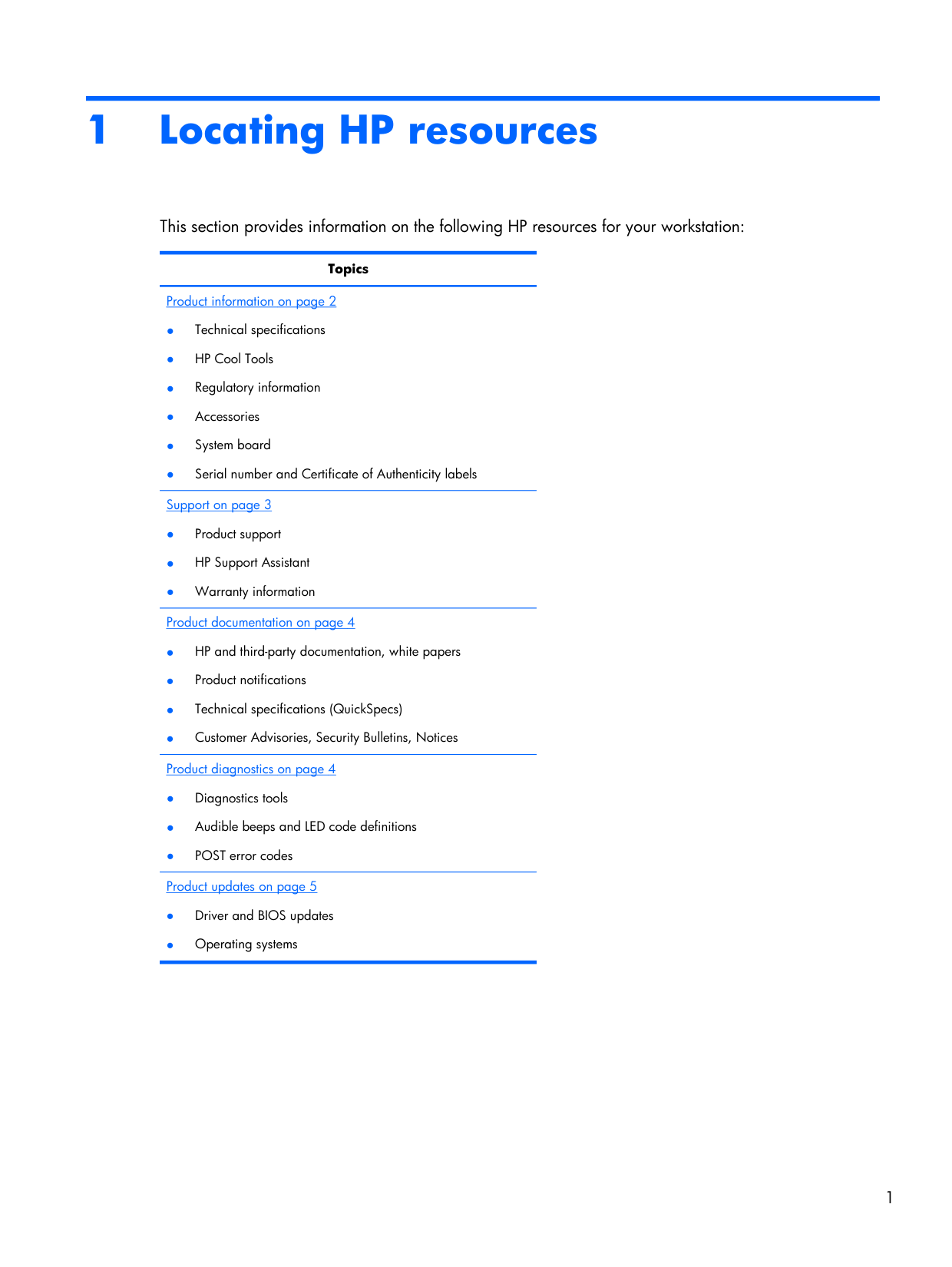
1 Locating HP resources This section provides information on the following HP resources for your workstation: Topics Product information on page 2 ● Technical specifications ● HP Cool Tools ● Regulatory information ● Accessories ● System board ● Serial number and Certificate of Authenticity labels Support on page 3 ● Product support ● HP Support Assistant ● Warranty information Product documentation on page 4 ● HP and third-party documentation, white papers ● Product notifications ● Technical specifications (QuickSpecs) ● Customer Advisories, Security Bulletins, Notices Product diagnostics on page 4 ● Diagnostics tools ● Audible beeps and LED code definitions ● POST error codes Product updates on page 5 ● Driver and BIOS updates ● Operating systems 1
Product information Table 1-1 Product information Topic Location Technical specifications Go to www.hp.com/go/quickspecs. In the left pane, select your region and then select Workstations. HP Cool Tools Most HP Microsoft Windows workstations are preloaded with tools that may enhance system performance and with additional software that is not automatically installed during first boot. To access these applications: ● Click the HP Cool Tools icon on the desktop, or ● Open the HP Cool Tools folder by selecting Start > All Programs > HP > HP Cool Tools. To learn more about these applications, click HP Cool Tools—Learn More. To install or launch the applications, click the appropriate application icon. Regulatory information Refer to the Safety & Regulatory Information guide for product Class information. You can also refer to the label on the workstation chassis. Accessories For complete and current information on supported accessories and components, see http://www.hp.com/go/workstations. System board A diagram of the system board is located on the inside of the side access panel (tower and desktop configurations) or on the inside of the chassis (all-in-one configurations). Additional information is located in the Maintenance and Service Guide on the Web at http://www.hp.com/support/workstation_manuals/. Serial number and Certificate of Authenticity (COA) labels (if applicable) Serial number labels are on the top or back panel (tower and desktop configurations) or on a pull-out card on the side of the display (all-in-one configuration). The COA label is typically located near the serial number label. Some workstations have this label on the bottom panel. Linux For information on running Linux on HP workstations, go to http://www.hp.com/ linux/, then select Linux on Workstations from the list on the left. 2 Chapter 1 Locating HP resources
Support Table 1-2 Support Topic Location Product support For U.S. support, go to http://www.hp.com/go/contactHP. For worldwide support, go to http://welcome.hp.com/country/us/en/wwcontact_us.html. Here you can: ● Chat online with an HP technician ● Obtain E-mail support ● Find support telephone numbers ● Locate an HP service center HP Support Assistant HP Support Assistant is an HP application that helps you maintain the performance of your workstation and resolve problems through automated updates and tune-ups, built-in diagnostics, and guided assistance. To access HP Support Assistant, double-click the HP Support Assistant icon on your desktop.
Note:
HP Support Assistant is pre-installed on all HP workstations running Microsoft Windows 7. HP Support Assistant is not available on workstations running Linux. Warranty information To locate base warranty information, see http://www.hp.com/support/warranty-lookuptool. To locate an existing Care Pack, see http://www.hp.com/go/lookuptool. To extend a standard product warranty, see http://h20219.www2.hp.com/services/us/en/warranty/ carepack-overview.html. HP Care Pack Services offer upgraded service levels to extend and expand a standard product warranty. For some countries/regions, a printed HP Limited Warranty is provided in the box. In countries/regions where the warranty is not provided in printed format, you may request a printed copy from www.hp.com/go/orderdocuments or write to: ● North America: Hewlett Packard, MS POD, 11311 Chinden Blvd, Boise, ID 83714, USA ● Europe, Middle East, Africa: Hewlett-Packard, POD, Via G. Di Vittorio, 9, 20063, Cernusco s/Naviglio (MI), Italy ● Asia Pacific: Hewlett-Packard, POD, P.O. Box 200, Alexandra Post Office, Singapore 911507 Please include your product number, warranty period (found on your serial number label), name and postal address. Support 3Product documentation Table 1-3 Product documentation Topic Location HP user documentation, white papers, and third-party documentation For the latest online documentation, go tohttp://www.hp.com/support/ workstation_manuals. These include this User Guide and the Maintenance and Service Guide. Removal and replacement videos To learn how to remove and replace workstation components, go to http://www.hp.com/go/sml. Product notifications Subscriber's Choice is an HP program that allows you to sign up to receive driver and software alerts, proactive change notifications (PCNs), the HP newsletter, customer advisories, and more. Sign up at www.hp.com/united-states/subscribe/ gateway/?jumpid=go/subscribe-gate1. Customer advisories and product change notifications are also available on http://www.hp.com/go/bizsupport/. Technical specifications The Product Bulletin contains QuickSpecs for HP Workstations. QuickSpecs include information the operating system, power supply, memory, CPU, and many other system components. To access the QuickSpecs, see http://www.hp.com/go/ quickspecs/. Customer Advisories, Security Bulletins, and Notices To find advisories, bulletins, and notices:
Product updates Table 1-5 Product updates Topic Location Driver and BIOS updates See http://www.hp.com/go/workstationsupport to verify that you have the latest drivers for the workstation. To determine the current workstation BIOS on your workstation, follow these steps during system power up:
2 Workstation features For complete and current information on supported accessories and components for your workstation, see http://partsurfer.hp.com. HP Z420 Workstation components HP Z420 Workstation front panel Figure 2-1 Front panel components Table 2-1 Component descriptions 1
Optical drive 5 USB 3.0 ports (2, blue) 2 Power button 6 Headphone connector 3 Hard drive activity light 7 Microphone connector 4 USB 2.0 port (black) 8 IEEE–1394a FireWire connector 6 Chapter 2 Workstation features
HP Z420 Workstation rear panel Figure 2-2 Rear panel components Table 2-2 Component descriptions 1
Power supply Built-In Self Test
(Bist) Led
9 Audio line-out connector (green) 2Universal chassis clamp opening 10 Microphone connector (pink) 3 PS/2 mouse connector (green) 11 AMT-enabled RJ-45 network connector (orange) 4 USB 2.0 ports (4, black) 12 USB 3.0 ports (2, blue) 5
Security slot 13 IEEE-1394a FireWire connector (white) 6
Padlock loop 14 PS/2 keyboard connector (purple) 7 Audio line-in connector (blue) 15 Rear power button 8
Graphics card connector 16
Power cord connector HP Z420 Workstation components 7
HP Z620 Workstation components HP Z620 Workstation front panel Figure 2-3 Front panel components Table 2-3 Component descriptions 1
Optical drive 5 USB 3.0 ports (2, blue) 2 Power button 6 Headphone connector 3 Hard drive activity light 7 Microphone connector 4 USB 2.0 port (black) 8 IEEE–1394a FireWire connector 8 Chapter 2 Workstation features
HP Z620 Workstation rear panel Figure 2-4 Rear panel components Table 2-4 Component descriptions 1
Power cord connector 8 Audio line-out connector (green) 2 PS/2 mouse connector (green) 9 Microphone connector (pink) 3 USB 2.0 ports (4, black) 10 USB 3.0 ports (2, blue) 4 RJ-45 network connectors (orange) Bottom connector is AMT enabled 11 IEEE-1394a FireWire connector (white) 5 Audio line-in connector (blue) 12 PS/2 keyboard connector (purple) 6
Graphics card connector 13 Rear power button 7
Security slot 14
Power supply Built-In Self Test (BIST)
Led
HP Z620 Workstation components 9HP Z820 Workstation components HP Z820 Workstation front panel Figure 2-5 Front panel components Table 2-5 Component descriptions 1
Optical drive 5 USB 3.0 ports (2, blue) 2 Power button 6 Headphone connector 3 Hard drive activity light 7 Microphone connector 4 USB 2.0 port (black) 8 IEEE–1394a FireWire connector 10 Chapter 2 Workstation features
HP Z820 Workstation rear panel Figure 2-6 Rear panel components Table 2-6 Component descriptions 1
Power cord connector 9 USB 3.0 ports (2, blue) 2 PS/2 mouse connector (green) 10 USB 2.0 ports (4, black) 3 Audio line-in connector (blue) 11 Audio line-out connector (green) 4 RJ-45 network connectors (2, orange) Top connector is AMT enabled 12 Microphone connector (pink) 5 IEEE-1394a FireWire connector (white) 13 PS/2 keyboard connector (purple) 6
Security slot 14 Rear power button 7
Graphics card connector(s) 15
Power supply Built-In Self Test (BIST)
Led
8 Serial connector (teal blue)HP Z820 Workstation components 11
Product specifications Workstation weights and dimensions Characteristic HP Z420 Workstation HP Z620 Workstation HP Z820 Workstation Weight (standard configuration) 13.2 kg (29.2 lb) 17.9 kg (39.4 lb) 26.6 kg (58.7 lb) Weight (minimum configuration) 12.5 kg (27.5 lb) 15.5 kg (34.2 lb) 24.0 kg (52.9 lb) Weight (maximum configuration) 17.7 kg (39.4 lb) 22.6 kg (49.9 lb) 32.0 kg (70.5 lb) Chassis dimensions Minitower Height: 44.76 cm (17.62 in) Width: 17.78 cm (7.00 in) Depth: 44.50 cm (17.53 in) Converted desktop Height: 17.78 cm (7.00 in) Width: 44.76 cm (17.62 in) Depth: 44.50 cm (17.53 in) Height: 44.45 cm (17.50 in) Width: 17.15 cm (6.75 in) Depth: 46.48 cm (18.30 in) Height: 44.4 cm (17.5 in) Width: 20.3 cm (8.0 in) Depth: 52.5 cm (20.7 in) 12 Chapter 2 Workstation features
Environmental specifications Table 2-7 HP Workstation environmental specifications Characteristic HP Z420, 620, and 820 Workstations Temperature Operating: 5°C to 35°C (40°F to 95°F) Non-operating: -40°C to 60°C (-40°F to 140°F)
Note:
Derate by 1°C (1.8°F) for every 305 m (1,000 ft) altitude over 1,524 m (5,000 ft). Humidity Operating: 8% to 85% relative humidity, non-condensing Non-operating: 8% to 90% relative humidity, non-condensing Altitude Operating: 0 to 3,048 m (10,000 ft) Non-operating: 0 to 9,144 m (30,000 ft) Shock Operating: ½-sine: 40g, 2-3ms Non-operating: ● ½-sine: 160 cm/s, 2-3ms (~100g) ● square: 422 cm/s, 20gNote:
Values represent individual shock events and do not indicate repetitive shock events. Vibration Operating Random: 0.5g (rms), 5-300 Hz Non-Operating: random: 2.0g (rms), 10-500 HzNote:
Values do not indicate continuous vibration. Product specifications 133 Setting up the workstation This chapter describes how to set up your workstation. Topics Ensuring proper ventilation on page 14 Setup procedures on page 16 Adding monitors on page 17 Ensuring proper ventilation Proper ventilation for the system is important for workstation operation. Follow these guidelines: ● Operate the workstation on a sturdy, level surface. ● Provide at least 15.24 cm (6 inches) of clearance at the front and back of the workstation. (Workstation models vary.) Figure 3-1 Proper workstation ventilation ● Ensure that the ambient air temperature falls within the environmental specifications listed in this document. 14 Chapter 3 Setting up the workstation
Note:
The ambient upper limit of 35 C is only good up to 1524 m (5000 ft) elevation. There is a 1 C per 304.8 m (1000 ft) derating above 1524 m (5000 ft). So, at 3,048 m (10,000 ft), the upper ambient air temperature limit is 30 C. ● For cabinet installation, ensure adequate cabinet ventilation and ensure that the ambient temperature within the cabinet does not exceed specified limits. ● Never restrict the incoming or outgoing airflow of the workstation by blocking any vents or air intakes as shown in the following figure. Figure 3-2 Proper workstation placement Ensuring proper ventilation 15Setup procedures
Warning!
To reduce the risk of electric shock or damage to your equipment, observe these practices:Note:
An HP Z820 workstation with a 1125W power supply might require more power than the typical office environment can supply. For details, see the Site Preparation Guide for the workstation at http://www.hp.com/support/workstation_manuals. To set up the workstation:Adding monitors Planning for additional monitors All graphics cards provided with HP Z series workstations support two simultaneous display monitors (see Connecting and configuring monitors on page 21). Cards that support more than two monitors are available. The process for adding monitors depends on your graphics card(s) and the type and number of monitors you add. Use this process to plan for adding more monitors.
Tip:
Some adapters for older legacy hardware may cost more than others. You may want to compare the cost of acquiring adapters with the cost of getting a newer monitor that doesn't need adapters.Note:
Monitors with resolutions above 1920 x 1200 pixels at 60 Hz require a graphics card with either Dual Link DVI (DL-DVI) or DisplayPort output. To get native resolution with DVI, however, you must use a DL-DVI cable, not standard DVI-I or DVI-D cables. HP computers do not support all graphics cards. Make sure a new graphics card is supported before purchasing it.See Finding supported graphics cards on page 19. Many graphics cards provide more than two monitor outputs but limit you to using only two at a time. Consult the graphics card documentation or look up information on the card according to the procedure in Finding supported graphics cards on page 19. Some graphics cards support multiple monitors by multiplexing the monitor signal across multiple outputs. This may reduce graphics performance. Consult the graphics card documentation or look up information on the card according to the procedure in Finding supported graphics cards on page 19. Make sure the card outputs match the input required by the monitors. (See Identifying monitor connection requirements on page 20.) The different models of Z-series workstations have different limits on the mechanical size, data speed, and power available for additional graphics cards. In addition, the usual practical limit for graphics cards is two per computer. Refer to the Manufacturing and Service Guide for expansion card slot identification to make sure a new graphics card will work for your computer.Tip:
To simplify troubleshooting of possible problems, enable the monitors one at a time: enable the first monitor and make sure it works properly before enabling the next monitor. 18 Chapter 3 Setting up the workstationFinding supported graphics cards To find information about graphics cards supported for your workstation:
Vga
Dvi
Dual LinkDvi
DisplayPort(Dp)
Hdmi
Displayport
DisplayPort to VGA adapter (sold separately) DP to DVI adapter DP to DL DVI adapter DP cable DP to HDMI adapterDvi (White)
DVI to VGA adapter or DVI- I cable DVI-D cable DL DVI cableN/A
N/A
Vga (Blue)
No adapter required DVI-I cableN/A
N/A
N/A
Dms-59*
DMS-59 to VGA adapter DMS-59 to DVI adapterN/A
DMS-59 to DP adapterN/A
Note:
HP graphics cards include monitor cable adapters unless otherwise indicated. DisplayPort cards have the highest performance; VGA graphics cards have the lowest. Adding monitors 19Identifying monitor connection requirements The following are various scenarios for connecting monitors. (See Matching graphics cards to monitor connectors on page 19 for more information about the different graphic cards): ● Graphics card with DisplayPort output — If the graphics card has four DisplayPort outputs, you can connect a monitor to each connector. Use the proper adapters if required. ● Graphics card with DVI output — If you have a PCIe graphics card with two DVI outputs, you can connect a monitor to each connector. Use the proper adapters if required.
Note:
Models that have only one DVI port always have a second graphics output option (Display Port or VGA). Many graphics cards provide more than two monitor outputs but limit you to using only two at a time. Consult the graphics card documentation or look up information on the card according to the procedure in Finding supported graphics cards on page 19. On a system with two DVI connections, port number 1 provides the primary display, which is where the BIOS POST screen appears after a system boot. (Usually this is the lower of the two outputs. Only one card is used during BIOS POST, although you can change this in the BIOS settings.) ● Graphics card with VGA and DL-DVI output — If the workstation does not have a PCIe graphics card, but has one or more SVGA and/or DL-DVI outputs, you can connect a monitor to each output. ● Graphics card with DMS-59 output — If the workstation has a PCIe graphics card with a DMS-59 output receptacle, use the appropriate adapter to connect your monitor. Adapters are available to connect the DMS-59 output to two DVI or two VGA monitors. 20 Chapter 3 Setting up the workstationConnecting and configuring monitors
Note:
HP-supported graphics card typically allow at least two monitors, as shown in this section; some supported cards allow more monitors. Refer to the graphics card documentation for details.Using a third-party graphics configuration utility Third-party graphics cards may include a monitor configuration utility. Upon installation, this utility is integrated into Windows. You can select the utility and use it to configure multiple monitors with your workstation. Refer to your graphics card documentation for details.
Note:
Some third-party configuration utilities require that you enable the monitors in Windows before using the configuration tool. Refer to your graphics card documentation for more information.Note:
Monitor configuration utilities are also often available on the HP support website. Customizing the monitor display (Microsoft Windows) You can manually select or change the monitor model, refresh rates, screen resolution, color settings, font sizes, and power management settings. To change display settings, right-click on the Windows Desktop, then click Screen Resolution. For more information about customizing your monitor display, refer to: ● Online documentation provided with the graphics controller utility ● Documentation included with your monitor 22 Chapter 3 Setting up the workstationConverting to desktop configuration (Z420 only) This workstation can be operated in mini-tower or desktop configuration. Follow these steps to convert to desktop configuration:
Note:
See a video of this task at http://www.hp.com/go/sml.Installing optional components Depending on the workstation model, additional components (such as memory, hard drives, optical drives, PCIe cards, or second processor) can be installed on your workstation. ● To view component installation videos, go to http://www.hp.com/go/sml. ● For installation guidelines and technical information, refer to the Maintenance and Service Guide for your workstation at http://www.hp.com/support/workstation_manuals. Security Some HP workstations have a lock on the side access panel. The key for this lock is shipped attached to the back panel of the workstation chassis. Additional security features to reduce the risk of theft and to warn of chassis intrusion. Refer to the Manufacturing and Service Guide at http://www.hp.com/support/workstation_manuals for information about additional hardware and software security features available for your system. Product recycling HP encourages customers to recycle used electronic hardware, HP original print cartridges, and rechargeable batteries. For information about recycling HP components or products, see http://www.hp.com/go/recycle. Installing optional components 25
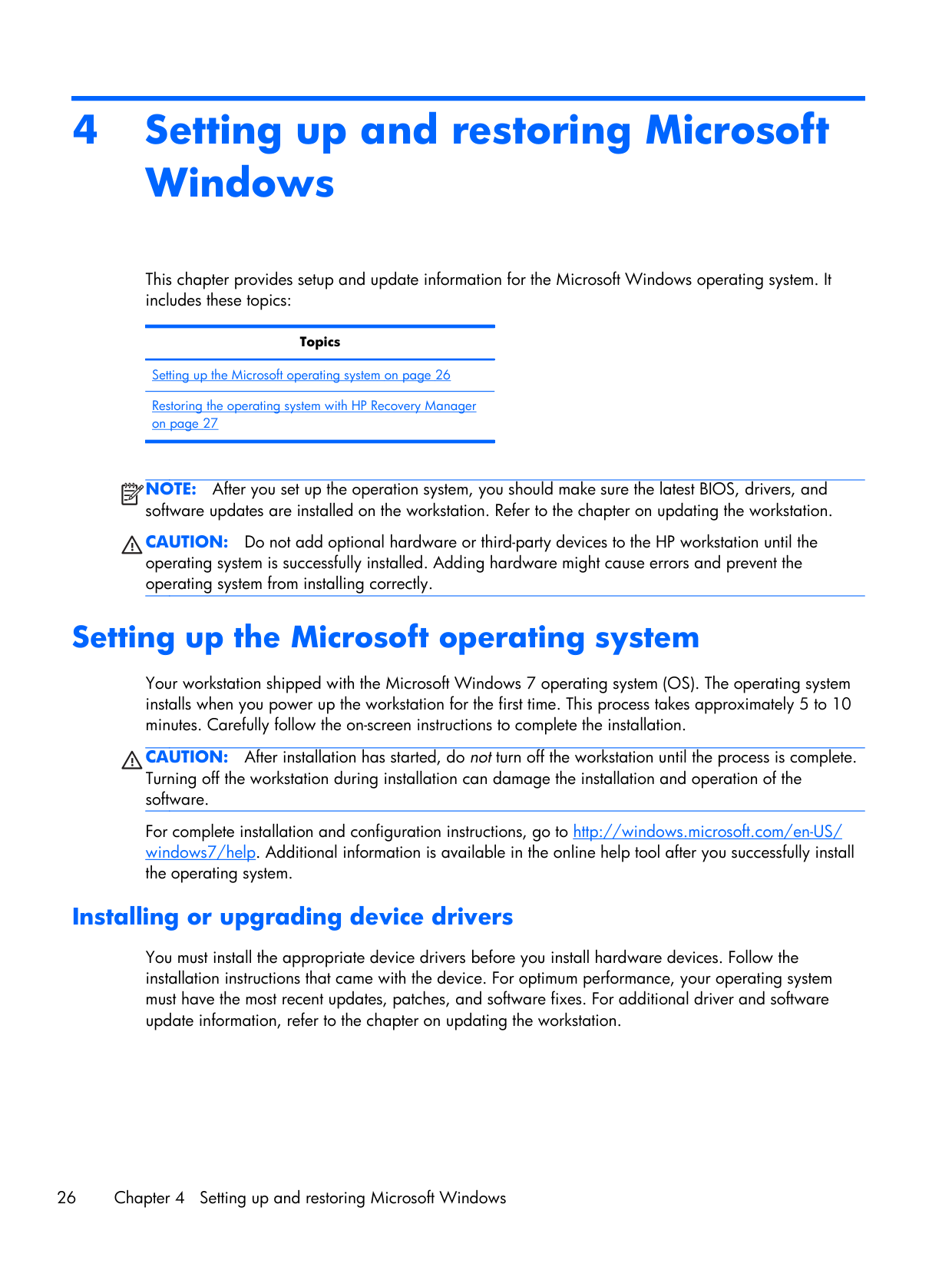
4 Setting up and restoring Microsoft Windows This chapter provides setup and update information for the Microsoft Windows operating system. It includes these topics: Topics Setting up the Microsoft operating system on page 26 Restoring the operating system with HP Recovery Manager on page 27
Note:
After you set up the operation system, you should make sure the latest BIOS, drivers, and software updates are installed on the workstation. Refer to the chapter on updating the workstation.Caution:
Do not add optional hardware or third-party devices to the HP workstation until the operating system is successfully installed. Adding hardware might cause errors and prevent the operating system from installing correctly. Setting up the Microsoft operating system Your workstation shipped with the Microsoft Windows 7 operating system (OS). The operating system installs when you power up the workstation for the first time. This process takes approximately 5 to 10 minutes. Carefully follow the on-screen instructions to complete the installation.Caution:
After installation has started, do not turn off the workstation until the process is complete. Turning off the workstation during installation can damage the installation and operation of the software. For complete installation and configuration instructions, go to http://windows.microsoft.com/en-US/ windows7/help. Additional information is available in the online help tool after you successfully install the operating system. Installing or upgrading device drivers You must install the appropriate device drivers before you install hardware devices. Follow the installation instructions that came with the device. For optimum performance, your operating system must have the most recent updates, patches, and software fixes. For additional driver and software update information, refer to the chapter on updating the workstation. 26 Chapter 4 Setting up and restoring Microsoft WindowsTransferring files and settings The Microsoft Windows operating system offers data migration tools that help you select and transfer files and data from one Microsoft Windows-based computer to another. For information on these tools, go to http://www.microsoft.com. Restoring the operating system with HP Recovery Manager The Microsoft Windows 7 operating system can be reinstalled using HP Recovery Manager, a tool that reinstalls the Windows operating system and device drivers (for devices included with the system) to a near-factory state. If you ordered HP Recovery Manager with your workstation, the restore media is included with your workstation components. If you did not order it, call HP support and request an HP Recovery Manager media kit.
Caution:
Restoring the operating system does not restore data. Before you restore the operating system, back up your data using the method and media of your choice. The HP Recovery Manager process deletes all information on the primary hard drive, including all partitions. To restore Windows 7:Note:
Microsoft Windows 7 also provides a backup and restore application. To learn more, go to http://www.microsoft.com. Restoring the operating system with HP Recovery Manager 275 Setting up and restoring Linux HP offers a variety of Linux solutions for HP workstation customers: ● HP certifies and supports Red Hat Enterprise Linux (RHEL) on HP workstations. ● HP certifies and supports SUSE® Linux Enterprise Desktop (SLED) on HP workstations. ● HP offers a SLED 11 preload on some Z series workstations. This chapter describes how to set up and restore the Linux® operating system. It includes these topics: Topics HP Installer Kit for Linux (HPIKL) on page 29 Setting up Red Hat Enterprise Linux on page 29 Setting up SUSE Linux Enterprise Desktop (SLED) on page 31 Proprietary graphics drivers on page 32
Note:
After you set up the operating system, make sure the latest BIOS, drivers, and software updates are installed. Refer to the chapter on updating the workstation.Caution:
Do not add optional hardware or third-party devices to the workstation until the operating system is successfully installed. Adding hardware might cause errors and prevent the operating system from installing correctly. HP Linux Support Matrix Not all release streams are supported on particular platforms. To find out which streams are supported on your workstation. refer to the Linux certification and support matrix:HP Installer Kit for Linux (HPIKL) The HP Installer Kit for Linux helps users install certified versions of RHEL or SLED on HP workstations. It is available as an operating system option on all HP workstations. The kit: ● Contains tested drivers that augment and/or replace those found in RHEL or SLED to enable proper use and behavior on HP workstations. ● Does not include Linux operating system, which must be purchased separately from Red Hat or SUSE. To view supported configurations and operating systems, go to http://www.hp.com/ support/linux_hardware_matrix. The HPIKL option includes a FreeDOS preload. This operating system option accommodates those who have a customized Linux distribution, or who have a licensed version of RHEL or SLED and would like to install the HP-recommended driver additions. The kit also can be downloaded:
HPIKL driver CD Recent versions of Red Hat Linux typically require only driver updates with minor fixes to support HP workstations. These releases can usually be supported with the HPIKL driver CD, which can be used as a post-installation utility for the standard Red Hat Linux install. After you complete the standard Red Hat install and restart the system, a Red Hat first-boot utility runs. After you specify a number of settings (such as the security level, time and date, root password, user accounts), the utility lets you to load additional CDs. The driver CD is used during this phase. All content added by HP is in the /HP directory on the CD. You can use it to build your own image or to browse the HP content.
Note:
Some installations may encounter problems if they are performed with a DisplayPort connection to the monitor. This is because the default drivers that the OS installers use do not support DisplayPort functionality. If you experience problems, try overriding the monitor choice for DisplayPort during the start of the install and using the VESA driver instead. You can then set up the DisplayPort monitor later. Installing with the HP Red Hat Linux driver CDSetting up SUSE Linux Enterprise Desktop (SLED) HP offers a 64-bit SLED 11 preload on some Z series workstations and supports 64-bit SLED 11 on other workstations. Various versions of SLED are certified and supported by Novell on HP workstations. For more information, refer to the Novell certification bulletin search page at http://developer.novell.com/ yessearch. Setting up preloaded SLED To set up SLED on systems preloaded with the operating system:
Note:
You can activate your SUSE subscription from the SUSE Customer Center Configuration screen. To view the full SUSE Customer Center documentation, go to http://www.suse.com/ documentation and select your operating system. Installing SLED with the CD Installer KitRestoring SLED (preloaded systems only) The SLED restore media is required to restore the Linux operating system. To create restore media:
Caution:
Restoring the operating system does not restore data. Back up your data using the method and media of your choice. Proprietary graphics drivers Most HP workstations can be ordered with graphics cards that have been through extensive verification by HP. See the Hardware Support Matrix for HP Linux Workstations at http://www.hp.com/support/ linux_hardware_matrix for a list of supported cards.Note:
Not all graphics cards are available on every workstation. Limitations generally occur for cards that consume large amounts of power in lower-power workstations. Proprietary graphics drivers supported by HP and the graphics vendors are available with the HP Installer Kit for Linux, with the SLED 11 preload on Z series workstations, and from HP Workstation Support at http://www.hp.com/go/workstationsupport. These proprietary drivers are not a standard part of the RHEL or SLED distributions because they are not open source. Driver revisions more recent than those at the HP support website are supported directly by the vendor. 32 Chapter 5 Setting up and restoring Linux6 Diagnostics and Minor Troubleshooting Calling technical support At times you might encounter an issue that requires technical support. When you call technical support: ● Have the computer readily accessible. ● Write down the computer serial numbers, product numbers, model names, and model numbers and have them in front of you. ● Note any applicable error messages. ● Note any add-on options. ● Note the operating system. ● Note any third-party hardware or software. ● Note the details of any blinking LEDs on the front of the computer (tower and desktop configurations) or on the side of the computer (all-in-one configurations). ● Note the applications you were using when you encountered the problem.
Note:
When calling in for service or support, you might be asked for the Product Number (example: PS988AV) of the computer. If the computer has a Product Number, it is generally located next to the 10- or 12-digit Serial Number of the computer.Note:
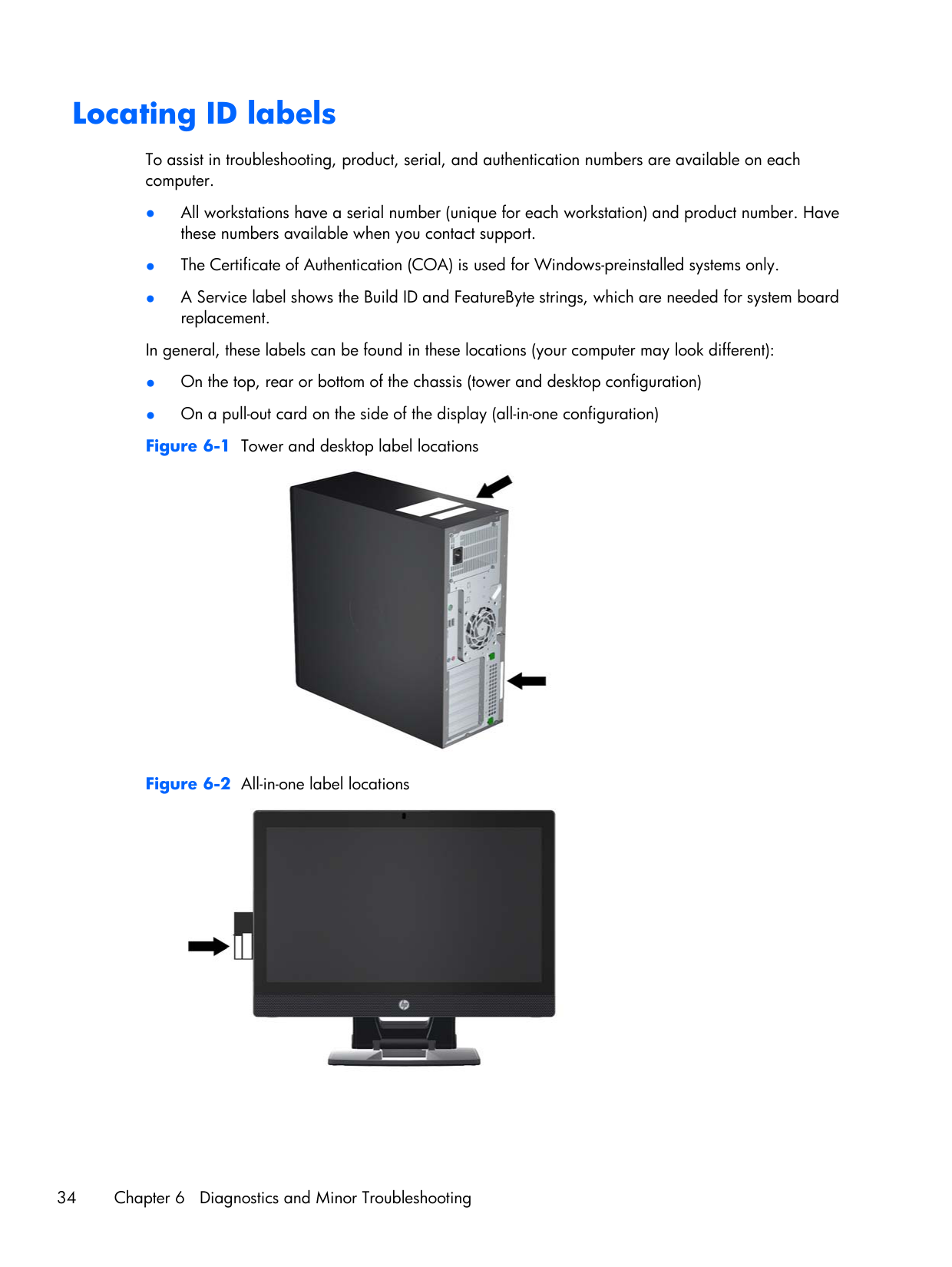
On most models, the serial number and product number labels can be found on the top or side panel and at the rear of the computer (tower and desktop configurations) or on a pull-out card on the side of the display (all-in-one configurations). For a listing of all worldwide technical support phone numbers, go to http://www.hp.com/support, select your region, and click Connect with HP in the upper-right corner. Calling technical support 33Locating ID labels To assist in troubleshooting, product, serial, and authentication numbers are available on each computer. ● All workstations have a serial number (unique for each workstation) and product number. Have these numbers available when you contact support. ● The Certificate of Authentication (COA) is used for Windows-preinstalled systems only. ● A Service label shows the Build ID and FeatureByte strings, which are needed for system board replacement. In general, these labels can be found in these locations (your computer may look different): ● On the top, rear or bottom of the chassis (tower and desktop configuration) ● On a pull-out card on the side of the display (all-in-one configuration) Figure 6-1 Tower and desktop label locations Figure 6-2 All-in-one label locations 34 Chapter 6 Diagnostics and Minor Troubleshooting
Locating warranty information To locate base warranty information, see http://www.hp.com/support/warranty-lookuptool. To locate an existing Care Pack, see http://www.hp.com/go/lookuptool. To extend a standard product warranty, visit http://www.hp.com/hps/carepack. HP Care Pack Services offer upgraded service levels to extend and expand a standard product warranty. HP troubleshooting resources and tools This section provides information on the HP Help and Support Center, E-support, and Helpful Hints for troubleshooting. HP Support Assistant HP Support Assistant (Windows 7 systems only) helps you maintain workstation performance and resolve problems. HPSA provides automated updates, onboard diagnostics, product information, and guided assistance to help maintain optimum workstation performance. To access HPSA, click Start > All Programs > HP Help and Support > HP Support Assistant.
Note:
HP Support Assistant is not available on Linux. E-support Online access and support resources include Web-based troubleshooting tools, technical knowledge databases, driver and patch downloads, online communities, and product change notification services. The following Web sites are also available to you: ● http://www.hp.com—Provides useful product information. ● http://www.hp.com/support/workstation_manuals—Provides the latest online documentation. ● http://www.hp.com/go/workstationsupport—Provides technical support information for workstations. ● http://www.hp.com/support—Provides a listing of the worldwide technical support phone numbers. Access the telephone numbers by visiting the Web site, then select your region, and click Contact HP in the upper-left corner. ● http://www.hp.com/support/workstation_swdrivers—Provides access to software and drivers for workstations. Locating warranty information 35Troubleshooting a problem To help you troubleshoot problems with your system, HP provides the Business Support Center (BSC). The BSC is a portal to an extensive selection of online tools. To access BSC and troubleshoot a problem with the workstation, complete the following:
Note:
This feature is not available on Linux. Customer Advisories, Customer and Security Bulletins, and Customer Notices To find advisories, bulletins, and notices:Helpful hints If you encounter a problem with the workstation, monitor, or software, the following general suggestions might help you isolate and focus on the problem before taking further action. At startup ● Verify that the workstation and monitor are plugged into a working electrical outlet. ● Remove all optical discs and USB drive keys from the drives before powering on the workstation. ● Verify that the workstation is turned on and the power light is on. ● If you have installed an operating system other than the factory-installed operating system, check to be sure that it is supported on your system by visiting http://www.hp.com/go/quickspecs. ● Verify that the monitor is turned on and the green monitor light is on. ● Turn up the brightness and contrast controls of the monitor if the monitor is dim. ● If the workstation has multiple video sources and only a single monitor, the monitor must be connected to the source selected as the primary VGA adapter. During startup, the other monitor connectors are disabled; if the monitor is connected to one of these ports, it will not function after Power-on Self Test (POST). You can select the default VGA source in Computer Setup (F10). During operation ● Look for blinking LEDs on the workstation. The blinking lights are error codes that will help you diagnose the problem. Refer to the Diagnostic lights and audible (beep) codes section in the Maintenance and Service Guide for your workstation for information on interpreting diagnostic lights and audible codes. ● Press and hold any key. If the system beeps, then your keyboard is operating correctly. ● Check all cables for loose or incorrect connections. ● Wake the workstation by pressing any key on the keyboard or the power button. If the system remains in suspend mode, shut down the system by pressing and holding the power button for at least four seconds, then press the power button again to restart the system. If the system does not shut down, unplug the power cord, wait a few seconds, then plug it in again. If it does not restart, press the power button to start the workstation. ● Reconfigure the workstation after installing a non–plug and play expansion board or other option. Refer to the Hardware installation problems section of this document for instructions. ● Be sure that all required device drivers have been installed. For example, if you have connected a printer, you must install a printer driver. ● If you are working on a network, plug another workstation with a different cable into the network connection. There might be a problem with the network plug or cable. ● If you recently added new hardware, remove the hardware and verify if the workstation functions properly. ● If you recently installed new software, uninstall the software and verify if the workstation functions properly. HP troubleshooting resources and tools 37
● If the monitor connected to a tower, desktop or all-in-one computer is blank: ◦ Plug the monitor into a different video port on the computer if one is available. Alternatively, replace the monitor with a monitor that you know is working properly. ◦ Verify that the computer and monitor are plugged into a working electrical outlet. ◦ Verify that the monitor is turned on and the green monitor light is on. ◦ Turn up the brightness and contrast controls of the monitor if the monitor is dim. ● If the internal display on an all-in-one computer is blank, open the computer and make sure the graphics card is properly installed. ● Upgrade the BIOS. A new release of the BIOS might have been released that supports new features or fixes your problem. ● For more detailed information, see the troubleshooting chapter in the Maintenance and Service Guide at http://www.hp.com/support/workstation_manuals. Customer self-repair Under the Customer Self-Repair program, you can order a replacement part and install the part without onsite HP technical assistance. Customer self-repair may be required for some components. See http://www.hp.com/go/selfrepair for information on the program.
Note:
Some components are not eligible for customer self-repair and must be returned to HP for service. Call HP Support for further instructions before attempting to remove or repair these components. Other troubleshooting options The following additional troubleshooting techniques and tools are located in the Maintenance and Service Guide at http://www.hp.com/support/workstation_manuals: ● POST Error Codes ● Diagnostic LEDs and audible beep codes ● Troubleshooting scenarios and solutions ● HP Vision Field Diagnostics 38 Chapter 6 Diagnostics and Minor Troubleshooting7 Routine Care General cleaning safety precautions ● Never use solvents or flammable solutions to clean the computer. ● Never immerse any component in water or cleaning solutions; apply any liquids to a clean cloth and then use the cloth on the component. ● Always unplug the computer before cleaning the keyboard, mouse, or air vents. ● Always disconnect the keyboard before cleaning it. ● Wear safety glasses equipped with side shields when cleaning the keyboard. Cleaning the chassis ● Follow the safety precautions in the Maintenance and Service Guide for your workstation before cleaning the computer. ● To remove light stains or dirt, use plain water with a clean, lint-free cloth or swab. ● For stronger stains, use a mild dish washing liquid diluted with water. Rinse well by wiping it with a cloth or swab dampened with clear water. ● For stubborn stains, use isopropyl (rubbing) alcohol. No rinsing is required because the alcohol evaporates quickly and does not leave a residue. ● After cleaning, always wipe the computer with a clean, lint-free cloth. ● Occasionally, clean the air vents on the computer. Lint and other foreign matter can block the vents and limit the airflow. General cleaning safety precautions 39
Cleaning the keyboard
Caution:
Use safety glasses equipped with side shields before attempting to clean debris from under the keys. ● If the keyboard has an on/off switch, turn it off. ● Follow the safety precautions in the Maintenance and Service Guide for your workstation before cleaning the computer. ● Visible debris underneath or between the keys can be removed by vacuuming or shaking. ● Canned, pressurized air can be used to clean debris from under the keys. Use caution because too much air pressure can dislodge lubricants applied under the wide keys. ● If you remove a key, use a specially designed key remover to prevent damage to the keys. This tool is available from many electronic supply outlets.Caution:
Never remove a wide key (like the space bar key) from the keyboard. If these keys are improperly removed or installed, the keyboard might not function properly. ● Clean under a key with a swab moistened with isopropyl alcohol and squeezed out. Be careful not to wipe away lubricants necessary for proper key functions. Allow the parts to air dry before reassembly. ● Use tweezers to remove any fibers or dirt in confined areas. Cleaning the monitor ● Follow the safety precautions in the Maintenance and Service Guide for your workstation before cleaning the computer. ● To clean the monitor, wipe the monitor screen with a towelette designed for cleaning monitors or a clean cloth moistened with water.Caution:
Do not use sprays or aerosols directly on the screen—the liquid might seep into the housing and damage a component. Never use solvents or flammable liquids on the monitor because display or housing damage may result. 40 Chapter 7 Routine CareCleaning the mouse