Johnson Controls Dhp09nwb21s manual
Unknown · 10 Q&As

Johnson Controls Dhp09nwb21s

Ask AI

— answers from the official manual

Answers from the official manual.

Common questions

Common Questions

10 total
1

How do I perform a factory reset on the [product]?

Press and hold the Power button for 10 seconds until the LED flashes red to clear all settings and return the device to factory defaults. Re-pairing any connected devices will be necessary after the reset. (Page 23)

2

What are the safety precautions I need to follow when installing this air conditioning unit?

Follow all safety instructions and precautions found in Section 1 Important Safety Instructions of the manual, including proper installation by certified personnel and adherence to electrical safety regulations. Incorrect installation could result in electric shock or malfunction (Page 4-7).

3

What should I do if I encounter refrigerant leakage during maintenance?

Use a leak detector or soap water to find leaks; apply soap water to joints and observe for 3 minutes. If bubbles appear, there is a leak that needs repair (Page 20).

4

How do I maintain high voltage capacitors safely?

Wait at least 20 minutes after turning off the power supply to allow discharge of high voltages in capacitors before performing maintenance; measure between points A and B with a meter to ensure safe discharge (Page 19).

5

What should I do if the air conditioner does not start?

Review common troubleshooting steps for malfunction in Section 3.4 on page 35, such as checking connection wires and ensuring correct wiring sequence (Page 35).

6

How do I troubleshoot error code E2?

Error code E2 indicates anti-freezing protection tripped, check if the indoor temperature is too low or if heat exchanger is obstructed. Clean components as necessary (Page 34).

Show 4 more questions

Full Manual

40 pages
Page 1

Installation and Maintenance Manual

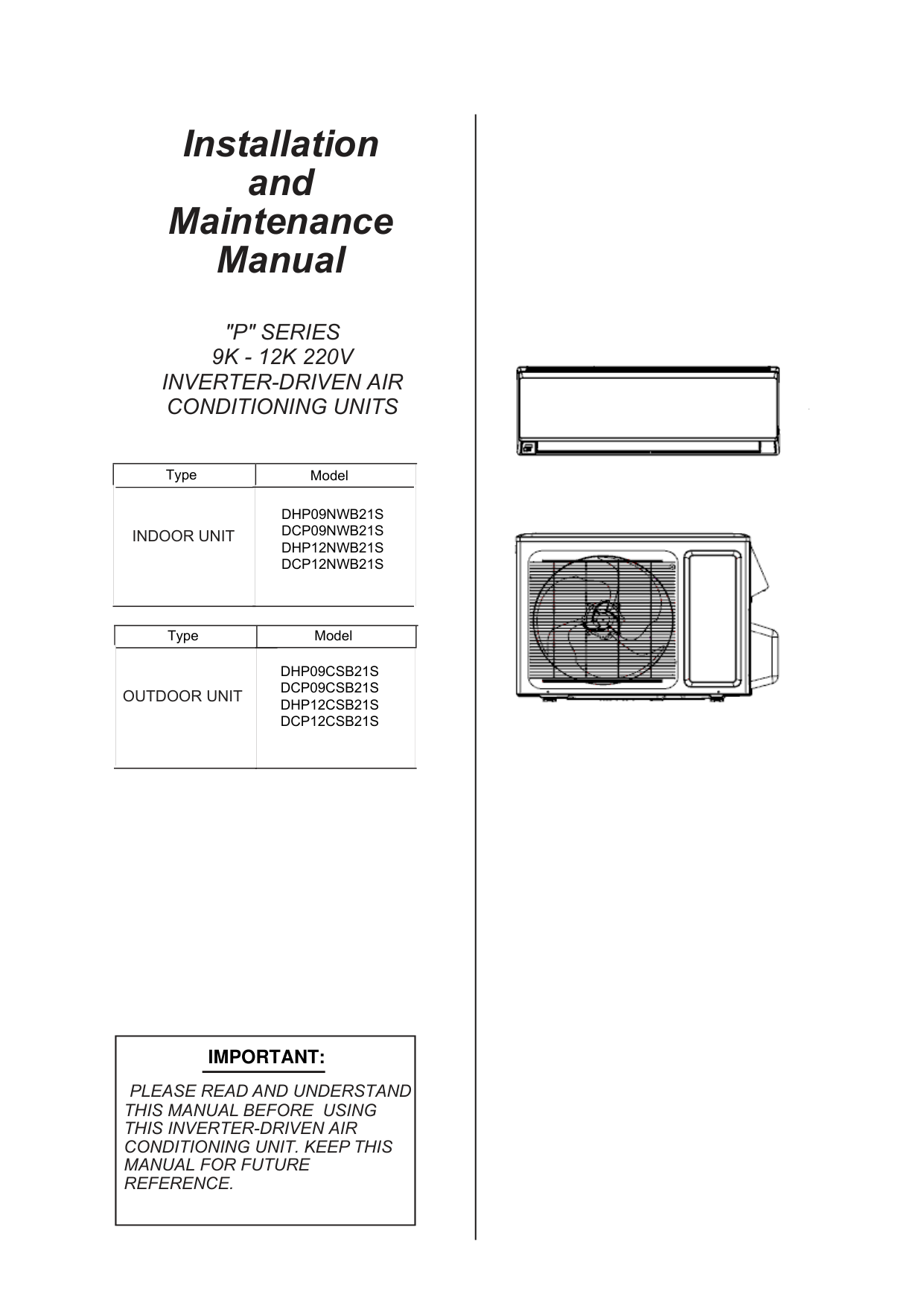
###### "P" SERIES 9K - 12K 220V INVERTER-DRIVEN AIR CONDITIONING UNITS

|Type|Model| |---|---| |INDOOR UNIT|DHP09NWB21S DCP09NWB21S DHP12NWB21S DCP12NWB21S|

|Type|Model| |---|---| |OUTDOOR UNIT|DHP09CSB21S DCP09CSB21S DHP12CSB21S DCP12CSB21S

|

|PLEASE READ AND UNDERSTAND THIS MANUAL BEFORE USING THIS INVERTER-DRIVEN AIR CONDITIONING UNIT. KEEP THIS MANUAL FOR FUTURE REFERENCE.| |---|

![image 1](lit_2012012182_20-_20iom_20p_20series_209k-12k__20220v_images/imageFile1.png)

![image 2](lit_2012012182_20-_20iom_20p_20series_209k-12k__20220v_images/imageFile2.png)

########## Important Notice

  • ● Johnson Controls, Inc. pursues a policy of continuing improvement in design and performance in its products. As such, Johnson Controls, Inc. reserves the right to make changes at any time without prior notice.
  • ● Johnson Controls, Inc. cannot anticipate every possible circumstance that might involve a potential hazard.
  • ● This inverter air conditioning unit is designed for standard air conditioning applications only. Do not use this unit for anything other than the purposes for which it was intended for.
  • ● The installer and system specialist should safeguard against leakage in accordance with local pipefitter and electrical codes. The following standards may be applicable, if local regulations are not available. International Organization for Standardization: (ISO 5149 or European Standard, EN 378). No part of this manual may be reproduced in any way without the expressed written consent of Johnson Controls, Inc.
  • ● This inverter-driven (cooling or heat pump) air conditioning unit will be operated and serviced in the United States of America and comes with all required Safety, Danger, and Caution, warnings.
  • ● If you have questions, please contact your distributor or dealer.
  • ● This manual provides common descriptions, basic and advanced information to maintain and service this inverter-driven (cooling or heat pump) air conditioning unit which you operate, as well for other models.
  • ● This inverter-driven (cooling or heat pump) air conditioning unit has been designed for a specific temperature range. For optimum performance and long life, operate this unit within range limits.
  • ● This manual should be considered as a permanent part of the air conditioning equipment and should remain with the air conditioning equipment.
  • ########## Product Inspection upon Arrival

  • 1. Upon receiving this product, inspect it for any damages incurred in transit. Claims for damage, either apparent or concealed, should be filed immediately with the shipping company.
  • 2. Check the model number, electrical characteristics (power supply, voltage, and frequency rating), and any accessories to determine if they agree with the purchase order.
  • 3. The standard utilization for this unit is explained in these instructions. Use of this equipment for purposes other than what it designed for is not recommended.
  • 4. Please contact your local agent or contractor as any issues involving installation, performance, or maintenance arise. Liability does not cover defects originating from unauthorized modifications performed by a customer without the written consent of Johnson Controls, Inc. Performing any mechanical alterations on this product without the consent of the manufacturer will render your warranty null and void.
  • Table of Contents

  • and ...................................................i
  • Page 2

  • Installation................................................................................................................ .
  • 2.1 Installation Dimension Diagram ................................................................................... ...1

  • ............................................................ ...
  • 2. Installation - Checking Parts.............................................................................................4
  • 2.4 Selection of Installation Location ......................................................................................4
  • 2.5 Electric Connection Requirement ....................................................................................4
  • 2.6 Installation of Indoor Unit ..................................................................................................4
  • 2.7 Installation of Outdoor Unit ...............................................................................................7
  • 2.8 Vacuum Pump/Leak Detection ........................................................................................8
  • 2.9 Post Installation Testing ..................................................................................................8
  • 3. Maintenance..............................................................................................................9
  • 3.1 Precautions before Maintenance .....................................................................................9
  • 3.2 Error Code List ...............................................................................................................10
  • 3.3 Troubleshooting for Main Malfunction ............................................................................11
  • 3.4 Troubleshooting for Normal Malfunction .........................................................................24
  • Appendix:........................................................................................................................26

  • Appendix 1: Reference Sheet of Celsius and Fahrenheit ....................................................26
  • Appendix 2: Configuration of Connection Pipe .....................................................................26
  • Appendix 3: Pipe Expanding Method ...................................................................................27
  • Appendix 4: List of Resistance for Temperature Sensor ......................................................28
  • Customer Service, Technical Support...................................................30

    Table of contents

    ########## 1. Introduction

    |This manual concentrates on inverter-driven cooling or heat pump air conditioning units. Read this manual carefully before installation.| |---|

    This manual should be considered as a permanent part of the air conditioning equipment and should remain with the air conditioning equipment.

    Page 3

    |2. Important Safety Instructions

    Safety Messages|2. Important Safety Instructions

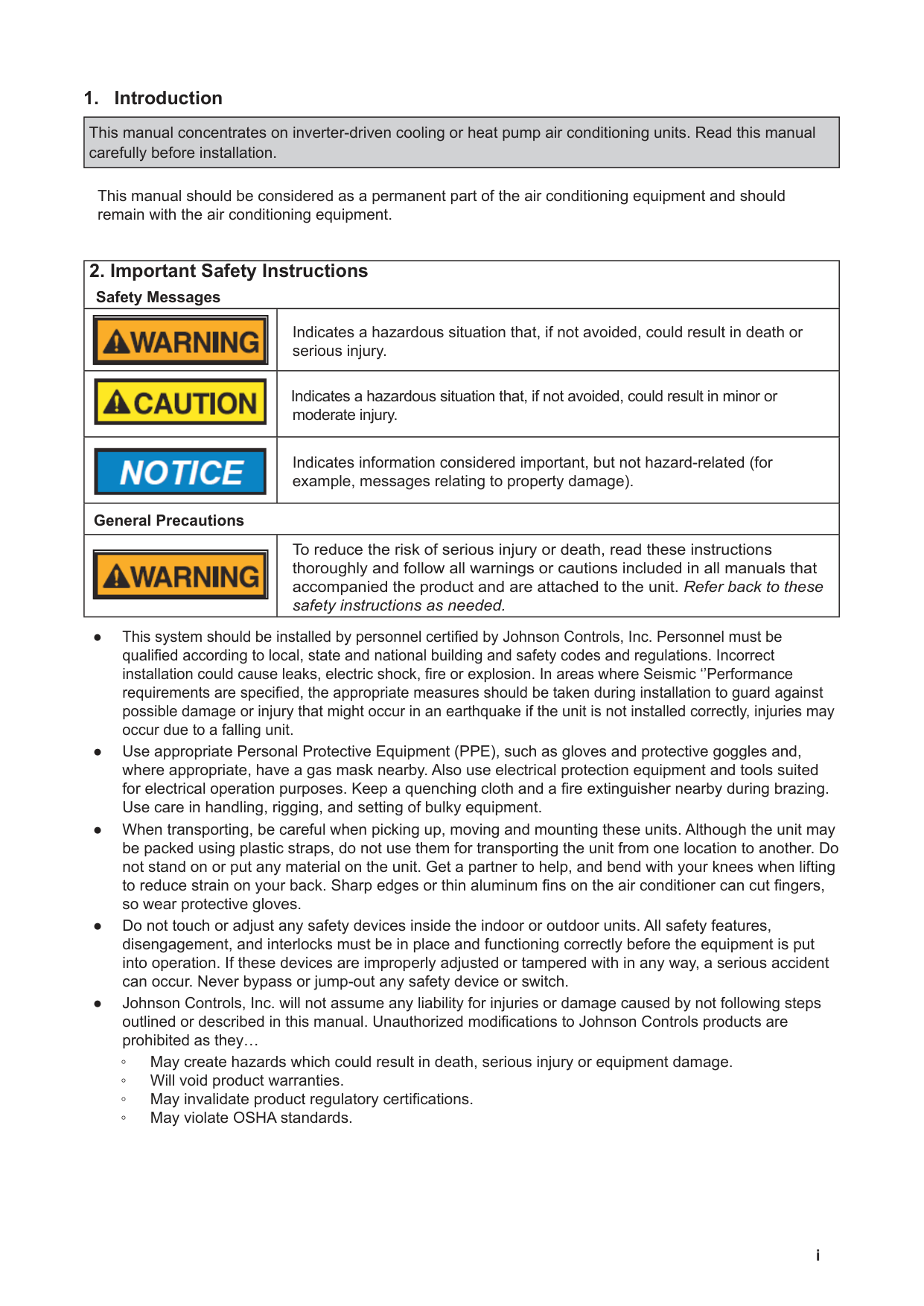
    Safety Messages| |---|---| ||![image 3](lit_2012012182_20-_20iom_20p_20series_209k-12k__20220v_images/imageFile3.png)| |---| |Indicates a hazardous situation that, if not avoided, could result in death or serious injury.| |![image 4](lit_2012012182_20-_20iom_20p_20series_209k-12k__20220v_images/imageFile4.png)|Indicates a hazardous situation that, if not avoided, could result in minor or moderate injury.| |![image 5](lit_2012012182_20-_20iom_20p_20series_209k-12k__20220v_images/imageFile5.png)|Indicates information considered important, but not hazard-related (for example, messages relating to property damage).| |General Precautions|General Precautions| ||![image 6](lit_2012012182_20-_20iom_20p_20series_209k-12k__20220v_images/imageFile6.png)| |---| |To reduce the risk of serious injury or death, read these instructions thoroughly and follow all warnings or cautions included in all manuals that accompanied the product and are attached to the unit. Refer back to these safety instructions as needed.|

  • ● This system should be installed by personnel certified by Johnson Controls, Inc. Personnel must be qualified according to local, state and national building and safety codes and regulations. Incorrect installation could cause leaks, electric shock, fire or explosion. In areas where Seismic ‘’Performance requirements are specified, the appropriate measures should be taken during installation to guard against possible damage or injury that might occur in an earthquake if the unit is not installed correctly, injuries may occur due to a falling unit.
  • ● Use appropriate Personal Protective Equipment (PPE), such as gloves and protective goggles and, where appropriate, have a gas mask nearby. Also use electrical protection equipment and tools suited for electrical operation purposes. Keep a quenching cloth and a fire extinguisher nearby during brazing. Use care in handling, rigging, and setting of bulky equipment.
  • ● When transporting, be careful when picking up, moving and mounting these units. Although the unit may be packed using plastic straps, do not use them for transporting the unit from one location to another. Do not stand on or put any material on the unit. Get a partner to help, and bend with your knees when lifting to reduce strain on your back. Sharp edges or thin aluminum fins on the air conditioner can cut fingers, so wear protective gloves.
  • ● Do not touch or adjust any safety devices inside the indoor or outdoor units. All safety features, disengagement, and interlocks must be in place and functioning correctly before the equipment is put into operation. If these devices are improperly adjusted or tampered with in any way, a serious accident can occur. Never bypass or jump-out any safety device or switch.
  • ● Johnson Controls, Inc. will not assume any liability for injuries or damage caused by not following steps outlined or described in this manual. Unauthorized modifications to Johnson Controls products are prohibited as they…
  • ◦ May create hazards which could result in death, serious injury or equipment damage.
  • ◦ Will void product warranties.
  • ◦ May invalidate product regulatory certifications.
  • ◦ May violate OSHA standards.
  • ########### i

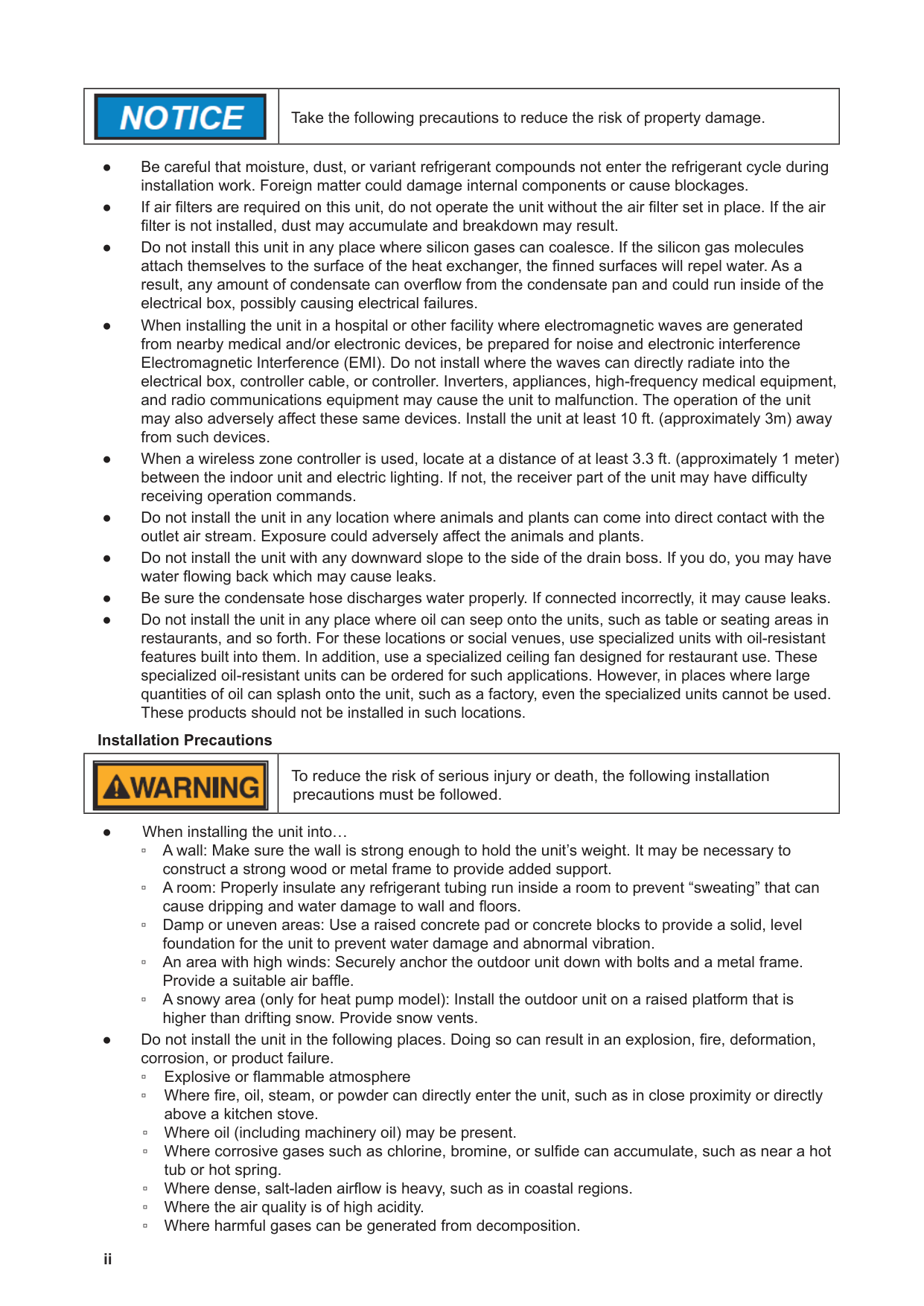
    |![image 7](lit_2012012182_20-_20iom_20p_20series_209k-12k__20220v_images/imageFile7.png)|Take the following precautions to reduce the risk of property damage.| |---|---|

  • ● Be careful that moisture, dust, or variant refrigerant compounds not enter the refrigerant cycle during installation work. Foreign matter could damage internal components or cause blockages.
  • ● If air filters are required on this unit, do not operate the unit without the air filter set in place. If the air filter is not installed, dust may accumulate and breakdown may result.
  • ● Do not install this unit in any place where silicon gases can coalesce. If the silicon gas molecules attach themselves to the surface of the heat exchanger, the finned surfaces will repel water. As a result, any amount of condensate can overflow from the condensate pan and could run inside of the electrical box, possibly causing electrical failures.
  • ● When installing the unit in a hospital or other facility where electromagnetic waves are generated from nearby medical and/or electronic devices, be prepared for noise and electronic interference Electromagnetic Interference (EMI). Do not install where the waves can directly radiate into the electrical box, controller cable, or controller. Inverters, appliances, high-frequency medical equipment, and radio communications equipment may cause the unit to malfunction. The operation of the unit may also adversely affect these same devices. Install the unit at least 10 ft. (approximately 3m) away from such devices.
  • ● When a wireless zone controller is used, locate at a distance of at least 3.3 ft. (approximately 1 meter) between the indoor unit and electric lighting. If not, the receiver part of the unit may have difficulty receiving operation commands.
  • ● Do not install the unit in any location where animals and plants can come into direct contact with the outlet air stream. Exposure could adversely affect the animals and plants.
  • ● Do not install the unit with any downward slope to the side of the drain boss. If you do, you may have water flowing back which may cause leaks.
  • ● Be sure the condensate hose discharges water properly. If connected incorrectly, it may cause leaks.
  • ● Do not install the unit in any place where oil can seep onto the units, such as table or seating areas in restaurants, and so forth. For these locations or social venues, use specialized units with oil-resistant features built into them. In addition, use a specialized ceiling fan designed for restaurant use. These specialized oil-resistant units can be ordered for such applications. However, in places where large quantities of oil can splash onto the unit, such as a factory, even the specialized units cannot be used. These products should not be installed in such locations.
  • ########### Installation Precautions

    ||![image 8](lit_2012012182_20-_20iom_20p_20series_209k-12k__20220v_images/imageFile8.png)|

    Page 4

    |---| |To reduce the risk of serious injury or death, the following installation precautions must be followed.| |---|---|

  • ● When installing the unit into… ▫ A wall: Make sure the wall is strong enough to hold the unit’s weight. It may be necessary to
  • construct a strong wood or metal frame to provide added support. ▫ A room: Properly insulate any refrigerant tubing run inside a room to prevent “sweating” that can cause dripping and water damage to wall and floors. ▫ Damp or uneven areas: Use a raised concrete pad or concrete blocks to provide a solid, level foundation for the unit to prevent water damage and abnormal vibration. ▫ An area with high winds: Securely anchor the outdoor unit down with bolts and a metal frame. Provide a suitable air baffle. ▫ A snowy area (only for heat pump model): Install the outdoor unit on a raised platform that is higher than drifting snow. Provide snow vents.

  • ● Do not install the unit in the following places. Doing so can result in an explosion, fire, deformation, corrosion, or product failure. ▫ Explosive or flammable atmosphere ▫ Where fire, oil, steam, or powder can directly enter the unit, such as in close proximity or directly
  • above a kitchen stove. ▫ Where oil (including machinery oil) may be present. ▫ Where corrosive gases such as chlorine, bromine, or sulfide can accumulate, such as near a hot

    tub or hot spring. ▫ Where dense, salt-laden airflow is heavy, such as in coastal regions. ▫ Where the air quality is of high acidity. ▫ Where harmful gases can be generated from decomposition.

    ########### ii

  • ● Do not position the condensate pipe for the indoor unit near any sanitary sewers where corrosive gases may be present. If you do, toxic gases can seep into breathable air spaces and can cause respiratory injuries. If the condensate pipe is installed incorrectly, water leakage and damage to the ceiling, floor, furniture, or other possessions may result. If condensate piping becomes clogged, moisture can back up and can drip from the indoor unit. Do not install the indoor unit where such dripping can cause moisture damage or uneven locations: Use a raised concrete pad or concrete blocks to provide a solid, level foundation for the unit to prevent water damage and abnormal vibration.
  • ● Before performing any brazing work, be sure that there are no flammable materials or open flames nearby.
  • ● Perform a run test to ensure normal operation. Safety guards, shields, barriers, covers, and protective devices must be in place while the compressor/unit is operating. During the test run, keep fingers and clothing away from any moving parts.
  • ● Clean up the site when finished, remembering to check that no metal scraps or bits of wiring have been left inside the unit being installed.
  • ● During transportation, do not allow the backrest of the forklift to make contact with the unit, otherwise, it may cause damage to the heat exchanger and also may cause injury when stopped or started suddenly.
  • ● Remove gas inside the closing pipe when the brazing work is performed. If the brazing filler metal is melted with remaining gas inside, the pipes will be blown off and it may cause injury.
  • ● Be sure to use nitrogen gas for an airtight test. If other gases such as oxygen gas, acetylene gas or fluorocarbon gas are accidentally used, it may cause explosion or gas intoxication.
  • After installation work for the system has been completed, explain the “Safety Precautions,” the proper use and maintenance of the unit to the customer according to the information in all manuals that came with the system. All manuals and warranty information must be given to the user or left near the Indoor Unit.

    ########### Refrigerant Precautions

    ![image 9](lit_2012012182_20-_20iom_20p_20series_209k-12k__20220v_images/imageFile9.png)

    To reduce the risk of serious injury or death, the following refrigerant precautions must be followed.
  • ● As originally manufactured, this unit contains refrigerant installed by Johnson Controls. Johnson Controls uses only refrigerants that have been approved for use in the unit’s intended home country or market. Johnson Controls distributors similarly are only authorized to provide refrigerants that have been approved for use in the countries or markets they serve. The refrigerant used in this unit is identified on the unit’s faceplate and/or in the associated manuals. Any additions of refrigerant into this unit must comply with the country’s requirements with regard to refrigerant use and should be obtained from Johnson Controls distributors. Use of any non-approved refrigerant substitutes will void the warranty and will increase the potential risk of injury or death.
  • ● If installed in a small room, take measures to prevent the refrigerant from exceeding the maximum allowable concentration in the event that refrigerant gases should escape. Refrigerant gases can cause asphyxiation (0.42 kg/m3 based on ISO 5149 for R410A). Consult with your distributor for countermeasures (ventilation system and so on). If refrigerant gas has leaked during the installation work, ventilate the room immediately.
  • ● The design pressure for this product is 601 psi (4.15MPa). The pressure of R410A refrigerant is 1.4 times higher than that of the refrigerant R22. Therefore, the refrigerant piping for R410A should be thicker than that for R22. Make sure to use the specified refrigerant piping. If not, the refrigerant piping may rupture due to an excessive refrigerant pressure. Besides, pay attention to the piping thickness when using copper refrigerant piping. The thickness of copper refrigerant piping differs depending on its material.
  • ● The refrigerant R410A is adopted. The refrigerant oil tends to be affected by foreign matters such as moisture, oxide film, (or fat). Perform the installation work with care to prevent moisture, dust, or different refrigerant from entering the refrigerant cycle. Foreign matter can be introduced into the cycle from such parts as expansion valve and the operation may be unavailable.
  • ● To avoid the possibility of different refrigerant or refrigerant oil being introduced into the cycle, the sizes of the charging connections have been changed from R407C type and R22 type. It is necessary to prepare the appropriate tools before performing the installation work.
  • ● Use refrigerant pipes and joints which are approved for use with R410A.
  • ● A compressor/unit comprises a pressurized system. Never loosen threaded joints while the system is iii
  • under pressure and never open pressurized system parts.
  • ● Before installation is complete, make sure that the refrigerant leak test has been performed. If refrigerant gases escape into the air, turn OFF the main switch, extinguish any open flames and contact your service contractor. Refrigerant (Fluorocarbon) for this unit is odorless. If the refrigerant should leak and come into contact with open flames, toxic gas could be generated. Also, because the fluorocarbons are heavier than air, they settle to the floor, which could cause asphyxiation.
  • Page 5

  • ● When installing the unit, and connecting refrigerant piping, keep all piping runs as short as possible, and make sure to securely connect the refrigerant piping before the compressor starts operating. If the refrigerant piping is not connected and the compressor activates with the stop valve opened, the refrigerant cycle will become subjected to extremely high pressure, which can cause an explosion or fire.
  • ● Tighten the flare nut with a torque wrench in the specified manner. Do not apply excessive force to the flare nut when tightening. If you do, the flare nut can crack and refrigerant leakage may occur.
  • ● When maintaining, relocating, and disposing of the unit, dismantle the refrigerant piping after the compressor stops.
  • ● When pipes are removed out from under the piping cover, after the insulation work is completed, cover the gap between the piping cover and pipes by a packing (field-supplied). If the gap is not covered, the unit may be damaged if snow, rain water or small animals enter the unit.
  • ● Do not apply an excessive force to the spindle valve at the end of opening. Otherwise, the spindle valve flies out due to refrigerant pressure. At the run test, fully open the gas and liquid valves, otherwise, these devices will be damaged. (It is closed before shipment.)
  • ● If the arrangement for outdoor units is incorrect, it may cause flowback of the refrigerant and result in failure of the outdoor unit.
  • ● The refrigerant system may be damaged if the slope of the piping connection kit exceeds +15o.
  • ########### Electrical Precautions

    ||![image 10](lit_2012012182_20-_20iom_20p_20series_209k-12k__20220v_images/imageFile10.png)| |---| |Take the following precautions to reduce the risk of electric shock, fire or explosion resulting in serious injury or death.| |---|---|

  • ● Highly dangerous electrical voltages are used in this system. Carefully refer to the wiring diagram and these instructions when wiring. Improper connections and inadequate grounding can cause serious injury or death.
  • ● Perform all electrical work in strict accordance with this installation and maintenance manual and all the relevant regulatory standards.
  • ● Before servicing, open and tag all disconnect switches. Never assume electrical power is disconnected. Check with meter and equipment.
  • ● Only use electrical protection equipment and tools suited for this installation.
  • ● Use specified cables between units.
  • ● The new air conditioner may not function normally in the following instances: ▫ If electrical power for the new air conditioner is supplied from the same transformer as the device*
  • referred to below.

    ▫ If the power source cables for this device* and the new air conditioner unit are located in close

    proximity to each other.

    Device*: (Example): A lift, container crane, rectifier for electric railway, inverter power device, arc furnace, electric furnace, large-sized induction motor and large-sized switch.

    Regarding the cases mentioned above, surge voltage may be inducted into the power supply cables for the packaged air conditioner due to a rapid change in power consumption of the device and an activation of a switch. Check field regulations and standards before performing electrical work in order to protect the power supply for the new air conditioner unit.

    ########### iv
  • ● Use an exclusive power supply for the air conditioner at the unit’s rated voltage.
  • ● Be sure to install circuit breakers (ground fault interrupter, isolating switch, molded case circuit breaker and so on), with the specified capacity. Ensure that the wiring terminals are tightened securely to recommended torque specifications.
  • ● Clamp electrical wires securely with a cable clamp after all wiring is connected to the terminal block. In addition, run wires securely through the wiring access channel.
  • ● When installing the power lines, do not apply tension to the cables. Secure the suspended cables at regular intervals, but not too tightly.
  • ● Make sure that the terminals do not come into contact with the surface of the electrical box. If the terminals are too close to the surface, it may lead to failures at the terminal connection.
  • ● Turn OFF and disconnect the unit from the power source when handling the service connector. Do not open the service cover or access panel to the indoor or outdoor units without turning OFF the main power supply.
  • ● After ceasing operation, be sure to wait at least five minutes before turning off the main power switch. Otherwise, water leakage or electrical breakdown may result. Disconnect the power source completely before attempting any maintenance for electrical parts. Check to ensure that no residual voltage is present after disconnecting the power source.
  • ● Do not clean with, or pour water into, the controller as it could cause electric shock and/or damage the unit. Do not use strong detergent such as a solvent. Clean with a soft cloth.
  • ● Check that the ground wire is securely connected. Do not connect ground wiring to gas piping, water piping, lighting conductor, or telephone ground wiring.
  • Page 6

  • ● If a circuit breaker or fuse is frequently activated, shut down the system and contact your service contractor.
  • ● Perform all electrical work in accordance with this manual and in compliance with all regulations and safety standards.
  • ● Do not open a service access cover or panel of an indoor or outdoor unit without first turning OFF the power at the main power supply.
  • ● Residual voltage can cause electric shock. At all times, check for residual voltage after disconnecting from the power source before starting work on the unit.
  • ● This equipment can be installed with a Ground Fault Circuit Breaker (GFCI), which is a recognized measure for added protection to a properly grounded unit. Install appropriate sized breakers/fuses/ overcurrent protection switches, and wiring in accordance with local, state and NEC codes and requirements. The equipment installer is responsible for understanding and abiding by applicable codes and requirements.
  • ########### v

    2. Installation

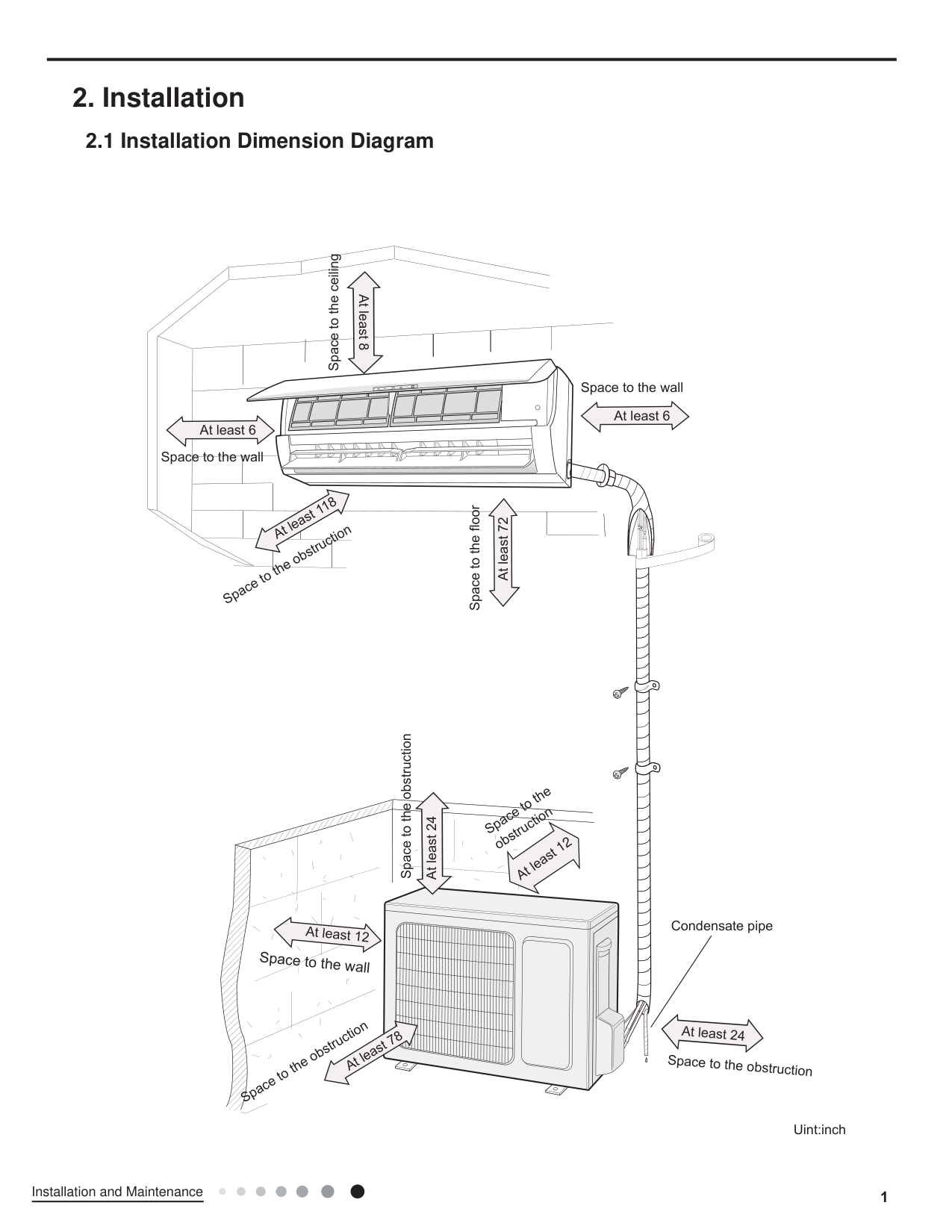
    ####### 2.1 Installation Dimension Diagram

    12

    Condensate

  • 1Installation and Maintenance
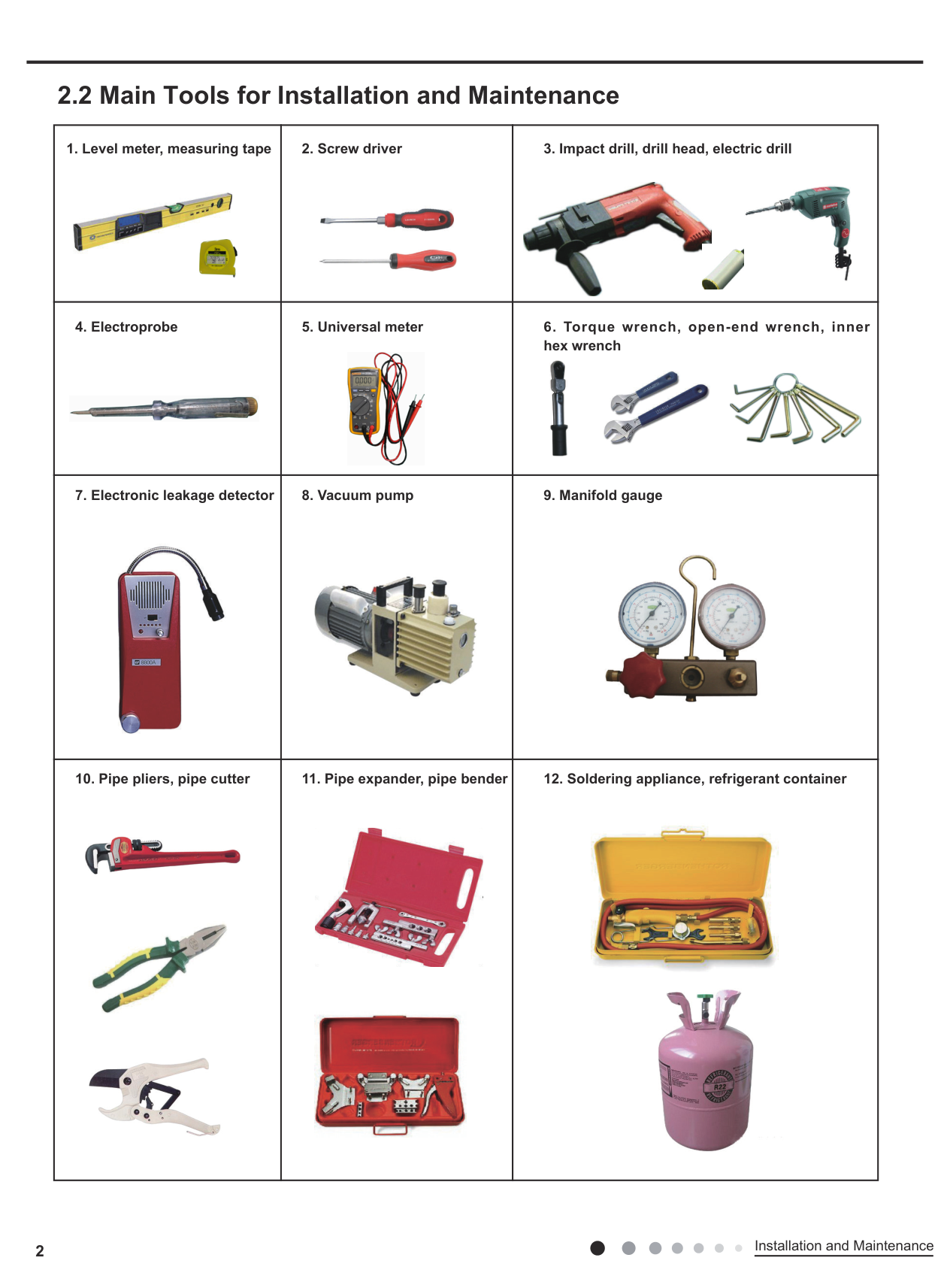
  • #### 2.2 Main Tools for Installation and Maintenance

    |1. Level meter, measuring tape

    ![image 11](lit_2012012182_20-_20iom_20p_20series_209k-12k__20220v_images/imageFile11.png)

    ![image 12](lit_2012012182_20-_20iom_20p_20series_209k-12k__20220v_images/imageFile12.png)|2. Screw driver

    ![image 13](lit_2012012182_20-_20iom_20p_20series_209k-12k__20220v_images/imageFile13.png)

    ![image 14](lit_2012012182_20-_20iom_20p_20series_209k-12k__20220v_images/imageFile14.png)|3. Impact drill, drill head, electric drill

    ![image 15](lit_2012012182_20-_20iom_20p_20series_209k-12k__20220v_images/imageFile15.png)

    ![image 16](lit_2012012182_20-_20iom_20p_20series_209k-12k__20220v_images/imageFile16.png)

    ![image 17](lit_2012012182_20-_20iom_20p_20series_209k-12k__20220v_images/imageFile17.png)| |---|---|---| |4. Electroprobe

    ![image 18](lit_2012012182_20-_20iom_20p_20series_209k-12k__20220v_images/imageFile18.png)|5. Universal meter

    ![image 19](lit_2012012182_20-_20iom_20p_20series_209k-12k__20220v_images/imageFile19.png)|6. Torque wrench, open-end wrench, inner hex wrench

    ![image 20](lit_2012012182_20-_20iom_20p_20series_209k-12k__20220v_images/imageFile20.png)

    ![image 21](lit_2012012182_20-_20iom_20p_20series_209k-12k__20220v_images/imageFile21.png)

    ![image 22](lit_2012012182_20-_20iom_20p_20series_209k-12k__20220v_images/imageFile22.png)| |7. Electronic leakage detector

    ![image 23](lit_2012012182_20-_20iom_20p_20series_209k-12k__20220v_images/imageFile23.png)|8. Vacuum pump

    ![image 24](lit_2012012182_20-_20iom_20p_20series_209k-12k__20220v_images/imageFile24.png)|9. Manifold gauge

    ![image 25](lit_2012012182_20-_20iom_20p_20series_209k-12k__20220v_images/imageFile25.png)| |10. Pipe pliers, pipe cutter

    ![image 26](lit_2012012182_20-_20iom_20p_20series_209k-12k__20220v_images/imageFile26.png)

    ![image 27](lit_2012012182_20-_20iom_20p_20series_209k-12k__20220v_images/imageFile27.png)

    ![image 28](lit_2012012182_20-_20iom_20p_20series_209k-12k__20220v_images/imageFile28.png)|11. Pipe expander, pipe bender

    ![image 29](lit_2012012182_20-_20iom_20p_20series_209k-12k__20220v_images/imageFile29.png)

    ![image 30](lit_2012012182_20-_20iom_20p_20series_209k-12k__20220v_images/imageFile30.png)|12. Soldering appliance, refrigerant container

    ![image 31](lit_2012012182_20-_20iom_20p_20series_209k-12k__20220v_images/imageFile31.png)

    ![image 32](lit_2012012182_20-_20iom_20p_20series_209k-12k__20220v_images/imageFile32.png)|

  • 2
  • Installation and Maintenance

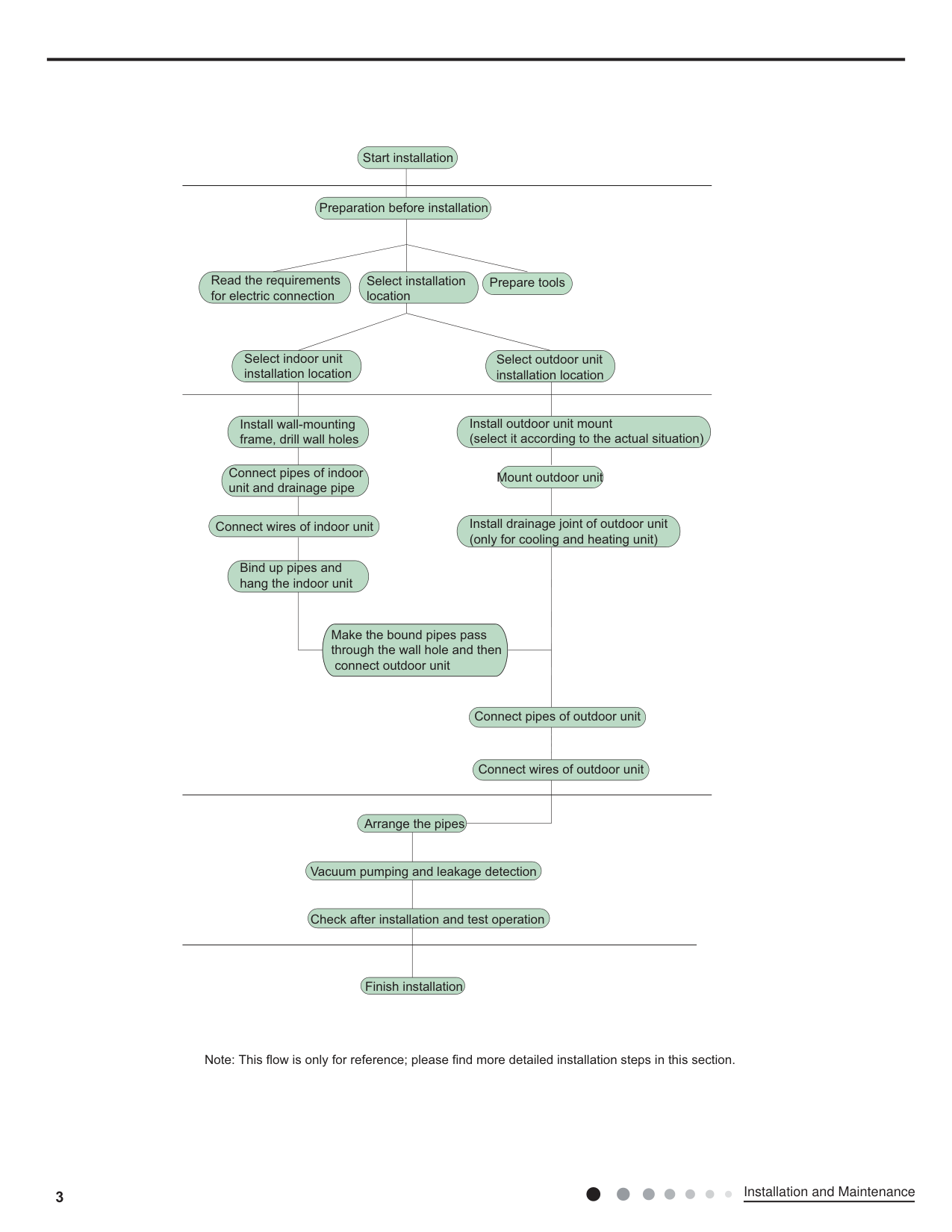
    Start installation

    | | | |---|---| | | |

    Preparation before installation

    Prepare toolsRead the requirements for electric connection

    Select installation location
    Page 7

    Select indoor unit installation location

    Select outdoor unit installation location

    | | | | |---|---|---| | | | |

    Install outdoor unit mount (select it according to the actual situation)

    Install wall-mounting frame, drill wall holes

    Connect pipes of indoor unit and drainage pipe

    Mount outdoor unit

    Install drainage joint of outdoor unit (only for cooling and heating unit)

    Connect wires of indoor unit

    Bind up pipes and hang the indoor unit

    Make the bound pipes pass through the wall hole and then

    connect outdoor unit

    Connect pipes of outdoor unit

    Connect wires of outdoor unit

    | | | |---|---| | | |

    Arrange the pipes

    Vacuum pumping and leakage detection

    Check after installation and test operation

    | | | |---|---| | | |
    Page 8

    Finish installation

    Note: This flow is only for reference; please find more detailed installation steps in this section.

  • 2.3 Installation - Checking Parts
  • 2.4 Selection of Installation Location
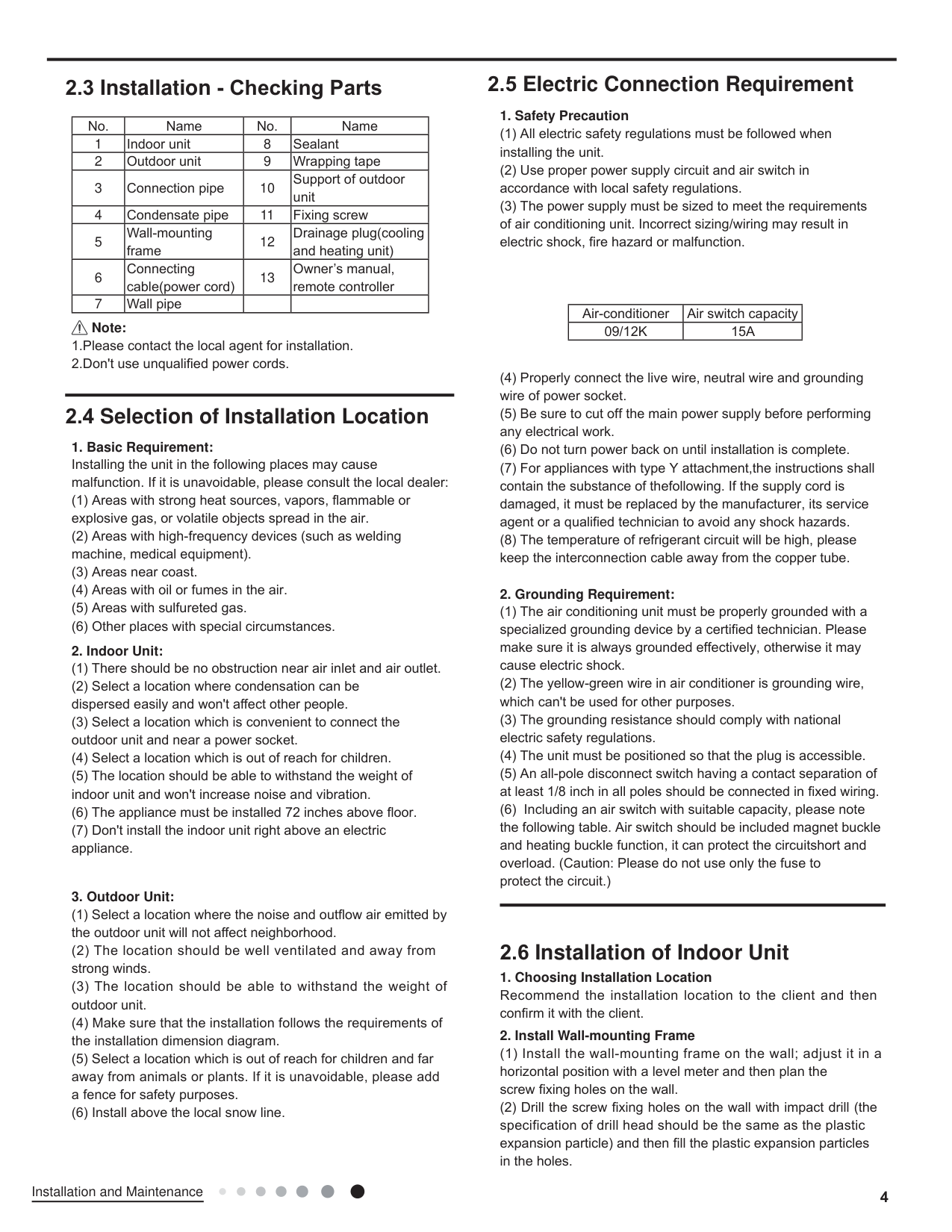
  • | | | | | |---|---|---|---| |1| |8|Sealant| |2| |9| | |3| |10| | |4|Condensate |11| | |5| |12| | |6| |13| | |7| | | |

    ################ Note:

    s
  • 1. Basic Requirement: Installing the unit in the following places may cause malfunction. If it is unavoidable, please consult the local dealer:
  • (1) Areas with strong heat sources, vapors, flammable or explosive gas, or volatile objects spread in the air.
  • (2) Areas with high-frequency devices (such as welding machine, medical equipment).
  • (3) Areas near coast.
  • (4) Areas with oil or fumes in the air.
  • (5) Areas with sulfureted gas.
  • (6) Other places with special circumstances.
  • Grounding Requirement:
  • (1) The air conditioning unit must be properly grounded with a specialized grounding device by a certified technician. Please make sure it is always grounded effectively, otherwise it may cause electric shock.
  • (2) The yellow-green wire in air conditioner is grounding wire, which can't be used for other purposes.
  • (3) The grounding resistance should comply with national electric safety regulations.
  • (4) The unit must be positioned so that the plug is accessible.
  • (5) An all-pole disconnect switch having a contact separation of at least 1/8 inch in all poles should be connected in fixed wiring.
  • (6) Including an air switch with suitable capacity, please note the following table. Air switch should be included magnet buckle and heating buckle function, it can protect the circuitshort and overload. (Caution: Please do not use only the fuse to protect the circuit.)
  • 1. Choosing Installation Location
  • Page 9

  • 2. Install Wall-mounting Frame Install a a plan
  • in the holes.

  • 2. Indoor Unit:
  • a

    es an

  • 3. Outdoor Unit:
  • s

    s the

    a s

    (6) Install above the local snow line.

  • 2.5 Electric Connection Requirement
  • 2.6 Installation of Indoor Unit
  • ############### 1. Safety Precaution

  • (1) All electric safety regulations must be followed when installing the unit.
  • (2) Use proper power supply circuit and air switch in accordance with local safety regulations.
  • (3) The power supply must be sized to meet the requirements of air conditioning unit. Incorrect sizing/wiring may result in electric shock, fire hazard or malfunction.
  • (4) Properly connect the live wire, neutral wire and grounding wire of power socket.
  • (5) Be sure to cut off the main power supply before performing any electrical work.
  • (6) Do not turn power back on until installation is complete.
  • (7) For appliances with type Y attachment,the instructions shall contain the substance of thefollowing. If the supply cord is damaged, it must be replaced by the manufacturer, its service agent or a qualified technician to avoid any shock hazards.
  • (8) The temperature of refrigerant circuit will be high, please keep the interconnection cable away from the copper tube.
  • | | | |---|---| | | |

  • 5. Connect the Pipe of Indoor Unit n
  • page

    Page 10

    n

    n

  • 6. Install Condensate Hose condensate n
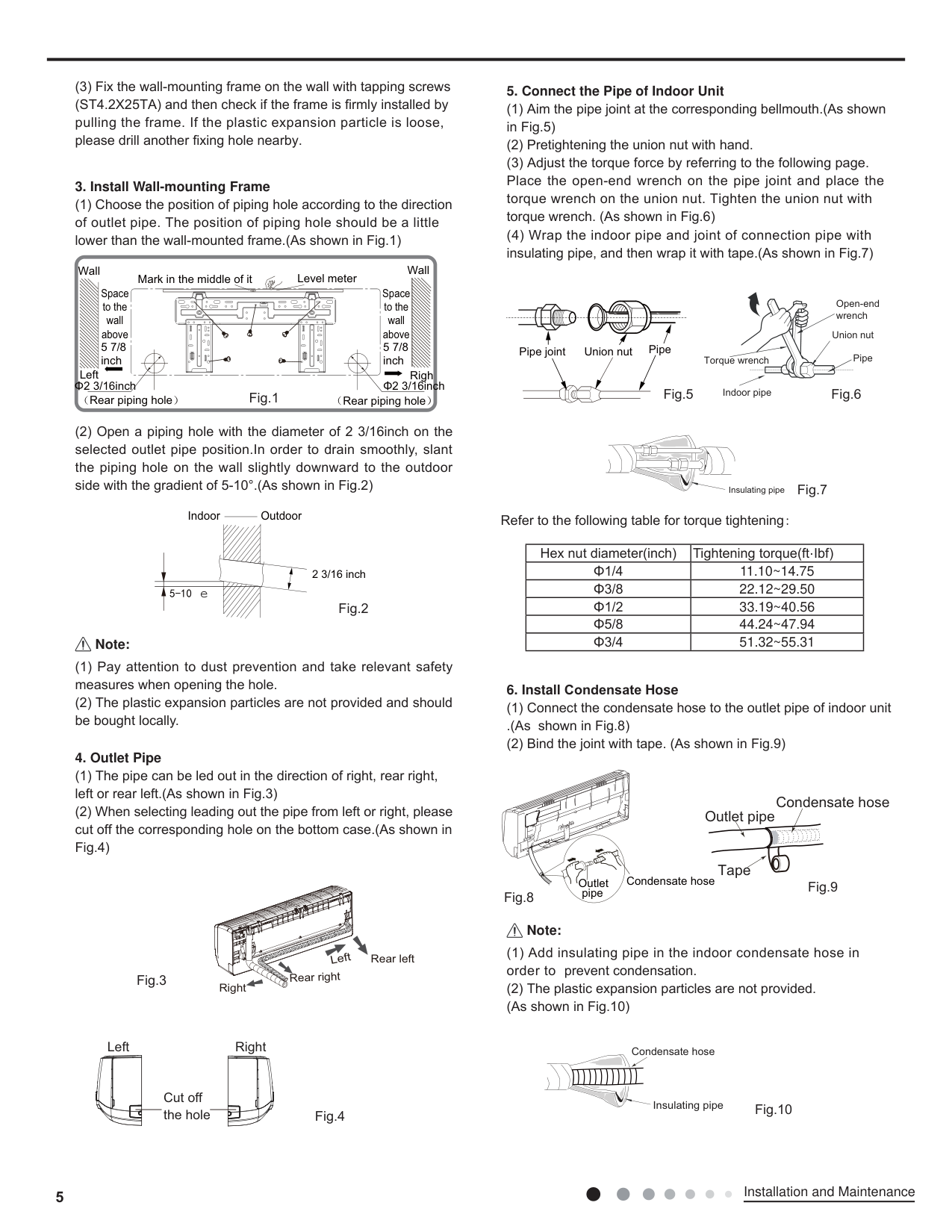
  • ############### 3. Install Wall-mounting Frame

    n

    Wall

    Wall

    Mark in the middle of it Level meter

    Space to the wall above

    Space to the wall above

    Open-end wrench

    | | | |---|---| | | |

    | | | | |---|---|---| | | | |

    Union nut Union nutPipe joint Pipe

    5 7/8 inch

    5 7/8 inch

    Pipe

    Torque wrench

    Left
    Page 11

    Righ

    Φ2 3/16inch

    Φ2 3/16inch

    Indoor pipe

    Rear piping hole

    Rear piping hole

    n

    Insulating pipe

    Indoor Outdoor

    torque tightening

    | |·| |---|---| | |11.10~14.75| | |22.12~29.50| | |33.19~40.56| | |44.24~47.94| | |51.32~55.31|

    2 3/16 inch

    e

    Note:

    n

    ############### 4. Outlet Pipe

    n

    Condensate hose

    Outlet pipe

    n
    Page 12

    Tape

    Condensate hose

    Outlet pipe

    Note:

    condensate

    Left

    Rear left

    Rear right

    Right

    n

    Left Right

    Condensate hose

    | | | |---|---| | | | | | |

    | | | |---|---| | | | | | |

    Cut off the hole

    Insulating pipe

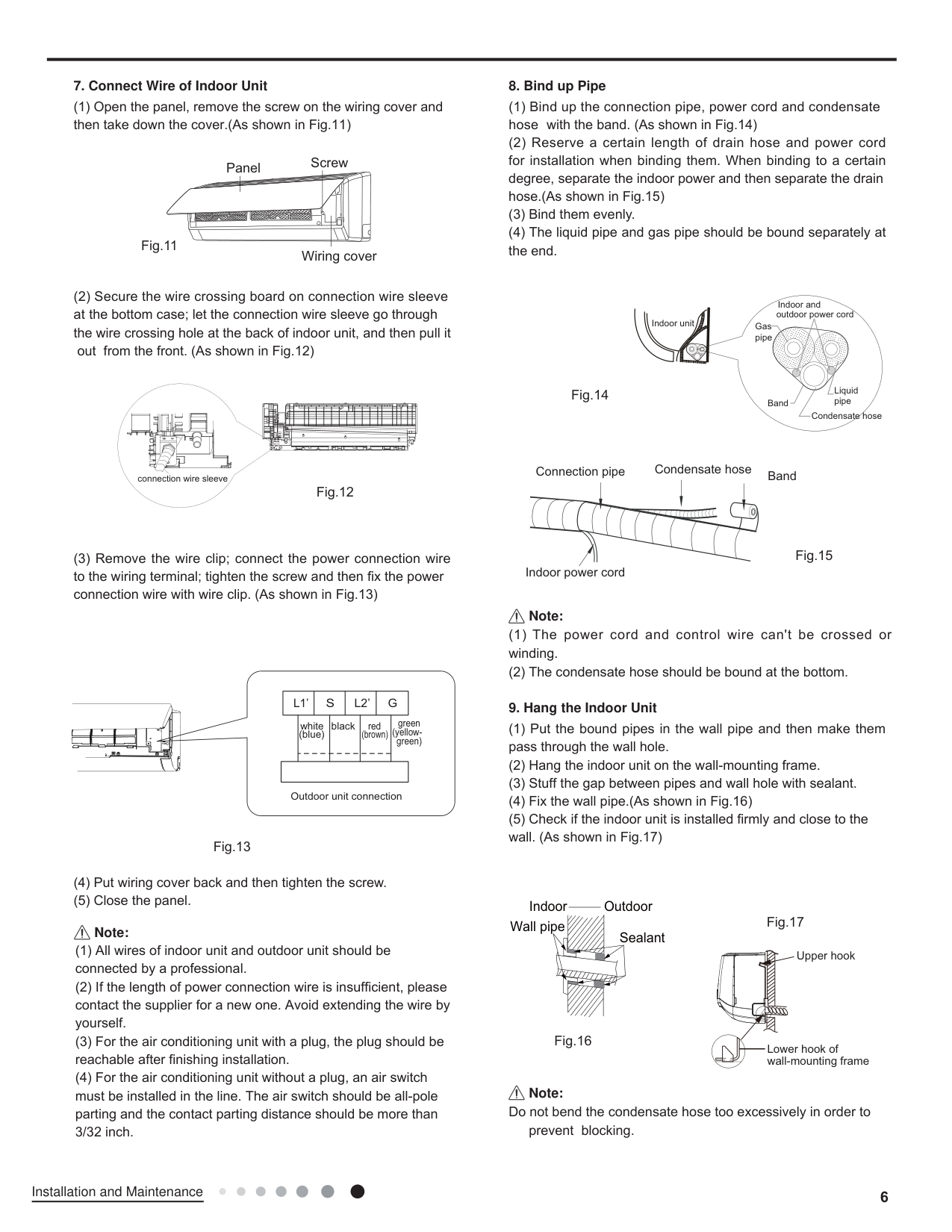
    ############### 7. Connect Wire of Indoor Unit

    n

    ScrewPanel
    Page 13

    Wiring cover

    Secure

    n

    | | | |---|---| | | | | | |

    connection wire sleeve

    | | | | | | | | | | | | | | | | | | | | | |---|---|---|---|---|---|---|---|---|---|---|---|---|---|---|---|---|---|---|---|

    n

    |L1’|L1’|S|S|L2’|L2’|G|G| |---|---|---|---|---|---|---|---| | |white (blue)|white (blue)|black|black|red (brown)|red (brown)| | | | | | | | | | | | | | | | | | | |

    green green)

    (yellow-

    Outdoor unit connection

    ############### 8. Bind up Pipecondensate

    hos n

    n

    Indoor and outdoor power cord

    Indoor unit Gas pipe

    Liquid pipe
    Page 14

    Band

    Condensate hose

    Condensate hose BandConnection pipe

    Indoor power cord

    ################ Note:

    condensate

    ############### 9. Hang the Indoor Unit

    n

    sealant n

    ################ Note:

  • (1) All wires of indoor unit and outdoor unit should be connected by a professional.
  • (2) If the length of power connection wire is insufficient, please contact the supplier for a new one. Avoid extending the wire by yourself.
  • (3) For the air conditioning unit with a plug, the plug should be reachable after finishing installation.
  • (4) For the air conditioning unit without a plug, an air switch must be installed in the line. The air switch should be all-pole parting and the contact parting distance should be more than 3/32 inch.
  • Indoor Outdoor Wall pipe

    Sealant

    ################ Note:

    condensate

    Upper hook

    Lower hook of wall-mounting frame

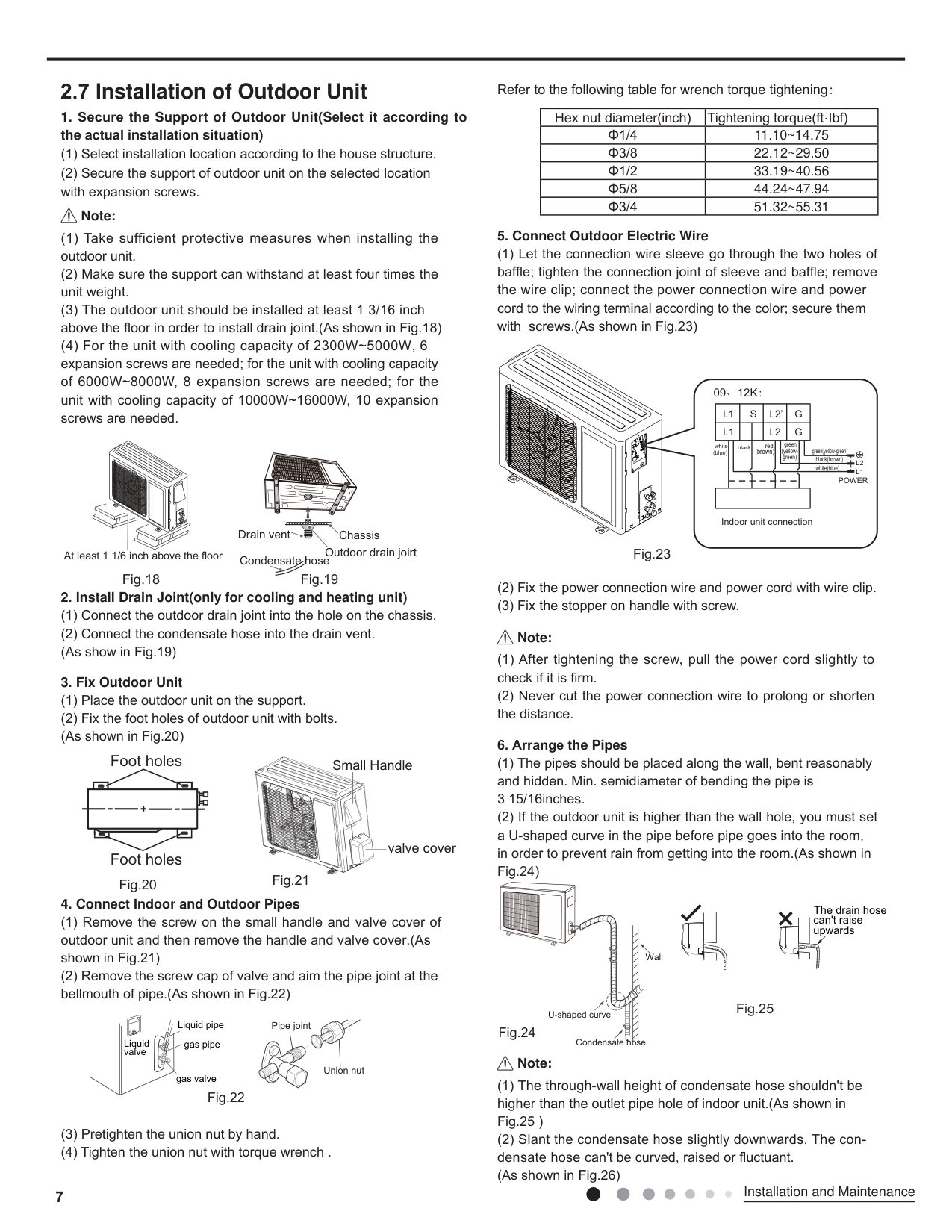
    ####### 2.7 Installation of Outdoor Unit

    ############### 1. Secure the Support of Outdoor Unit(Select it according tothe actual installation situation)

    Secure

    Note:
    Page 15

    n

    6

    Drain vent At least 1 1/6 inch above the floor

    Chassis

    Outdoor drain joint Condensate hose

    ############### 2. Install Drain Joint(only for cooling and heating unit)

    condensate

    ############### 3. Fix Outdoor Unit

    n

    Foot holes

    Foot holes

    ############### 4. Connect Indoor and Outdoor Pipes

    n

    n

    Liquid pipe

    Liquid valve

    gas pipe

    gas valve

    Pipe joint

    Union nut

    torque tightening

    | |·| |---|---| | |11.10~14.75| | |22.12~29.50|
    Page 16

    | |33.19~40.56| | |44.24~47.94| | |51.32~55.31|

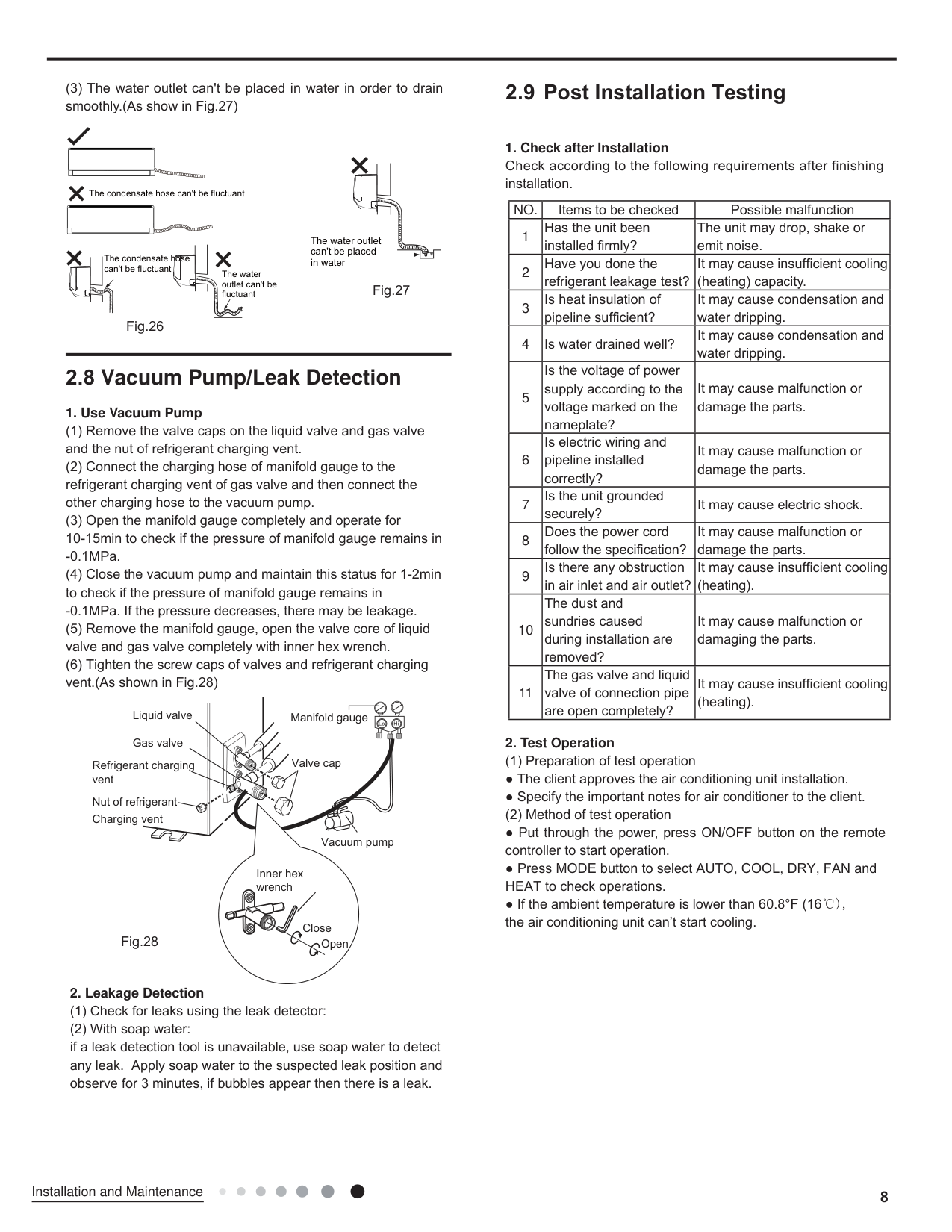
  • 5. Connect Outdoor Electric Wire
  • secure n

  • 6. Arrange the Pipes
  • 09、12K:

    G L1

    S L2’L1’

    L2 G

    green

    redblack

    white (blue)

    (yellow-(brown)

    green(yellow-green) black(brown) white(blue)

    green)

  • L1
  • L2
  • POWER

    Indoor unit connection

    Note:

    es

    n
    Page 17

    The drain hose can't raise upwards

    | | | | |---|---|---| | | | |

    Wall

    U-shaped curve

    Condensate hose

    Note:

    condensate n

    by

    condensate condensate or n

    The condensate hose can't be fluctuant

    The condensate hose can't be fluctuant

    The water outlet can't be fluctuant

    The water outlet can't be placed in water

    ####### 2.8 Vacuum Pump/Leak Detection

    ############### 1. Use Vacuum Pump

  • (1) Remove the valve caps on the liquid valve and gas valve and the nut of refrigerant charging vent.
  • (2) Connect the charging hose of manifold gauge to the refrigerant charging vent of gas valve and then connect the other charging hose to the vacuum pump.
  • (3) Open the manifold gauge completely and operate for 10-15min to check if the pressure of manifold gauge remains in
  • -0.1MPa.

  • (4) Close the vacuum pump and maintain this status for 1-2min to check if the pressure of manifold gauge remains in
  • -0.1MPa. If the pressure decreases, there may be leakage.
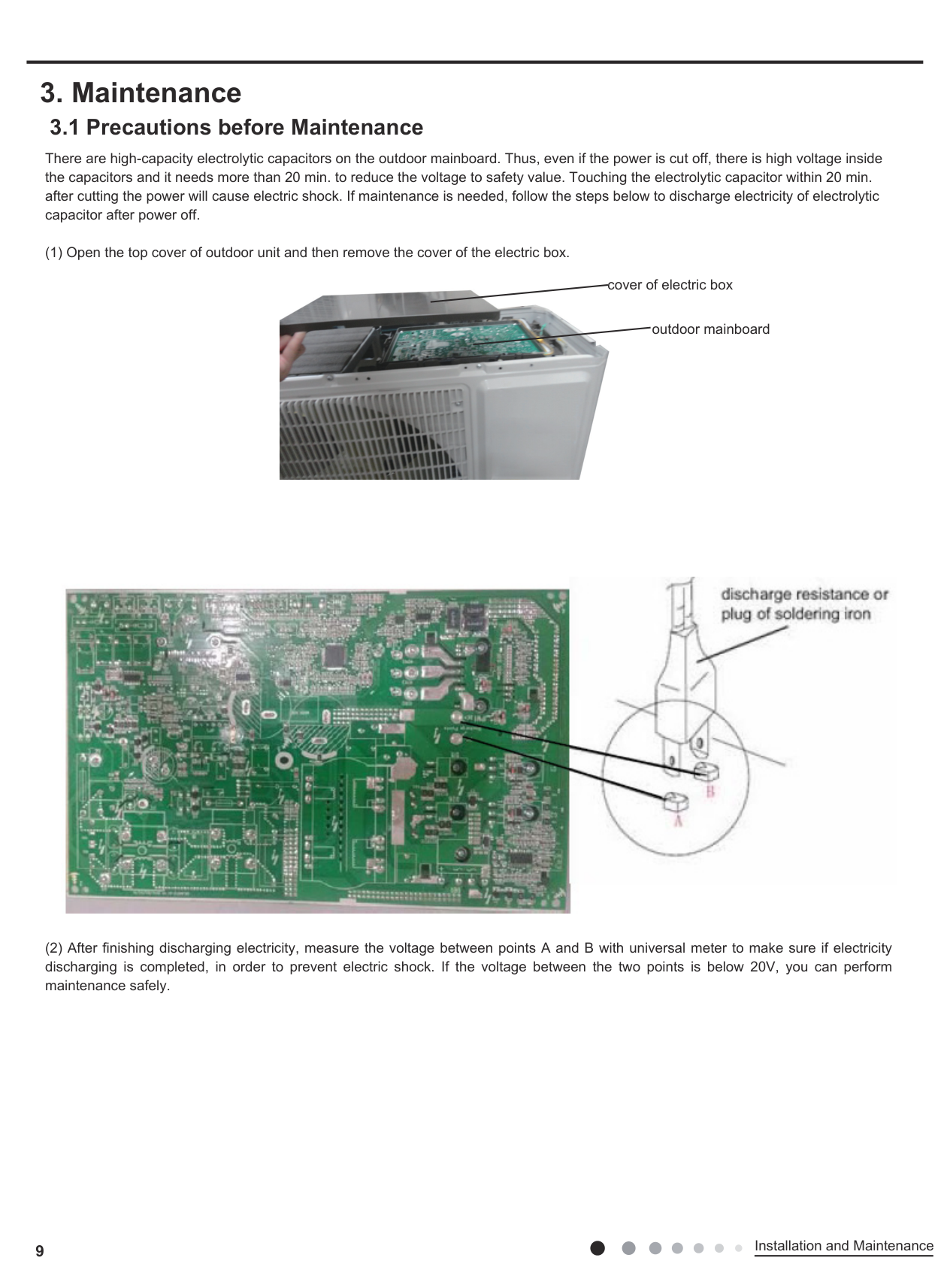
  • (5) Remove the manifold gauge, open the valve core of liquid valve and gas valve completely with inner hex wrench.
  • (6) Tighten the screw caps of valves and refrigerant charging vent. n
  • Page 18

    Liquid valve Gas valve

    Manifold gauge

    Lo Hi

    Valve cap

    Refrigerant charging vent

    Nut of refrigerant Charging vent

    Vacuum pump

    Inner hex wrench

    Close

    Open

    ############### 2. Leakage Detection

  • (1) Check for leaks using the leak detector:
  • (2) With soap water: if a leak detection tool is unavailable, use soap water to detect any leak. Apply soap water to the suspected leak position and observe for 3 minutes, if bubbles appear then there is a leak.
  • ####### 2.9 Post Installation Testing

  • 1. Check after Installation s
  • 2. Test Operation
  • |NO.| | | |---|---|---| |1| | | |2| | | |3| | | |4| | | |5| | | |6| | | |7| |shock| |8| | | |9| | | |10| | | |11| | |
    Page 19

    ing unit

    operations

    60.8°F ( ), ing unit

    3. Maintenance

    ##### 3.1 Precautions before Maintenance

    There are high-capacity electrolytic capacitors on the outdoor mainboard. Thus, even if the power is cut off, there is high voltage inside the capacitors and it needs more than 20 min. to reduce the voltage to safety value. Touching the electrolytic capacitor within 20 min. after cutting the power will cause electric shock. If maintenance is needed, follow the steps below to discharge electricity of electrolytic capacitor after power off.

    ![image 33](lit_2012012182_20-_20iom_20p_20series_209k-12k__20220v_images/imageFile33.png)

  • (1) Open the top cover of outdoor unit and then remove the cover of the electric box.
  • (2) After finishing discharging electricity, measure the voltage between points A and B with universal meter to make sure if electricity discharging is completed, in order to prevent electric shock. If the voltage between the two points is below 20V, you can perform maintenance safely.
  • cover of electric box

    outdoor mainboard

    ![image 34](lit_2012012182_20-_20iom_20p_20series_209k-12k__20220v_images/imageFile34.png)

    9

    Installation and Maintenance

    ####### 3.2 Error Code List

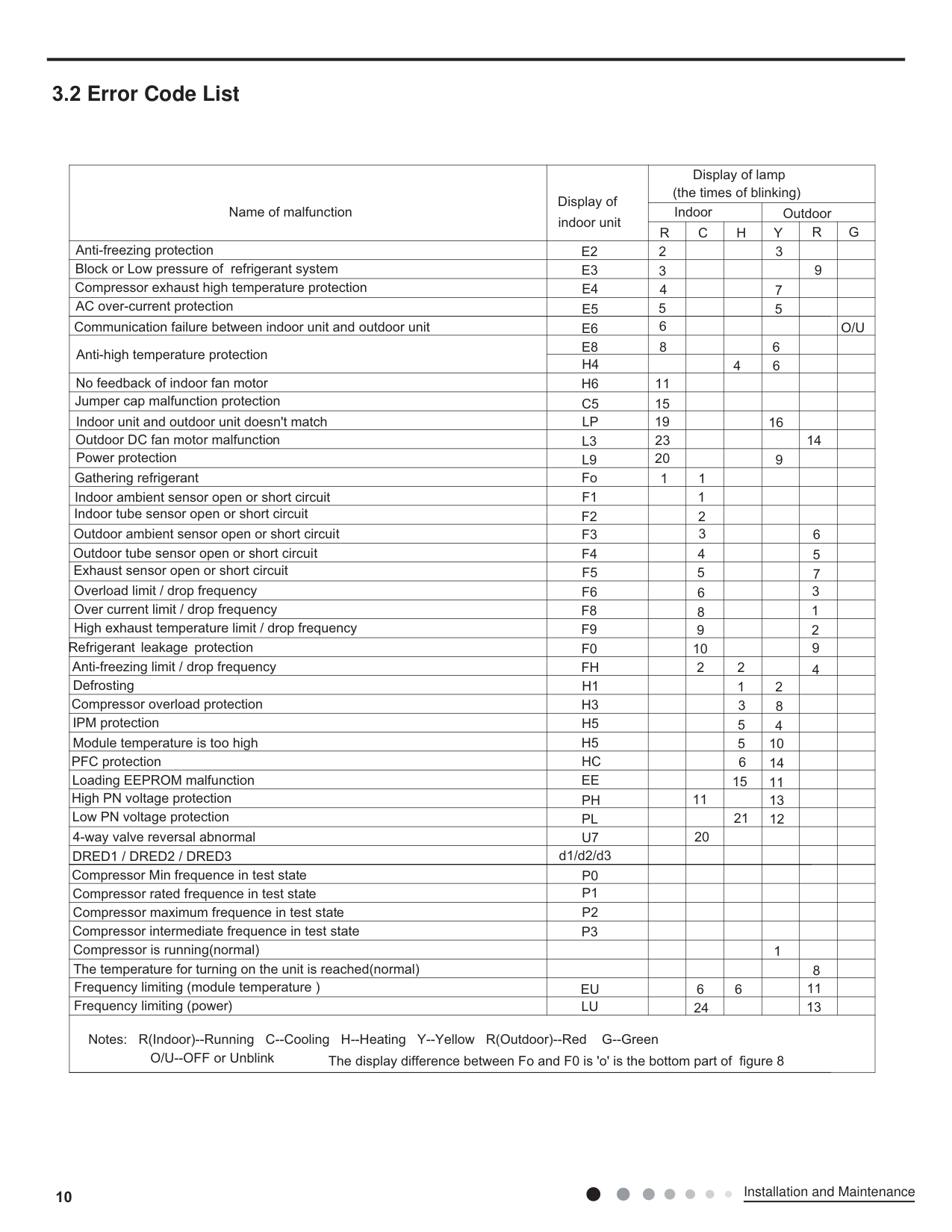
    |Name of malfunction|Display of indoor unit|Display of lamp (the times of blinking)|Display of lamp (the times of blinking)|Display of lamp (the times of blinking)|Display of lamp (the times of blinking)|Display of lamp (the times of blinking)|Display of lamp (the times of blinking)| |---|---|---|---|---|---|---|---| |Name of malfunction|Display of indoor unit|Indoor|Indoor|Indoor|Outdoor|Outdoor|Outdoor| |Name of malfunction|Display of indoor unit|R|C|H|Y|R|G| |Anti-freezing protection|E2|2| | |3| | | |Block or Low pressure of refrigerant system|E3|3| | | |9| | |Compressor exhaust high temperature protection|E4|4| | |7| | | |AC over-current protection|E5|5| | |5| | | |Communication failure between indoor unit and outdoor unit|E6|6| | | | |O/U| |Anti-high temperature protection|E8|8| | |6| | | |Anti-high temperature protection|H4| | |4|6| | | |No feedback of indoor fan motor|H6|11| | | | | | |Jumper cap malfunction protection|C5|15| | | | | | |Indoor unit and outdoor unit doesn't match|LP|19| | |16| | |
    Page 20

    |Outdoor DC fan motor malfunction|L3|23| | | |14| | |Power protection|L9|20| | |9| | | |Gathering refrigerant|Fo|1|1| | | | | |Indoor ambient sensor open or short circuit|F1| |1| | | | | |Indoor tube sensor open or short circuit|F2| |2| | | | | |Outdoor ambient sensor open or short circuit|F3| |3| | |6| | |Outdoor tube sensor open or short circuit|F4| |4| | |5| | |Exhaust sensor open or short circuit|F5| |5| | |7| | |Overload limit / drop frequency|F6| |6| | |3| | |Over current limit / drop frequency|F8| |8| | |1| | |High exhaust temperature limit / drop frequency|F9| |9| | |2| | |Refrigerant leakage protection|F0| |10| | |9| | |Anti-freezing limit / drop frequency|FH| |2|2| |4| | |Defrosting|H1| | |1|2| | | |Compressor overload protection|H3| | |3|8| | | |IPM protection|H5| | |5|4| | | |Module temperature is too high|H5| | |5|10| | | |PFC protection|HC| | |6|14| | | |Loading EEPROM malfunction|EE| | |15|11| | | |High PN voltage protection|PH| |11| |13| | | |Low PN voltage protection|PL| | |21|12| | | |4-way valve reversal abnormal|U7| |20| | | | | |DRED1 / DRED2 / DRED3|d1/d2/d3| | | | | | | |Compressor Min frequence in test state|P0| | | | | | | |Compressor rated frequence in test state|P1| | | | | | | |Compressor maximum frequence in test state|P2| | | | | | | |Compressor intermediate frequence in test state|P3| | | | | | | |Compressor is running(normal)| | | | |1| | | |The temperature for turning on the unit is reached(normal)| | | | | |8| | |Frequency limiting (module temperature )|EU| |6|6| |11| | |Frequency limiting (power)|LU| |24| | |13| | |O/U--OFF or Unblink

    Notes: R(Indoor)--Running C--Cooling H--Heating Y--Yellow R(Outdoor)--Red G--Green The display difference between Fo and F0 is 'o' is the bottom part of figure 8|O/U--OFF or Unblink

    Notes: R(Indoor)--Running C--Cooling H--Heating Y--Yellow R(Outdoor)--Red G--Green The display difference between Fo and F0 is 'o' is the bottom part of figure 8|O/U--OFF or Unblink

    Notes: R(Indoor)--Running C--Cooling H--Heating Y--Yellow R(Outdoor)--Red G--Green The display difference between Fo and F0 is 'o' is the bottom part of figure 8|O/U--OFF or Unblink

    Notes: R(Indoor)--Running C--Cooling H--Heating Y--Yellow R(Outdoor)--Red G--Green The display difference between Fo and F0 is 'o' is the bottom part of figure 8|O/U--OFF or Unblink

    Notes: R(Indoor)--Running C--Cooling H--Heating Y--Yellow R(Outdoor)--Red G--Green The display difference between Fo and F0 is 'o' is the bottom part of figure 8|O/U--OFF or Unblink

    Notes: R(Indoor)--Running C--Cooling H--Heating Y--Yellow R(Outdoor)--Red G--Green The display difference between Fo and F0 is 'o' is the bottom part of figure 8|O/U--OFF or Unblink

    Notes: R(Indoor)--Running C--Cooling H--Heating Y--Yellow R(Outdoor)--Red G--Green The display difference between Fo and F0 is 'o' is the bottom part of figure 8|O/U--OFF or Unblink

    Notes: R(Indoor)--Running C--Cooling H--Heating Y--Yellow R(Outdoor)--Red G--Green The display difference between Fo and F0 is 'o' is the bottom part of figure 8|

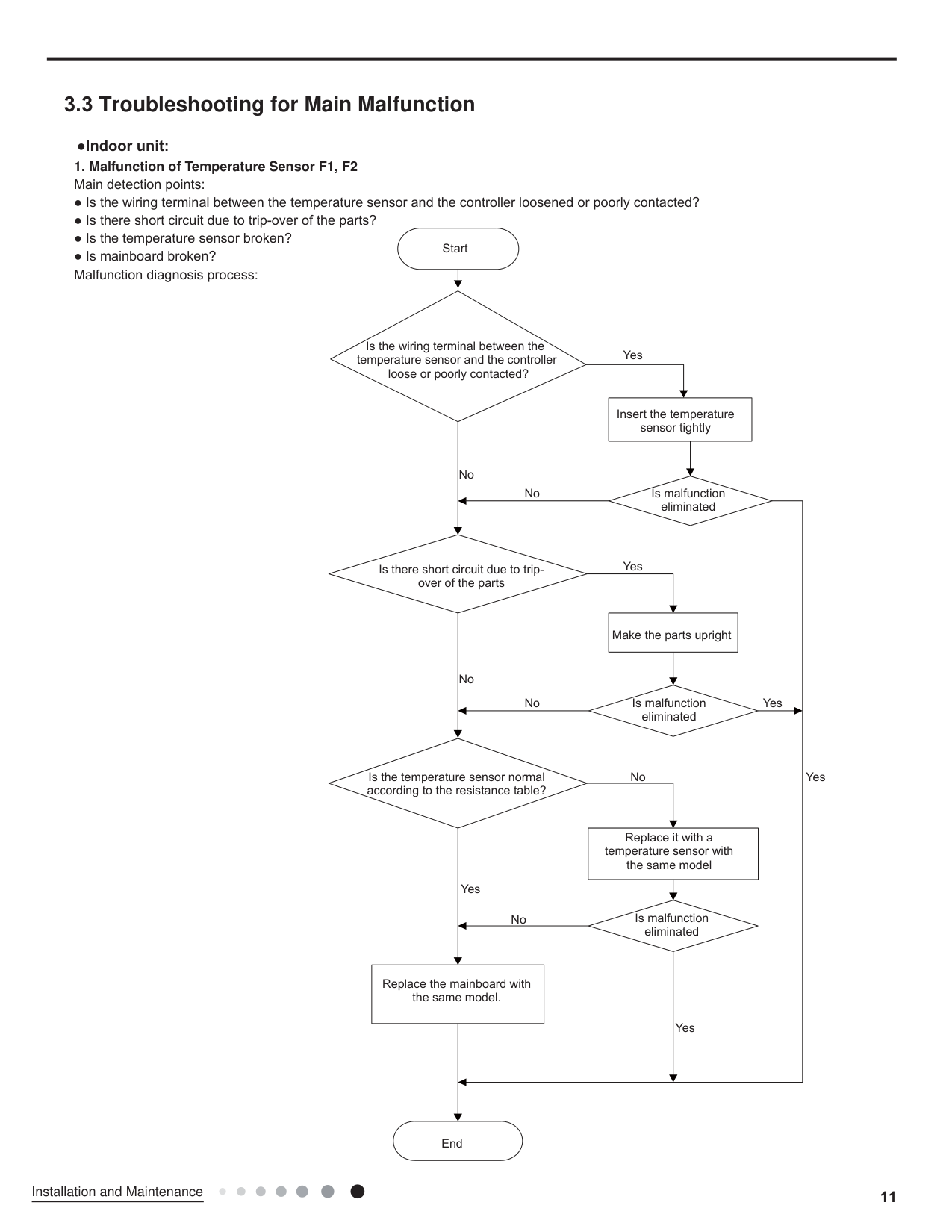
    ####### 3.3 Troubleshooting for Main Malfunction

  • 1. Malfunction of Temperature Sensor F1, F2
  • | | | |---|---| | | |

    | | | |---|---|

    Page 21

    | | |

    | | | |---|---| | | |

    | | | |---|---| | | |

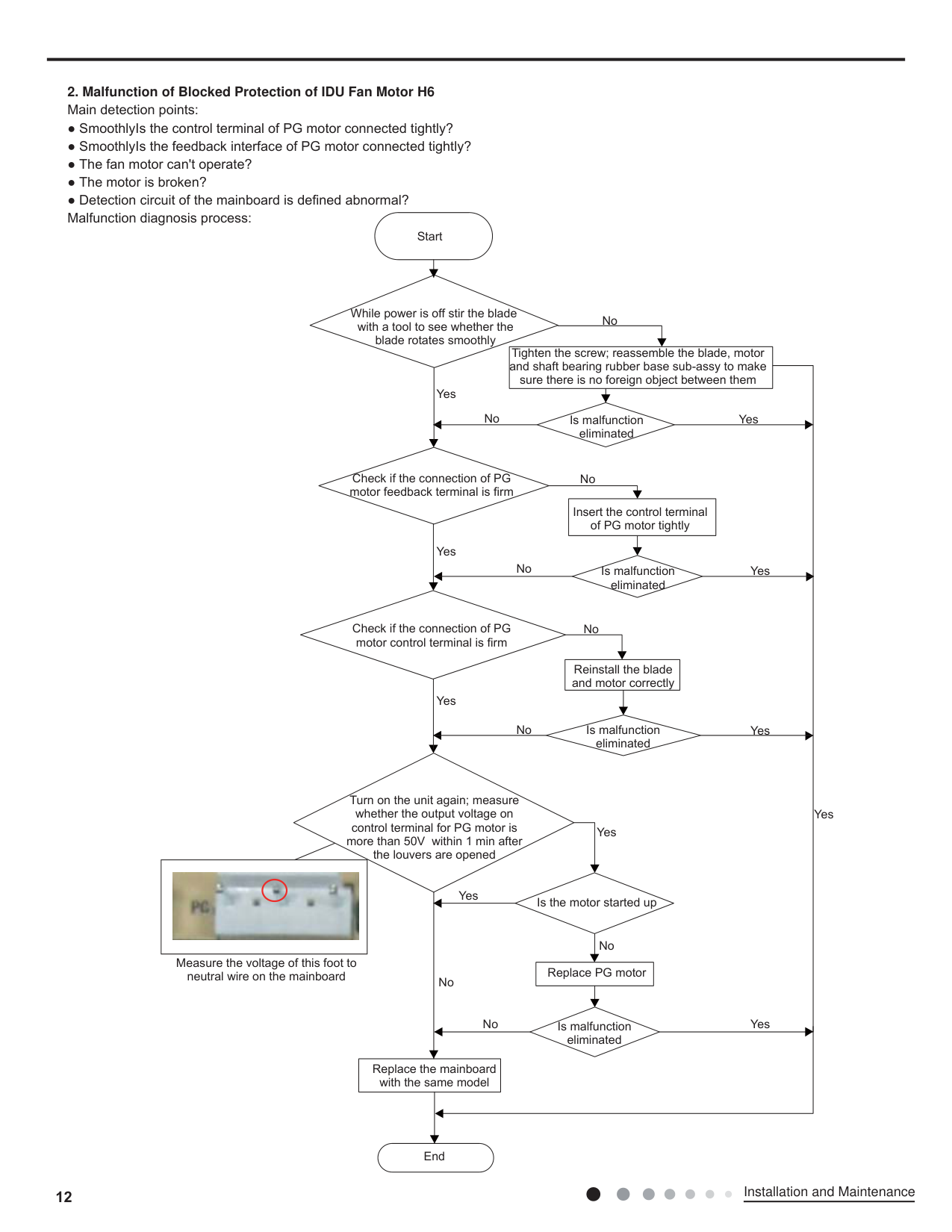
    ############### 2. Malfunction of Blocked Protection of IDU Fan Motor H6

    |![image 35](lit_2012012182_20-_20iom_20p_20series_209k-12k__20220v_images/imageFile35.png)| |---|

    | | | |---|---| | | |

    | | | |---|---| | | |

    | | | |---|---| | | |

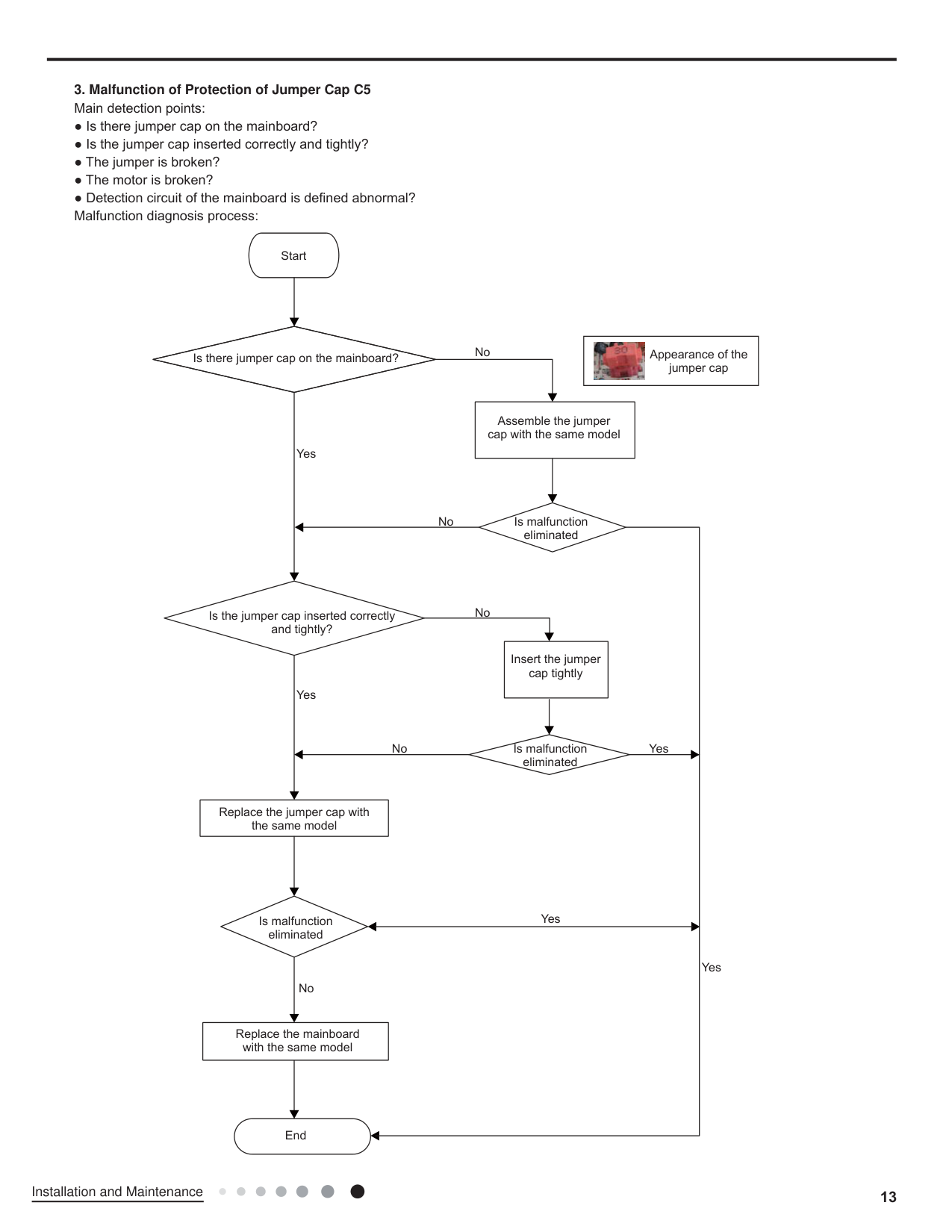
    ############### 3. Malfunction of Protection of Jumper Cap C5

    |![image 36](lit_2012012182_20-_20iom_20p_20series_209k-12k__20220v_images/imageFile36.png)| |---|

    | | | |---|---| | | |

    | |

    Page 22

    |---|

    | | | |---|---| | | |

    | | | |---|---| | | |

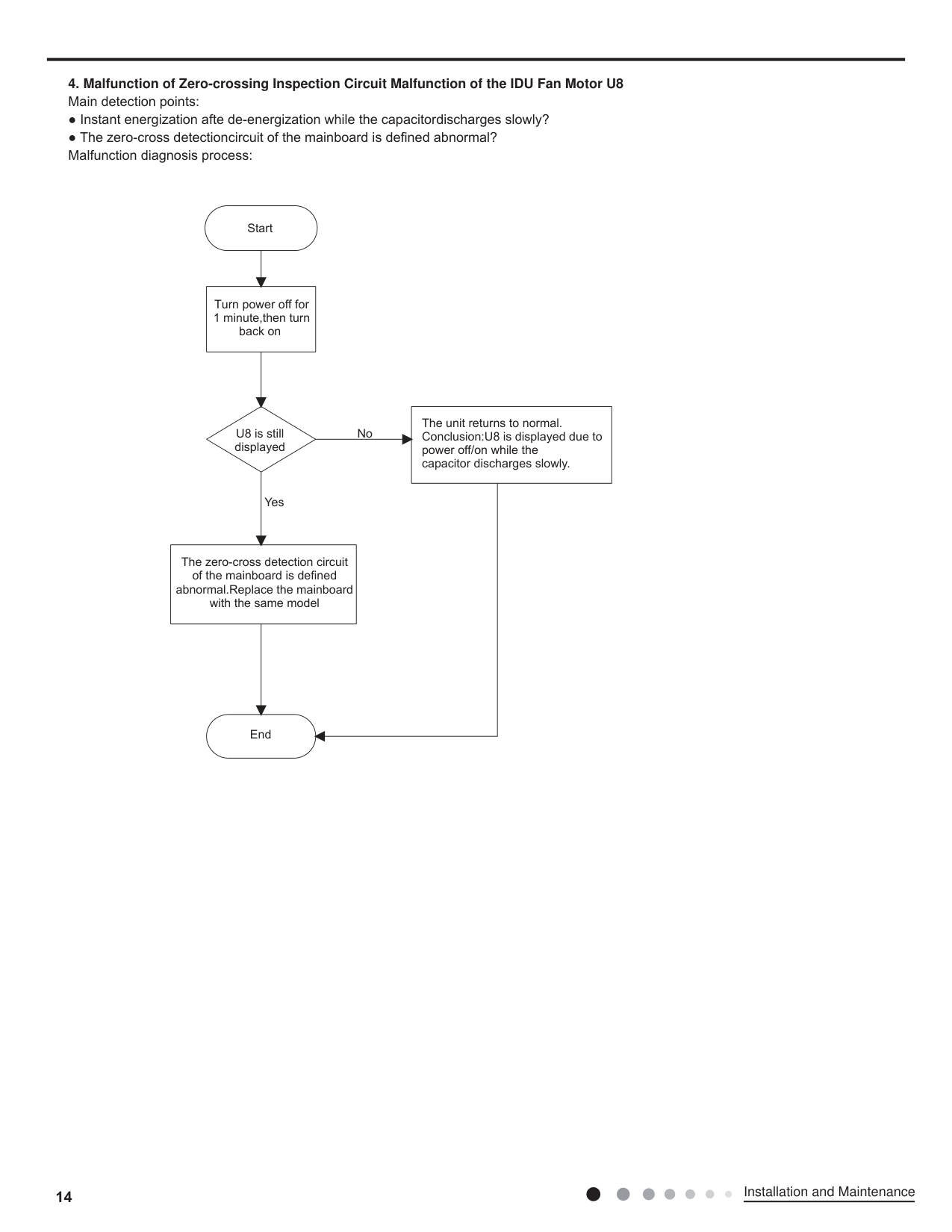
    ############### 4. Malfunction of Zero-crossing Inspection Circuit Malfunction of the IDU Fan Motor U8

    |n|n| |---|---| | | |

    | | | |---|---| | | |

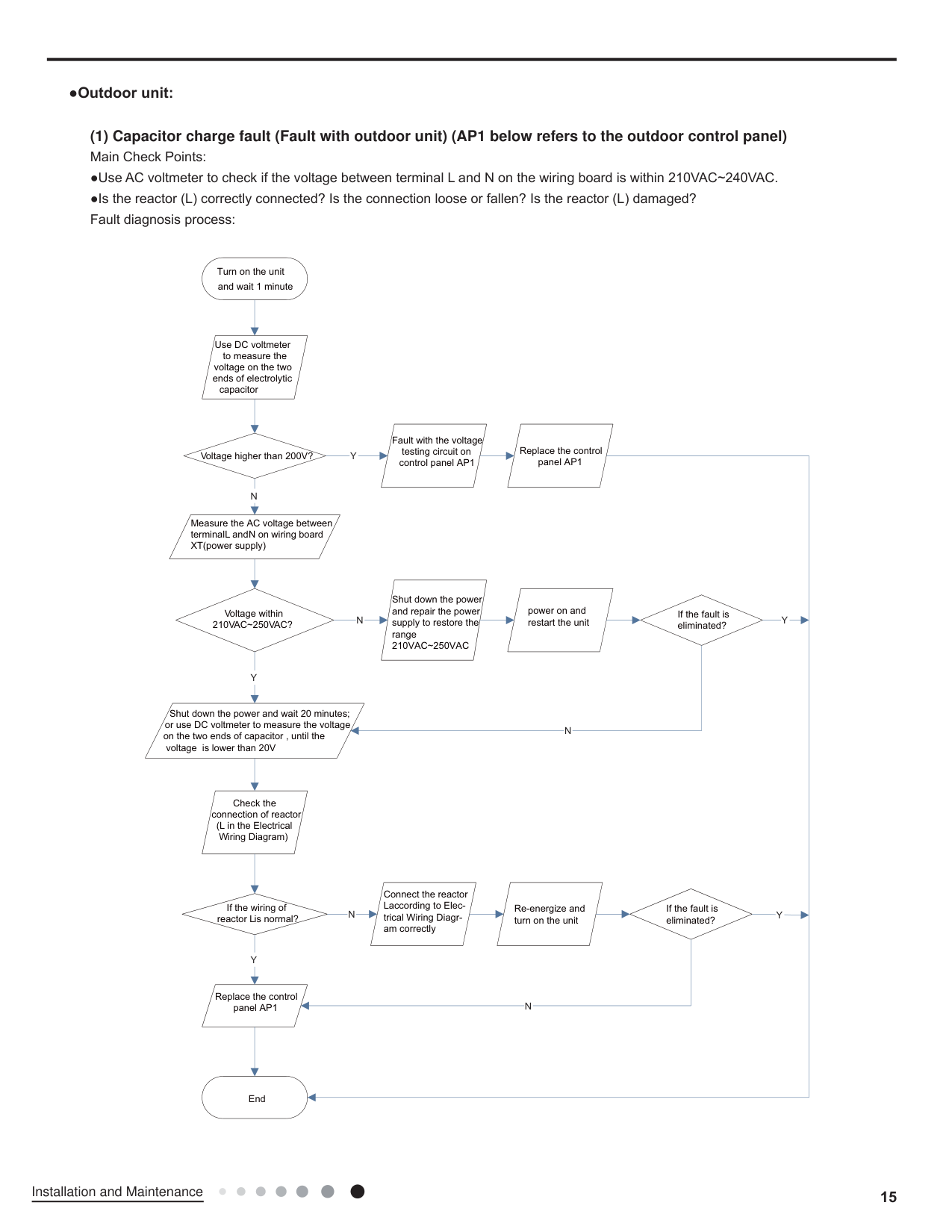
    ############# (1) Capacitor charge fault (Fault with outdoor unit) (AP1 below refers to the outdoor control panel)

    Turn on the unit and wait 1 minute

    Use DC voltmeter to measure the

    voltage on the two ends of electrolytic

    capacitor

    Fault with the voltage testing circuit on control panel AP1

    Replace the control panel AP1

    Y

    Voltage higher than 200V?

    N

    Measure the AC voltage between terminalL and N on wiring board XT(power supply)
    Page 23

    Shut down the power and repair the power supply to restore the range 210VAC~250VAC

    power on and restart the unit

    Voltage within 210VAC~250VAC?

    If the fault is eliminated?

    N

    Y

    Shut down the power and wait 20 minutes; or use DC voltmeter to measure the voltage on the two ends of capacitor , until the

    N

    voltage is lower than 20V

    Check the connection of reactor

    (L in the Electrical Wiring Diagram)

    Connect the reactor Laccording to Electrical Wiring Diagram correctly

    If the wiring of reactor Lis normal?

    Re-energize and turn on the unit

    If the fault is eliminated?

    N

    Y

    Replace the control panel AP1

    N

    Y

    Y

    End

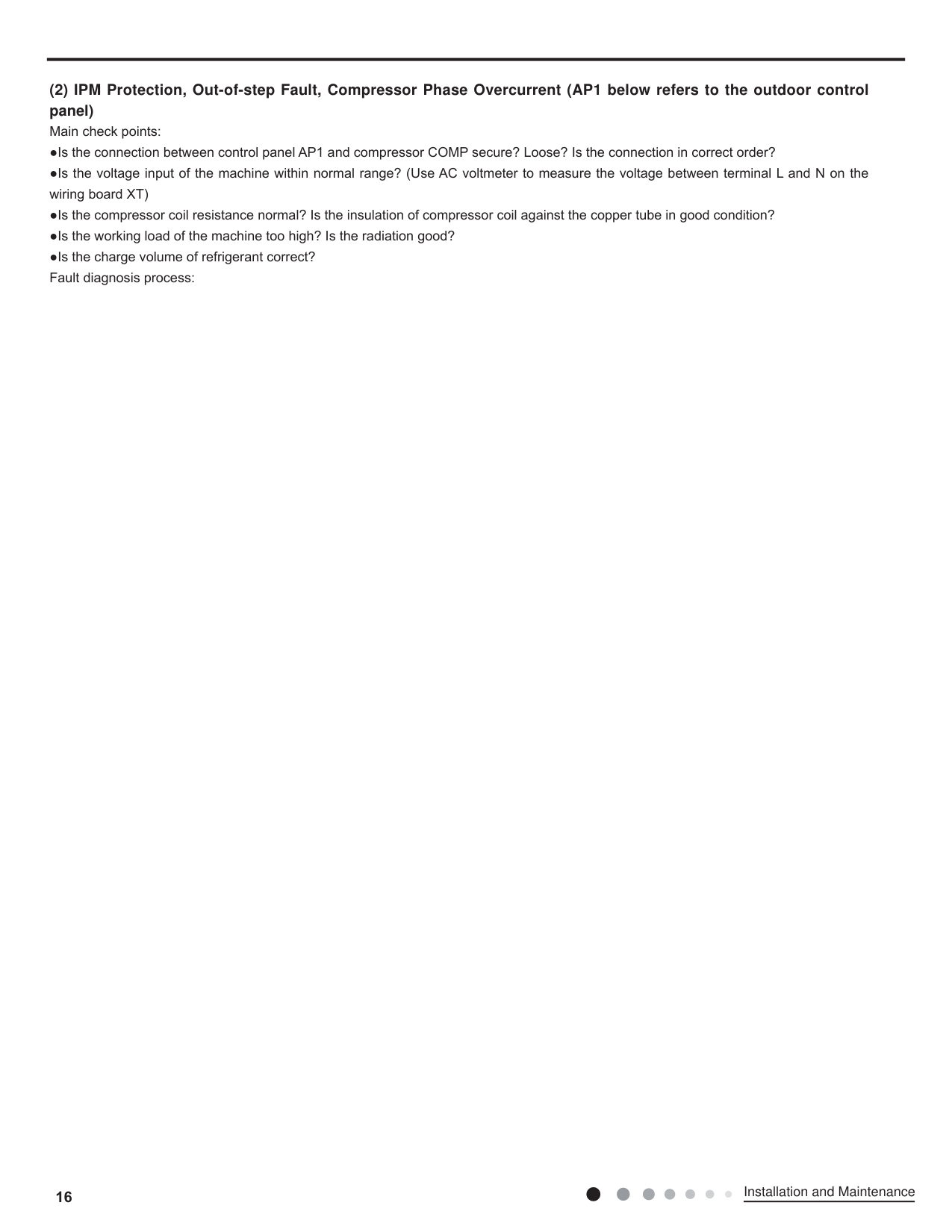
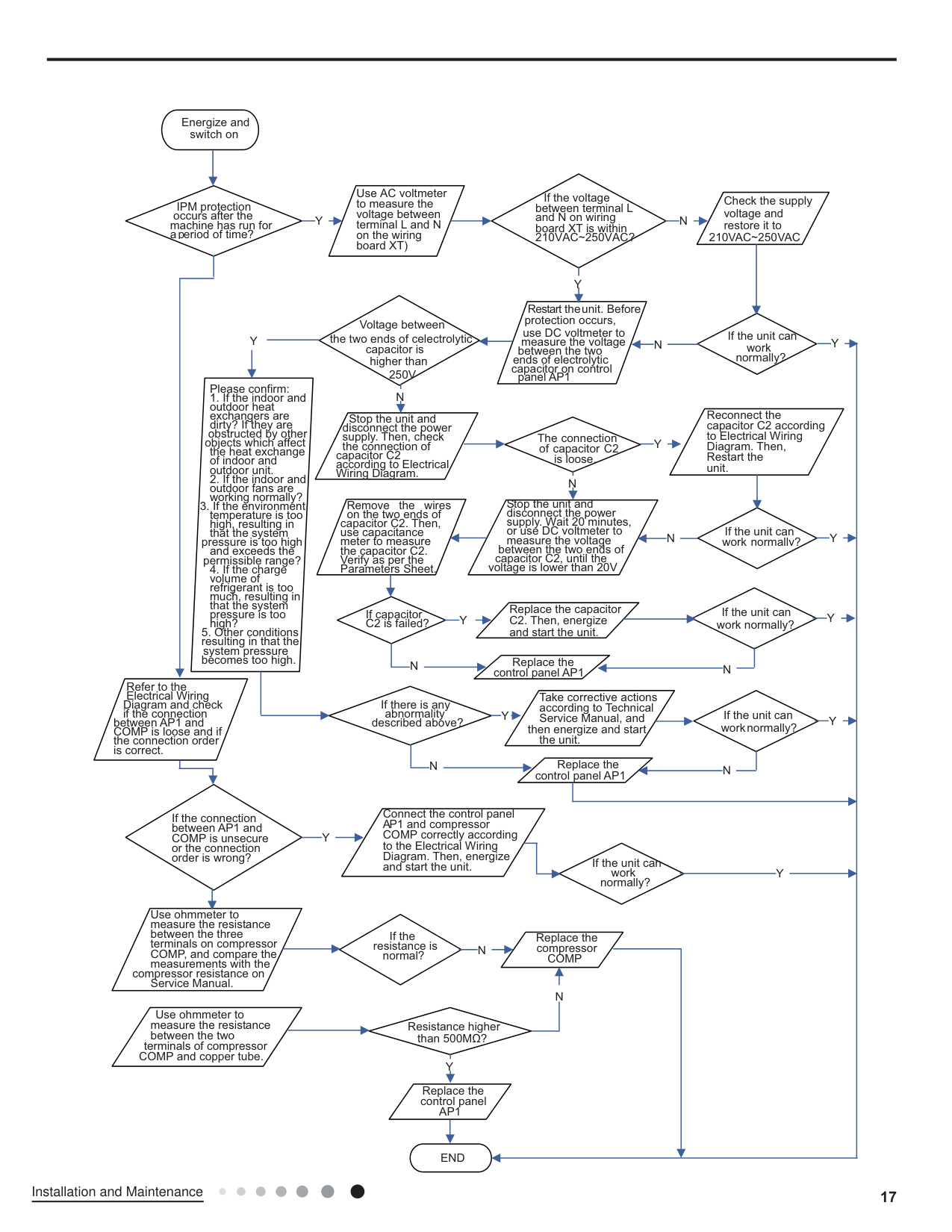
    ############# (2) IPM Protection, Out-of-step Fault, Compressor Phase Overcurrent (AP1 below refers to the outdoor controlpanel)
    Page 24

    Energize and switch on

    Use AC voltmeter to measure the voltage between terminal L and N on the wiring board XT)

    If the voltage between terminal L and N on wiring board XT is within 210VAC~250VAC?

    Check the supply voltage and restore it to 210VAC~250VAC

    IPM protection

    occurs after the machine has run for aperiod of time?

    Y N

    Y

    Restart the unit. Before protection occurs,

    Voltage between the two ends of celectrolytic

    use DC voltmeter to measure the voltage

    If the unit can

    Y

    YN

    work normally?

    capacitor is

    between the two ends of electrolytic capacitor on control

    higher than 250V

    panel AP1

    Please confirm:

    N

  • If the indoor and outdoor heat exchangers are dirty? If they are obstructed by other
  • Reconnect the capacitor C2 according to Electrical Wiring Diagram. Then, Restart the unit.
    Page 25

    Stop the unit and disconnect the power supply. Then, check the connection of

    The connection of capacitor C2

    objects which affect the heat exchange of indoor and outdoor unit.

    Y

    capacitor C2 according to Electrical Wiring Diagram.

    is loose.

  • 2. If the indoor and outdoor fans are working normally?
  • 3. If the environment temperature is too high, resulting in that the system
  • N

    Stop the unit and disconnect the power supply. Wait 20 minutes, or use DC voltmeter to measure the voltage between the two ends of capacitor C2, until the voltage is lower than 20V

    Remove the wires on the two ends of

    capacitor C2. Then, use capacitance meter to measure the capacitor C2. Verify as per the Parameters Sheet.

    If the unit can work normallv? Y

    N

    pressure is too high and exceeds the permissible range?

  • 4. If the charge volume of refrigerant is too much, resulting in that the system pressure is too high?
  • 5. Other conditions resulting in that the system pressure becomes too high.
  • Replace the capacitor C2. Then, energize and start the unit.

    If the unit can work normally?

    If capacitor C2 is failed?

    Y

    Y

    Replace the control panel AP1
    Page 26

    N

    N

    Refer to the Electrical Wiring

    Take corrective actions according to Technical Service Manual, and

    Diagram and check if the connection

    If there is any abnormality

    If the unit can work normally?

    YY

    described above?

    between AP1 and COMP is loose and if the connection order is correct.

    then energize and start the unit.

    Replace the control panel AP1

    N N

    Connect the control panel AP1 and compressor COMP correctly according to the Electrical Wiring Diagram. Then, energize and start the unit.

    If the connection between AP1 and COMP is unsecure or the connection order is wrong?

    Y

    If the unit can

    work normally?

    Y

    Use ohmmeter to measure the resistance between the three terminals on compressor COMP, and compare the measurements with the

    If the

    Replace the compressor COMP

    resistance is normal?
    Page 27

    N

    compressor resistance on Service Manual.

    N

    Use ohmmeter to measure the resistance between the two

    Resistance higher than 500MΩ?

    terminals of compressor COMP and copper tube.

    Y

    Replace the control panel

    AP1

    END

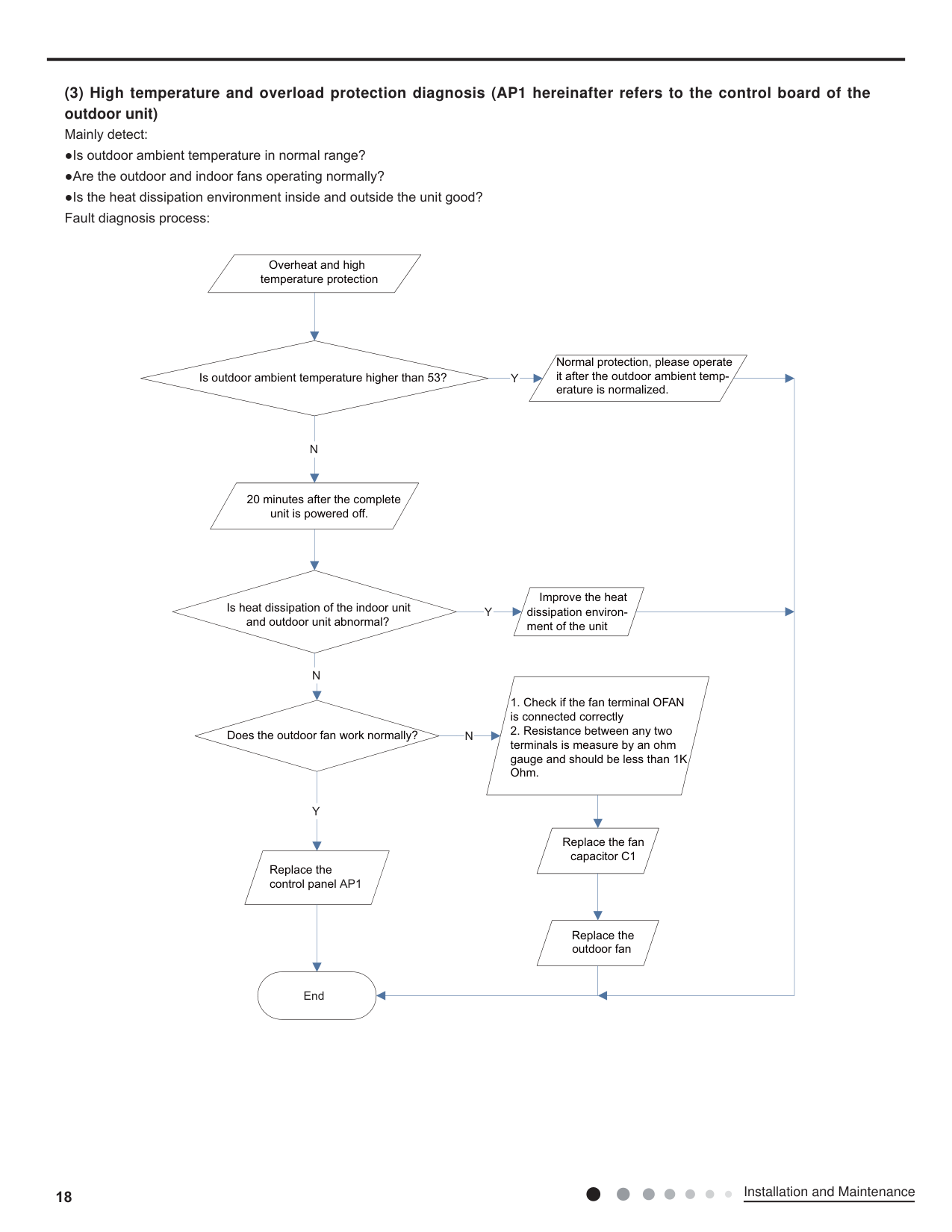
    ############# (3) High temperature and overload protection diagnosis (AP1 hereinafter refers to the control board of theoutdoor unit)

    Overheat and high temperature protection

    Is outdoor ambient temperature higher than 53?

    Y

    Normal protection, please operate it after the outdoor ambient temperature is normalized.

    N

    20 minutes after the complete unit is powered off.

    Is heat dissipation of the indoor unit and outdoor unit abnormal?

    Improve the heat dissipation environment of the unit

    Y

    N
  • 1. Check if the fan terminal OFAN is connected correctly
  • 2. Resistance between any two terminals is measure by an ohm gauge and should be less than 1K Ohm.
  • Page 28

    Does the outdoor fan work normally?

    N

    Y

    Replace the fan capacitor C1

    Replace the control panel AP1

    Replace the outdoor fan

    End

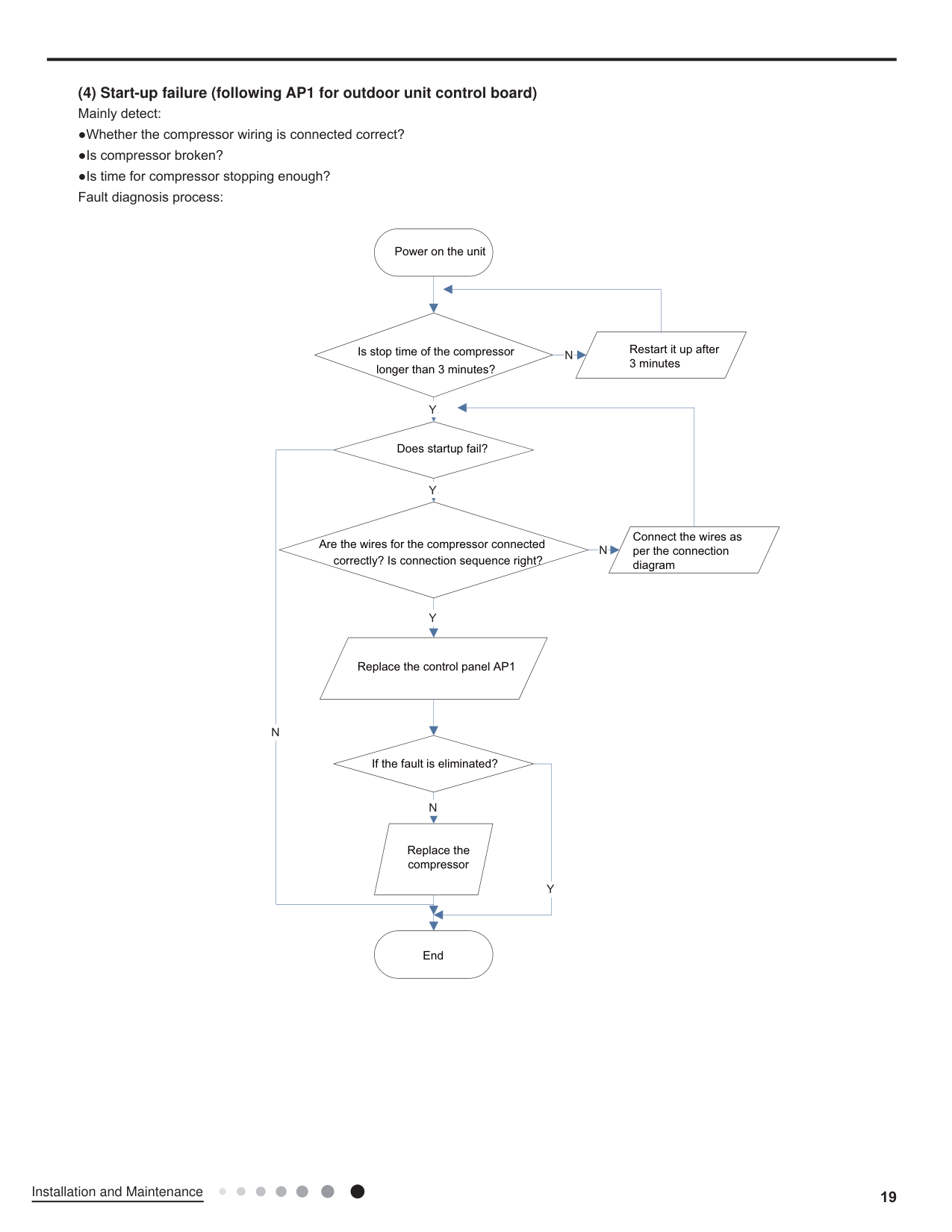
    ############# (4) Start-up failure (following AP1 for outdoor unit control board)

    Power on the unit

    Restart it up after 3 minutes

    Is stop time of the compressor longer than 3 minutes?

    N

    Y

    Does startup fail?

    Y

    Connect the wires as per the connection diagram

    Are the wires for the compressor connected correctly? Is connection sequence right?

    N

    Y

    Replace the control panel AP1

    N

    If the fault is eliminated?

    N
    Page 29

    Replace the compressor

    Y

    End

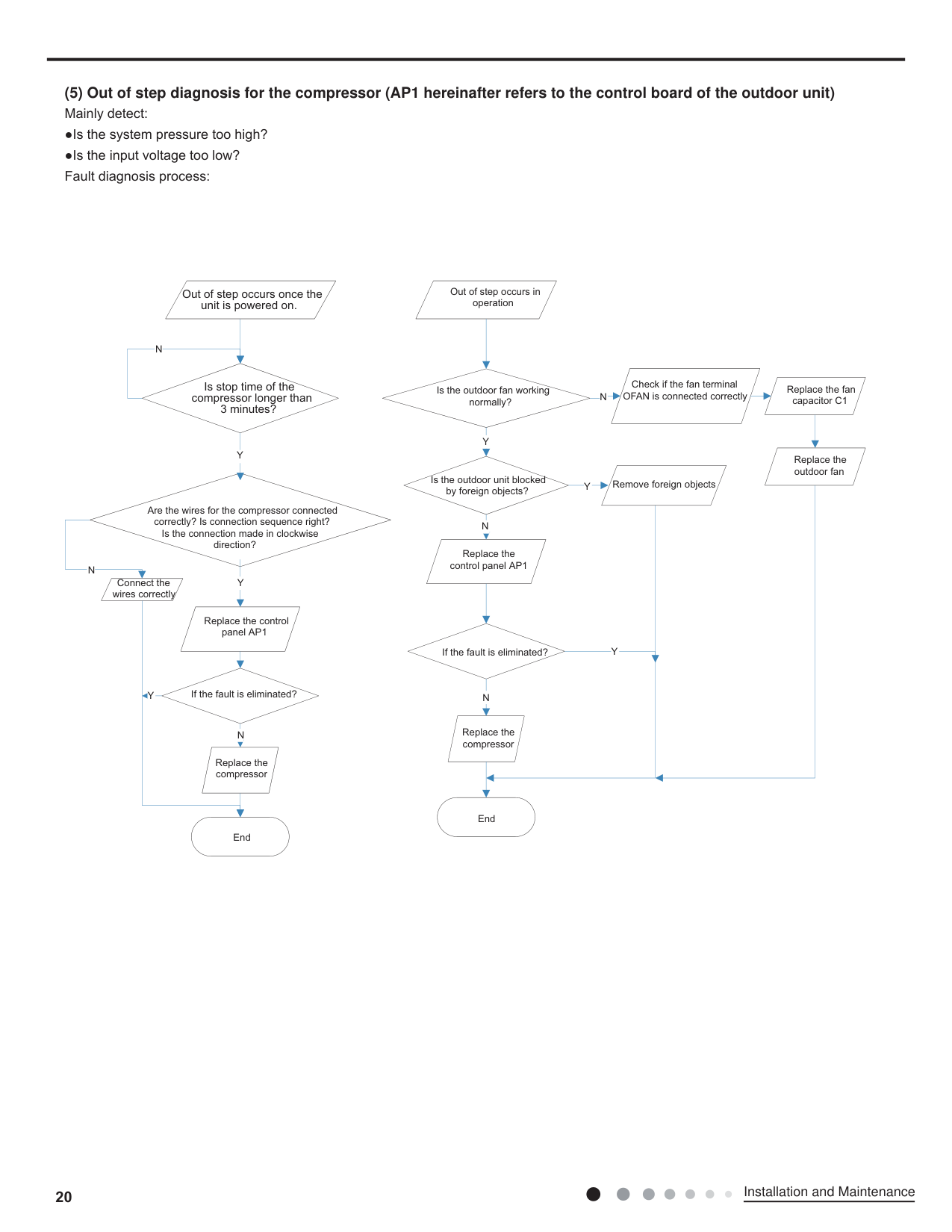
    ############# (5) Out of step diagnosis for the compressor (AP1 hereinafter refers to the control board of the outdoor unit)

    Out of step occurs once the unit is powered on.

    N

    Is stop time of the compressor longer than 3 minutes?

    Y

    N

    Are the wires for the compressor connected correctly? Is connection sequence right? Is the connection made in clockwise

    direction?

    Connect the wires correctly

    Y

    Replace the control panel AP1

    Y

    If the fault is eliminated?

    N

    Replace the compressor

    End

    Out of step occurs in operation

    Is the outdoor fan working normally?

    Y

    Is the outdoor unit blocked by foreign objects?
    Page 30

    N

    Replace the control panel AP1

    N

    Check if the fan terminal OFAN is connected correctly

    Y

    Remove foreign objects

    Replace the fan capacitor C1

    Replace the outdoor fan

    If the fault is eliminated?

    N

    Replace the compressor

    End

    Y

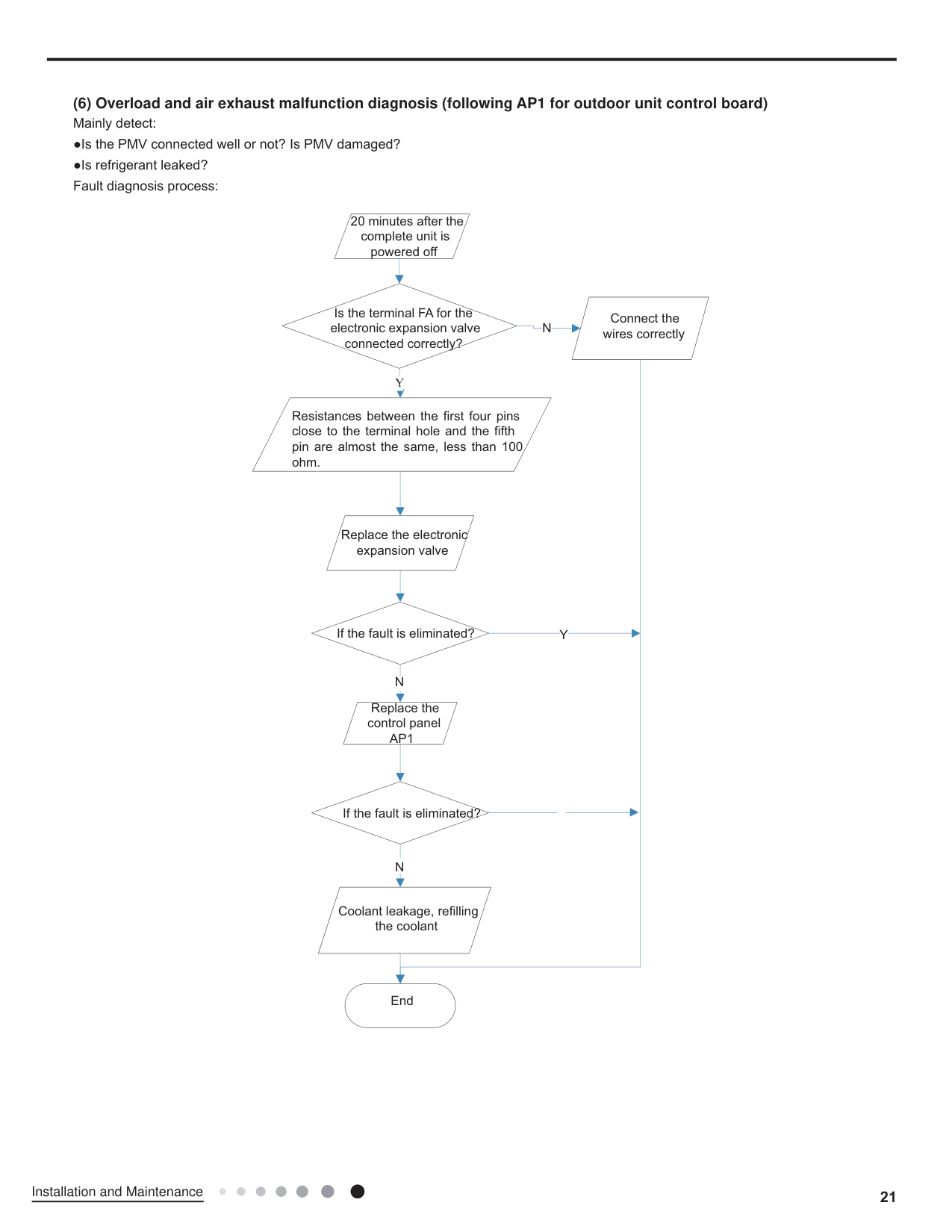
    ############# (6) Overload and air exhaust malfunction diagnosis (following AP1 for outdoor unit control board)

    20 minutes after the complete unit is powered off

    Is the terminal FA for the electronic expansion valve connected correctly?

    N

    ![image 37](lit_2012012182_20-_20iom_20p_20series_209k-12k__20220v_images/imageFile37.png)

    Resistances between the first four pins close to the terminal hole and the fifth pin are almost the same, less than 100 ohm.

    Connect the wires correctly

    Replace the electronic expansion valve

    If the fault is eliminated?

    N
    Page 31

    Replace the

    control panel AP1

    If the fault is eliminated?

    N

    Coolant leakage, refilling the coolant

    End

    Y

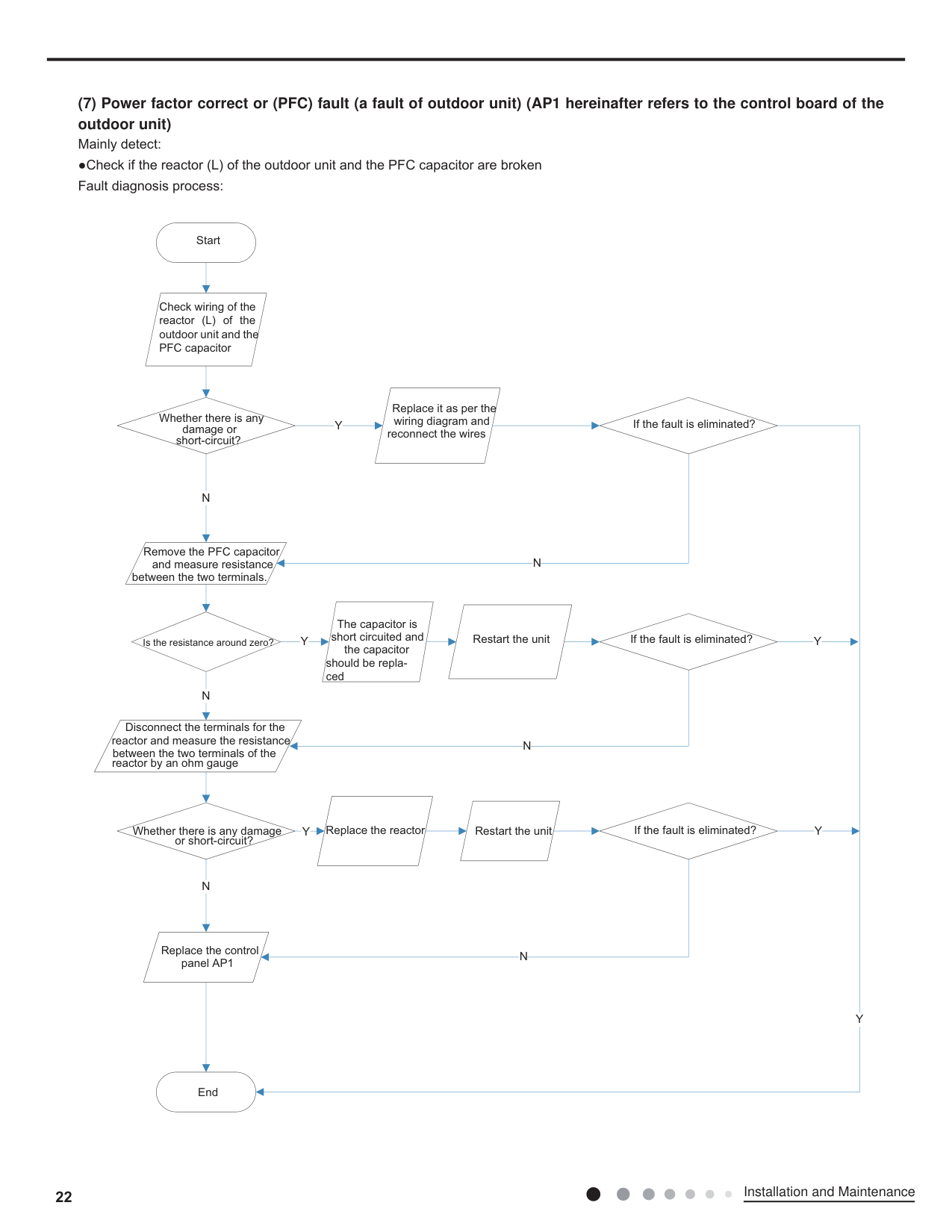
    ############# (7) Power factor correct or (PFC) fault (a fault of outdoor unit) (AP1 hereinafter refers to the control board of theoutdoor unit)

    Start

    Check wiring of the reactor (L) of the outdoor unit and the PFC capacitor

    Replace it as per the wiring diagram and

    Whether there is any damage or short-circuit?

    If the fault is eliminated?

    Y

    reconnect the wires

    N

    Remove the PFC capacitor and measure resistance between the two terminals.

    N

    The capacitor is short circuited and the capacitor should be replaced

    Restart the unit If the fault is eliminated?

    Y

    Is the resistance around zero?

    N
    Page 32

    Disconnect the terminals for the reactor and measure the resistance between the two terminals of the reactor by an ohm gauge

    N

    Replace the reactor Restart the unit If the fault is eliminated?

    Whether there is any damage or short-circuit?

    ################## Y

    N

    Replace the control panel AP1

    N

    Y

    Y

    Y

    End

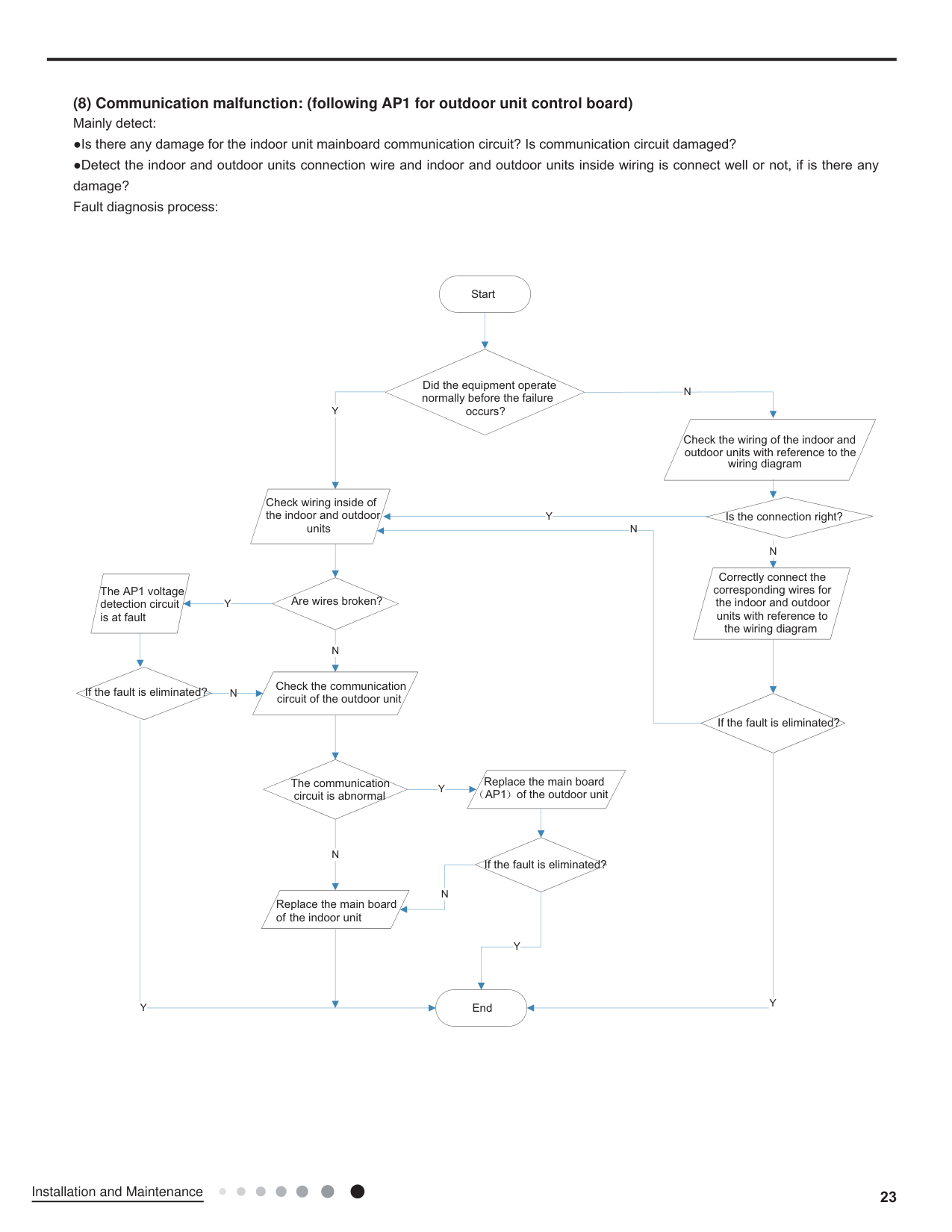
    ############# (8) Communication malfunction: (following AP1 for outdoor unit control board)

    Start

    Y

    Did the equipment operate normally before the failure occurs?

    N

    Check the wiring of the indoor and outdoor units with reference to the

    wiring diagram

    Check wiring inside of the indoor and outdoor

    Is the connection right?

    Y

    units
    Page 33

    N

    N

    Correctly connect the corresponding wires for the indoor and outdoor units with reference to the wiring diagram

    The AP1 voltage detection circuit is at fault

    Are wires broken?

    Y

    N

    Check the communication circuit of the outdoor unit

    If the fault is eliminated?

    N

    If the fault is eliminated?

    Y

    Replace the main board

    The communication circuit is abnormal

    Y

    AP1 of the outdoor unit

    N

    If the fault is eliminated?

    N

    Replace the main board of the indoor unit

    Y

    Y

    End
    Page 34

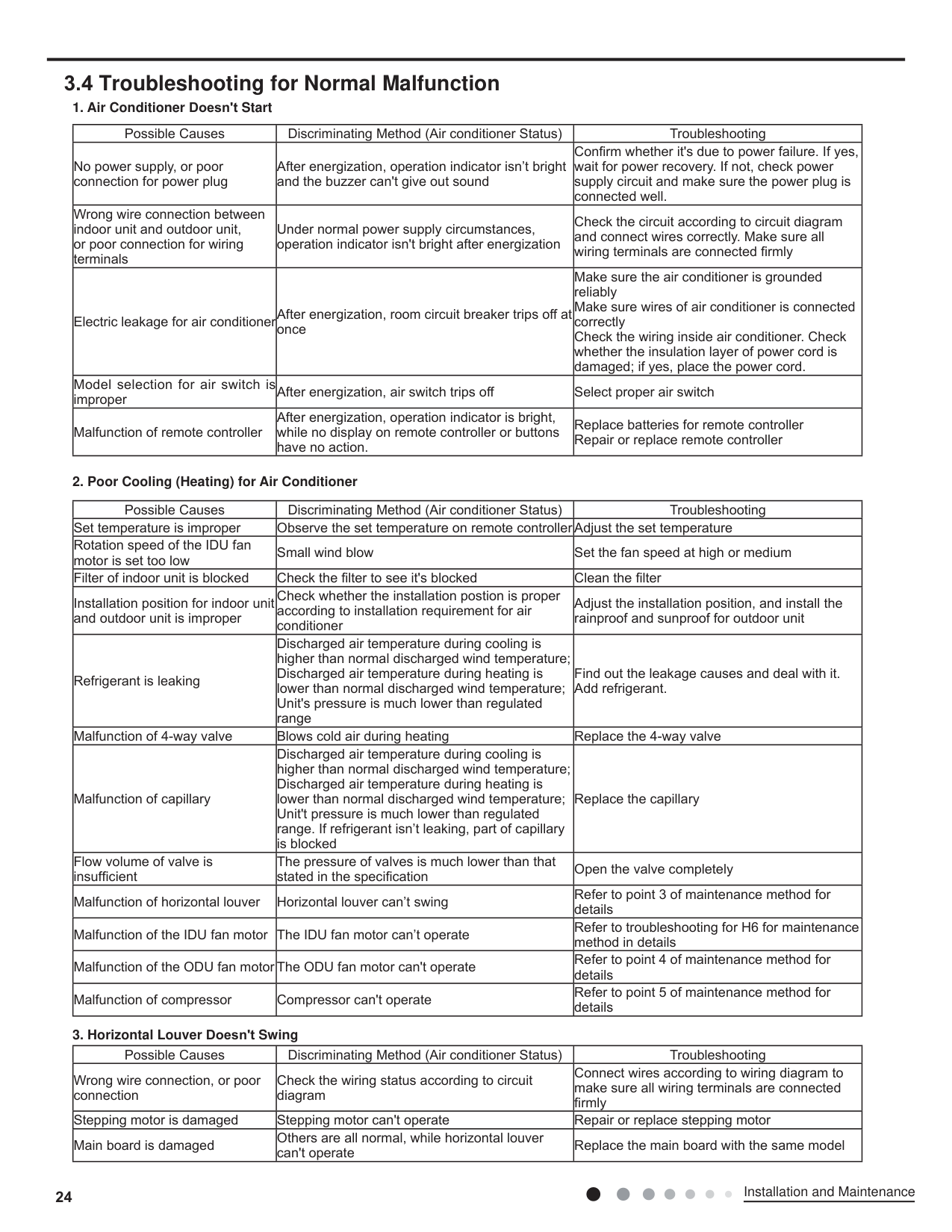
    ####### 3.4 Troubleshooting for Normal Malfunction

  • 1. Air Conditioner Doesn't Start
  • 2. Poor Cooling (Heating) for Air Conditioner
  • 3. Horizontal Louver Doesn't Swing
  • | | | | |---|---|---| | | | | | | | | | | | | | | | | | | | |

    | | | | |---|---|---| | | | | | | | | | | | | | | | | | | | | | |s air| | | | | | | | | | | | | | | | | | | | | | | | | |
    | | | | |---|---|---| | | | | | | | | | | | |

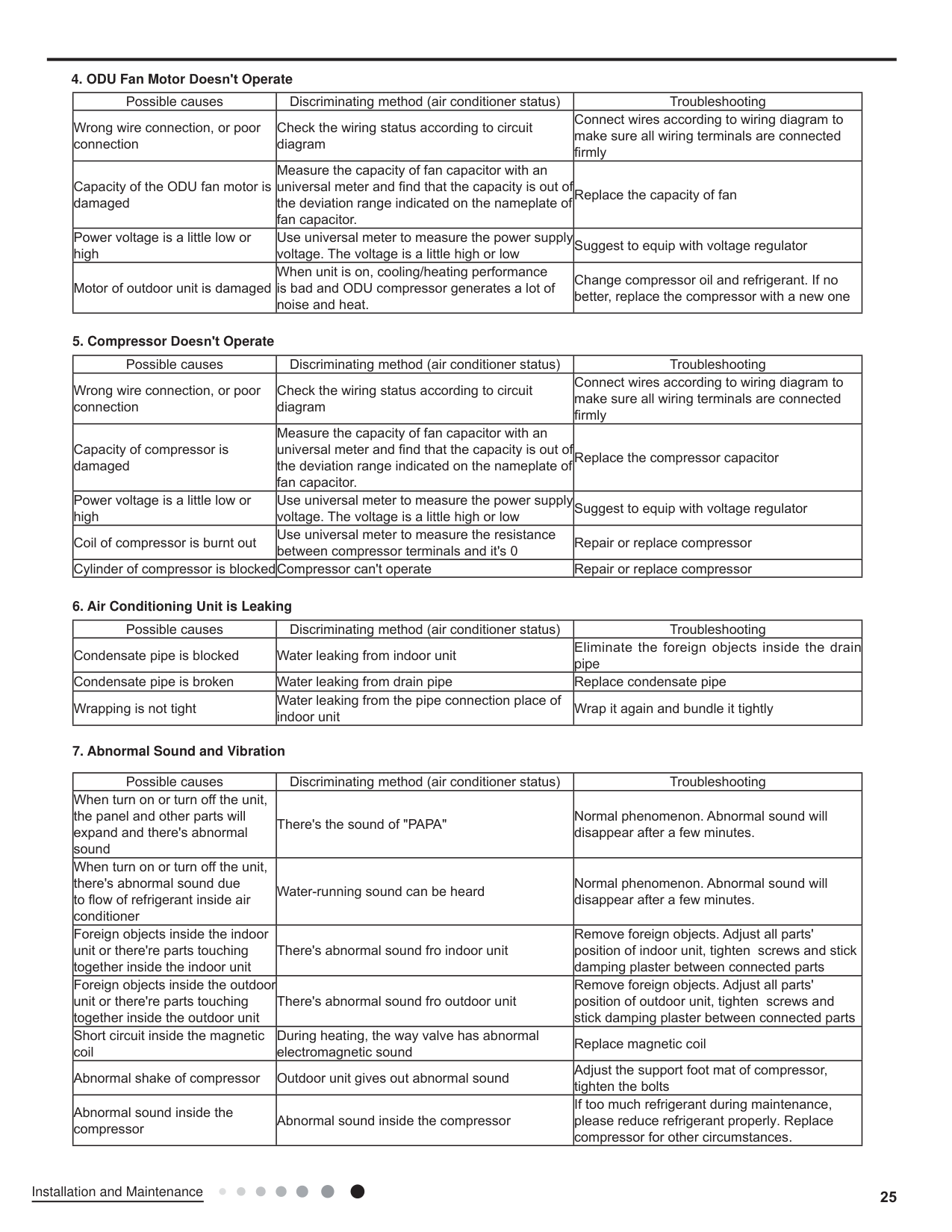
  • 4. ODU Fan Motor Doesn't Operate
  • | | | | |---|---|---| | | | |

    Page 35

    | | | | | | | | | | | |

  • Compressor Doesn't Operate
  • | | | | |---|---|---| | | | | | | | | | | | | | | | | | | | |

  • Air Conditioning Unit is Leaking
  • | | | | |---|---|---| |Condensate| |pipe| |Condensate| |condensate| | | | |

  • Abnormal Sound and Vibration
  • | | | | |---|---|---| | | | | | | | | | | | | | | | | | | | | | | | | | | | |

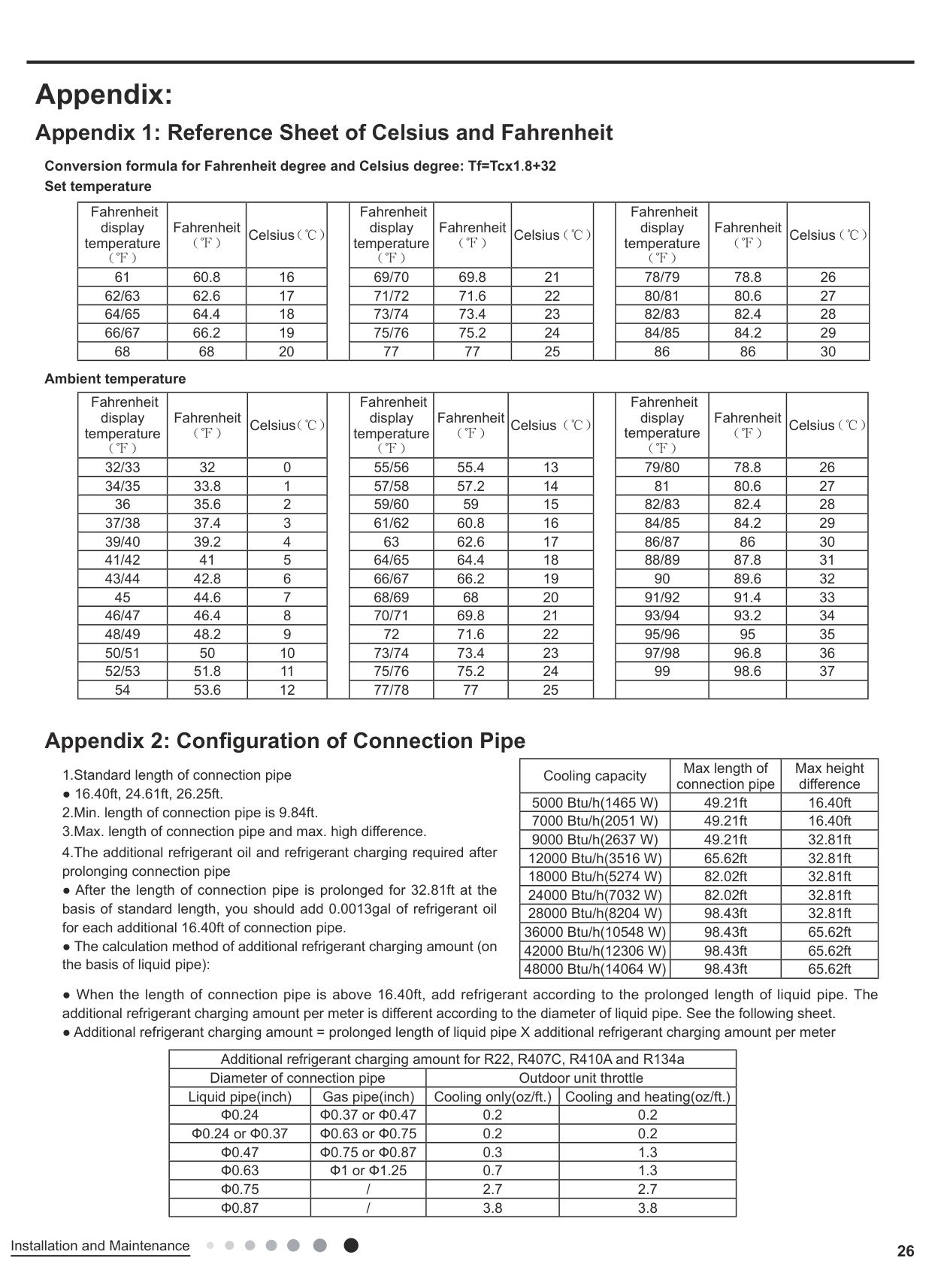
    Appendix:

  • Appendix 1: Reference Sheet of Celsius and Fahrenheit
  • Appendix 2: Configuration of Connection Pipe
  • Conversion formula for Fahrenheit degree and Celsius degree: Tf=Tcx1.8+32
    Page 36

    Set temperature

    |Fahrenheit display temperature (℉)|Fahrenheit (℉)|Celsius(℃| |Fahrenheit display temperature (℉)|Fahrenheit (℉)|Celsius(℃| |Fahrenheit display temperature (℉)|Fahrenheit (℉)|Celsius(℃)| |---|---|---|---|---|---|---|---|---|---|---| |61|60.8|16| |69/70|69.8|21| |78/79|78.8|26| |62/63|62.6|17| |71/72|71.6|22| |80/81|80.6|27| |64/65|64.4|18| |73/74|73.4|23| |82/83|82.4|28| |66/67|66.2|19| |75/76|75.2|24| |84/85|84.2|29| |68|68|20| |77|77|25| |86|86|30|

    Ambient temperature

    |Fahrenheit display temperature (℉)|Fahrenheit (℉)|Celsius(℃| |Fahrenheit display temperature (℉)|Fahrenheit (℉)|Celsius(℃| |Fahrenheit display temperature (℉)|Fahrenheit (℉)|Celsius(℃)| |---|---|---|---|---|---|---|---|---|---|---| |32/33|32|0| |55/56|55.4|13| |79/80|78.8|26| |34/35|33.8|1| |57/58|57.2|14| |81|80.6|27| |36|35.6|2| |59/60|59|15| |82/83|82.4|28| |37/38|37.4|3| |61/62|60.8|16| |84/85|84.2|29| |39/40|39.2|4| |63|62.6|17| |86/87|86|30| |41/42|41|5| |64/65|64.4|18| |88/89|87.8|31| |43/44|42.8|6| |66/67|66.2|19| |90|89.6|32| |45|44.6|7| |68/69|68|20| |91/92|91.4|33| |46/47|46.4|8| |70/71|69.8|21| |93/94|93.2|34| |48/49|48.2|9| |72|71.6|22| |95/96|95|35| |50/51|50|10| |73/74|73.4|23| |97/98|96.8|36| |52/53|51.8|11| |75/76|75.2|24| |99|98.6|37| |54|53.6|12| |77/78|77|25| | | | |

    |Cooling capacity|Max length of connection pipe|Max height difference| |---|---|---| |5000 Btu/h(1465 W)|49.21ft|16.40ft| |7000 Btu/h(2051 W)|49.21ft|16.40ft| |9000 Btu/h(2637 W)|49.21ft|32.81ft| |12000 Btu/h(3516 W)|65.62ft|32.81ft| |18000 Btu/h(5274 W)|82.02ft|32.81ft| |24000 Btu/h(7032 W)|82.02ft|32.81ft| |28000 Btu/h(8204 W)|98.43ft|32.81ft| |36000 Btu/h(10548 W)|98.43ft|65.62ft| |42000 Btu/h(12306 W)|98.43ft|65.62ft| |48000 Btu/h(14064 W)|98.43ft|65.62ft|
  • 1.Standard length of connection pipe
  • Page 37

    ● 16.40ft, 24.61ft, 26.25ft.

  • 2.Min. length of connection pipe is 9.84ft.
  • 3.Max. length of connection pipe and max. high difference.
  • 4.The additional refrigerant oil and refrigerant charging required after prolonging connection pipe
  • ● After the length of connection pipe is prolonged for 32.81ft at the basis of standard length, you should add 0.0013gal of refrigerant oil for each additional 16.40ft of connection pipe.
  • ● The calculation method of additional refrigerant charging amount (on the basis of liquid pipe):
  • ● When the length of connection pipe is above 16.40ft, add refrigerant according to the prolonged length of liquid pipe. The additional refrigerant charging amount per meter is different according to the diameter of liquid pipe. See the following sheet.
  • ● Additional refrigerant charging amount = prolonged length of liquid pipe X additional refrigerant charging amount per meter
  • |Additional refrigerant charging amount for R22, R407C, R410A and R134a|Additional refrigerant charging amount for R22, R407C, R410A and R134a|Additional refrigerant charging amount for R22, R407C, R410A and R134a|Additional refrigerant charging amount for R22, R407C, R410A and R134a| |---|---|---|---| |Diameter of connection pipe|Diameter of connection pipe|Outdoor unit throttle|Outdoor unit throttle| |Liquid pipe(inch)|Gas pipe(inch)|Cooling only(oz/ft.)|Cooling and heating(oz/ft.)| |Ф0.24|Ф0.37 or Ф0.47|0.2|0.2| |Ф0.24 or Ф0.37|Ф0.63 or Ф0.75|0.2|0.2| |Ф0.47|Ф0.75 or Ф0.87|0.3|1.3| |Ф0.63|Ф1 or Ф1.25|0.7|1.3| |Ф0.75|/|2.7|2.7| |Ф0.87|/|3.8|3.8|

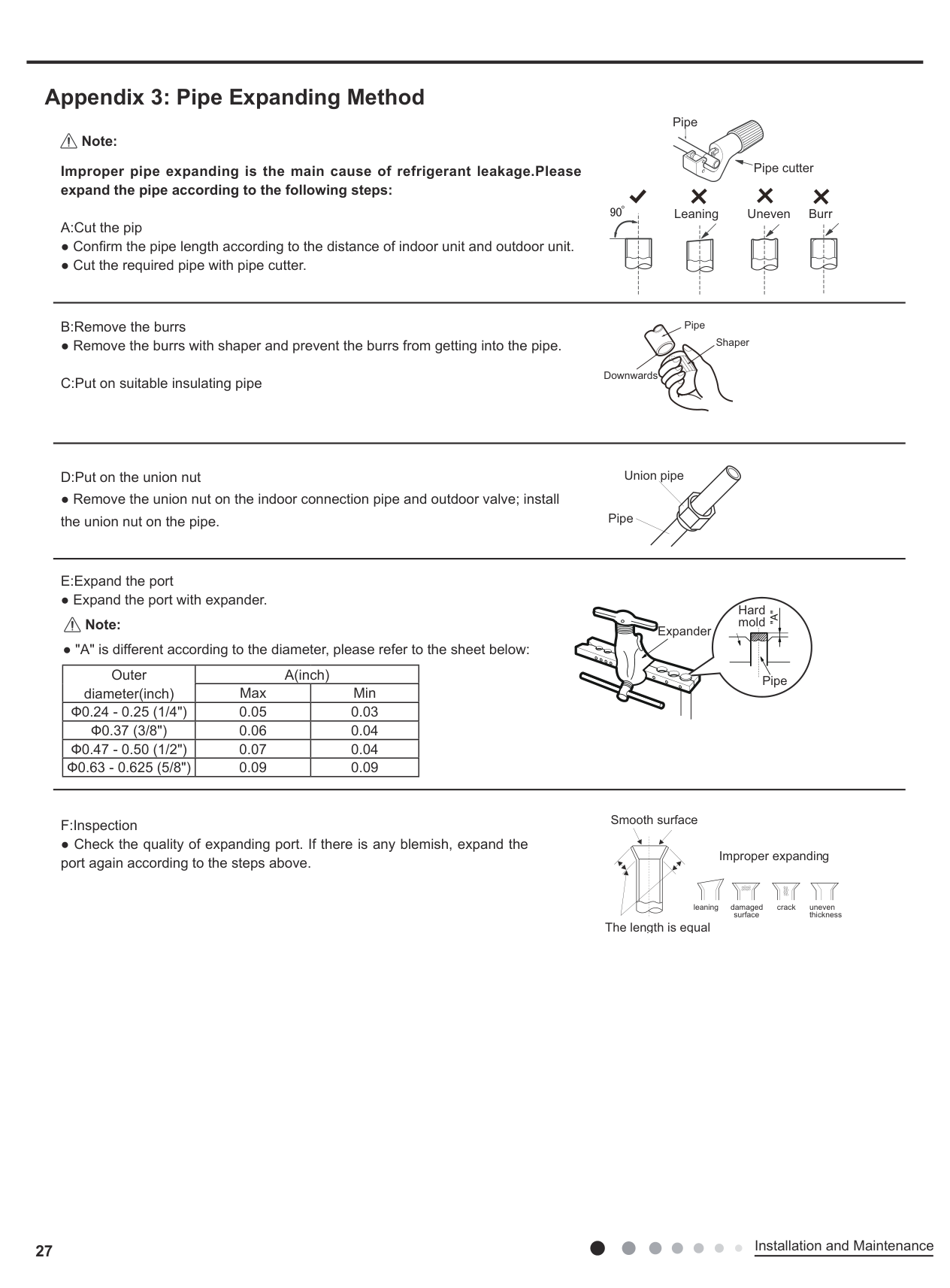
    ##### Appendix 3: Pipe Expanding Method

    Pipe

    Note:

    Pipe cutter

    ############## Improper pipe expanding is the main cause of refrigerant leakage.Please expand the pipe according to the following steps:

    Leaning Uneven Burr
  • A:Cut the pip
  • ● Confirm the pipe length according to the distance of indoor unit and outdoor unit.
  • ● Cut the required pipe with pipe cutter.
  • B:Remove the burrs
  • Page 38

    ● Remove the burrs with shaper and prevent the burrs from getting into the pipe.

  • C:Put on suitable insulating pipe
  • D:Put on the union nut
  • ● Remove the union nut on the indoor connection pipe and outdoor valve; install the union nut on the pipe.

  • E:Expand the port
  • | | | |---|---| | | |

    Pipe

    Shaper

    Downwards

    Union pipe

    Pipe

  • ● Expand the port with expander.
  • ● "A" is different according to the diameter, please refer to the sheet below:
  • Hard mold

    Note:

    Expander

    |Outer diameter(inch)|A(inch)|A(inch)| |---|---|---| |Outer diameter(inch)|Max|Min| |Ф0.24 - 0.25 (1/4")|0.05|0.03| |Ф0.37 (3/8")|0.06|0.04| |Ф0.47 - 0.50 (1/2")|0.07|0.04| |Ф0.63 - 0.625 (5/8")|0.09|0.09|

    Pipe
    Page 39

  • F:Inspection
  • ● Check the quality of expanding port. If there is any blemish, expand the port again according to the steps above.
  • Smooth surface

    Improper expanding

    leaning damaged surface

    crack uneven thickness

    The length is equal

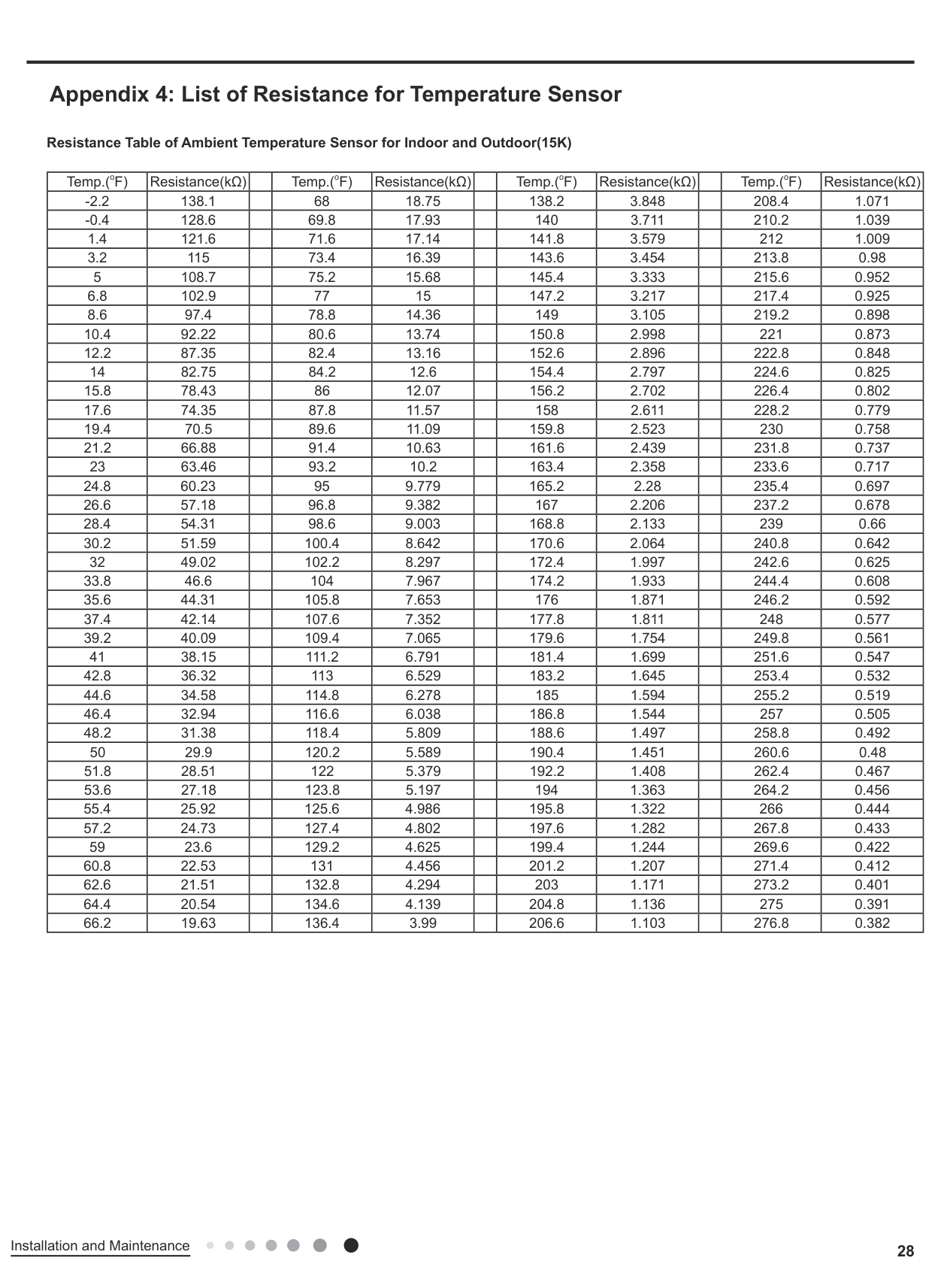
    ##### Appendix 4: List of Resistance for Temperature Sensor

    Resistance Table of Ambient Temperature Sensor for Indoor and Outdoor(15K)

    |Temp.(oF)|Resistance(kΩ)| |Temp.(oF)|Resistance(kΩ)| |Temp.(oF)|Resistance(kΩ)| |Temp.(oF)|Resistance(kΩ)| |---|---|---|---|---|---|---|---|---|---|---| |-2.2|138.1| |68|18.75| |138.2|3.848| |208.4|1.071| |-0.4|128.6| |69.8|17.93| |140|3.711| |210.2|1.039| |1.4|121.6| |71.6|17.14| |141.8|3.579| |212|1.009| |3.2|115| |73.4|16.39| |143.6|3.454| |213.8|0.98| |5|108.7| |75.2|15.68| |145.4|3.333| |215.6|0.952| |6.8|102.9| |77|15| |147.2|3.217| |217.4|0.925| |8.6|97.4| |78.8|14.36| |149|3.105| |219.2|0.898| |10.4|92.22| |80.6|13.74| |150.8|2.998| |221|0.873| |12.2|87.35| |82.4|13.16| |152.6|2.896| |222.8|0.848| |14|82.75| |84.2|12.6| |154.4|2.797| |224.6|0.825| |15.8|78.43| |86|12.07| |156.2|2.702| |226.4|0.802| |17.6|74.35| |87.8|11.57| |158|2.611| |228.2|0.779| |19.4|70.5| |89.6|11.09| |159.8|2.523| |230|0.758| |21.2|66.88| |91.4|10.63| |161.6|2.439| |231.8|0.737| |23|63.46| |93.2|10.2| |163.4|2.358| |233.6|0.717| |24.8|60.23| |95|9.779| |165.2|2.28| |235.4|0.697| |26.6|57.18| |96.8|9.382| |167|2.206| |237.2|0.678| |28.4|54.31| |98.6|9.003| |168.8|2.133| |239|0.66| |30.2|51.59| |100.4|8.642| |170.6|2.064| |240.8|0.642| |32|49.02| |102.2|8.297| |172.4|1.997| |242.6|0.625| |33.8|46.6| |104|7.967| |174.2|1.933| |244.4|0.608| |35.6|44.31| |105.8|7.653| |176|1.871| |246.2|0.592| |37.4|42.14| |107.6|7.352| |177.8|1.811| |248|0.577| |39.2|40.09| |109.4|7.065| |179.6|1.754| |249.8|0.561| |41|38.15| |111.2|6.791| |181.4|1.699| |251.6|0.547|

    Page 40

    |42.8|36.32| |113|6.529| |183.2|1.645| |253.4|0.532| |44.6|34.58| |114.8|6.278| |185|1.594| |255.2|0.519| |46.4|32.94| |116.6|6.038| |186.8|1.544| |257|0.505| |48.2|31.38| |118.4|5.809| |188.6|1.497| |258.8|0.492| |50|29.9| |120.2|5.589| |190.4|1.451| |260.6|0.48| |51.8|28.51| |122|5.379| |192.2|1.408| |262.4|0.467| |53.6|27.18| |123.8|5.197| |194|1.363| |264.2|0.456| |55.4|25.92| |125.6|4.986| |195.8|1.322| |266|0.444| |57.2|24.73| |127.4|4.802| |197.6|1.282| |267.8|0.433| |59|23.6| |129.2|4.625| |199.4|1.244| |269.6|0.422| |60.8|22.53| |131|4.456| |201.2|1.207| |271.4|0.412| |62.6|21.51| |132.8|4.294| |203|1.171| |273.2|0.401| |64.4|20.54| |134.6|4.139| |204.8|1.136| |275|0.391| |66.2|19.63| |136.4|3.99| |206.6|1.103| |276.8|0.382|

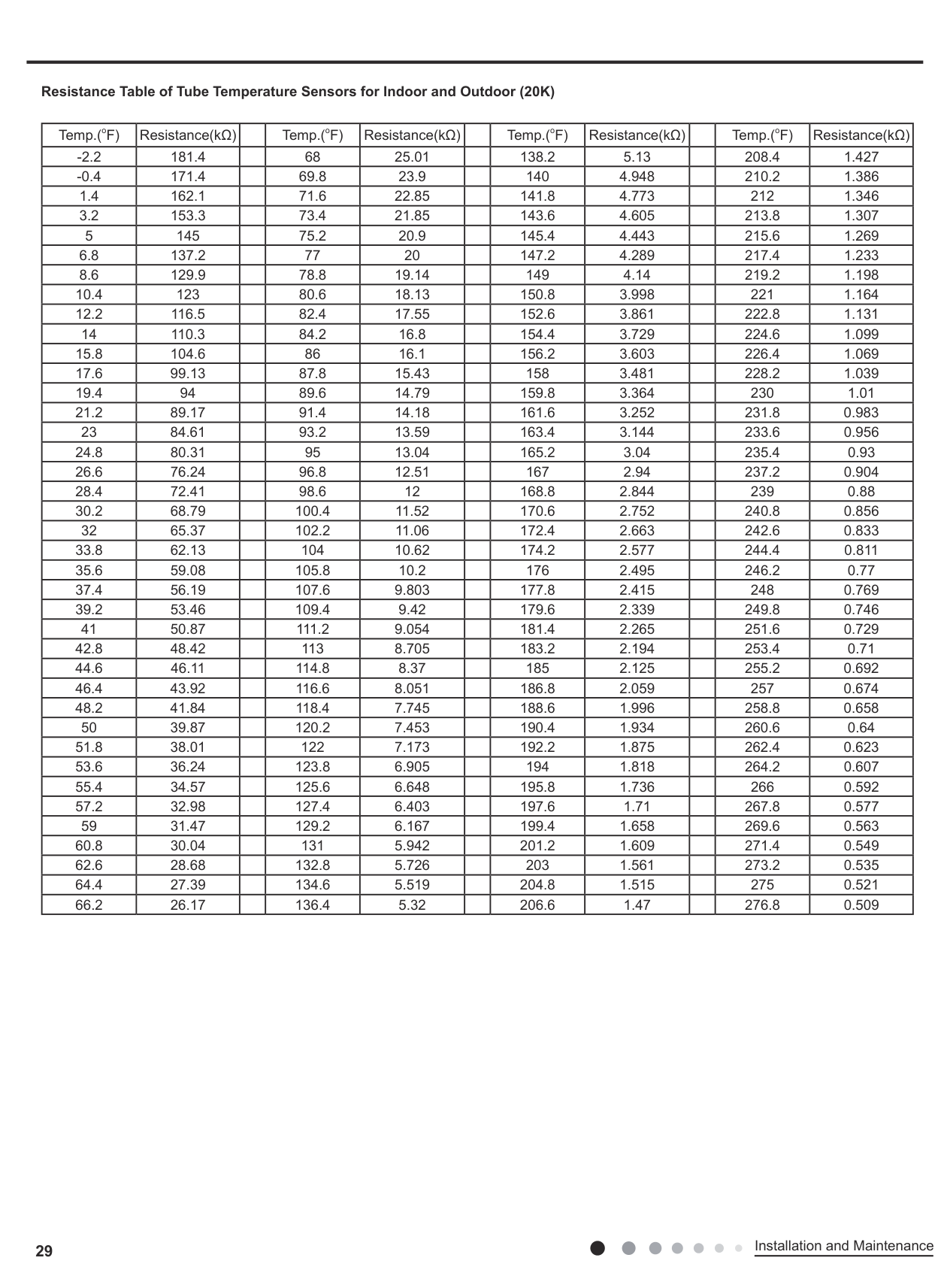
    ############## Resistance Table of Tube Temperature Sensors for Indoor and Outdoor (20K)

    |Temp.(oF)|Resistance(kΩ)| |Temp.(oF)|Resistance(kΩ)| |Temp.(oF)|Resistance(kΩ)| |Temp.(oF)|Resistance(kΩ)| |---|---|---|---|---|---|---|---|---|---|---| |-2.2|181.4| |68|25.01| |138.2|5.13| |208.4|1.427| |-0.4|171.4| |69.8|23.9| |140|4.948| |210.2|1.386| |1.4|162.1| |71.6|22.85| |141.8|4.773| |212|1.346| |3.2|153.3| |73.4|21.85| |143.6|4.605| |213.8|1.307| |5|145| |75.2|20.9| |145.4|4.443| |215.6|1.269| |6.8|137.2| |77|20| |147.2|4.289| |217.4|1.233| |8.6|129.9| |78.8|19.14| |149|4.14| |219.2|1.198| |10.4|123| |80.6|18.13| |150.8|3.998| |221|1.164| |12.2|116.5| |82.4|17.55| |152.6|3.861| |222.8|1.131| |14|110.3| |84.2|16.8| |154.4|3.729| |224.6|1.099| |15.8|104.6| |86|16.1| |156.2|3.603| |226.4|1.069| |17.6|99.13| |87.8|15.43| |158|3.481| |228.2|1.039| |19.4|94| |89.6|14.79| |159.8|3.364| |230|1.01| |21.2|89.17| |91.4|14.18| |161.6|3.252| |231.8|0.983| |23|84.61| |93.2|13.59| |163.4|3.144| |233.6|0.956| |24.8|80.31| |95|13.04| |165.2|3.04| |235.4|0.93| |26.6|76.24| |96.8|12.51| |167|2.94| |237.2|0.904| |28.4|72.41| |98.6|12| |168.8|2.844| |239|0.88| |30.2|68.79| |100.4|11.52| |170.6|2.752| |240.8|0.856| |32|65.37| |102.2|11.06| |172.4|2.663| |242.6|0.833| |33.8|62.13| |104|10.62| |174.2|2.577| |244.4|0.811| |35.6|59.08| |105.8|10.2| |176|2.495| |246.2|0.77| |37.4|56.19| |107.6|9.803| |177.8|2.415| |248|0.769| |39.2|53.46| |109.4|9.42| |179.6|2.339| |249.8|0.746| |41|50.87| |111.2|9.054| |181.4|2.265| |251.6|0.729| |42.8|48.42| |113|8.705| |183.2|2.194| |253.4|0.71| |44.6|46.11| |114.8|8.37| |185|2.125| |255.2|0.692| |46.4|43.92| |116.6|8.051| |186.8|2.059| |257|0.674| |48.2|41.84| |118.4|7.745| |188.6|1.996| |258.8|0.658| |50|39.87| |120.2|7.453| |190.4|1.934| |260.6|0.64| |51.8|38.01| |122|7.173| |192.2|1.875| |262.4|0.623| |53.6|36.24| |123.8|6.905| |194|1.818| |264.2|0.607| |55.4|34.57| |125.6|6.648| |195.8|1.736| |266|0.592| |57.2|32.98| |127.4|6.403| |197.6|1.71| |267.8|0.577| |59|31.47| |129.2|6.167| |199.4|1.658| |269.6|0.563| |60.8|30.04| |131|5.942| |201.2|1.609| |271.4|0.549| |62.6|28.68| |132.8|5.726| |203|1.561| |273.2|0.535| |64.4|27.39| |134.6|5.519| |204.8|1.515| |275|0.521| |66.2|26.17| |136.4|5.32| |206.6|1.47| |276.8|0.509|

    ######### Support Contact Information

    | |Email| |---|---| |Technical Support Support during installation, commissioning,

    service, and troubleshooting|[email protected]| |Customer ServiceAssistance ordering equipment, parts, and accessories

    |[email protected]| |Warranty Assistance with warranty registration, warrantyclaims, etc.

    |[email protected]| |Application and Design

    Pre-sale assistance with equipment applications and design support, as well as use of Selection Tool|[email protected]|

    For all functions mentioned above, please call: 1(844) 873-4445

    30

    Product improvement, specifications and appearance in this manual are subject to change without prior notice.

    ######## © Johnson Controls, Inc. USA LIT - 12012182

    Similar Unknown