
Ask AI
— answers from the official manualAnswers from the official manual.
Common questions
Common Questions
20 totalHow do I disinfect the lift strap?
Disinfect the lift strap with Virox Accel TB RTU (consult a local representative for other solutions). Do not use products containing chlorine, as this may damage the material.
How do I charge the C-450/C-625 lift?
The C-450/C-625 can be charged using the End-Point Charging or Constant Charging method. For End-Point Charging, move the lift to one end of the track with a charging point and connect it there. For Constant Charging, charging strips run along the rail, allowing charging at any place on the rail.
What happens when the battery is low?
When battery power drops below 25%, the lift goes into Low Battery Mode. The indicator light turns orange, an audible alarm sounds every 10 seconds, and "Low Batt!" appears on the LCD display. A completely discharged battery will turn the indicator red.
How do I perform a monthly inspection?
Monthly inspections include visually checking: lift strap for damage or wear, stitching where it connects to the carry bar, that slings show no unusual wear, hand controller cable has no issues, all functions work properly on the hand control, and verifying there are no cuts/dents/sharp edges on the carry bar.
What maintenance is required every six months?
Semi-annual inspections include checking emergency stopping/lowering functions, inspecting the carry bar for damage, verifying the lift moves freely along the track, and performing a function test of all controls. Additionally, ensure the battery lights indicate proper charge levels.
How do I perform an emergency stop?
To perform an emergency stop, pull down on the red emergency lowering cord located under the lift unit until it clicks into place. The indicator and display will shut off, and all output functions will disable.
Show 14 more questions
What are battery specifications?
How do I manually lower the lift if automatic lowering fails?
How do I reset the preventive maintenance counter?
How do I install endstops?
What is the Safe Working Load (SWL) for the C-450?
Who is authorized to install the C-450/C-625 lift system?
How long should the lift be charged before initial use?
Can the charger be located near the patient during use?
What is the recommended service lifespan for the C-450/C-625 lift?
Who is permitted to perform service on the C-450/C-625 lift?
Is the C-450/C-625 hand control waterproof?
What should be checked before each use of the C-450/C-625?
Can the charger remain connected to the lift indefinitely?
What should be done to prepare the area before performing a transfer with the C-450/C-625?
Full Manual
26 pages
C-450
C-625
User manual – English SWL: 450 lb / 204 kg SWL: 625 lb / 284 kg Manual: C450/C625 - 2nd edition - Rev 052019
2 Cautions • The C-450/C-625 must be installed only by persons authorized by Vancare, Inc.. The installation guide is available to and for use by authorized dealers only. • Under no circumstance should the C-450/C-625 track, lift, sling, or the entire system be put in control of a person who has not been properly trained in the use and care of this equipment. Failure to adhere to this warning may result in serious injury to the operator, and/or the individual being lifted/transferred. • The C-450/C-625 lift, and associated track and slings are not toys. Do not use it for unsafe practices. Do not allow children to play with the lift or any of its components. • The manufacturer's warranty is void if persons unauthorized by Vancare perform work on the C-450/C-625 lift system. • Only an individual trained by Vancare shall perform service to the equipment. Refer to technical manuals and training documents for specific procedures. Improper or incorrect service may void any warranty. • In facilities where more than one operator will be responsible for using the C-450/C-625, associated track, and slings, it is imperative that all such individuals be trained in its proper use. A training program should be established by the facility to acquaint new operators with this equipment. Contact your local Vancare dealer or your local Vancare business distributor for training assistance. • Although the hand control is waterproof, the ceiling lift and the charger are not. Do not expose the C-450/C-625 lift directly to water. Warranty does not cover any misuse or abuse of the lift system. • To maintain optimum function, the C-450/C-625 should be inspected and maintained on a regular basis. See the section titled “General Inspection and Maintenance.” • Any accessories used with the C-450/C-625, including, but not limited to, track and slings, should be checked to ensure that they are in good working order. Check for signs of wear or fraying prior to each use. Report any unusual wear or damage immediately to your local Vancare dealer. • The C-450/C-625 and associated accessories, track, and slings are intended only for lifting, repositioning and transferring of a person. Vancare will not be responsible for any damage caused by the misuse, neglect or purposeful destruction of the lift, or its associated components. Do not attempt to modify or alter the C-450/C-625 lifts. • Do not in any circumstance exceed the maximum allowable load of this lift. Refer to the specifications section of this manual, or the labels on the lift. • The installation of the lift, track, accessories, and sling are certified to a maximum load. Do not exceed the maximum rated load of any of the components. • There is a risk of explosion if the lift is used in the presence of flammable anesthetics. • Ensure that a clear space is maintained around the lift and track. Move all curtain material and other obstacles out of the way before performing a transfer. • The charger must be located outside the patient vicinity at all times. The patient vicinity is the space with surfaces likely contacted by the patient or an attendant who can touch the patient. • C-450/C-625 lifts should be decommissioned/disposed of after 10 years of service in accordance with regional component specific disposal recommendations.
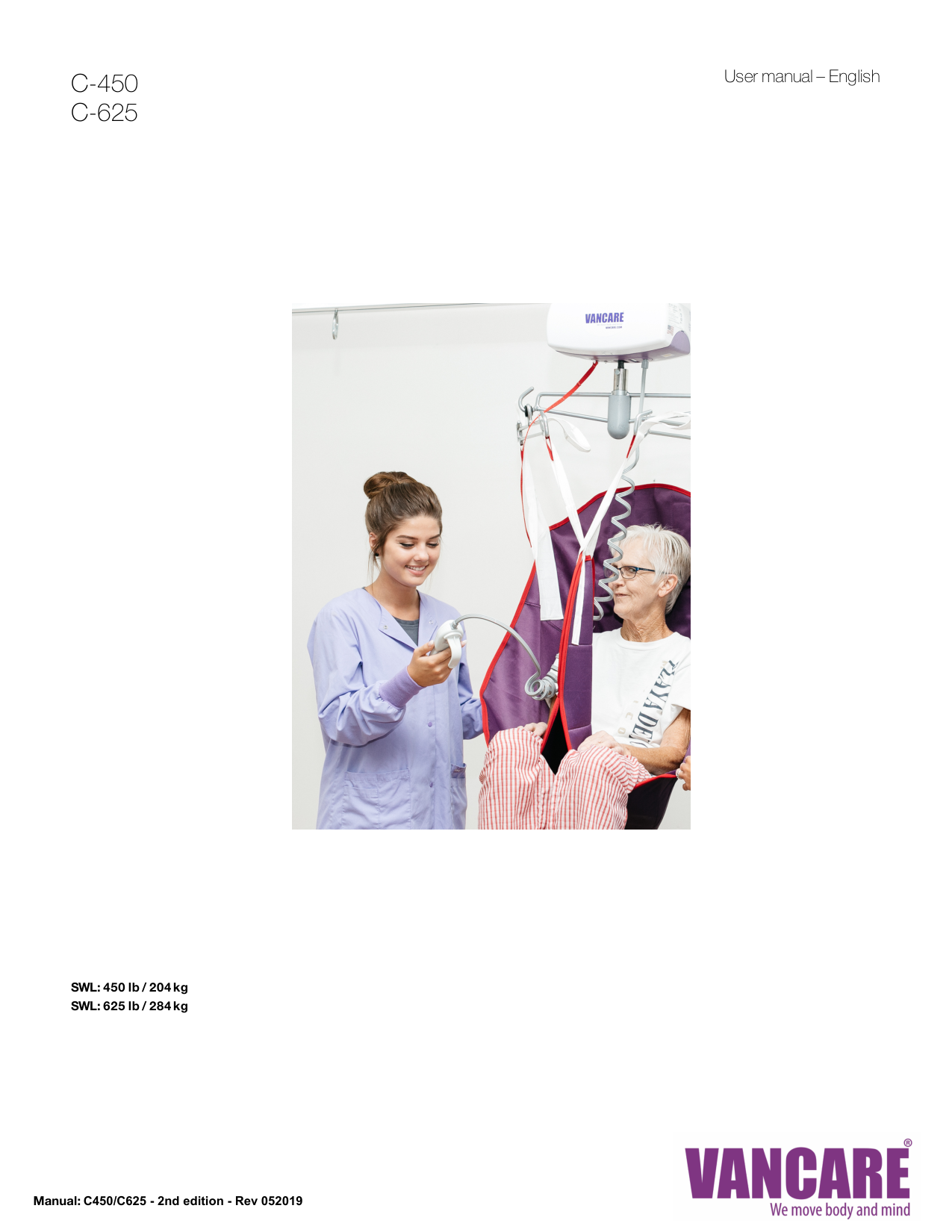
3 Use and Care Introduction To ensure safe operation of your C-450/C-625 lift, carefully read this entire manual before usage. The C-450 and C-625 are designed to be used in conjunction with Vancare lift track, accessories, and slings. Refer to the user guides supplied with these components before usage and refer to them while reviewing this manual. Be sure to understand the contents of this manual completely before using this equipment. Failure to comply with warnings in this manual or proper lifting instructions may result in injury to the operator or the individual being lifted or transferred, as well as damage to the lift and related components. If you have any questions after reviewing this manual, contact your local Vancare dealer. Store this manual with the documents included with the lift system, sling, and all related components. Contents of this manual are subject to change without prior written notice. Overview of C-450/C-625 Lift System The C-450/C-625 is a lifting aid used by health care professionals and caregivers in homes, institutions, and long-term care facilities to lift, position and transfer clients or a disabled family member. The C-450/C-625 is one part of a ceiling lift system that lifts an individual directly from above, making it possible to transfer and reposition mobility impaired individuals safely, with dignity, and in comfort while minimizing both strain and risk to the caregiver. The ceiling lift also does not take up valuable floor space as most traditional methods do. The C-450/C-625 lift is one of the three major parts that make up a ceiling lift system: Lift - Motorized unit that raises and lowers an individual directly from above Track - Custom tailored and securely mounted to a ceiling structure, wall or floor provides the path for the lift to traverse Sling - Specially designed fabric accessory that attaches to the lift’s carry bar to hold and support an individual for positioning or transfer Refer to any user guides supplied with the accessories and reference them while reviewing this lift guide. C-450 and C-625 Ceiling Lifts The C-450/C-625 is designed to raise and transfer an individual along a track from one surface to another surface. The lift remains on the lift track when in use or charging. With manual configurations, the caregiver can move the patient along the track with minimal push/pull force. Power traverse configurations include a secondary motor that moves the patient along the track system with no push/pull force. Lifting, lowering, and traverse functions are controlled by the hand controller attached to the lift. Lift System The following parts are included with your new C-450/C-625 lift system: • Pneumatic hand control • Charger to be connected to end-point or constant charge contacts • Owner’s manual Additional parts may include: • Slings - If a sling has been supplied with the lift, refer to the instructions included with the sling. • Accessories - If additional accessories such as a turntable or transition gate system have been supplied with the lift, refer to the instructions included with those items.
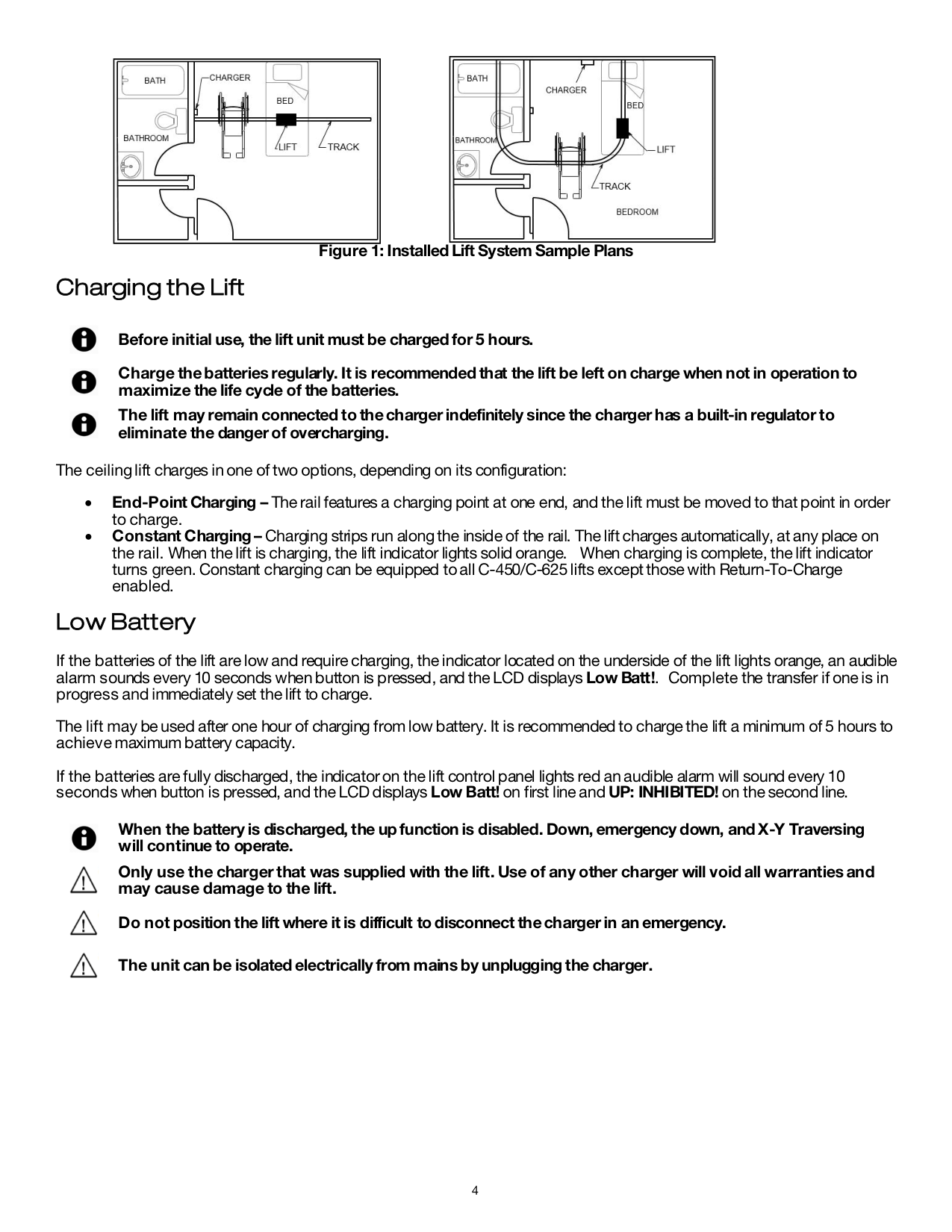
4 Figure 1: Installed Lift System Sample Plans Charging the Lift Before initial use, the lift unit must be charged for 5 hours. Charge the batteries regularly. It is recommended that the lift be left on charge when not in operation to maximize the life cycle of the batteries. The lift may remain connected to the charger indefinitely since the charger has a built-in regulator to eliminate the danger of overcharging. The ceiling lift charges in one of two options, depending on its configuration: • End-Point Charging – The rail features a charging point at one end, and the lift must be moved to that point in order to charge. • Constant Charging – Charging strips run along the inside of the rail. The lift charges automatically, at any place on the rail. When the lift is charging, the lift indicator lights solid orange. When charging is complete, the lift indicator turns green. Constant charging can be equipped to all C-450/C-625 lifts except those with Return-To-Charge enabled. Low Battery If the batteries of the lift are low and require charging, the indicator located on the underside of the lift lights orange, an audible alarm sounds every 10 seconds when button is pressed, and the LCD displays Low Batt!. Complete the transfer if one is in progress and immediately set the lift to charge. The lift may be used after one hour of charging from low battery. It is recommended to charge the lift a minimum of 5 hours to achieve maximum battery capacity. If the batteries are fully discharged, the indicator on the lift control panel lights red an audible alarm will sound every 10 seconds when button is pressed, and the LCD displays Low Batt! on first line and UP: INHIBITED! on the second line. When the battery is discharged, the up function is disabled. Down, emergency down, and X-Y Traversing will continue to operate. Only use the charger that was supplied with the lift. Use of any other charger will void all warranties and may cause damage to the lift. Do not position the lift where it is difficult to disconnect the charger in an emergency. The unit can be isolated electrically from mains by unplugging the charger.
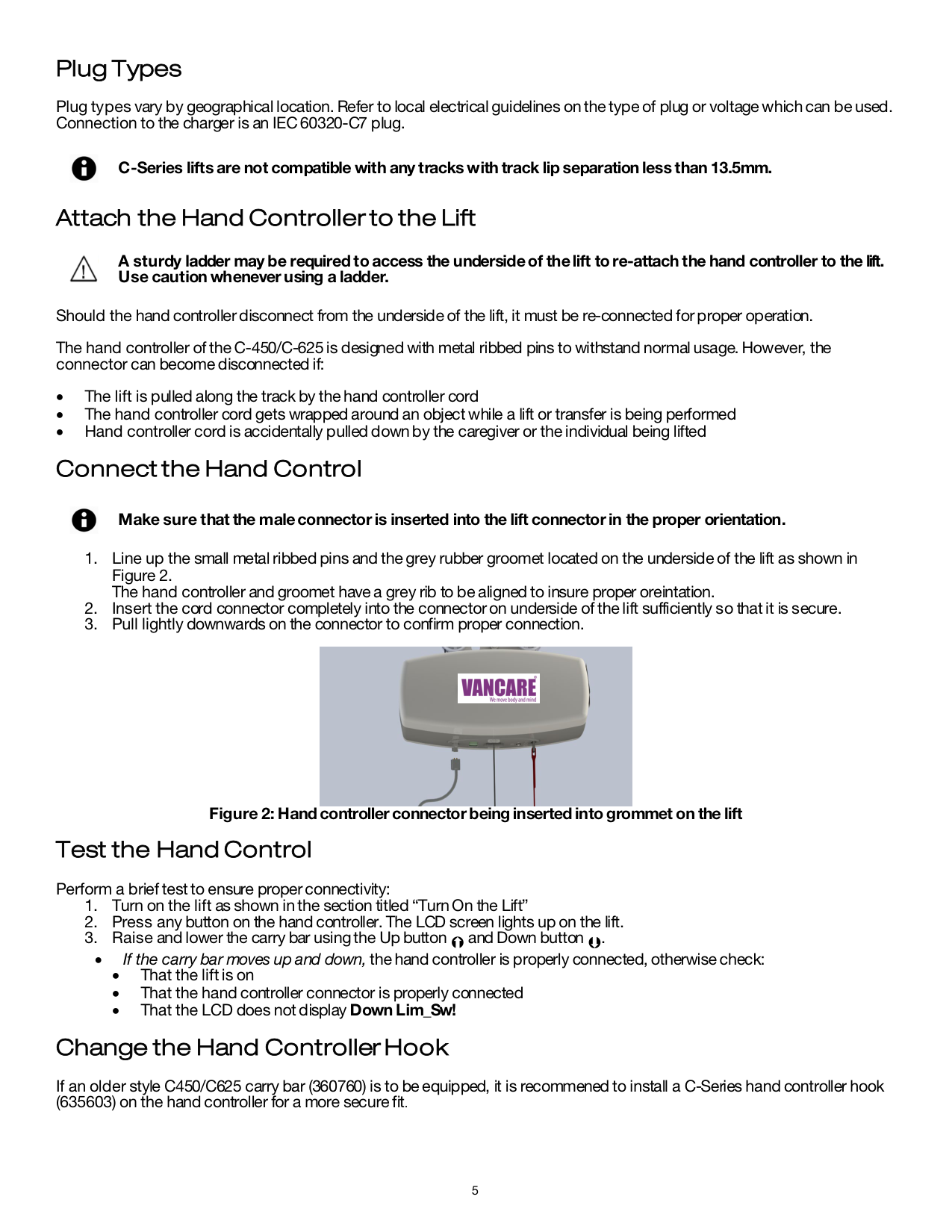
5 Plug Types Plug types vary by geographical location. Refer to local electrical guidelines on the type of plug or voltage which can be used. Connection to the charger is an IEC 60320-C7 plug. C-Series lifts are not compatible with any tracks with track lip separation less than 13.5mm. Attach the Hand Controller to the Lift A sturdy ladder may be required to access the underside of the lift to re-attach the hand controller to the lift. Use caution whenever using a ladder. Should the hand controller disconnect from the underside of the lift, it must be re-connected for proper operation. The hand controller of the C-450/C-625 is designed with metal ribbed pins to withstand normal usage. However, the connector can become disconnected if: • The lift is pulled along the track by the hand controller cord • The hand controller cord gets wrapped around an object while a lift or transfer is being performed • Hand controller cord is accidentally pulled down by the caregiver or the individual being lifted Connect the Hand Control Make sure that the male connector is inserted into the lift connector in the proper orientation.
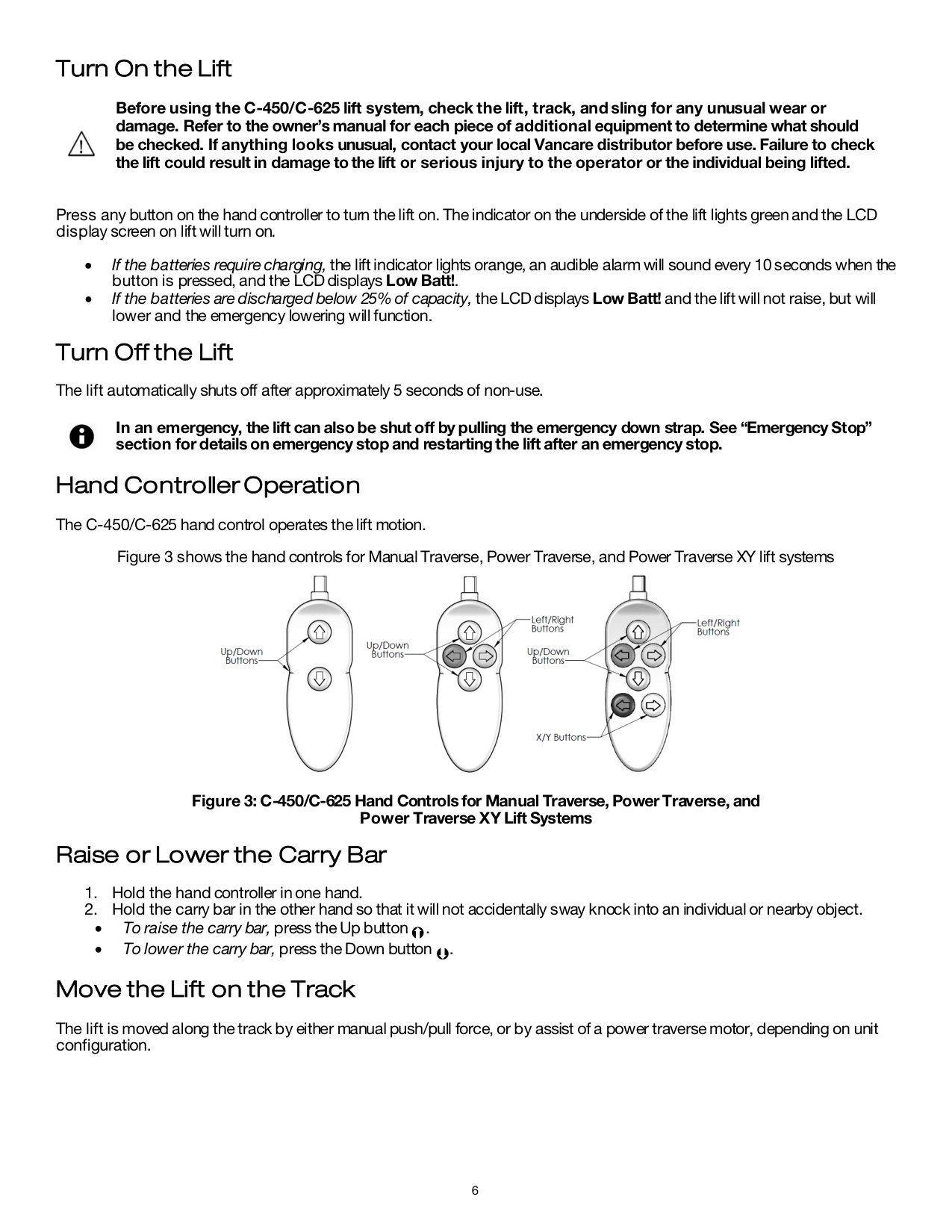
6 Turn On the Lift Before using the C-450/C-625 lift system, check the lift, track, and sling for any unusual wear or damage. Refer to the owner’s manual for each piece of additional equipment to determine what should be checked. If anything looks unusual, contact your local Vancare distributor before use. Failure to check the lift could result in damage to the lift or serious injury to the operator or the individual being lifted. Press any button on the hand controller to turn the lift on. The indicator on the underside of the lift lights green and the LCD display screen on lift will turn on. • If the batteries require charging, the lift indicator lights orange, an audible alarm will sound every 10 seconds when the button is pressed, and the LCD displays Low Batt!. • If the batteries are discharged below 25% of capacity, the LCD displays Low Batt! and the lift will not raise, but will lower and the emergency lowering will function. Turn Off the Lift The lift automatically shuts off after approximately 5 seconds of non-use. In an emergency, the lift can also be shut off by pulling the emergency down strap. See “Emergency Stop” section for details on emergency stop and restarting the lift after an emergency stop. Hand Controller Operation The C-450/C-625 hand control operates the lift motion. Figure 3 shows the hand controls for Manual Traverse, Power Traverse, and Power Traverse XY lift systems Figure 3: C-450/C-625 Hand Controls for Manual Traverse, Power Traverse, and Power Traverse XY Lift Systems Raise or Lower the Carry Bar
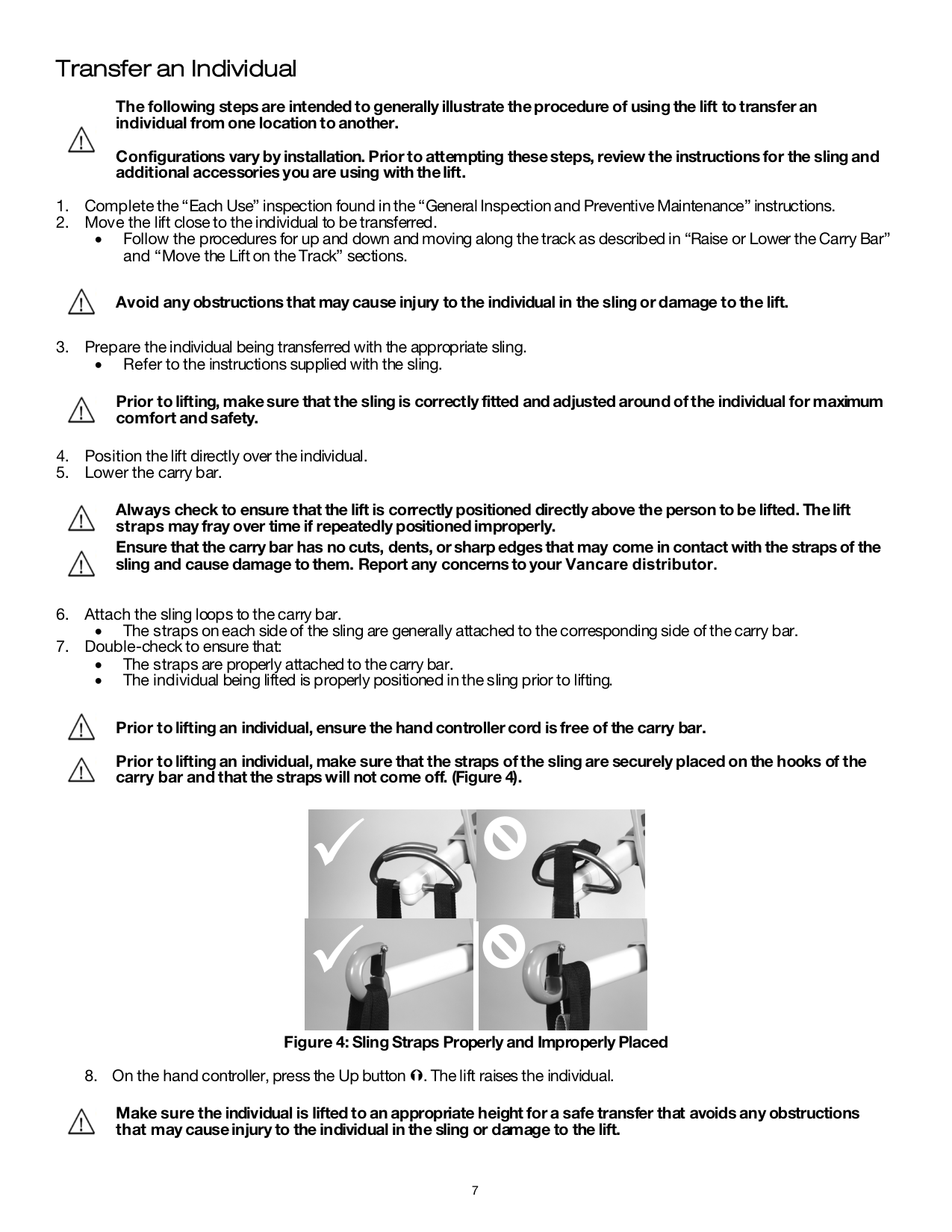
7 Transfer an Individual The following steps are intended to generally illustrate the procedure of using the lift to transfer an individual from one location to another. Configurations vary by installation. Prior to attempting these steps, review the instructions for the sling and additional accessories you are using with the lift.
8
Warning: Strangulation Hazard
Following the completion of the transfer, ensure that the carry bar, strap, and hand control are raised up away from reach of children, toddlers, or anyone not intended to use the product. Psychological, mental, and emotional state assessment is key to safe use of a ceiling lift; ensure that use and storage of the ceiling lift and accessories are safe for the patient’s mental condition. While raising a ceiling lift system with or without patient, ensure that the patient, caregiver, other individuals, furniture, and other items are not at risk of becoming entangled with the moving lift strap and carry bar.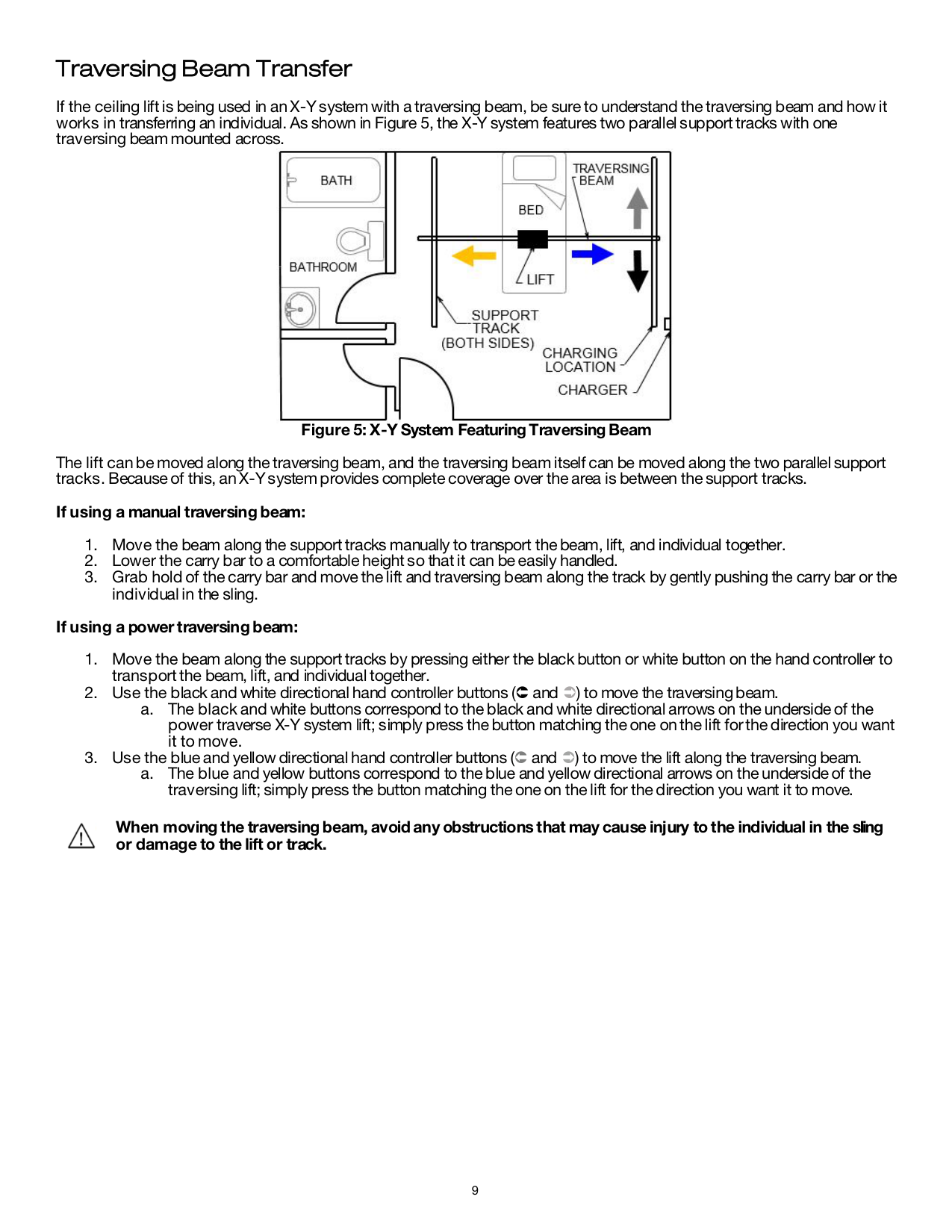
9 Traversing Beam Transfer If the ceiling lift is being used in an X-Y system with a traversing beam, be sure to understand the traversing beam and how it works in transferring an individual. As shown in Figure 5, the X-Y system features two parallel support tracks with one traversing beam mounted across. Figure 5: X-Y System Featuring Traversing Beam The lift can be moved along the traversing beam, and the traversing beam itself can be moved along the two parallel support tracks. Because of this, an X-Y system provides complete coverage over the area is between the support tracks. If using a manual traversing beam:
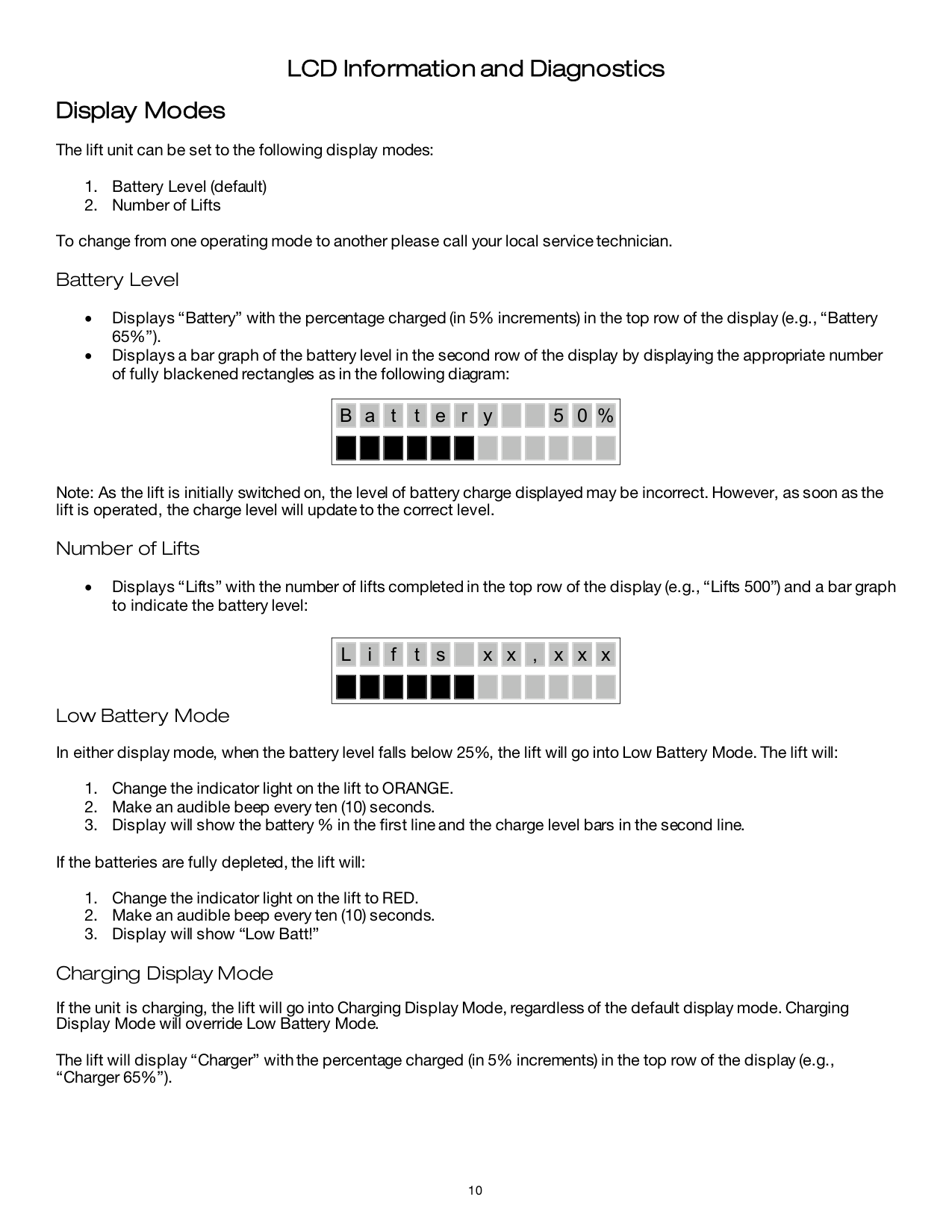
10 LCD Information and Diagnostics Display Modes The lift unit can be set to the following display modes:
L
i f s , t x x x x x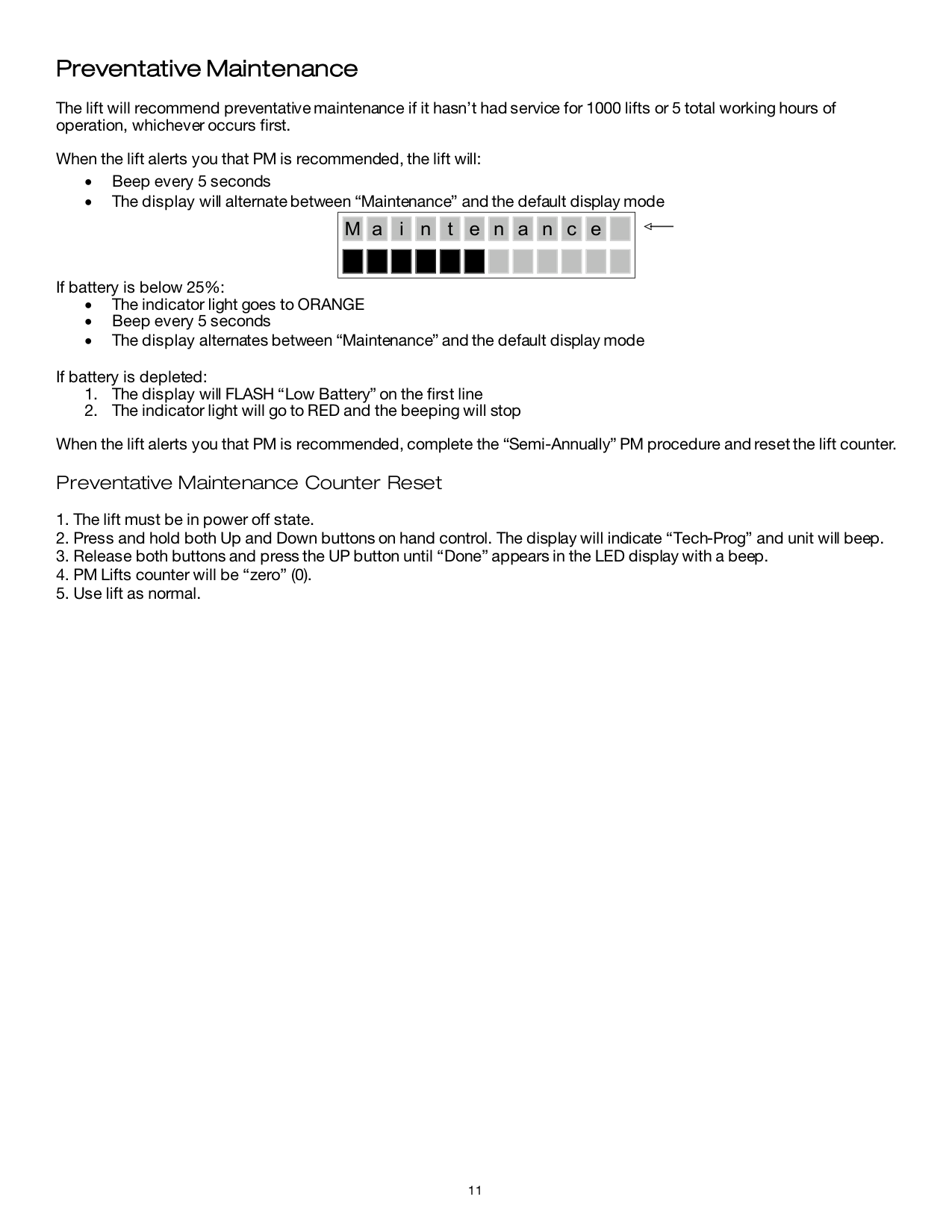
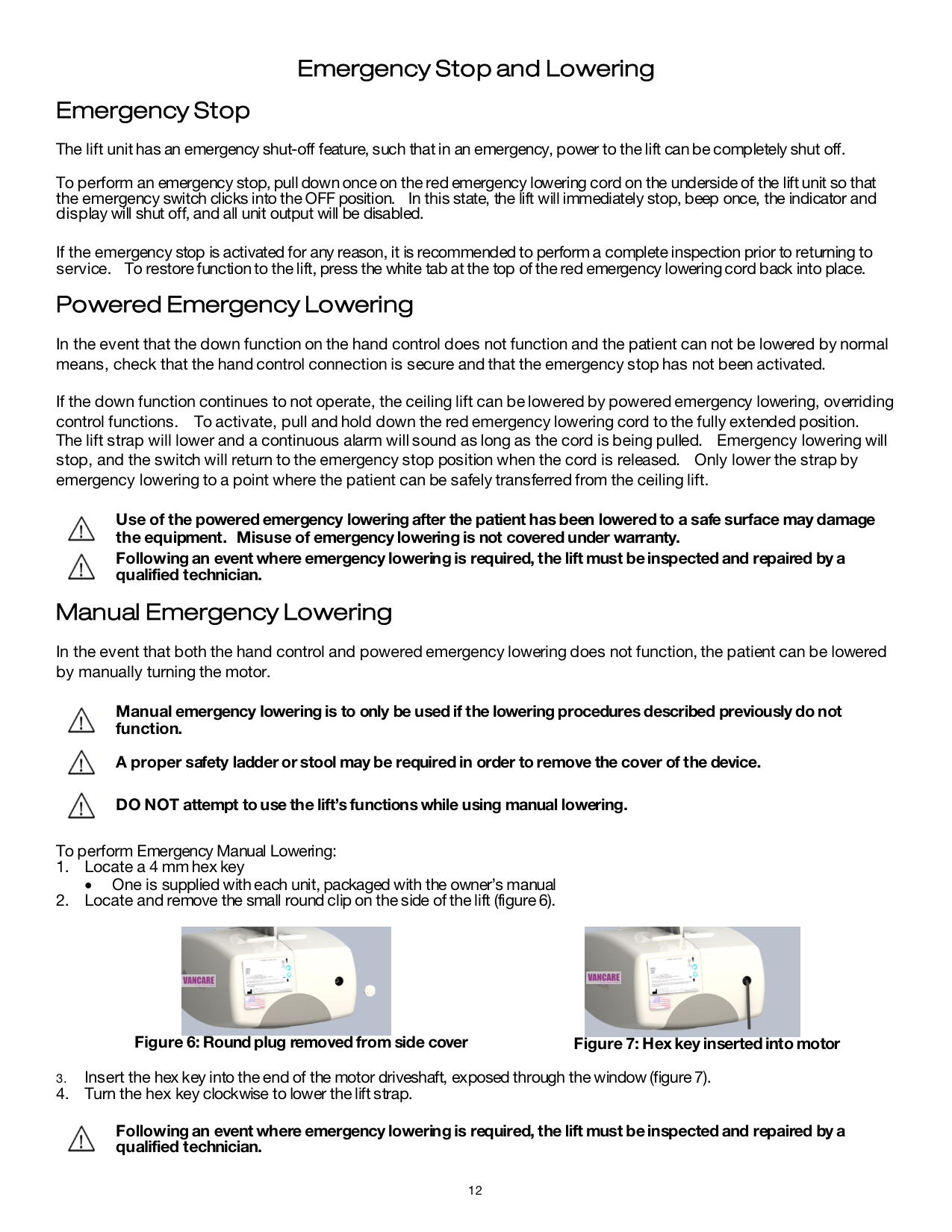
11 Preventative Maintenance The lift will recommend preventative maintenance if it hasn’t had service for 1000 lifts or 5 total working hours of operation, whichever occurs first. When the lift alerts you that PM is recommended, the lift will: • Beep every 5 seconds • The display will alternate between “Maintenance” and the default display mode If battery is below 25%: • The indicator light goes to ORANGE • Beep every 5 seconds • The display alternates between “Maintenance” and the default display mode If battery is depleted:
12 Emergency Stop and Lowering Emergency Stop The lift unit has an emergency shut-off feature, such that in an emergency, power to the lift can be completely shut off. To perform an emergency stop, pull down once on the red emergency lowering cord on the underside of the lift unit so that the emergency switch clicks into the OFF position. In this state, the lift will immediately stop, beep once, the indicator and display will shut off, and all unit output will be disabled. If the emergency stop is activated for any reason, it is recommended to perform a complete inspection prior to returning to service. To restore function to the lift, press the white tab at the top of the red emergency lowering cord back into place. Powered Emergency Lowering In the event that the down function on the hand control does not function and the patient can not be lowered by normal means, check that the hand control connection is secure and that the emergency stop has not been activated. If the down function continues to not operate, the ceiling lift can be lowered by powered emergency lowering, overriding control functions. To activate, pull and hold down the red emergency lowering cord to the fully extended position. The lift strap will lower and a continuous alarm will sound as long as the cord is being pulled. Emergency lowering will stop, and the switch will return to the emergency stop position when the cord is released. Only lower the strap by emergency lowering to a point where the patient can be safely transferred from the ceiling lift. Use of the powered emergency lowering after the patient has been lowered to a safe surface may damage the equipment. Misuse of emergency lowering is not covered under warranty. Following an event where emergency lowering is required, the lift must be inspected and repaired by a qualified technician. Manual Emergency Lowering In the event that both the hand control and powered emergency lowering does not function, the patient can be lowered by manually turning the motor. Manual emergency lowering is to only be used if the lowering procedures described previously do not function. A proper safety ladder or stool may be required in order to remove the cover of the device. DO NOT attempt to use the lift’s functions while using manual lowering. To perform Emergency Manual Lowering:
13 Cleaning and Disinfection Cleaning the Lift and Carry Bar The exterior of the lift should only be cleaned and disinfected with isopropyl alcohol. Dampen a cloth with isopropyl alcohol and wipe down the entire exterior of the lift and carry bar. Ensure that no liquids get inside the lift unit. Failure to protect the lift from liquids may result in damage to the lift and result in personal injury. Cleaning the Lift Strap The lift strap has been tested to be compatible with Virox Accel TB RTU (Ready-to-Use). Consult your local Vancare representative for guidance on other disinfectancts. Do NOT use products containing chlorine, as this will degrade the strap material.
Return to Charge If your power traversing lift has return-to-charge (RTC) equipped, press and hold the blue and yellow colored directional hand controller buttons simultaneously for 3-5 seconds until it beeps to activate. The lift automatically retracts the carry bar and drives along the track until it docks at the charger. If the operator inadvertently enables return-to-charge while a patient is in the lift, the function stops automatically by sensing excess load on the lift. If the lift’s carry bar gets tangled with obstacles such as furniture or drapery during return-to-charge, the lift automatically detects the change in the load. If the load varies more than 15-30 lb (6.8-13.6 kg), the lift stops automatically. The overload threshold is between 35-50 lb (15.8-22.6 kg). The return-to-charge feature can be interrupted manually either by pressing any button on the hand controller or by grasping the carry bar firmly. The return-to-charge feature does not work with power traversing lifts equipped with constant charge (Omni). Make sure the carry bar is attached to the lift before activating return-to-charge. The added weight of the carry bar is required to ensure correct limit switch operation. Avoid any obstructions that may cause injury to the individual in the sling or damage to the lift or track. Return to Charge features several settings that can be customized: • RTC Max. Time - The maximum time allowed for the lift to travel to and dock at the charger before aborting; may be set in 60 second increments from 60 to 240 seconds • RTC Drop Time - The time the lift lowers the carry bar upon docking at the charger; may be set in 3 sec increments from 3 to 24 seconds • RTC Speed - The relative speed the lift travels at to reach the charger; may be set to 2, 4, 6 or 8
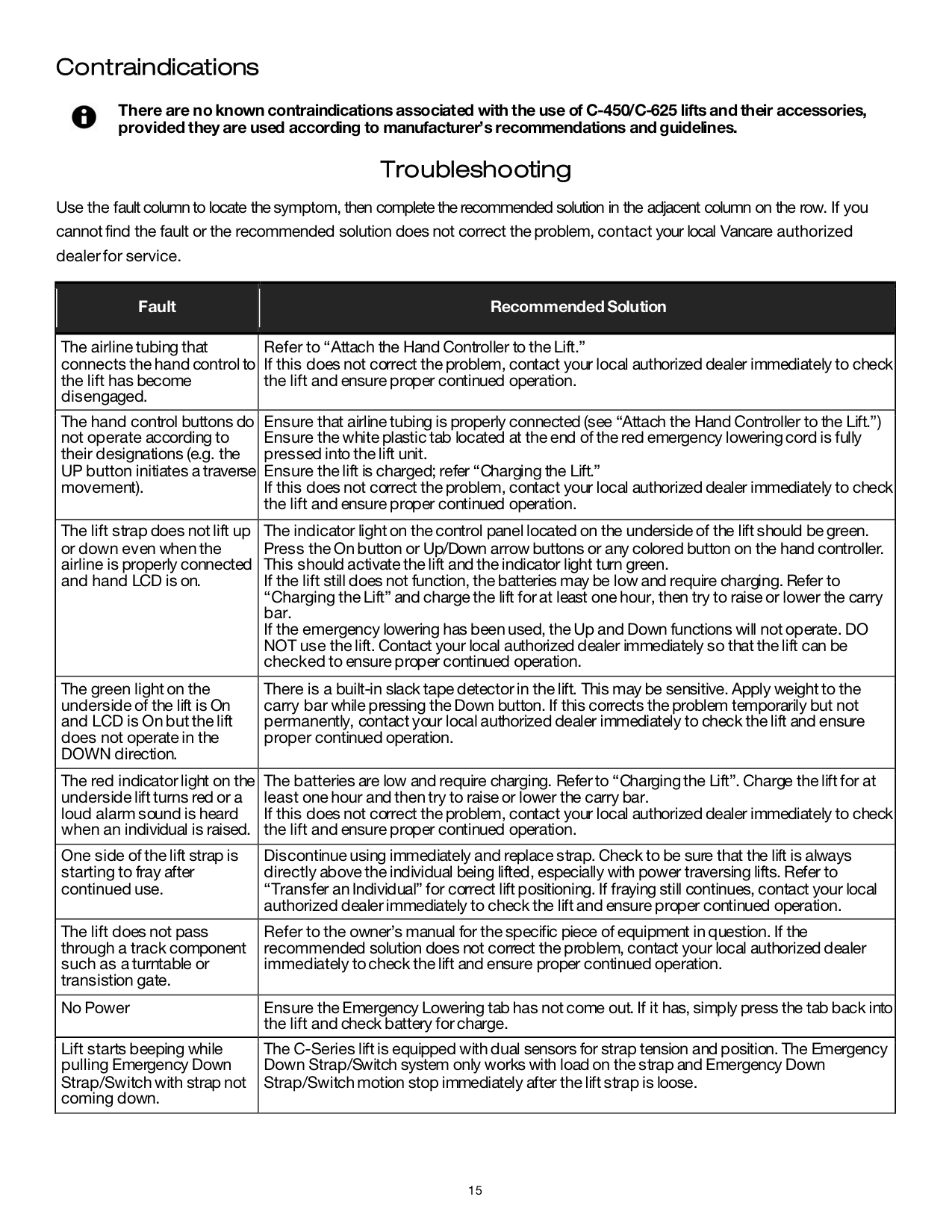
15 Contraindications There are no known contraindications associated with the use of C-450/C-625 lifts and their accessories, provided they are used according to manufacturer’s recommendations and guidelines. Troubleshooting Use the fault column to locate the symptom, then complete the recommended solution in the adjacent column on the row. If you cannot find the fault or the recommended solution does not correct the problem, contact your local Vancare authorized dealer for service. Fault Recommended Solution The airline tubing that connects the hand control to the lift has become disengaged. Refer to “Attach the Hand Controller to the Lift.” If this does not correct the problem, contact your local authorized dealer immediately to check the lift and ensure proper continued operation. The hand control buttons do not operate according to their designations (e.g. the UP button initiates a traverse movement). Ensure that airline tubing is properly connected (see “Attach the Hand Controller to the Lift.”) Ensure the white plastic tab located at the end of the red emergency lowering cord is fully pressed into the lift unit. Ensure the lift is charged; refer “Charging the Lift.” If this does not correct the problem, contact your local authorized dealer immediately to check the lift and ensure proper continued operation. The lift strap does not lift up or down even when the airline is properly connected and hand LCD is on. The indicator light on the control panel located on the underside of the lift should be green. Press the On button or Up/Down arrow buttons or any colored button on the hand controller. This should activate the lift and the indicator light turn green. If the lift still does not function, the batteries may be low and require charging. Refer to “Charging the Lift” and charge the lift for at least one hour, then try to raise or lower the carry bar. If the emergency lowering has been used, the Up and Down functions will not operate. DO NOT use the lift. Contact your local authorized dealer immediately so that the lift can be checked to ensure proper continued operation. The green light on the underside of the lift is On and LCD is On but the lift does not operate in the DOWN direction. There is a built-in slack tape detector in the lift. This may be sensitive. Apply weight to the carry bar while pressing the Down button. If this corrects the problem temporarily but not permanently, contact your local authorized dealer immediately to check the lift and ensure proper continued operation. The red indicator light on the underside lift turns red or a loud alarm sound is heard when an individual is raised. The batteries are low and require charging. Refer to “Charging the Lift”. Charge the lift for at least one hour and then try to raise or lower the carry bar. If this does not correct the problem, contact your local authorized dealer immediately to check the lift and ensure proper continued operation. One side of the lift strap is starting to fray after continued use. Discontinue using immediately and replace strap. Check to be sure that the lift is always directly above the individual being lifted, especially with power traversing lifts. Refer to “Transfer an Individual” for correct lift positioning. If fraying still continues, contact your local authorized dealer immediately to check the lift and ensure proper continued operation. The lift does not pass through a track component such as a turntable or transistion gate. Refer to the owner’s manual for the specific piece of equipment in question. If the recommended solution does not correct the problem, contact your local authorized dealer immediately to check the lift and ensure proper continued operation. No Power Ensure the Emergency Lowering tab has not come out. If it has, simply press the tab back into the lift and check battery for charge. Lift starts beeping while pulling Emergency Down Strap/Switch with strap not coming down. The C-Series lift is equipped with dual sensors for strap tension and position. The Emergency Down Strap/Switch system only works with load on the strap and Emergency Down Strap/Switch motion stop immediately after the lift strap is loose.
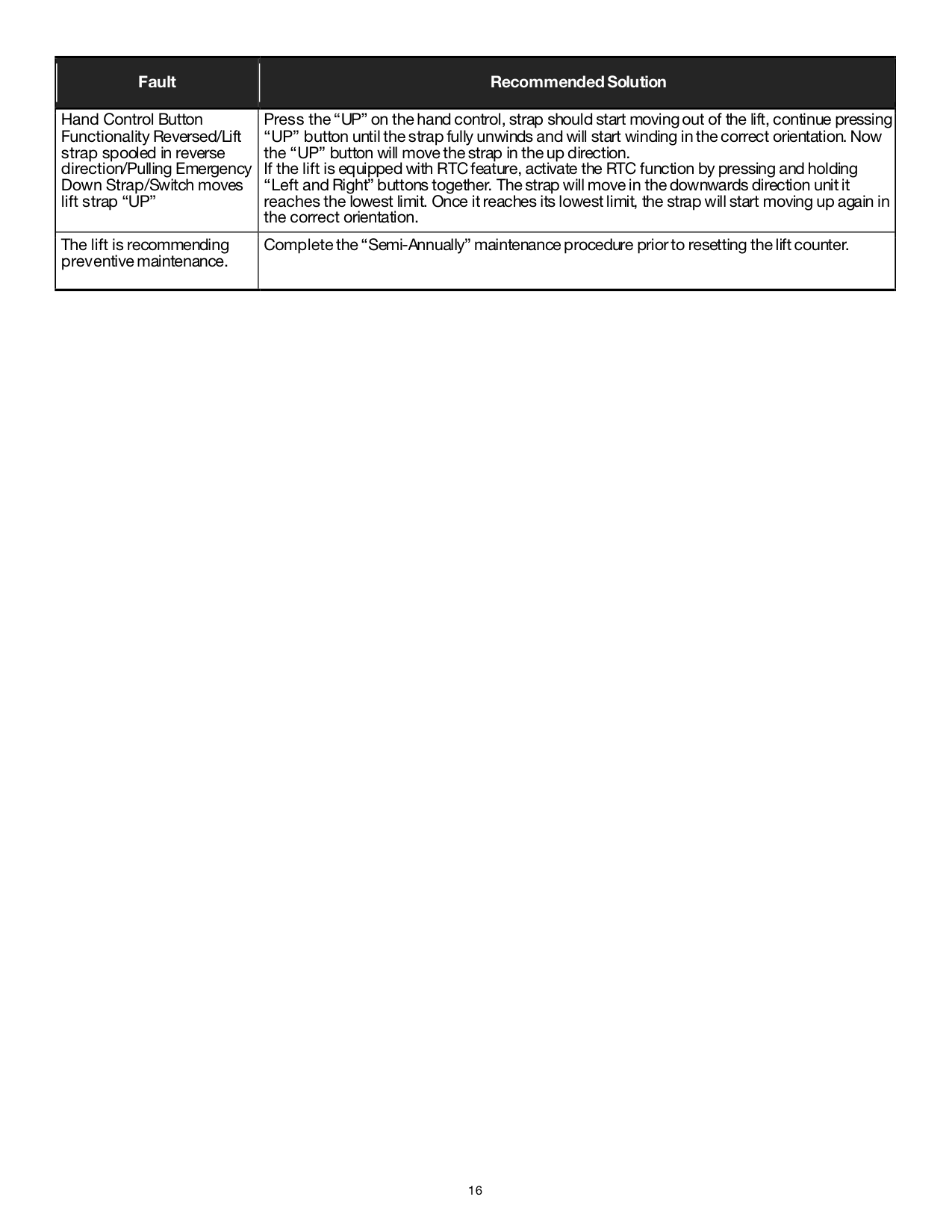
16 Fault Recommended Solution Hand Control Button Functionality Reversed/Lift strap spooled in reverse direction/Pulling Emergency Down Strap/Switch moves lift strap “UP” Press the “UP” on the hand control, strap should start moving out of the lift, continue pressing “UP” button until the strap fully unwinds and will start winding in the correct orientation. Now the “UP” button will move the strap in the up direction. If the lift is equipped with RTC feature, activate the RTC function by pressing and holding “Left and Right” buttons together. The strap will move in the downwards direction unit it reaches the lowest limit. Once it reaches its lowest limit, the strap will start moving up again in the correct orientation. The lift is recommending preventive maintenance. Complete the “Semi-Annually” maintenance procedure prior to resetting the lift counter.
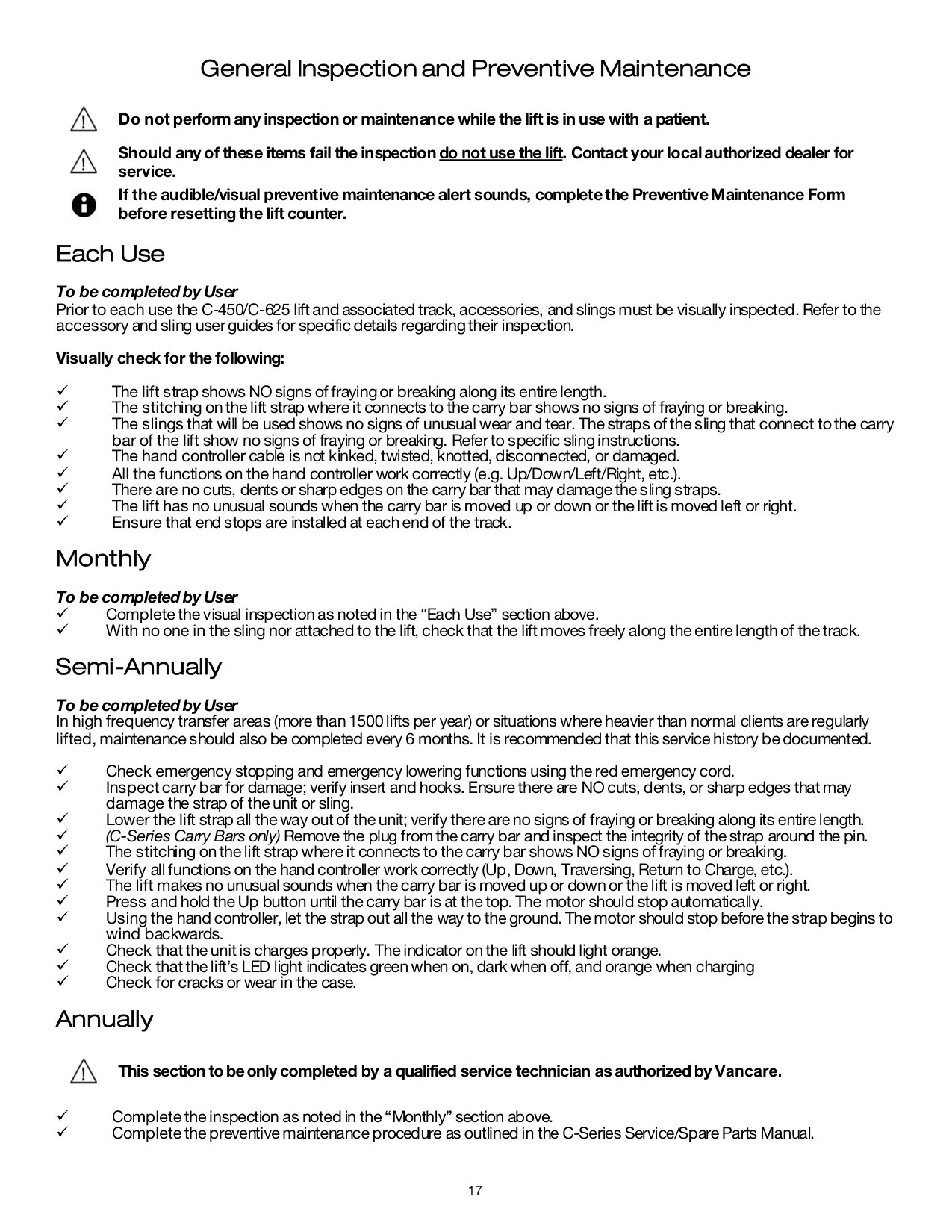
17 General Inspection and Preventive Maintenance Do not perform any inspection or maintenance while the lift is in use with a patient. Should any of these items fail the inspection do not use the lift. Contact your local authorized dealer for service. If the audible/visual preventive maintenance alert sounds, complete the Preventive Maintenance Form before resetting the lift counter. Each Use To be completed by User Prior to each use the C-450/C-625 lift and associated track, accessories, and slings must be visually inspected. Refer to the accessory and sling user guides for specific details regarding their inspection. Visually check for the following: The lift strap shows NO signs of fraying or breaking along its entire length. The stitching on the lift strap where it connects to the carry bar shows no signs of fraying or breaking. The slings that will be used shows no signs of unusual wear and tear. The straps of the sling that connect to the carry bar of the lift show no signs of fraying or breaking. Refer to specific sling instructions. The hand controller cable is not kinked, twisted, knotted, disconnected, or damaged. All the functions on the hand controller work correctly (e.g. Up/Down/Left/Right, etc.). There are no cuts, dents or sharp edges on the carry bar that may damage the sling straps. The lift has no unusual sounds when the carry bar is moved up or down or the lift is moved left or right. Ensure that end stops are installed at each end of the track. Monthly To be completed by User Complete the visual inspection as noted in the “Each Use” section above. With no one in the sling nor attached to the lift, check that the lift moves freely along the entire length of the track. Semi-Annually To be completed by User In high frequency transfer areas (more than 1500 lifts per year) or situations where heavier than normal clients are regularly lifted, maintenance should also be completed every 6 months. It is recommended that this service history be documented. Check emergency stopping and emergency lowering functions using the red emergency cord. Inspect carry bar for damage; verify insert and hooks. Ensure there are NO cuts, dents, or sharp edges that may damage the strap of the unit or sling. Lower the lift strap all the way out of the unit; verify there are no signs of fraying or breaking along its entire length. (C-Series Carry Bars only) Remove the plug from the carry bar and inspect the integrity of the strap around the pin. The stitching on the lift strap where it connects to the carry bar shows NO signs of fraying or breaking. Verify all functions on the hand controller work correctly (Up, Down, Traversing, Return to Charge, etc.). The lift makes no unusual sounds when the carry bar is moved up or down or the lift is moved left or right. Press and hold the Up button until the carry bar is at the top. The motor should stop automatically. Using the hand controller, let the strap out all the way to the ground. The motor should stop before the strap begins to wind backwards. Check that the unit is charges properly. The indicator on the lift should light orange. Check that the lift’s LED light indicates green when on, dark when off, and orange when charging Check for cracks or wear in the case. Annually This section to be only completed by a qualified service technician as authorized by Vancare. Complete the inspection as noted in the “Monthly” section above. Complete the preventive maintenance procedure as outlined in the C-Series Service/Spare Parts Manual.
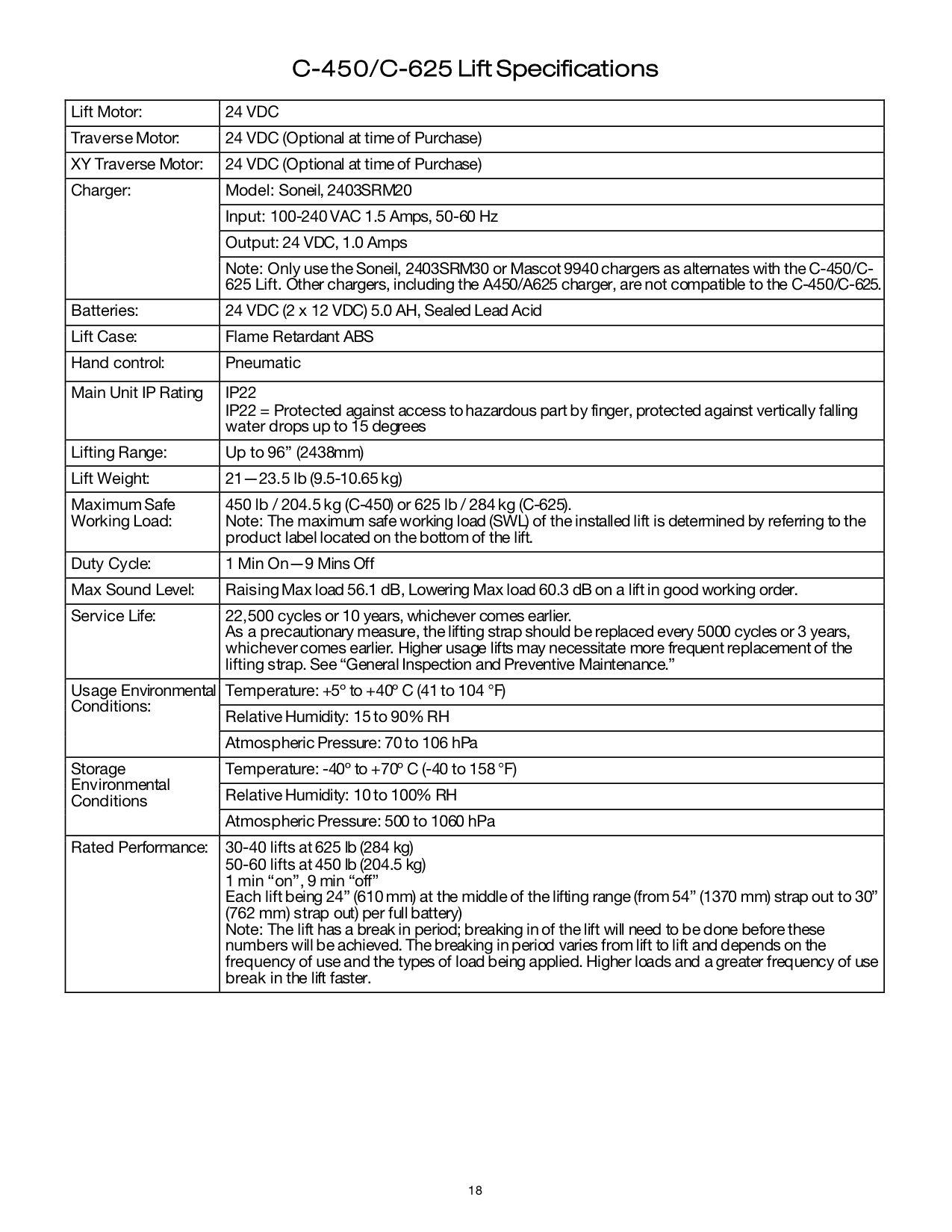
18 C-450/C-625 Lift Specifications Lift Motor:
24 Vdc
Traverse Motor: 24 VDC (Optional at time of Purchase) XY Traverse Motor: 24 VDC (Optional at time of Purchase) Charger: Model: Soneil, 2403SRM20 Input: 100-240 VAC 1.5 Amps, 50-60 Hz Output: 24 VDC, 1.0 Amps Note: Only use the Soneil, 2403SRM30 or Mascot 9940 chargers as alternates with the C-450/C- 625 Lift. Other chargers, including the A450/A625 charger, are not compatible to the C-450/C-625. Batteries: 24 VDC (2 x 12 VDC) 5.0 AH, Sealed Lead Acid Lift Case: Flame Retardant ABS Hand control: Pneumatic Main Unit IP RatingIp22
IP22 = Protected against access to hazardous part by finger, protected against vertically falling water drops up to 15 degrees Lifting Range: Up to 96” (2438mm) Lift Weight: 21—23.5 lb (9.5-10.65 kg) Maximum Safe Working Load: 450 lb / 204.5 kg (C-450) or 625 lb / 284 kg (C-625). Note: The maximum safe working load (SWL) of the installed lift is determined by referring to the product label located on the bottom of the lift. Duty Cycle: 1 Min On—9 Mins Off Max Sound Level: Raising Max load 56.1 dB, Lowering Max load 60.3 dB on a lift in good working order. Service Life: 22,500 cycles or 10 years, whichever comes earlier. As a precautionary measure, the lifting strap should be replaced every 5000 cycles or 3 years, whichever comes earlier. Higher usage lifts may necessitate more frequent replacement of the lifting strap. See “General Inspection and Preventive Maintenance.” Usage Environmental Conditions: Temperature: +5º to +40º C (41 to 104 °F) Relative Humidity: 15 to 90% RH Atmospheric Pressure: 70 to 106 hPa Storage Environmental Conditions Temperature: -40º to +70º C (-40 to 158 °F) Relative Humidity: 10 to 100% RH Atmospheric Pressure: 500 to 1060 hPa Rated Performance: 30-40 lifts at 625 lb (284 kg) 50-60 lifts at 450 lb (204.5 kg) 1 min “on”, 9 min “off” Each lift being 24” (610 mm) at the middle of the lifting range (from 54” (1370 mm) strap out to 30” (762 mm) strap out) per full battery) Note: The lift has a break in period; breaking in of the lift will need to be done before these numbers will be achieved. The breaking in period varies from lift to lift and depends on the frequency of use and the types of load being applied. Higher loads and a greater frequency of use break in the lift faster.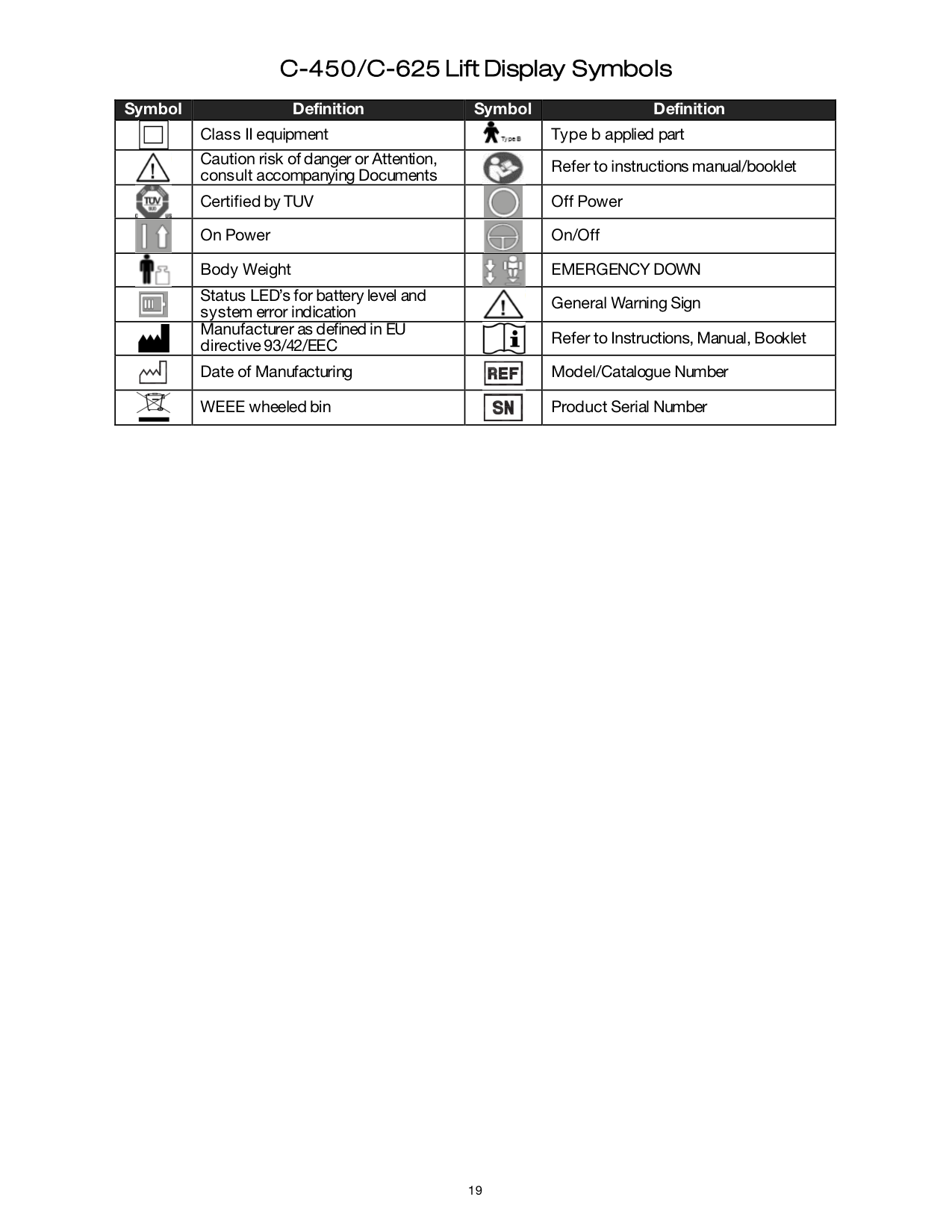
19 C-450/C-625 Lift Display Symbols Symbol Definition Symbol Definition Class II equipment Type b applied part Caution risk of danger or Attention, consult accompanying Documents Refer to instructions manual/booklet Certified by TUV Off Power On Power On/Off Body Weight
Emergency Down
Status LED’s for battery level and system error indication General Warning Sign Manufacturer as defined in EU directive 93/42/EEC Refer to Instructions, Manual, Booklet Date of Manufacturing Model/Catalogue Number WEEE wheeled bin Product Serial Number
Warranty This Warranty does not affect or in any way limit your Statutory Rights. Vancare, Inc. guarantees all equipment, which includes Ceiling Lifts, Floor Lifts, Slings, Service Parts and Track and accessories, supplied as new, against failure within the period of 1 year from date of installation or 12 months from date of manufacturing, whichever is shorter, by virtue of defects in material or workmanship. Vancare, Inc. guarantees all refurbished equipment supplied against failure within a period of three months from date of installation or six months from date of purchase whichever is shorter. This guarantee does not apply to failure attributable to normal wear and tear, damage by natural forces, user neglect or misuse or to deliberate destruction, or to batteries more than 90 days after original purchase. This guarantee shall be void if the equipment is not serviced by Vancare, Inc. or its authorized service agents in accordance with the manufacturer’s recommendations or if any unauthorized person carries out works on the equipment. The liability of Vancare under the terms of this guarantee shall be limited to the replacement of defective parts and in no event shall Vancare incur liability for any consequential or unforeseeable losses. Always make sure you have the correct version of the manual. The most recent version is available on our website, www.vancare.com For questions about the manufacture or operation of this equipment, contact your local Vancare distributor. Vancare, Inc. 1515 1st St Aurora, NE 68818 1.800.694.4525 www.vancare.com Manufactured for:
Final Checklist and Inspection Commissioning Cover Sheet Client Name: Client Address: Order Number: Number of Pages Including Cover Sheet: Date: Client Signature: The above signed acknowledges the receipt of the completed Certified Inspection Information attached herein. VCD.397 Rev 0 2016 38
So#_______________________
Delivery Ticket Delivered to: _____________________________________________________________________ Address: ________________________________________________________________________ ________________________________________________________________________________ Product Description: _______________________________________________________________ ________________________________________________________________________________ ________________________________________________________________________________ Serial #'s: _______________________________________________________________________ _______________________________________________________________________________ _______________________________________________________________________________ I, the client, or an authorized representative of the above client, acknowledge receipt of the attached equipment, service and/or supplies and am satisfied with work completed by Vancare and/or Vancare representative. I was demonstrated the proper use of the slings, hand controls, and the operations of the lift(s) or products I received, if applicable. I am in receipt of the owner's manual with information. I understand that any system must be periodically inspected for loose fittings, and I will not operate the lift with a frayed or worn sling. Every product sold or rented by our compnay carries a manufacturer's warranty. Vancare will notify all clients of the warranty coverage, and we will honor all warranties under applicable law. I understand that using the system other than instructed, using unauthorized equipment and/or having repairs or modifications by others not certified to complete the work will void the warranty. The warranty does not cover misuse or unauthorized maintenance or any other events beyond our control. Shipping of parts or any other shipping charges that occur at the responsibility of the owner/client and will be invoiced accordingly, if applicable. I have been instructed and understand the coverage on the product that I have received. Client Signature: _________________________________________________________________ Print Name: _________________________________________ Date: ______________________ Vancare Representative Signature: __________________________________________________ Print Name: _________________________________________ Date: ______________________ Vancare, Inc. 1515 1st St Aurora, NE 68818 800-694-4525 www.vancare.com VCD.410 Rev 0 2018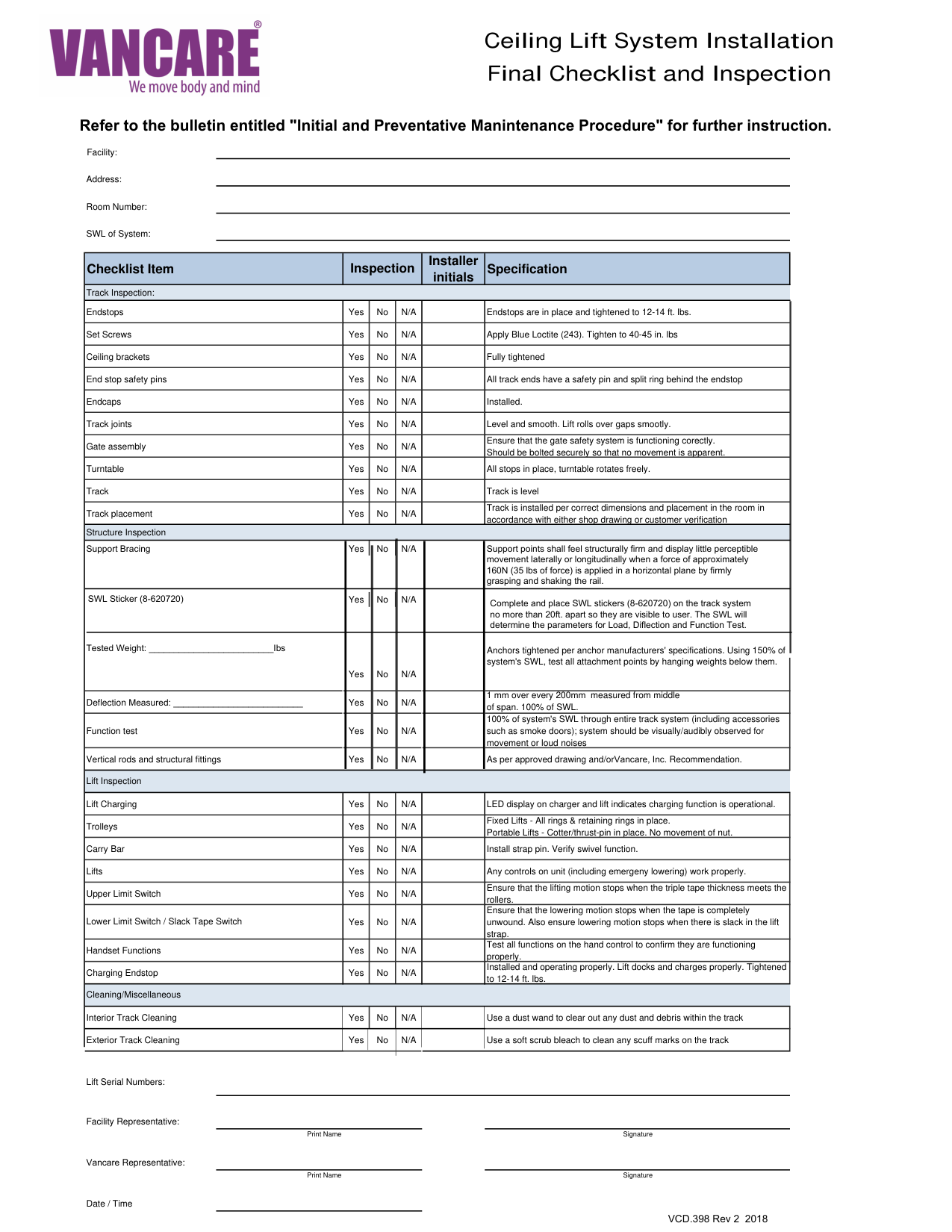
Facility: Address: Room Number: SWL of System: Checklist Item Installer initials Specification Endstops Yes No
N/A
Endstops are in place and tightened to 12-14 ft. lbs. Set Screws Yes NoN/A
Apply Blue Loctite (243). Tighten to 40-45 in. lbs Ceiling brackets Yes NoN/A
Fully tightened End stop safety pins Yes NoN/A
All track ends have a safety pin and split ring behind the endstop Endcaps Yes NoN/A
Installed. Track joints Yes NoN/A
Level and smooth. Lift rolls over gaps smootly. Gate assembly Yes NoN/A
Ensure that the gate safety system is functioning corectly. Should be bolted securely so that no movement is apparent. Turntable Yes NoN/A
All stops in place, turntable rotates freely. Track Yes NoN/A
Track is level Track placement Yes NoN/A
Track is installed per correct dimensions and placement in the room in accordance with either shop drawing or customer verification Support Bracing Yes NoN/A
Support points shall feel structurally firm and display little perceptible movement laterally or longitudinally when a force of approximately 160N (35 lbs of force) is applied in a horizontal plane by firmly grasping and shaking the rail. Tested Weight: _________________________Ibs Yes NoN/A
Anchors tightened per anchor manufacturers' specifications. Using 150% of system's SWL, test all attachment points by hanging weights below them. Deflection Measured: __________________________ Yes NoN/A
1 mm over every 200mm measured from middle of span. 100% of SWL. Function test Yes NoN/A
100% of system's SWL through entire track system (including accessories such as smoke doors); system should be visually/audibly observed for movement or loud noises Vertical rods and structural fittings Yes NoN/A
As per approved drawing and/orVancare, Inc. Recommendation. Lift Charging Yes NoN/A
LED display on charger and lift indicates charging function is operational. Trolleys Yes NoN/A
Fixed Lifts - All rings & retaining rings in place. Portable Lifts - Cotter/thrust-pin in place. No movement of nut. Carry Bar Yes NoN/A
Install strap pin. Verify swivel function. Lifts Yes NoN/A
Any controls on unit (including emergeny lowering) work properly. Upper Limit Switch Yes NoN/A
Ensure that the lifting motion stops when the triple tape thickness meets the rollers. Yes NoN/A
Ensure that the lowering motion stops when the tape is completely unwound. Also ensure lowering motion stops when there is slack in the lift strap. Handset Functions Yes NoN/A
Test all functions on the hand control to confirm they are functioning properly. Charging Endstop Yes NoN/A
Installed and operating properly. Lift docks and charges properly. Tightened to 12-14 ft. lbs. Interior Track Cleaning Yes NoN/A
Use a dust wand to clear out any dust and debris within the track Exterior Track Cleaning Yes NoN/A
Use a soft scrub bleach to clean any scuff marks on the track Lift Serial Numbers: Facility Representative: Vancare Representative: Print Name Signature Date / Time Print Name Signature VCD.398 Rev 2 2018 Inspection Ceiling Lift System Installation Final Checklist and Inspection Track Inspection: Structure Inspection Lift Inspection Cleaning/Miscellaneous Lower Limit Switch / Slack Tape Switch SWL Sticker (8-620720) Yes NoN/A
Complete and place SWL stickers (8-620720) on the track system no more than 20ft. apart so they are visible to user. The SWL will determine the parameters for Load, Diflection and Function Test. Refer to the bulletin entitled "Initial and Preventative Manintenance Procedure" for further instruction.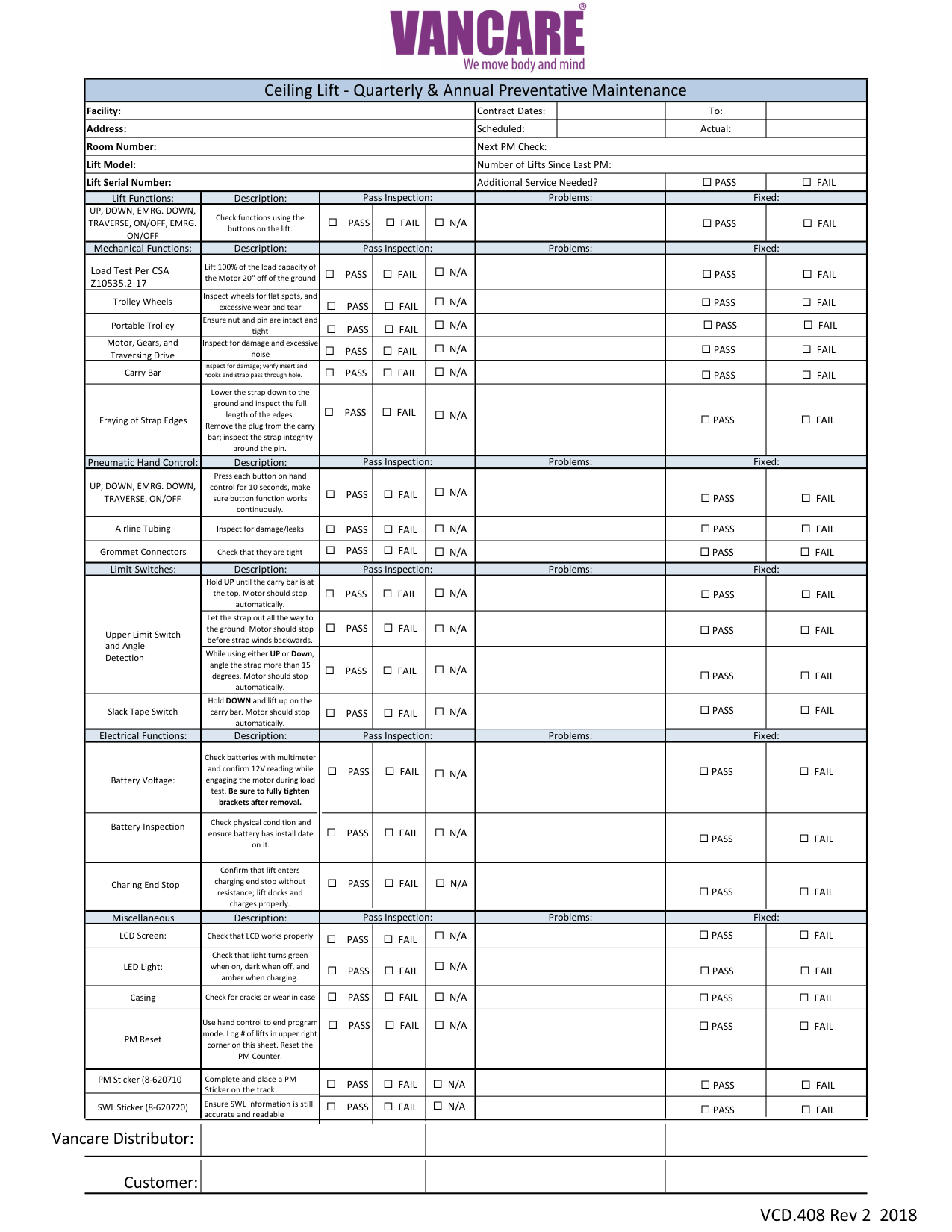
Facility: Contract Dates: To: Address: Scheduled: Actual: Room Number: Next PM Check: Lift Model: Number of Lifts Since Last PM: Lift Serial Number: Additional Service Needed?
Pass
Fail
Lift Functions: Description:Up, Down, Emrg. Down,
Traverse, On/Off, Emrg.
On/Off
Check functions using the buttons on the lift. Pass
Fail
N/A
Pass
Fail
Mechanical Functions: Description: Load Test Per CSAZ10535.2-17
Lift 100% of the load capacity of the Motor 20" off of the ground N/A
Trolley Wheels Inspect wheels for flat spots, and excessive wear and tear N/A
Portable Trolley Ensure nut and pin are intact and tight N/A
Motor, Gears, and Traversing Drive Inspect for damage and excessive noise N/A
Carry Bar Inspect for damage; verify insert and hooks and strap pass through hole. N/A
Fraying of Strap Edges Lower the strap down to the ground and inspect the full length of the edges. Remove the plug from the carry bar; inspect the strap integrity around the pin. N/A
Pneumatic Hand Control: Description:Up, Down, Emrg. Down,
Traverse, On/Off
Press each button on hand control for 10 seconds, make sure button function works continuously. N/A
Airline Tubing Inspect for damage/leaks N/A
Grommet Connectors Check that they are tight N/A
Limit Switches: Description: Hold UP until the carry bar is at the top. Motor should stop automatically. N/A
Let the strap out all the way to the ground. Motor should stop before strap winds backwards. N/A
While using either UP or Down, angle the strap more than 15 degrees. Motor should stop automatically. N/A
Slack Tape Switch Hold DOWN and lift up on the carry bar. Motor should stop automatically. N/A
Electrical Functions: Description: Battery Voltage: Check batteries with multimeter and confirm 12V reading while engaging the motor during load test. Be sure to fully tighten brackets after removal. N/A
Charing End Stop Confirm that lift enters charging end stop without resistance; lift docks and charges properly. N/A
Miscellaneous Description: LCD Screen: Check that LCD works properly N/A
LED Light: Check that light turns green when on, dark when off, and amber when charging. N/A
Casing Check for cracks or wear in case N/A
PM Reset Use hand control to end program mode. Log # of lifts in upper right corner on this sheet. Reset the PM Counter. N/A
Vancare Distributor: Customer: Upper Limit Switch and Angle Detection Pass Inspection: Fixed: Problems: Problems: Fixed: Pass Inspection: Pass Inspection: Fixed: Problems: Problems: Problems: Ceiling Lift ‐ Quarterly & Annual Preventative Maintenance Pass Inspection: Pass Inspection: Fixed: Fixed: Pass Inspection: Problems: Fixed: VCD.408 Rev 2 2018 Battery Inspection Check physical condition and ensure battery has install date on it. N/A
Pass
Fail
Pass
Fail
Pass
Fail
Pass
Fail
Pass
Fail
Pass
Fail
Pass
Fail
Pass
Fail
Pass
Fail
Pass
Fail
Pass
Fail
Pass
Fail
Pass
Fail
Pass
Fail
Pass
Fail
Pass
Fail
Pass
Fail
Pass
Fail
Pass
Fail
Pass
Fail
Pass
Fail
Pass
Fail
Pass
Fail
Pass
Fail
Pass
Fail
Pass
Fail
Pass
Fail
Pass
Fail
Pass
Fail
Pass
Fail
Pass
Fail
Pass
Fail
Pass
Fail
Pass
Fail
Pass
Fail
Pass
Fail
Pass
Fail
Pass
Fail
Pass
Fail
Pass
Fail
PM Sticker (8-620710 Complete and place a PM Sticker on the track. SWL Sticker (8-620720) Ensure SWL information is still accurate and readable N/A
Pass
Fail
N/A
Pass
Fail
Pass
Fail
Pass
Fail
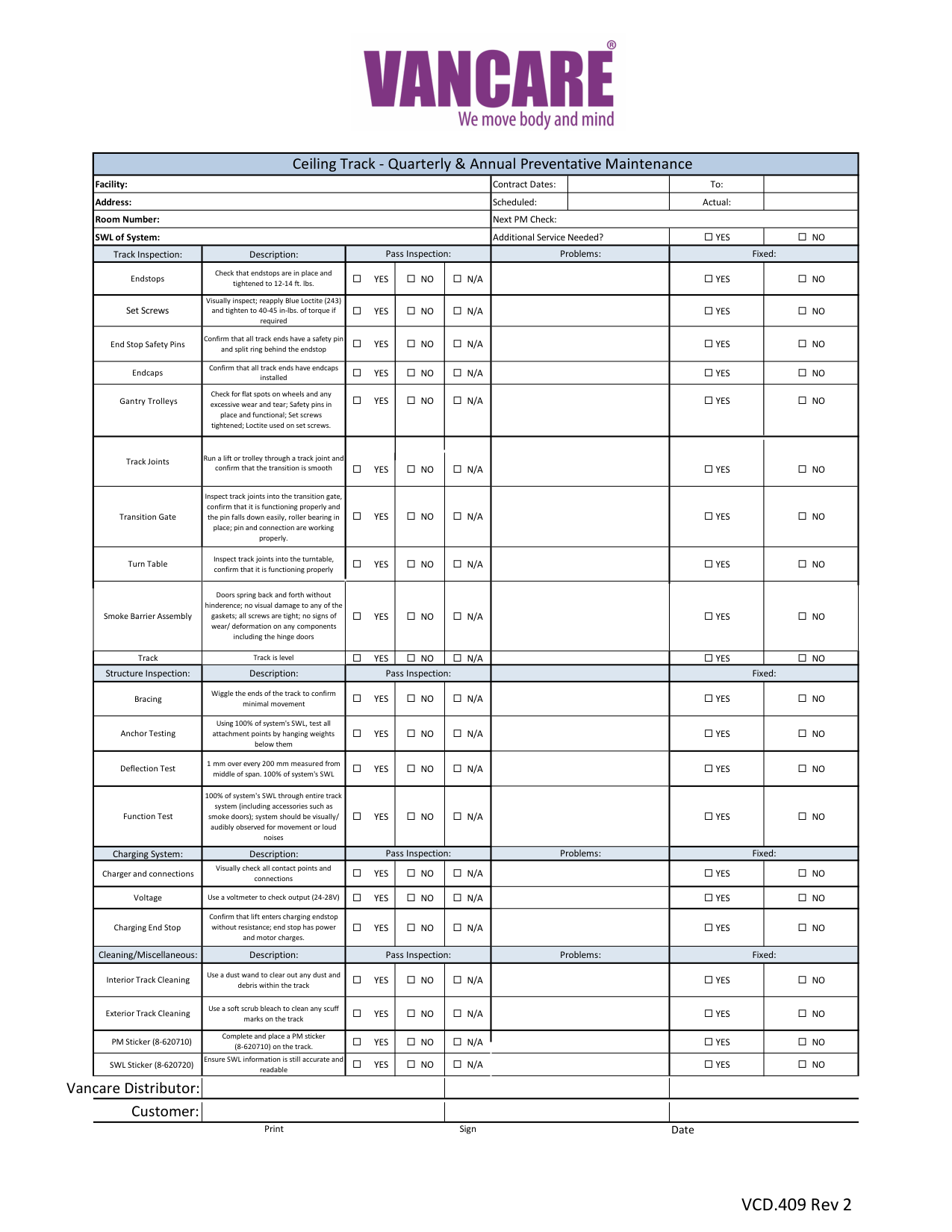
Facility: Contract Dates: To: Address: Scheduled: Actual: Room Number: Next PM Check: SWL of System: Additional Service Needed?
Yes
No
Track Inspection: Description: Endstops Check that endstops are in place and tightened to 12‐14 ft. lbs. Yes
No
N/A
Yes
No
Set Screws Visually inspect; reapply Blue Loctite (243) and tighten to 40‐45 in‐lbs. of torque if required Yes
No
N/A
Yes
No
End Stop Safety Pins Confirm that all track ends have a safety pin and split ring behind the endstop Yes
No
N/A
Yes
No
Endcaps Confirm that all track ends have endcaps installed Yes
No
N/A
Yes
No
Gantry Trolleys Check for flat spots on wheels and any excessive wear and tear; Safety pins in place and functional; Set screws tightened; Loctite used on set screws. Yes
No
N/A
Yes
No
Track Joints Run a lift or trolley through a track joint and confirm that the transition is smooth Yes
No
N/A
Yes
No
Transition Gate Inspect track joints into the transition gate, confirm that it is functioning properly and the pin falls down easily, roller bearing in place; pin and connection are working properly. Yes
No
N/A
Yes
No
Turn Table Inspect track joints into the turntable, confirm that it is functioning properly Yes
No
N/A
Yes
No
Smoke Barrier Assembly Doors spring back and forth without hinderence; no visual damage to any of the gaskets; all screws are tight; no signs of wear/ deformation on any components including the hinge doors Yes
No
N/A
Yes
No
Track Track is level Yes
No
N/A
Yes
No
Structure Inspection: Description: Bracing Wiggle the ends of the track to confirm minimal movement Yes
No
N/A
Yes
No
Anchor Testing Using 100% of system's SWL, test all attachment points by hanging weights below them Yes
No
N/A
Yes
No
Deflection Test 1 mm over every 200 mm measured from middle of span. 100% of system's SWL Yes
No
N/A
Yes
No
Function Test 100% of system's SWL through entire track system (including accessories such as smoke doors); system should be visually/ audibly observed for movement or loud noises Yes
No
N/A
Yes
No
Charging System: Description: Charger and connections Visually check all contact points and connections Yes
No
N/A
Yes
No
Voltage Use a voltmeter to check output (24‐28V) Yes
No
N/A
Yes
No
Charging End Stop Confirm that lift enters charging endstop without resistance; end stop has power and motor charges. Yes
No
N/A
Yes
No
Cleaning/Miscellaneous: Description: Interior Track Cleaning Use a dust wand to clear out any dust and debris within the track Yes
No
N/A
Yes
No
Exterior Track Cleaning Use a soft scrub bleach to clean any scuff marks on the track Yes
No
N/A
Yes
No
PM Sticker (8-620710) Complete and place a PM sticker (8-620710) on the track. Yes
No
N/A
Yes
No
SWL Sticker (8-620720) Ensure SWL information is still accurate and readable Yes
No
N/A
Yes
No
Vancare Distributor: Customer: Print Sign Date Problems: Ceiling Track ‐ Quarterly & Annual Preventative Maintenance Fixed: Pass Inspection: Pass Inspection: Fixed: Problems: Pass Inspection: Fixed: Pass Inspection: Problems: Fixed: VCD.409 Rev 2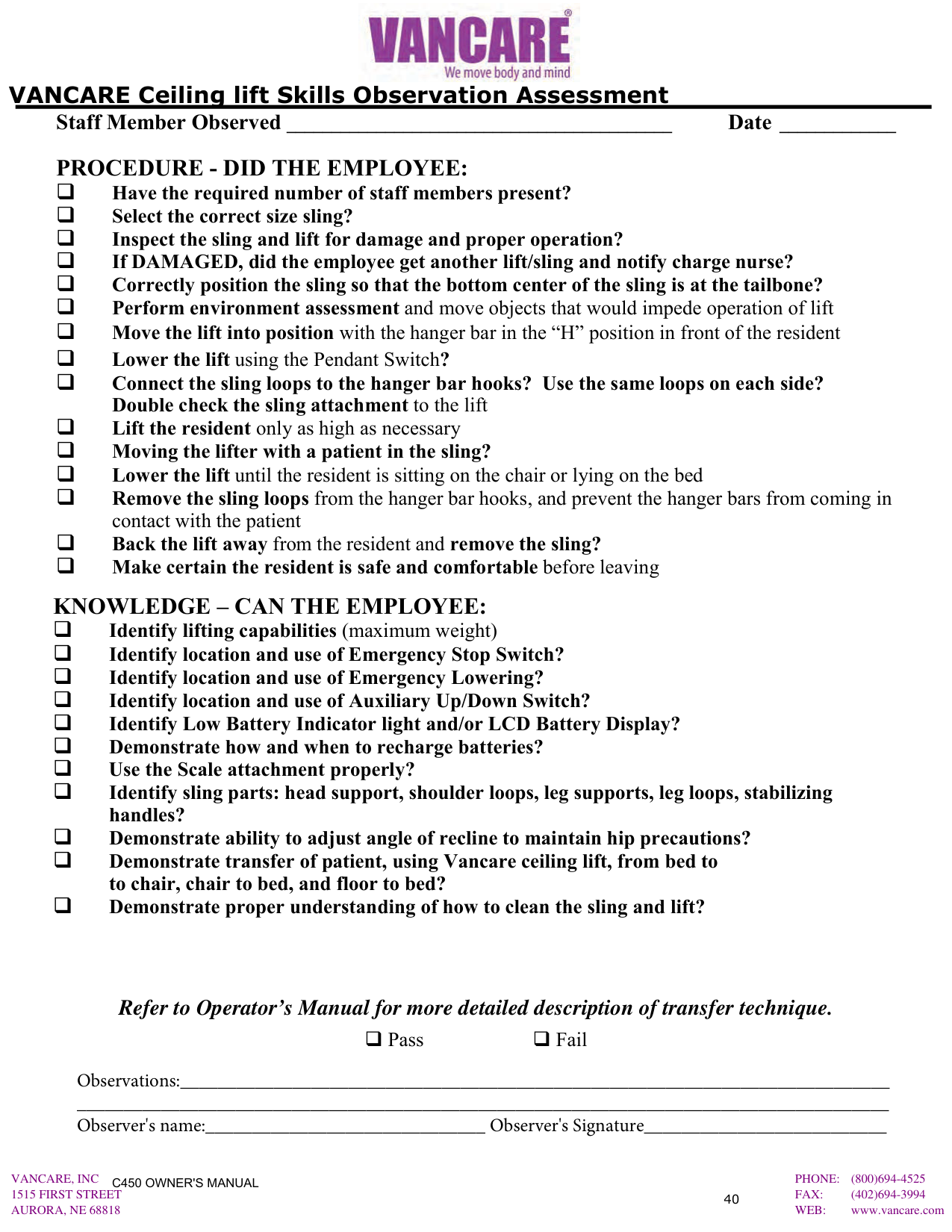
VANCARE Ceiling lift Skills Observation Assessment Staff Member Observed ___________________________________________ Date _____________
Procedure - Did The Employee:
Have the required number of staff members present? Select the correct size sling? Inspect the sling and lift for damage and proper operation? If DAMAGED, did the employee get another lift/sling and notify charge nurse? Correctly position the sling so that the bottom center of the sling is at the tailbone? Perform environment assessment and move objects that would impede operation of lift? Move the lift into position with the hanger bar in the “H” position in front of the resident? Lower the lift using the Pendant Switch? Connect the sling loops to the hanger bar hooks? Use the same loops on each side? Double check the sling attachment to the lift? Lift the resident only as high as necessary? Moving the lifter with a patient in the sling? Lower the lift until the resident is sitting on the chair or lying on the bed? Remove the sling loops from the hanger bar hooks, and prevent the hanger bars from coming in contact with the patient? Back the lift away from the resident and remove the sling? Make certain the resident is safe and comfortable before leaving?