
Ask AI
— answers from the official manualAnswers from the official manual.
Common questions
Common Questions
27 totalHow full can I fill the Inner Pot?
You should never fill the Inner Pot above the MAX line. When using foods that expand during cooking, such as rice or dried beans, do not fill the unit above the halfway point, as overfilling may cause clogging and allow excess pressure to develop. (Page 11)
How can I prepare my Power Cooker Express™ for its first use?
Wash the INNER POT (C), the LID (D) and the RUBBER GASKET (G) with warm soapy water, rinse thoroughly, and dry.
What do I need to ensure before locking the lid?
Make sure nothing is blocking the Pressure Valve or Lid from achieving a tight seal when closed.
How can I turn off the Power Cooker Express™ if it is overheating during use?
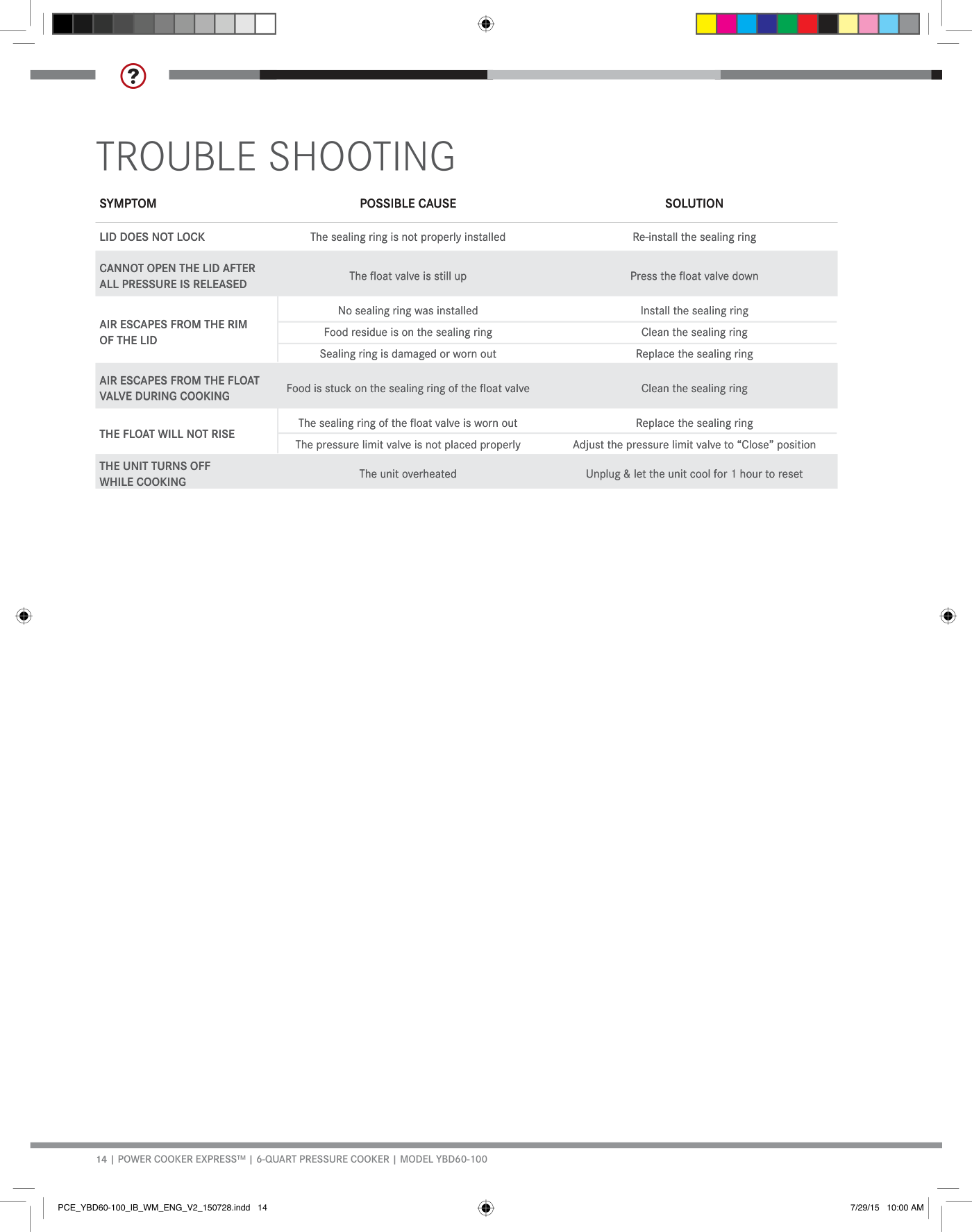
Unplug and let the unit cool for one hour to reset, then plug back in and restart as needed.
How should I clean and maintain my Power Cooker Express™ after each use?
Pour out leftover water, rinse the inner pot with clean water, then towel dry; empty and clean the condensation collector after each use.
Can I use an extension cord with the Power Cooker Express?
No, you should never use the Power Cooker Express with an extension cord of any kind. Always plug the electrical cord directly into a wall outlet. (Page 11)
Show 21 more questions
How do I prepare the Power Cooker Express for first use?
How do I safely release pressure and open the lid after cooking?
What do the indicator lights on the control panel mean?
What should I do if the unit turns off while cooking?
What should I do if the lid won't lock?
Why is air escaping from the rim of the lid during cooking?
What are the power and capacity specifications of the Power Cooker Express?
How do I perform a factory reset on the unit?
What causes steam to escape around the lid?
What are the maintenance steps after each use?
How do I check the operation of safety devices?
What is the function of the Condensation Collector?
Why shouldn't I fill the Inner Pot above the MAX line?
How do I check if my food is sealed properly after canning?
What temperatures are reached during pressure cooking?
Can I override the default cooking time?
What should I do if air escapes from the float valve while cooking?
How do I factory reset the Power Cooker Express™?
What are the safety precautions I need to follow while using the Pressure Cooker?
How do I cook rice properly in my Power Cooker Express™?
How do I clean the Floating Valve?
Full Manual
19 pages

For Model #PPC780

Congratulations...
You are about to discover what so many other food lovers have known for years. Simply, that meals prepared properly with the pressure cooking method taste better and cook faster than foods prepared using conventional stovetop methods.
For decades, our culinary design division has created some of the most useful and popular kitchen appliances for worldwide use. The Power Pressure Cooker XL™ is the latest in our distinguished line.
We have tested and perfected the right combination of metals, cooking surfaces and digital technology guaranteed to help you get mealtime raves from the whole family. Once familiar with the “one-touch” pre-set system, you’ll find that many of your favorite family recipes can be cooked perfectly in a fraction of the time.
The sealed cooking chamber builds up heat and pressure. The result ... more flavor stays locked within the food and less energy is wasted in a shorter cooking time. The “sealed” cooking process eliminates messy stovetop spills while “trapping” heat, making for cooler kitchens and easier cleanups.
The Power Pressure Cooker XL™ will provide you many years of delicious family meals and memories around the dinner table… but before you begin it is very important that you read this entire manual making certain that you are totally familiar with its operation and precautions.
Index
Topic Page Importand Safeguards / Special Features 1-2 Built-In Safety Features / Parts and Accessories 3 Before First Use / Care and Cleaning 4-5 Digital Control Panel 6 Program Settings / Important Information 7 Pressure Cooking Tables / Unit Specifications / FAQ’s 8 PRESSURE CANNING GUIDE 9 Food Acidity / Raw Packing and Hot Packing 10 Processing Time and Pressure / Safe Canning Tips 11 Getting Started 12 Power Cooker Pressure Canning Process 13-14 Limited Warranty 15
Important Safeguards
####### When using electrical appliances, basic safety precautions should always be followed including the following:

SAVE THESE INSTRUCTIONS - FOR HOUSEHOLD USE ONLY.
Important Safeguards (continued)
SHORT CORD INSTRUCTIONS ELECTRIC POWER
A short power-supply cord is provided to reduce the risk resulting from becoming entangled in or tripping over a longer cord. Do not use an extension cord with this product.
If the electrical circuit is overloaded with other appliances, your appliance may not operate properly. It should be operated on a dedicated electrical circuit.
NOTE: This product must be grounded. If it should malfunction or break down, grounding provides a path of least resistance for electric current to reduce the risk of electric shock. This product is equipped with a cord having an equipment grounding conductor and a grounding plug. The plug must be plugged into an appropriate outlet that is properly installed and grounded in accordance with all local codes and ordinances.
SPECIAL FEATURES
position using tongs or another kitchen tool. Never use bare hands.
CAUTION: During this process protect your skin from any contact with escaping steam.
Built-In Safety Features
Power Pressure Cooker XL PARTS & ACCESSORIES
|Ladle

Condensation Collector


Steamer Tray


Wire Canning Rack| |---|

|| |---|

IMPORTANT: Your Power Pressure Cooker XLTM has been shipped with the components shown above. Check everything carefully before use. If any part is missing or damaged do not use this product and contact shipper using the customer service number located on the back cover of the owner’s manual.
####### BEFORE THE FIRST USE
Before using the Power Pressure Cooker XL for the first time, wash the Inner Pot, the Lid and the Rubber Gasket (pictured below # 1) with warm soapy water. Rinse with clean water and dry thoroughly.
To ensure correct fitting of the Rubber Gasket, fill the Inner Pot (pictured below #2) with water about 2/3 full, place the Lid on the cooker (Pictured below #3), then Rotate the Pressure Valve to the Lock position and run on CANNING mode for 10 minutes. When the cycle is complete, useing tongs or another kitchen tool, carefully rotate the Pressure Valve to the Open position (Pictured below #4) allowing all pressure to escape. Let the appliance cool to room temperature. Pour out the water. Rinse and towel dry the Inner Pot. The Power Pressure Cooker XL is now ready for use.
####### #1 Lid (underside) Rubber Gasket

For proper cleaning the Rubber Gasket should be removed. Using the Pull Tab located beneath the Lid, remove the Pot Lid Liner that holds the Gasket. After cleaning, re-attach Gasket to Lid Liner and snap back in place.
####### #3 Placing The Lid On The Cooker

|| |---|
Place Inner Pot into the unit. Never load Inner Pot above the MAX line. Rotate the Inner Pot to make certain that it is seated properly.
Place Lid on Cooker with Handle and Recessed Valve (Fig. A) pointed to the “10:00 o’clock” position. Rotate Lid counter-clockwise until you feel a click.
HOT LID WARNING: Use black composite handle only when opening lid. The stainless steal parts become very hot and could burn your hands.

####### #2 Inner Pot
Note Max Fill Line

2/3


####### Open Position Lock Position
####### #4 Pressure Valve
WARNING: Avoid serious injury... Never use your hand to set the Pressure Valve in the Open Position after any cooking process. Use tongs or some other kitchen tool.
|| |---|
####### Condensation Collector
The Condensation Collector easily picks up any moisture that may drip off when using your Power Pressure Cooker XL. Simply align and push the collector into the channels on the back of the cooker. Empty and clean after each use.
CAUTION: During this process protect your skin by avoiding any contact with escaping steam or the stainless steel portion of the Pot Lid.
• Press down gently on Lid and turn clockwise until Lid meets resistance... lift carefully and place aside. Avoid personal injury resulting from hot unit surfaces and dripping liquids.
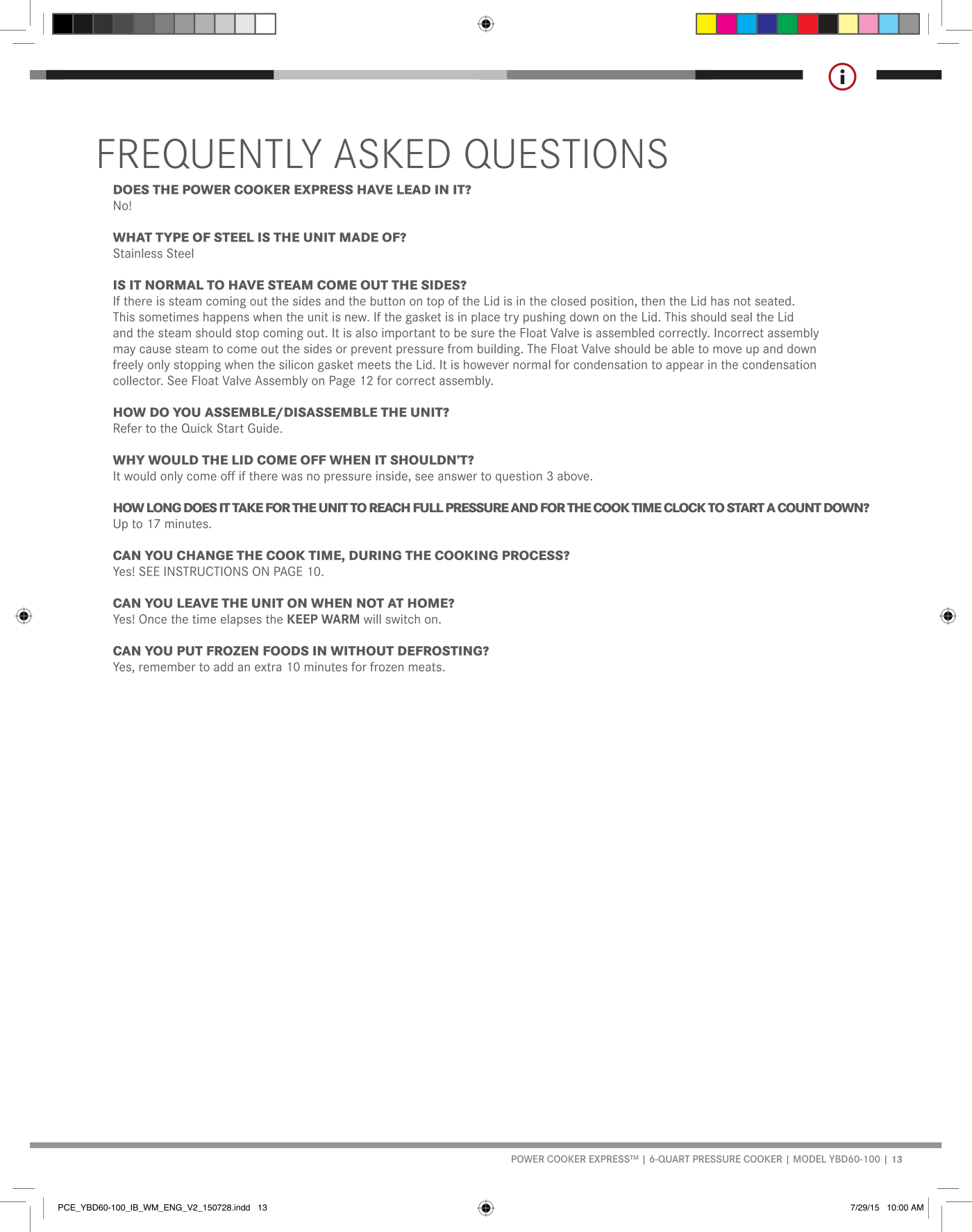
Note: The “cook times” shown in the recipe booklet do not include the additional time needed to pressurize the unit before cooking begins. Full pressurization could take up to 17 minutes.
####### CARE AND CLEANING
CLEANING THE SAFETY DEVICES: In addition to the gasket, the other safety devices on the Power Pressure Cooker XL must also be cleaned after each use. THE PRESSURE VALVE: To remove the Pressure Valve, simply pull up and valve will release from its spring lock mechanism. Apply mild detergent and wash it
under warm running water. After cleaning, check to see that the interior spring-loaded part moves freely by pressing down on it. Put the Pressure Valve back in place by pushing it down onto the spring-loaded mechanism. This appliance requires little maintenance. It contains no user serviceable parts. Do not try to repair it yourself. Contact customer service for qualified repair information.
TO CLEAN: After use, unplug unit and allow to cool completely before cleaning. The Power Pressure Cooker XL must be cleaned thoroughly after each use in order to avoid staining caused by a build-up of food or cooking residue.
DO NOT POUR COLD WATER INTO A HOT Power Pressure Cooker XL. Note: To ensure safe operation of this Power Pressure Cooker XL, strictly follow the cleaning and maintenance instructions after each use, should a tiny bit of food (such as a grain of rice or pea shell) remain in the unit, it could prevent the safety devices from operating during subsequent use. IMPORTANT: Always remove the Pressure Valve and clean the opening with pin to remove any blockage that might have occurred during the cooking process. This must be done after each use. The removable cooking pot and Lid are immersible for cleaning. Rinse cooking pot and Lid under hot running water. Use only a mild liquid detergent and a soft cloth, sponge or nylon scrubber for cleaning. Do not use abrasive powders, bicarbonate of soda or bleach. Do not use scouring pads. WIPE BASE AFTER EACH USE WITH A SOFT, DAMP CLOTH OR SPONGE, MAKING SURE ALL FOOD RESIDUE IS REMOVED. DO NOT IMMERSE BASE IN WATER
When cleaning the Lid, the Rubber Gasket (page 4, Illustration #1) must be removed and washed separately with a sponge or soft cloth and warm, soapy water.
####### DIGITAL CONTROL PANEL

####### The Power Pressure Cooker XL has seven basic cooking modes that may be used alone or in combination to produce an infinite variety of results.
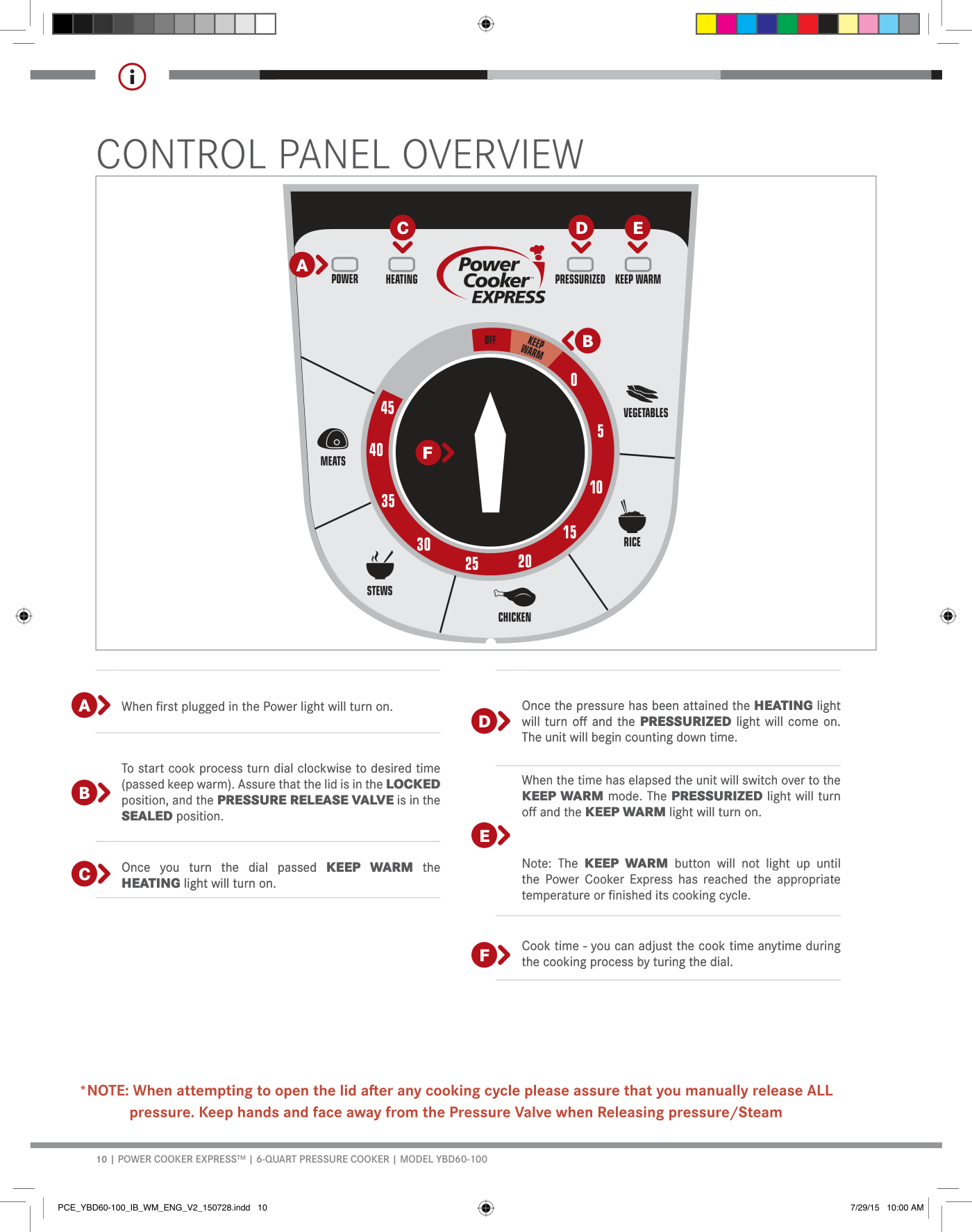
WHEN THE UNIT IS FIRST PLUGGED IN, 0000 will appear on the LED Display. When a cooking process is selected, such as CANNING/PRESERVING, the default time will be displayed for 5 seconds in the LED window. Then a rotating effect will appear on the screen to signify it is building pressure. Once pressure is built, the rotating effect will end and the display will begin counting down the time. When the process is completed, the unit will beep and enter KEEP WARM mode until cancelled.
COOK TIME SELECTOR BUTTON: When a specific cooking program is selected, the unit will display the default time in the LED window and the “Food:Quick” indicator below the LED window will light. Should your recipe or personal taste require “Medium” or “Well” results, you may select those options by pushing the Cook Time Selector button. In addition, the Cook Time Selector Button may be used when cooking Rice to select the perfect program for White, Brown or Wild varieties.
NOTE: You may override pre-programmed time by selecting the Time Adjustment button. IMPORTANT: Any function can be stopped immediately by selecting the CANCEL button.
|Program Buttons|Default Time|Quick- Med-Well Select Button|Cook Time Adjust Range|Temperature ° C ° F|Pressure kPa PSI| |---|---|---|---|---|---| |Delay Timer|N / A|N / A|0-24 hrs| | | |Canning / Preserving|10 mins|10-45-120 mins|10-120 mins|116 241|82.7 12| |Soup / Stew|10 mins|10-30-60 mins|10-60 mins|109 228|50 7.2| |Slow Cook|2 hrs|2-6-12 hrs|2-12 hrs|79-93 174-199|<30 <4.3| |Rice / Risotto|6 mins|6-18-25 mins|6-25 mins|109 228|50 7.2| |Beans / Lentils|5 mins|5-15-30 mins|5-30 mins|109 228|50 7.2| |Fish / Veg. / Steam|2 mins|2-4-10 mins|2-10 mins|109 228|50 7.2| |Meat / Chicken|15 mins|15-40-60 mins|15-60 mins|109 228|50 7.2| |Time Adjustment|10 mins|N / A|10-120 mins| | | |Cancel / Keep Warm|N / A|N / A|N / A| | |
##### IMPORTANT INFORMATION
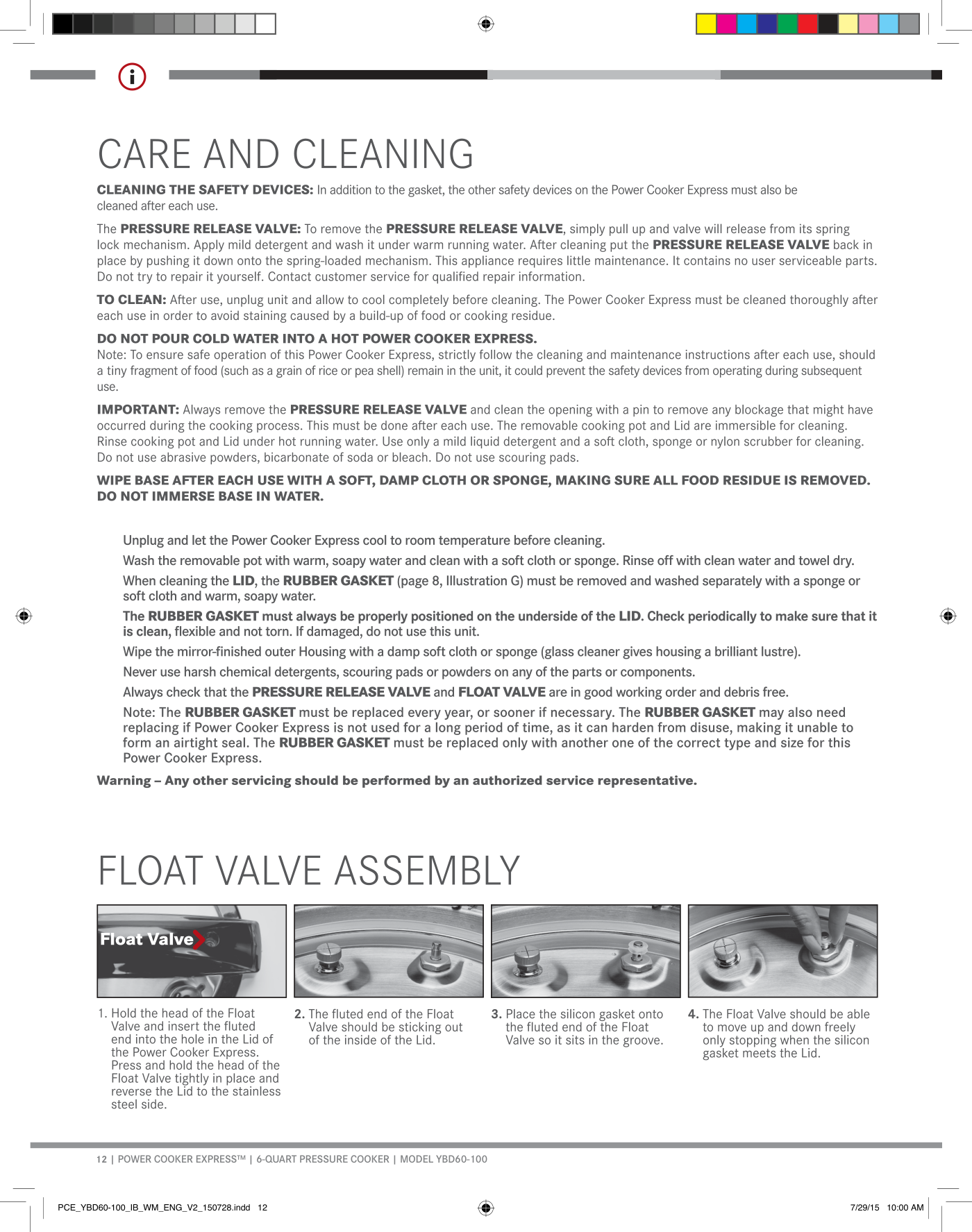
If there is steam coming out the sides and the Pressure Valve on top of the Lid is in the Lock position, then the Lid has not seated. This sometimes happens when the unit is new. If the gasket is in place try pushing down on the Lid. This should seal the Lid and the steam should stop coming out. It is also important to be sure the Float Valve is assembled correctly. Incorrect assembly may cause steam to come out the sides or prevent pressure from building. The Float Valve should be able to move up and down freely only stopping when the silicon gasket meets the Lid. It is however normal for condensation to appear in the condensation collector. See illustration below for assembly.
|| |---|
|| |---|
|| |---|
|| |---|
##### PRESSURE COOKING CHARTS
|Meats|Liquid / Cups|Approximate Minutes| |---|---|---| |Beef/Veal, roast or brisket|3-4|35-40|
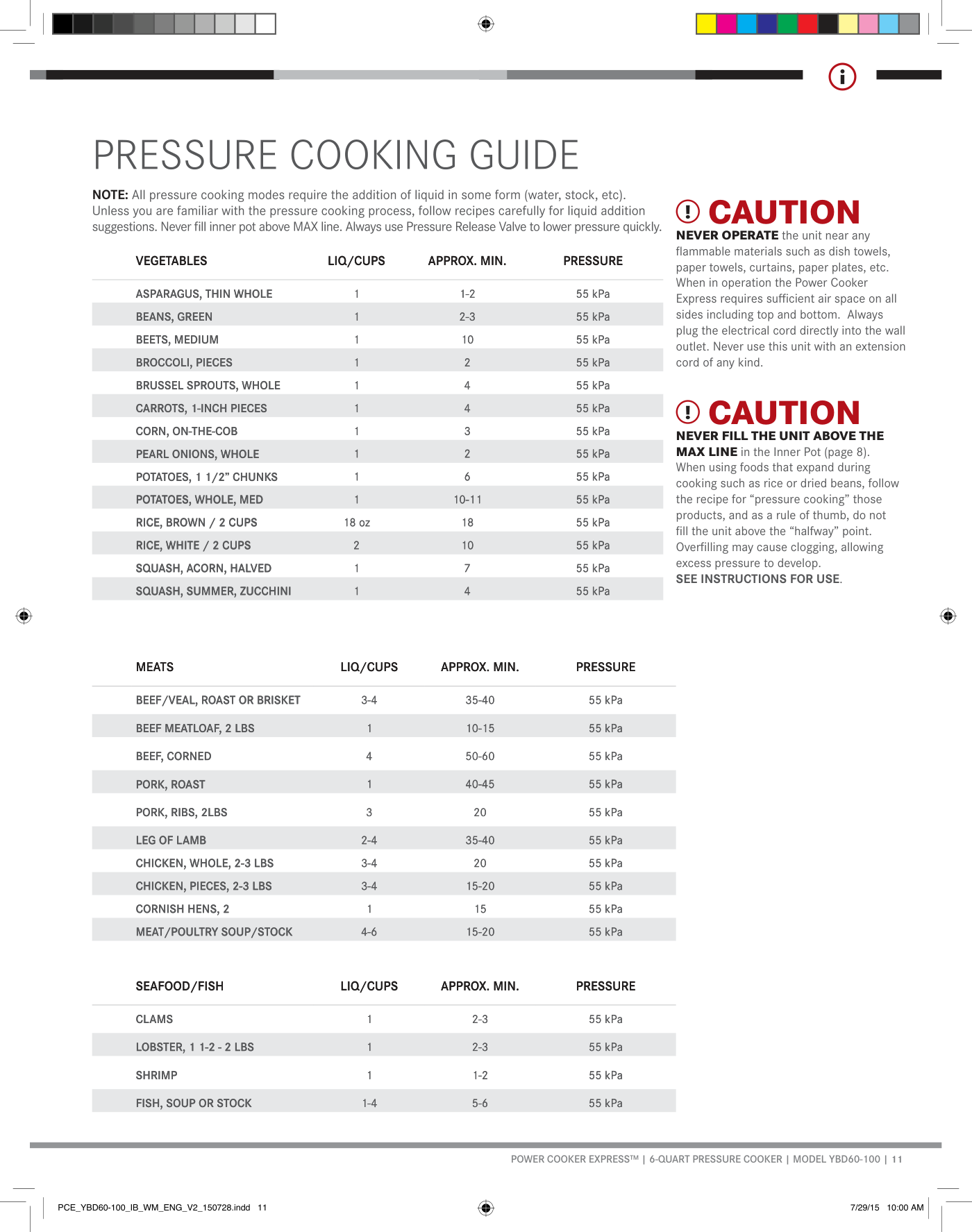
|Beef Meatloaf, 2 lbs|1|10-15| |Beef, Corned|4|50-60| |Pork, roast|1|40-45| |Pork, ribs, 2 lbs.|3|20| |Leg of Lamb|2-4|35-40| |Chicken, whole, 2-3 lbs.|3-4|20| |Chicken, pieces, 2-3 lbs.|3-4|15-20| |Cornish Hens, two|1|15| |Meat/Poultry Soup/Stock|4-6|15-20|
|Seafood / Fish|Liquid / Cups|Approximate Minutes| |---|---|---| |Clams|1|2-3| |Lobster, 1 1/2 - 2 lbs.|1|2-3| |Shrimp|1|1-2| |Fish, Soup or Stock|1-4|5-6|
##### UNIT SPECIFICATIONS
|Vegetables|Liquid / Cups|Approximate Minutes| |---|---|---| |Asparagus, thin whole|1|1 -2| |Beans, fava|1|4| |Beans, green|1|2-3|
|Beans, lima|1|2| |Beets, medium|1|10| |Broccoli, pieces|1|2| |Brussel sprouts, whole|1|4| |Carrots, 1-inch pieces|1|4| |Corn, on-the-cob|1|3| |Pearl Onions, whole|1|2| |Potatoes, 1 1/2” chunks|1|6| |Potatoes, whole, medium|1|10-11| |Squash, acorn, halved|1|7| |Squash, summer, zucchini|1|4|
NOTE: All pressure cooking modes require the addition of liquid in some form (water, stock, etc.). Unless you are familiar with the pressure cooking process, follow recipes carefully for liquid addition suggestions. Never fill inner pot above MAX line. Always use Pressure Valve to lower pressure quickly.
|Model Number|Supply Power|Rated Power|Capacity of Inner Pot|Working Pressure|Safety Working Pressure| |---|---|---|---|---|---| |PPC780|AC 120V 60HZ|1300W|8QT|0-80 kPa|80-90 kPa|
##### FREQUENTLY ASKED QUESTIONS
Great Food Anytime...
The canning process will enable you to prepare and preserve all of your family’s favorites including fresh and cooked fruits, vegetables, meats, jams and jellies. Canning is a great way to bring “out of season” foods to the table economically. You can buy in bulk now at low prices and preserve for the future when items are scarce and more costly.
NOTE: It is important that you read this guide carefully following all steps to ensure that the food has been processed to preserve its nutritional value and is safe for consumption by your family. Improper canning can lead to serious health consequences.
##### Pressure Canning
The Pressure Canning process can be used for all foods and particularly for those containing little acid. These include vegetables, meats and seafood.
When canning there is no room for experimentation. Altering cooking time, ingredients and temperatures can be dangerous and risky. Using the exact time, temperature and method specified in the recipe will protect the food from harmful bacteria, molds and enzymes. Adding too much time to a recipe will destroy nutrients and flavor.
Food enzymes can promote the growth of molds and yeasts, which in turn will cause food to spoil. These agents can be destroyed by achieving a temperature of 212° with steam canning methods however other contaminants may develop such as salmonella, staphylococcus aureus, and clostridium botulinum, the cause of botulism. Killing these harmful bacteria requires a temperature of 240° provided only by the Pressure Canning process.

##### Food Acidity
The lower the acid content in the food, the greater the potential for spoilage and contamination. Many foods such as fruits are high in acid where as others such as meats, dairy products and sea foods have low acid levels. (see charts below)
Proper Pressure Canning minimizes the possibility of spoilage and contamination.
##### Examples of High Acid Foods
##### Examples of Low Acid Foods
|Apples|Oranges| |---|---| |Applesauce|Peaches| |Apricots|Pears| |Berries|Pickled Beets| |Cherries|Pineapple| |Cranberries|Plums| |Fruit Juices|Rhubarb|
|Asparagus|Mushrooms| |---|---| |Beans|Okra| |Beets|Peas| |Carrots|Potatoes| |Corn|Seafood|

|Hominy|Spinach| |Meat|Winter Squash|
##### Raw Packing and Hot Packing
Fresh foods contain air. The shelf life of canned food depends on how much air has been removed during the canning process. The more air removed, the longer the shelf life.
Raw Packing is the process of canning fresh but unheated foods. The process causes foods such as fresh fruit to float in their jars. Raw packed foods tend to lose color over time. Raw packing may be preferable in some recipes.
Hot Packing is the process of canning foods that have been pre-cooked prior to packing them in their jars. This reduces the air in the food. Regardless of the method used, all liquids added to the foods should always be heated to a boiling point. This will remove excess air, shrink the foods, prevent floating and create a tighter seal.
IMPORTANT INFORMATION Altitude and Pressure Canning The temperature at which water will boil can vary depending upon your location in regards to sea level. The Power Pressure Cooker XL will operate properly up to a maximum altitude of 2,000 ft. above sea level. Do not use this unit for pressure canning above an altitude of 2,000 ft.
##### Processing Time and Pressure
The chart below demonstrates proper processing time and pressure for various foods using your Power Pressure Cooker XL. The CANNING button sets the pressure. A kPa setting of 80 is equal to 11.6 lbs. PSI. At up to 2,000 ft. above sea level, the Power Pressure Cooker XL with a kPa 80 setting will produce sufficient pressure and heat to safely process all foods for canning.

For processing times and methods for additional low acid foods, please refer to the National Center for Home Food Preservation (http://www.uga.edu/nchfp/): or your local county extension agent.
##### Safe Canning Tips
##### Getting Started
Your Power Pressure Cooker XL is designed to accommodate 4 - 16 oz. (1 pint) wide mouth jars per canning session. We suggest you use jars with self-sealing lids.
####### Jar Cleaning
Always wash empty jars in hot water with detergent by hand or in dishwasher. Rinse thoroughly. Scale or hard-water films on jars are easily removed by soaking jars several hours in a solution containing 1 cup of vinegar (5 percent acidity) per gallon of water.
####### Lid Preparation
The self-sealing lid (A) consists of a flat metal lid held in place during processing by a metal screw band (B). When jars are processed, the lid gasket softens to form an airtight seal with the jar. To ensure a good seal, carefully follow the manufacturer’s directions in preparing lids for use. Examine all metal lids carefully.
Do not use old, dented, or deformed lids, or lids with gaps or other defects in the sealing gasket.
|
A
B
Lid & Jar Assembly| |---|
##### Additional Accessories You May Need


Canning Tongs16oz. Canning Jars
##### The Power Pressure Cooker XL Pressure Canning Process
####### To begin, select a recipe that has been pre-tested and approved for pressure canning. Though ingredients vary, generally speaking you will be processing the food as demonstrated in this guide.

FIG. 1
Lid
Headspace Liquid Level
|
FIG. 3| |---|

|
FIG. 2| |---|
NOTE: Never retighten lids after processing jars. As jars cool, the contents contract, pulling the self-sealing lid firmly against the jar to form a high vacuum.
If screw bands are too loose, liquid may escape from jars during processing, and seals may fail.
If screw bands are too tight, air cannot vent during processing, and food will discolor during storage. Over tightening also may cause lids to buckle and jars to break, especially with raw-packed, pressureprocessed food. Screw bands are not needed on stored jars. They should be removed after jars are cooled.
When removed, washed, dried, and stored, screw bands may be used many times. If left on stored jars, they become difficult to remove, often rust, and may not work properly again.
Lid


Jars and Rack

Inner Pot
Base
|Inner Pot Hot Water Level
| |---|
IMPORTANT: The Power Pressure Cooker XL when used as a pressure canning device does not have an effective operating capacity for more than 2,000 ft. above sea level.

We are very proud of the design and quality of our
This product has been manufactured to the highest standards. Should you have any problem, our friendly customer service staff is here to help you.
1-973-287-5169
Distributed By: Tristar Products, Inc. Fairfield, NJ 07004

© 2014 Tristar Products, Inc.
PPC_780_8QT IB_QVC_ENG_V1_141216