
Ask AI
— answers from the official manualAnswers from the official manual.
Common questions
Common Questions
10 totalHow can I configure my unit’s operation using a dry contact connection?
Connect an external switch or any dry contact to activate the vent input if no specific input is available on the thermostat. Choose between minimum, intermittent, automatic, and maximum modes based on outdoor temperature conditions.
How do I ensure proper insulation for ducts in unconditioned spaces?
Use insulated ductwork to prevent condensation when ducts pass through areas such as attics. Maintain continuous airflow, especially below freezing temperatures, to avoid moisture issues.
What causes an 'E40' wall control communication error?
Unplug the unit and inspect wiring connections for loose wires or damage. Test with a short cable if necessary, and replace the wall control or electronic assembly as indicated.
How can I reset the settings on my unit?
Press and hold the OK button and (-) buttons simultaneously for 4 seconds to enter the reset menu. Use (+/-) buttons to select Yes or No, then press OK to confirm. (Page 16)
What should I do if my unit displays an 'E02' error?
Unplug the unit and check the exhaust damper system for obstacles or dirt. If it does not resolve, open the electrical compartment and ensure J7 (red) connector is fully inserted with no loose wires. Replace the electronic assembly if only the damper moves but the error persists; otherwise, replace the damper system. (Page 20)
How do I install the MERV13 filter?
Pull out the core about 3-4 inches to insert the MERV13 filter on top of it, ensuring proper orientation. Bend two MERV13 flaps down at a 45-degree angle, then push both the core and filter back into place. (Pages 22, 27)
Full Manual
22 pages
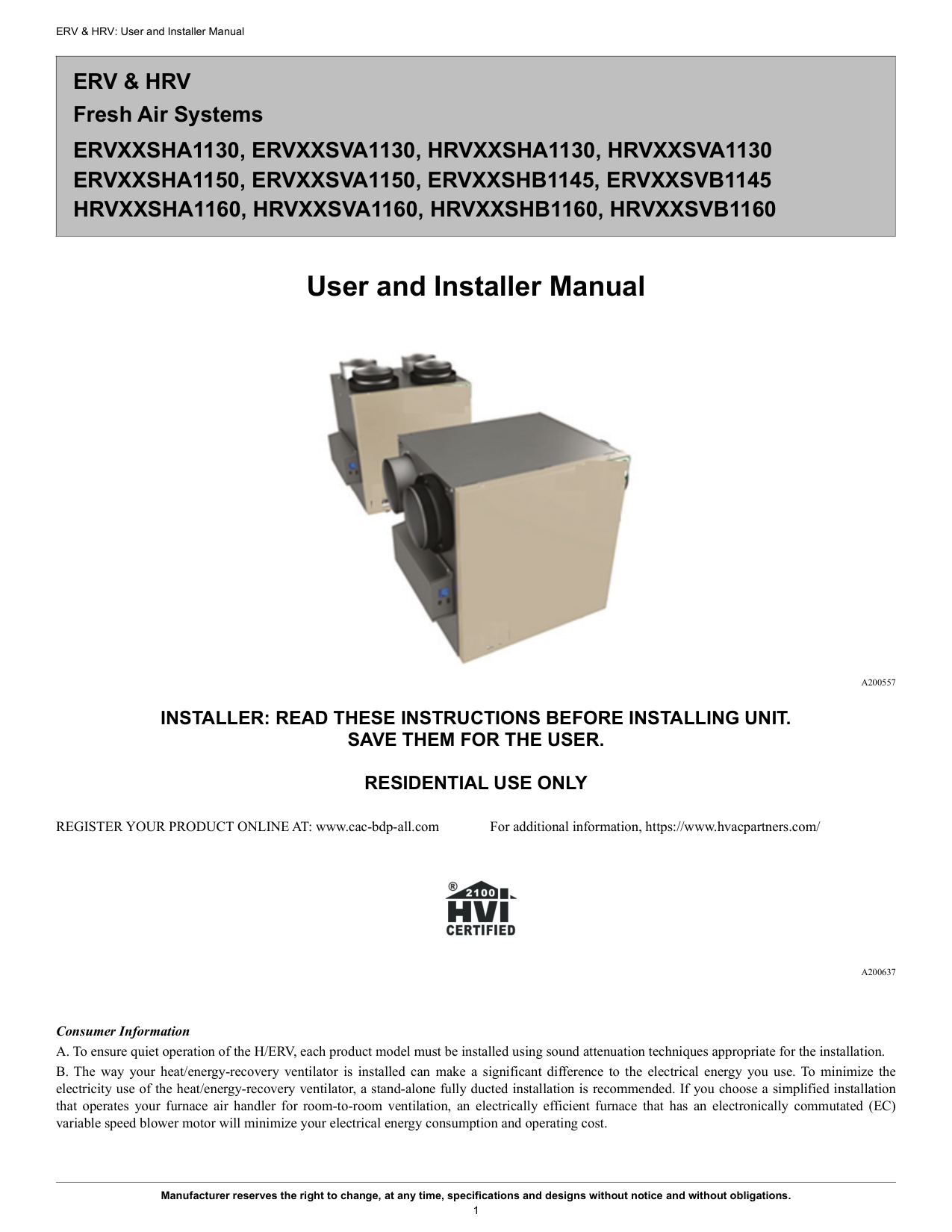
|ERV & HRV Fresh Air Systems
ERVXXSHA1130, ERVXXSVA1130, HRVXXSHA1130, HRVXXSVA1130 ERVXXSHA1150, ERVXXSVA1150, ERVXXSHB1145, ERVXXSVB1145 HRVXXSHA1160, HRVXXSVA1160, HRVXXSHB1160, HRVXXSVB1160| |---|
User and Installer Manual

INSTALLER: READ THESE INSTRUCTIONS BEFORE INSTALLING UNIT. SAVE THEM FOR THE USER.
RESIDENTIAL USE ONLY
REGISTER YOUR PRODUCT ONLINE AT: www.cac-bdp-all.com For additional information, https://www.hvacpartners.com/

A200557
A200637
####### Consumer Information
Please take note that this manual uses the following symbols to emphasize particular information:

Recognize safety information. When you see this symbol on the unit and in instructions or manuals, be alert to the potential for personal injury. Understand the signal words DANGER, WARNING, and CAUTION. These words are used with the safety-alert symbol. DANGER identifies the most serious hazards, which will result in severe personal injury or death. WARNING signifies hazards, which could result in personal injury or death. CAUTION is used to identify unsafe practices, which may result in minor personal injury or product and property damage. NOTE is used to highlight suggestions which will result in enhanced installation, reliability, or operation.
##### LIMITATION
For residential (domestic) installation only. Installation work and electrical wiring must be done by a qualified person in accordance with all applicable codes and standards, including fire-rated construction codes and standards.
|WARNING!
| |---| |TO REDUCE THE RISK OF FIRE, ELECTRIC SHOCK, OR INJURY TO PERSON(S) OBSERVE THE FOLLOWING
1. Use this unit only in the manner intended by the manufacturer.
2. Before servicing or cleaning this unit, disconnect power cord from electrical outlet.
3. This unit is not designed to provide combustion and/or dilution air for fuel-burning appliances.
4. When cutting or drilling into a wall or ceiling, do not damage electrical wiring and other hidden utilities.
5. Do not use this unit with any solid-state speed control device other than those specified in (CONNECTIONS on p8).
6. This unit must be grounded. The power supply cord has a 3-prong grounding plug for your personal safety. It must be plugged into a mating 3-prong grounding receptacle, grounded in accordance with the national electrical code and local codes and ordinances. Do not remove the ground prong. Do not use an extension cord.
7. Do not install in a cooking area or connect directly to any appliances.
8. Do not use to exhaust hazardous or explosive materials and vapors.
9. When performing installation, servicing or cleaning this unit, it is recommended to wear safety glasses and gloves.
10. When applicable local regulation comprises more restrictive installation and/or certification requirements, the aforementioned requirements prevail on those of this document and the installer agrees to conform to these at his own expenses.
|
|CAUTION!
| |---| |TO AVOID UNIT DAMAGE AND ENSURE LONG LIFE
1. To avoid prematurely clogged filters, turn the unit OFF during construction or renovation.
2. Please read specification label on product for further information and requirements.
3. Be sure to duct air outside – Do not intake/exhaust air into spaces within walls or ceiling or into attics, crawl spaces, or garage. Do not attempt to recover the exhaust air from a dryer or a range hood.
4. Intended for residential installation only in accordance with the requirements of NFPA 90B (for a unit installed in U.S.A.) or Part 9 of the National Building Code of Canada (for a unit installed in Canada).
5. Do not run any air ducts directly above or within 2 feet (0.61 m) of a furnace or its supply plenum, boiler, or other heat producing appliance. If a duct has to be connected to the furnace return plenum, it must be connected 10 feet (3.1 m) away from plenum’s connection to the furnace.
6. The ductwork is intended to be installed in compliance with all applicable local and national codes.
7. When leaving the house for a long period of time (more than two weeks), a responsible person should regularly check if the unit operates adequately.
8. If the ductwork passes through an unconditioned space (e.g.: attic), the unit must operate continuously except when performing maintenance and/or repair. Also, the ambient temperature of the house should never drop below 18°C (65°F).
9. At least once a year, the unit mechanical and electronic parts should be inspected by qualified service personnel.
10. Do not use your unit during construction or renovation of your house or when sanding drywall. Certain types of dust and vapors may damage your system.
11. Make sure at all times that the outside intake and exhaust hoods are free from any snow during the winter season. It is important to check your unit during a big snow storm, so it doesn’t draw in any snow. If this is the case, please turn the unit OFF for a few hours.
12. Since the electronic control system of the unit uses a microprocessor, it may not operate correctly because of external noise or very short power failure. If this happens, unplug the unit and wait approximately 10 seconds. Then, plug the unit in again.
13. Do not make excessive use of fragrance appliances or chemicals since some may damage the unit components material.
|
#### TABLE OF CONTENTS
LIMITATION . . . . . . . . . . . . . . . . . . . . . . . . . . . . . . . . . . . . . . . . 2 TABLE OF CONTENTS . . . . . . . . . . . . . . . . . . . . . . . . . . . . . . . . . . 3 AIR DISTRIBUTION (NORMAL OPERATION) . . . . . . . . . . . . . . 4 INSTALLATION . . . . . . . . . . . . . . . . . . . . . . . . . . . . . . . . . . . . . . . . 4
LOCATING AND MOUNTING THE UNIT . . . . . . . . . . . . . . . . 4 Choose an appropriate location for the unit:. . . . . . . . . . . . . . . . 4 Suspended to the Joists or Trusses:. . . . . . . . . . . . . . . . . . . . . . . 4 Wall Mounted: . . . . . . . . . . . . . . . . . . . . . . . . . . . . . . . . . . . . . . 4
INSTALLING THE DUCTWORK AND THE REGISTERS . . . 5 FULLY DUCTED SYSTEM (T-1) . . . . . . . . . . . . . . . . . . . . . . 5 EXHAUST DUCTED SYSTEM (T-2) . . . . . . . . . . . . . . . . . . . 5 CONNECTING THE DRAIN (HRV ONLY) . . . . . . . . . . . . . . 6 INSTALLING DUAL EXTERIOR HOOD USING TANDEM® TRANSITION KIT (OPTIONAL) . . . . . . . . . . . . . . . . . . . . . . . 7 INSTALLING THE EXTERIOR HOODS . . . . . . . . . . . . . . . . 7 CONNECTING THE DUCTS TO THE UNIT . . . . . . . . . . . . . 7
CONNECTIONS . . . . . . . . . . . . . . . . . . . . . . . . . . . . . . . . . . . . . . . . 8 ELECTRICAL CONNECTION TO OPTIONAL MAIN WALL CONTROL. . . . . . . . . . . . . . . . . . . . . . . . . . . . . . . . . . . . . . . . . . . 8 Connection to Speed Selector, Automatic, Dehumidistat or Premium Optional Main Wall Control . . . . . . . . . . . . . . . . . . . . . . . . . . . . . 9 Electrical Connection to Optional Auxiliary Wall Control . . . . . . 9 Electrical Connection to Bathroom Override Optional Auxiliary Wall Control . . . . . . . . . . . . . . . . . . . . . . . . . . . . . . . . . . . . . . . . 9 Electrical Connection to Dry Contact Optional Auxiliary Wall Control (Crank Timer). . . . . . . . . . . . . . . . . . . . . . . . . . . . . . . . . . . . 9
CONNECTION TO THE CENTRAL FORCED-AIR SYSTEM 10 Unit Operation Using a Dry Contact Connection. . . . . . . . . . . 10 UNIT INTERCONNECTION WITH CENTRAL FORCED-AIR SYSTEM (R/C/G/GF) . . . . . . . . . . . . . . . . . . . . . . . . . . . . . . . 10 SYNCHRONIZATION WITH CENTRAL FORCED-AIR SYSTEM FUNCTION . . . . . . . . . . . . . . . . . . . . . . . . . . . . . . . . . . . . . . . . . 11 Infinity®/Evolution™ Control . . . . . . . . . . . . . . . . . . . . . . . . . . 11
WIRING DIAGRAM . . . . . . . . . . . . . . . . . . . . . . . . . . . . . . . . . . . . 12 NAVIGATION ON LCD SCREEN. . . . . . . . . . . . . . . . . . . . . . . . . 13 UNIT FIRST BOOT. . . . . . . . . . . . . . . . . . . . . . . . . . . . . . . . . . . . . 14
PREPARATION . . . . . . . . . . . . . . . . . . . . . . . . . . . . . . . . . . . . . 14 AUTO-BALANCING PROCEDURE. . . . . . . . . . . . . . . . . . . . . 14
PROCEDURE TO RESET SETTINGS. . . . . . . . . . . . . . . . . . 14
USING THIS UNIT . . . . . . . . . . . . . . . . . . . . . . . . . . . . . . . . . . . . . 15 YOUR VENTILATION SYSTEM . . . . . . . . . . . . . . . . . . . . . . . 15 INTEGRATED CONTROL . . . . . . . . . . . . . . . . . . . . . . . . . . . . 15
MODE SELECTION . . . . . . . . . . . . . . . . . . . . . . . . . . . . . . . . 15
AHU MODE DISPLAY . . . . . . . . . . . . . . . . . . . . . . . . . . . . . . . 15 SERVICE PARTS . . . . . . . . . . . . . . . . . . . . . . . . . . . . . . . . . . . . . . 16 INSTALLER’S TROUBLESHOOTING. . . . . . . . . . . . . . . . . . . . . 18
QUARTERLY . . . . . . . . . . . . . . . . . . . . . . . . . . . . . . . . . . . . . . . 21 ANNUAL (AT FALL). . . . . . . . . . . . . . . . . . . . . . . . . . . . . . . . . 22
USER’S TROUBLESHOOTING. . . . . . . . . . . . . . . . . . . . . . . . . . . 22
#### AIR DISTRIBUTION (NORMAL OPERATION)
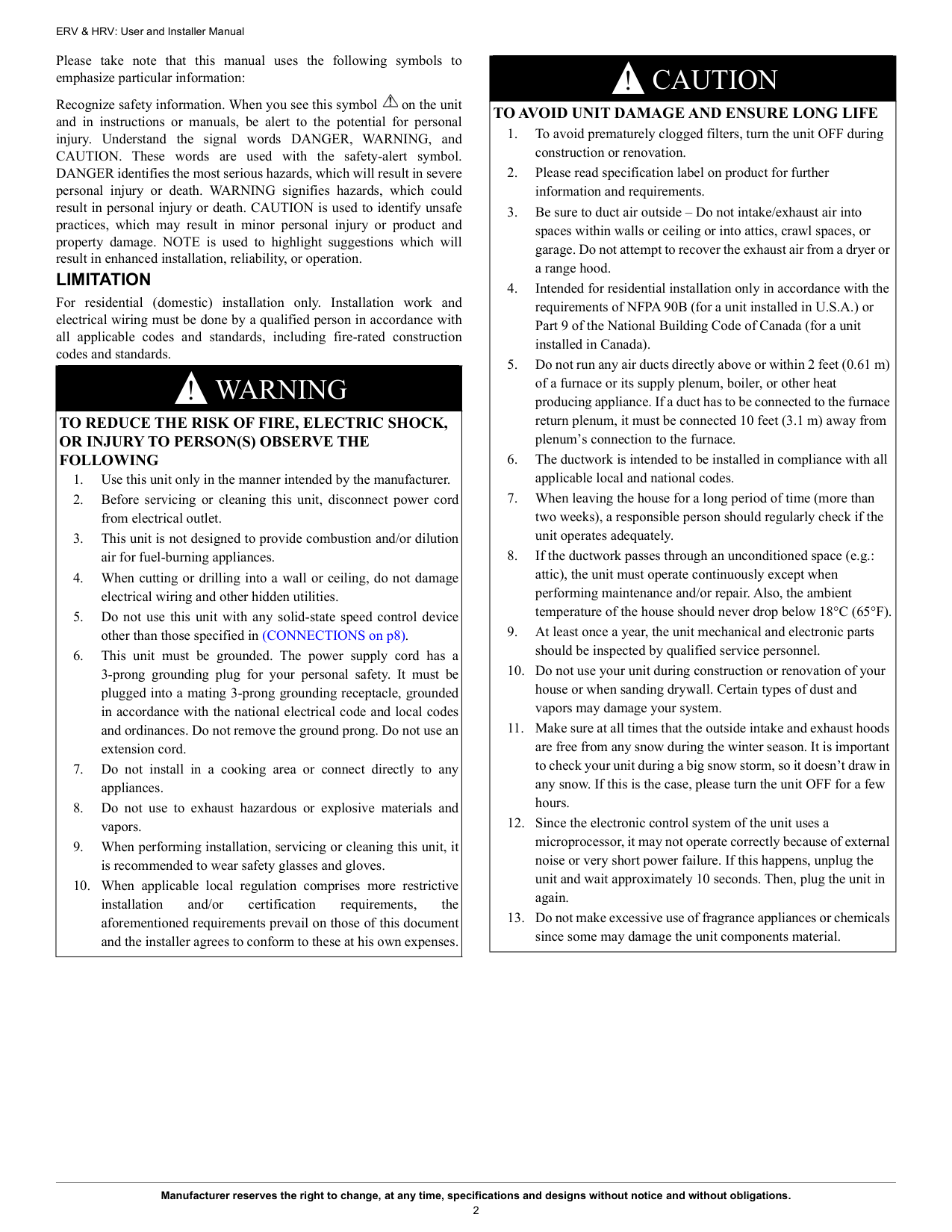

A200558 Fig. 1 – Air Distribution
NOTE: The dimensions, performance charts, defrost cycle tables and specifications are listed on the specification sheets of the unit. Visit our website at https://www.hvacpartners.com/.

#### INSTALLATION
|CAUTION!
| |---| |SAFETY HAZARD Failure to follow this caution could result in bodily injury. When performing installation, servicing or cleaning the unit, it is recommended to wear safety glasses and gloves.|
##### LOCATING AND MOUNTING THE UNIT Choose an appropriate location for the unit:
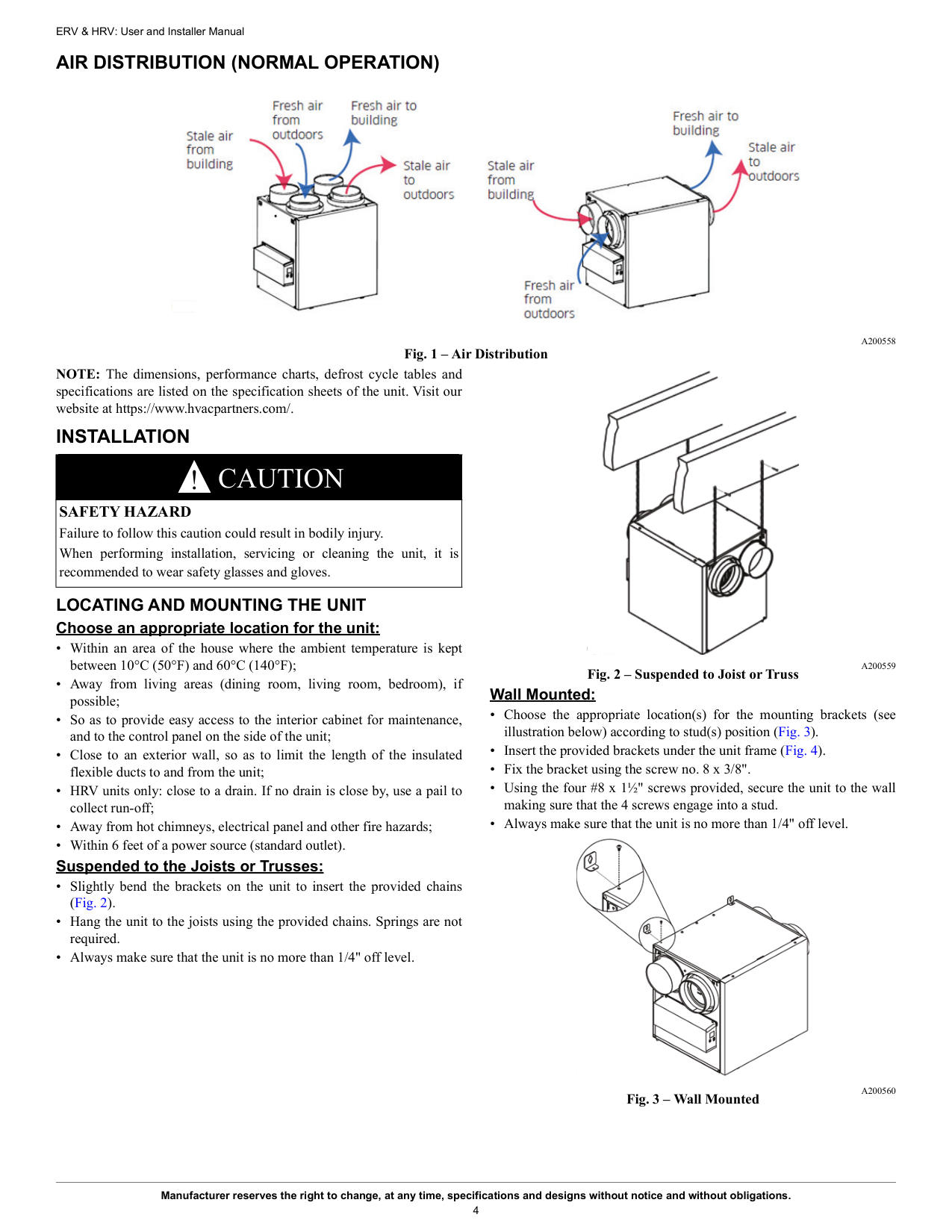
A200559Fig. 2 – Suspended to Joist or Truss Wall Mounted:

####### A200560Fig. 3 – Wall Mounted
INSTALLATION WITH 2 BRACKETS INSTALLATION WITH 4 BRACKETS

A200561
##### Fig. 4 – Installation With Brackets INSTALLING THE DUCTWORK AND THE REGISTERS
|WARNING!
| |---| |CARBON MONOXIDE HAZARD Failure to follow this warning could result in serious personal injury or death.
Never install stale air exhaust register in a room where there is a combustion device, such as a gas furnace, a gas water heater or a fireplace. A negative pressure could be created in the area of the fuel burning unit and draw carbon monoxide into the room. CO can cause personal injury or death.|
####### FRESH AIR TO BUILDING:
A200563Fig. 6 – Exhaust Ducted System STALE AIR FROM BUILDING:
NOTE: This 10-ft. distance applies only in areas where the outside temperature falls below the freezing point 0°C (32°F).
NOTE: The furnace/AHU blower operation can be synchronized with the unit (CONNECTION TO THE CENTRAL FORCED-AIR SYSTEM on p10). It is recommended, but not essential that the furnace/AHU blower runs when the unit is in operation.
|CAUTION!
| |---| |PROPERTY DAMAGE HAZARD
If ducts have to go through an unconditioned space (e.g.attic), always use insulated ducts to prevent condensation from forming inside and outside ducts, which could cause material damage and/or mold growth. Also, if fresh air to building duct and/or stale air from building duct goes through an unconditioned space, the unit must be set to operate continuously in cold conditions (below 10°C/50°F). Continuous air movement inside ducts will prevent condensation formation. The unit can be stopped temporarily for maintenance and/or repair purposes in such conditions.|

FULLY DUCTED SYSTEM (T-1) This configuration allows Recirculation mode to operate.

A200562Fig. 5 – Fully Ducted System STALE AIR FROM BUILDING:
• Install registers in areas where contaminants and humidity are produced: kitchen, bathrooms, laundry room, etc.
ALTERNATE INSTALLATION (T-3) This configuration does NOT allow Recirculation mode to operate.

A200564Fig. 7 – Exhaust Ducted System – Alternate Unit should be synchronized with AHU/furnace operation to avoid Stale air from bathroom condensation and mold growth in furnace/AHU distribution ducting if cooling mode of furnace/AHU is used. This configuration is not recommended with high velocity furnace. NOTE: For this type of configuration, the T-3 option must be selected on the LCD screen when auto-balancing the unit.
|CAUTION!
| |---| |UNIT DAMAGE HAZARD Failure to follow this caution may result in equipment damage or improper operation. This configuration is not recommended with high velocity furnace. High pressures produced by these systems could cause errors.|
SIMPLIFIED INSTALLATION (T-4) This configuration does NOT allow Recirculation mode to operate.

A200565Fig. 8 – Simplified Installation For this type of installation, the furnace/AHU must always be synchronized with the unit in order to maximize the amount of fresh air to the building (CONNECTION TO THE CENTRAL FORCED-AIR SYSTEM on p10).
When performing duct connection to the furnace/AHU, installation must be done in accordance with all applicable codes and standards. Please refer to your local building code.
Fresh air and exhaust air flow through the furnace/AHU ducts, which simplifies the installation. The use of bathroom fans and a range hood is suggested to exhaust stale air. STALE AIR FROM BUILDING:
Connect the stale air intake port of the unit to the furnace return duct at least 3 feet ahead of the fresh air distribution from the unit.
FRESH AIR TO BUILDING: Connect the fresh air distribution duct of the unit to the furnace return duct at least 10 feet away from the furnace (A+B). NOTE: This 10-ft. distance applies only in areas where the outside temperature falls below the freezing point 0°C (32°F).
A200566Fig. 9 – Alternate Installation Unit should be synchronized with AHU/Furnace operation to building avoid condensation and mold growth in furnace/AHU distribution ducting if cooling mode of furnace/AHU is used.

|CAUTION!
| |---| |UNIT DAMAGE HAZARD Failure to follow this caution may result in equipment damage or improper operation. This configuration is not recommended with high velocity furnace. High pressures produced by these systems could cause errors.|
|CAUTION!
| |---| |UNIT DAMAGE HAZARD Failure to follow this caution may result in equipment/property damage or improper operation. A drain hose (included) must be installed on these units, as they may generate a large amount of water, especially in cooler weather.|




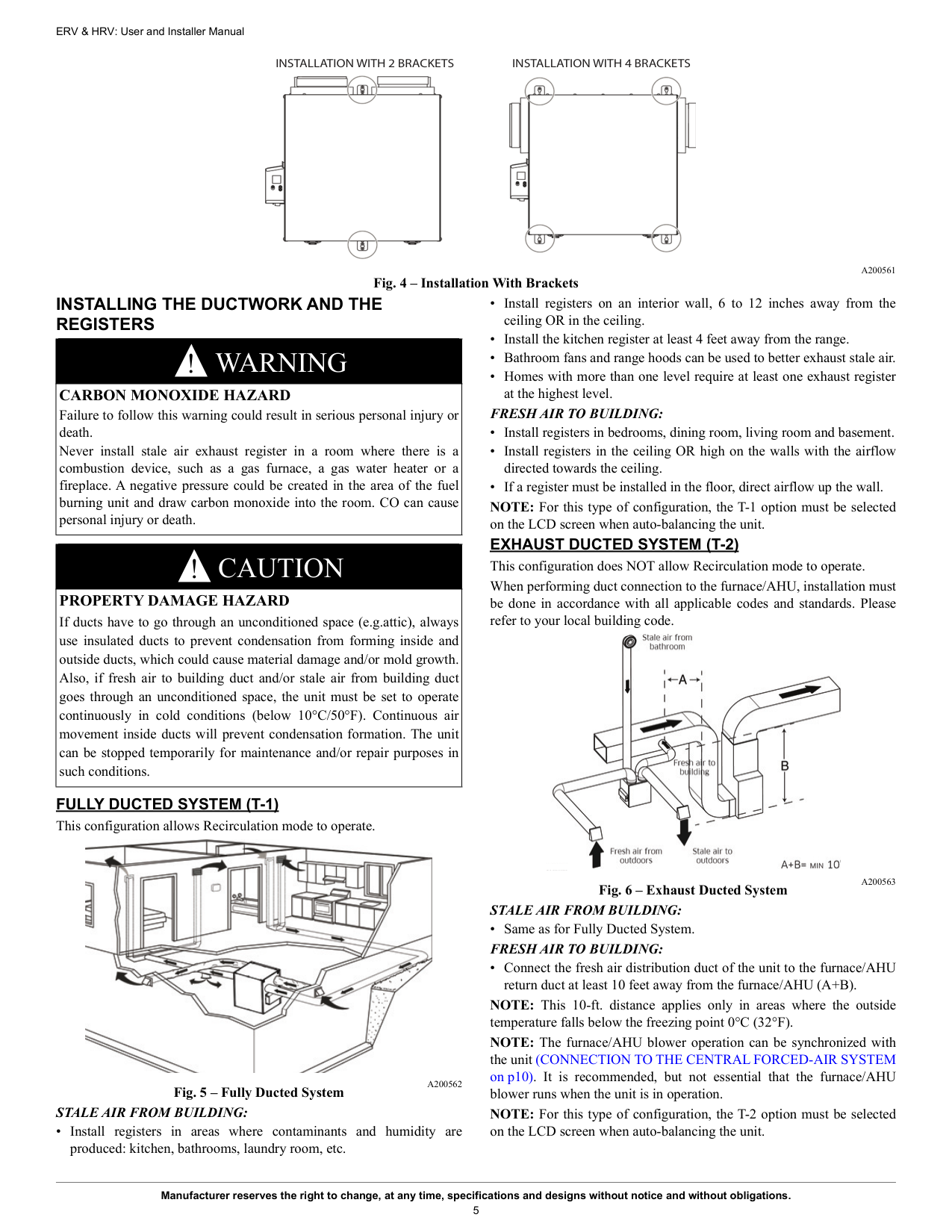


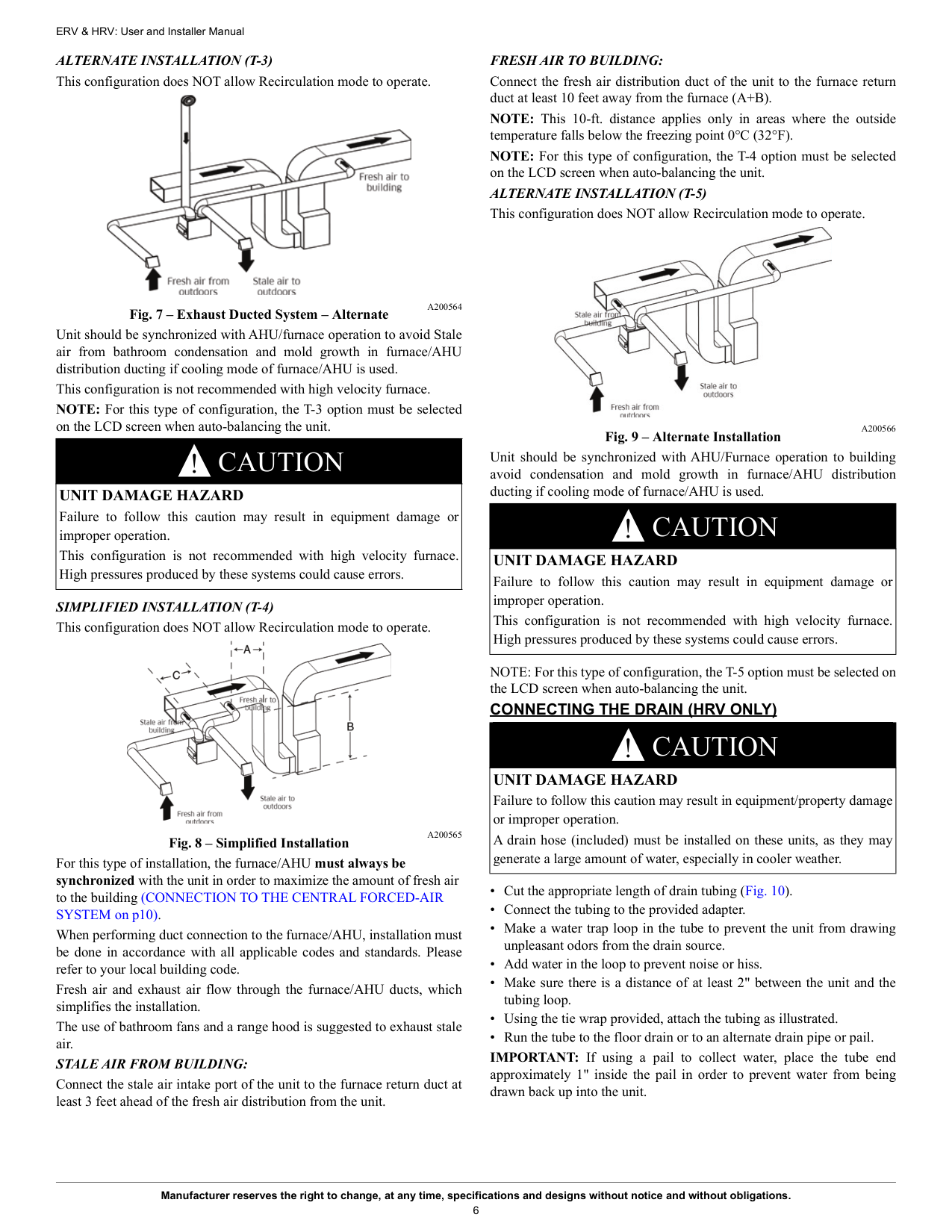


###### A200567Fig. 10 – Drain Connection INSTALLING DUAL EXTERIOR HOOD USING TANDEM® TRANSITION KIT (OPTIONAL)
For units set at 110 CFM or less, a Tandem transition kit can be used instead of 2 exterior hoods; but take into account this device will generate approximately an additional 0.2 in w.g. static pressure depending on the installation.
The minimum joist opening needed to install the Tandem® transition is 9¾". The maximum height of the Tandem transition is 8¾".
To connect the insulated flexible ducts to the Tandem transition (Exhaust air to outdoors and Fresh air from outdoors), follow the instructions included with the Tandem transition kit (P/N KVAAC0101HCO).

A200568Fig. 11 – Dual Exterior Hood with Tandem Kit
INSTALLING THE EXTERIOR HOODS Choose an appropriate location for the exterior hoods:
|WARNING!
| |---| |EXPLOSION HAZARD Failure to follow this warning could result in death, serious personal injury, and/or property damage. Make sure the intake hood is at least 6 feet away from any of the following:
- Dryer exhaust, high efficiency furnace vent, central vacuum vent
- Gas meter exhaust, gas barbecue-grill
- Any exhaust from a combustion source
- Garbage bin and any other source of contamination.
|
Refer to Fig. 12 for proper connection method of the insulated ducts to the hoods. An “Anti-Gust Intake Hood” should be installed in regions where a lot of snow is expected to fall.

###### A200569Fig. 12 – Exterior Hoods CONNECTING THE DUCTS TO THE UNIT
|CAUTION!
|
|---| |UNIT DAMAGE HAZARD Failure to follow this caution may result in equipment damage or improper operation.
- If ducts have to go through an unconditioned space (e.g.: attic), always use insulated ducts to avoid condensation and mold.
- Do not use screws to connect the ducts or transitions to the ports. They could interfere with proper damper operation.
|
INSULATED FLEXIBLE DUCTS Use the following procedure to connect the insulated flexible ducts to the ports of the unit (exhaust to outside and fresh air from outside).
|CAUTION!
| |---| |UNIT DAMAGE HAZARD Failure to follow this caution may result in equipment damage or improper operation.
- Avoid tearing off the vapor barrier on the insulated ducts during installation to avoid condensation within the ducts.|

A200570 Fig. 13 – Connecting Duct to the Unit
TRANSITIONING TO 6-IN. DUCTS (FOR 130 CFM UNITS ONLY)

If using 6-in. ducts, install 5-in. to 6-in. transitions on the ports, and secure using duct tape only. If rigid ducting is used, install a 12-in. section of flexible duct between the transition and the rigid ducting (Fig. 13).
####### RIGID DUCTS
To prevent potential water leakage in cold side rigid ducting insulation, seal all rigid ducting joints with duct tape. To avoid transmission of vibrations, always use a 12-inch section of flexible duct to connect rigid ducts to the unit. To connect insulated rigid ducts to the unit (cold side) using insulated flexible ducts, follow instructions per (INSTALLING THE EXTERIOR HOODS on p7). To connect regular rigid ducts (warm side) to the unit using non-insulated flexible ducts, use a tie wrap.
A200572Fig. 15 – Incorrect Installation CONNECTIONS ELECTRICAL CONNECTION TO OPTIONAL MAIN WALL CONTROL
####### DUCTS CONNECTION
|WARNING!
| |---| |ELECTRIC SHOCK HAZARD Failure to follow this warning could result in personal injury, death, or equipment damage.
Always disconnect the unit before making any connections. Failure to cut power could result in electrical shock or damage to the wall control or electronic module inside the unit.|
IMPORTANT: Make sure to connect ducting as illustrated below to get airflows reading accuracy. Correct installation will also allow proper drainage of water that may accumulate in ducting.

|CAUTION!
| |---| |EQUIPMENT DAMAGE HAZARD Failure to follow this caution may result in equipment damage or improper operation.
- Never install more than one optional main wall control per unit.
- Make sure the wires do not short-circuit between themselves or by touching any other components on the wall control.
- Avoid poor wiring connections.
- To reduce the risk of electrical interference (noise), do not run wall control wiring next to control contactors or near light dimming circuits, electrical motors, dwelling/building power or lighting wiring or power distribution panel.
|
A200571Fig. 14 – Correct Installation
|CAUTION!
| |---| |UNIT DAMAGE HAZARD Failure to follow this caution may result in equipment damage or improper operation.
- Ducting must not be too crushed. Otherwise, airflows reading accuracy will be affected.
- Insulated ducts must have the same diameter as the ports to ensure proper drainage of water that may accumulate in ducts.
|

A200573Fig. 16 – Connection to Wall Control
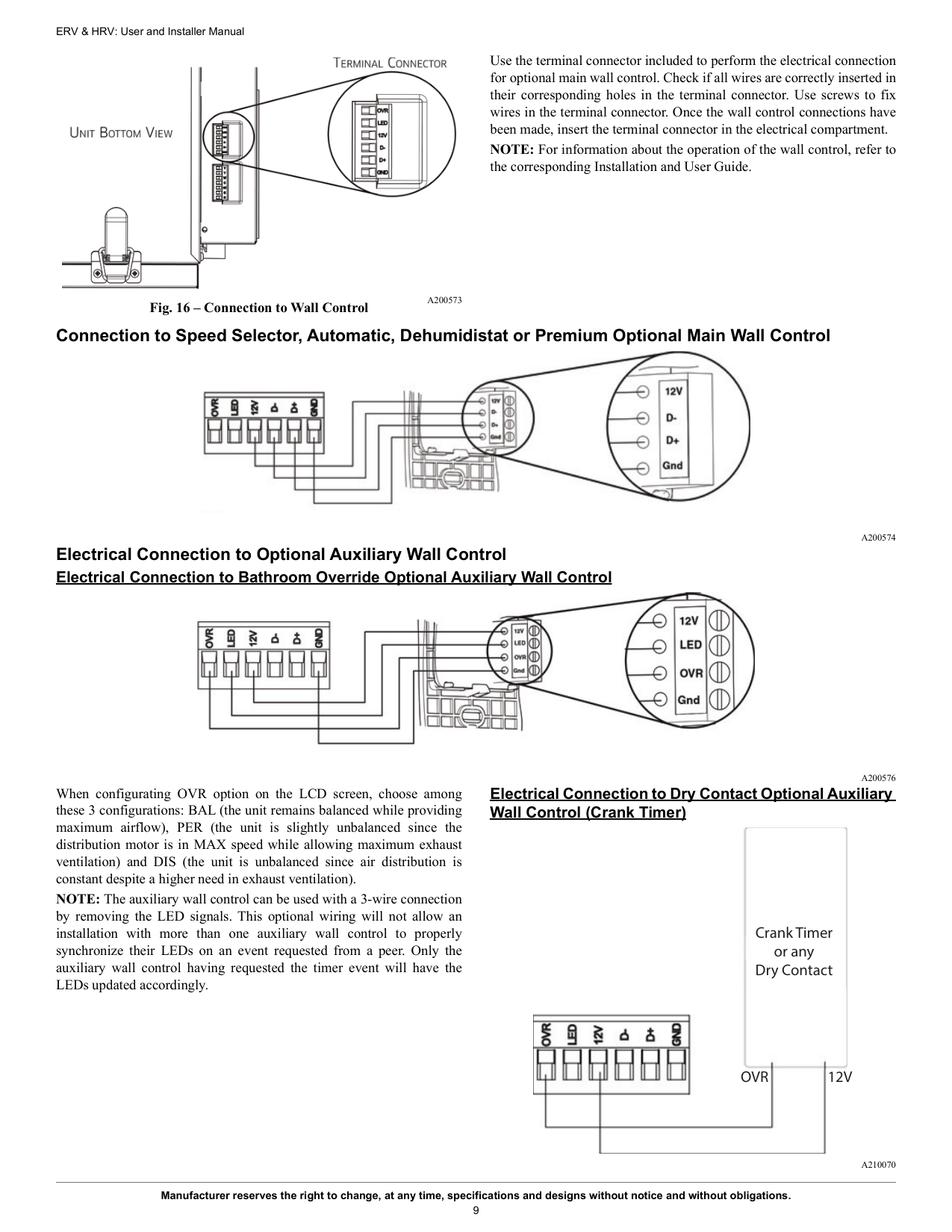
Use the terminal connector included to perform the electrical connection for optional main wall control. Check if all wires are correctly inserted in their corresponding holes in the terminal connector. Use screws to fix wires in the terminal connector. Once the wall control connections have been made, insert the terminal connector in the electrical compartment.
NOTE: For information about the operation of the wall control, refer to the corresponding Installation and User Guide.
##### Connection to Speed Selector, Automatic, Dehumidistat or Premium Optional Main Wall Control

A200574
##### Electrical Connection to Optional Auxiliary Wall Control Electrical Connection to Bathroom Override Optional Auxiliary Wall Control

A200576 When configurating OVR option on the LCD screen, choose among
###### Electrical Connection to Dry Contact Optional Auxiliary Wall Control (Crank Timer)
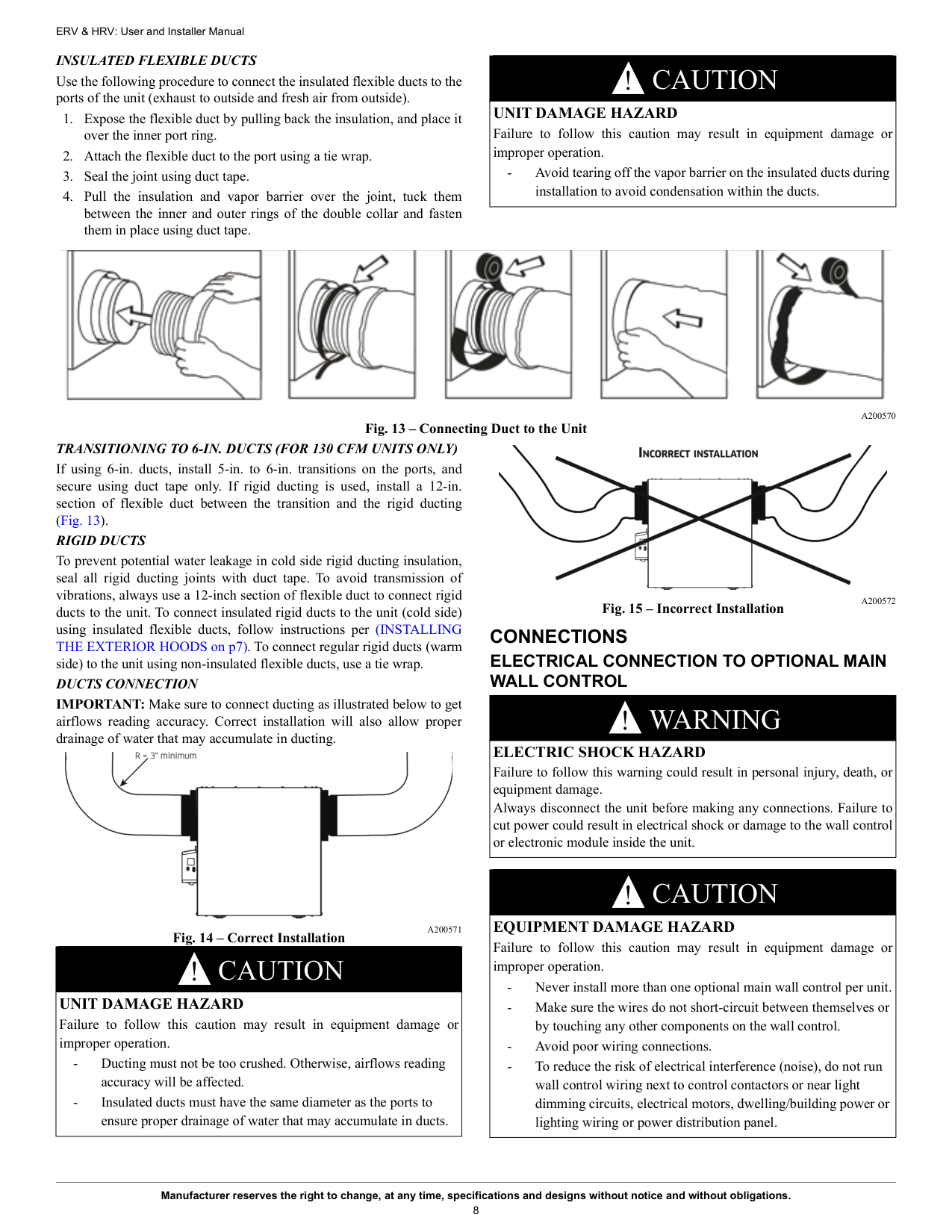

Crank Timer or any Dry Contact
OVR 12V
A210070
##### CONNECTION TO THE CENTRAL FORCED-AIR SYSTEM
|CAUTION!
| |---| |UNIT DAMAGE HAZARD Failure to follow this caution may result in equipment damage or improper operation.
Never connect a 120V AC circuit to the terminals of the central forced-air system interlock (standard wiring). Only use the low voltage class 2 circuit of the central forced-air system blower control. The unit is designed for low voltages only. Connecting the unit to 120V would damage it instantly.|
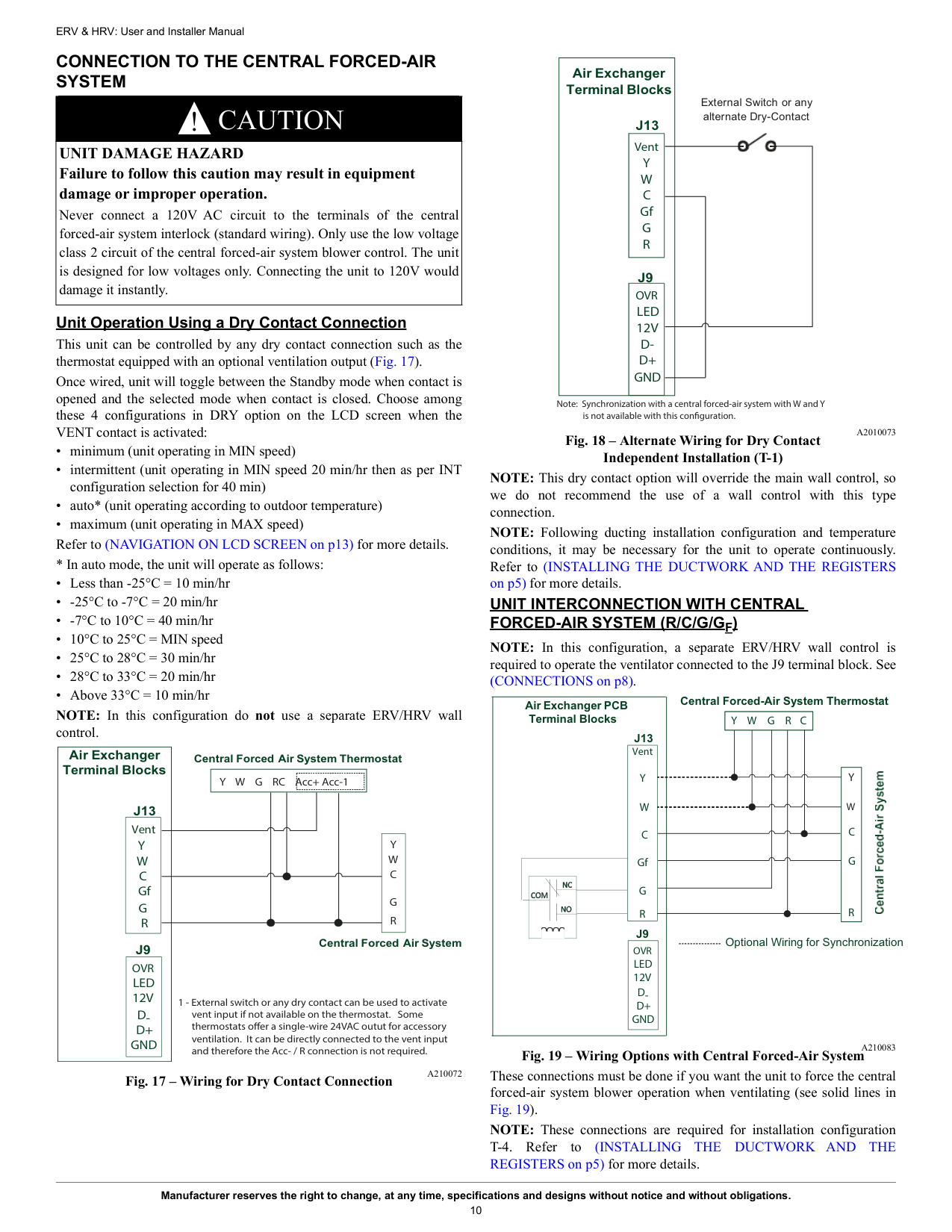
Unit Operation Using a Dry Contact Connection This unit can be controlled by any dry contact connection such as the thermostat equipped with an optional ventilation output (Fig. 17).
Once wired, unit will toggle between the Standby mode when contact is opened and the selected mode when contact is closed. Choose among
Air Exchanger Terminal Blocks
Central Forced Air System Thermostat
|Y W G RC Acc+ Acc-1| |---|
J13
|Y W C Gf
G R
Vent| |---|
Y W C
G R
Central Forced Air System
J9
|DD+ GND
OVR LED 12V| |---|
1 - External switch or any dry contact can be used to activate vent input if not available on the thermostat. Some thermostats offer a single-wire 24VAC outut for accessory ventilation. It can be directly connected to the vent input and therefore the Acc- / R connection is not required.
A210072Fig. 17 – Wiring for Dry Contact Connection
Air Exchanger Terminal Blocks
External Switch or any alternate Dry-Contact
J13

Vent Y W C


Gf G R
######## J9
OVR LED 12V DD+ GND
Note: Synchronization with a central forced-air system with W and Y is not available with this configuration.
A2010073Fig. 18 – Alternate Wiring for Dry Contact
Independent Installation (T-1) NOTE: This dry contact option will override the main wall control, so we do not recommend the use of a wall control with this type connection.
NOTE: Following ducting installation configuration and temperature conditions, it may be necessary for the unit to operate continuously. Refer to (INSTALLING THE DUCTWORK AND THE REGISTERS on p5) for more details.
###### UNIT INTERCONNECTION WITH CENTRAL FORCED-AIR SYSTEM (R/C/G/GF)
NOTE: In this configuration, a separate ERV/HRV wall control is required to operate the ventilator connected to the J9 terminal block. See (CONNECTIONS on p8).
Central Forced-Air System Thermostat
Air Exchanger PCB
Terminal Blocks
YWGRC
J13
Vent Y
Y

W C
W
C
G
Gf
G R
R
J9 OVR LED 12V

Optional Wiring for Synchronization
DD+ GND
A210083Fig. 19 – Wiring Options with Central Forced-Air System These connections must be done if you want the unit to force the central forced-air system blower operation when ventilating (see solid lines in Fig. 19).
NOTE: These connections are required for installation configuration T-4. Refer to (INSTALLING THE DUCTWORK AND THE REGISTERS on p5) for more details.
##### SYNCHRONIZATION WITH CENTRAL FORCED-AIR SYSTEM FUNCTION
The new ventilation technology allows synchronizing the unit operation with the central forced-air system operating time. It prevents unnecessary central forced-air system operating time while providing a better air distribution.
To use this function, W and Y connections must be added to R and C connections to inform the unit that the central forced-air system is running (refer to dotted lines in Fig. 19).
##### Infinity®/Evolution™ Control
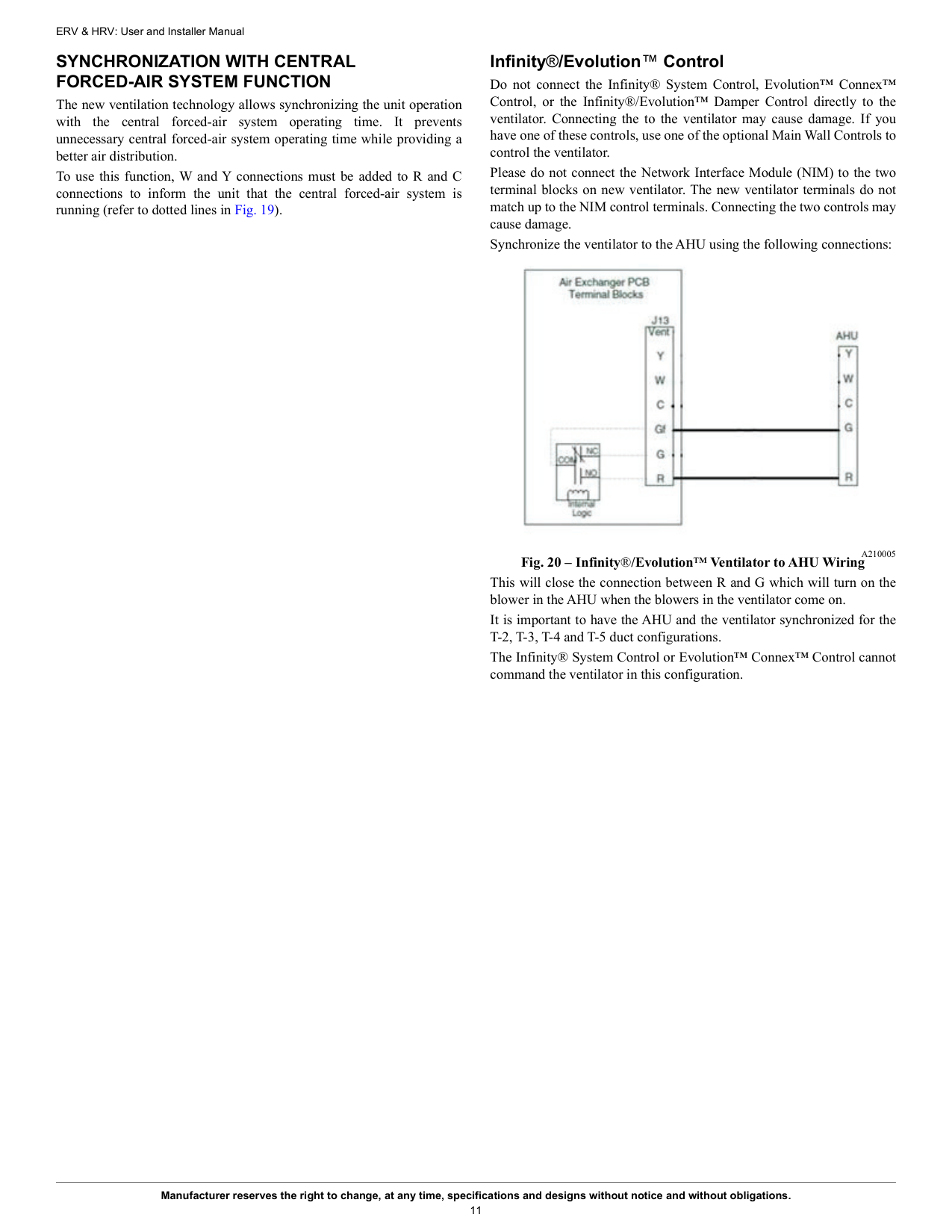
Do not connect the Infinity® System Control, Evolution™ Connex™ Control, or the Infinity®/Evolution™ Damper Control directly to the ventilator. Connecting the to the ventilator may cause damage. If you have one of these controls, use one of the optional Main Wall Controls to control the ventilator.
Please do not connect the Network Interface Module (NIM) to the two terminal blocks on new ventilator. The new ventilator terminals do not match up to the NIM control terminals. Connecting the two controls may cause damage.
Synchronize the ventilator to the AHU using the following connections:

A210005Fig. 20 – Infinity®/Evolution™Ventilator to AHU Wiring This will close the connection between R and G which will turn on the blower in the AHU when the blowers in the ventilator come on. It is important to have the AHU and the ventilator synchronized for the T-2, T-3, T-4 and T-5 duct configurations. The Infinity® System Control or Evolution™ Connex™ Control cannot command the ventilator in this configuration.
#### WIRING DIAGRAM
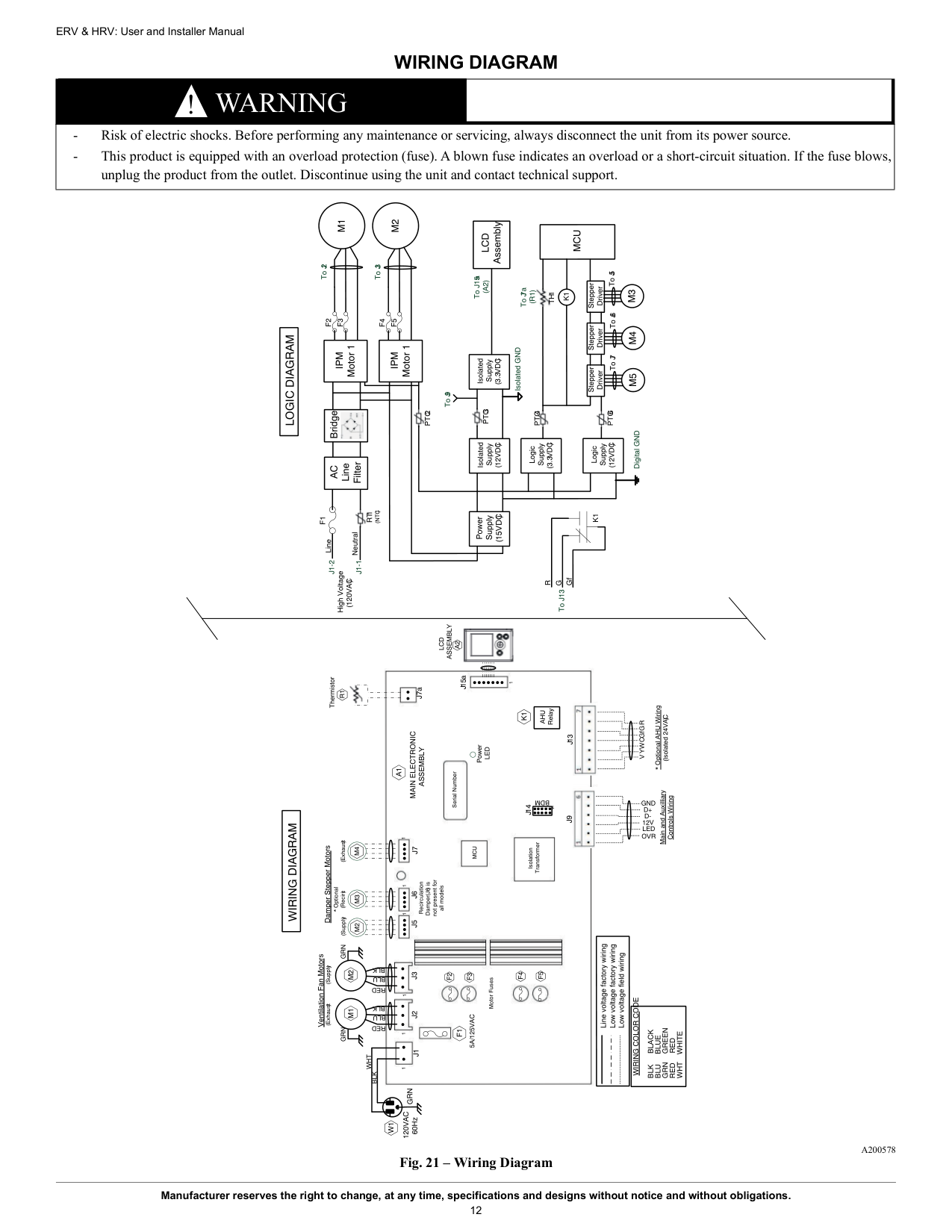
|WARNING!
| | |---|---| |- Risk of electric shocks. Before performing any maintenance or servicing, always disconnect the unit from its power source.
- This product is equipped with an overload protection (fuse). A blown fuse indicates an overload or a short-circuit situation. If the fuse blows, unplug the product from the outlet. Discontinue using the unit and contact technical support.
|- Risk of electric shocks. Before performing any maintenance or servicing, always disconnect the unit from its power source.
- This product is equipped with an overload protection (fuse). A blown fuse indicates an overload or a short-circuit situation. If the fuse blows, unplug the product from the outlet. Discontinue using the unit and contact technical support.
|
2 M
Assembly
CD L
J15 o Ta()2
3
J o T
A
ToJ7a

R1)
H1
T
(
TJ o 6
F3F2
F 54 F
Sp ep rerrive
M1r
|LOGIC DIAGRAM| |---|
M4 t
D
tN
D
tor 1 IPMto o
IM
rr oTJ7
de
ode
G
VDC)
pepr
ply
P
Mo
tIsola
Sup(.3
3
ive
############# M5
la
te S
D
sI
J9
To
Bge
TPC


3

C6 PT
C4
TC P 2


iN
T P
lD
rid
()
2CDV)
DCV)
ppyl
ppyl
G
d eply
2VDC
ic g
gic
gita
olat
p u S
Lo
Lo
3
(.3
u S
u S
(1
1
Is
D

CT)
RT1
(N
R
3
1 J
o
T
Trotrmis


R1
e h
g n iri
|AUHe
Ryla| |---|
K1
)C
W
A 24V
R
HU tional A
G
Gf C
1J3
ted a so (I
ir
*p O
be um
l N a
yiar ll ux
ng s Wir
er S
GND
############## J41
D+
A
D-
Cront
9
nd in a a
ol
12V
J
LED
OVR
M
tus a xh
)
re
nnsform
U
M4
t
MC
tio
a o s
E(
eno culatirpe
Tra
I
DJ(
t for
is
models
al
6)
presen
rc c )
on Opt
3 M
e
ir c
R(
m a
a
R
(pp u
y)
S
|n Li
v
etol
ae
gaf
rcto
w y
r
in
ig
o
Lo
w v
tag l
ef
c a
tor
wir
ygn
Lo
vo w l g ta
ed iel
f
wir
g
in| |---|
ts
aoM n
ro
y)
BLK
uppl
M2
5
4 F F
3 F
2 F
############## OED
BLU RED
sse u F rto Mo
S(
F
n tio
BLK
ht)
BLU RED
C A 0V
12
Hz 60
1 W
N R G
F1 1
P
o
rweDE L
1 J
M2
a D
rpe
S
ep ep
totr Mo
rs
Y
1 M
WH
T
BKL
1 A
MAIN
ELE
C
T
R
NIC O
SE S
AYL MB
1 M
w o
Pre
p u
Sypl
V 15
(
C D )
ne Li N
u
ela tr
K1
G fG
ACi
Lneter lFi
2-J1
F
1
h Vo g Hi
ltageC VA 0 (12
)
J1-1
o JT2
MCU
K1
3 M
Ste
pe p
r
D
ive
rr
ToJ5
|AGRAM
G DI N RI WI| |---|


BDM
1
5A 5 2 /1
V
AC
J3
2
J6J
5 J
7 J
1
1
1
1
1
a J7
Ja5
1
AL
CD
AS
SE B
MLY

GRN
Ve
ila
|IWIR
G
NOC
L
R
CO
L B
L B
KK
AC
BL
U BL
U
E
G
N
RG N
EE R
DR
E R
ED
WH
TWHITE| |---|
(Ex
N GR
A200578 Fig. 21 – Wiring Diagram
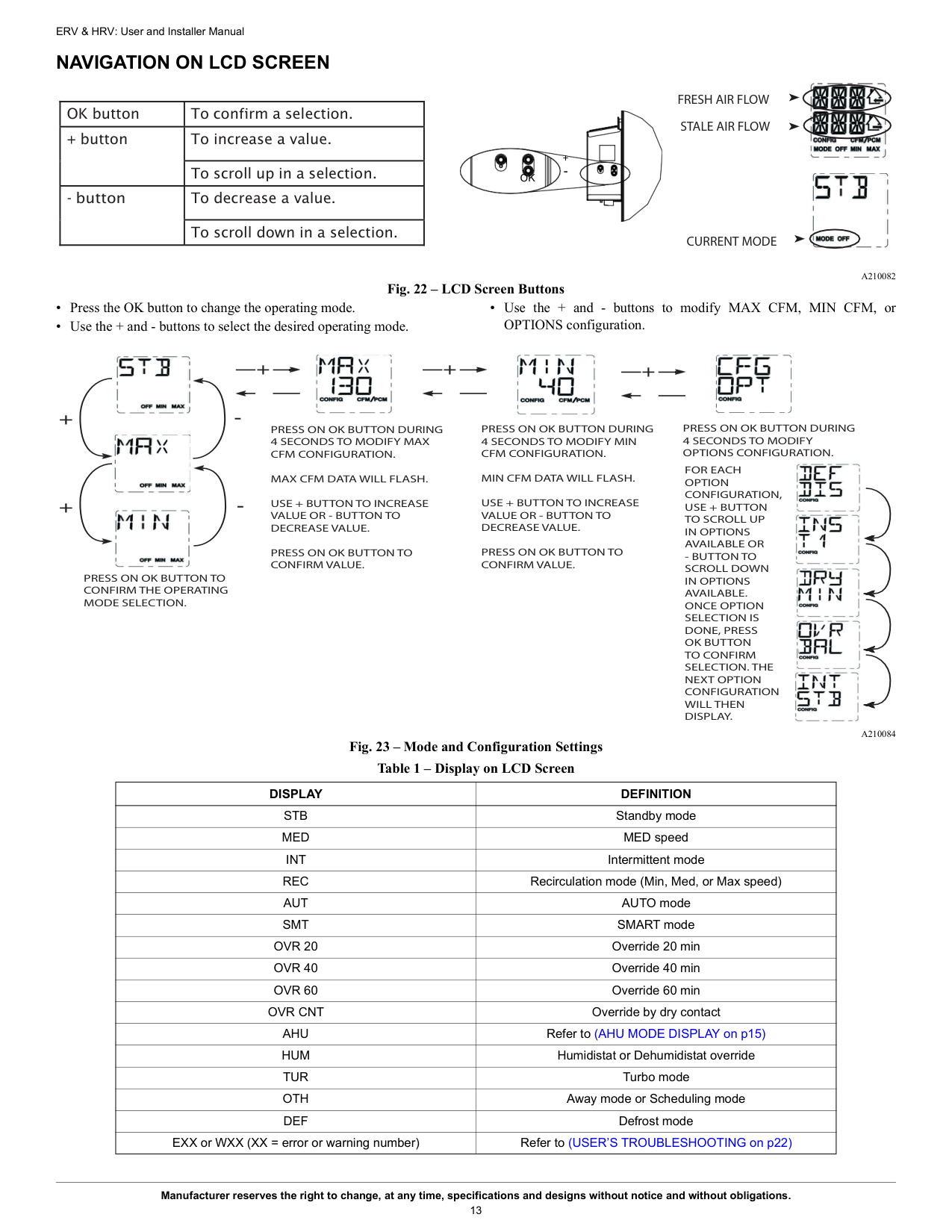
#### NAVIGATION ON LCD SCREEN
|OK button|To confirm a selection.| |---|---| |+ button
|To increase a value.| |+ button
|To scroll up in a selection.| |- button
|To decrease a value.| |- button
|To scroll down in a selection.|

+ -
OK
FRESH AIR FLOW STALE AIR FLOW

CURRENT MODE

A210082 Fig. 22 – LCD Screen Buttons
• Use the + and - buttons to modify MAX CFM, MIN CFM, or OPTIONS configuration.


+ + +


-
+
PRESS ON OK BUTTON DURING 4 SECONDS TO MODIFY OPTIONS CONFIGURATION.
PRESS ON OK BUTTON DURING 4 SECONDS TO MODIFY MIN CFM CONFIGURATION.
PRESS ON OK BUTTON DURING 4 SECONDS TO MODIFY MAX CFM CONFIGURATION.


FOR EACH OPTION CONFIGURATION, USE + BUTTON TO SCROLL UP IN OPTIONS AVAILABLE OR


MIN CFM DATA WILL FLASH. USE + BUTTON TO INCREASE VALUE OR - BUTTON TO DECREASE VALUE. PRESS ON OK BUTTON TO CONFIRM VALUE.
MAX CFM DATA WILL FLASH. USE + BUTTON TO INCREASE VALUE OR - BUTTON TO DECREASE VALUE. PRESS ON OK BUTTON TO CONFIRM VALUE.




PRESS ON OK BUTTON TO CONFIRM THE OPERATING MODE SELECTION.


A210084 Fig. 23 – Mode and Configuration Settings
Table 1 – Display on LCD Screen
|DISPLAY|DEFINITION| |---|---| |STB|Standby mode| |MED|MED speed| |INT|Intermittent mode| |REC|Recirculation mode (Min, Med, or Max speed)| |AUT|AUTO mode| |SMT|SMART mode| |OVR 20|Override 20 min| |OVR 40|Override 40 min| |OVR 60|Override 60 min| |OVR CNT|Override by dry contact| |AHU|Refer to (AHU MODE DISPLAY on p15)| |HUM|Humidistat or Dehumidistat override| |TUR|Turbo mode| |OTH|Away mode or Scheduling mode| |DEF|Defrost mode| |EXX or WXX (XX = error or warning number)|Refer to (USER’S TROUBLESHOOTING on p22)|
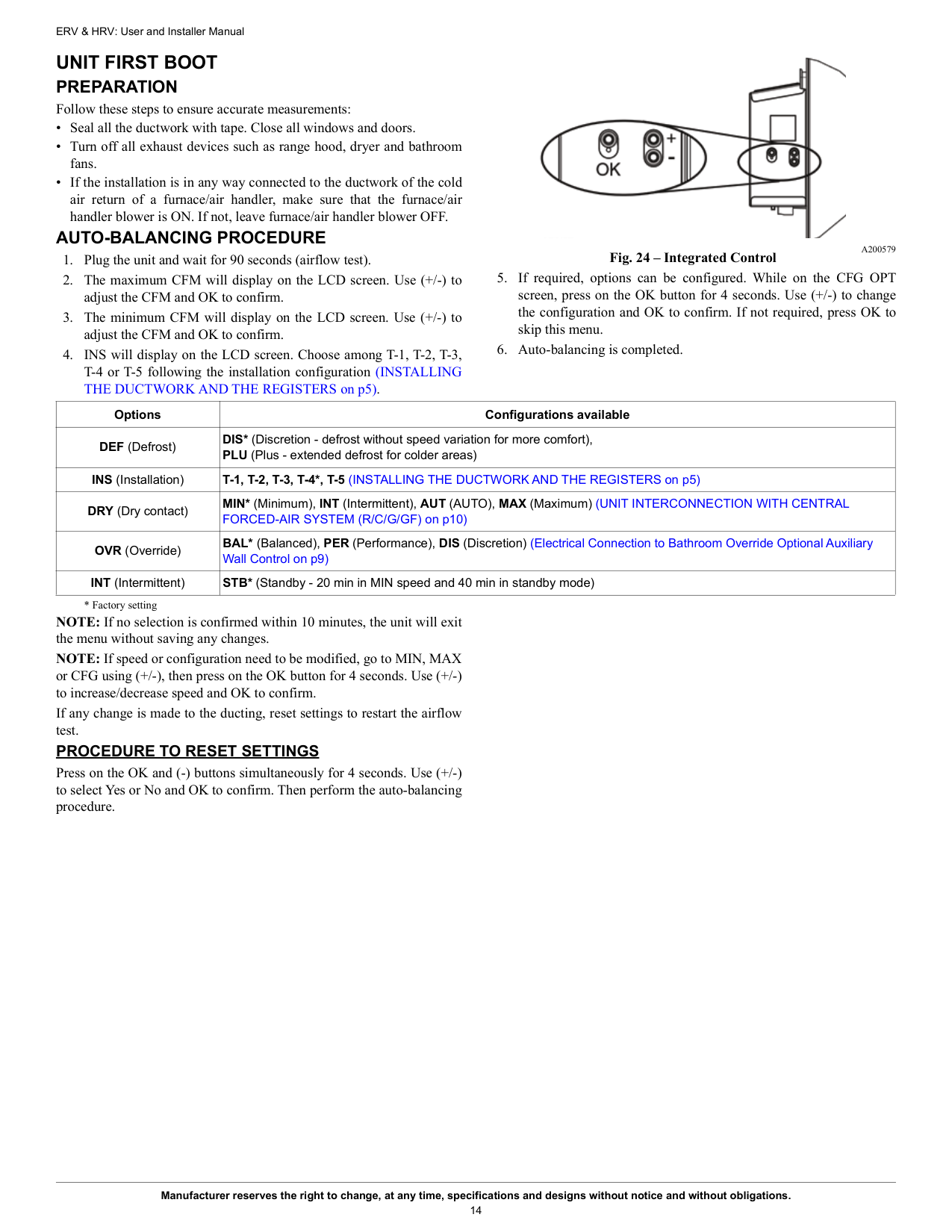
UNIT FIRST BOOT PREPARATION Follow these steps to ensure accurate measurements:

##### AUTO-BALANCING PROCEDURE
####### A200579Fig. 24 – Integrated Control
|Options|Configurations available| |---|---| |DEF (Defrost)|DIS* (Discretion - defrost without speed variation for more comfort), PLU (Plus - extended defrost for colder areas)| |INS (Installation)|T-1, T-2, T-3, T-4*, T-5 (INSTALLING THE DUCTWORK AND THE REGISTERS on p5)| |DRY (Dry contact)|MIN* (Minimum), INT (Intermittent), AUT (AUTO), MAX (Maximum) (UNIT INTERCONNECTION WITH CENTRAL FORCED-AIR SYSTEM (R/C/G/GF) on p10)| |OVR (Override)|BAL* (Balanced), PER (Performance), DIS (Discretion) (Electrical Connection to Bathroom Override Optional Auxiliary Wall Control on p9)| |INT (Intermittent)|STB* (Standby - 20 min in MIN speed and 40 min in standby mode)|
NOTE: If speed or configuration need to be modified, go to MIN, MAX or CFG using (+/-), then press on the OK button for 4 seconds. Use (+/-) to increase/decrease speed and OK to confirm.
If any change is made to the ducting, reset settings to restart the airflow test. PROCEDURE TO RESET SETTINGS
Press on the OK and (-) buttons simultaneously for 4 seconds. Use (+/-) to select Yes or No and OK to confirm. Then perform the auto-balancing procedure.
#### USING THIS UNIT YOUR VENTILATION SYSTEM
This balanced ventilation unit is designed to provide fresh air to your home while exhausting stale, humid air. Thanks to its energy/heat recovery module, the unit recovers a large proportion of heat or energy that is part of indoor or outdoor air according to the seasons to improve comfort and energy efficiency during the heating and the cooling periods. With the new ventilation technology, this unit responds to the variations in its environment in an autonomous way, ensuring to provide a proper level of ventilation and air quality. This unit also features automatic modes (AUTO or SMART) that manage autonomously the required ventilation level as per indoor and/or outdoor conditions. In colder areas, the unit will perform, at intervals, recovery module discreet defrost to maintain performance and comfort.
##### INTEGRATED CONTROL

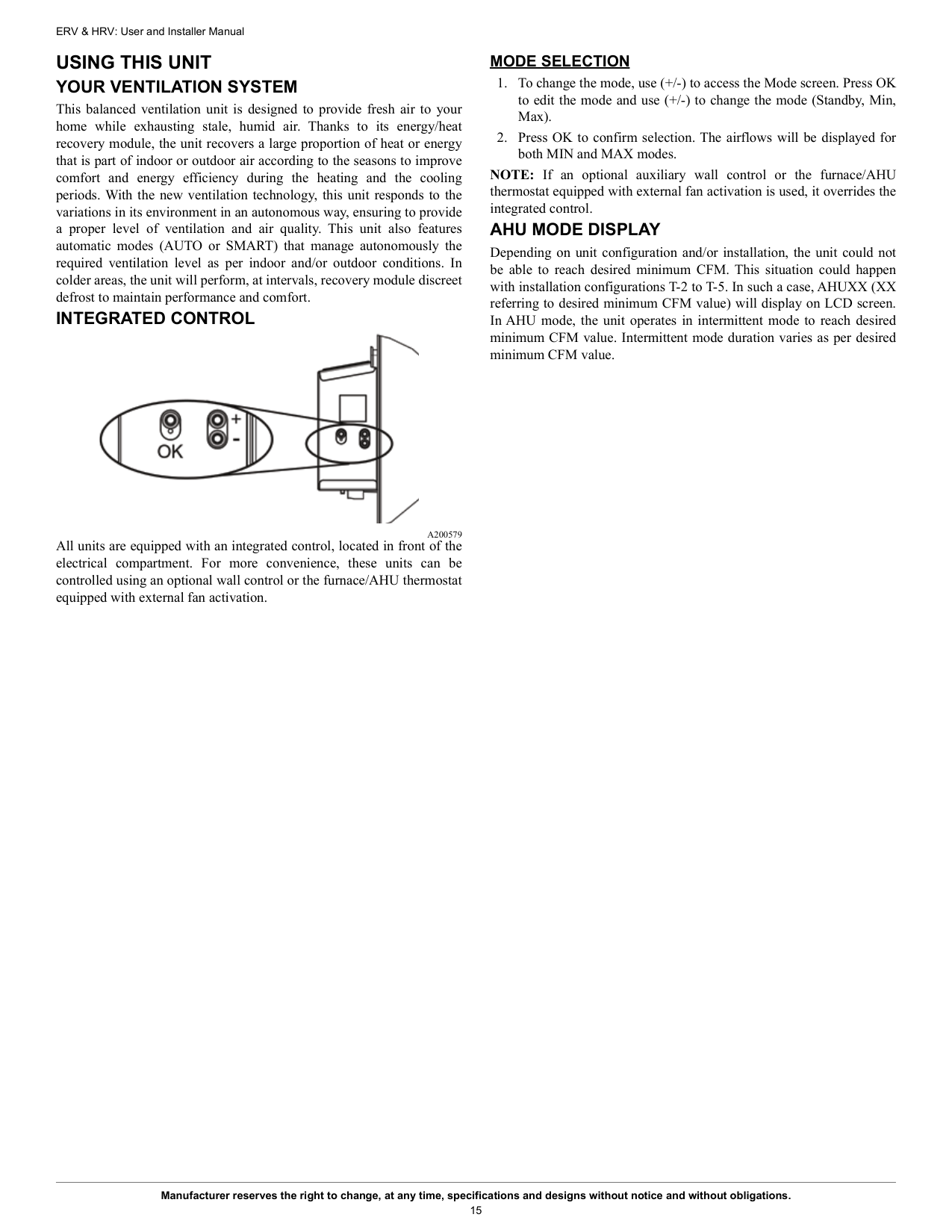
A200579 All units are equipped with an integrated control, located in front of the electrical compartment. For more convenience, these units can be controlled using an optional wall control or the furnace/AHU thermostat equipped with external fan activation.
###### MODE SELECTION
NOTE: If an optional auxiliary wall control or the furnace/AHU thermostat equipped with external fan activation is used, it overrides the integrated control.
##### AHU MODE DISPLAY
Depending on unit configuration and/or installation, the unit could not be able to reach desired minimum CFM. This situation could happen with installation configurations T-2 to T-5. In such a case, AHUXX (XX referring to desired minimum CFM value) will display on LCD screen. In AHU mode, the unit operates in intermittent mode to reach desired minimum CFM value. Intermittent mode duration varies as per desired minimum CFM value.
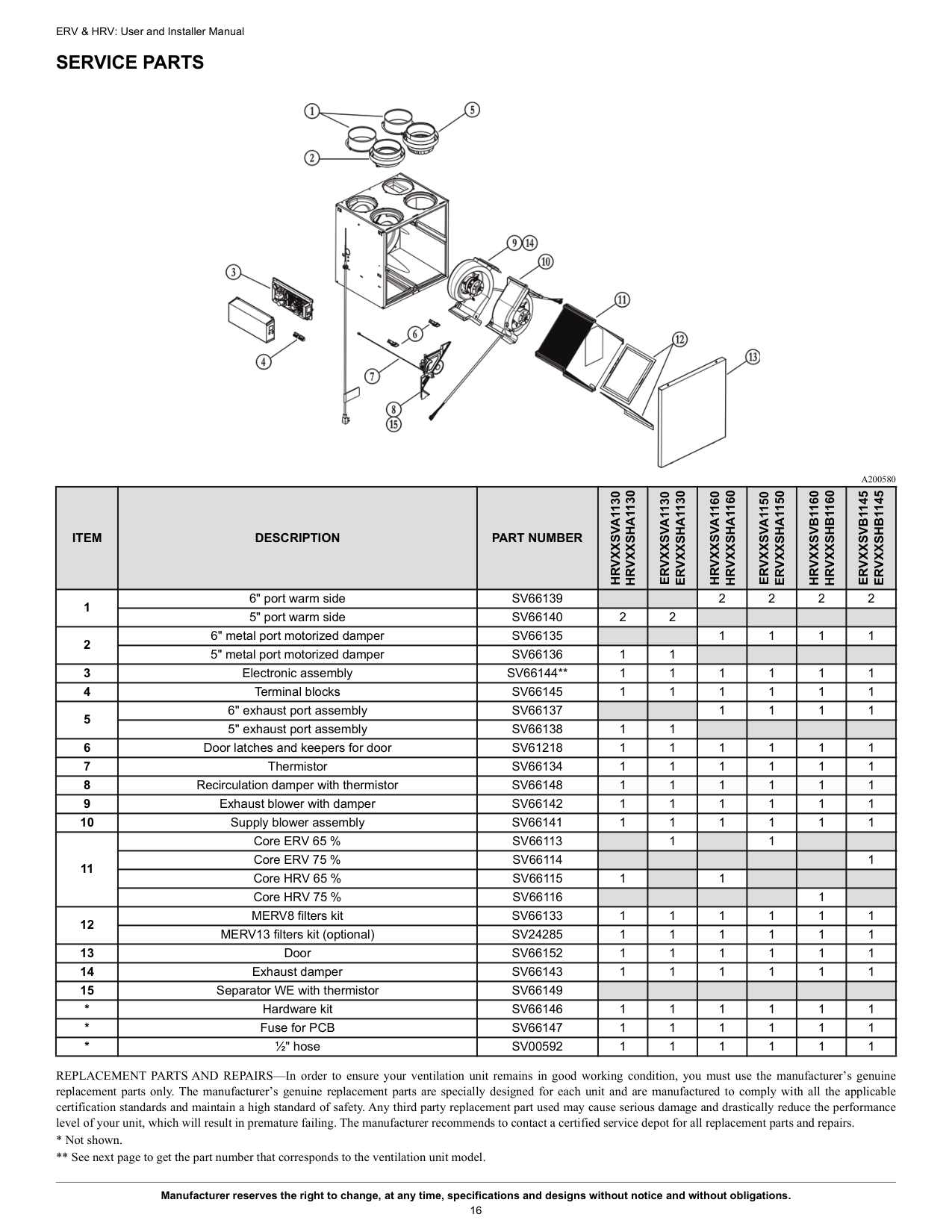
#### SERVICE PARTS

A200580
|ITEM|DESCRIPTION|PART NUMBER|HRVXXSVA1130
HRVXXSHA1130|ERVXXSVA1130
ERVXXSHA1130|HRVXXSVA1160
HRVXXSHA1160|ERVXXSVA1150
ERVXXSHA1150|HRVXXSVB1160
HRVXXSHB1160|ERVXXSVB1145
ERVXXSHB1145| |---|---|---|---|---|---|---|---|---| |1|6" port warm side|SV66139| | |2|2|2|2| |1|5" port warm side|SV66140|2|2| | | | | |2|6" metal port motorized damper|SV66135| | |1|1|1|1| |2|5" metal port motorized damper|SV66136|1|1| | | | | |3|Electronic assembly|SV66144**|1|1|1|1|1|1| |4|Terminal blocks|SV66145|1|1|1|1|1|1| |5|6" exhaust port assembly|SV66137| | |1|1|1|1| |5|5" exhaust port assembly|SV66138|1|1| | | | | |6|Door latches and keepers for door|SV61218|1|1|1|1|1|1| |7|Thermistor|SV66134|1|1|1|1|1|1| |8|Recirculation damper with thermistor|SV66148|1|1|1|1|1|1| |9|Exhaust blower with damper|SV66142|1|1|1|1|1|1| |10|Supply blower assembly|SV66141|1|1|1|1|1|1| |11|Core ERV 65 %|SV66113| |1| |1| | | |11|Core ERV 75 %|SV66114| | | | | |1| |11|Core HRV 65 %|SV66115|1| |1| | | | |11|Core HRV 75 %|SV66116| | | | |1| | |12|MERV8 filters kit|SV66133|1|1|1|1|1|1| |12|MERV13 filters kit (optional)|SV24285|1|1|1|1|1|1| |13|Door|SV66152|1|1|1|1|1|1| |14|Exhaust damper|SV66143|1|1|1|1|1|1| |15|Separator WE with thermistor|SV66149| | | | | | | |*|Hardware kit|SV66146|1|1|1|1|1|1| |*|Fuse for PCB|SV66147|1|1|1|1|1|1| |*|½" hose|SV00592|1|1|1|1|1|1|
REPLACEMENT PARTS AND REPAIRS—In order to ensure your ventilation unit remains in good working condition, you must use the manufacturer’s genuine replacement parts only. The manufacturer’s genuine replacement parts are specially designed for each unit and are manufactured to comply with all the applicable certification standards and maintain a high standard of safety. Any third party replacement part used may cause serious damage and drastically reduce the performance level of your unit, which will result in premature failing. The manufacturer recommends to contact a certified service depot for all replacement parts and repairs.
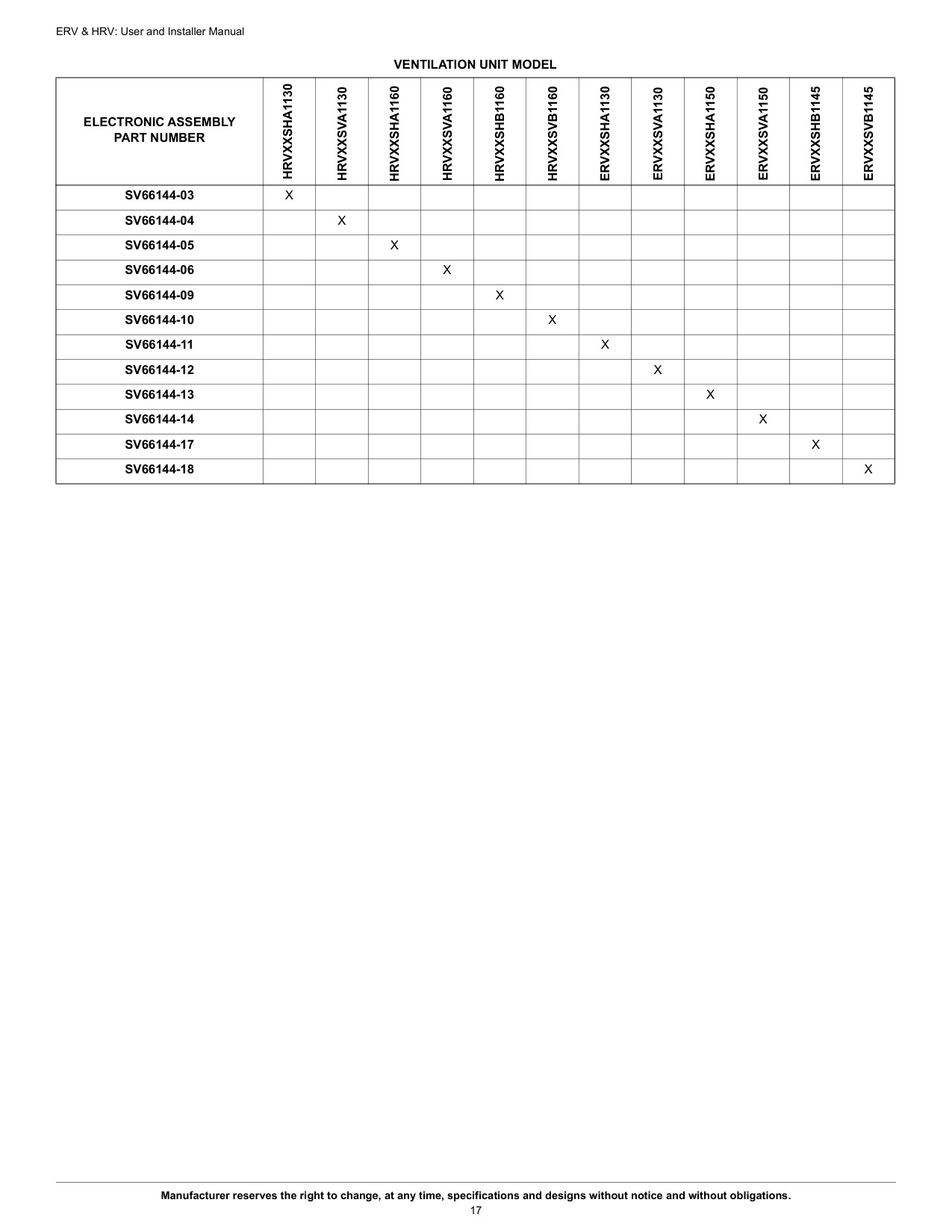
######### VENTILATION UNIT MODEL
|ELECTRONIC ASSEMBLY PART NUMBER|HRVXXSHA1130|HRVXXSVA1130|HRVXXSHA1160|HRVXXSVA1160|HRVXXSHB1160|HRVXXSVB1160|ERVXXSHA1130|ERVXXSVA1130|ERVXXSHA1150|ERVXXSVA1150|ERVXXSHB1145|ERVXXSVB1145| |---|---|---|---|---|---|---|---|---|---|---|---|---| |SV66144-03|X| | | | | | | | | | | | |SV66144-04| |X| | | | | | | | | | | |SV66144-05| | |X| | | | | | | | | | |SV66144-06| | | |X| | | | | | | | | |SV66144-09| | | | |X| | | | | | | |
|SV66144-10| | | | | |X| | | | | | | |SV66144-11| | | | | | |X| | | | | | |SV66144-12| | | | | | | |X| | | | | |SV66144-13| | | | | | | | |X| | | | |SV66144-14| | | | | | | | | |X| | | |SV66144-17| | | | | | | | | | |X| | |SV66144-18| | | | | | | | | | | |X|
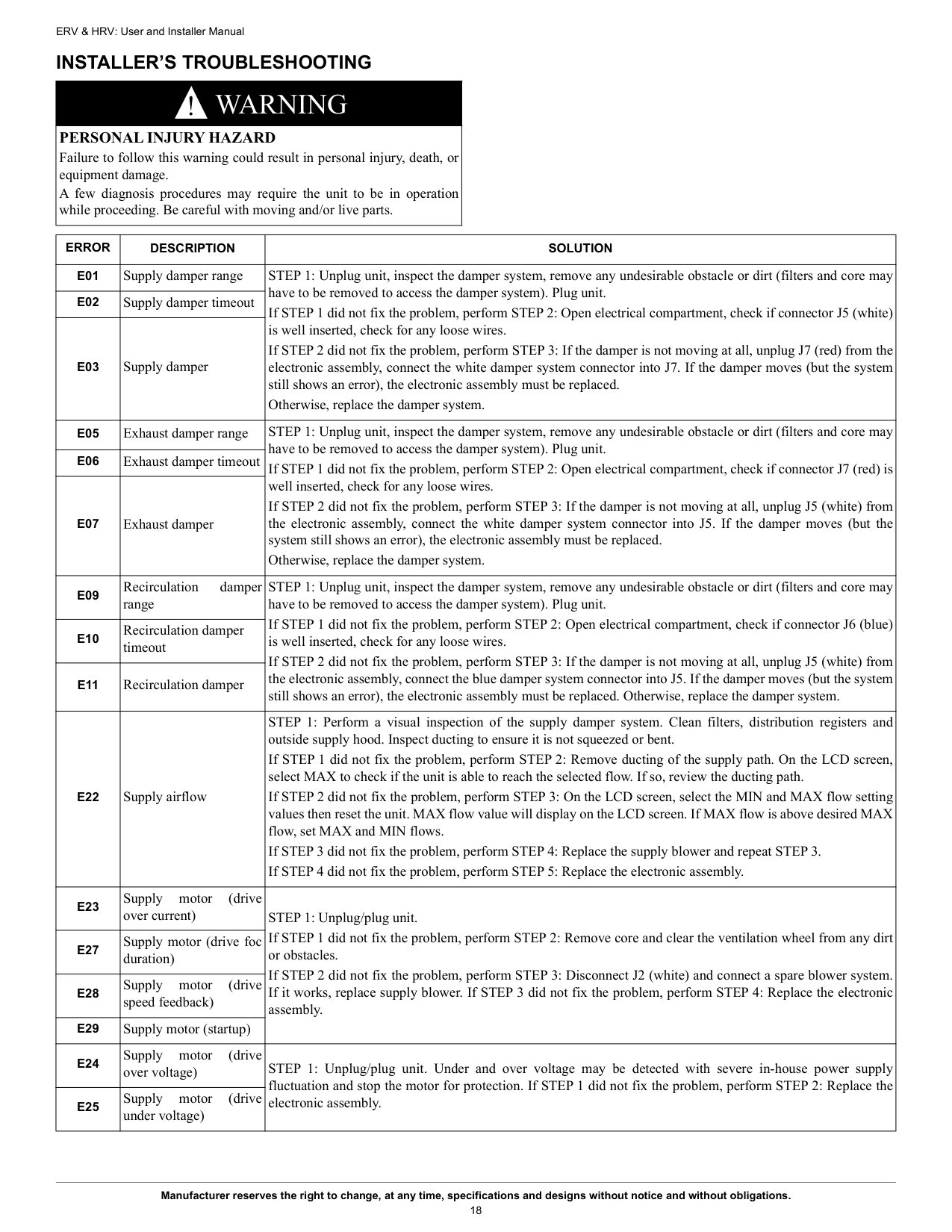
#### INSTALLER’S TROUBLESHOOTING
|WARNING!
| |---| |PERSONAL INJURY HAZARD Failure to follow this warning could result in personal injury, death, or equipment damage. A few diagnosis procedures may require the unit to be in operation while proceeding. Be careful with moving and/or live parts.|
|ERROR|DESCRIPTION|SOLUTION| |---|---|---| |E01|Supply damper range|STEP 1: Unplug unit, inspect the damper system, remove any undesirable obstacle or dirt (filters and core may have to be removed to access the damper system). Plug unit.
If STEP 1 did not fix the problem, perform STEP 2: Open electrical compartment, check if connector J5 (white) is well inserted, check for any loose wires.
If STEP 2 did not fix the problem, perform STEP 3: If the damper is not moving at all, unplug J7 (red) from the electronic assembly, connect the white damper system connector into J7. If the damper moves (but the system still shows an error), the electronic assembly must be replaced. Otherwise, replace the damper system.
| |E02|Supply damper timeout|STEP 1: Unplug unit, inspect the damper system, remove any undesirable obstacle or dirt (filters and core may have to be removed to access the damper system). Plug unit.
If STEP 1 did not fix the problem, perform STEP 2: Open electrical compartment, check if connector J5 (white) is well inserted, check for any loose wires.
If STEP 2 did not fix the problem, perform STEP 3: If the damper is not moving at all, unplug J7 (red) from the electronic assembly, connect the white damper system connector into J7. If the damper moves (but the system still shows an error), the electronic assembly must be replaced. Otherwise, replace the damper system.
| |E03|Supply damper|STEP 1: Unplug unit, inspect the damper system, remove any undesirable obstacle or dirt (filters and core may have to be removed to access the damper system). Plug unit.
If STEP 1 did not fix the problem, perform STEP 2: Open electrical compartment, check if connector J5 (white) is well inserted, check for any loose wires.
If STEP 2 did not fix the problem, perform STEP 3: If the damper is not moving at all, unplug J7 (red) from the electronic assembly, connect the white damper system connector into J7. If the damper moves (but the system still shows an error), the electronic assembly must be replaced. Otherwise, replace the damper system.
| |E05|Exhaust damper range|STEP 1: Unplug unit, inspect the damper system, remove any undesirable obstacle or dirt (filters and core may have to be removed to access the damper system). Plug unit.
If STEP 1 did not fix the problem, perform STEP 2: Open electrical compartment, check if connector J7 (red) is well inserted, check for any loose wires.
If STEP 2 did not fix the problem, perform STEP 3: If the damper is not moving at all, unplug J5 (white) from the electronic assembly, connect the white damper system connector into J5. If the damper moves (but the system still shows an error), the electronic assembly must be replaced. Otherwise, replace the damper system.
| |E06|Exhaust damper timeout|STEP 1: Unplug unit, inspect the damper system, remove any undesirable obstacle or dirt (filters and core may have to be removed to access the damper system). Plug unit.
If STEP 1 did not fix the problem, perform STEP 2: Open electrical compartment, check if connector J7 (red) is well inserted, check for any loose wires.
If STEP 2 did not fix the problem, perform STEP 3: If the damper is not moving at all, unplug J5 (white) from the electronic assembly, connect the white damper system connector into J5. If the damper moves (but the system still shows an error), the electronic assembly must be replaced. Otherwise, replace the damper system.
| |E07|Exhaust damper|STEP 1: Unplug unit, inspect the damper system, remove any undesirable obstacle or dirt (filters and core may have to be removed to access the damper system). Plug unit.
If STEP 1 did not fix the problem, perform STEP 2: Open electrical compartment, check if connector J7 (red) is well inserted, check for any loose wires.
If STEP 2 did not fix the problem, perform STEP 3: If the damper is not moving at all, unplug J5 (white) from the electronic assembly, connect the white damper system connector into J5. If the damper moves (but the system still shows an error), the electronic assembly must be replaced. Otherwise, replace the damper system.
| |E09|Recirculation damper range|STEP 1: Unplug unit, inspect the damper system, remove any undesirable obstacle or dirt (filters and core may have to be removed to access the damper system). Plug unit.
If STEP 1 did not fix the problem, perform STEP 2: Open electrical compartment, check if connector J6 (blue) is well inserted, check for any loose wires.
If STEP 2 did not fix the problem, perform STEP 3: If the damper is not moving at all, unplug J5 (white) from the electronic assembly, connect the blue damper system connector into J5. If the damper moves (but the system still shows an error), the electronic assembly must be replaced. Otherwise, replace the damper system.
| |E10|Recirculation damper timeout|STEP 1: Unplug unit, inspect the damper system, remove any undesirable obstacle or dirt (filters and core may have to be removed to access the damper system). Plug unit.
If STEP 1 did not fix the problem, perform STEP 2: Open electrical compartment, check if connector J6 (blue) is well inserted, check for any loose wires.
If STEP 2 did not fix the problem, perform STEP 3: If the damper is not moving at all, unplug J5 (white) from the electronic assembly, connect the blue damper system connector into J5. If the damper moves (but the system still shows an error), the electronic assembly must be replaced. Otherwise, replace the damper system.
| |E11|Recirculation damper|STEP 1: Unplug unit, inspect the damper system, remove any undesirable obstacle or dirt (filters and core may have to be removed to access the damper system). Plug unit.
If STEP 1 did not fix the problem, perform STEP 2: Open electrical compartment, check if connector J6 (blue) is well inserted, check for any loose wires.
If STEP 2 did not fix the problem, perform STEP 3: If the damper is not moving at all, unplug J5 (white) from the electronic assembly, connect the blue damper system connector into J5. If the damper moves (but the system still shows an error), the electronic assembly must be replaced. Otherwise, replace the damper system.
| |E22|Supply airflow|STEP 1: Perform a visual inspection of the supply damper system. Clean filters, distribution registers and outside supply hood. Inspect ducting to ensure it is not squeezed or bent.
If STEP 1 did not fix the problem, perform STEP 2: Remove ducting of the supply path. On the LCD screen, select MAX to check if the unit is able to reach the selected flow. If so, review the ducting path.
If STEP 2 did not fix the problem, perform STEP 3: On the LCD screen, select the MIN and MAX flow setting values then reset the unit. MAX flow value will display on the LCD screen. If MAX flow is above desired MAX flow, set MAX and MIN flows.
If STEP 3 did not fix the problem, perform STEP 4: Replace the supply blower and repeat STEP 3.
If STEP 4 did not fix the problem, perform STEP 5: Replace the electronic assembly.
| |E23|Supply motor (drive over current)|STEP 1: Unplug/plug unit.
If STEP 1 did not fix the problem, perform STEP 2: Remove core and clear the ventilation wheel from any dirt or obstacles.
If STEP 2 did not fix the problem, perform STEP 3: Disconnect J2 (white) and connect a spare blower system. If it works, replace supply blower. If STEP 3 did not fix the problem, perform STEP 4: Replace the electronic assembly.
| |E27|Supply motor (drive foc duration)|STEP 1: Unplug/plug unit.
If STEP 1 did not fix the problem, perform STEP 2: Remove core and clear the ventilation wheel from any dirt or obstacles.
If STEP 2 did not fix the problem, perform STEP 3: Disconnect J2 (white) and connect a spare blower system. If it works, replace supply blower. If STEP 3 did not fix the problem, perform STEP 4: Replace the electronic assembly.
| |E28|Supply motor (drive speed feedback)|STEP 1: Unplug/plug unit.
If STEP 1 did not fix the problem, perform STEP 2: Remove core and clear the ventilation wheel from any dirt or obstacles.
If STEP 2 did not fix the problem, perform STEP 3: Disconnect J2 (white) and connect a spare blower system. If it works, replace supply blower. If STEP 3 did not fix the problem, perform STEP 4: Replace the electronic assembly.
| |E29|Supply motor (startup)|STEP 1: Unplug/plug unit.
If STEP 1 did not fix the problem, perform STEP 2: Remove core and clear the ventilation wheel from any dirt or obstacles.
If STEP 2 did not fix the problem, perform STEP 3: Disconnect J2 (white) and connect a spare blower system. If it works, replace supply blower. If STEP 3 did not fix the problem, perform STEP 4: Replace the electronic assembly.
| |E24|Supply motor (drive over voltage)|STEP 1: Unplug/plug unit. Under and over voltage may be detected with severe in-house power supply fluctuation and stop the motor for protection. If STEP 1 did not fix the problem, perform STEP 2: Replace the electronic assembly.| |E25|Supply motor (drive under voltage)|STEP 1: Unplug/plug unit. Under and over voltage may be detected with severe in-house power supply fluctuation and stop the motor for protection. If STEP 1 did not fix the problem, perform STEP 2: Replace the electronic assembly.|
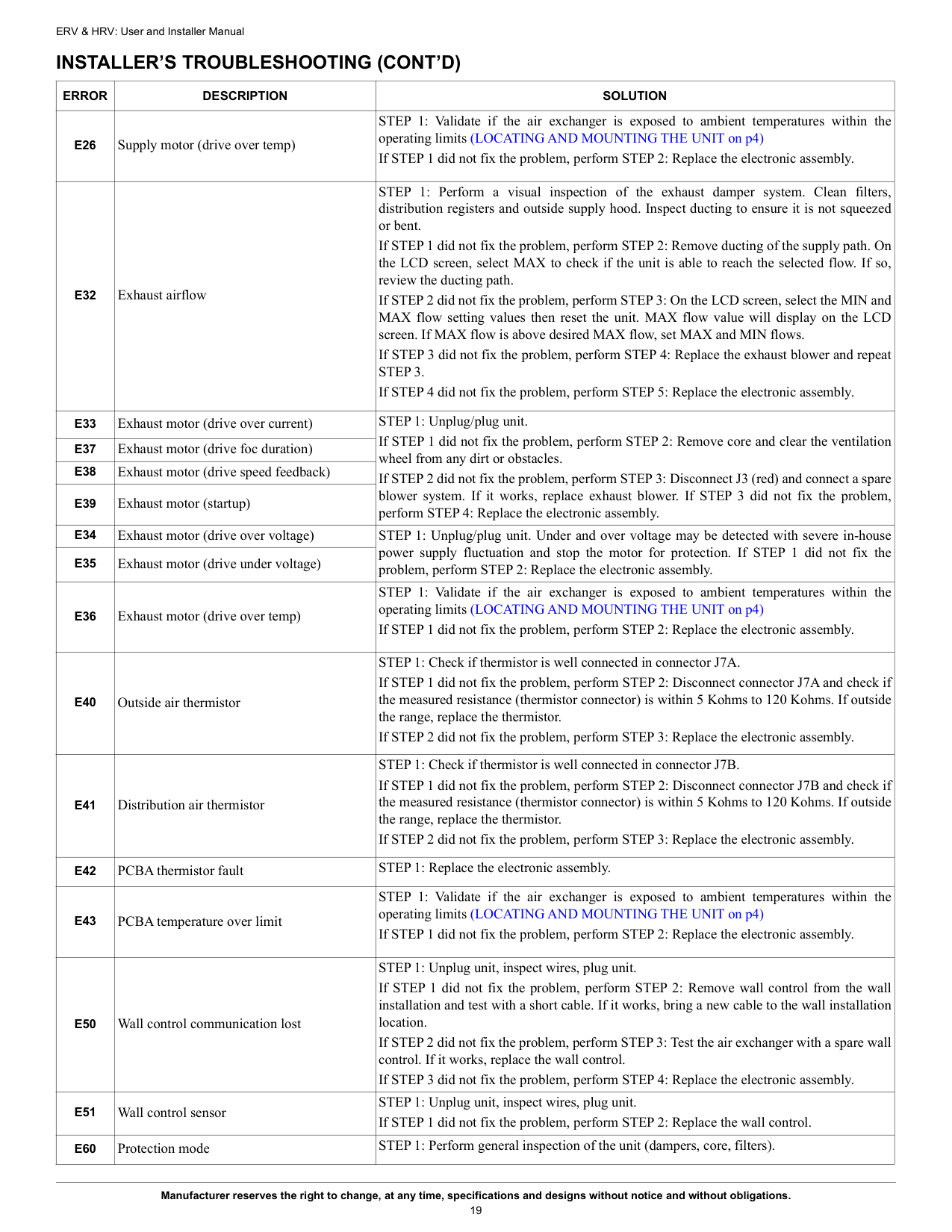
|ERROR|DESCRIPTION|SOLUTION| |---|---|---| |E26|Supply motor (drive over temp)|STEP 1: Validate if the air exchanger is exposed to ambient temperatures within the operating limits (LOCATING AND MOUNTING THE UNIT on p4) If STEP 1 did not fix the problem, perform STEP 2: Replace the electronic assembly.| |E32|Exhaust airflow|STEP 1: Perform a visual inspection of the exhaust damper system. Clean filters, distribution registers and outside supply hood. Inspect ducting to ensure it is not squeezed or bent.
If STEP 1 did not fix the problem, perform STEP 2: Remove ducting of the supply path. On the LCD screen, select MAX to check if the unit is able to reach the selected flow. If so, review the ducting path.
If STEP 2 did not fix the problem, perform STEP 3: On the LCD screen, select the MIN and MAX flow setting values then reset the unit. MAX flow value will display on the LCD screen. If MAX flow is above desired MAX flow, set MAX and MIN flows.
If STEP 3 did not fix the problem, perform STEP 4: Replace the exhaust blower and repeat STEP 3.
If STEP 4 did not fix the problem, perform STEP 5: Replace the electronic assembly.
| |E33|Exhaust motor (drive over current)|STEP 1: Unplug/plug unit.
If STEP 1 did not fix the problem, perform STEP 2: Remove core and clear the ventilation wheel from any dirt or obstacles.
If STEP 2 did not fix the problem, perform STEP 3: Disconnect J3 (red) and connect a spare blower system. If it works, replace exhaust blower. If STEP 3 did not fix the problem, perform STEP 4: Replace the electronic assembly.
| |E37|Exhaust motor (drive foc duration)|STEP 1: Unplug/plug unit.
If STEP 1 did not fix the problem, perform STEP 2: Remove core and clear the ventilation wheel from any dirt or obstacles.
If STEP 2 did not fix the problem, perform STEP 3: Disconnect J3 (red) and connect a spare blower system. If it works, replace exhaust blower. If STEP 3 did not fix the problem, perform STEP 4: Replace the electronic assembly.
| |E38|Exhaust motor (drive speed feedback)|STEP 1: Unplug/plug unit.
If STEP 1 did not fix the problem, perform STEP 2: Remove core and clear the ventilation wheel from any dirt or obstacles.
If STEP 2 did not fix the problem, perform STEP 3: Disconnect J3 (red) and connect a spare blower system. If it works, replace exhaust blower. If STEP 3 did not fix the problem, perform STEP 4: Replace the electronic assembly.
| |E39|Exhaust motor (startup)|STEP 1: Unplug/plug unit.
If STEP 1 did not fix the problem, perform STEP 2: Remove core and clear the ventilation wheel from any dirt or obstacles.
If STEP 2 did not fix the problem, perform STEP 3: Disconnect J3 (red) and connect a spare blower system. If it works, replace exhaust blower. If STEP 3 did not fix the problem, perform STEP 4: Replace the electronic assembly.
| |E34|Exhaust motor (drive over voltage)|STEP 1: Unplug/plug unit. Under and over voltage may be detected with severe in-house power supply fluctuation and stop the motor for protection. If STEP 1 did not fix the problem, perform STEP 2: Replace the electronic assembly.| |E35|Exhaust motor (drive under voltage)|STEP 1: Unplug/plug unit. Under and over voltage may be detected with severe in-house power supply fluctuation and stop the motor for protection. If STEP 1 did not fix the problem, perform STEP 2: Replace the electronic assembly.| |E36|Exhaust motor (drive over temp)|STEP 1: Validate if the air exchanger is exposed to ambient temperatures within the operating limits (LOCATING AND MOUNTING THE UNIT on p4) If STEP 1 did not fix the problem, perform STEP 2: Replace the electronic assembly.| |E40|Outside air thermistor|STEP 1: Check if thermistor is well connected in connector J7A.
If STEP 1 did not fix the problem, perform STEP 2: Disconnect connector J7A and check if the measured resistance (thermistor connector) is within 5 Kohms to 120 Kohms. If outside the range, replace the thermistor.
If STEP 2 did not fix the problem, perform STEP 3: Replace the electronic assembly.
| |E41|Distribution air thermistor|STEP 1: Check if thermistor is well connected in connector J7B.
If STEP 1 did not fix the problem, perform STEP 2: Disconnect connector J7B and check if the measured resistance (thermistor connector) is within 5 Kohms to 120 Kohms. If outside the range, replace the thermistor.
If STEP 2 did not fix the problem, perform STEP 3: Replace the electronic assembly.
| |E42|PCBA thermistor fault|STEP 1: Replace the electronic assembly.| |E43|PCBA temperature over limit|STEP 1: Validate if the air exchanger is exposed to ambient temperatures within the operating limits (LOCATING AND MOUNTING THE UNIT on p4) If STEP 1 did not fix the problem, perform STEP 2: Replace the electronic assembly.| |E50|Wall control communication lost|STEP 1: Unplug unit, inspect wires, plug unit.
If STEP 1 did not fix the problem, perform STEP 2: Remove wall control from the wall installation and test with a short cable. If it works, bring a new cable to the wall installation location.
If STEP 2 did not fix the problem, perform STEP 3: Test the air exchanger with a spare wall control. If it works, replace the wall control.
If STEP 3 did not fix the problem, perform STEP 4: Replace the electronic assembly.
| |E51|Wall control sensor|STEP 1: Unplug unit, inspect wires, plug unit. If STEP 1 did not fix the problem, perform STEP 2: Replace the wall control.| |E60|Protection mode|STEP 1: Perform general inspection of the unit (dampers, core, filters).|
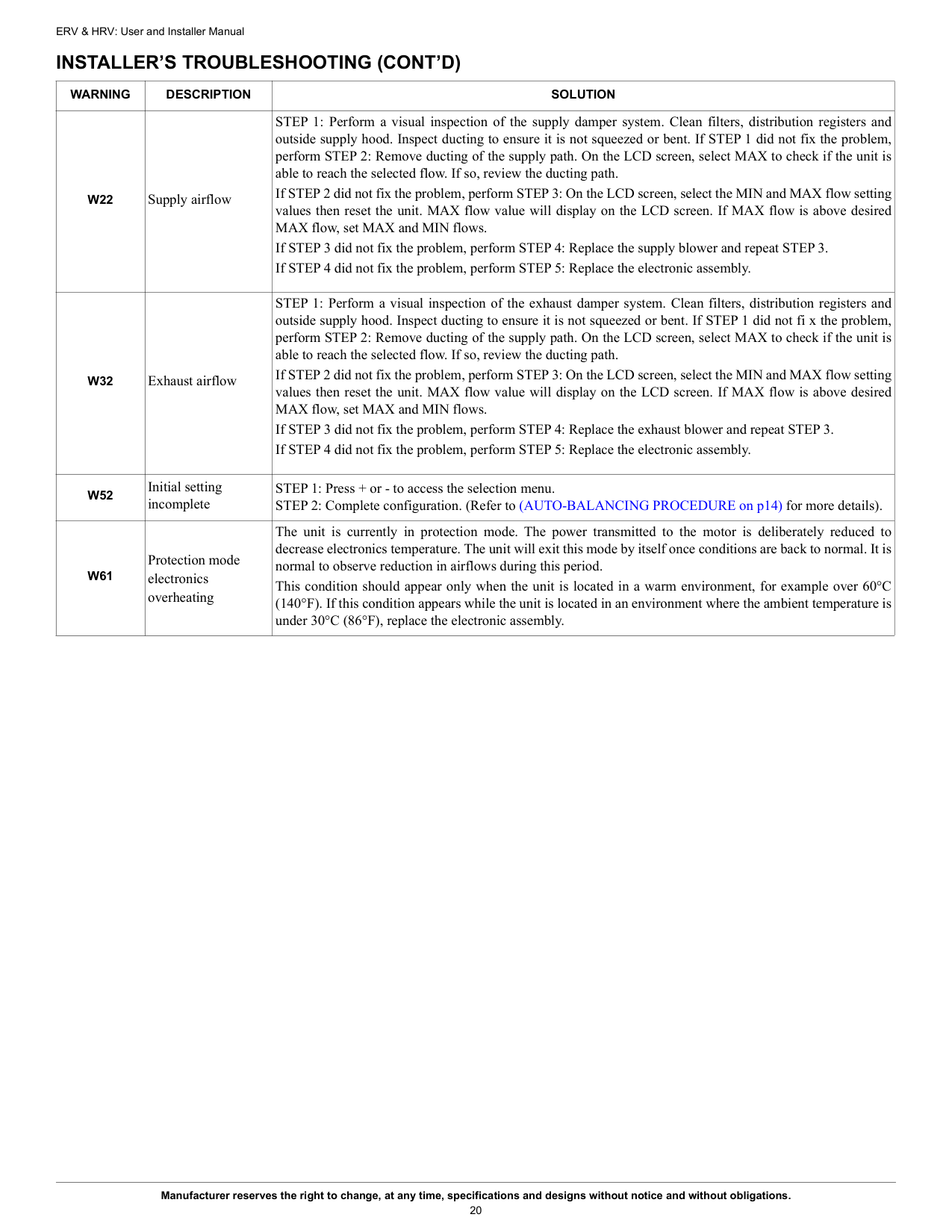
|WARNING|DESCRIPTION|SOLUTION| |---|---|---| |W22|Supply airflow|STEP 1: Perform a visual inspection of the supply damper system. Clean filters, distribution registers and outside supply hood. Inspect ducting to ensure it is not squeezed or bent. If STEP 1 did not fix the problem, perform STEP 2: Remove ducting of the supply path. On the LCD screen, select MAX to check if the unit is able to reach the selected flow. If so, review the ducting path.
If STEP 2 did not fix the problem, perform STEP 3: On the LCD screen, select the MIN and MAX flow setting values then reset the unit. MAX flow value will display on the LCD screen. If MAX flow is above desired MAX flow, set MAX and MIN flows.
If STEP 3 did not fix the problem, perform STEP 4: Replace the supply blower and repeat STEP 3.
If STEP 4 did not fix the problem, perform STEP 5: Replace the electronic assembly.
| |W32|Exhaust airflow|STEP 1: Perform a visual inspection of the exhaust damper system. Clean filters, distribution registers and outside supply hood. Inspect ducting to ensure it is not squeezed or bent. If STEP 1 did not fi x the problem, perform STEP 2: Remove ducting of the supply path. On the LCD screen, select MAX to check if the unit is able to reach the selected flow. If so, review the ducting path.
If STEP 2 did not fix the problem, perform STEP 3: On the LCD screen, select the MIN and MAX flow setting values then reset the unit. MAX flow value will display on the LCD screen. If MAX flow is above desired MAX flow, set MAX and MIN flows.
If STEP 3 did not fix the problem, perform STEP 4: Replace the exhaust blower and repeat STEP 3.
If STEP 4 did not fix the problem, perform STEP 5: Replace the electronic assembly.
| |W52|Initial setting incomplete|STEP 1: Press + or - to access the selection menu.
STEP 2: Complete configuration. (Refer to (AUTO-BALANCING PROCEDURE on p14) for more details).
| |W61|Protection mode electronics overheating|The unit is currently in protection mode. The power transmitted to the motor is deliberately reduced to decrease electronics temperature. The unit will exit this mode by itself once conditions are back to normal. It is normal to observe reduction in airflows during this period.
This condition should appear only when the unit is located in a warm environment, for example over 60°C (140°F). If this condition appears while the unit is located in an environment where the ambient temperature is under 30°C (86°F), replace the electronic assembly.|
#### MAINTENANCE
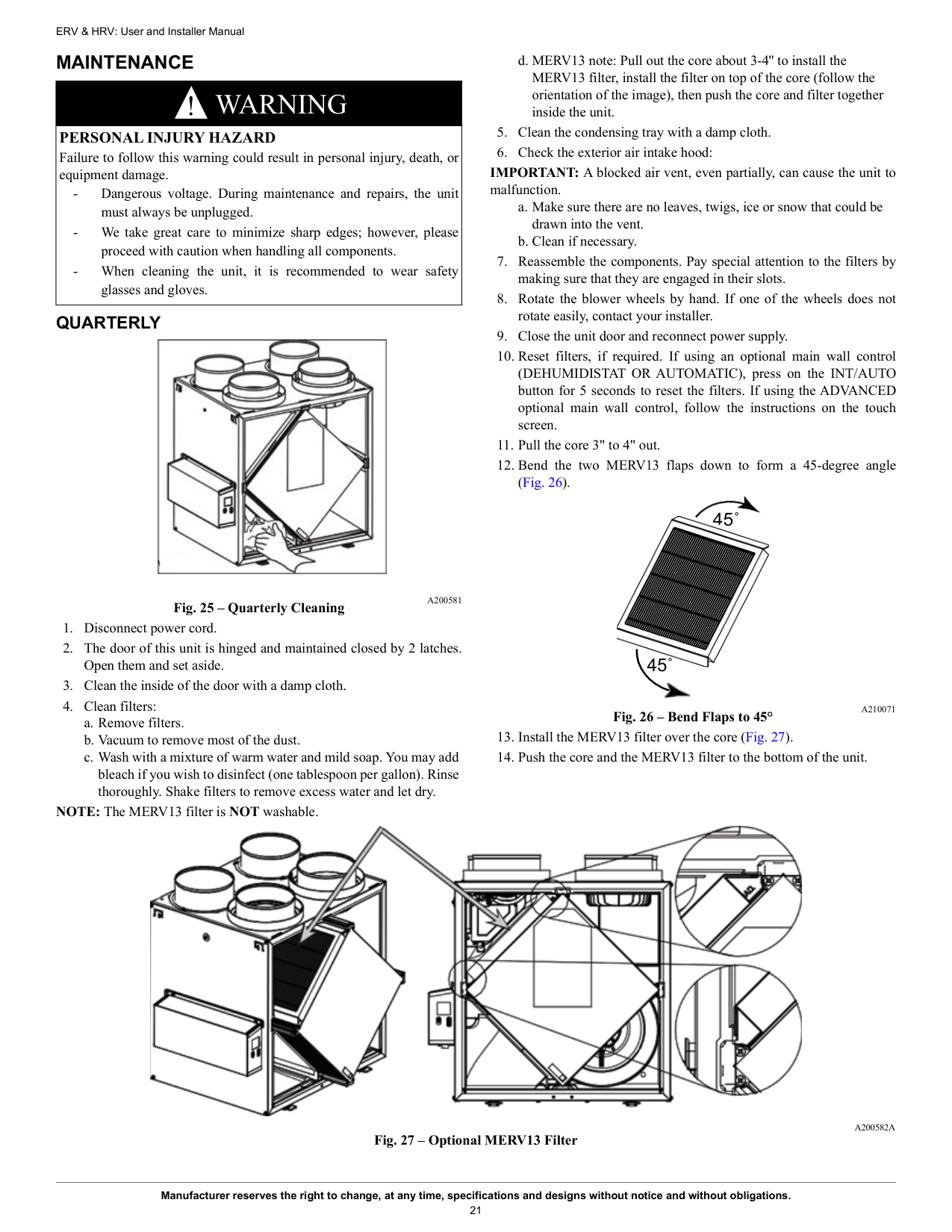
d. MERV13 note: Pull out the core about 3-4'' to install the MERV13 filter, install the filter on top of the core (follow the orientation of the image), then push the core and filter together inside the unit.
|WARNING!
| |---| |PERSONAL INJURY HAZARD Failure to follow this warning could result in personal injury, death, or equipment damage.
- Dangerous voltage. During maintenance and repairs, the unit must always be unplugged.
- We take great care to minimize sharp edges; however, please proceed with caution when handling all components.
- When cleaning the unit, it is recommended to wear safety glasses and gloves.
|
IMPORTANT: A blocked air vent, even partially, can cause the unit to malfunction.
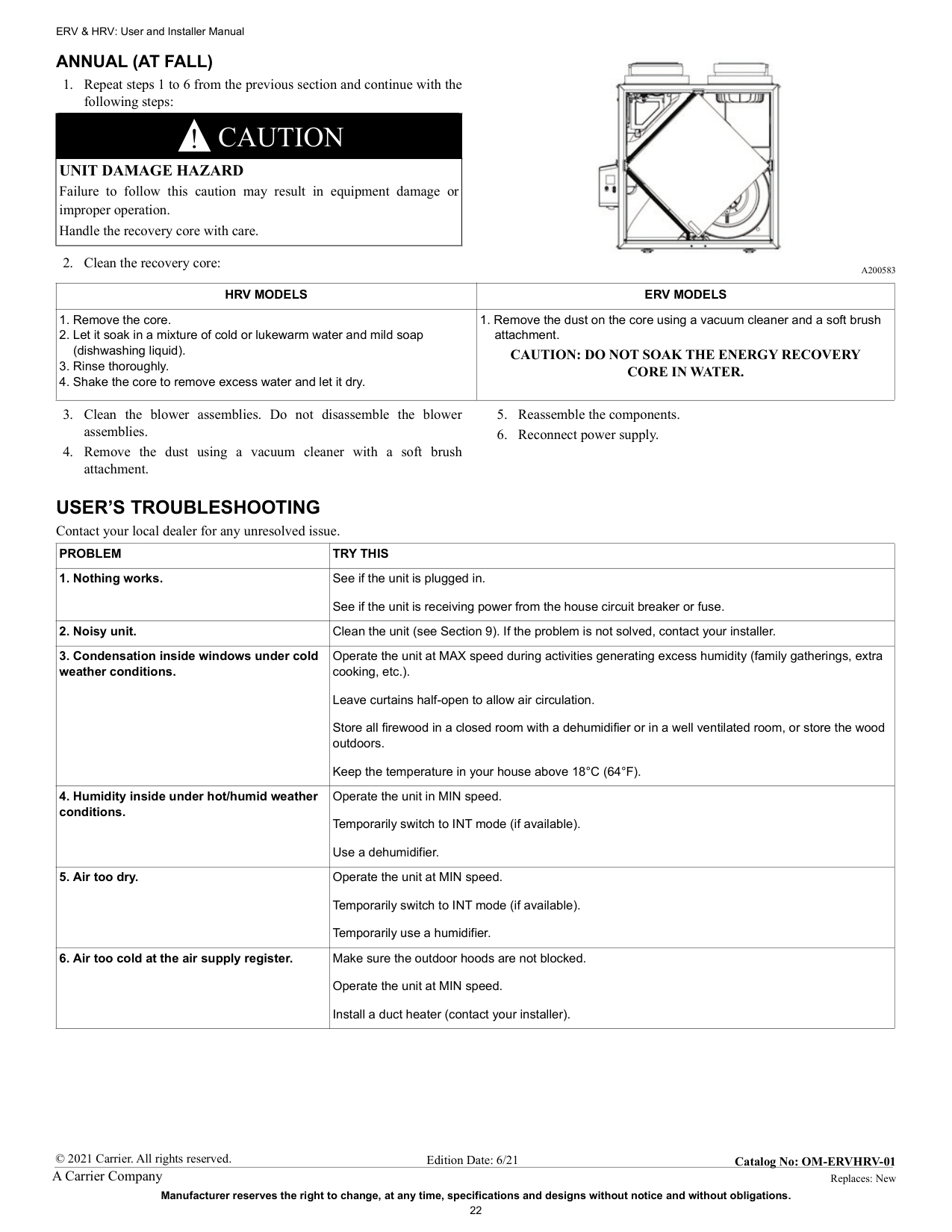
A210071Fig. 26 – Bend Flaps to 45°
##### QUARTERLY


45˚
####### A200581Fig. 25 – Quarterly Cleaning

45˚45˚


NOTE: The MERV13 filter is NOT washable.

A200582A Fig. 27 – Optional MERV13 Filter
##### ANNUAL (AT FALL)

|CAUTION!
| |---| |UNIT DAMAGE HAZARD Failure to follow this caution may result in equipment damage or improper operation. Handle the recovery core with care.|
|HRV MODELS|ERV MODELS| |---|---| |1. Remove the core.
2. Let it soak in a mixture of cold or lukewarm water and mild soap (dishwashing liquid).
3. Rinse thoroughly.
4. Shake the core to remove excess water and let it dry.
|1. Remove the dust on the core using a vacuum cleaner and a soft brush attachment.
CAUTION: DO NOT SOAK THE ENERGY RECOVERY CORE IN WATER.|
USER’S TROUBLESHOOTING Contact your local dealer for any unresolved issue.
|PROBLEM|TRY THIS| |---|---| |1. Nothing works.|See if the unit is plugged in. See if the unit is receiving power from the house circuit breaker or fuse.| |2. Noisy unit.|Clean the unit (see Section 9). If the problem is not solved, contact your installer.| |3. Condensation inside windows under cold weather conditions.|Operate the unit at MAX speed during activities generating excess humidity (family gatherings, extra cooking, etc.).
Leave curtains half-open to allow air circulation. Store all firewood in a closed room with a dehumidifier or in a well ventilated room, or store the wood outdoors. Keep the temperature in your house above 18°C (64°F).| |4. Humidity inside under hot/humid weather conditions.|Operate the unit in MIN speed. Temporarily switch to INT mode (if available). Use a dehumidifier.| |5. Air too dry.|Operate the unit at MIN speed. Temporarily switch to INT mode (if available). Temporarily use a humidifier.| |6. Air too cold at the air supply register.|Make sure the outdoor hoods are not blocked. Operate the unit at MIN speed. Install a duct heater (contact your installer).|
© 2021 Carrier. All rights reserved. A Carrier Company
Edition Date: 6/21 Catalog No: OM-ERVHRV-01 Replaces: New