Ask AI
— answers from the official manualAnswers from the official manual.
Common questions
Common Questions
10 totalWhat is the no-load speed of the Craftsman Radial Arm Saw Model 315.220100?
The no-load speed of this saw is approximately 3,450 rpm. This speed is not constant and may vary depending on load and operating conditions. (Page 8)
How do I change the voltage from 120V to 240V on my radial arm saw?
Have a qualified electrician change the voltage on the main power system. The procedure involves removing the blade, lifting the motor cover to expose the switch, using a small screwdriver to slide the dual voltage switch to the 240V position, and replacing the 120V plug with a UL listed 240V, 15 amp, 3-prong plug. Do not modify the control cut cord, which is set up for 120V AC only. (Page 9)
What safety equipment should I wear when operating the radial arm saw?
Always wear safety goggles or safety glasses with side shields and a full face shield when needed. The manual recommends a Wide Vision Safety Mask for use over eyeglasses or standard safety glasses. All eye protection must be marked to comply with ANSI Z87.1. Additionally, wear hearing protection during extended operations and a dust mask to prevent inhaling fine particles. (Page 2)
How do I properly maintain the saw blade to ensure safe operation?
Keep blades clean, sharp, and with sufficient set. Sharp blades minimize stalling and kickback. Keep blades free of rust, grease, and pitch. Use only blades rated for at least 5,000 rpm and recommended for use on this saw, with a 5/8 inch arbor hole. (Page 6)
What is the maximum cutting capacity of this saw?
The maximum cross cut capacity is 15.50 inches, the maximum out-rip capacity is 26 inches, and the maximum in-rip capacity is 16 inches. The depth of cut at 90° is 3 inches, and the depth of cut at 45° is 2.25 inches. (Page 10)
How do I properly assemble the leg stand for the saw?
Assemble the leg stand by installing leveling feet into the bottom of the legs, attaching short upper and lower braces to two legs, connecting the leg sets with long upper braces, and installing long lower braces. Use the provided truss head screws, star washers, and hex nuts, and tighten all fasteners with a 7/16 inch wrench. Finally, use a level to adjust the leveling feet and securely tighten all four nuts. (Page 22)
Show 4 more questions
Full Manual
86 pages
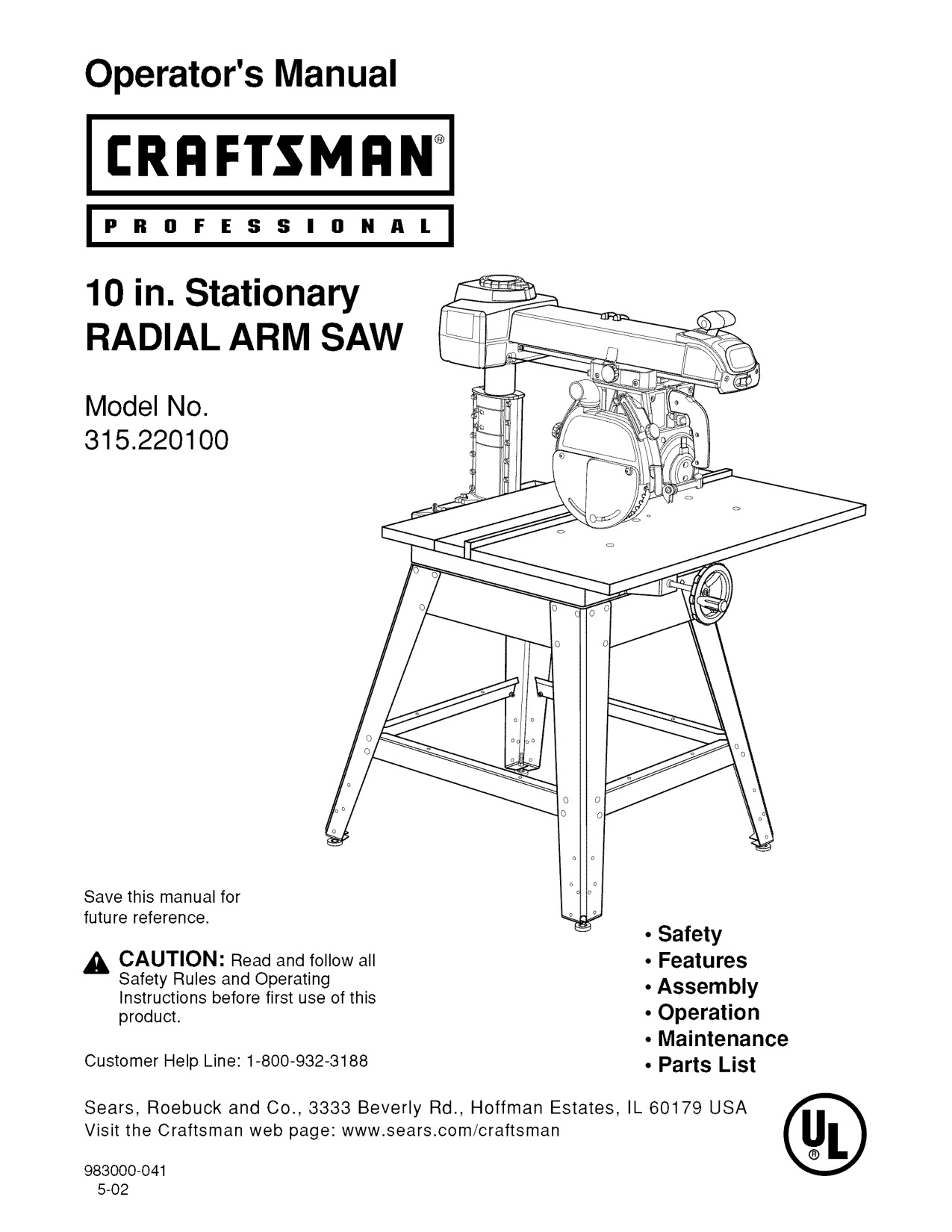
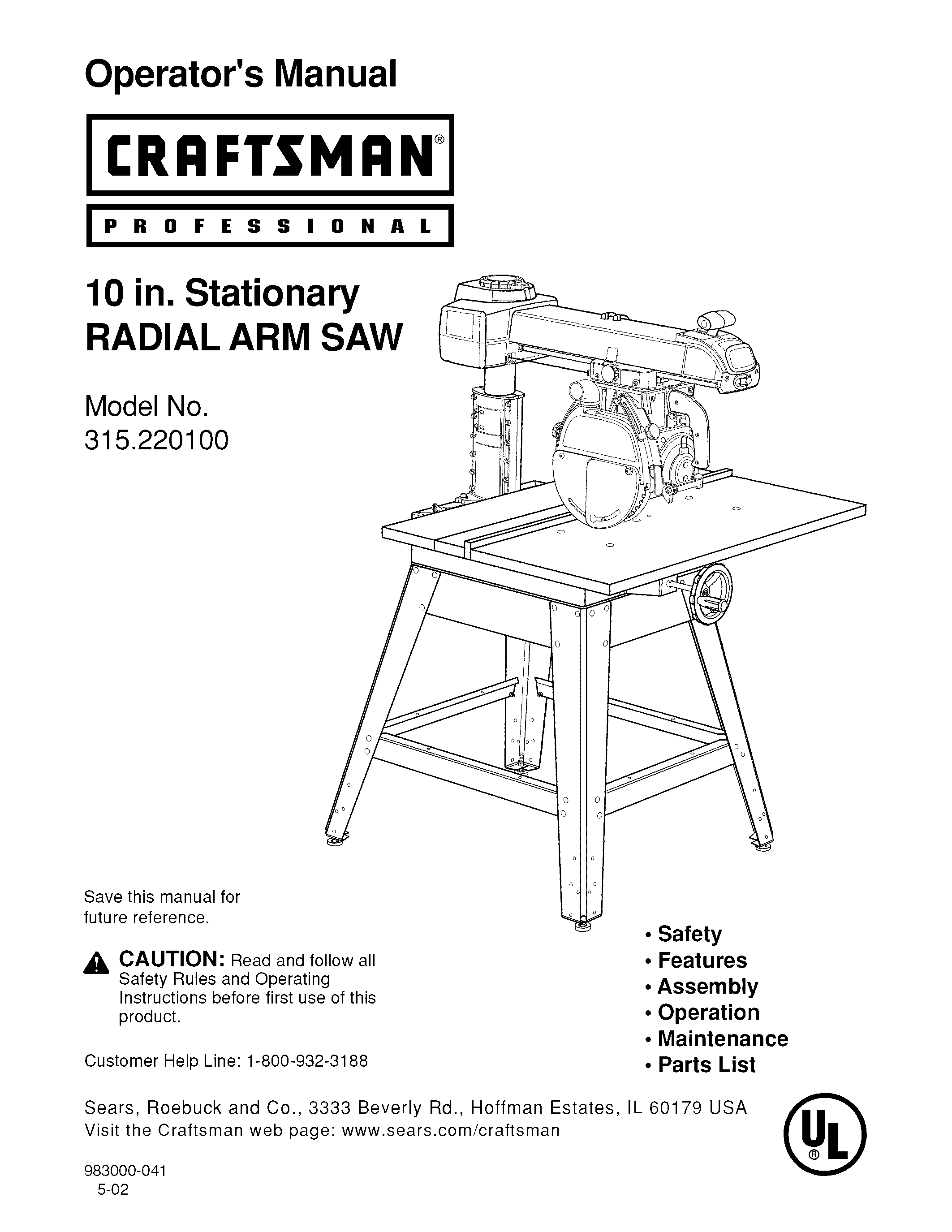
Operator's Manual
Craftsman +
Pro
I
0H
A
L
10 in. StationaryRadial Arm Saw
Model No. 315.220100 Save this manual for future reference.Caution:
Read and follow all Safety Rules and Operating Instructions before first use of this product. Customer Help Line: 1-800-932-3188Il 60179
Usa
Visit the Craftsman web page: www.sears.com/craftsman 983000-041 5-02
Full One Year Warranty
On Craftsman
Radial Arm Saw
If this product fails due to a defect in material or workmanship within one year from the date of purchase, Sears will repair it, free of charge, Contact a Sears Service Center for repair. If this product is used for commercial or rental purposes, this warranty applies only for 90 days from the date of purchase. This warranty gives you specific legal rights, and you may also have other rights which vary from state to state. Sears, Roebuck and Co., Dept. 817WA, Hoffman Estates,Il 60179
Your saw has many features for making cutting operations more pleasant and enjoyable. Safety, performance and dependability have been given top priority in the design of this saw making it easy to maintain and operate. _kCaution:
Carefully read through this entire operator's manual before using your new saw. Pay close attention to the Rules For Safe Operation, and all Safety Alert Symbols, including Danger, Warning and Caution. If you use your saw properly and only for what it is intended, you will enjoy years of safe, reliable service. Look for this symbol to point out important safety precautions. It means attention!!! Your safety is involved. _,Warning:
The operation of any power tool can result in foreign objects being thrown into your eyes, which can result in severe eye damage. Before beginning tool operation, always wear safety goggles or safety glasses with side shields and a full face shield when needed. We recommend Wide Vision Safety Mask for use over eyeglasses or standard safety glasses with side shields. Always wear eye protection which is marked to comply with ANSI Z87.1. • Warranty and Introduction .................................................................................................................................. 2 • Table of Contents ............................................................................................................................................. 2-3 • Rules for Safe Operation ................................................................................................................................ 4-7 • Electrical ........................................................................................................................................................... 8-9 • Product Specifications and Glossary .......................................................................................................... 10-11 • Unpacking and Accessories ............................................................................................................................. 11 • Loose Parts List .......................................................................................................................................... 12-14 • Tools Needed .................................................................................................................................................... 15 • Labels .......................................................................................................................................................... 16-17 • Features ...................................................................................................................................................... 18-21 • Assembly ..................................................................................................................................................... 22-36 Assembling Leg Stand ...................................................................................................................................... 22 Mounting Saw to Leg Stand .............................................................................................................................. 23 [RRFT._IvlI_N_RADIALSAW 315.220100 2
Attaching Elevating Handwheel ........................................................................................................................ 23 Installing the Yoke Assembly ............................................................................................................................ 24 Removing the Blade .......................................................................................................................................... 25 Attaching Table Supports ................................................................................................................................. 25 Setting the Arm Lock Knob ............................................................................................................................... 26 Setting the Yoke Clamp .................................................................................................................................... 26 Setting the Bevel Lock Lever ............................................................................................................................ 27 Tightening the Arm and Column ....................................................................................................................... 28 Adjusting the Column Tube ........................................................................................................................ 28-29 Adjusting the Carriage Bearings ....................................................................................................................... 30 Leveling the Table Supports ............................................................................................................................. 31 Installing the Front Table .................................................................................................................................. 32 Leveling the Front Table ................................................................................................................................... 33 Installing Rear Table, Spacer Table, Fence, and Clamps .......................................................................... 33-34 Installing Blade and Blade Guard ..................................................................................................................... 34 Aligning Riving Knife to Blade ........................................................................................................................... 35 Installing Rip Scale Indicators ........................................................................................................................... 36 • Adjustments ................................................................................................................................................ 36-43 Aligning the Arm for Cross Cuts ....................................................................................................................... 37 Aligning the Blade to Table at 0° Bevel ............................................................................................................ 38 Squaring Blade to Fence .................................................................................................................................. 39 Paralleling Blade to Table ................................................................................................................................. 40 Aligning the Rip Scale Indicators ...................................................................................................................... 41 Installing Control Cut Device ............................................................................................................................ 42 Check Alignment of Arm and Blade using Laser ............................................................................................. 43 • Operation .................................................................................................................................................... 44-54 Basic Operation of the Radial Arm Saw ........................................................................................................... 44 Types of Cuts .................................................................................................................................................... 44 Switch and Switch Key ...................................................................................................................................... 45 Causes of Kickback .......................................................................................................................................... 45 Avoiding Kickback ............................................................................................................................................. 45 Cutting Aids ....................................................................................................................................................... 46 Making a Cross Cut .......................................................................................................................................... 47 Making a Miter Cut ............................................................................................................................................ 48 Making a Bevel Cut ........................................................................................................................................... 49 Making a Compound Cross Cut ........................................................................................................................ 50 Rip Cut Hazards and Precautions .................................................................................................................... 51 Setting Up a Rip Cut ................................................................................................................................... 51-52 Making a Rip Cut .............................................................................................................................................. 52 Making Other Cuts ............................................................................................................................................ 53 Cutting Long Workpieces .................................................................................................................................. 53 Non-Through Cuts ............................................................................................................................................ 54 • Laser Guide ................................................................................................................................................ 55-56 • Maintenance ..................................................................................................................................................... 57 • Troubleshooting .......................................................................................................................................... 58-62 • Exploded View and Repair Parts List ......................................................................................................... 64-85 • Parts Ordering / Service ...................................................................................................................... back page 3 rRI:IFI"$1_tI:IN
_ Radialsaw315.220100
The purpose of safety symbols is to attract your attention to possible dangers, The safety symbols, and the explanations with them, deserve your careful attention and understanding. The safety warnings do not by themselves eliminate any danger. The instructions or warnings they give are not substitutes for proper accident prevention measures,
Symbol
A
A
A
A
Note:Meaning
Safety
Alert
Symbol
Indicates danger, warning or caution, May be used in conjunction with other symbols or pictographs,Danger:
Failure to obey a safety warning will result in serious injury to yourself or to others. Always follow the safety precautions to reduce the risk of fire, electric shock and personal injury,Warning:
Failure to obey a safety warning can result in serious injury to yourself or to others, Always follow the safety precautions to reduce the risk of fire, electric shock and personal injury,Caution:
Failure to obey a safety warning may result in property damage or personal injury to yourself or to others, Always follow the safety precautions to reduce the risk of fire, electric shock and personal injury, Advises you of information or instructions vital to the operation or maintenance of the equipment.Important
Servicing requires extreme care and knowledge of the system and should be performed only by a qualified service technician, For service we suggest you return the tool to you nearest Sears store or repair center for repair. Always use original factory replacement parts when servicing. If you have questions about terms in the following rules, refer to the Glossary of Terms for Woodworking or the Features section,A
Warning:
Do not attempt to operate this tool until you have read thoroughly and understand completely all instructions, safety rules, etc. contained in this manual, Failure to comply can result in accidents involving fire, electric shock, or serious personal injury. Save operator's manual and review frequently for continuing safe operation, and instructing others who may use this tool.Read
All Instructions
• KNOW YOUR POWER TOOL. Read the operator's manual carefully, Learn the saw's applications and limitations as well as the specific potential hazards related to this tool. •Do Not Use In Dangerous
Environment.
Do not use power tools near gasoline or other flammable liquids, in damp or wet locations, or expose them to rain, Keep the work area well lit. •Keep Children
And Visitors
AWAY. All visitors should wear safety glasses and be kept a safe distance from work area. Do not let visitors contact the tool or extension cord while operating, •Keep Work Area Clean.
Cluttered work areas and work benches invite accidents.Do Not
leave tools or pieces of wood on the saw while it is in operation. Keep floors clean and free of saw- dust, •Maintain
Tools With Care.
Keep tools sharp and clean for better and safer performance, Follow instructions for lubricating and changing accesso- • ries, I:RRFI'$MnN"RADIALSAW 315.220100 •Make Workshop
Childproof
with padlocks and master switches or by removing switch keys, •Use The Right Tool
FOR THE JOB. Do not force the tool or attachment to do a job it was not designed for, Use it only the way it was intended, •Dress Properly.
Do not wear loose clothing, gloves, neckties, rings, bracelets, or other jewelry, They can get caught and draw you into moving parts. Nonslip footwear is recommended, Also wear protective hair covering to contain long hair. •Always
Wear Safety Glasses
With Side
Shields.
Everyday eyeglasses have only impact- resistant lenses; they are NOT safety glasses. •Never Stand
ON TOOL. Serious injury could occur if the tool is tipped or if the blade is uninten- tionally contacted.Do Not Overreach.
Keep proper footing and balance at all times,Secure Work.
Use clamps or a vise to hold work when practical. It's safer than using your hand and frees both hands to operate the tool,
•
Use The Proper Extension
CORD. Make sure your extension cord is in good condition. Use only a cord heavy enough to carry the current your product will draw, An undersized cord will cause a drop in line voltage resulting in loss of power and overheating, A wire gage size (A.W,G,) of at least 14 is recommended for an extension cord 25 feet or less in length. If in doubt, use the next heavier gage, The smaller the gage number, the heavier the cord, •Avoid Accidental
Starting.
Be sure switch is off when plugging in the tool, •Remove Wrenches
And Adjusting
Keys.
Get in the habit of checkingCheck
Damaged
Parts.
Before using the tool again, check any damaged parts, including guards, for proper operation and performance, Check alignment of moving parts, binding of moving parts, breakage of parts, saw stability, mounting and any other conditions that may affect its operation,A
damaged part must be properly repaired or re- placed by a qualified service technician at a Sears store or repair center to avoid risk of personal injury, •Use Only Correct
Blades.
Use the right blade style for the material and the type of cut, Use only blades marked for at least 5,000 rpm and 10 in, or smaller, with a 5/8 in. arbor hole, •Keep Guards
IN PLACE and in good working order, This includes the blade guard, the riving knife, and the anti-kickback pawls. •Check
Direction
OF FEED. When ripping, feed work into a blade or cutter against the direc- tion of rotation of the blade or cutter, •Never Leave Tool
Running
Unattended.
TURN THE POWER OFF. Do not leave the tool until it comes to a complete stop, •Use Recommended
Accessories.
Using improper accessories may risk injury, Consult the Accessories section for recommended accesso- ries, •Replacement
PARTS. All repairs, whether electrical or mechanical, should be made by a qualified service technician at a Sears authorized service center, •Disconnect
All Tools.
When not in use, before servicing, or when changing attachments, blades, bits, cutters, etc., all tools should be disconnected from the power supply. • DO NOT FORCE THE TOOL. It will do the job better and more safely at the rate for which it was designed. •Before
Mounting,
Disconnecting
Or
Remounting
THE MOTOR; unplug the saw and remove the switch key. •When Servicing,
use only identical Sears replacement parts. Use of any other parts may create a hazard or damage product, •Never Use This Tool In An Explosive
Atmosphere.
Normal sparking of the motor could ignite fumes, •Make Sure The Work Area Has Ample
Lighting
to see the work and that no obstruc- tions will interfere with safe operationBefore
performing any work using this tool. •Do Not Use Tool If Switch
Does Not
TURN IT ON AND OFF. Have defective switches replaced by an authorized service center, •Guard
Against
Electrical
Shock
by preventing body contact with grounded surfaces such as pipes, radiators, ranges, refrigerator enclosures. •Ground All Tools.
See Electrical page. • WEAR A DUST MASK to keep from inhaling fine particles. Use wood dust collection systems whenever possible. •Protect
Your Hearing.
Wear hearing protection during extended periods of operation, •Do Not Operate
This Tool While
Under
The Influence
Of Drugs, Alcohol,
Or
Any Medication.
•Stay Alert And Exercise
Control.
Watch what you are doing and use common sense. Do not operate tool when you are tired, Do not rush, •Avoid Awkward
Operations
And Hand
Positions
where a sudden slip could cause your hand to move into the blade. ALWAYS make sure you have good balance. •Guard
Against
Kickback.
Kickback can occur when the blade stalls, driving the work piece back toward the operator, It can cause your hand to contact the blade, resulting in serious personal injury. Stay out of the blade path and turn switch off immediately if blade binds or stalls, •Do Not Use A Person As A Substitute
For A Table
if additional support is needed, Use a support the same height as the table, •Use A Support
For The Sides And Back
Of The Saw Table
when sawing wide or long workpieces to minimize the risk of blade pinching and kickback. Use a sturdy "outrigger" support to prevent tipping if a table extension more than 24 in, long is attached to the saw, rRFIFTSMRN_Radialsaw315.220100
•
Cut Only Wood,
Plastic Or Wood-Like
Materials.
Do not cut metal, •Before Making
A CUT, be sure all adjustments are secure. • NEVER cut more than one piece at a time, DONot Stack
more than one workpiece on the saw table at a time, •Do Not Remove The Saw'S Blade Guard.
Never operate the saw with the blade guard removed. Make sure all guards are operating • properly before each use. • •Never Perform
Any Operation
Free-
HAND. Always place the workpiece to be cut on the saw table and position it firmly against the fence as a backstop. • USE THE RIP FENCE. Always use a fence or straight edge guide when ripping. •Be Sure The Blade Path Is Free Of
•Nails.
Inspect for and remove all nails from lumber before cutting, •Be Sure The Blade
Clears
The Work-
PIECE. Never start the saw with the blade touching the stock. •Keep Hands Away From Cutting
Area.
Do not reach underneath work or in blade cutting path with your hands and fingers for any reason, Always turn the power off when cut is complete. •Use A Pushblock
Or Pushstick
in rip mode for workpieces so small that your fingers go under the blade guard, NEVER TOUCHBlade
or other moving parts during use, for any reason, •Allow
The Motor To Come Up To Full
SPEED before starting a cut to avoid blade binding or stalling. •Always
Push The Workpiece
when ripping; never pull it toward the saw, •Do Not Feed The Material
Too Quickly.
Do not force the workpiece against the blade. •Always
TURN OFF SAW before disconnecting it, to avoid accidental starting when reconnecting to the power supply. NEVER leave the saw unat- tended while connected to a power source. •Before Changing
The Setup,
Removing
Covers,
Guards,
Or Blade
unplug the saw and remove the switch key, • AVOID direct eye exposure when using the laser guide.Keep Tool
Dry, Clean,
And Free From
Oil And Grease.
Always use a clean cloth when cleaning. Never use brake fluids, gasoline, petroleum-based products, or any solvents to clean tool,Keep Blades
Clean,
Sharp
And With
Sufficient
SET. Sharp blades minimize stalling and kickback, Keep blades free of rust, grease, and pitch,Blade
Coasts
After
Being Turned
Off.
Use Only Outdoor
Extension
Cords.
Use only extension cords with the marking "Ac- ceptable for use with outdoor appliances; store indoors while not in use," Use extension cords with an electrical rating not less than the saw's rating, Always disconnect the extension cord from the outlet before disconnecting the product from the extension cord,Inspect Tool
Cords And Extension
Cords Periodically
and, if damaged, have repaired by at your nearest Sears Authorized Repair Center, Stay constantly aware of cord location and keep it well away from the moving blade. • DO NOT ABUSE CORD. Never yank the cord to disconnect it from receptacle, Keep the cord from heat, oil, and sharp edges, •Save These Instructions.
Refer to them frequently and use to instruct other users, If you loan someone this tool, loan them these instruc- tions also, ,_Warning:
Some dust created by power sanding, sawing, grinding, drilling, and other construction activities contains chemicals known to cause cancer, birth defects or other reproductive harm. Some examples of these chemicals are:Save These Instructions
[RRI:TSIvlRN"RADIALSAW 315.220100 6
•
Secure
THE SAW. Firmly bolt the saw to the leg stand to keep the saw from tipping, walking, or sliding, •Do Not Set Up Work With The Blade
Spinning.
Keep the saw power off until you are ready to use it. •Rip Only Workpieces
Longer Than The
Blade'S
Diameter.
Never rip a piece of wood that is shorter than the diameter of the blade. •Never Lower An Unlocked
Revolving
CUTTING TOOL. Always lock the carriage lock knob before lowering the blade. •Shut Off The Power To Free A Jammed
Guard.
Press the switch off before putting your hands near the blade, Wait for the blade to stop, then free the guard, •Lock The Saw Before
Moving
IT. Secure the radial arm with the arm lock knob, Secure the carriage with the carriage lock knob, •Position The Workpiece
With The Fin-
ISHED SIDE DOWN. If the anti-kickback pawls catch the wood to stop kickback, they could mar the top surface or cause splintering, •Position The Workpiece
So No One Must
Stand
In Line With The Blade.
If kickback or climb occurs, a helper, operator, or observer in the sawblade path could be seriously injured, •Position The Cut So The Waste
Part
Falls
OFF. Never use a length stop on the free end of the workpiece, Never apply force to the free end or hold it while the sawblade is rotating, • IN A RIP CUT, holding the cut-off edge behind the blade can cause the cut edges to pinch, risking kickback, It could cause the blade to climb over the front edge of the wood and contact your hand, •Before Starting
EACH CUT, check that no play exists in the carriage, Be sure the arm, yoke and bevel locks and clamps are tight, Verify the blade, all handles, blade washers, and blade nuts are secure, •Before Making
A CUT, test the upper and lower blade guards for free movement up and down, Position the nose of the guard to just clear the workpiece, •Avoid
Kickback
And Possible
Injury
by preventing heeling, grabbing, and pinching. •Before Cutting,
position and tighten the blade guard and anti-kickback pawls. Test the pawls to make sure they would stop kickback if it started, Keep the points sharp, •Keep The Saw Blade
Path Clear.
Position the saw to allow enough room on all sides so neither the operator nor a visitor stands in line with the sawblade, •Avoid Heeling
by adjusting the saw blade so it exactly parallels the fence during ripping opera- tions, •Avoid Grabbing
in rip mode by keeping the saw blade correctly adjusted and by feeding the work from the infeed side (opposite the anti- kickback pawls), •Avoid
PINCHING by using a riving knife and sharp saw blade, Keep the work positioned firmly against the fence, •Use In-Rip Whenever
Possible
by position- ing the work so the blade is between (inside) the column and the motor, •Never Adjust Guard,
Pawls, Or Blade
Without
Disconnecting
The Power.
Always turn off the switch and unplug the cord before freeing a jammed blade, tightening a loose blade, or repositioning the guard or pawls, • DO NOT turn the motor switch on and off rapidly, This can loosen the sawblade. •Never Cut More Than One Piece Of
WOOD AT A TIME. The feed will be uneven and could cause the blade to pick up one or more pieces and cause serious injury, •Turn Off Saw If A Strange
Noise Or
Heavy Vibration
Occurs.
Immediately turn off the saw, locate the source, and correct the problem before using the saw further, •Position The Cut So The Blade Will Not
Extend
Beyond The Edge Of The Table.
Keep The Guards
In Place And The Work
Surface
Clear
DURING A CUT. Small objects or wood slivers can ricochet from the blade into the fence and back toward the operator, If the blade loosens slivers, remove them with a stick, not your hand,In A Rip Cut, Do Not Let Go Of The Work-
Piece Until The Cut Is Complete.
When the workpiece is fed into the blade, push the workpiece all the way past the blade, 7 rRFIFTSMRN_Radialsaw315.220100
Extension
Cords
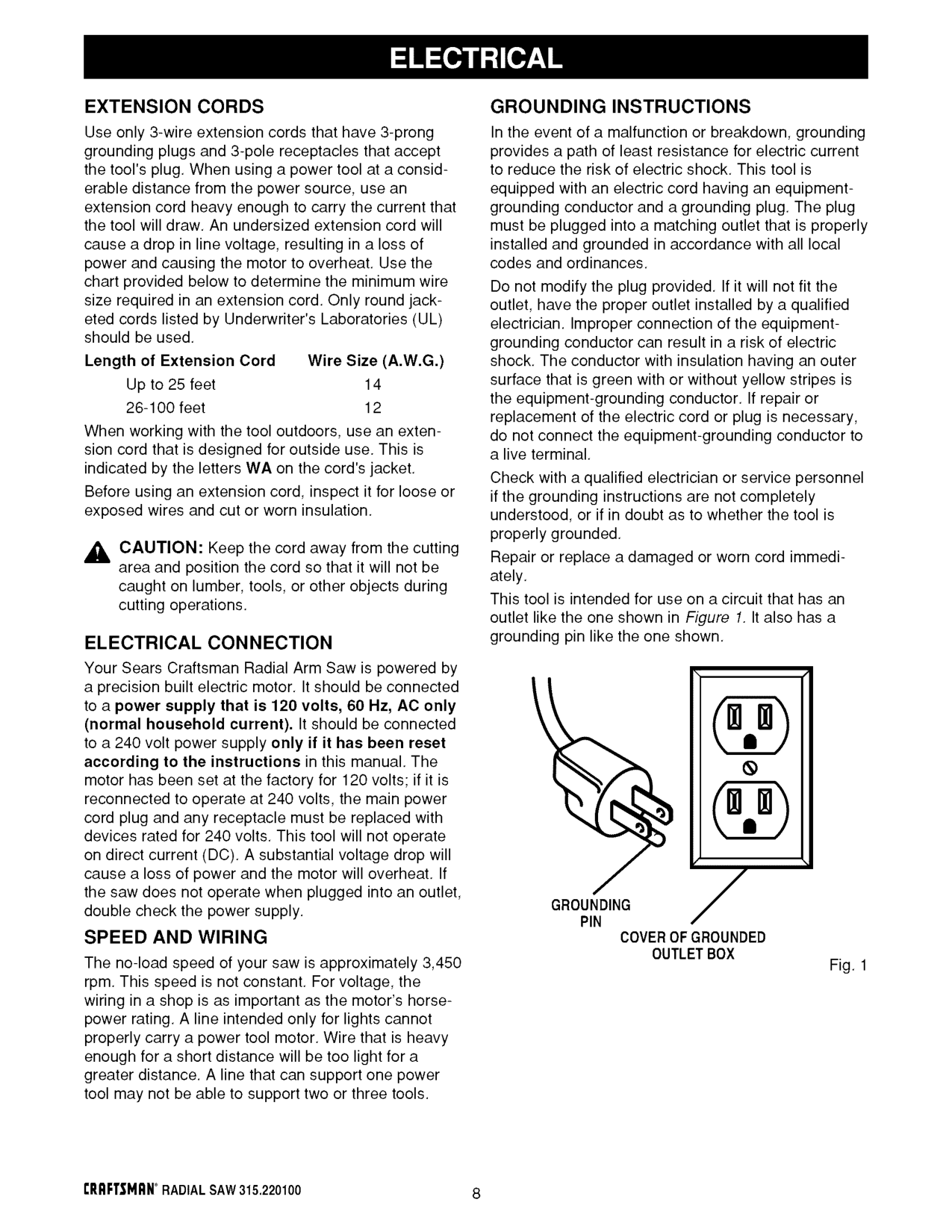
Use only 3-wire extension cords that have 3-prong grounding plugs and 3-pole receptacles that accept the tool's plug, When using a power tool at a consid- erable distance from the power source, use an extension cord heavy enough to carry the current that the tool will draw, An undersized extension cord will cause a drop in line voltage, resulting in a loss of power and causing the motor to overheat, Use the chart provided below to determine the minimum wire size required in an extension cord. Only round jack- eted cords listed by Underwriter's Laboratories(Ul)
should be used, Length of Extension Cord Wire Size (A.W.G.) Up to 25 feet 14 26-100 feet 12 When working with the tool outdoors, use an exten- sion cord that is designed for outside use. This is indicated by the letters WA on the cord's jacket, Before using an extension cord, inspect it for loose or exposed wires and cut or worn insulation. ,_,Caution:
Keep the cord away from the cutting area and position the cord so that it will not be caught on lumber, tools, or other objects during cutting operations.Electrical
Connection
Your Sears Craftsman Radial Arm Saw is powered by a precision built electric motor, It should be connected to a power supply that is 120 volts, 60 Hz, AC only (normal household current). It should be connected to a 240 volt power supply only if it has been reset according to the instructions in this manual. The motor has been set at the factory for 120 volts; if it is reconnected to operate at 240 volts, the main power cord plug and any receptacle must be replaced with devices rated for 240 volts, This tool will not operate on direct current (DC), A substantial voltage drop will cause a loss of power and the motor will overheat. If the saw does not operate when plugged into an outlet, double check the power supply.Speed
And
Wiring
The no-load speed of your saw is approximately 3,450 rpm. This speed is not constant, For voltage, the wiring in a shop is as important as the motor's horse- power rating, A line intended only for lights cannot properly carry a power tool motor, Wire that is heavy enough for a short distance will be too light for a greater distance. A line that can support one power tool may not be able to support two or three tools.Grounding
Instructions
In the event of a malfunction or breakdown, grounding provides a path of least resistance for electric current to reduce the risk of electric shock, This tool is equipped with an electric cord having an equipment- grounding conductor and a grounding plug, The plug must be plugged into a matching outlet that is properly installed and grounded in accordance with all local codes and ordinances, Do not modify the plug provided, If it will not fit the outlet, have the proper outlet installed by a qualified electrician. Improper connection of the equipment- grounding conductor can result in a risk of electric shock, The conductor with insulation having an outer surface that is green with or without yellow stripes is the equipment-grounding conductor, If repair or replacement of the electric cord or plug is necessary, do not connect the equipment-grounding conductor to a live terminal, Check with a qualified electrician or service personnel if the grounding instructions are not completely understood, or if in doubt as to whether the tool is properly grounded, Repair or replace a damaged or worn cord immedi- ately, This tool is intended for use on a circuit that has an outlet like the one shown in Figure 1, It also has a grounding pin like the one shown,Grounding
Pin
Coverof Grounded
Outletbox
Fig. 1[Raftsman
_Radialsaw 315.220100
8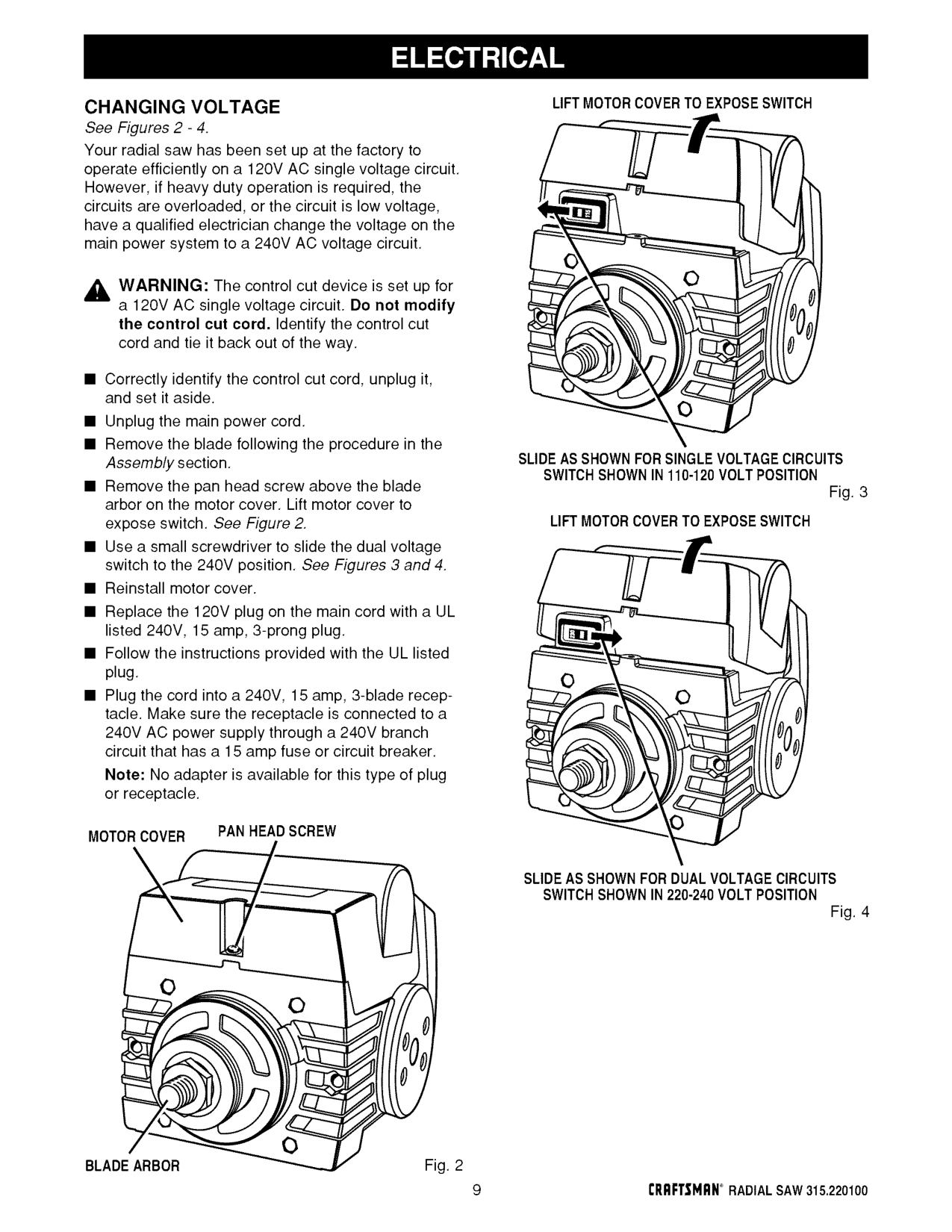
Changing
Voltage
See Figures 2- 4. Your radial saw has been set up at the factory to operate efficiently on a 120V AC single voltage circuit, However, if heavy duty operation is required, the circuits are overloaded, or the circuit is low voltage, have a qualified electrician change the voltage on the main power system to a 240V AC voltage circuit, ,_Warning:
The control cut device is set up for a 120V AC single voltage circuit. Do not modify the control cut cord. Identify the control cut cord and tie it back out of the way. • Correctly identify the control cut cord, unplug it, and set it aside. • Unplug the main power cord, • Remove the blade following the procedure in the Assembly section, • Remove the pan head screw above the blade arbor on the motor cover, Lift motor cover to expose switch. See Figure 2, • Use a small screwdriver to slide the dual voltage switch to the 240V position, See Figures 3 and 4, • Reinstall motor cover. • Replace the 120V plug on the main cord with a UL listed 240V, 15 amp, 3-prong plug, • Follow the instructions provided with the UL listed plug, • Plug the cord into a 240V, 15 amp, 3-blade recep- tacle. Make sure the receptacle is connected to a 240V AC power supply through a 240V branch circuit that has a 15 amp fuse or circuit breaker. Note: No adapter is available for this type of plug or receptacle.Motorcover
Panheadscrew
/Bladearbor
_ Fig. 2Lift Motorcoverto Exposeswitch
Slideasshownforsinglevoltagecircuits
Switchshownin110-120Voltposition
Fig. 3Liftmotorcoverto Exposeswitch
Slideas Shownfordualvoltagecircuits
Switchshownin 220-240Volt Position
Fig. 4 rRFIFTSMRN_Radialsaw315.220100

Blade Arbor Blade Diameter Blade Bevel Angle Radial Arm Swing Range Blade Height Adjust Carriage Travel Cutting Capacity - Maximum Cross Cut Cutting Capacity - Maximum Out-Rip 5/8 in. lOin. 0o_90 ° 45 ° minimum left - 90° right 5.35 in. 17.25 in. 15.50 in. 26 in. Cutting Capacity- Maximum In-Rip Depth of Cut at 90 ° Depth of Cut at 45 ° Table Size Table Height Rating Input No Load Speed 16in. 3 in. 2.25 in. 40x27x 1 in. 36 in. 13.0/6.5 Amperes
120V/240V
60 Hz - AC only3,450 Rpm
Bevel Cut A cut made across a workpiece with the blade at any angle other than 90° to the table surface. Chamfer A cut removing a wedge from a block so the end (or part of it) is angled rather than at 90 degrees. Climb A hazard in which the blade "climbs" over and out of the workpiece, pulling the stock out of the operator's hands or running across the workpiece. Compound Cut A cross cut with both a miter angle and a bevel angle. Cross Cut A cutting operation with the blade parallel to the carriage arm and the blade teeth pointing down, It can be across or with the grain, normally across the grain or width of the workpiece, Dado Cut A non-through cut that leaves a square notch or trough; requires a special blade, Featherboard A device to help guide workpieces during rip cuts. Fence A piece of wood used as a edge guide for the workpiece, Located perpendicular to the carriage arm, Can be placed at different distances from the rear table edge in combination with the other table pieces and is secured with table clamps. Freehand Dangerous practice of making a cut without using a fence, Gum A sticky, sap-based residue from wood products, Heel Alignment of the blade to the fence, Infeed The side of the blade where the blade teeth point up, opposite the anti-kickback pawls. In-Rip A type of rip cut in which the blade is between the column and the motor. Kerf The space left by the removal of material in a cut or the slot produced by the blade in a non-through cut. Kickback A hazard that can occur when blade binds or stalls, throwing workpiece back toward operator. Leading End The end of the workpiece pushed into the cutting tool first. Miter Cut A vertical cut made at any angle other than 0° across the workpiece. Molding A shaping cut that gives a varied shape to the workpiece and requires a special blade. Out-Rip A type of rip cut in which the motor is between the blade and the column. (The blade is "outside" the motor.) Pushstick A device used to feed the workpiece through the saw blade during cutting operations. It helps keep the operator's hands well away from the blade. Rabbet A type of cut that gives a notch in the edge of a workpiece. Resaw A cutting operation to reduce the thickness of the workpiece to make thinner pieces.[Raftsman
_Radialsaw315.220100
10
Resin Asticky,sap-basedsubstance. RipCut Ina radialsaw,acutmadewiththebladeparallelto thefenceandperpendiculartothearm(canbeacross orwiththegrain),Theteethpointupatthepointof contactwiththewood. SawbladePath Theareadirectlyinlinewiththeblade-- over,under, behind,orinfrontof it,Also,theworkpieceareawhich willbeorhasbeencutbytheblade, Set Thedistancethatthetipofthesawbladetoothisoff setfromthefaceoftheblade, Throw-Back Sawthrowingbacka workpiecesimilarto kickback, ThroughSawing Anycuttingoperationwherethebladeextends completelythroughtheworkpiece. TrailingEnd Theworkpieceendlastcutbythebladeina ripcut. Workpiece Theitemonwhichthecuttingoperationis beingdone, Thesurfacesofa workpiecearecommonlyreferredto asfaces,ends,andedges, Worktable Thesurfaceonwhichtheworkpiecerestswhile performingacuttingoperation, WARNING:Topreventaccidentalstartingthat • couldcausepossibleseriouspersonalinjury, assembleall partstoyoursawbeforeconnecting itto powersupply.Thesawshouldneverbe • connectedtothepowersupplywhenyouare assemblingparts,makingadjustments,installing orremovingblades,orwhennotinuse, WARNING:Ifanypartsaremissing,donot operatethistooluntilthemissingpartsare replaced.Failureto dosocouldresultinpossible seriouspersonalinjury. Carefullyremoveall partsfromthecartonand placethesawona levelworksurface,Separate andcheckagainstthelistoflooseparts. Donotdiscardthepackingmaterialsuntilyouhave carefullyinspectedthesaw,identifiedallparts,and satisfactorilyoperatedyournewsaw, Note:Ifanypartsaredamagedormissing,donot attempttopluginthepowercordandturnthe switchonuntilthedamagedormissingpartsare obtainedandareinstalledcorrectly, Thefollowingrecommended accessoriesarecurrentlyavailableat SearsRetailStores.
Warning:
The use of attachments or accessories not listed might be hazardous, 11 rRI:IR'$MI:IN"RADIALSAW315.220100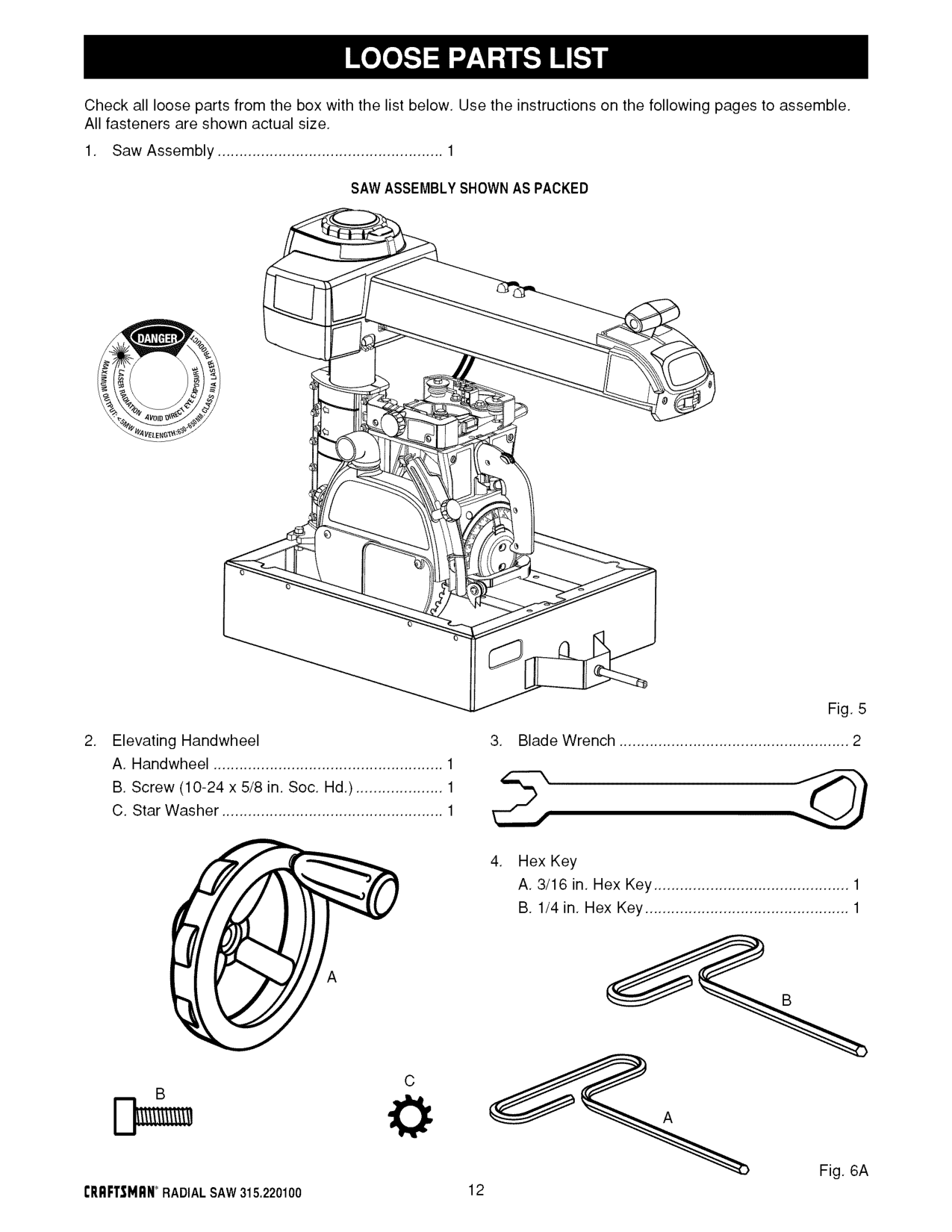
Check all loose parts from the box with the list below, Use the instructions on the following pages to assemble. All fasteners are shown actual size, 1, Saw Assembly .................................................... 1
Saw Assemblyshownas Packed
2, Elevating Handwheel 3, A, Handwheel ..................................................... 1 B. Screw (10-24 x 5/8 in. Soc, Hd,) .................... 1 C. Star Washer ................................................... 1 Fig, 5 Blade Wrench ..................................................... 2 Hex Key A, 3/16 in, Hex Key ............................................. 1 B. 1/4 in, Hex Key ............................................... 1 Fig, 6A rRnFT._MnN RADIALSAW315.220100 12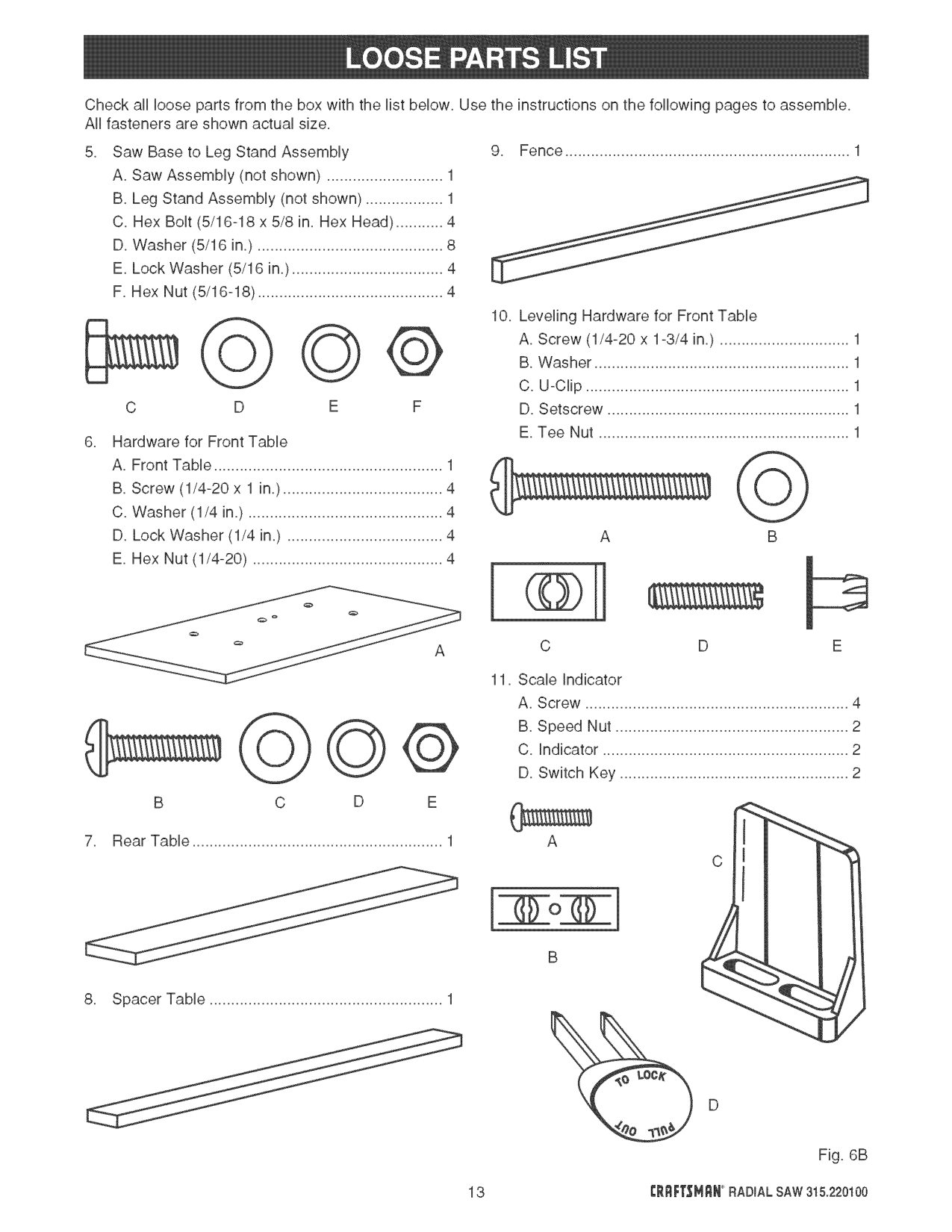
Check aH bose parts from the box with the Hst bebw. Use the instructions on the following pages to assembb. AH fasteners are shown actual size. . Saw Base to Leg Stand AssemMy A. Saw AssemMy (not shown) ........................... 1 B, Leg Stand AssemMy (not shown) .................. 1 C, Hex BoUt(5/16-18 x 5/8 in, Hex Head) ........... 4 D, Washer (5/16 in.) ........................................... 8 E. Lock Washer (5/16 in.) ................................... 4 F. Hex Nut (5/16-18) ........................................... 4
(D@@
D
E
F
. Hardware for Front TaMe A. Front TaMe ..................................................... 1 B. Screw (1/4-20 x 1 in.) ..................................... 4 C. Washer (1/4 in.) ............................................. 4 D. Lock Washer (1/4 in.) .................................... 4 E. Hex Nut (1/4-20) ............................................ 4A
C
D
E
A
bC
D
Fig. 6B 13 CRnFT$MRN' RADIAL SAW315.220100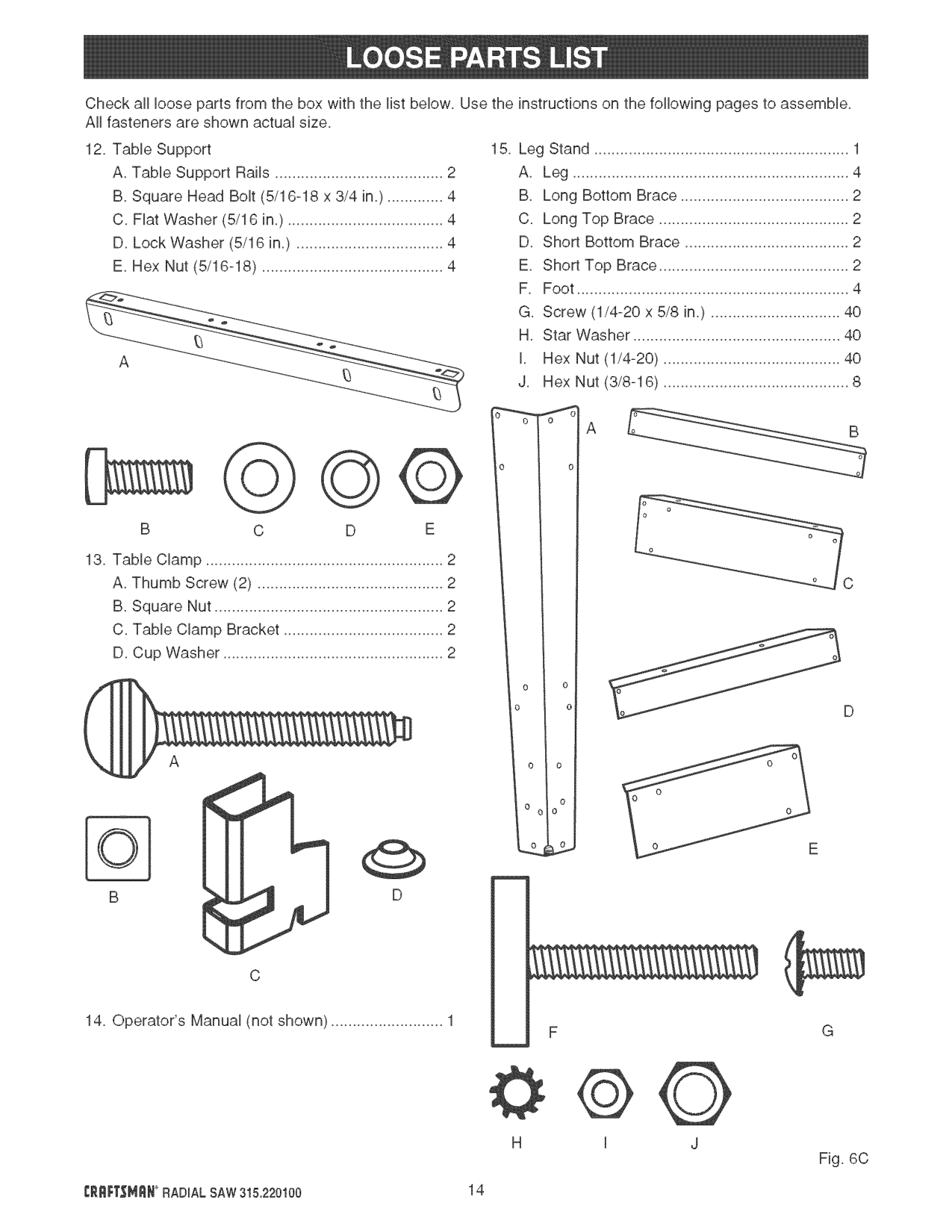
Check aH Uooseparts from the box with the Hst beUow. Use the instructions on the following pages to assemMe. AH fasteners are shown actuaUsize,
B
C ©
D
E
B iC
D
A.
Leg ................................................................ 4 B. Long Bottom Brace ....................................... 2 C. Long Top Brace ............................................ 2 D. Short Bottom Brace ...................................... 2 E. Short Top Brace ............................................ 2 F. Foot ............................................................... 4 G. Screw (1/4-20 x 5/8 in.) .............................. 40 H. Star Washer ................................................ 40 [. Hex Nut (1/4-20) ......................................... 40J.
Hex Nut (3/8-16) ........................................... 8 o o o o o o °1 0A
E
G
Fig. 6C CRnFTSMRN_RADIAL SAW315.220100 14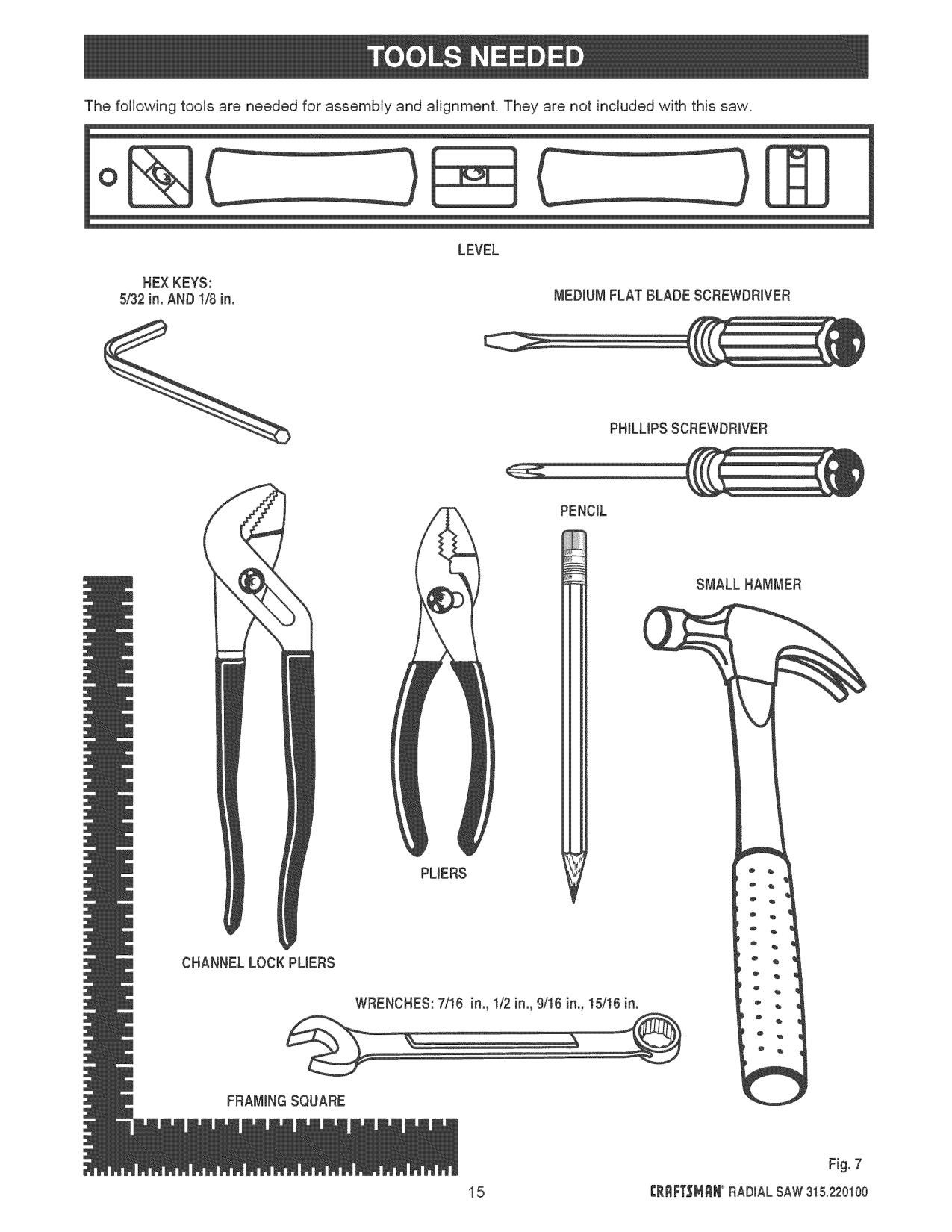
The following tools are needed for assembly and alignment. They are not included with this saw.
Level
Hexkeys:
5/32in. AND 1/8in,Mediumflatblade Screwdriver
Phillipsscrewdriver
Pencil
Puers
Channellock Pliers
Framingsquare
Small Hammer
15
] Carriage Lock
Contro_Ut
C
_R3W_E
10 inch Radial Arm Saw "_ 00RPM 120/ 240VOLTS13/ 6.5 Amp60Hz AC0NLY INservicing,Use Onlyidenticalcraftsman
|Lacementparts.
!I Model
315.220100Ber.
No.
_1I Madeintaiwan
/ _ __I
Sears,
Roebuckand
Co.
L
-- _43F1
_.Customer He/p _1-800-932-3188J
D
A Warning/ Advertencia
For your own safety, Read and understand owner's manual before operating saw.Crrftshrh
iP
R
O
Iohal
i I Rip Feed Direction > 6e Rotatio/)_, Warning/ Advertencia
O
Crrftshrw
Radialsaw315.220100
16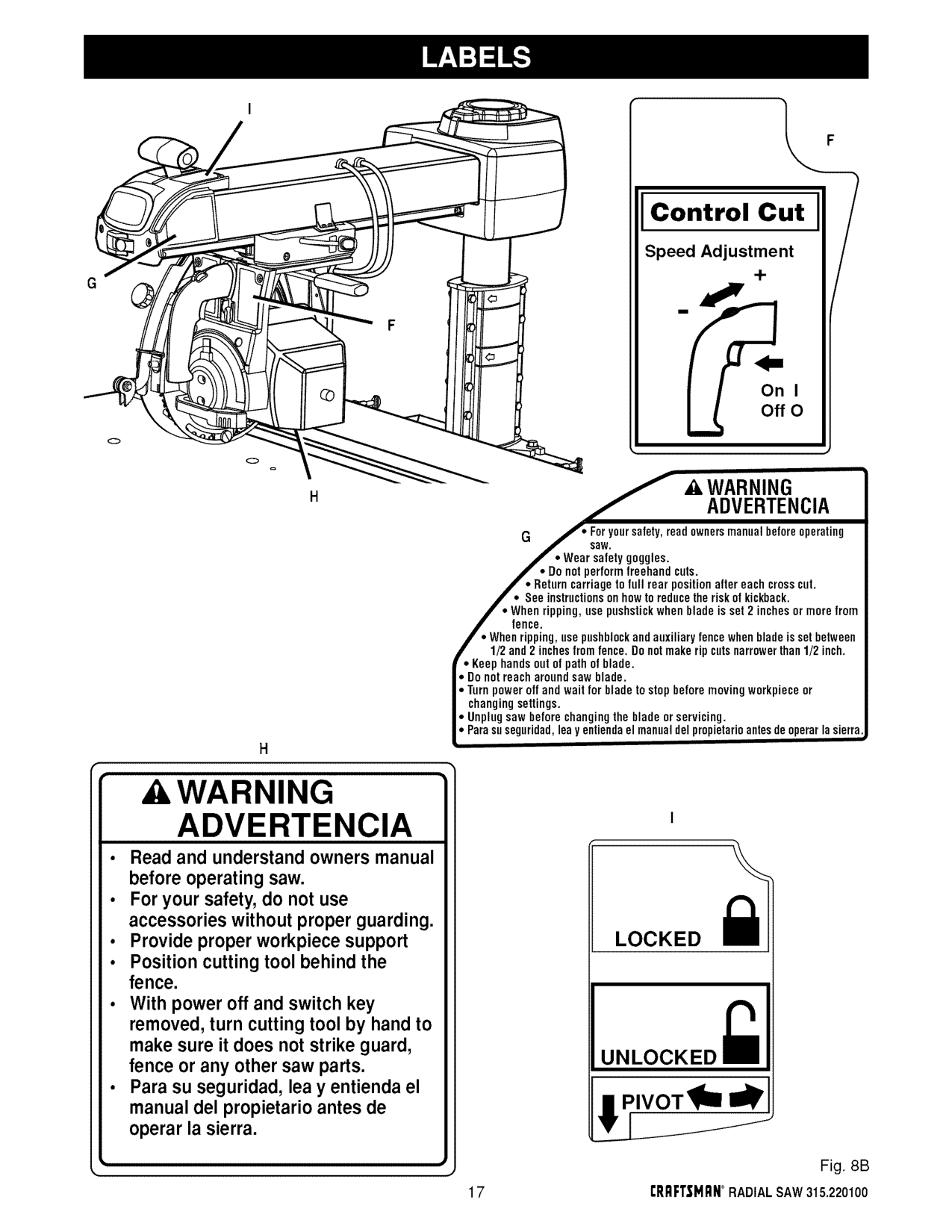
A Warning
Advertencia
• Read and understand owners manual before operating saw. • For your safety, do not use accessories without proper guarding. • Provide proper workpiece support • Position cutting tool behind the fence.C
Speed Adjustment / OnI
Off O,_ Warning
Advertencia
G
J°
_oryoursafety,readownersmanualbeforeoperating fJ
J
° Seeinstructions onhowtoreducetheriskofkickback. j"J
I
changingsettings. I'Unplug sawbeforechangingthebladeorservicing. _. Parasuseguridad,leayentiendael manualdelpropietario antesdeoperarlasierra.,I
\Locked
Unlocked
Pivot_Iii
I_
17 Fig, 8B rRRFTSMRN+Radialsaw315.220100
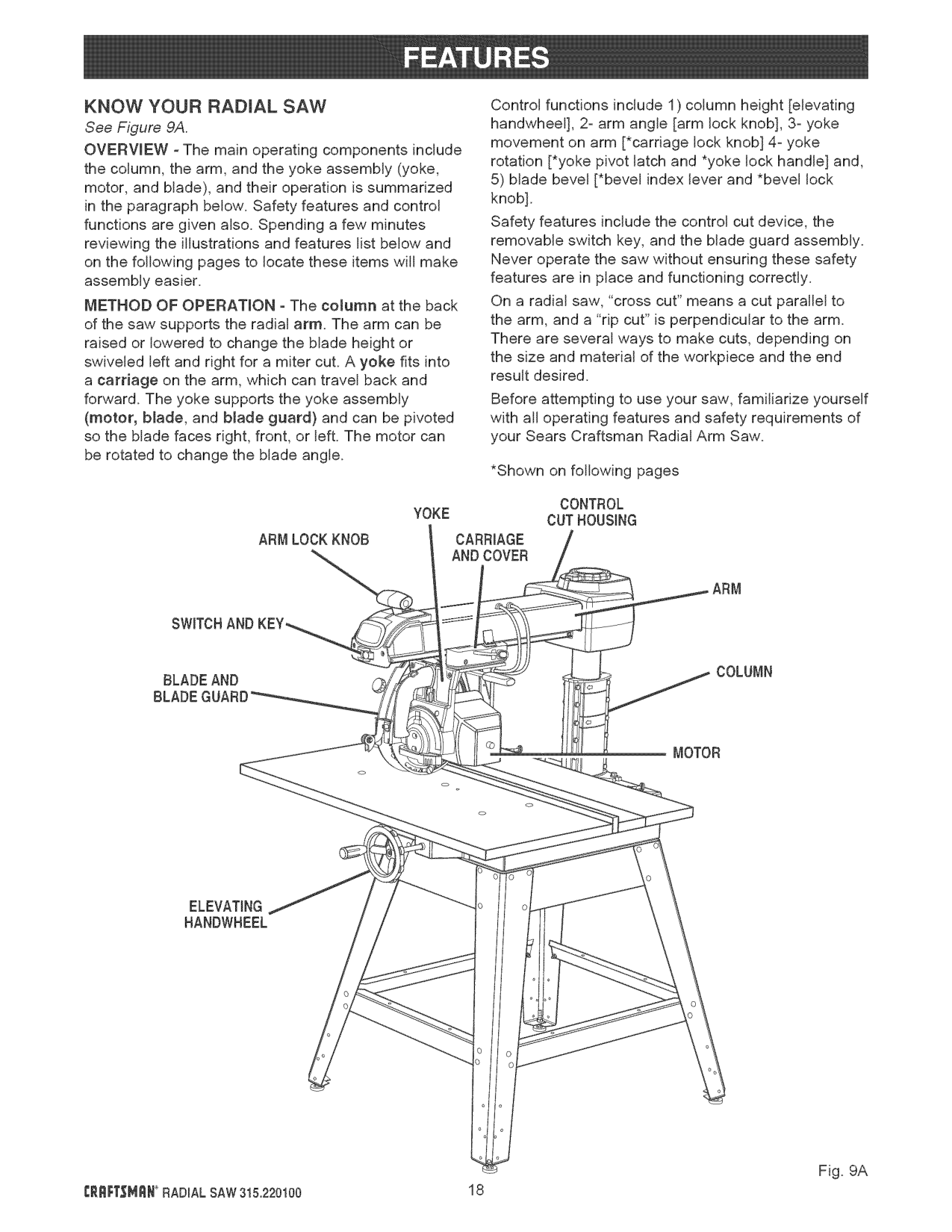
Know
Your
Radial
Saw
See Figure 9A.Overview
Method Of Operation
oThe cotumn at the back of the saw supports the radial arm. The arm can be raised or lowered to change the blade height or swiveled left and right for a miter cut. A yoke fits into a carriage on the arm, which can travel back and forward. The yoke supports the yoke assembly (motor, blade, and blade guard) and can be pivoted so the blade faces right, front, or left. The motor can be rotated to change the blade angle. Control functions include 1) column height [elevating handwheel], 2- arm angle [arm lock knob], 3- yoke movement on arm [*carriage lock knob] 4- yoke rotation [*yoke pivot latch and *yoke lock handle] and, 5) blade bevel [*bevel index lever and *bevel lock knob]. Safety features include the control cut device, the removable switch key, and the blade guard assembly. Never operate the saw without ensuring these safety features are in place and functioning correctly. On a radial saw, "cross cut" means a cut parallel to the arm, and a "rip cut" is perpendicular to the arm. There are several ways to make cuts, depending on the size and material of the workpiece and the end result desired. Before attempting to use your saw, familiarize yourself with all operating features and safety requirements of your Sears Craftsman Radial Arm Saw. *Shown on following pagesArm Lockknob
Yoke
Carriage
Andcover
Control
Cut Housing
Switchand
Bladeanb
Blade
Column
Elevating
Handwheel
Fig. 9A CP,nFI'SMAN_RADIAL SAW315.220100 18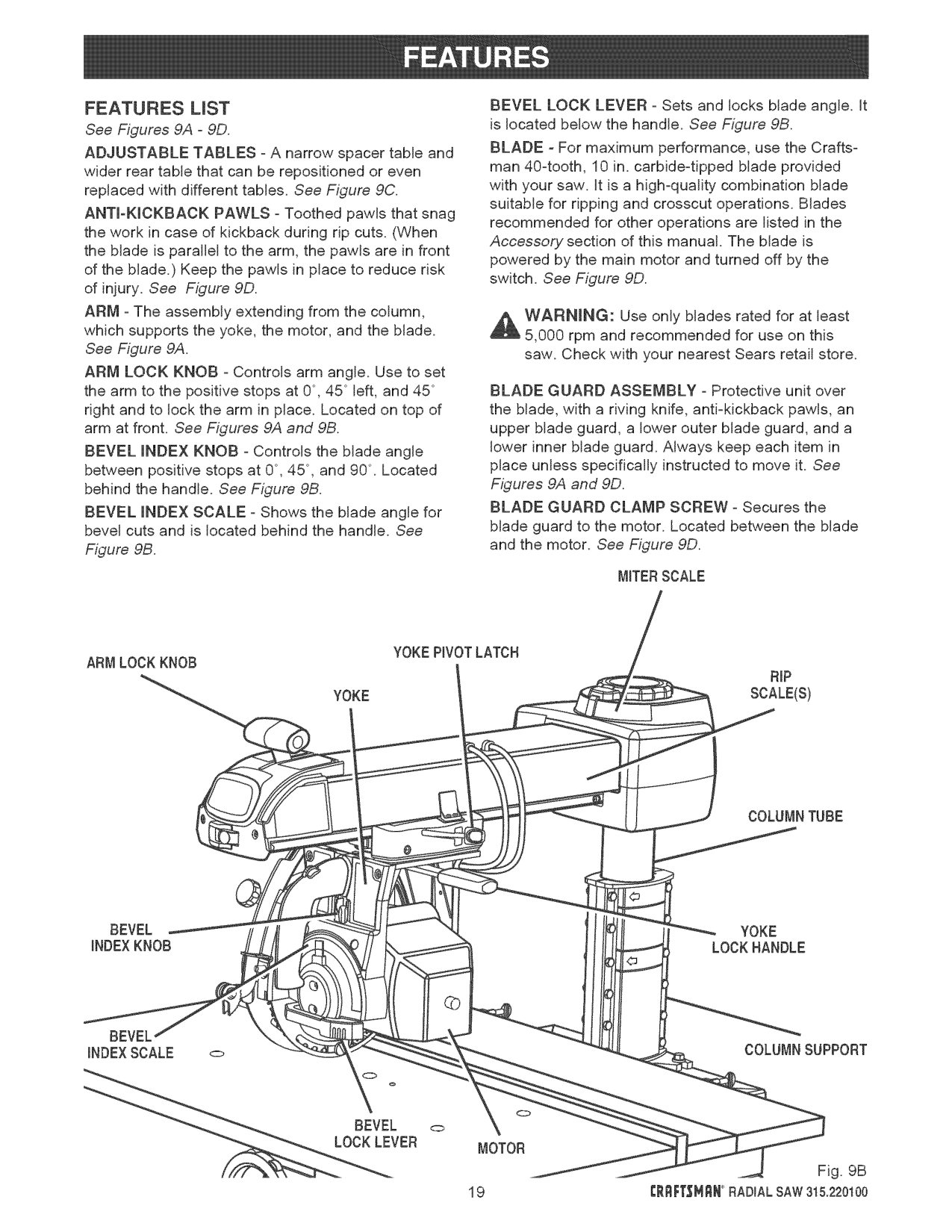
Features
LiST See Figures 9A - 9D.Adjustable
Tables
Anti-Kickback
PAWLS - Toothed pawls that snag the work in case of kickback during rip cuts. (When the blade is parallel to the arm, the pawls are in front of the blade.) Keep the pawls in place to reduce risk of injury. See Figure 9D. ARM - The assembly extending from the column, which supports the yoke, the motor, and the blade. See Figure 9A.Arm Lock
KNOB - Controls arm angle. Use to set the arm to the positive stops at 0°, 45 ° left, and 45 ° right and to lock the arm in place. Located on top of arm at front. See Figures 9A and 9B. BEVEL INDEX KNOB - Controls the blade angle between positive stops at 0°, 45 °, and 90 °. Located behind the handle. See Figure 9B.Bevel Index Scale
Bevel
LOCK LEVER - Sets and locks blade angle, it is located below the handle. See Figure 9B.Blade
Blade
Guard
Assembly
Blade
Guard
Clamp Screw
Miterscale
Arm Lock Knob
Yoke
Yokepivotlatch
Rip
Scale{S)
Bevel
Indexknob
Bevel
Indexscale
o \ ° oBevel
<>__:__V
Er
Motor
19 iColumntube
Yoke
Lockhandle
Columnsupport
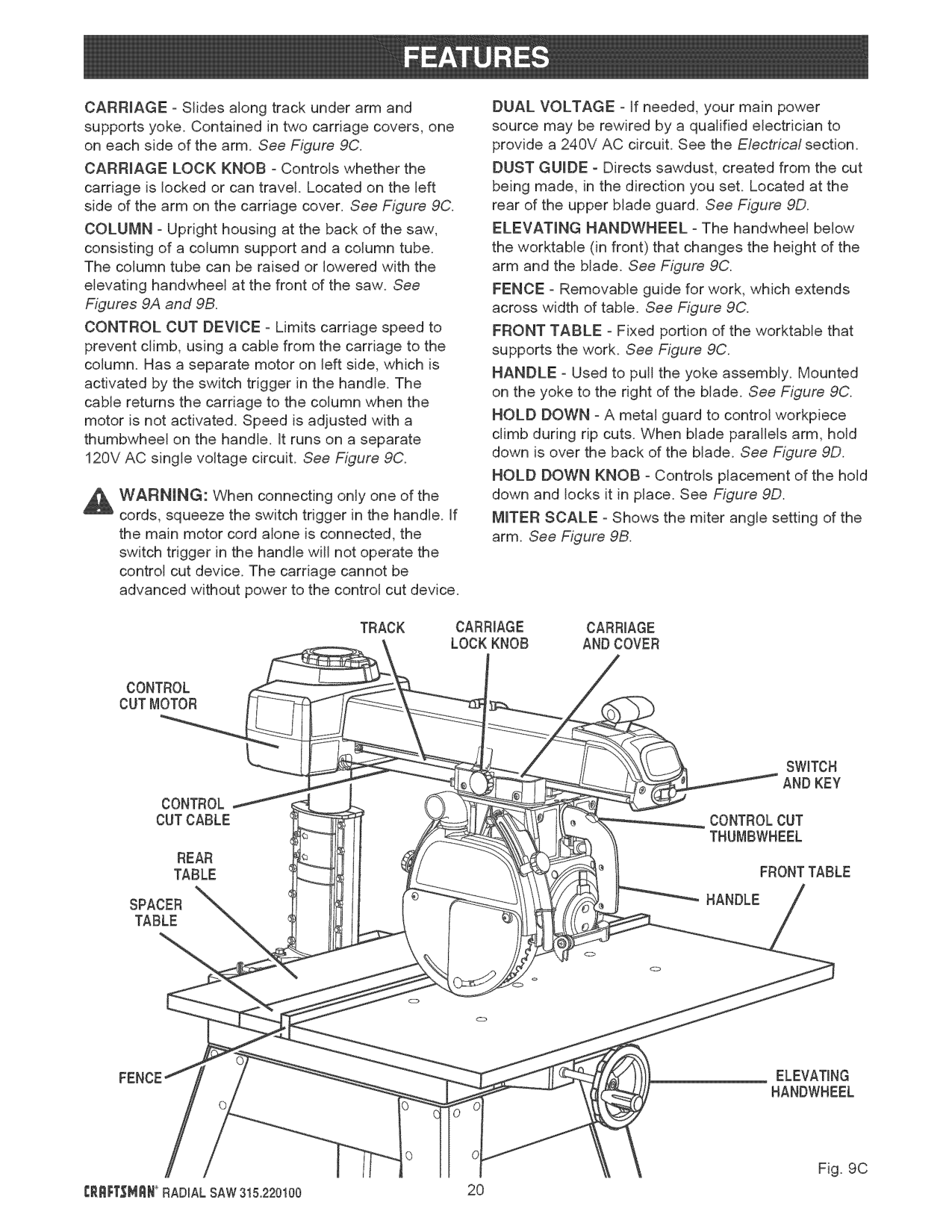
CARRIAGE- Slides along track under arm and supports yoke. Contained in two carriage covers, one on each side of the arm. See Figure 9C.
Carriage
LOCK KNOB - Controls whether the carriage is locked or can travel. Located on the left side of the arm on the carriage cover. See Figure 9C.Column
Control
CUT DEVICE - Limits carriage speed to prevent climb, using a cable from the carriage to the column. Has a separate motor on left side, which is activated by the switch trigger in the handle. The cable returns the carriage to the column when the motor is not activated. Speed is adjusted with a thumbwheel on the handle. It runs on a separate 120V AC single voltage circuit. See Figure 9C.Warning:
When connecting only one of the cords, squeeze the switch trigger in the handle. If the main motor cord alone is connected, the switch trigger in the handle will not operate the control cut device. The carriage cannot be advanced without power to the control cut device.Dual Voltage
Elevating
Handwheel
Front Table
Handle
Miter Scale
Track
Carriage
Carriage
Lock Knob
Andcover
Control
Cut Motor
Control
Cutcable
Rear
Table
Spacer
Table
Switch
And Key
Controlcut
Thumbwneel
Fronttable
Handle
Fen_
Elevating
Nandwneel
Fig. 9C CP,nFI'SMAN_RADIAL SAW315.220100 20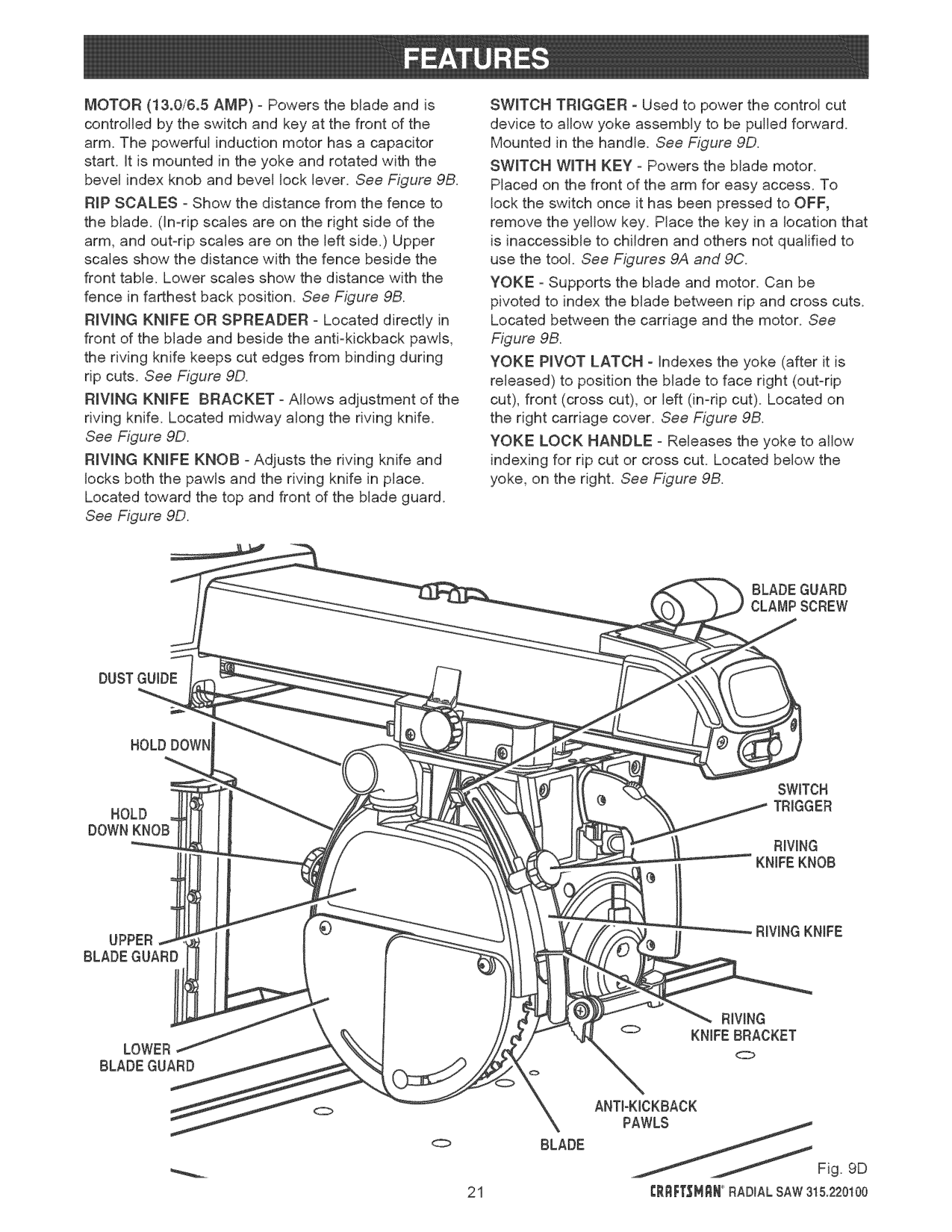
Motor (13.0/6.5
AMP) - Powers the blade and is controlled by the switch and key at the front of the arm. The powerful induction motor has a capacitor start, it is mounted in the yoke and rotated with the bevel index knob and bevel lock lever. See Figure 9B.Rip Scales
Riving Knife Or Spreader
Riving Knife
Bracket
Switch Trigger
Yoke Lock Handle
Blade Guard
Clampscrew
Dustguide
Holddown
Hold
Down Knob
Switch
Trigger
Riving
Knifeknob
Upper
Blade Guard
Rivingknife
Lower
Bladeguard
Riving
Knife Bracket
0 21Blade
Assembly is best done in the area where the saw will be used. When you remove the saw and hardware from the packing materials, carefully check the items with the Loose Parts list. If you are unsure about the description of any part, refer to their illustrations. For your convenience, all fasteners have been drawn actual size. If any parts are missing, delay assembling until you have obtained the missing part(s). Your radial arm saw is capable of a wide variety of operations, and thus requires a number of initial setup adjustments. However, once the saw is set up, you can check your saw in about ten minutes and correct any misalignment with the procedures in the Adjust- ment section.
Caution:
Perform all the procedures in both the Assembly and Adjustments sections before using the saw. Run a check on your saw frequently, referring to the Adjustments section. Failure to perform the adjustments in the initial set up or on a frequent basis can result in poor performance or machine damage.Assembung
Leg Stand
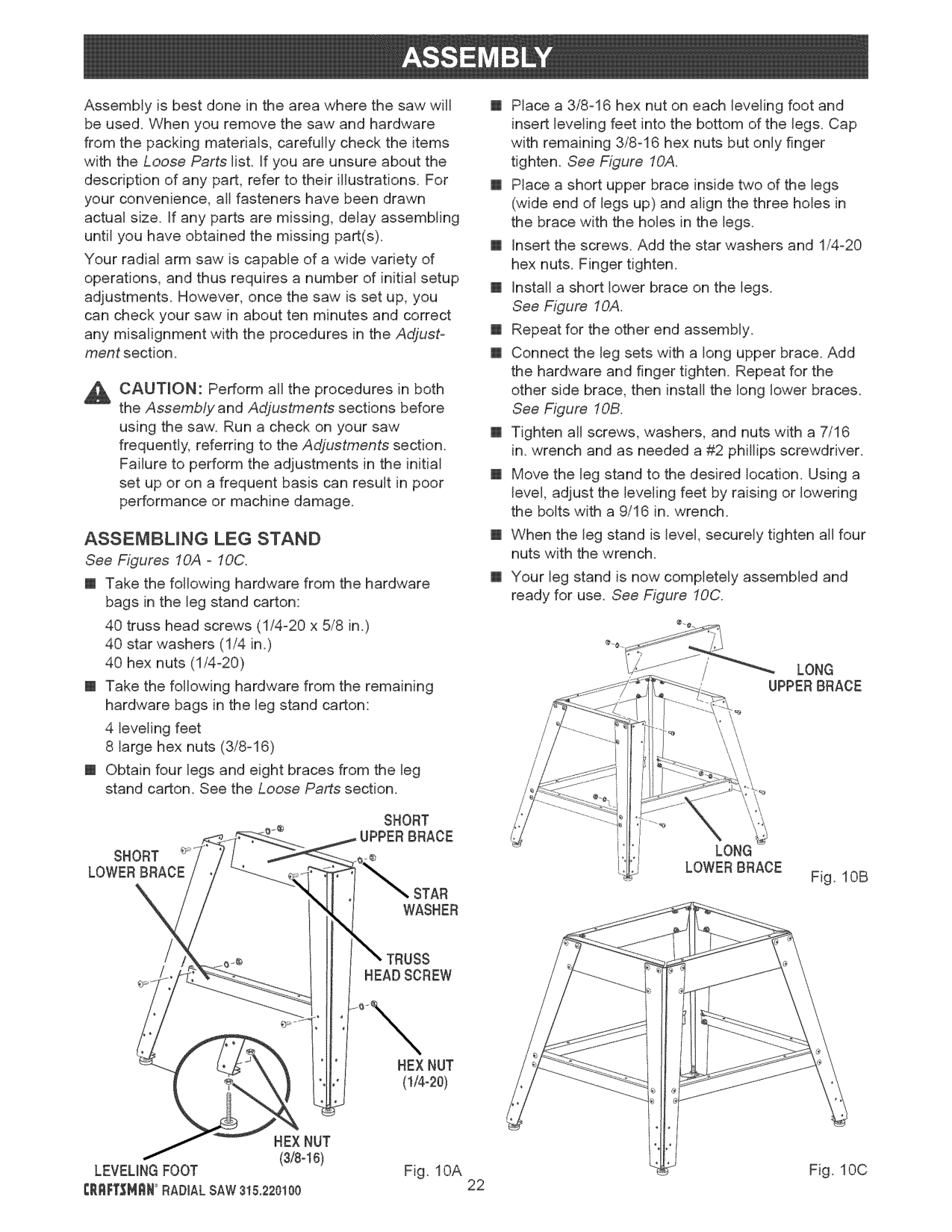
See FiguresIoa - 10C.
[] Take the following hardware from the hardware bags in the leg stand carton: 40 truss head screws (1/4-20 x 5/8 in.) 40 star washers (114 in.) 40 hex nuts (1/4-20) [] Take the following hardware from the remaining hardware bags in the leg stand carton: 4 leveling feet 8 large hex nuts (3/8-16) [] Obtain four legs and eight braces from the leg stand carton. See the Loose Parts section.Short
Lowerbrace
Short
Brace
_Tar
Washer
[] Place a 3/8-16 hex nut on each leveling foot and insert leveling feet into the bottom of the legs. Cap with remaining 3/8-16 hex nuts but only finger tighten. See Figure fOA. [] Place a short upper brace inside two of the legs (wide end of legs up) and align the three holes in the brace with the holes in the legs. [] Insert the screws. Add the star washers and 1/4-20 hex nuts. Finger tighten. [] Install a short lower brace on the legs. See Figure fOA. [] Repeat for the other end assembly. [] Connect the leg sets with a long upper brace. Add the hardware and finger tighten. Repeat for the other side brace, then install the long lower braces. See Figure fOB. [] Tighten all screws, washers, and nuts with a 7/16 in. wrench and as needed a #2 phillips screwdriver. [] Move the leg stand to the desired location. Using a level, adjust the leveling feet by raising or lowering the bolts with a 9/16 in. wrench. [] When the leg stand is level, securely tighten all four nuts with the wrench. [] Your leg stand is now completely assembled and ready for use. See Figure10C.
Upperbrace
\' / \ \ \/ // '\ \Long
Lowerbrace
Fig. 10BTruss
Headscrew
Hexnut
(lb-20)Hexnut
(3/8-16)Levelingfoot
CRRFT_MRNRADIALSAW3t5.220100 Fig. 10A 22 Fig. 10C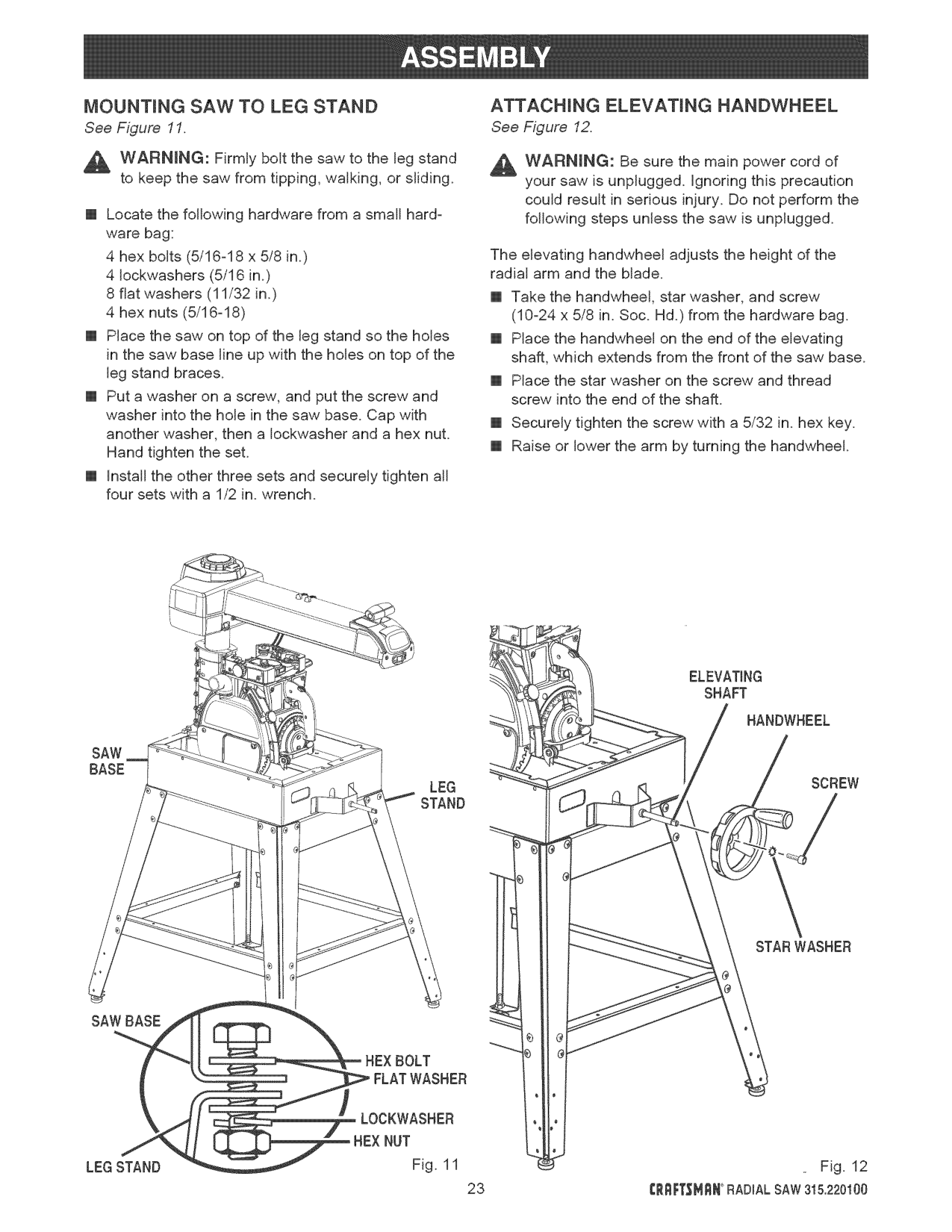
Mounting
Saw
To Leg Stand
See Figure ! 1. _Warning:
Firmly bolt the saw to the leg stand to keep the saw from tipping, walking, or sliding. [] Locate the following hardware from a small hard- ware bag: 4 hex bolts (5/16-18 x 5/8 in.) 4 Iockwashers (5t16 in.) 8 flat washers (11/32 in.) 4 hex nuts (5/16-18) [] Place the saw on top of the leg stand so the holes in the saw base line up with the holes on top of the leg stand braces. [] Put a washer on a screw, and put the screw and washer into the hole in the saw base. Cap with another washer, then a lockwasher and a hex nut. Hand tighten the set. [] Install the other three sets and securely tighten aft four sets with a 1/2 in. wrench.Attachung
Elevating
Handwheel
See FigureWarning:
Saw
Base
Leg
Stand
Elevating
Shaft
Handwheel
Screw
Sawbase
Hexbolt
Sher!
Starwasher
Legstand
}Her
Nut
Fig. 11 23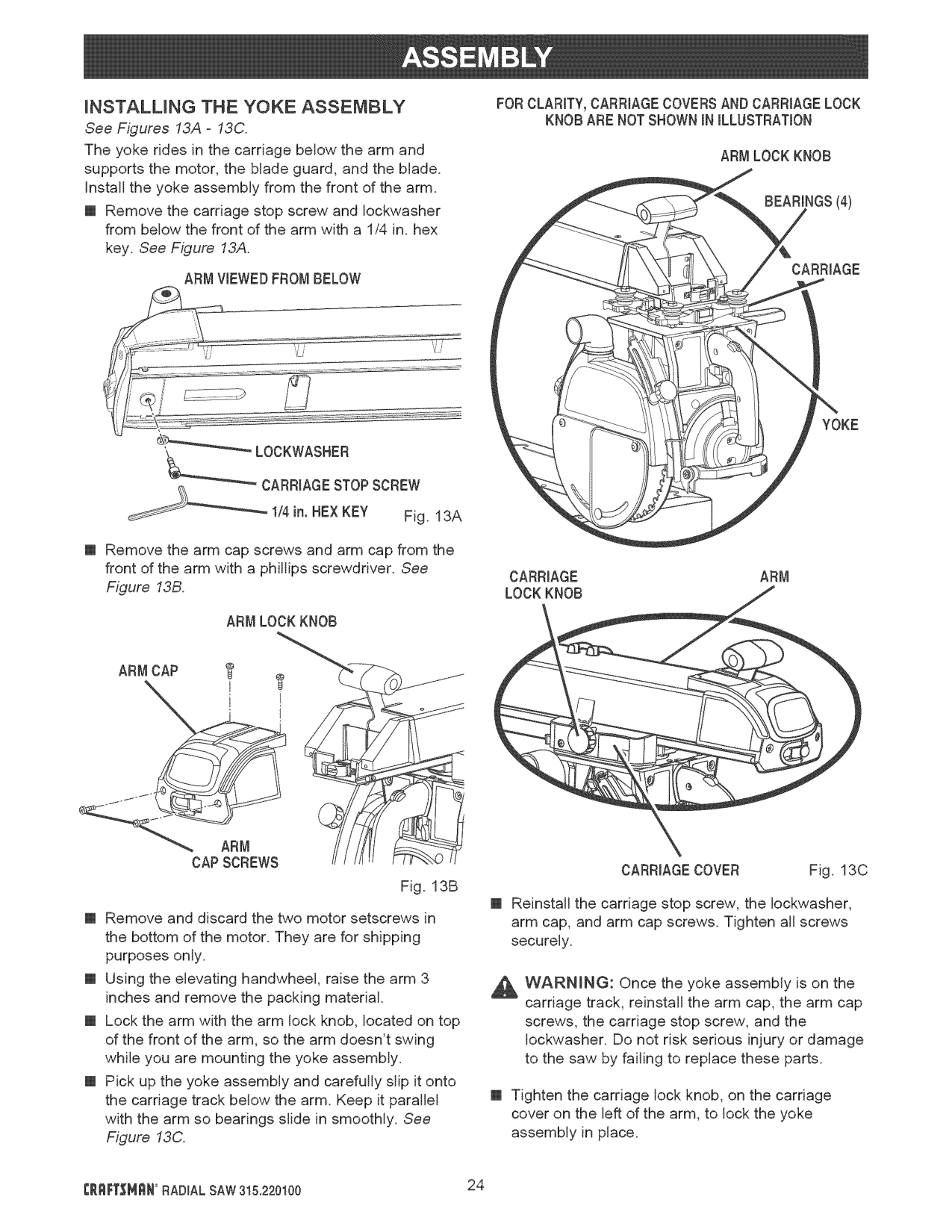
Instalung
The Yoke
Assembly
See Figures13A-
13C.
The yoke rides in the carriage below the arm and supports the motor, the blade guard, and the blade. Install the yoke assembly from the front of the arm. [] Remove the carriage stop screw and lockwasher from below the front of the arm with a 1/4 in. hex key. See Figure 13A.Armviewedfrombelow
Forclarity,Carriagecoversandcarriagelock
Knobare Notshowninillustration
Armlock Knob
Bearings(4)
Carriage
Lockwasher
__Carriage
Stopscrew
1/4in. HEXKEY Fig. 13A [] Remove the arm cap screws and arm cap from the front of the arm with a phillips screwdriver. See Figure13B.
Arm Lockknob
ARMcAP i ! 'I
Fig. 13B [] Remove and discard the two motor setscrews in the bottom of the motor. They are for shipping purposes only. [] Using the elevating handwheel, raise the arm 3 inches and remove the packing material. [] Lock the arm with the arm lock knob, located on top of the front of the arm, so the arm doesn't swing while you are mounting the yoke assembly. [] Pick up the yoke assembly and carefully slip it onto the carriage track below the arm. Keep it parallel with the arm so bearings slide in smoothly. See F_gure !3C.Yoke
Carriage
Arm
Lockknob
Carriagecover
Fig. 13C Reinstall the carriage stop screw, the Iockwasher, arm cap, and arm cap screws. Tighten all screws securely. _Warmng:
Once the yoke assembly is on the carriage track, reinstall the arm cap, the arm cap screws, the carriage stop screw, and the lockwasher. Do not risk serious injury or damage to the saw by failing to replace these parts. [] Tighten the carriage lock knob, on the carriage cover on the left of the arm, to lock the yoke assembly in place.Crrf[_Mrn Radialsaw 315.220100
24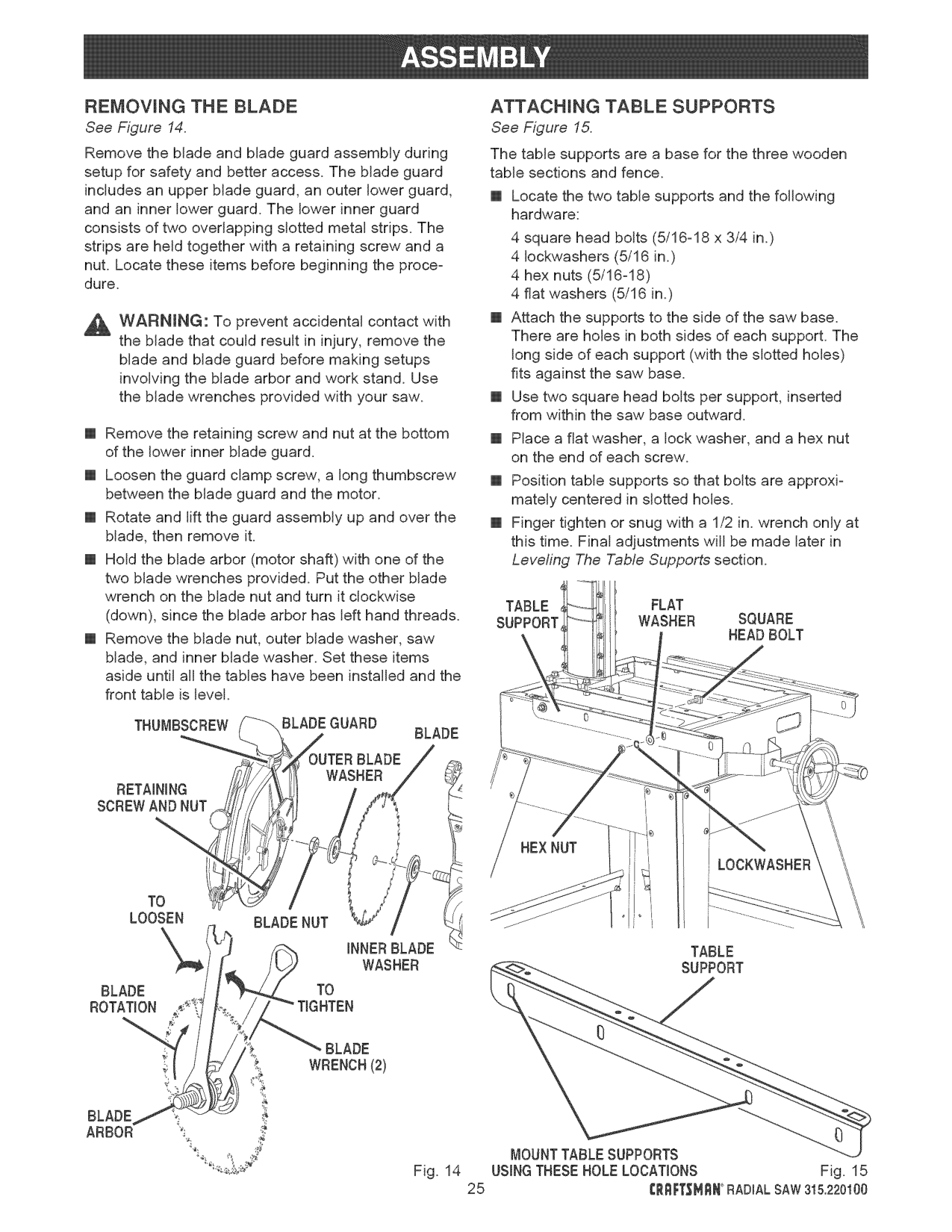
Removing
The
Blade
See FigureWarning:
To prevent accidental contact with the blade that could result in injury, remove the blade and blade guard before making setups involving the blade arbor and work stand. Use the blade wrenches provided with your saw. [] Remove the retaining screw and nut at the bottom of the lower inner blade guard. [] Loosen the guard clamp screw, a long thumbscrew between the blade guard and the motor. [] Rotate and lift the guard assembly up and over the blade, then remove it. [] Hold the blade arbor (motor shaft) with one of the two blade wrenches provided. Put the other blade wrench on the blade nut and turn it clockwise (down), since the blade arbor has left hand threads. [] Remove the blade nut, outer blade washer, saw blade, and inner blade washer. Set these items aside until all the tables have been installed and the front table is level.Thumbscrew
Bladeguard
Retaining
Screwand Nut
Arbor
To
Loosen
Blade Nut
:,,,_Ti
Innerblade
Washer
To
Ghten
}tBlabe
¢,Wrench(2)
& Fig. 14Attaching
Table
Supports
See FigureTable
Flat
Support
Washer
Square
Bead Bolt
Table
Support
25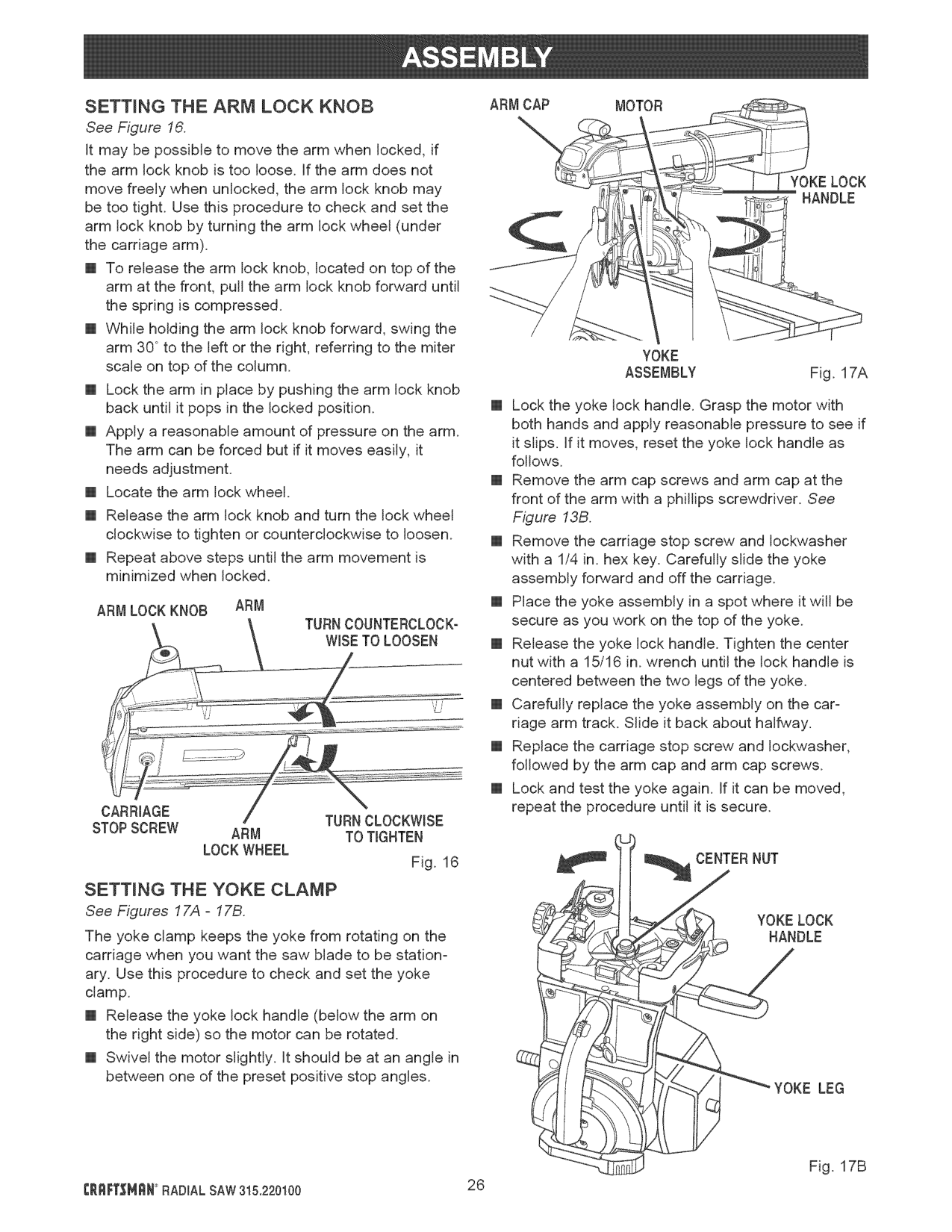
Setting
The Arm
Lock
Knob
See FigureArm Lockknob
Arm
Turnclockwise
Stopscrew
Arm
To Tighten
Lockwheel
Fig. 16Setting
The Yoke
Clamp
See Figures 17A - 17B. The yoke clamp keeps the yoke from rotating on the carriage when you want the saw blade to be station- ary. Use this procedure to check and set the yoke clamp. [] Release the yoke lock handle (below the arm on the right side) so the motor can be rotated. [] Swivel the motor slightly. It should be at an angle in between one of the preset positive stop angles.Armcap
Motor
Yokelock
Handle
[] [] [] [] []Yoke
Assembly
Fig. 17A Lock the yoke lock handle. Grasp the motor with both hands and apply reasonable pressure to see if it slips. If it moves, reset the yoke lock handle as follows. Remove the arm cap screws and arm cap at the front of the arm with a phillips screwdriver. See Figure13B.
Remove the carriage stop screw and Iockwasher with a 1/4 in. hex key. Carefully slide the yoke assembly forward and off the carriage. Place the yoke assembly in a spot where it will be secure as you work on the top of the yoke. Release the yoke lock handle. Tighten the center nut with a 15/16 in. wrench until the lock handle is centered between the two legs of the yoke. Carefully replace the yoke assembly on the car- riage arm track. Slide it back about halfway. Replace the carriage stop screw and Iockw'asher followed by the arm cap and arm cap screws. Lock and test the yoke again. If it can be moved repeat the procedure until it is secure._Center
Nut
Yokelock
Handle
Yoke Leg
Fig. 17BCrrf_',_Mrnradialsaw 315.220100
26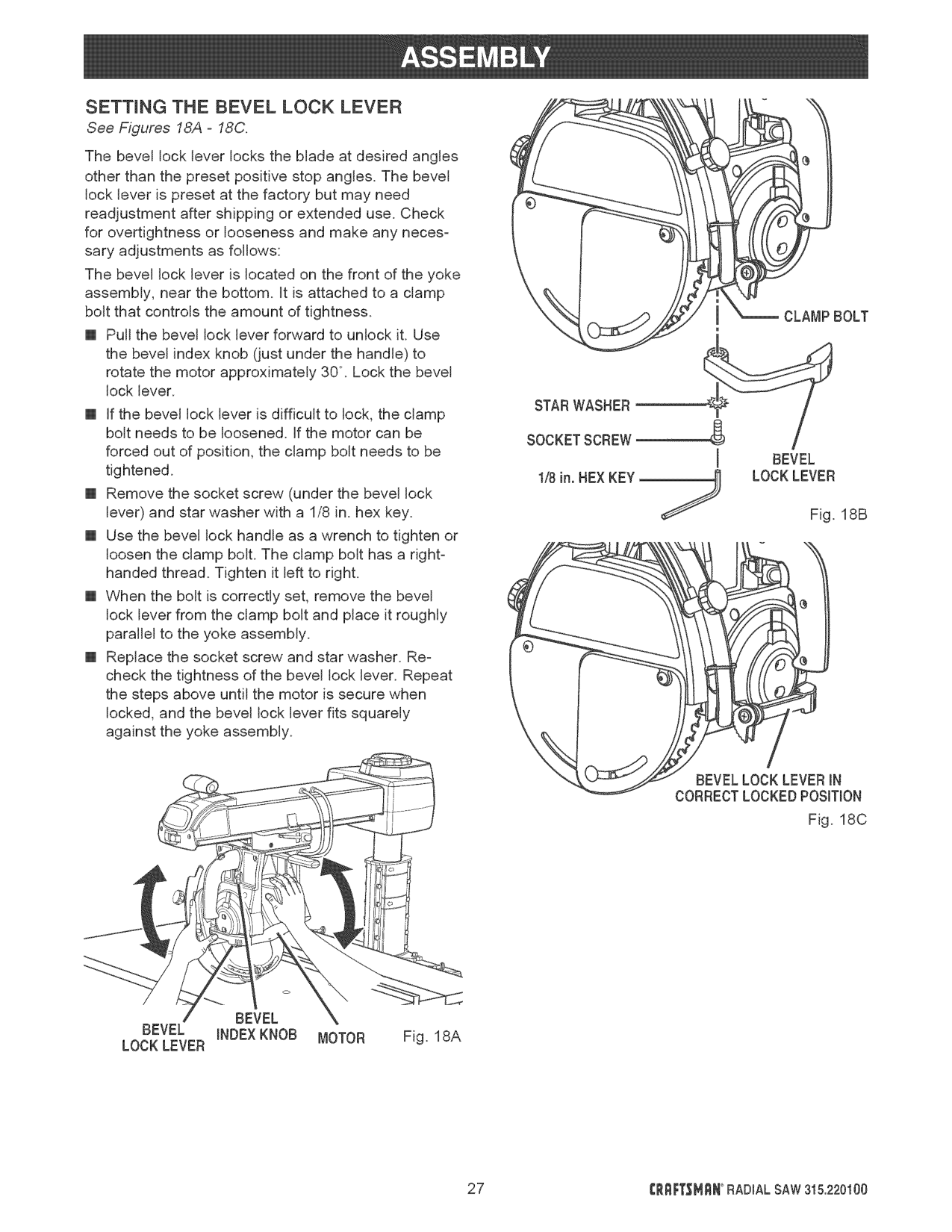
Setting
The
Bevel
Lock
Lever
See Figures18A- 18C.
The bevel lock lever locks the blade at desired angles other than the preset positive stop angles. The bevel lock lever is preset at the factory but may need readjustment after shipping or extended use. Check for overtightness or looseness and make any neces- sary adjustments as follows: The bevel lock lever is located on the front of the yoke assembly, near the bottom. It is attached to a clamp bolt that controls the amount of tightness. [] Pull the bevel lock lever forward to unlock it. Use the bevel index knob (just under the handle) to rotate the motor approximately 30 °. Lock the bevel lock lever. [] if the bevel lock lever is difficult to lock, the clamp bolt needs to be loosened. If the motor can be forced out of position, the clamp bolt needs to be tightened. [] Remove the socket screw (under the bevel lock lever) and star washer with a 1/8 in. hex key. [] Use the bevel lock handle as a wrench to tighten or loosen the clamp bolt. The clamp bolt has a right- handed thread. Tighten it left to right. [] When the bolt is correctly set, remove the bevel lock lever from the clamp bolt and place it roughly parallel to the yoke assembly. [] Replace the socket screw and star washer. Re- check the tightness of the bevel lock lever. Repeat the steps above until the motor is secure when locked, and the bevel lock lever fits squarely against the yoke assembly.Clampbolt
mI
Bevel
1/8 in. BEXKEY ./_Locklever
Fig. 18B / BEVELLOCK LEVERiNCorrectlockedposition
Fig. 18CBevel
Bevel
Indexknob
Motor
Fig. 18ALock Lever
27 t:RRFTSMnN RADIALSAW 315.220100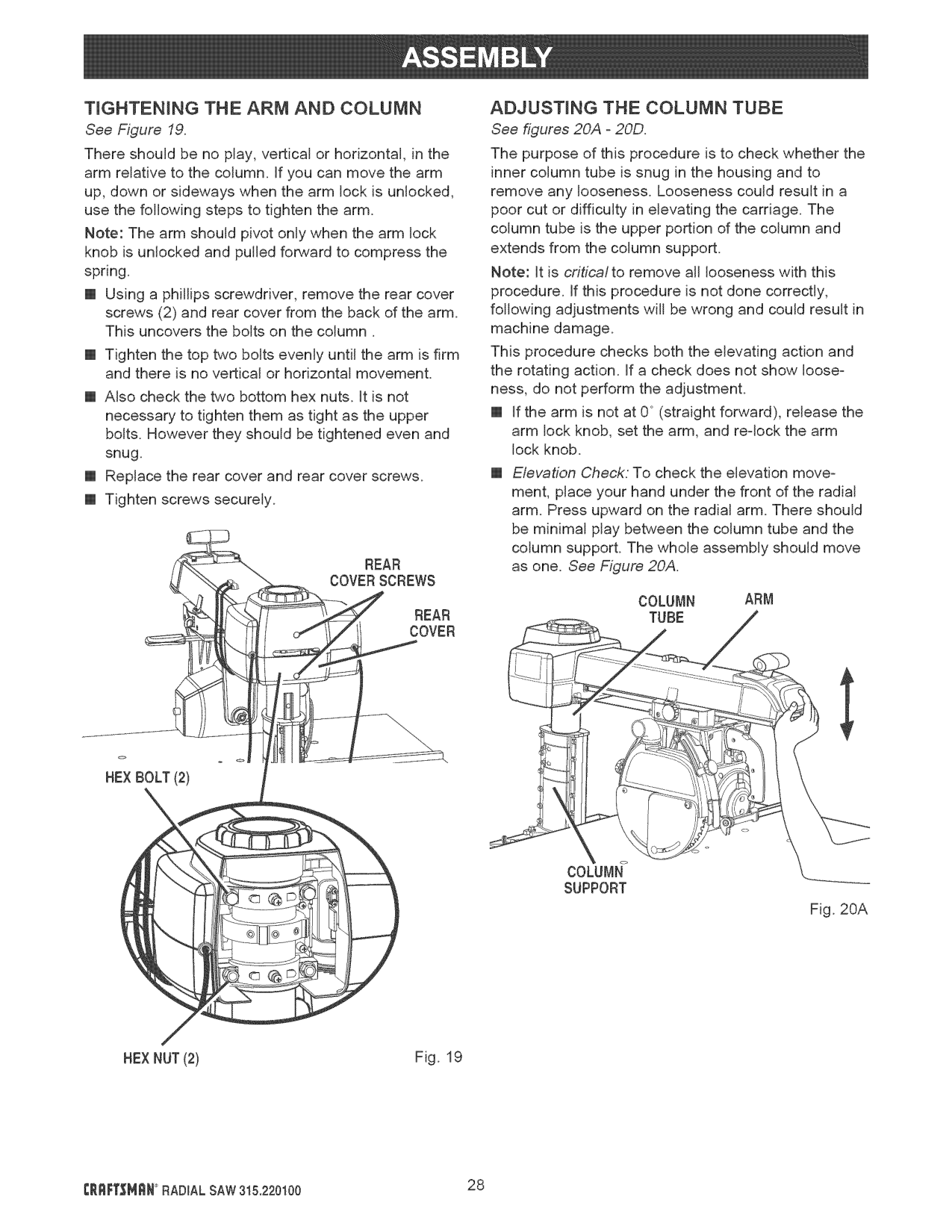
TiGHTENiNG
The Arm
And
Column
See FigureRear
Coverscrews
Rear
Cover
Adjusting
The
Column
Tube
See fLgures 20A - 20D. The purpose of this procedure is to check whether the inner coJumn tube is snug in the housing and to remove any looseness. Looseness could result in a poor cut or difficulty in elevating the carriage. The coJumn tube is the upper portion of the column and extends from the column support. Note: It is critical to remove alJ looseness with this procedure. If this procedure is not done correctly, folJowing adjustments will be wrong and could result in machine damage. This procedure checks both the elevating action and the rotating action. If a check does not show loose- ness, do not perform the adjustment. [] if the arm is not at 0° (straight forward), release the arm lock knob, set the arm, and reqock the arm lock knob. [] Elevation Check: To check the elevation move- ment, place your hand under the front of the radial arm. Press upward on the radial arm. There should be minimal play between the column tube and the column support. The whole assembly should move as one. See Figure 20A.Hexbolt (2)
Column
Support
Fig. 20AHex Nut(2)
Fig. 19Crrf[_Mrn Radialsaw 315.220100
28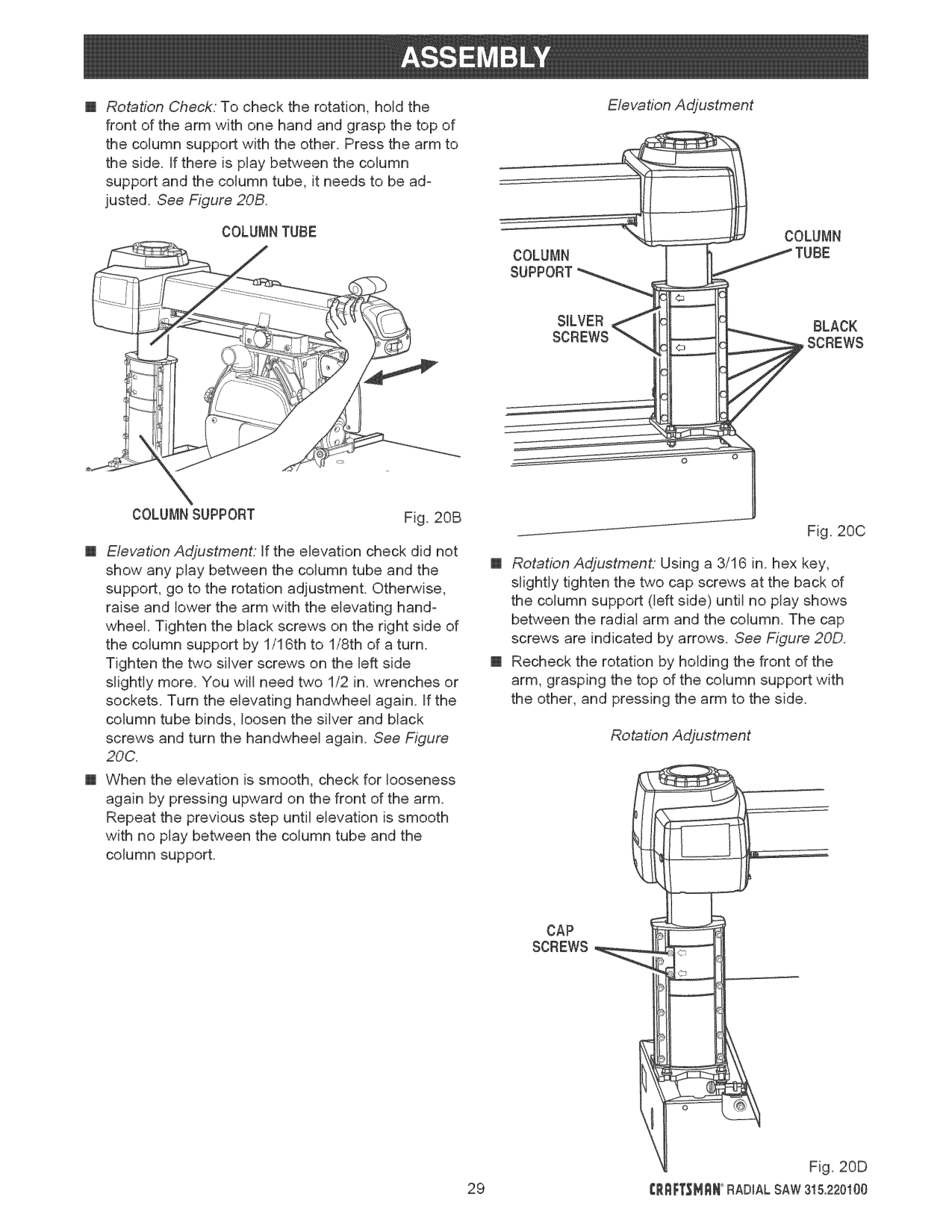
[] Rotation Check: To check the rotation, hold the front of the arm with one hand and grasp the top of the column support with the other. Press the arm to the side. if there is play between the column support and the column tube, it needs to be ad= justed. See Figure 20B.
Columntube
X
Colunnsupport
Fig. 20B [] Elevation Adjustment: If the elevation check did not show any play between the column tube and the support, go to the rotation adjustment. OthenMse, raise and lower the arm with the elevating hand= wheel. Tighten the black screws on the right side of the column support by 1/16th to l/8th of a turn. Tighten the two silver screws on the left side slightly more. You will need two 1/2 in. wrenches or sockets. Turn the elevating handwheel again. If the column tube binds, loosen the silver and black screws and turn the handwheel again. See Figure20C.
[] When the elevation is smooth, check for looseness again by pressing upward on the front of the arm. Repeat the previous step until elevation is smooth with no play between the column tube and the column support. Elevation AdjustmentColumn
Column
1 h_Tube
Support_
Silver
.....Silver _
_]If[_
_La_R
Screws
Fig. 20C [] Rotation Adjustment. Using a 3/16 in. hex key, slightly tighten the two cap screws at the back of the column support (left side) until no play shows between the radial arm and the column. The cap screws are indicated by arrows. See Figure 20D. [] Recheck the rotation by holding the front of the arm, grasping the top of the column support with the other, and pressing the arm to the side. Rotation AdjustmentCap
Screws
Adjusting
The Carriage
Bearings
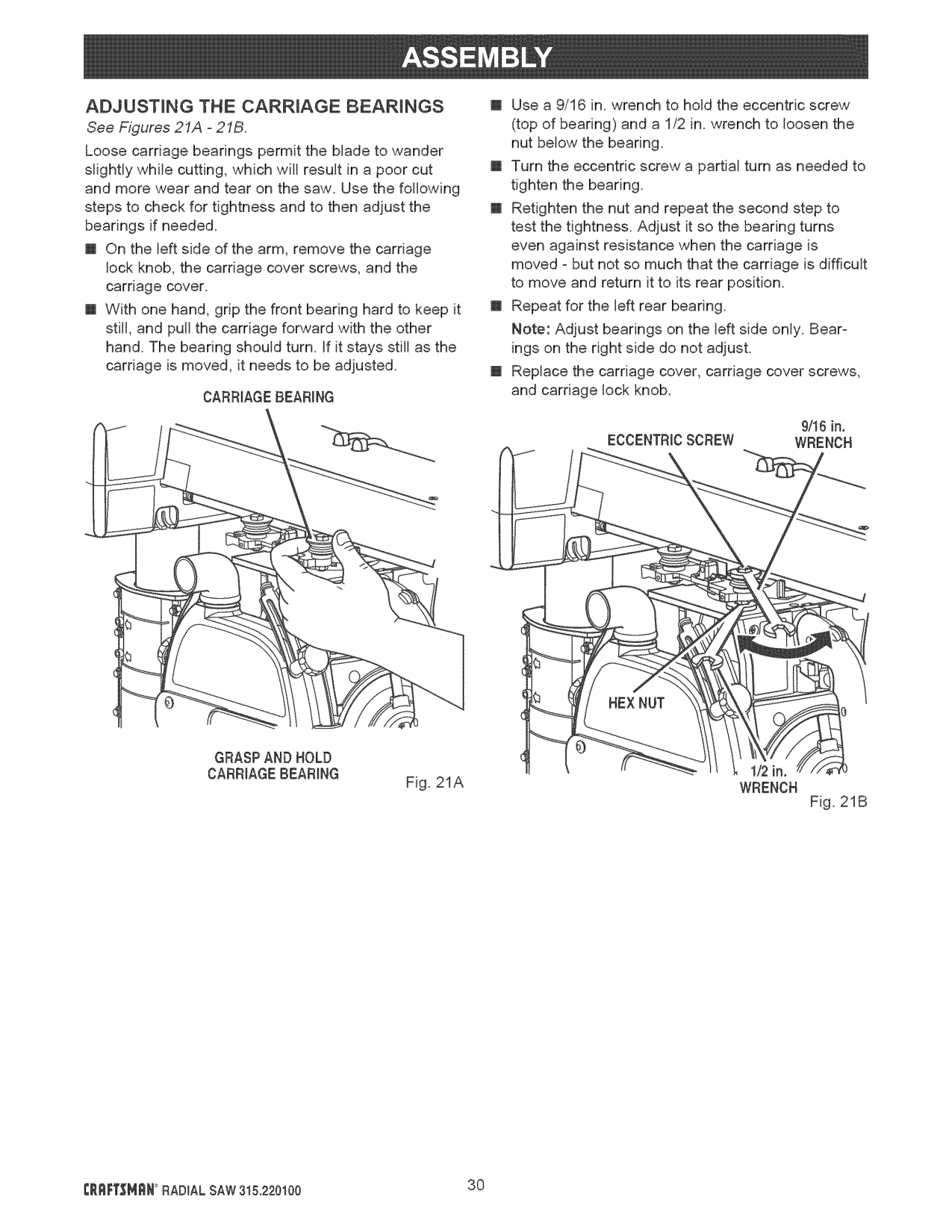
See Figures 21A - 21B. Loose carriage bearings permit the blade to wander slightly while cutting, which will result in a poor cut and more wear and tear on the saw. Use the following steps to check for tightness and to then adjust the bearings if needed. [] On the left side of the arm, remove the carriage lock knob, the carriage cover screws, and the carriage cover. [] With one hand, grip the front bearing hard to keep it still, and pull the carriage forward with the other hand. The bearing should turn. if it stays still as the carriage is moved, it needs to be adjusted.Carriagesearing
[] Use a 9/16 in. wrench to hold the eccentric screw (top of bearing) and a 1/2 in. wrench to loosen the nut below the bearing. [] Turn the eccentric screw a partial turn as needed to tighten the bearing. [] Retighten the nut and repeat the second step to test the tightness. Adjust it so the bearing turns even against resistance when the carriage is moved - but not so much that the carriage is difficult to move and return it to its rear position. [] Repeat for the left rear bearing. Note: Adjust bearings on the left side only. Bear- ings on the right side do not adjust. [] Replace the carriage cover, carriage cover screws, and carriage lock knob.Eccentricscrew
9/16 in.Wrench
Graspand Hold
Carriagesearing
Fig. 21A 1/2 in.Wrench
Fig. 21BCrrft_Nrnradialsaw 315.220100
30
Leveung
The Table
Supports
See Figures 22A - 22B. The table supports must be perfectly level. [] Pull the bevel lock lever forward to unlock it. Use the bevel index knob to rotate the motor so the arbor shaft points down. Lock the bevel lock lever. [] Release the arm lock knob to angle the arm. Begin by positioning the arbor shaft over the back of the highest table support. Normally this is the left side. See Figure 22A. [] Lock the arm lock knob and the carriage lock knob. [] Using one of the blade wrenches as a feeler gage, place it on the table support below the arbor shaft. [] With the elevating handwheel, carefully lower the motor until the shaft just touches the wrench. The wrench should move with only slight resistance. Securely tighten the back screw on the table support. [] Without changing the elevation, move the arm to place the blade arbor over the front of table sup- port. See Figure 22B.Armlock Knob
[] Place the wrench below the shaft and check that the clearance is the same. If not, adjust the table support until it is the same. Securely tighten the front screw. [] Move the arm to the opposite side and repeat the above procedure. When the opposite side is level, recheck the first side to make sure that it is still accurate and even. [] Return the saw and motor to normal height and position.Blade
Wrenchat
Front
Fig. 22BBevel
Indexknob
Bevel
Locklever
Blade Wrench
At Back
Blade
Arbor
Leftside
Table Support
@_Rightside
Table Support
Elevating
Nandwheel
31 Fig. 22A CRRFT'SMnN°Radialsaw315.220100

iNSTALLiNG
The
Front
Table
See Figures 23A - 23C. Use this procedure to install the fixed front table. The top of the table has counterbored holes, predrifled from the top, around the center to attach the table, in the center are a counterbored hole and a small hole, which is not counterbored. They are used for raising or lowering the center of the table until it is level. [] Locate the front table and the following hardware: 1 tee nut 1 U-clip (1/4 in.) 1 setscrew (1/4-20 x 7/8 in.) 4 pan head screws (1/4-20 x 1 in.) 1 pan head screw (1/4-20 x 1-3/4 in.) 5 flat washers (5/8 in.) 4 lock washers (1/4 in.) 4 hex nuts (1/4-20) [] Place the front table on a solid worksurface, with the top surface face down. Place the tee nut in the non-counterbored hole and tap it in place with a hammer.Setscrew
_Screw
_ / _'_Rearof
Rearof Fronttable
Fig. 23A [] Snap the U-clip onto the front edge of the saw base. Line up the hole in the U-cfip with the saw base hole just to the left of the center notch in saw base. See Figure 23B. [] Place the table, top up, on the table supports so the center counterbored hole lines up over the hole in the U-clip. [] Place a fiat washer in each counterbored hole.Alignu-Clip
U-Clip
OVERTHiSHOLESaw Base
Fig. 23B [] Place the long pan head screw into the center hole and thread into the U-clip. Do not tighten until the table has been checked for evenness. See Figure23A.
[] Place the setscrew through the small leveling hole and thread into the tee nut, but do not tighten. [] Put a 1 in. long pan head screw in the four remain- ing holes and through the holes in the support. Cap with a lock washer and hex nut. Tighten with a 7/16 in. wrench and phillips screwdriver. This completes installation of the front table. 1 in.Screw
Setscrew
1-3/4 in. SCREW _ , !,Flat
Z
Z
!Washer
Lockwasner
Hex Nut
Fig. 23CCrrf[_Nrn Radialsaw 315.220100
32
Leveling
The
Front
Table
See Figure 24. If there are any high or low areas on the front table, they should be removed by adjusting the leveling screws in the center holes on the front table. [] Place the rear table on its edge across the front table to check for gaps. [] Adjust gaps of Jess than 1/32 in. in the center of the table by turning the setscrew with a fiat blade screwdriver until the setscrew touches the frame. Then lightly secure the center pan head screw with a phiJJips screwdriver. [] For a gap of more than 1/32 in. in the center of the table, raise the center by turning the setscrew against the frame. Then lightly secure the center pan head screw with a phillips screwdriver. [] For a gap of more than 1/32 in. on the sides, lower the center of the table by tightening the center pan head screw with a phiJJips screwdriver. Then tighten the setscrew.Phillipsscrewdriver
On Pan Headscrew
Setscrew
Reartable
Fronttable
Fig. 24Jnstalung
Rear
Table,
Spacer
Table,
Fence,
And
Clamps
See Figures 25A - 25C. The placement of the tables and fence may need to be changed for different cuts, depending on the size of the workpiece and the position of the blade. The fence should be installed next to the front table for maximum depth capacity; it should be installed in the middle for maximum cross cut capacity; and installed all the way back for maximum rip capacity. [] Locate the fence, the spacer table, the rear table, and two unassembied clamps, which consist of the following hardware: 2 cup washers 2 clamp brackets 2 square nuts 2 thumbscrews [] Place the fence behind the front table, then the spacer table behind it, and then the rear table behind it. [] Slip a square nut into the slot of each clamp bracket. [] Place a thumbscrew into the end of the clamp bracket farthest from the slot. Thread it into the square nut. Note: If the screw is inserted in the wrong end of the bracket, the clamp will not work. [] Place the clamp bracket into the rectangle holes in the table support. Hold the cup washer against the rear table and turn the thumbscrew clockwise until it snaps into the cup washer. [] Tighten the thumbscrews to clamp the table sec- tions into place.Reartable
Fence
Spacertable
Fronttable
Fig. 25A 33J:Rrftsm_Jn
°Radialsaw 315.220100

Thumbscrew
Clamp
Bracket
Squarenut
1Cup
Washer
Rectangle
Hole
Cup
To
Washer
Loosen
To
Tighten
Clampshown
Assembled
Slot
Fig. 25BTable
Support
_Nstalung
Blade
And
Blade
Guard
See Figures 26A26C.
Thumbscrew
Blade Guard
Blade
Retaining
Screwand Nut
Rivingknife
Blade Nut
Andpawls
To
Loosen_
Blade
Rotation
iNNERBLADEWasher
Fig. 26ATo
Tighten
Fig. 25CBlade
Arbor
%'Blade
Wrench(2)
Fig. 26BCrrf_',_Mrn
Radialsaw315,220100
34
[] Orientinnerslottedmetalstripsothatit islocated totheleftofouterslottedmetalstrip. [] Topreventbinding,alignflatsofretainingscrewnut inslotsofinnerslottedmetalstrip. [] insertretainingscrewthroughouterslottedmetal stripandthreadintoretainingscrewnut.Tighten retainingscrewsecurely.
Flats
Retaininginnerslotted
J
Screw
Nut Metalstripj
Augn
R_V_Ng Knife
To Blade
See F_gures 2ZA _27C. When ripping the riving knife must be centered with the blade to ride in the middle of the kerr and keep it from binding. Binding pinches the blade. Blade pinching can cause kickback. There are two pairs of anti-kickback pawls. ,_Warmng:
Failure to use the riving knife, hold downs, and anti-kickback pawls can allow kickback. Kickback can throw the workpiece toward the operator, resulting in serious injury. [] Put the blade to the in-rip position by first loosening the yoke lock handle, below the carriage on the right. Then pull the yoke pivot latch (right side of arm, on carriage) forward and rotate the yoke to the left. This indexes the yoke 90 ° so the blade isRivingknife Ontop Of Fence
Too Farleftof Blade
Fig. 27B between the motor and the column. Lock the yoke lock handle. [] With the elevating handwheeJ, lower the arm until the blade just clears the table. [] Support the lower outer blade guard and loosen the carriage lock knob on the left of the arm. Move the yoke back until the blade touches the fence. Reset the carriage lock knob. [] Loosen the riving knife knob, at the front of the upper blade guard. Lower the riving knife to the table and tighten the knob. If the knife rests against the fence, with one set of pawls riding on the fence, no adjustment is needed. [] If the riving knife is on the fence or not touching it, loosen the riving knife slotted nut (just above the pawls, to the right). Correct the riving knife position and retighten the cap nut.Rivingknifetoofar
Rightof Fenceand Blade
Correctalignmentof Therivingknife
And Antfkickpawls
Fig. 27C CRRFT'$NnN°Radialsaw315.220100
Fig. 27A 35
_Nstalling
RiP SCALE_Nd_Cators
See Figure 28. The rip scale indicators on the arm show the distance between the blade and the rip fence with the fence in the front and rear positions. The upper scale is used when the fence is positioned directly behind the front table. The lower scale is used when the fence is at the extreme rear, directly in front of the column. The In-Rip Indicator is on the right side of the arm. The Out-Rip indicator is on the left side of the arm. [] Remove the following from a small hardware bag. 2 rip scale indicators 4 screws 2 speed nuts [] On the left of the radial arm saw, remove the carriage lock knob and spring. [] Remove the two carriage cover screws and the carriage cover. [] insert a speed nut inside the carriage cover with the flat side up. Place the scale indicator on top of the carriage cover and attach with two screws. Se- curely tighten screws. [] Replace the carriage cover and tighten the carriage cover screws. [] Replace carriage lock knob and spring. [] Repeat for the right side.Ripscale
Indicator
Carriage
Screws
Speednut
Spring
Carriage
Lock Knob
Screws
Fig. 28 To complete setting up your saw, continue with the Adjustment procedures. The adjustments should be checked regularly, depending on usage. Your saw will provide accurate cuts with fine tolerances as long as you protect the accuracy with frequent alignment checks. The radial arm saw can perform a wide range of high quality cuts. The final step will be connecting the control cut device. The control cut device offers many benefits. As it increases operator control, it eliminates the risk in a cross cut of the saw "climbing" out and over the workpiece at the operator. Feed control of the blade as it cuts through the workpiece increases, as does the accuracy of the cut. The following adjustments need to be completed before the control cut device is connected. Your radial arm saw is designed to perform a variety of complex cuts with fine tolerances. A weekly alignment check ensures that your saw can perform with precision. It takes about ten minutes and the results is better performance and a longer life for your saw. Perform the checks in the order given. If you miss an adjustment, go back to the missed adjustment and repeat all steps from that point forward. _ CAUTmON: Failure to check alignments and perform the adjustments in the initial set up or on a frequent basis can result in poor performance or machine damage.Crrf[_Mrn Radialsaw 315.220100
36
Aligning
The
Arm For Cross
Cuts
See Figures 29,4 - 29C. This procedure checks whether the arm is exactly 0° for cross cut travel by checking the blade against the table and the miter indicator. Remove the rear table, spacer table, and fence, but leave the front table in place. You will need a framing square, a 3/16 in. hex key, and a pencil. _Warning:
Be sure the saw is unplugged before performing these adjustments. Accidental start-up could result in serious personal injury. • First check the framing square by fitting one side against the back edge of the table. Lightly draw a line on the table along the edge of the square in the middle of the table. Flip the square over. If the edge still matches the line with no gaps or over- laps, the square is true.Drawa Straigh1
Linealongthisedge :
Framing
Square
Thereshouldbe Nogap Herewhen
Squareis Flippedoverto Dottedposition
Fig. 29AFraming
Square
Miterindicator
Arm
Lockknob
/ • Release the arm lock knob. Position the arm straight forward (0°) and leave it unlocked. • Lower the arm with the elevating handwheel until the saw blade just clears the front table. Lock the yoke lock handle (right side of saw, below yoke) and the bevel lock lever. • Place the framing square on the table and position one edge of the square firmly against the back edge of the table. Position the other leg of the square against the blade until it rests beside but not touching a tooth. With a pencil, mark beside this tooth. • Slowly move the yoke assembly forward and backward along the arm and against the square without rotating the blade. If the mark moves into or away from the square, adjust the arm with the following steps. • At the back of the column, loosen the three set- screws with a 3/16 in. hex key and position the arm as needed to align with the framing square. • Lock the arm lock knob and retighten the three setscrews. Recheck the cross cut travel with the blade against the framing square. • Set the miter indicator on top of the column to 0°. • Replace the fence, spacer table, rear table, and table clamps.Rearcover
Removedfor
Clarity
Yoke
Lock
Handle
Setscrews
Elevating
Handwheel
Setscrews
Fig. 29C Fig. 29B 37Crrftsmrn
_Radialsaw315.220100

Aligning
Blade
To Table
At 0° Bevel
See Figures 30A - 30D, This procedure squares the blade to the table at 0° bevel (vertical) so the blade angle will be accurate. If the blade is not at 0° bevel, follow the steps below to rotate slightly, You will need a framing square and a 1/4 in, hex key, • Position the blade in front of the fence. Lower the blade with the elevating handwheel until it just clears the front table. • Lock the following controls: bevel lock lever below the handle, carriage lock knob on the left side, arm lock knob on top of the arm, and yoke lock handle below the yoke, on the right. • Stand a framing square on the table with the short leg pointing up against the saw blade and the long leg parallel to the fence, Place the square flat against the blade between two teeth. • If both the top and bottom of the saw blade are flat against the square, no adjustment is needed, • If the saw blade gaps at the top or bottom, remove the bevel index cap by removing the two phillips head screws (below the handle), You will see four socket head screws, • Loosen the socket head screws with a 1/4 in. hex key, Rotate the motor slightly while holding the square against the saw blade and table top, • Slightly tighten each of the four screws and recheck the blade and framing square,Armlockknob
• If there are no gaps, fully tighten each screw, If there is still a gap, repeat the previous two steps. • Check the bevel indicator on the yoke assembly near the handle, It should read 0°. If it does not, reset it by loosening the screws and rotating the bevel index cap, Retighten the two screws, • Loosen the carriage lock knob,Bladesquareto Table
Noadjustmentneeded
Framing
Square\
I
_Blade
TABLEj Fig, 30BFraming
Square
GAPj JGap
Blade
tBlade
Fronttable
Bevel
Indexcap
Bevel
Lock
Lever
Gap-Adjustmentneeded
Fig. 30CBevelindex
Cap Removed
Elevating
Socket
Bevel
Handwheel
Fig. 30AHeadscrews
Lock Lever
Fig. 30D rRnR'$MI:1N_RADIALSAW 315.2201O0 38
Squaring
Blade
To Fence
See Figures 31A - 31C. This procedure squares the miter angle of the blade to the fence to reduce the risk of binding and kickback. If the blade is not square to the fence, the yoke assem- bly must be rotated slightly. Have a framing square, a 1/2 in. wrench, and a phillips screwdriver at hand. The blade should be lowered to just clear the table. Release the carriage lock knob. ,_Warning:
The blade must be angled at 90 ° to the fence when the handle is at the front of the saw. If not, kickback could result during a cross cut. Kickback can cause serious injury by throw- ing the workpiece toward the operator. In addi- tion, a faulty miter angle on the blade can splinter or burn the cut edges of the workpiece during cross cuts or rip cuts. • Use the arm lock knob to index and lock the arm in 0 ° miter position (straight forward). • Pull the yoke assembly forward to the front of the arm. Lock the carriage lock knob. • Place the short end of the framing square against the fence. Rotate the square to 45° to the table. Place the long edge across the flat surface of the blade, below the center of the blade. (Do not place the edge against a tooth.) • Check whether the blade is flat against the edge for the entire length or whether a gap is visible. • If the blade needs adjustment, remove the right side carriage cover with a phillips screwdriver.Fence
Arm Lockknob
Framingsquare
Fig. 31A • Release the yoke lock handle (below the yoke on the right). With a 1/2 in. wrench, slightly loosen the two hex bolts holding the yoke pivot latch. • Rotate yoke assembly until the gap is eliminated. • Lock the yoke lock handle. Retighten the two hex bolts on the yoke pivot latch. • Replace the carriage cover. • Loosen the carriage lock knob and guide the yoke assembly to the back of the arm.Saw Viewed
From Above
, " __Adjustment
Needed
Blade
No Adjustmentneeded
Fence
Framing
Blade
Square
Gap-
Adjustmentneeded
Fig. 31BHex Bolts
Yokelockhandle
Fig. 31C 39Crrftsnrh
° Radial Saw315.220100

Paralleling
Blade
To Table
See Figures 32A - 32C. This procedure squares the blade to the table at 90° bevel so horizontal cuts will be accurate. This also reduces kickback, as well as splintering and burning of the cut edges of the workpiece. If the blade is not at 90 ° bevel, follow the steps to rotate the blade unit slightly. You will need a framing square and a flat blade screwdriver. ,_Warning:
The blade must be perfectly parallel to the table at the 90 ° reading on the bevel scale. If not, kickback could result, as well as splintering or burning the cut. Kickback can result in serious personal injury as the workpiece can be thrown at the operator. • Use the arm lock knob to lock the arm in 0° miter position (straight forward). • Turn the elevating handwheel to raise the blade at least 2 in. above the table. • Release the bevel lock lever below the handle. Use the bevel index knob, just under the handle, to turn the motor to 90°. The blade will be horizontal. Lock the bevel lock lever. • Place the framing square with the short end hang- ing down in front of the worktable and the long side on edge under the blade. • Lower the arm with the elevating handwheel so the blade surface rests on the square. Turn the blade slightly if necessary so the face of the blade, not a tooth, lies on the square.Noadjustment
Needed
Fence
/Fronttable
Blade
Framing_
Square
Bevel
Lock
Lever
• Check whether the blade is flat against the edge the entire length or whether a gap is visible. If you can see a gap, adjust the blade to be at 90 ° bevel to the table with the following steps. • Unlock the bevel lock lever. Loosen the rear motor mount nut, which holds the motor on the yoke. Place a flat blade screwdriver in one of the slots, and rotate the cam behind the nut to eliminate the gap between the blade and the square. • Retighten the nut. • Tighten the bevel lock lever. Recheck the blade and the square for any gaps. • Raise the blade with the elevating handwheel to approximately halfway up. Index the blade to a vertical 0° bevel with the bevel index knob. Lock it with the bevel lock lever.Adjustment
Gap
Needed
Fig. 32BCam
Fig. 32A Fig. 32C rRRFTSMFINRADIALSAW 315.220100 40
Aligning
The
Rip Scale
Indicators
See Figures 33A - 33B. The rip scale indicators on the arm show the distance between the blade and the rip fence. The upper scale is used when the fence is positioned directly behind the front table, The lower scale is used when the fence is at the extreme rear, directly in front of the column. The in-rip indicator and scale are on the right side of the arm, The out-rip indicator and scale are on the left side. This procedure checks the indicators with the fence at the back of the tables directly in front of the column. The blade should be turned to the in-rip position to set the rip scale indicator on the right side of the arm. Then, the blade should be turned to the out-rip position to set the rip scale indicator on the left side of the arm, You will need a framing square. • If the fence is not at the rear of the tables, place it there. • Turn the blade to the in-rip position by loosening the yoke lock handle, below the arm on the right, Then pull the yoke pivot latch forward and rotate the yoke to the in-rip position, This indexes the yoke 90 ° so the blade is between the motor and the column, Lock the yoke lock handle. • With the elevating handwheel, lower the arm until the blade just clears the table. • Loosen the carriage lock knob and guide the blade back to just touch the fence, Tighten the carriage lock knob.In-Ripscale Onrightsideof Arm
Rip-Scaleindicator
• On the right side of the arm, check the lower in-rip scale indicator, which should be set on 0 inches, If it is not, loosen the screws and shift the indicator until it reads zero, Tighten the screws. • Loosen the yoke lock handle, Pull the yoke pivot latch forward and rotate the yoke to the out-rip position, The blade should be in front of (outside) the motor and the column. • Lay the framing square on the table with the short edge against the fence and with the long side toward the table front. • Note the distance where the blade contacts the framing square, • On the left side of the arm on the out-rip scale, check the rip scale indicator on the rear fence position (lower scale), The rip scale indicator should mark the same number as the distance measured from the fence to the blade, If it does not, loosen the screws and shift the scale until the indicator is correct, Tighten the screws.Out-Ripscaleon Leftsideof Arm
Rip-Scaleindicator
.... 10" Front Fence Position _ 7,I,1,1,
Ro.rFence Position /Carriagelockknob
Fig, 33BYokepivotlatch
Fig, 33A 41Craftsi4Rn
° Radialsaw315.220100

Installing
Control
Cut
Device
See Figure 34, Note: Before installing the control cut device, the yoke assembly will travel back and forward on the carriage by pulling the handle, After installing the control cut device, the power cord for the control cut device must be plugged in and switch trigger pressed to move the yoke assembly and carriage on the arm, ,_Warning:
Do not install the control cut device until after all of the initial adjustments and alignments are made to prevent accidental starting of the saw that could result in serious personal injury, The control cut device offers many benefits, As it increases operator control, it eliminates the risk in a cross cut of the saw "climbing" out and over the workpiece at the operator, Feed control of the blade as it cuts through the workpiece increases, as does the accuracy of the cut, The control cut cable maintains a steady pull on the carriage assembly from the column, This tension keeps the assembly at the column, unless you squeeze the switch trigger in the handle, The switch trigger activates the motor to counter the pull of the cable, After a cut is completed, press the switch on the arm off, then release the switch trigger to prevent further forward motion, Hold the handle until the blade has stopped rotating. The yoke assembly will not roll forward unless you are squeezing the switch trigger, The control cut power cord is designed to operate on a single voltage AC circuit. The speed can be set with a thumbwheel on top of the handle, The three speed settings are described on the label located on the left side of the control cut housing, ,_Warning:
Do not use the saw without the control cut and blade guards in place unless specifically instructed to do so. Otherwise uncontrolled contact with the blade could occur, resulting in personal injury, ,_,Warning:
Take great care when working with either cord to ensure you have the correct one, If you intend to unplug the main power cord but remove the control cut cord instead, the blade could be accidentally started and cause injury. • Plug in the control cut cord, leaving the main power cord disconnected, Squeeze the switch trigger to confirm the control cut motor is receiving power, • On the left side of the saw, remove the carriage lock knob and spring. Remove the two screws that attach the carriage cover and remove the cover. • Replace the spring and carriage lock knob, Pull the carriage assembly about halfway to the front. Tighten the carriage lock knob, • Squeeze the switch trigger in the handle with your right hand and pull the spring loaded cable from the column with your left hand. If you prefer to use a pair of pliers, do not damage the cable. Note: Do not to let the spring loaded cable clamp slip out of your hand or pliers. If it slips past the cable bracket and goes up into the control cut motor housing, then disassembly of the control cut assembly will be required to get it back out. • Place the barrel fitting into the socket at the back of the carriage assembly. • Remove the carriage lock knob and spring, Replace the carriage cover and screws, then replace the spring and carriage lock knob. • Set the speed thumbwheel, using the chart on page 53, If you are unsure of the proper speed setting, use the lowest setting,Barrel
Fitting
Carriage
Assembly
Socket
Fig, 34 rRRFTSMFINRADIALSAW 315.220100 42
Check
Alignment
Of
Arm
And
Blade
Using
Laser
See Figure 35. The laser can be used as a quick, accurate routine check for the alignment of your Radial Arm Saw, The saw should be aligned according to the procedures outlined in the Adjustments Section of this manual, • Using a two-foot length of 1 x 12 in, board and an accurate framing square, draw a fine line perpen- dicular to the edge of the board using the fence as a guide. Position the marked board against the fence, • With the guard in place, align the blade arbor at the CENTER of the width of the board. • Raise the arm so that the blade is approximately 5 in, above the surface of the board. • Tighten the carriage lock knob to prevent the carriage from moving, • Carefully start the motor and observe the red laser line. By shifting the board, align the laser line with the line you drew on the board. If the laser line aligns parallel with the drawn line, the saw align- ment is acceptable, • When making adjustments to the radial arm saw, use ONLY the procedures outlined in the adjust- ments section of this manual, using a framing square and the saw UNPLUGGED. Do not attempt to perform adjustments while using the laser as an indication of alignment. • Save the board with the drawn line for future routine alignment checks, Fig. 35 43Craftsi4Rx_ Radialsaw315.220100

Basic
Operation
Of The
Radial
Arm
Saw
A radial arm saw can be used for straight-line cutting operations such as cross cutting, ripping, mitering, beveling, compound cutting, and resawing. It can make dado or molding cuts with special attachments, This saw is designed to cut wood and wood composi- tion products only, The three-prong plug must be plugged into a match- ing outlet that is properly installed and grounded according to all local codes and ordinances, Improper connection of the equipment can result in electric shock, Check with an electrician or service personnel if you are unsure about proper grounding, Do not modify the plug; if it will not fit the outlet, have the correct outlet installed by a qualified electrician, Refer to the Electrical page of this manual,Types
Of Cuts
See Figure 36, The radial saw makes cross cuts parallel with the arm (across the grain), and rip cuts square to the arm (with the grain). Each can be made with the blade vertical or beveled, Instructions for making each kind of cut are given later in this section, ,_Warning:
All blades and cutting accessories must be rated for at least 5,000 rpm to prevent possible injury.Cross
Cuts
Cross cuts are made parallel to the arm, The blade is pulled along the length of the radial arm with the wood secured,Q
There are several types of cross cuts, A cross cut shows 0° on the miter scale (arm straight) and 0° on the bevel scale (blade straight). A miter cut is made with the radial arm angled and the blade straight, A bevel cut is produced with the arm straight and the blade angled. A final type of cross cut is the compound cross cut. Both the arm and the blade are angled. Be thoroughly 4_ familiar with making cross cuts, bevel cuts, and miter cuts before trying a compound miter cut. Note: In cross cuts, the blade teeth point down as they strike the wood. In rip cuts, the teeth point up as they strike the wood, ,_Warning:
NEVER make a cross cut with the .! short edge of the wood parallel to the fence, Kick back is likely to occur, causing the workpiece to be thrown back at you, Treat such a workpiece as a rip cut,Rip
Cuts
Note: For ease of set-up, better accuracy, and your safety, do not use the laser guide during any rip cuts. In rip cuts, the yoke is rotated 90 ° left or right and locked in place, The wood must ride firmly against the rip fence, There are two orientations of rip cuts - the in-rip and the out-rip. The in-rip position provides better visibility, Out-rip cuts can also be made with the blade beveled, In an in-rip cut, the yoke is rotated to the left, which puts the blade in between the column and the motor, The wood is fed from the right hand side, In an out-rip cut, the blade is in front of the motor, and the wood is fed from the left, Out-rip cutting is recom- mended only when the blade is set 12 in, or more from the fence. ,_,Warning:
Always make sure the blade guard and anti-kickback pawls are in place and working properly when making rip cuts to avoid possible injury,Warning:,
Always use a pushstick with small pieces of wood, and also to finish the cut when ripping a long narrow piece of wood, to prevent your hands from getting close to the blade,Q
__Cross
Cut
Mitercut
Bevelcut
®Compoundcrosscut
Ripcut
__Evel
Ripcut
Fig, 36Crrftsmrn
_Radialsaw 315.220100
44
Switch
And Switch
Key
See Figures 37 - 39. The main power switch has been placed on the front of the arm for easy access. The yellow switch key prevents accidental starting of the main power switch when saw is not being used. To activate the switch, insert the switch key and lift switch to ON position. To lock the switch once it has been pressed to OFF, remove the yellow key. Place the key in a location that is inaccessible to children and others not qualified to use the tool.L
Insertswitchkey
Fig. 37Switchon
Fig. 38Causes
Of Kickback
Kickback can occur when the blade stalls or binds, kicking the workpiece back toward you with great force and speed. If your hands are near the blade, they may be jerked loose and contact the blade. Obviously, kickback can cause serious injury and it is well worth using precautions to avoid the risks. Kickback can be caused by any action that pinches the blade in the wood, such as the following: • Making a cut with incorrect blade depth • Sawing into knots or nails in the workpiece • Twisting the wood while making a cut • Failing to support work • Forcing a cut • Cutting warped or wet lumber • Misusing the saw • Not following correct operating procedures • Using the wrong blade for the type of cut • Cutting with a dull, gummed-up, or improperly set blade.Avoiding
Kickback
• Always use the correct blade depth setting. The outer point of the blade teeth should clear the lower surface of the workpiece by 1/8 in. to 1/4 in. when making these cuts. • Inspect the work for knots or nails before beginning a cut. Knock out any loose knots with a hammer. Never saw into a loose knot or nail. • Always use the fence when rip cutting. This helps prevent twisting the wood in the cut. • Always use clean, sharp, and properly-set blades. Never make cuts with dull blades. • To avoid pinching the blade, support the work properly before beginning a cut. • When making a cut, use steady, even pressure. Never force cuts. • Do not cut wet or warped lumber. • Always hold your workpiece firmly with both hands or with pushsticks. Keep your body in a balanced position to be ready to resist kickback should it occur. Never stand directly in line with the blade. • Use the right type of blade for the cut being made. • Use the riving knife and anti-kickback pawls when performing rip cuts.Switchoff
Fig. 39 45I:Rrft,_Mrn
° Radialsaw 315,220100

Cutting
Aids
See Figures 40 - 42. Cutting aids are used to improve the setup and help make the operator's work safer and more accurate. They can be made from scrap wood and in various sizes and shapes for specific projects. The basic types are pushsticks, pushblocks, and featherboards. If the blade is set 2 in. or more from the fence, use a pushstick. Use a pushblock when the blade is between 1/2 in. and 2 in. from the fence. (If the cut is narrower than 1/2 in., use a different saw.) Refer to the drawings and instructions provided so you can make safer and more precise cuts.Pushsticks
See Figure 40. Pushsticks must be narrower than the workpiece, with a 90 ° notch in one end and shaped for a grip on the other end.Pushblocks
See Figure 41. A pushblock has an upright handle with a base attached to the handle. Some pushblocks have a foot that extends down from the base and against the workpiece. The foot is attached to the base with glue only to prevent damage to the blade.Featherboards
See Figure 42. Featherboards are used for large panels, along with an auxiliary table and a C-clamp. A featherboard has an angled end to fit against the edge of the workpiece. It is clamped in place so the workpiece moves be- tween either the fence and the featherboard or the table and featherboard. Slots in the end of the featherboard help resist kickback and allow for variations in the width of the workpiece. ,_Warning:
Clamp the featherboard against the infeed side of the workpiece. If clamped behind the blade, it could squeeze the cut edges together, causing binding and kickback. Kickback can cause serious injury. -> o)Pushsticks
Fig. 40Pushblocks
Fig. 41 2Featherboard
Fig. 42 Note: The Pushstick designs above are for illustration purposes only. They have not been drawn to scale,Crrftsmrn_Radialsaw 315.220100
46
Making
A Cross
Cut
See Figure 43. Use this procedure to make a cut with the blade vertical and straight forward, If a kerf does not exist for the line of the cut (cutting path), follow the steps to make one, Each cutting path requires its own kerf, ,_Warning:
Make sure the blade guard is lowered and is working properly to prevent possible injury, Always raise the clear plastic guard before changing the bevel or lowering the blade to avoid damage to the guard,Warning:
Keep one hand on the handle until the blade stops rotating to prevent the risk of injury. • Put the fence in the front position (next to the front table) and tighten the table clamps, • Check that the control cut device is set for the correct speed for the type of wood and cut you are planning, Refer to the chart on the label and adjust the thumbwheel on the handle accordingly, • If the yoke is not in the cross cut position with the blade parallel to the arm, release the yoke lock handle (right side, under yoke). Position the yoke correctly with the yoke pivot latch. • If the arm is too low or too high, first lift the blade guard if the arm is too low, and turn the elevating handwheel at the front of the table. Set the blade to just clear the kerf or table, • If the arm is angled, release the arm lock knob on top of the arm, position it straight ahead and lock the arm lock knob, • If the blade is angled, raise the plastic lower guard, release the bevel lock lever, and set the bevel indicator to zero, Retighten the bevel lock lever, • If the blade is in front of the fence, loosen the carriage lock knob on the left side of the arm. Release the switch trigger and let the carriage return to the back. • If there is no kerf, cut one approximately 1/16 in. deep, Grasp the handle and turn the saw on with the switch on the arm, Squeeze the switch trigger on the handle and pull the blade forward across the table to make the kerf, • Release the switch trigger and let the carriage return to the back, Turn the saw off with the switch on the arm but hold the handle until the blade stops rotating, Adjust the height with the elevating handwheel so the blade will rotate freely in the kerf. • With saw behind the fence and workpiece against the fence, turn on the saw and align mark with laser. Clamp workpiece and make the cut, • Position the workpiece against the fence, Place the pawls and riving knife to clear the workpiece or the fence, whichever is higher, by at least 1/4 in. • Grasp the handle with one hand. With the other, turn the saw on, then hold the workpiece down and against the fence, Keep your hand well away from the blade, • Squeeze the switch trigger on the handle and pull the blade through the workpiece but only far enough to complete the cut, Keep your hand on the handle, even after the cut has been made and the saw turned off, until the blade stops rotating, • After completing the cut, move the workpiece to the side and turn off the saw with the switch on the arm, Release the switch trigger on the handle and let the yoke move back behind the fence. Do not release the handle until the blade stops rotating.Armlock
Handle
Carriage
Lockknob
Tableclamps
Switch
Handle
Bevel
;K Lever
Crosscut
Rivingknife
Elevating
Handwheel
Fig, 43 47Crrftsnrn"
Radialsaw315.220100

Making
A Miter
Cut
See Figure 44. In a miter cut, the blade is vertical and the arm angled, If a kerf does not exist for the cutting path, make one (instructions below). Each cutting path requires its own kerf, ,_Warning:
Make sure the blade guard is lowered and is working properly to prevent possible injury. Always raise the clear plastic guard before changing the bevel or lowering the blade to avoid damage to the guard, ,_Warning:
Keep one hand on the handle until the blade stops rotating to prevent the risk of injury, • Put the fence in the front position (next to the front table) and tighten the table clamps, • Check that the control cut device is set for the correct speed for the type of wood and cut you are planning, Refer to the chart on the label and adjust the thumbwheel on the handle accordingly, • If the yoke is not in the cross cut position with the blade parallel to the arm, release the yoke lock handle and position the yoke correctly with the yoke pivot latch on the right side of the arm. • If the arm is too low or too high, first lift the blade guard if the arm is too low, and turn the elevating handwheel at the front of the table. Set the blade to just clear the kerf or table, • To set the angle of the arm, release the arm lock knob on top of the arm. Use the miter scale above the column to position the arm to the desired angle, and lock the arm lock knob. • If the blade is angled, raise the plastic lower guard, release the bevel lock lever, and set the bevel indicator to zero. Retighten the bevel lock lever,Ercut
Elevating
Handwheel
• If the blade is in front of the fence, loosen the carriage lock knob on the left side of the arm and let the carriage move back. • If there is no kerf, cut one approximately 1/16 in. deep, Grasp the handle and turn the saw on with the switch on the arm, Squeeze the switch trigger on the handle and pull the blade forward across the table to make the kerf, • Release the switch trigger and let the carriage return to the back. Turn the saw off with the switch on the arm but hold the handle until the blade stops rotating, Adjust the height with the elevating handwheel so the blade will rotate freely in the kerf, • Position the workpiece against the fence. Place the pawls and riving knife to clear the workpiece or the fence, whichever is higher, by at least 1/4 in. • Grasp the handle with one hand, With the other, turn the saw on, then hold the workpiece down and against the fence, Keep your hand well away from the blade. • Squeeze the switch trigger and pull the blade through the workpiece but only far enough to complete the cut, Keep your hand on the handle, even after the cut has been made and the saw turned off, until the blade stops rotating, • After completing the cut, move the workpiece to the side and turn off the saw with the switch on the arm, Release the switch trigger and let the yoke move back behind the fence, Do not release the handle until the blade stops rotating,Arm
Lockknob
Miterscale
Switch
Carriage
Lock
Yoke
Pivotlatch
Yokelock
Handle
Bladeguard
Handle
Bevel
Indicator
Bevel
Locklever
Table
Clamp
Fig. 44Craftsman_Radialsaw 315.220100
48
Making
A Bevel
Cut
See Figure 45. This procedure makes a cut with the blade and motor angled and the arm straight (90 ° to fence), If there is no kerf, follow the steps to make one, Try this cut on scrap wood before cutting your workpiece,,A,
Warning:
Make sure the blade guard is lowered and is working properly to prevent possible injury, Always raise the clear plastic guard before changing the bevel or lowering the blade to avoid damage to the guard, ,_Warning:
Keep one hand on the handle until the blade stops rotating to prevent the risk of injury, • Put the fence in the front position (next to the front table) and tighten the table clamps. • Check that the control cut device is set for the correct speed for the type of wood and cut you are planning, Refer to the chart on the label and adjust the thumbwheel on the handle accordingly. • If the yoke is not in the cross cut position with the blade parallel to the arm, release the yoke lock handle and position the yoke correctly with the yoke pivot latch on the right side of the arm. • If the arm is too low or too high, first lift the blade guard if the arm is too low, and turn the elevating handwheel at the front of the table, Set the blade to just clear the kerf or table. • If the arm is angled, release the arm lock knob on top of the arm, position it straight ahead and lock the arm lock knob. • If the blade is in front of the fence, loosen the carriage lock knob on the left side of the arm. Release the switch trigger on the handle and let the carriage return to the back, • To set the blade angle, first raise the plastic lower guard, Release the bevel lock lever, and position the blade with the bevel index lever. Retighten the bevel lock lever, Note: For a 45 ° or 90 ° angle, the bevel index lever will seat automatically at the preset positive stop positions. For any other angle, use the bevel lock lever, • If there is no kerf, cut one approximately 1/16 in. deep, Grasp the handle and turn the saw on with the switch on the arm, Squeeze the switch trigger on the handle and pull the blade forward across the table to make the kerf, • Release the switch trigger and let the carriage return to the back. Turn the saw off with the switch on the arm but hold the handle until the blade stops rotating. Adjust the height with the elevating handwheel so the blade will rotate freely in the kerf, • Position the workpiece against the fence. Place the pawls and riving knife to clear the workpiece or the fence, whichever is higher, by at least 1/4 in, • Grasp the handle with one hand, With the other hand, turn the saw on, then hold the workpiece down and against the fence, Keep your hand well away from the blade. • Squeeze the switch trigger on the handle and pull the blade through the workpiece but only far enough to complete the cut, Keep your hand on the handle, even after the cut has been made and the saw turned off, until the blade stops rotating. • After completing the cut, move the workpiece to the side and turn off the saw with the switch on the arm. Release the switch trigger on the handle and let the blade move back behind the fence, Do not release the handle until the blade stops rotating,B_Eveledcut
Arm
Lockknob
Switch
Handle
Yokelock
Handle
Riving
Elevating
Handwheel
Fig. 45 49 rRRFTSMRN"RADIALSAW 315.220100
Making
A Compound
Cross
Cut
See Figure 46. In this cut, both the blade and the arm are angled, Be familiar with both bevel and miter cuts before making a compound cut, Practice on scrap wood, ,_Warning:
Make sure the blade guard is lowered and is working properly to prevent possible injury, Always raise the clear plastic guard before changing the bevel or lowering the blade to avoid damage to the guard, ,_Warning:
Keep one hand on the handle until the blade stops rotating to prevent the risk of injury, • Put the fence in the front position (next to the front table) and tighten the table clamps, • Check that the control cut device is set for the correct speed for the type of wood and cut you are planning, Refer to the chart on the label and adjust the thumbwheel on the handle accordingly, • If the yoke is not in the cross cut position with the blade parallel to the arm, release the yoke lock handle and position the yoke correctly with the yoke pivot latch on the right side of the arm. • If the arm is too low or too high, first lift the blade guard if the arm is too low, and turn the elevating handwheel at the front of the table, Set the blade to just clear the kerf or table, • To set the angle of the arm, release the arm lock knob on top of the arm. Use the miter scale above the column to position it to the desired angle, and lock the arm lock knob, • To set the blade angle, first raise the plastic lower guard. Release the bevel lock lever, and position the blade with the bevel index lever, • Retighten the bevel lock lever. Note: For a 45° or 90 ° angle, the bevel index lever will seat automatically at the preset positive stop positions. For any other angle, use the bevel lock lever. • If the yoke is in front of the fence, loosen the carriage lock knob on the left side of the arm. Release the switch trigger on the handle and let the carriage return to the back. • If there is no kerf, cut one approximately 1/16 in, deep, Grasp the handle, Turn the saw on with the switch on the arm, Squeeze the switch trigger and pull the blade forward to make the kerf, • Release the switch trigger and let the carriage return to the back. Turn the saw off with the switch on the arm but hold the handle until the blade stops rotating, Adjust the height with the elevating handwheel so the blade will rotate freely in the kerf, • Position the workpiece against the fence. Place the pawls and riving knife to clear the workpiece or the fence, whichever is higher, by at least 1/4 in. • Grasp the handle with one hand, With the other hand, turn the saw on, then hold the workpiece down and against the fence, If necessary, slightly raise the outer blade guard for clearance. Keep your hand well away from the blade. • Squeeze the switch trigger and pull the blade through the workpiece but only far enough to complete the cut, Keep your hand on the handle, even after the cut has been made and the saw turned off, until the blade stops rotating, • After completing the cut, move the workpiece to the side and turn off the saw with the switch on the arm. Release the switch trigger and let the yoke move back behind the fence, Do not release the handle until the blade stops rotating.Miterscale
Yoke
Arm
Pivotlatch
Switch
Yokelock
Handle
Bevellock
Lever
Clamps
Beveled And
Cut
Elevating
Handwheel
Fig, 46Craftsman
_Radialsaw 315.220100
50
Rip Cut
Hazards
And Precautions
Two hazards are specifically associated with rip cutting: outfeed zone and wrong way feed, In the outfeed zone (behind the blade), the blade teeth point down. The slightest contact while the blade is still spinning can snag clothing, jewelry, the work- piece, or even skin, causing serious personal injury. Wrong way feed occurs when the workpiece contacts the blade from the outfeed side, It is very hazardous and will jerk the workpiece violently, You could be cut if you are holding the workpiece, ,_,Warning:
Failure to observe any of these precautions can result in serious injury, • The first precaution is, of course, simply to stay completely away from the outfeed zone, Keep hands away from the outfeed zone. • Point the anti-kickback pawls away from the blade teeth to snag a workpiece if the blade grabs, They should be positioned to rest lightly on the workpiece. The flat side of the pawls should be level and horizontal. • Set the riving knife to just clear the table, • Set the hold down in front of the blade to just clear the workpiece, • Start and finish your cut from the infeed side, • Push the workpiece past the pawls with push- blocks and pushsticks to finish the cut, • If the blade jams, turn the saw off with the switch on the arm, remove the yellow key, and wait for the blade to fully stop before freeing it, • Make sure the blade is parallel to the fence and the workpiece is not warped or twisted, • Make sure no pressure is applied to the workpiece on the outfeed side, • Make sure the blade guard is lowered and is working properly. • Always set up the workpiece so the wider part of the wood is between the blade and the fence, This stabilizes the workpiece better, • Do not release the workpiece until it has moved past the pawls. Keep pushsticks firmly in place, • Use pushsticks and pushblocks, not your hands, when the trailing edge of the workpiece is within 3 in, of the blade. If the blade is set 2 in. or more from the fence, use a pushstick. Use a pushblock and auxiliary fence when the blade is between 2 in, and 1/2 in, from the fence, (If the cut is narrower than 1/2 in,, use a different saw.) For large panel rip cuts, use a featherboard instead of pushblocks or pushsticks. See the section on Cutting Aids.Setting
Up A Rip
Cut
See Figure 47, Note: For ease of set-up, better accuracy, and your safety, do not use the laser guide during any rip cuts, A precise and safe rip cut requires a careful set up, Before setting up for in-rip or out-rip, especially for a bevel cut, try the workpiece in both placements. Check for stability, visibility, and control, Test which will give the best pushstick clearance, Instructions are given for an in-rip cut. At certain points, the instructions will vary for a bevel rip cut or an out-rip process and will be enclosed in parenthe- ses (example), Figure 47 shows an out-rip setup. • Insert a solid fence with no kerfs. Use an auxiliary fence if the blade will be set only 1/2 in. to 2 in, from the fence, Tighten the table clamps, • If the arm is too low or too high, first lift the blade guard if the arm is too low, and turn the elevating handwheel at the front of the table. Set the blade to just clear the kerf or table, • Change the blade angle if needed. Raise the plastic lower guard to keep it from jamming, release the bevel lock lever, and set the bevel indicator to zero, (For a bevel rip cut, set the bevel indicator to the desired angle.) Test the clearance on the guard, Retighten the bevel lock lever,Switch
Holddown
Elevating
Handwheel
Infeedfor
Inripcutting
Fig, 47 51 rRRFTSMRN_RADIALSAW 315.220100
• Put the blade in the in-rip position between the motor and the column. Release the yoke lock handle and pivot the yoke to the left, with the yoke pivot latch on the right side of the arm, (Use the out-rip position only for rips 12 in. or more in width; pivot the yoke to the right so the motor is between the blade and column.) • Loosen the carriage lock knob, Place the blade the right distance from the fence for the cut and lock the knob, • Cut a kerr. Turn the saw on with the switch on the arm, Lower the blade about 1/16 in, into the table to cut a shallow groove, Turn the saw off and remove the yellow key, • Position the workpiece against the blade, from the front of the table, Lower the hold-down in front of the blade to just clear the workpiece, (For a bevel rip cut, place the workpiece directly under the guard rather than beside the blade.) • Loosen the pawls and riving knife. Lower the riving knife to the table. Slide the workpiece back and lower the pawls so that one set rests on the work- piece, Lock the riving knife and pawls in place, (For a bevel rip cut, place the workpiece under the lower set of pawls.) • Remove the workpiece from the table, Set the push block, featherboard, or pushstick nearby, • Set up table extension(s) and supports. ,_
Warning:
Never use a person to support workpieces, This can cause kickback and serious injury. Never have someone stand at the outfeed side,Making
A Rip
Cut
See Figure 48, • Review the Hazards and Precautions page. • Do not make a rip cut without following all the setup steps in the previous procedure, • After the saw has been set up, insert the yellow key, and turn the saw on with the switch on the arm, Let the blade build up to full speed, • Stand at the infeed side of the blade and out of the line of the workpiece, in case kickback occurs. _1,Warning:
Never stand directly in the line of cut. Stand to the side to reduce the chance of injury should kickback occur. Start and finish the cut from the infeed side. • With the hand closest to the fence, push the workpiece under the hold down and into the blade, • Keep your other hand on the table and steady the workpiece against the fence. Keep that hand at least 8 in. from the blade, • If the blade cover does not automatically rise as the workpiece moves from the infeed to the out- feed side, stop the cut, Turn off the saw and adjust the blade cover so it rests on the workpiece, • When the end of the workpiece is still several inches from the blade, pick up the cutting aid you selected earlier. Push the wood with the pushstick or pushblock rather than your hand.Warning:
Use a pushstick as the end of the workpiece nears the blade to reduce the risk of injury, • Push the wood completely through the blade to the outfeed, past the pawls, • When the work is completed, press the switch off and remove the key.I_-I_
Ripcut
Switch
Anti-Kickback
Pawls
Infeedfor
Outripcutting
Fig. 48Craftsman_Radialsaw 315.220100
52
Making
Other
Cuts
See Figures 49 - 50. Variations from the basic cuts include cutting long workpieces and non-through cuts. When making one of the following cuts, follow the instructions that apply for the basic cut, depending on the position, shape, and size of the wood. Do not attempt these cuts until you are skilled with the basic cuts.Cutting
Long
Workpieces
See Figure 49. • Place a support the same height as the saw table nearby for the cut work.Supportlongworkpieces
,_,Warning:
Make sure the blade guard is lowered and is working properly to prevent possible injury. ,_,Warning:
Never put your hands within 3 in. of the blade when it is on. • Make sure the wood does not touch the blade before you turn on the saw with the switch on the arm. Let the blade build up to full speed before it contacts the wood. • When the work is completed, press the switch off and remove the key.J
Fig. 49 53Crrftsmrn_Radialsaw 315.220100

Non-Through
Cuts
See Figure 50. ,_,Warning:
Unplug the saw while removing or replacing the blade guard, Turn on the saw with the switch on the arm to confirm the blade is not receiving power. • Remove the blade and blade guard (see Assembly section), • Place a support the same height as the saw table nearby for the cut work. Lower the blade with the elevating handwheel, • Make sure the wood is not touching the blade. Insert the key and turn on the saw, Let the blade build up to full speed before contacting the work- piece, ,_Warning:
Always use pushblocks when making non-through rip cuts to avoid the risk of serious injury. Never feed wood with your hands. • When the work is completed, press the switch off and remove the key,Non-Throughcut
Fig. 50Crrftsmrn
_Radialsaw 315.220100
54
Mounting
The
Laser
Guide
See Figure 51. • Unplug your saw, ,_,Warning:
Failure to unplug your saw could result in accidental starting causing possible serious personal injury, • Remove the blade nut and outer blade washer from the blade arbor, (Refer to "Removing the Blade" in the Assembly section of this operator's manual,) Note: The laser guide replaces the outer blade washer. • Position flat surface of laser guide against the blade. Warning labels are visible when laser guide is mounted properly, • Secure laser guide using blade nut provided, • Hold the blade arbor with one wrench and rotate the other blade wrench counterclockwise (up) to tighten the blade nut, • Refer to "Installing Blade and Blade Guard" in the Assembly section of this operator's manual for replacing the blade guard (see page 34), ,_Danger:
Laser radiation. Avoid direct eye contact with light source,Operation
See Figure 52. The laser guide will generate a red line on the work surface when the saw blade is spinning above 500 rpm and the motor switch is activated. Fig. 51 For Cross Cuts, Miter Cuts, Bevel Cuts, and Compound Cross Cuts: Position the workpiece as described in the Operation section. Turn the saw on and position the blade directly behind the fence; align the laser line with your mark, For Non-Through Cuts: Position the workpiece as described in the Operation section, Turn the saw on and align the laser line with your mark,Alignment
Align the laser line and your mark with the blade. Once both lines are in alignment, do not move the workpiece until after you have finished cutting, Make several practice cuts on different styles and thickness of material. Follow the directions below for using your Laser Guide, Removing Your Mark: Position the laser line near the left edge of your mark on the work surface in order to remove the mark, To Cut Your Mark: Position the laser line near or over your mark on the work surface in order to cut the mark, To Leave Your Mark: Position the laser line near the right edge of your mark on the work surface in order to leave the mark. After you have become familiar with using your Laser Guide, you will be able to remove, cut, or leave your mark on the work surface, Practice will teach you the correct position for aligning the laser line with your mark,Laser
Bladenut
Innerblade
Washer
)-Blade
Arbor
Redline
55 Fig. 52 rRRFTSMRN° Radialsaw315.220100

Changing
The
Batteries
See Figure 53. • Unplug your saw. ,_Warning:
Failure to unplug your saw could result in accidental starting causing possible serious personal injury, Remove the laser guide from the saw. Lay laser guide on a flat surface with the two phillips screws facing upward. Remove the screws and separate the laser guide cover from the laser guide support, Remove the three button cell batteries using a non- conductive device such as a toothpick, Note: Replace the batteries with silver oxide, button batteries that have a rating of 1,5 volt and 180 mah (milliampere hour) minimum (number 357 series or equivalent). When replacing the batteries, the laser guide should be thoroughly cleaned, Use a soft paintbrush or similar device, to remove all sawdust and debris, Do not attempt to activate the laser. The laser is activated by means of a centrifugal switch only while the saw motor is running and the laser guide is mounted on the saw. After cleaning laser guide and replacing batteries, secure laser guide cover to laser guide support using the two phillips head screws, For proper assembly, be sure to align the key on the laser guide cover with the key slot in the laser guide support. Tighten screws securely, Note: Aperture in laser guide cover must be aligned with aperture in laser guide support. ,_Caution:
Use of controls or adjustments or performance of procedures other than those specified herein may result in hazardous radiation exposure.Laserguide
t !Support
Laserguide
Aperture
Support
(Upsidedownview)
Key
Plastic
Battery
Insulator
oQLaserguide
t iCover
I
iBatteries
Gative(-)
tKey
Slot
Aperture
Laserguide
,_Danger:
Laser radiation when open and interlock defeated.Avoid Direct
Eye
Exposure,
Fig, 53Crrftimrn_ Radialsaw315.220100
56
General
Maintenance
,_Warning:
When servicing, use only identical Craftsman replacement parts. Use of any other part may create a hazard or cause product damage. ,_ WARNmNG: To prevent accidental starting that could cause possible serious personal injury, turn off the saw with the switch on the arm, remove the switch key, and unplug the saw before working on the radial saw. [] Remove sawdust from the work area, inside the blade cover, frequently. [] Remove sawdust from and clean the blade guards [] Clean plastic parts with a soft damp cloth. Do not use any strong solvents. WARNmNG: Do not at any time let brake fluids, gasoline, petroleum-based products, penetrating oils, etc. contact plastic parts. They contain chemicals that can damage, weaken or destroy plastic. [] Check teeth of anti-kickback pawls; sharpen with fib if needed. [] Regularly check all nuts, bolts, screws, and cables for tightness and condition.Motor/Electrical
[] Frequently vacuum or blow out any sawdust from the work areas._I_
Warning:
Rfthe power cords are worn, cut, or damaged in any way, have them replaced immediately by a qualified service technician at a Sears store or repair center. Failure to do so could result in serious personal injury.Warning:
To avoid fire or electrocution, reassemble electric parts only with identical Craftsman replacement parts. Reassemble exactly as originally assembled. 57 CRRFT$_4nNRADIALSAW315.220100
Cause
Solution
Saw does not start._Rrftsmrn'Radialsaw 315.220100
58
Problem
Cause
Solution
Saw vibrates excessiveUy.Crrftsmanradialsaw315.220100

Cause
Solution
HandwheeU is hard to turn or 1_ Sawdust has collected on the 1_ Remove handwheeU; clean and column binds, elevating shafL Uubricate the shafL 2_ Column is out of aHgnmenL 2_ See Adjusting the Column Tube in Assembly section, Saw burns or scores edges of 1_ Column tube is too Uoosein the 1_ See Adjusting the Column wood in cut. column support. Tube in Assembly section,_Rrftsmrn Radialsaw 315.220100
60
Problem
Cause
Solution
Miter or cross cuts are not true.Crrftsmanradialsaw315.220100

Problem
Cause
Solution
Saw Made tends to push wood to 1, BUadeis heeling, 1, See Squaring the Blade to the one side when cross cutting, Fence in Adjustments section, 2, CoUumn tube is Uoosein coUumn 2, See Adjusting the Column support, Tube in Assembly section, 3, Arm is Uooseor misaHgned, 3, See Setting the Arm Lock L,_Zheelin the Assembly section, 4, Fence/taMes are not straight, 4, Check with square; sand or repUace, 5, BUadeor teeth are bent or dull, 5, Sharpen or repUace the Made, See the removaU procedure in Assembly section,[Rrstsmrn' Radialsaw 315.220100
62
G3
CRRFTSMnN RADIALSAW315.220100
Craftsman
Radial
Arm
Saw-
Model
No. 315.220100
The model number will be found on a plate attached to the base. Always mention the model number in all correspondence regarding your RADIAL ] ARM SAW or when ordering repair parts.J
31 18See Figure J
12See Figure E
7 \ 18 i 51 11 33See Figurei
® 40 39See Figuresf And G
31Figure A

Craftsman Radial Arm Saw-
Model No. 315.220100
I
The model number will be found on a plate attached to the base. Always mention the model number in all correspondence regarding your RADIAL ! ARM SAW or when ordering repair parts.J
Key
Part
No.
Number
1 976830-001 2** Std611006
4 980667-001 5 976793-001 6 980669-001 7 976786-001 8 976834-002 9** Std511103
10 989001-002 11** Std600803
12 976342-001 13 703776-098 14** Std541437
15 967917-001 16 990908-009 17 976384-001 18** Std511103
19 621380-007 20 976328-001 21 624282-003 24 980534-001 25 976829-001 26** Std511105
27 976344-001Parts List For Figure
A
Description
Quan.
Lower Arm Cover ........................................ 1Key
Part
No.
Number
28 976354-001 29 980532-001 30 980447-001 31 641700-008 32 976327-002 33 980550-001 34 976393-001 35 980697-001 36 981241-001 37 980542-001 38 980544-001 39 976331-001 40 980546-001 41 976863-001 42** Std510803
43 976862-002 44** Std551131
45 977471-001 46 969220-005 47 976368-001 48** Std512505
49 642409-002 50 976369-001 51 618364-000Description
Quan.
Miter Indicator ............................................. 1 Miter Scale Label ........................................ 1 Strain Relief ................................................ 2
Craftsman
Radial
Arm
Saw-
Model
No. 315.220100
•I
The model number will be found on a plate attached to the base. Always mention the model numberI
in all correspondence regarding your RADIAL ARM SAW or when ordering repair parts,J
19 18 _ 17See Figure [
14 24 _f_......._25 26Figure B
rRI:IFTSMI:IN° RADIALSAW315,220100See Figure C
66
Craftsman
Radial
Arm
Saw-
Model
No. 315.220100
•I
The model number will be found on a plate attached to the base, Always mention the model number in all correspondence regarding your RADIAL ARM SAW or when ordering repair parts,I
Parts List For Figure
B
Key
Part
No.
Number
Description
Quan.
1** Std541031
2** Std551131
3 624088-002 4 976698-001 5 931275-028 6** Std551131
7** Std541031
8 976339-001 9 976340-001 10 624282-002 11 977249-001 12** Std523106
13 976834-001 14 976335-001 15 976334-001 16 976333-001 17 976332-001 18 931744-059 19 607737-004 20 989594-003 21** Std512510
22 976791-001 23 976792-001 24 703473-089 25** Std541025
26 940021-008 27 621032-002 28 977227-001 29 976361-000 983000-041
Craftsman
Radial
Arm
Saw-
Model
No. 315.220100
I
The model number will be found on a plate attached to the base. Always mention the model number in all correspondence regarding your RADIAL ! ARM SAW or when ordering repair parts.J
10Figure C
1 9 10 3 1
Craftsman
Radial
Arm
Saw-
Model
No. 315.220100
I
he model number will be found on a plate attached to the base. Always mention the model number in all correspondence regarding your RADIAL ! ARM SAW or when ordering repair parts.J
Parts List For Figure
C
Key
Part
No.
Number
Description
Quan.
1 618112-000 2 618109-000 3 618113-000 4 618106-000 5** Std541037
6** Std541025
7A37136512064
8A13053140586
9 618110-000 10 618111-000618D10010
Lower Front/Rear Brace .................................................................................................................................... 2 Leg .................................................................................................................................................................... 4 Lower Side Brace .............................................................................................................................................. 2 Leveling Foot ..................................................................................................................................................... 4 Hex Nut (3/8-16) ................................................................................................................................................ 8 Hex Nut (1/4-20) .............................................................................................................................................. 40 Star Washer (1/4 in.) ...................................................................................................................................... 40 Screw (1/4-20 x 5/8 in. Truss Hd.) ................................................................................................................... 40 Side Brace ......................................................................................................................................................... 2 Front/Rear Brace ............................................................................................................................................... 2 Complete Leg Stand Assembly (Includes Items Listed Above)
Craftsman
Radial
Arm Saw-
Model
No. 315.220100
•I
The model number will be found on a plate attached to the base, Always mention the model numberI
in all correspondence regarding your RADIAL ARM SAW or when ordering repair parts,J
14 15 22 21 19 23Figure D
rRRI:TSMRN+TABLESAW315.220100 70
Craftsman
Radial
Arm
Saw-
Model
No. 315.220100
•I
The model number will be found on a plate attached to the base, Always mention the model number in all correspondence regarding your RADIAL ARM SAW or when ordering repair parts,I
Parts List For Figure
D
Key
Part
No.
Number
Description
Quan.
1 618235-000 2 618233-000 3 976386-001 4 976296-001 5 976294-001 6 976293-001 7 976292-001 8** Std503705
9** Std541031
10 977492-001 11 976289-002 12 976295-001 13 976833-001 14 976290-002 15 615570-022 16 615570-021 17** Std523712
18 617264-001 19 615570-020 20** Std551137
21 615570-007 22** Std541037
23 976301-001 25 976302-001 26 623111-006 27 622141-002 28 976300-001 29 706239-932 30 976299-001 31 623111-001 32** Std571450
33 976298-001 34 976297-001 Data Plate ...................................................................................... 1 Base Assembly .............................................................................. 1° Radialsaw315.220100

Craftsman
Radial
Arm Saw-
Model
No. 315.220100
•I
The model number will be found on a plate attached to the base, Always mention the model numberI
in all correspondence regarding your RADIAL ARM SAW or when ordering repair parts,I
12 14 15 21 22 23 16 19 20 18 24 26 27 1\Figure E
£Rrftsmrn° Tablesaw315.220100
72
Craftsman
Radial
Arm
Saw-
Model
No. 315.220100
•I
The model number will be found on a plate attached to the base, Always mention the model number in all correspondence regarding your RADIAL ARM SAW or when ordering repair parts,I
Parts List For Figure
E
Key
Part
No.
Number
Description
Quan.
1 622210-043 2 976323-001 3 976326-002 4 980613-001 5 611114-002 6 706382-834 7 980455-001 8 641180-005 9 976321-001 10 976804-001 11 976314-001 12 976312-001 13 976313-001 14 976310-001 15 976311-001 16 976315-001 17 976316-001 18** Std541110
19 618375-000 20 976827-001 21 618376-000 22 931055-006 23 606066-011 24 641180-006 25 931744-059 26 976319-001 27 976320-001 28 976322-001° Radialsaw315.220100

Craftsman
Radial
Arm Saw-
Model
No. 315.220100
•I
The model number will be found on a plate attached to the base, Always mention the model numberI
in all correspondence regarding your RADIAL ARM SAW or when ordering repair parts,J
18 \ \3O
3 22 31 \Figure F
rRRFTSMRN+TABLESAW315.220100See Figure G
74 \ \ \ \ \ \, 32 33
Craftsman
Radial
Arm
Saw-
Model
No. 315.220100
•I
The model number will be found on a plate attached to the base, Always mention the model numberI
in all correspondence regarding your RADIAL ARM SAW or when ordering repair parts,I
Parts List For Figure
F
Key
Part
No.
Number
Description
Quan.
1 980548-001 2 618488-000 3** Std511105
4 976287-001 5 976348-001 6** Std510606
7 976352-001 8 976409-001 9 976286-002 10 976831-001 11 976285-001 12 976337-001 13 976349-001 14 976350-001 15 976353-001 16 976278-001 17 999982-001 18** Std541462
19 976385-001 20 620074-001 21 615570-020 22** Std551231
23 624088-002 24 976345-001 25 976771-001 26 976346-001 27 976288-001 28 976347-002 29 624282-002 30** Std541031
31 980538-001 32 976472-001 33 980524-001 34 980526-001 Carriage Lock Label ....................................................................... 1 Carriage Lock Knob ....................................................................... 1Crrftsmrn° Radialsaw315.220100

Craftsman
Radial
Arm Saw-
Model
No. 315.220100
•I
The model number will be found on a plate attached to the base, Always mention the model numberI
in all correspondence regarding your RADIAL ARM SAW or when ordering repair parts,I
15 14 13See Figure F
, _117 11 10 20 Note: For Laser Guide repair o+ replacement, contact your nea Sears Service Center _j'_ Laser 1'_ _ Guide 19Figure H
21 22 est 22Z3 24
25 26 29 27_ 41 42Figure G
rRRFTSMRN+TABLESAW315.220100 76
Craftsman
Radial
Arm
Saw-
Model
No. 315.220100
•I
The model number will be found on a plate attached to the base, Always mention the model number in all correspondence regarding your RADIAL ARM SAW or when ordering repair parts,I
Parts List For Figure
G
Key
Part
No.
Number
Description
Quan.
1 976773-001 2 976284-001 *** 4 976271-001 5 976272-001 6 976273-001 7 703776-098 8** Std541437
9 976249-001 10 976281-001 11 977225-001 12 976268-002 13 980556-001 14 989001-002 15** Std511103
16 976279-001 17 976772-001 18 624282-002 19** Std511107
20 980554-001 21 976275-001 22** Std511105
23** Std551131
24 969220-006 25 977250-001 26 976338-001 27 606066-012 28 980522-001 29 976274-002 30** Std523120
31** Std551231
32 976832-001 33 976265-001 34 980552-001 35 976267-002 36 624088-002 37 976391-001 38 621032-002 39 998991-002 40 977245-001 41 976481-001 42 976481-002 Blade Nut ....................................................................................... 1 Blade Washer ................................................................................ 2 Saw Blade ...................................................................................... 1 Rubber Bushing ............................................................................. 1 Motor Stud ..................................................................................... 1 Motor Cam ..................................................................................... 1° Radialsaw315.220100

Craftsman
Radial
Arm
Saw-
Model
No. 315.220100
I
he model number will be found on a plate attached to the base. Always mention the model number in all correspondence regarding your RADIAL ! ARM SAW or when ordering repair parts.J
Figure H
8 9, 7_J
_J
J

Craftsman
Radial
Arm
Saw-
Model
No. 315.220100
I
he model number will be found on a plate attached to the base. Always mention the model number in all correspondence regarding your RADIAL ! ARM SAW or when ordering repair parts.J
Parts List For Figure
H
Key
Part
No.
Number
Description
Quan.
1 610122-006 2 976449-001 3 971665-001 4 977207-001 5 998196-001 6 607617-003 7 977203-001 8 976336-001 9** Std510605
10 967917-001 11 976785-001 12** Std510803

Craftsman
Radial
Arm
Saw-
Model
No. 315.220100
The model number will be found on a plate attached to the base. Always mention the model number in all correspondence regarding your RADIAL ! ARM SAW or when ordering repair parts.J
13 17 18 19 lOI
11 12 _" 11 20 25 24 8 32 28 30 31Figurei
2
Craftsman Radial Arm Saw-
Model No. 315.220100
I
The model number will be found on a plate attached to the base. Always mention the model number in all correspondence regarding your RADIAL ! ARM SAW or when ordering repair parts.J
Parts List For Figure
I
Key
Part
No.
Number
Description
Quan.
1 976366-001 2 977237-001 3 976370-002 4 979528-001 5 641180-003 6 977244-001 7 621032-009 8 977478-001 9** Std541425
10 931744-059 11 977243-001 12 977253-001 13** Std512510
14 980498-001 15 976370-001 16 706382-327 Guard Screw (10-24 Slotted) ......................... 1 Inner Lower Guard ......................................... 2 Shoulder Screw (1/4-20 Button Hd.) .............. 2 Guard Nut (10-24) .......................................... 1Key
Part
No.
Number
Description
Quan.
17 977246-001 18 706382-041 19 977254-001 20 977240-001 21 977239-001 22 641180-004 23 976879-002 24 977480-003 25** Std533106
26 977225-001 27 977224-001 28 977223-001 29 977238-001 30 977230-001 31 622210-041 32 977480-001 Guard Knob .................................................... 2 Washer ........................................................... 2 Spacer ............................................................ 1 Riving Knife .................................................... 1 Anti-Kickback Bracket .................................... 1
Craftsman
Radial
Arm
Saw-
Model
No. 315.220100
I
he model number will be found on a plate attached to the base. Always mention the model number in all correspondence regarding your RADIAL ! ARM SAW or when ordering repair parts.J
2See Figure K
7 8 ./ \ 11 10 12 w, FIGURE J
Craftsman Radial Arm Saw-
Model No. 315.220100
I
he model number will be found on a plate attached to the base. Always mention the model number in all correspondence regarding your RADIAL ! ARM SAW or when ordering repair parts.J
Parts List For Figure
J
Key
Part
No.
Number
Description
Quan.
1 607818-002 2 990908-009 3 976450-001 4** Std511005
5 662029-001 6 977215-001 7 976416-001 8 644186-002 9 976414-001 10 706239-830 11 090403-080 12 976411-001 13 976412-001 Sleeve Bearing .................................................................................................................................................. 1 Screw (6-19 x 5/8 in. Pan Hd.) .......................................................................................................................... 4 Gear Case Cover .............................................................................................................................................. 1 Screw (10-24 x 1/2 in. Pan Hd.) ........................................................................................................................ 1 Washer .............................................................................................................................................................. 1 Spring ................................................................................................................................................................ 1 Pulley Shaft Assembly ....................................................................................................................................... 1 Sleeve Bearing (Flange) .................................................................................................................................... 2 Worm Gear Assembly ........................................................................................................................................ 1 Washer .............................................................................................................................................................. 1 Screw (M3 x 8 Pan Hd.) .................................................................................................................................... 2 Gear Case ......................................................................................................................................................... 1 Motor Assembly ................................................................................................................................................. 1
Craftsman
Radial
Arm
Saw-
Model
No. 315.220100
I
he model number will be found on a plate attached to the base. Always mention the model number in all correspondence regarding your RADIAL ! ARM SAW or when ordering repair parts.J
1 4_, Figure K

Craftsman Radial Arm Saw-
Model No. 315.220100
I
he model number will be found on a plate attached to the base. Always mention the model number in all correspondence regarding your RADIAL ! ARM SAW or when ordering repair parts.J
Parts
List For Figure
K
Key
Part
No.
Number
Description
Quan.
** Std510803
662028-001 976420-001 976421-001 1 2 3 4
For repair of major brand appliances in your own home... no matter who made it no matter who sold it! 1-800-4°MYoHOM EsMAnybme. day or n,ght (1-800-469-4663) www.sears.com To bring in products such as vacuums lawn equipment and electronics for repair, call for the location of your nearest Sears Parts & Repair Center. 1o800o488o1222 Anytime day or n,ght www,sears,coR1 For the replacement parts, accessories and owner's manuaUs that you need to doqt=yourself call Sears PartsDirect3M_ t-800o366-PART e am = 11 p m CST. (1-800-366-7278) 7 days a week www.sears.comipartsdirect To purchase or inquire about a Sears Service Agreement: t °800 -827 °6655 7 a.m. = 5 p.m. CST. Mon.= Sat. Para pedir servJclo de reparaci6n a domicilio_ y para ordenar plezas con entrega a domicilio: