Innova 5610 Obd Scanner manual
OBD Scanners · 10 Q&As

Innova 5610 Obd Scanner

Ask AI

— answers from the official manual

AI-powered answers from the official manual. Verify critical info.

Common questions

Common Questions

10 total
1

How do I retrieve diagnostic trouble codes from my vehicle using the Innova 5610?

First, turn the ignition off and locate the vehicle's 16-pin Data Link Connector (DLC). Connect the Scan Tool to the DLC (the cable connector is keyed and fits only one way), then turn the ignition on without starting the engine. The Scan Tool will automatically power on and identify the vehicle's communication protocol, establishing a link to retrieve any stored diagnostic trouble codes. After approximately 10-60 seconds, the Scan Tool will display any codes, monitor status, and freeze frame data present in the vehicle's computer.

2

What do the green, yellow, and red LED indicators on the Innova 5610 mean?

The green LED indicates all engine systems are operating normally with no trouble codes present. The yellow LED indicates either a pending code is present or some monitors have not yet completed their diagnostic testing. The red LED indicates there is a problem in one or more vehicle systems and DTCs are present, corresponding to the Malfunction Indicator ('Check Engine') lamp lighting on the vehicle's dashboard.

3

How do I replace the batteries in the Innova 5610 OBD Scanner?

Replace batteries when the battery symbol is visible on the display and/or when all 3 LEDs are lit. Locate the battery cover on the back of the Scan Tool, slide it off using your fingers, and replace the three AA-size batteries (alkaline-type batteries are recommended for longer life). Reinstall the battery cover. After installation, you must select your desired display language and unit of measurement on first startup.

4

What is the difference between pending and stored diagnostic trouble codes?

A pending DTC is displayed in yellow and indicates a fault was detected on the first trip, but the MIL (Malfunction Indicator Lamp) has not yet been commanded on. A stored DTC is displayed in red and indicates the fault was detected on consecutive trips, causing the MIL to light. Stored codes are the highest priority and have freeze frame data associated with them. If a pending code is not detected again on the second trip, it is automatically erased from the computer's memory.

5

How do I view freeze frame data on the Innova 5610?

Press the DTC/FF button to display freeze frame data for the priority code (Code #1). Freeze frame is a snapshot of engine conditions at the time the malfunction occurred, including engine speed, open or closed loop operation, fuel system commands, coolant temperature, calculated load value, fuel pressure, vehicle speed, air flow rate, and intake manifold pressure. Only the highest priority code contains freeze frame data.

6

What safety precautions must I follow when using the Innova 5610?

Always turn the ignition off before connecting or disconnecting the Scan Tool from the vehicle's DLC to prevent damage to the tool and vehicle's electronic components. Operate the vehicle only in a well-ventilated area to avoid carbon monoxide poisoning. Before starting the engine, engage the parking brake, put the transmission in park (automatic) or neutral (manual), and block the drive wheels. Never replace parts based only on DTC definitions; always consult the vehicle's service manual for proper testing procedures.

Show 4 more questions

Full Manual

122 pages
Page 2

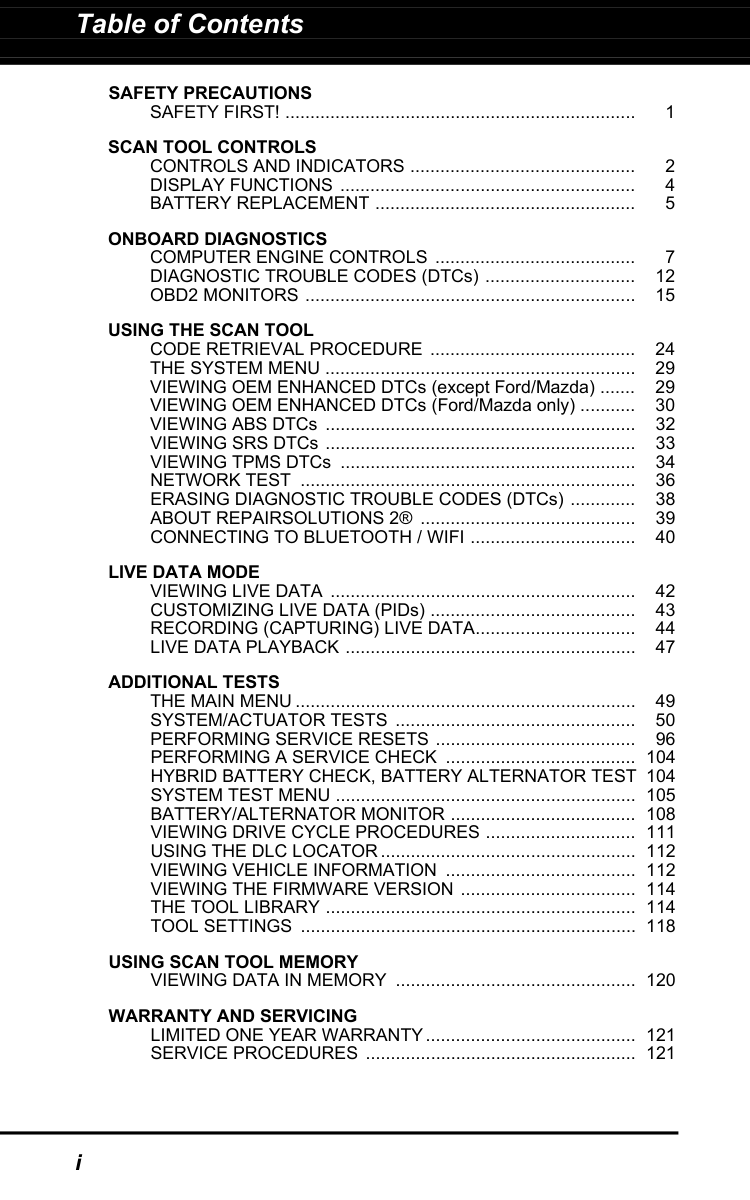
Table of Contents

i

Safety Precautions

SAFETY FIRST! ...................................................................... 1

Scan Tool Controls

Controls And Indicators .............................................

2

Display Functions ...........................................................

4

Battery Replacement ....................................................

5

Onboard Diagnostics

Computer Engine Controls ........................................

7 DIAGNOSTIC TROUBLE CODES (DTCs) .............................. 12 OBD2 MONITORS .................................................................. 15

Using The Scan Tool

Code Retrieval Procedure ......................................... 24

THE SYSTEM MENU .............................................................. 29 VIEWING OEM ENHANCED DTCs (except Ford/Mazda) ....... 29 VIEWING OEM ENHANCED DTCs (Ford/Mazda only) ........... 30 VIEWING ABS DTCs .............................................................. 32 VIEWING SRS DTCs .............................................................. 33 VIEWING TPMS DTCs ........................................................... 34 NETWORK TEST ................................................................... 36 ERASING DIAGNOSTIC TROUBLE CODES (DTCs) ............. 38

About Repairsolutions 2® ........................................... 39

Connecting To Bluetooth / Wifi ................................. 40

Live Data Mode

VIEWING LIVE DATA ............................................................. 42 CUSTOMIZING LIVE DATA (PIDs) ......................................... 43

Recording (Capturing) Live Data ................................ 44

LIVE DATA PLAYBACK .......................................................... 47

Additional Tests

THE MAIN MENU .................................................................... 49

System/Actuator Tests ................................................ 50

Performing Service Resets ........................................ 96

Performing A Service Check ...................................... 104

Hybrid Battery Check, Battery Alternator Test 104

SYSTEM TEST MENU ............................................................ 105

Battery/Alternator Monitor ..................................... 108

Viewing Drive Cycle Procedures .............................. 111

Using The Dlc Locator ................................................... 112

Viewing Vehicle Information ...................................... 112

Viewing The Firmware Version ................................... 114

THE TOOL LIBRARY .............................................................. 114 TOOL SETTINGS ................................................................... 118

Using Scan Tool Memory

Viewing Data In Memory ................................................ 120

Warranty And Servicing

Limited One Year Warranty .......................................... 121

Service Procedures ...................................................... 121
Page 3

Safety Precautions

Safety First!

1

Safety First!

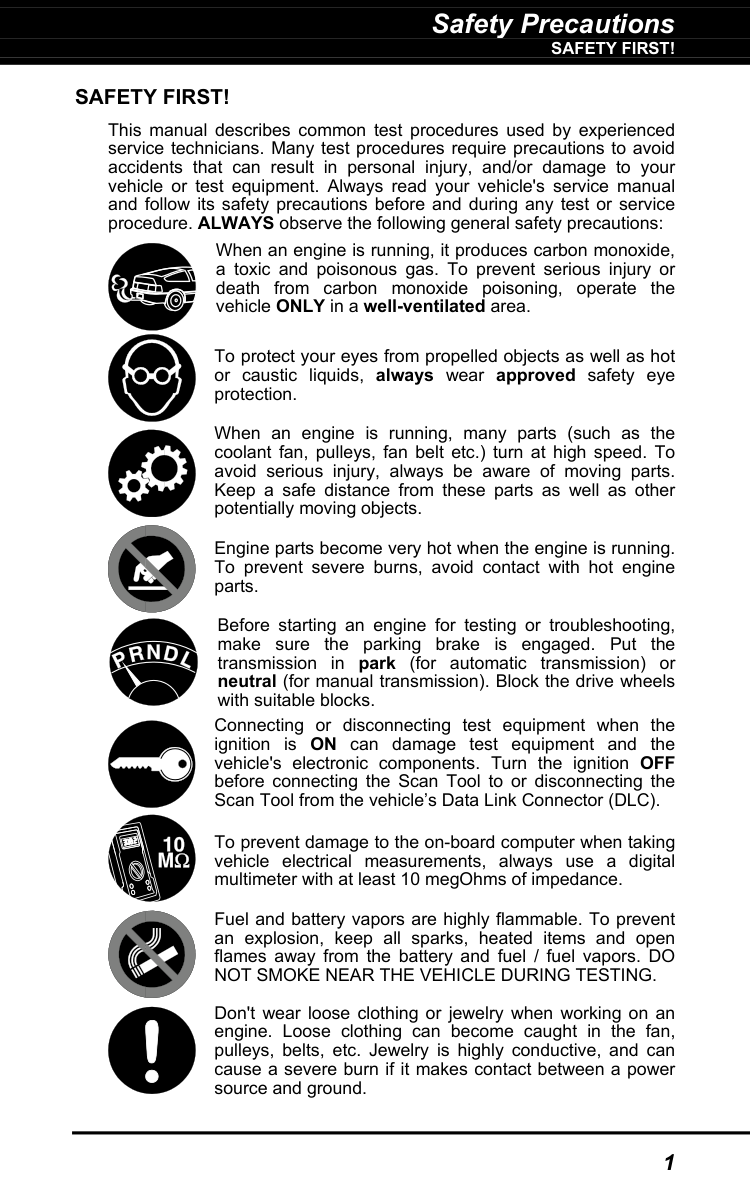
This manual describes common test procedures used by experienced service technicians. Many test procedures require precautions to avoid accidents that can result in personal injury, and/or damage to your vehicle or test equipment. Always read your vehicle's service manual and follow its safety precautions before and during any test or service procedure. ALWAYS observe the following general safety precautions: When an engine is running, it produces carbon monoxide, a toxic and poisonous gas. To prevent serious injury or death from carbon monoxide poisoning, operate the vehicle ONLY in a well-ventilated area. To protect your eyes from propelled objects as well as hot or caustic liquids, always wear approved safety eye protection. When an engine is running, many parts (such as the coolant fan, pulleys, fan belt etc.) turn at high speed. To avoid serious injury, always be aware of moving parts. Keep a safe distance from these parts as well as other potentially moving objects. Engine parts become very hot when the engine is running. To prevent severe burns, avoid contact with hot engine parts. Before starting an engine for testing or troubleshooting, make sure the parking brake is engaged. Put the transmission in park (for automatic transmission) or neutral (for manual transmission). Block the drive wheels with suitable blocks. Connecting or disconnecting test equipment when the ignition is ON can damage test equipment and the vehicle's electronic components. Turn the ignition OFF before connecting the Scan Tool to or disconnecting the Scan Tool from the vehicle’s Data Link Connector (DLC). To prevent damage to the on-board computer when taking vehicle electrical measurements, always use a digital multimeter with at least 10 megOhms of impedance. Fuel and battery vapors are highly flammable. To prevent an explosion, keep all sparks, heated items and open flames away from the battery and fuel / fuel vapors. DO

Not Smoke Near The Vehicle During Testing.

Don't wear loose clothing or jewelry when working on an engine. Loose clothing can become caught in the fan, pulleys, belts, etc. Jewelry is highly conductive, and can cause a severe burn if it makes contact between a power source and ground.
Page 4

Scan Tool Controls

Controls And Indicators

2

Controls And Indicators

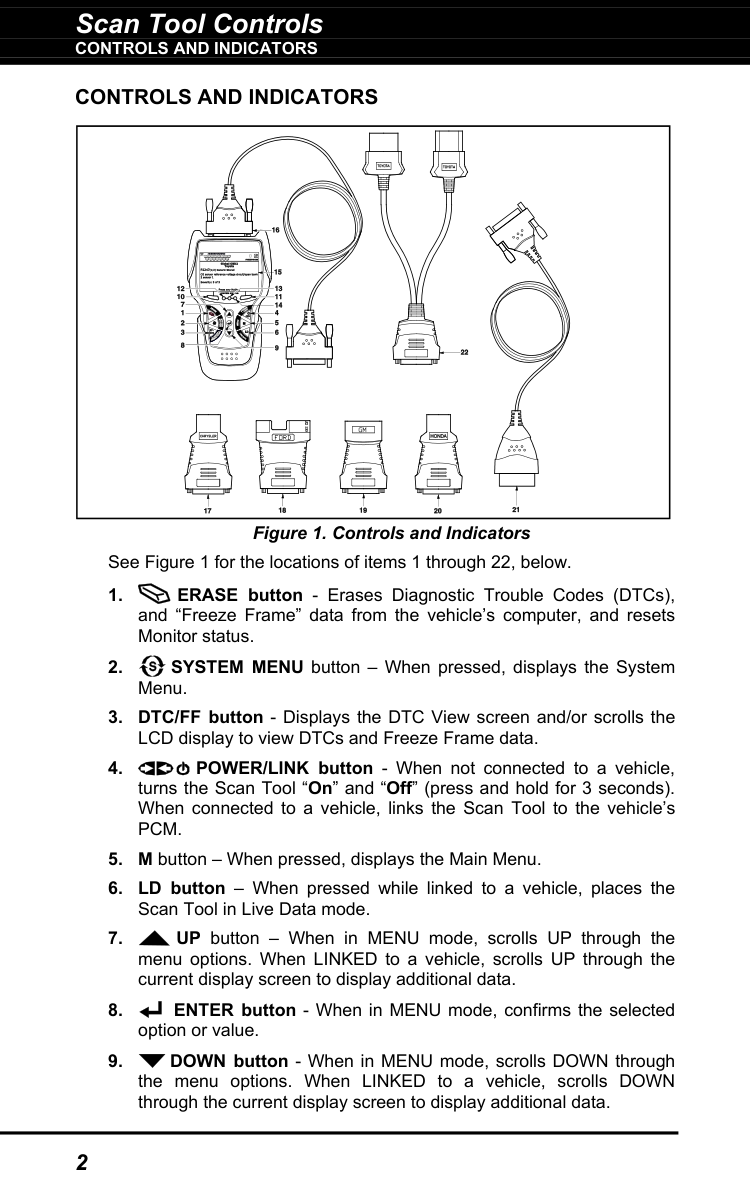
Figure 1. Controls and Indicators See Figure 1 for the locations of items 1 through 22, below.
  • ERASE button - Erases Diagnostic Trouble Codes (DTCs),
  • and “Freeze Frame” data from the vehicle’s computer, and resets Monitor status.
  • SYSTEM MENU button – When pressed, displays the System
  • Menu.
  • DTC/FF button - Displays the DTC View screen and/or scrolls the
  • LCD display to view DTCs and Freeze Frame data.
  • POWER/LINK button - When not connected to a vehicle,
  • turns the Scan Tool “On” and “Off” (press and hold for 3 seconds). When connected to a vehicle, links the Scan Tool to the vehicle’s

    Pcm.

  • M button – When pressed, displays the Main Menu.
  • LD button – When pressed while linked to a vehicle, places the
  • Scan Tool in Live Data mode.
  • UP button – When in MENU mode, scrolls UP through the
  • menu options. When LINKED to a vehicle, scrolls UP through the current display screen to display additional data.
  • ENTER button - When in MENU mode, confirms the selected
  • option or value.
  • DOWN button - When in MENU mode, scrolls DOWN through
  • the menu options. When LINKED to a vehicle, scrolls DOWN through the current display screen to display additional data.

    Page 5

    Scan Tool Controls

    Controls And Indicators

    3
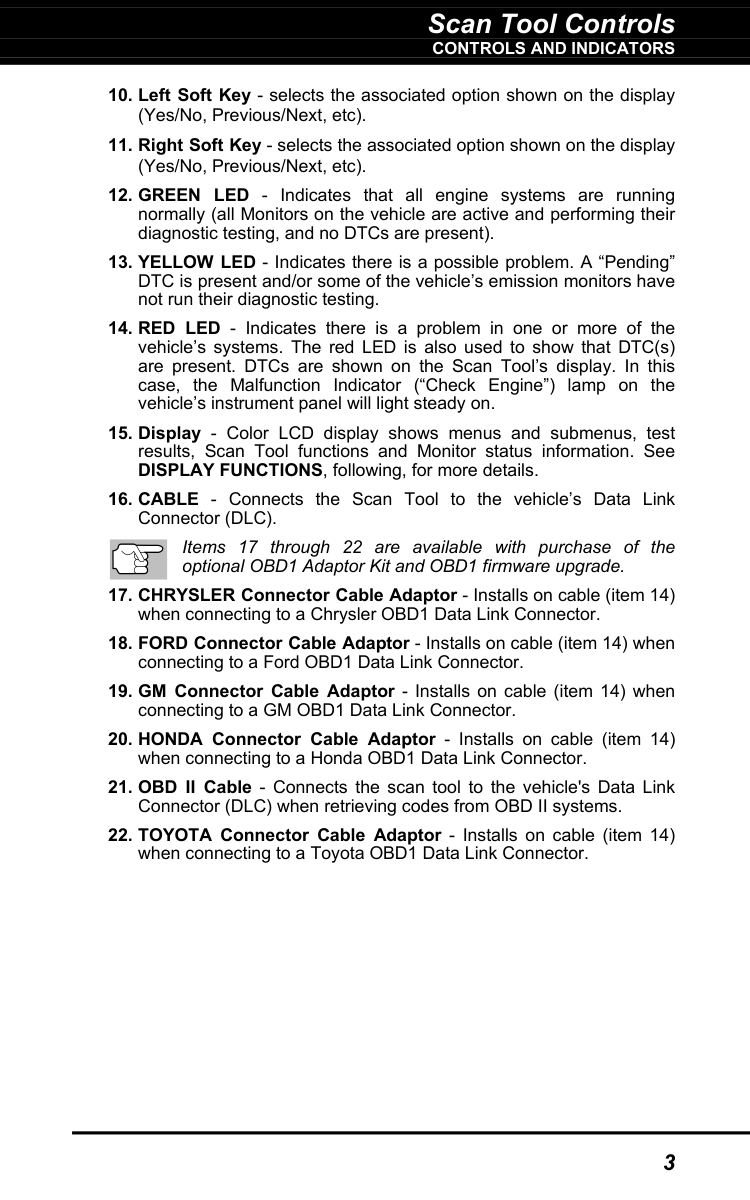
  • Left Soft Key - selects the associated option shown on the display
  • (Yes/No, Previous/Next, etc).
  • Right Soft Key - selects the associated option shown on the display
  • (Yes/No, Previous/Next, etc).
  • GREEN LED - Indicates that all engine systems are running
  • normally (all Monitors on the vehicle are active and performing their diagnostic testing, and no DTCs are present).
  • YELLOW LED - Indicates there is a possible problem. A “Pending”
  • DTC is present and/or some of the vehicle’s emission monitors have not run their diagnostic testing.
  • RED LED - Indicates there is a problem in one or more of the
  • vehicle’s systems. The red LED is also used to show that DTC(s) are present. DTCs are shown on the Scan Tool’s display. In this case, the Malfunction Indicator (“Check Engine”) lamp on the vehicle’s instrument panel will light steady on.
  • Display - Color LCD display shows menus and submenus, test
  • results, Scan Tool functions and Monitor status information. See DISPLAY FUNCTIONS, following, for more details.
  • CABLE - Connects the Scan Tool to the vehicle’s Data Link
  • Connector (DLC). Items 17 through 22 are available with purchase of the optional OBD1 Adaptor Kit and OBD1 firmware upgrade.
  • CHRYSLER Connector Cable Adaptor - Installs on cable (item 14)
  • when connecting to a Chrysler OBD1 Data Link Connector.
  • FORD Connector Cable Adaptor - Installs on cable (item 14) when
  • connecting to a Ford OBD1 Data Link Connector.
  • GM Connector Cable Adaptor - Installs on cable (item 14) when
  • connecting to a GM OBD1 Data Link Connector.
  • HONDA Connector Cable Adaptor - Installs on cable (item 14)
  • when connecting to a Honda OBD1 Data Link Connector.
  • OBD II Cable - Connects the scan tool to the vehicle's Data Link
  • Connector (DLC) when retrieving codes from OBD II systems.
  • TOYOTA Connector Cable Adaptor - Installs on cable (item 14)
  • when connecting to a Toyota OBD1 Data Link Connector.

    Page 6

    Scan Tool Controls

    Display Functions

    4

    Display Functions

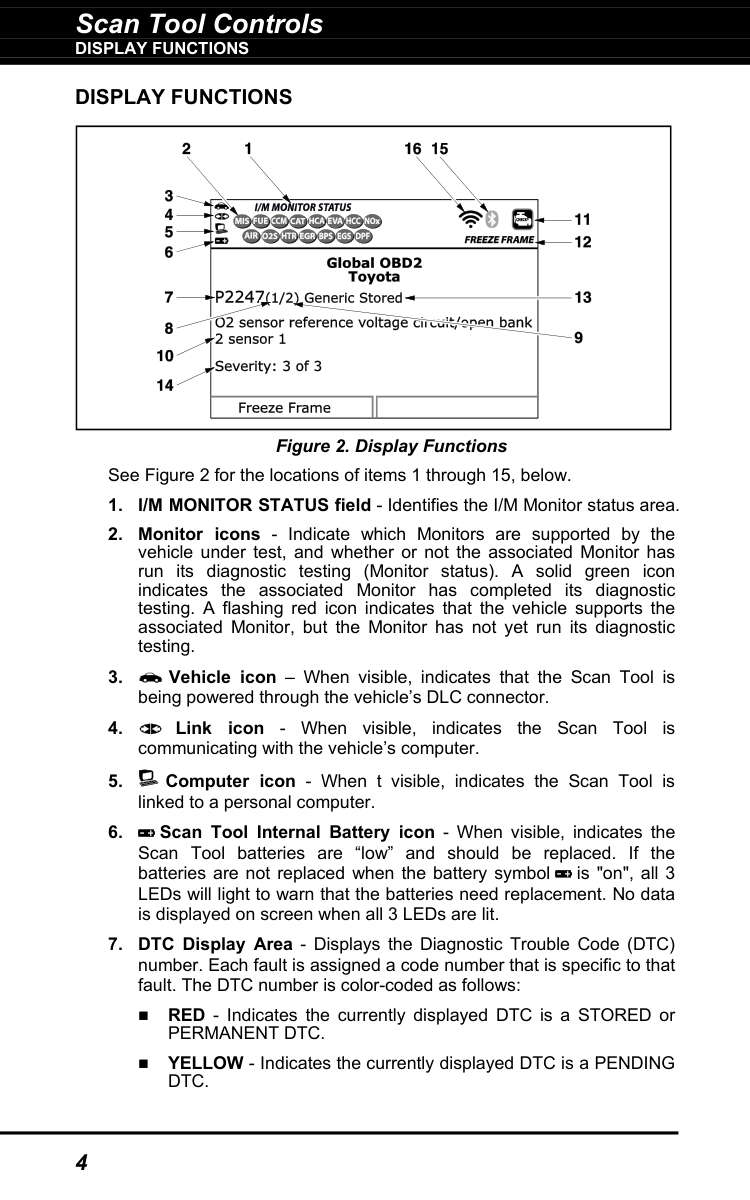
    Figure 2. Display Functions See Figure 2 for the locations of items 1 through 15, below.
  • I/M MONITOR STATUS field - Identifies the I/M Monitor status area.
  • Monitor icons - Indicate which Monitors are supported by the
  • vehicle under test, and whether or not the associated Monitor has run its diagnostic testing (Monitor status). A solid green icon indicates the associated Monitor has completed its diagnostic testing. A flashing red icon indicates that the vehicle supports the associated Monitor, but the Monitor has not yet run its diagnostic testing.
  • Vehicle icon – When visible, indicates that the Scan Tool is
  • being powered through the vehicle’s DLC connector.
  • Link icon - When visible, indicates the Scan Tool is
  • communicating with the vehicle’s computer.
  • Computer icon - When t visible, indicates the Scan Tool is
  • linked to a personal computer.
  • Scan Tool Internal Battery icon - When visible, indicates the
  • Scan Tool batteries are “low” and should be replaced. If the batteries are not replaced when the battery symbol is "on", all 3 LEDs will light to warn that the batteries need replacement. No data is displayed on screen when all 3 LEDs are lit.
  • DTC Display Area - Displays the Diagnostic Trouble Code (DTC)
  • number. Each fault is assigned a code number that is specific to that fault. The DTC number is color-coded as follows:  RED - Indicates the currently displayed DTC is a STORED or

    Permanent Dtc.

     YELLOW - Indicates the currently displayed DTC is a PENDING

    Dtc.

    Page 7

    Scan Tool Controls

    Battery Replacement

    5

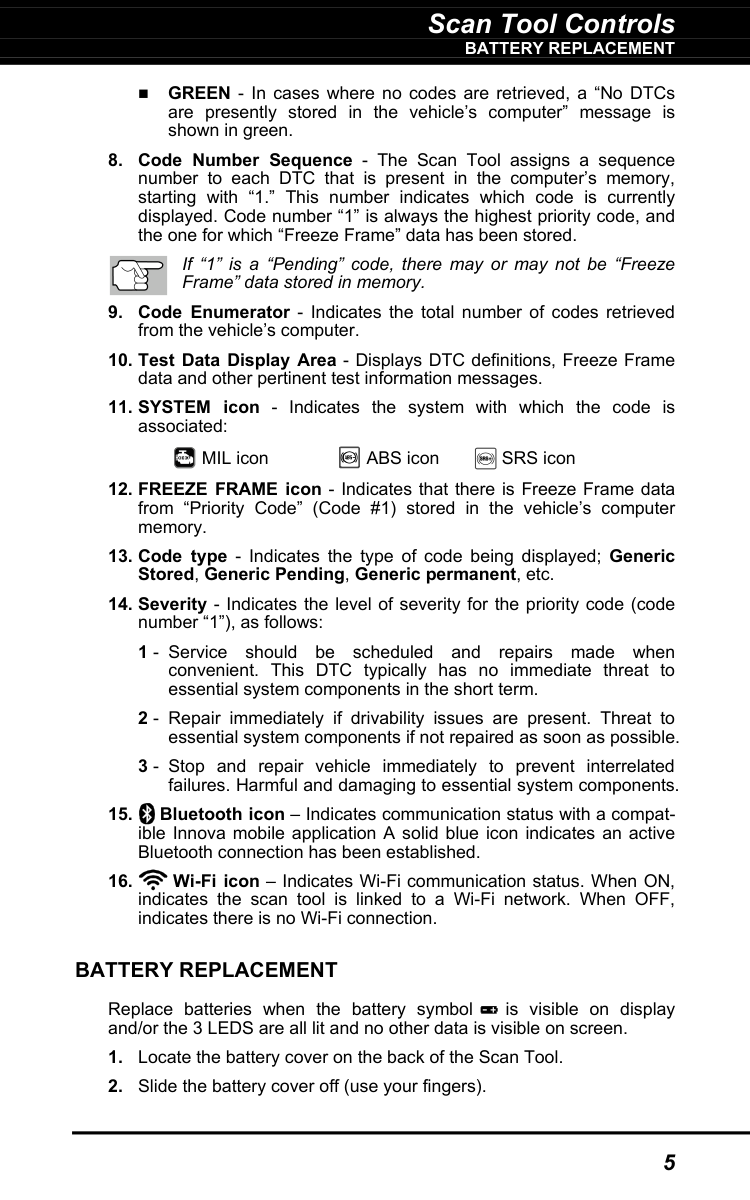
     GREEN - In cases where no codes are retrieved, a “No DTCs are presently stored in the vehicle’s computer” message is shown in green.

  • Code Number Sequence - The Scan Tool assigns a sequence
  • number to each DTC that is present in the computer’s memory, starting with “1.” This number indicates which code is currently displayed. Code number “1” is always the highest priority code, and the one for which “Freeze Frame” data has been stored. If “1” is a “Pending” code, there may or may not be “Freeze Frame” data stored in memory.
  • Code Enumerator - Indicates the total number of codes retrieved
  • from the vehicle’s computer.
  • Test Data Display Area - Displays DTC definitions, Freeze Frame
  • data and other pertinent test information messages.
  • SYSTEM icon - Indicates the system with which the code is
  • associated: MIL icon

    ABS icon SRS icon

  • FREEZE FRAME icon - Indicates that there is Freeze Frame data
  • from “Priority Code” (Code #1) stored in the vehicle’s computer memory.
  • Code type - Indicates the type of code being displayed; Generic
  • Stored, Generic Pending, Generic permanent, etc.
  • Severity - Indicates the level of severity for the priority code (code
  • number “1”), as follows: 1 - Service should be scheduled and repairs made when convenient. This DTC typically has no immediate threat to essential system components in the short term. 2 - Repair immediately if drivability issues are present. Threat to essential system components if not repaired as soon as possible. 3 - Stop and repair vehicle immediately to prevent interrelated failures. Harmful and damaging to essential system components.
  • Bluetooth icon – Indicates communication status with a compat-
  • ible Innova mobile application A solid blue icon indicates an active Bluetooth connection has been established.
  • Wi-Fi icon – Indicates Wi-Fi communication status. When ON,
  • indicates the scan tool is linked to a Wi-Fi network. When OFF, indicates there is no Wi-Fi connection.

    Battery Replacement

    Replace batteries when the battery symbol is visible on display and/or the 3 LEDS are all lit and no other data is visible on screen.
  • Locate the battery cover on the back of the Scan Tool.
  • Slide the battery cover off (use your fingers).
  • Page 8

    Scan Tool Controls

    Battery Replacement

    6
  • Replace batteries with three AA-size batteries (for longer life, use
  • Alkaline-type batteries).
  • Reinstall the battery cover on the back of the Scan Tool.
  • Adjustments After Battery Installation The first time the Scan Tool is turned on, you must select the desired display language (English, French or Spanish) and unit of measurement (Standard or metric) as follows:
  • Press and hold POWER/LINK
  • to turn the Scan Tool “ON.”  The Select Language screen displays.
  • Select the desired display language, then press ENTER
  • .  The Select Unit screen displays.
  • Select the desired unit of measurement, then press ENTER
  • .  The Firmware Version screen displays. After the initial language and unit of measurement selections are performed, these, as well as other settings, can be changed as desired. Proceed to TOOL SETTINGS on page 118 for further instructions.

    Page 9

    Onboard Diagnostics

    Computer Engine Controls

    7

    Computer Engine Controls

    The Introduction of Electronic Engine Controls

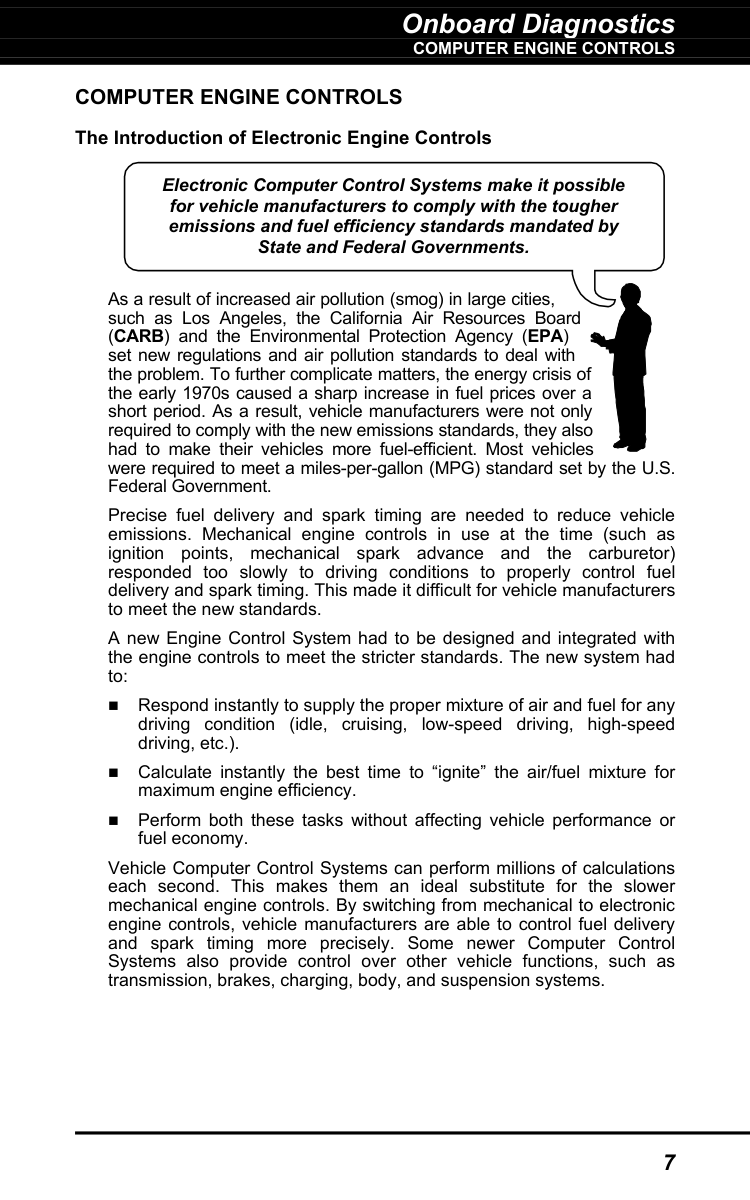
    As a result of increased air pollution (smog) in large cities, such as Los Angeles, the California Air Resources Board (CARB) and the Environmental Protection Agency (EPA) set new regulations and air pollution standards to deal with the problem. To further complicate matters, the energy crisis of the early 1970s caused a sharp increase in fuel prices over a short period. As a result, vehicle manufacturers were not only required to comply with the new emissions standards, they also had to make their vehicles more fuel-efficient. Most vehicles were required to meet a miles-per-gallon (MPG) standard set by the U.S. Federal Government. Precise fuel delivery and spark timing are needed to reduce vehicle emissions. Mechanical engine controls in use at the time (such as ignition points, mechanical spark advance and the carburetor) responded too slowly to driving conditions to properly control fuel delivery and spark timing. This made it difficult for vehicle manufacturers to meet the new standards. A new Engine Control System had to be designed and integrated with the engine controls to meet the stricter standards. The new system had to:  Respond instantly to supply the proper mixture of air and fuel for any driving condition (idle, cruising, low-speed driving, high-speed driving, etc.).  Calculate instantly the best time to “ignite” the air/fuel mixture for maximum engine efficiency.  Perform both these tasks without affecting vehicle performance or fuel economy. Vehicle Computer Control Systems can perform millions of calculations each second. This makes them an ideal substitute for the slower mechanical engine controls. By switching from mechanical to electronic engine controls, vehicle manufacturers are able to control fuel delivery and spark timing more precisely. Some newer Computer Control Systems also provide control over other vehicle functions, such as transmission, brakes, charging, body, and suspension systems. Electronic Computer Control Systems make it possible for vehicle manufacturers to comply with the tougher emissions and fuel efficiency standards mandated by State and Federal Governments.
    Page 10

    Onboard Diagnostics

    Computer Engine Controls

    8

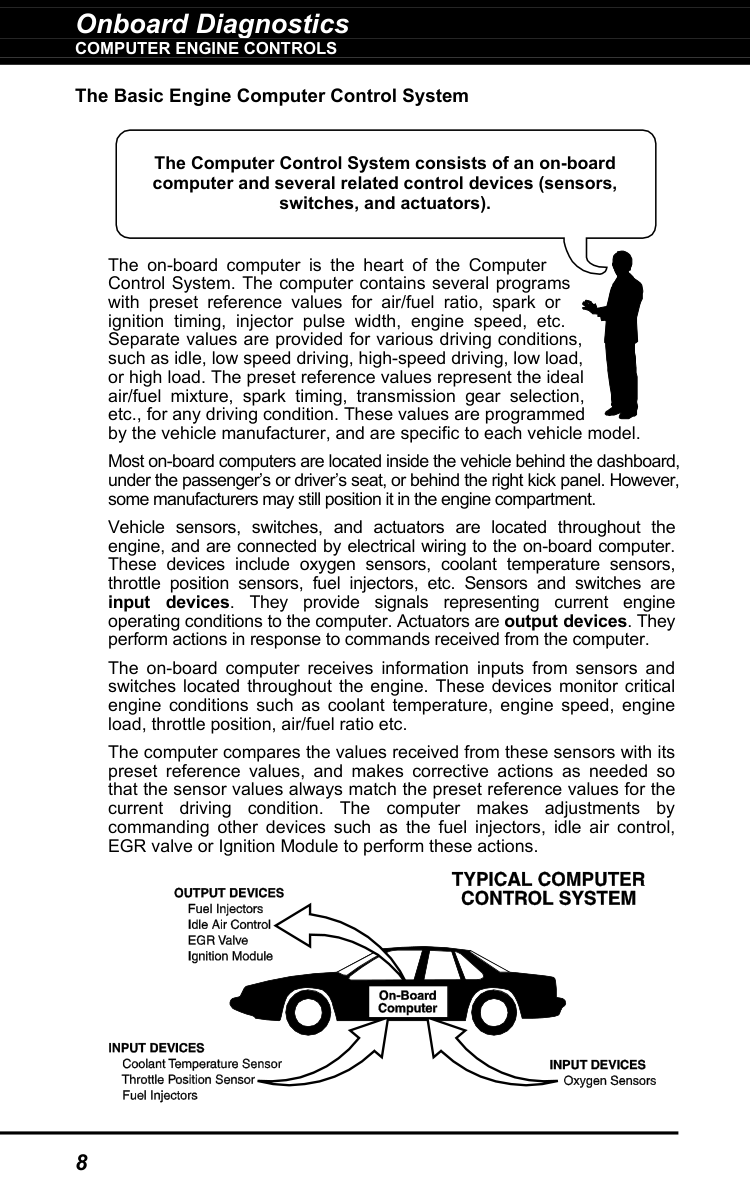
    The Basic Engine Computer Control System The on-board computer is the heart of the Computer Control System. The computer contains several programs with preset reference values for air/fuel ratio, spark or ignition timing, injector pulse width, engine speed, etc. Separate values are provided for various driving conditions, such as idle, low speed driving, high-speed driving, low load, or high load. The preset reference values represent the ideal air/fuel mixture, spark timing, transmission gear selection, etc., for any driving condition. These values are programmed by the vehicle manufacturer, and are specific to each vehicle model. Most on-board computers are located inside the vehicle behind the dashboard, under the passenger’s or driver’s seat, or behind the right kick panel. However, some manufacturers may still position it in the engine compartment. Vehicle sensors, switches, and actuators are located throughout the engine, and are connected by electrical wiring to the on-board computer. These devices include oxygen sensors, coolant temperature sensors, throttle position sensors, fuel injectors, etc. Sensors and switches are input devices. They provide signals representing current engine operating conditions to the computer. Actuators are output devices. They perform actions in response to commands received from the computer. The on-board computer receives information inputs from sensors and switches located throughout the engine. These devices monitor critical engine conditions such as coolant temperature, engine speed, engine load, throttle position, air/fuel ratio etc. The computer compares the values received from these sensors with its preset reference values, and makes corrective actions as needed so that the sensor values always match the preset reference values for the current driving condition. The computer makes adjustments by commanding other devices such as the fuel injectors, idle air control, EGR valve or Ignition Module to perform these actions. The Computer Control System consists of an on-board computer and several related control devices (sensors, switches, and actuators).
    Page 11

    Onboard Diagnostics

    Computer Engine Controls

    9

    Vehicle operating conditions are constantly changing. The computer continuously makes adjustments or corrections (especially to the air/fuel mixture and spark timing) to keep all the engine systems operating within the preset reference values. On-Board Diagnostics - First Generation (OBD1)

    Beginning in 1988, California’s Air Resources Board (CARB), and later the Environmental Protection Agency (EPA) required vehicle manufacturers to include a self-diagnostic program in their on-board computers. The program would be capable of identifying emissions-related faults in a system. The first generation of Onboard Diagnostics came to be known as

    Obd1.

    OBD1 is a set of self-testing and diagnostic instructions programmed into the vehicle’s on-board computer. The programs are specifically designed to detect failures in the sensors, actuators, switches and wiring of the various vehicle emissions-related systems. If the computer detects a failure in any of these components or systems, it lights an indicator on the dashboard to alert the driver. The indicator lights only when an emissions-related problem is detected. The computer also assigns a numeric code for each specific problem that it detects, and stores these codes in its memory for later retrieval. These codes can be retrieved from the computer’s memory with the use of a “Code Reader” or a “Scan Tool.” On-Board Diagnostics - Second Generation (OBD2) In addition to performing all the functions of the OBD1 System, the OBD2 System has been enhanced with new Diagnostic Programs. These programs closely monitor the functions of various emissions-related compo- nents and systems (as well as other systems) and make this information readily available (with the proper equipment) to the technician for evaluation. The California Air Resources Board (CARB) conducted studies on OBD1 equipped vehicles. The information that was gathered from these studies showed the following:  A large number of vehicles had deteriorating or degraded emissions-related components. These components were causing an increase in emissions. With the exception of some 1994 and 1995 vehicles, most vehicles from 1982 to 1995 are equipped with some type of first generation On-Board Diagnostics. The OBD2 System is an enhancement of the OBD1 System.
    Page 12

    Onboard Diagnostics

    Computer Engine Controls

    10

     Because OBD1 systems only detect failed components, the degraded components were not setting codes.  Some emissions problems related to degraded components only occur when the vehicle is being driven under a load. The emission checks being conducted at the time were not performed under simulated driving conditions. As a result, a significant number of vehicles with degraded components were passing Emissions Tests.  Codes, code definitions, diagnostic connectors, communication protocols and emissions terminology were different for each manufacturer. This caused confusion for the technicians working on different make and model vehicles. To address the problems made evident by this study, CARB and the EPA passed new laws and standardization requirements. These laws required that vehicle manufacturers to equip their new vehicles with devices capable of meeting all of the new emissions standards and regulations. It was also decided that an enhanced on-board diagnostic system, capable of addressing all of these problems, was needed. This new system is known as “On-Board Diagnostics Generation Two (OBD2).” The primary objective of the OBD2 system is to comply with the latest regulations and emissions standards established by CARB and the EPA. The Main Objectives of the OBD2 System are:  To detect degraded and/or failed emissions-related components or systems that could cause tailpipe emissions to exceed by 1.5 times the Federal Test Procedure (FTP) standard.  To expand emissions-related system monitoring. This includes a set of computer run diagnostics called Monitors. Monitors perform diagnostics and testing to verify that all emissions-related components and/or systems are operating correctly and within the manufacturer’s specifications.  To use a standardized Diagnostic Link Connector (DLC) in all vehicles. (Before OBD2, DLCs were of different shapes and sizes.)  To standardize the code numbers, code definitions and language used to describe faults. (Before OBD2, each vehicle manufacturer used their own code numbers, code definitions and language to describe the same faults.)  To expand the operation of the Malfunction Indicator Lamp (MIL).  To standardize communication procedures and protocols between the diagnostic equipment (Scan Tools, Code Readers, etc.) and the vehicle’s on-board computer. OBD2 Terminology The following terms and their definitions are related to OBD2 systems. Read and reference this list as needed to aid in the understanding of OBD2 systems.
    Page 13

    Onboard Diagnostics

    Computer Engine Controls

    11

     Powertrain Control Module (PCM) - The PCM is the OBD2 accepted term for the vehicle’s “on-board computer.” In addition to controlling the engine management and emissions systems, the PCM also participates in controlling the powertrain (transmission) operation. Most PCMs also have the ability to communicate with other computers on the vehicle (ABS, ride control, body, etc.).  Monitor - Monitors are “diagnostic routines” programmed into the PCM. The PCM utilizes these programs to run diagnostic tests, and to monitor operation of the vehicle’s emissions-related components or systems to ensure they are operating correctly and within the vehicle’s manufacturer specifications. Currently, up to fifteen Monitors are used in OBD2 systems. Additional Monitors will be added as the OBD2 system is further developed. Not all vehicles support all fifteen Monitors.  Enabling Criteria - Each Monitor is designed to test and monitor the operation of a specific part of the vehicle’s emissions system (EGR system, oxygen sensor, catalytic converter, etc.). A specific set of “conditions” or “driving procedures” must be met before the computer can command a Monitor to run tests on its related system. These “conditions” are known as “Enabling Criteria.” The requirements and procedures vary for each Monitor. Some Monitors only require the ignition key to be turned “On” for them to run and complete their diagnostic testing. Others may require a set of complex procedures, such as, starting the vehicle when cold, bringing it to operating temperature, and driving the vehicle under specific conditions before the Monitor can run and complete its diagnostic testing.  Monitor Has/Has Not Run - The terms “Monitor has run” or “Monitor has not run” are used throughout this manual. “Monitor has run,” means the PCM has commanded a particular Monitor to perform the required diagnostic testing on a system to ensure the system is operating correctly (within factory specifications). The term “Monitor has not run” means the PCM has not yet commanded a particular Monitor to perform diagnostic testing on its associated part of the emissions system.  Trip - A Trip for a particular Monitor requires that the vehicle is being driven in such a way that all the required “Enabling Criteria” for the Monitor to run and complete its diagnostic testing are met. The “Trip Drive Cycle” for a particular Monitor begins when the ignition key is turned “On.” It is successfully completed when all the “Enabling Criteria” for the Monitor to run and complete its diagnostic testing are met by the time the ignition key is turned “Off.” Since each of the fifteen monitors is designed to run diagnostics and testing on a different part of the engine or emissions system, the “Trip Drive Cycle” needed for each individual Monitor to run and complete varies.
    Page 14

    Onboard Diagnostics

    DIAGNOSTIC TROUBLE CODES (DTCs)

    12

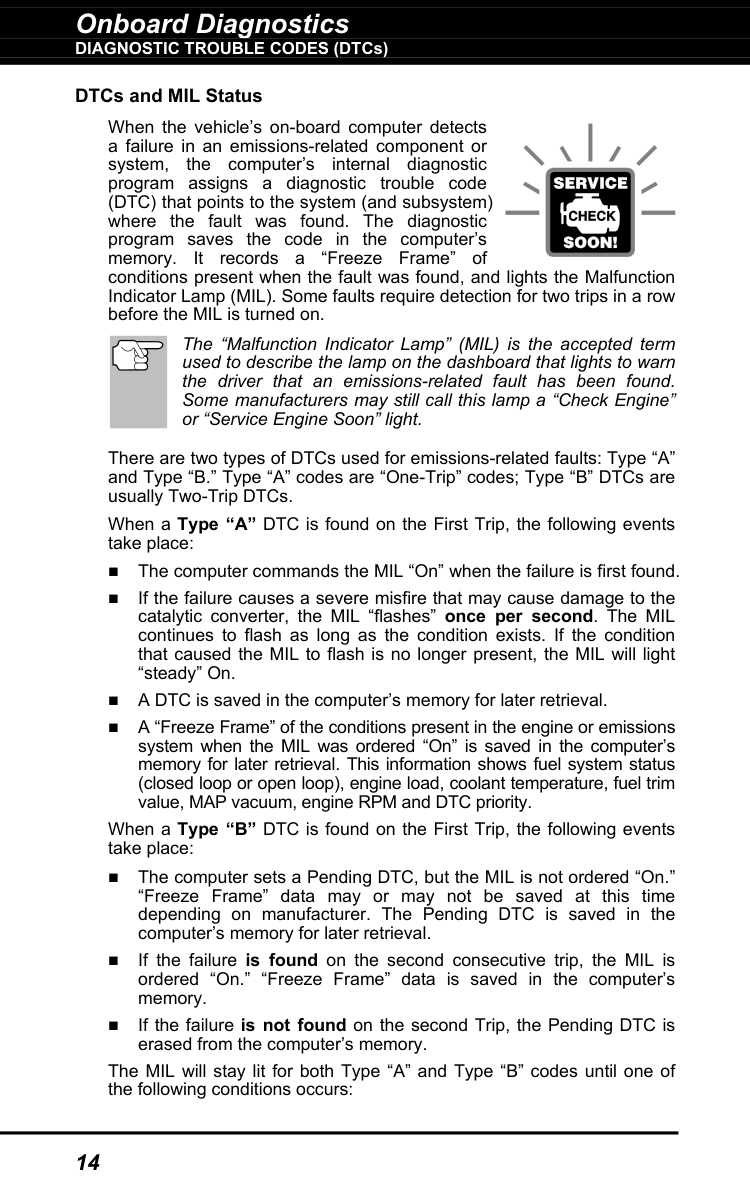
     OBD2 Drive Cycle - An OBD2 Drive Cycle is an extended set of driving procedures that takes into consideration the various types of driving conditions encountered in real life. These conditions may include starting the vehicle when it is cold, driving the vehicle at a steady speed (cruising), accelerating, etc. An OBD2 Drive Cycle begins when the ignition key is turned “On” (when cold) and ends when the vehicle has been driven in such a way as to have all the “Enabling Criteria” met for all its applicable Monitors. Only those trips that provide the Enabling Criteria for all Monitors applicable to the vehicle to run and complete their individual diagnostic tests qualify as an OBD2 Drive Cycle. OBD2 Drive Cycle requirements vary from one model of vehicle to another. Vehicle manufacturers set these procedures. Consult your vehicle’s service manual for OBD2 Drive Cycle procedures. Do not confuse a “Trip” Drive Cycle with an OBD2 Drive Cycle. A “Trip” Drive Cycle provides the “Enabling Criteria” for one specific Monitor to run and complete its diagnostic testing. An OBD2 Drive Cycle must meet the “Enabling Criteria” for all Monitors on a particular vehicle to run and complete their diagnostic testing.  Warm-up Cycle - Vehicle operation after an engine off period where engine temperature rises at least 40°F (22°C) from its temperature before starting, and reaches at least 160°F (70°C). The PCM uses warm-up cycles as a counter to automatically erase a specific code and related data from its memory. When no faults related to the original problem are detected within a specified number of warm-up cycles, the code is erased automatically. DIAGNOSTIC TROUBLE CODES (DTCs) Diagnostic Trouble Codes (DTCs) are meant to guide you to the proper service procedure in the vehicle’s service manual. DO NOT replace parts based only on DTCs without first consulting the vehicle’s service manual for proper testing procedures for that particular system, circuit or component. DTCs are alphanumeric codes that are used to identify a problem that is present in any of the systems that are monitored by the on-board computer (PCM). Each trouble code has an assigned message that identifies the circuit, component or system area where the problem was found. OBD2 diagnostic trouble codes are made up of five characters:  The 1st character is a letter (B, C, P or U). It identifies the “main system” where the fault occurred (Body, Chassis, Powertrain, or Network).  The 2nd character is a numeric digit (0 thru 3). It identifies the “type” of code (Generic or Manufacturer-Specific). Generic DTCs are codes that are used by all vehicle manu- facturers. The standards for generic DTCs, as well as their definitions, are set by the Society of Automotive Engineers (SAE). Diagnostic Trouble Codes (DTCs) are codes that identify a specific problem area.
    Page 15

    Onboard Diagnostics

    DIAGNOSTIC TROUBLE CODES (DTCs)

    13

    Manufacturer-Specific DTCs are codes that are controlled by the vehicle manufacturers. The Federal Government does not require vehicle manufacturers to go beyond the standardized generic DTCs in order to comply with the new OBD2 emissions standards. However, manufacturers are free to expand beyond the standardized codes to make their systems easier to diagnose.  The 3rd character is a letter or a numeric digit (0 thru 9, A thru F). It identifies the specific system or sub-system where the problem is located.  The 4th and 5th characters are letters or numeric digits (0 thru 9, A thru F). They identify the section of the system that is malfunctioning.
    Page 16

    Onboard Diagnostics

    DIAGNOSTIC TROUBLE CODES (DTCs)

    14

    DTCs and MIL Status When the vehicle’s on-board computer detects a failure in an emissions-related component or system, the computer’s internal diagnostic program assigns a diagnostic trouble code (DTC) that points to the system (and subsystem) where the fault was found. The diagnostic program saves the code in the computer’s memory. It records a “Freeze Frame” of conditions present when the fault was found, and lights the Malfunction Indicator Lamp (MIL). Some faults require detection for two trips in a row before the MIL is turned on. The “Malfunction Indicator Lamp” (MIL) is the accepted term used to describe the lamp on the dashboard that lights to warn the driver that an emissions-related fault has been found. Some manufacturers may still call this lamp a “Check Engine” or “Service Engine Soon” light. There are two types of DTCs used for emissions-related faults: Type “A” and Type “B.” Type “A” codes are “One-Trip” codes; Type “B” DTCs are usually Two-Trip DTCs. When a Type “A” DTC is found on the First Trip, the following events take place:  The computer commands the MIL “On” when the failure is first found.  If the failure causes a severe misfire that may cause damage to the catalytic converter, the MIL “flashes” once per second. The MIL continues to flash as long as the condition exists. If the condition that caused the MIL to flash is no longer present, the MIL will light “steady” On.  A DTC is saved in the computer’s memory for later retrieval.  A “Freeze Frame” of the conditions present in the engine or emissions system when the MIL was ordered “On” is saved in the computer’s memory for later retrieval. This information shows fuel system status (closed loop or open loop), engine load, coolant temperature, fuel trim value, MAP vacuum, engine RPM and DTC priority. When a Type “B” DTC is found on the First Trip, the following events take place:  The computer sets a Pending DTC, but the MIL is not ordered “On.” “Freeze Frame” data may or may not be saved at this time depending on manufacturer. The Pending DTC is saved in the computer’s memory for later retrieval.  If the failure is found on the second consecutive trip, the MIL is ordered “On.” “Freeze Frame” data is saved in the computer’s memory.  If the failure is not found on the second Trip, the Pending DTC is erased from the computer’s memory. The MIL will stay lit for both Type “A” and Type “B” codes until one of the following conditions occurs:
    Page 17

    Onboard Diagnostics

    Obd2 Monitors

    15

     If the conditions that caused the MIL to light are no longer present for the next three trips in a row, the computer automatically turns the MIL “Off” if no other emissions-related faults are present. However, the DTCs remain in the computer’s memory as a history code for 40 warm-up cycles (80 warm-up cycles for fuel and misfire faults). The DTCs are automatically erased if the fault that caused them to be set is not detected again during that period.  Misfire and fuel system faults require three trips with “similar conditions” before the MIL is turned “Off.” These are trips where the engine load, RPM and temperature are similar to the conditions present when the fault was first found. After the MIL has been turned off, DTCs and Freeze Frame data stay in the computer’s memory.  Erasing the DTCs from the computer’s memory can also turn off the MIL. See ERASING DIAGNOSTIC TROUBLE CODES (DTCs) on page 38, before erasing codes from the computer’s memory. If a Diagnostic Tool or Scan Tool is used to erase the codes, Freeze Frame data will also be erased.

    Obd2 Monitors

    To ensure the correct operation of the various emissions-related components and systems, a diagnostic program was developed and installed in the vehicle’s on-board computer. The program has several procedures and diagnostic strategies. Each procedure or diagnostic strategy is made to monitor the operation of, and run diagnostic tests on, a specific emissions-related component or system. These tests ensure the system is running correctly and is within the manufacturer’s specifications. On OBD2 systems, these procedures and diagnostic strategies are called “Monitors.” Currently, fifteen Monitors are supported by OBD2 systems. Additional monitors may be added as a result of Government regulations as the OBD2 system grows and matures. Not all vehicles support all fifteen Monitors. Additionally, some Monitors are supported by “spark ignition” vehicles only, while others are supported by “compression ignition” vehicles only. Monitor operation is either “Continuous” or “Non-Continuous,” depending on the specific monitor. Continuous Monitors Three of these Monitors are designed to constantly monitor their associated components and/or systems for proper operation. Continuous Monitors run constantly when the engine is running. The Continuous Monitors are: Comprehensive Component Monitor (CCM) Misfire Monitor Fuel System Monitor
    Page 18

    Onboard Diagnostics

    Obd2 Monitors

    16

    Non-Continuous Monitors The other twelve Monitors are “non-continuous” Monitors. “Non- continuous” Monitors perform and complete their testing once per trip. The “non-continuous” Monitors are: Oxygen Sensor Monitor Oxygen Sensor Heater Monitor Catalyst Monitor Heated Catalyst Monitor EGR System Monitor EVAP System Monitor Secondary Air System Monitor The following Monitors became standard beginning in 2010. The majority of vehicles produced before this time will not support these Monitors NMHC Monitor NOx Adsorber Monitor Boost Pressure System Monitor Exhaust Gas Sensor Monitor PM Filter Monitor The following provides a brief explanation of the function of each Monitor: Comprehensive Component Monitor (CCM) - This Monitor continuously checks all inputs and outputs from sensors, actuators, switches and other devices that provide a signal to the computer. The Monitor checks for shorts, opens, out of range value, functionality and “rationality.” Rationality: Each input signal is compared against all other inputs and against information in the computer’s memory to see if it makes sense under the current operating conditions. Example: The signal from the throttle position sensor indicates the vehicle is in a wide-open throttle condition, but the vehicle is really at idle, and the idle condition is confirmed by the signals from all other sensors. Based on the input data, the computer determines that the signal from the throttle position sensor is not rational (does not make sense when compared to the other inputs). In this case, the signal would fail the rationality test. The CCM is supported by both “spark ignition” vehicles and “compression ignition” vehicles. The CCM may be either a “One-Trip” or a “Two-Trip” Monitor, depending on the component.
    Page 19

    Onboard Diagnostics

    Obd2 Monitors

    17

    Fuel System Monitor - This Monitor uses a Fuel System Correction program, called Fuel Trim, inside the on-board computer. Fuel Trim is a set of positive and negative values that represent adding or subtracting fuel from the engine. This program is used to correct for a lean (too much air/not enough fuel) or rich (too much fuel/not enough air) air-fuel mixture. The program is designed to add or subtract fuel, as needed, up to a certain percent. If the correction needed is too large and exceeds the time and percent allowed by the program, a fault is indicated by the computer. The Fuel System Monitor is supported by both “spark ignition” vehicles and “compression ignition” vehicles. The Fuel System Monitor may be a “One-Trip” or “Two-Trip” Monitor, depending on the severity of the problem. Misfire Monitor - This Monitor continuously checks for engine misfires. A misfire occurs when the air-fuel mixture in the cylinder does not ignite. The misfire Monitor uses changes in crankshaft speed to sense an engine misfire. When a cylinder misfires, it no longer contributes to the speed of the engine, and engine speed decreases each time the affected cylinder(s) misfire. The misfire Monitor is designed to sense engine speed fluctuations and determine from which cylinder(s) the misfire is coming, as well as how bad the misfire is. There are three types of engine misfires, Types 1, 2, and 3.
  • Type 1 and Type 3 misfires are two-trip monitor faults. If a fault is sensed
  • on the first trip, the computer temporarily saves the fault in its memory as a Pending Code. The MIL is not commanded on at this time. If the fault is found again on the second trip, under similar conditions of engine speed, load and temperature, the computer commands the MIL “On,” and the code is saved in its long term memory.
  • Type 2 misfires are the most severe type of misfire. When a Type 2
  • misfire is sensed on the first trip, the computer commands the MIL to light when the misfire is sensed. If the computer determines that a Type 2 misfire is severe , and may cause catalytic converter damage, it commands the MIL to “flash” once per second as soon as the misfire is sensed. When the misfire is no longer present, the MIL reverts to steady “On” condition. The Misfire Monitor is supported by both “spark ignition” vehicles and “compression ignition” vehicles. Catalyst Monitor - The catalytic converter is a device that is installed downstream of the exhaust manifold. It helps to oxidize (burn) the unburned fuel (hydrocarbons) and partially burned fuel (carbon monoxide) left over from the combustion process. To accomplish this, heat and catalyst materials inside the converter react with the exhaust gases to burn the remaining fuel. Some materials inside the catalytic converter also have the ability to store oxygen, and release it as needed to oxidize hydrocarbons and carbon monoxide. In the process, it reduces vehicle emissions by converting the polluting gases into carbon dioxide and water. The computer checks the efficiency of the catalytic converter by monitoring the oxygen sensors used by the system. One sensor is located before (upstream of) the converter; the other is located after (downstream of) the converter. If the catalytic converter loses its ability to store oxygen,

    Page 20

    Onboard Diagnostics

    Obd2 Monitors

    18

    the downstream sensor signal voltage becomes almost the same as the upstream sensor signal. In this case, the monitor fails the test. The Catalyst Monitor is supported by “spark ignition” vehicles only. The Catalyst Monitor is a “Two-Trip” Monitor. If a fault is found on the first trip, the computer temporarily saves the fault in its memory as a Pending Code. The computer does not command the MIL on at this time. If the fault is sensed again on the second trip, the computer commands the MIL “On” and saves the code in its long-term memory. Heated Catalyst Monitor - Operation of the “heated” catalytic converter is similar to the catalytic converter. The main difference is that a heater is added to bring the catalytic converter to its operating temperature more quickly. This helps reduce emissions by reducing the converter’s down time when the engine is cold. The Heated Catalyst Monitor performs the same diagnostic tests as the catalyst Monitor, and also tests the catalytic converter’s heater for proper operation. The Heated Catalyst Monitor is supported by “spark ignition” vehicles only. This Monitor is also a “Two-Trip” Monitor. Exhaust Gas Recirculation (EGR) Monitor - The Exhaust Gas Recirculation (EGR) system helps reduce the formation of Oxides of Nitrogen during combustion. Temperatures above 2500°F cause nitrogen and oxygen to combine and form Oxides of Nitrogen in the combustion chamber. To reduce the formation of Oxides of Nitrogen, combustion temperatures must be kept below 2500°F. The EGR system recirculates small amounts of exhaust gas back into the intake manifold, where it is mixed with the incoming air/fuel mixture. This reduces combustion temperatures by up to 500°F. The computer determines when, for how long, and how much exhaust gas is recirculated back to the intake manifold. The EGR Monitor performs EGR system function tests at preset times during vehicle operation. The EGR Monitor is supported by both “spark ignition” vehicles and “compression ignition” vehicles. The EGR Monitor is a “Two-Trip” Monitor. If a fault is found on the first trip, the computer temporarily saves the fault in its memory as a Pending Code. The computer does not command the MIL on at this time. If the fault is sensed again on the second trip, the computer commands the MIL “On,” and saves the code in its long-term memory. Evaporative System (EVAP) Monitor - OBD2 vehicles are equipped with a fuel Evaporative system (EVAP) that helps prevent fuel vapors from evaporating into the air. The EVAP system carries fumes from the fuel tank to the engine where they are burned during combustion. The EVAP system may consist of a charcoal canister, fuel tank cap, purge solenoid, vent solenoid, flow monitor, leak detector and connecting tubes, lines and hoses. Fumes are carried from the fuel tank to the charcoal canister by hoses or tubes. The fumes are stored in the charcoal canister. The computer controls the flow of fuel vapors from the charcoal canister to the engine via a purge solenoid. The computer energizes or de-energizes the purge solenoid (depending on solenoid design). The purge solenoid opens a
    Page 21

    Onboard Diagnostics

    Obd2 Monitors

    19

    valve to allow engine vacuum to draw the fuel vapors from the canister into the engine where the vapors are burned. The EVAP Monitor checks for proper fuel vapor flow to the engine, and pressurizes the system to test for leaks. The computer runs this Monitor once per trip. The EVAP Monitor is supported by “spark ignition” vehicles only. The EVAP Monitor is a “Two-Trip” Monitor. If a fault is found on the first trip, the computer temporarily saves the fault in its memory as a Pending Code. The computer does not command the MIL on at this time. If the fault is sensed again on the second trip, the PCM commands the MIL “On,” and saves the code in its long-term memory. Oxygen Sensor Heater Monitor - The Oxygen Sensor Heater Monitor tests the operation of the oxygen sensor’s heater. There are two modes of operation on a computer-controlled vehicle: “open- loop” and “closed-loop.” The vehicle operates in open-loop when the engine is cold, before it reaches normal operating temperature. The vehicle also goes to open-loop mode at other times, such as heavy load and full throttle conditions. When the vehicle is running in open-loop, the oxygen sensor signal is ignored by the computer for air/fuel mixture corrections. Engine efficiency during open-loop operation is very low, and results in the production of more vehicle emissions. Closed-loop operation is the best condition for both vehicle emissions and vehicle operation. When the vehicle is operating in closed-loop, the computer uses the oxygen sensor signal for air/fuel mixture corrections. In order for the computer to enter closed-loop operation, the oxygen sensor must reach a temperature of at least 600°F. The oxygen sensor heater helps the oxygen sensor reach and maintain its minimum operating temperature (600°F) more quickly, to bring the vehicle into closed-loop operation as soon as possible. The Oxygen Sensor Heater Monitor is supported by “spark ignition” vehicles only. The Oxygen Sensor Heater Monitor is a “Two-Trip” Monitor. If a fault is found on the first trip, the computer temporarily saves the fault in its memory as a Pending Code. The computer does not command the MIL on at this time. If the fault is sensed again on the second trip, the computer commands the MIL “On,” and saves the code in its long-term memory. Oxygen Sensor Monitor - The Oxygen Sensor monitors how much oxygen is in the vehicle’s exhaust. It generates a varying voltage of up to one volt, based on how much oxygen is in the exhaust gas, and sends the signal to the computer. The computer uses this signal to make corrections to the air/fuel mixture. If the exhaust gas has a large amount of oxygen (a lean air/fuel mixture), the oxygen sensor generates a “low” voltage signal. If the exhaust gas has very little oxygen (a rich mixture condition), the oxygen sensor generates a “high” voltage signal. A 450mV signal indicates the most efficient, and least polluting, air/fuel ratio of 14.7 parts of air to one part of fuel. The oxygen sensor must reach a temperature of at least 600-650°F, and the engine must reach normal operating temperature, for the computer to enter into closed-loop operation. The oxygen sensor only functions when the computer is in closed-loop. A properly operating
    Page 22

    Onboard Diagnostics

    Obd2 Monitors

    20

    oxygen sensor reacts quickly to any change in oxygen content in the exhaust stream. A faulty oxygen sensor reacts slowly, or its voltage signal is weak or missing. The Oxygen Sensor Monitor is supported by “spark ignition” vehicles only. The Oxygen Sensor Monitor is a “Two-Trip” monitor. If a fault is found on the first trip, the computer temporarily saves the fault in its memory as a Pending Code. The computer does not command the MIL on at this time. If the fault is sensed again on the second trip, the computer commands the MIL “On,” and saves the code in its long-term memory. Secondary Air System Monitor - When a cold engine is first started, it runs in open-loop mode. During open-loop operation, the engine usually runs rich. A vehicle running rich wastes fuel and creates increased emissions, such as carbon monoxide and some hydrocarbons. A Secondary Air System injects air into the exhaust stream to aid catalytic converter operation:
  • It supplies the catalytic converter with the oxygen it needs to oxidize
  • the carbon monoxide and hydrocarbons left over from the combustion process during engine warm-up.
  • The extra oxygen injected into the exhaust stream also helps the
  • catalytic converter reach operating temperature more quickly during warm-up periods. The catalytic converter must heat to operating temperature to work properly. The Secondary Air System Monitor checks for component integrity and system operation, and tests for faults in the system. The computer runs this Monitor once per trip. The Secondary Air System Monitor is a “Two-Trip” monitor. If a fault is found on the first trip, the computer temporarily saves this fault in its memory as a Pending Code. The computer does not command the MIL on at this time. If the fault is sensed again on the second trip, the computer commands the MIL “On,” and saves the code in its long-term memory. Non-Methane Hydrocarbon Catalyst (NMHC) Monitor - The non-methane hydrocarbon catalyst is a type of catalytic converter. It helps to remove non-methane hydrocarbons (NMH) left over from the combustion process from the exhaust stream. To accomplish this, heat and catalyst materials react with the exhaust gases to convert NMH to less harmful compounds. The computer checks the efficiency of the catalyst by monitoring the quantity of NMH in the exhaust stream. The monitor also verifies that sufficient temperature is present to aid in particulate matter (PM) filter regeneration. The NMHC Monitor is supported by “compression ignition” vehicles only. The NMHC Monitor is a “Two-Trip” Monitor. If a fault is found on the first trip, the computer temporarily saves the fault in its memory as a Pending Code. The computer does not command the MIL on at this time. If the fault is sensed again on the second trip, the computer commands the MIL “On,” and saves the code in its long-term memory.
    Page 23

    Onboard Diagnostics

    Obd2 Monitors

    21

    NOx Aftertreatment Monitor - NOx aftertreatment is based on a catalytic converter support that has been coated with a special washcoat containing zeolites. NOx Aftertreatment is designed to reduce oxides of nitrogen emitted in the exhaust stream. The zeolite acts as a molecular "sponge" to trap the NO and NO2 molecules in the exhaust stream. In some implementations, injection of a reactant before the aftertreatment purges it. NO2 in particular is unstable, and will join with hydrocarbons to produce H2O and N2. The NOx Aftertreatment Monitor monitors the function of the NOx aftertreatment to ensure that tailpipe emissions remain within acceptable limits. The NOx Aftertreatment Monitor is supported by “compression ignition” vehicles only. The NOx Aftertreatment Monitor is a “Two-Trip” Monitor. If a fault is found on the first trip, the computer temporarily saves the fault in its memory as a Pending Code. The computer does not command the MIL on at this time. If the fault is sensed again on the second trip, the computer commands the MIL “On,” and saves the code in its long-term memory. Boost Pressure System Monitor - The boost pressure system serves to increase the pressure produced inside the intake manifold to a level greater than atmospheric pressure. This increase in pressure helps to ensure compete combustion of the air-fuel mixture. The Boost Pressure System Monitor checks for component integrity and system operation, and tests for faults in the system. The computer runs this Monitor once per trip. The Boost Pressure System Monitor is supported by “compression ignition” vehicles only. The Boost Pressure System Monitor is a “Two- Trip” Monitor. If a fault is found on the first trip, the computer temporarily saves the fault in its memory as a Pending Code. The computer does not command the MIL on at this time. If the fault is sensed again on the second trip, the computer commands the MIL “On,” and saves the code in its long-term memory. Exhaust Gas Sensor Monitor - The exhaust gas sensor is used by a number of systems/monitors to determine the content of the exhaust stream. The computer checks for component integrity, system operation, and tests for faults in the system, as well as feedback faults that may affect other emission control systems. The Exhaust Gas Sensor Monitor is supported by “compression ignition” vehicles only. The Exhaust Gas Sensor Monitor is a “Two-Trip” Monitor. If a fault is found on the first trip, the computer temporarily saves the fault in its memory as a Pending Code. The computer does not command the MIL on at this time. If the fault is sensed again on the second trip, the computer commands the MIL “On,” and saves the code in its long-term memory.

    Page 24

    Onboard Diagnostics

    Obd2 Monitors

    22

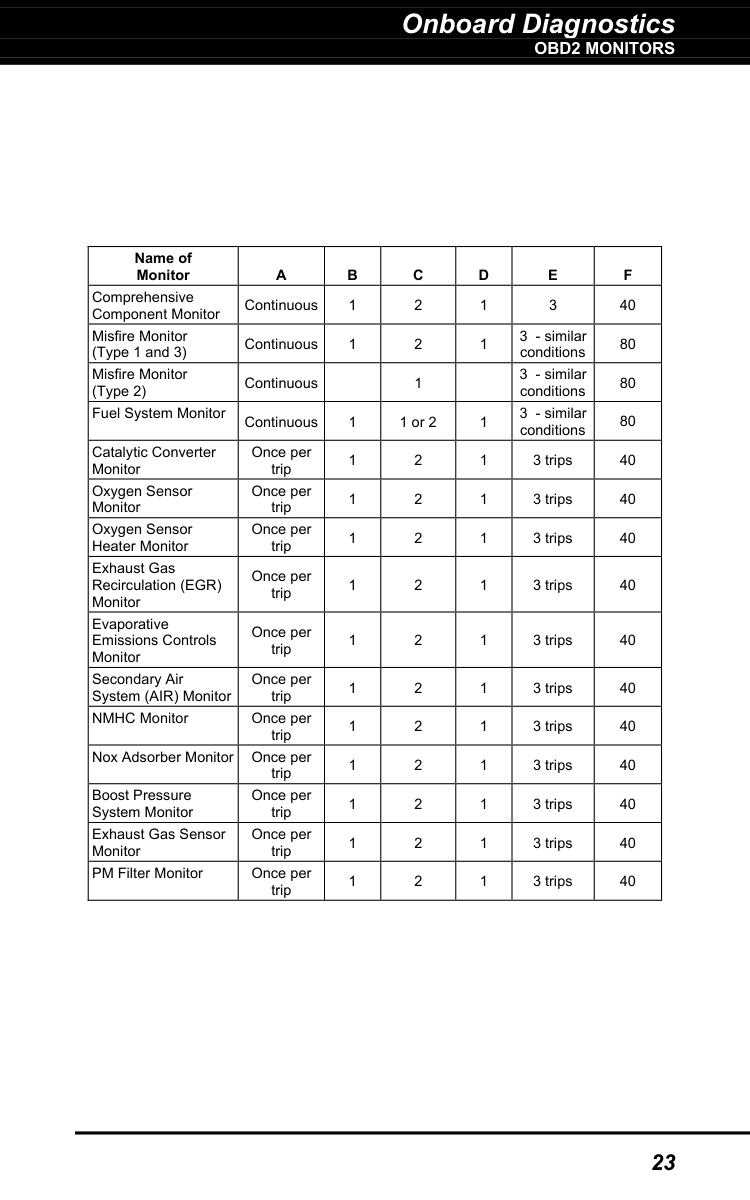
    PM Filter Monitor - The particulate matter (PM) filter removes particulate matter from the exhaust stream by filtration. The filter has a honeycomb structure similar to a catalyst substrate, but with the channels blocked at alternate ends. This forces the exhaust gas to flow through the walls between the channels, filtering the particulate matter out. The filters are self-cleaning by periodic modification of the exhaust gas concentration in order to burn off the trapped particles (oxidizing the particles to form CO2 and water). The computer monitors the efficiency of the filter in trapping particulate matter, as well as the ability of the filter to regenerate (self-clean). The PM Filter Monitor is supported by “compression ignition” vehicles only. The PM Filter Monitor is a “Two-Trip” Monitor. If a fault is found on the first trip, the computer temporarily saves the fault in its memory as a Pending Code. The computer does not command the MIL on at this time. If the fault is sensed again on the second trip, the computer commands the MIL “On,” and saves the code in its long-term memory. OBD2 Reference Table The table below lists current OBD2 Monitors, and indicates the following for each Monitor:

    A.

    Monitor Type (how often does the Monitor run; Continuous or Once per trip)

    B.

    Number of trips needed, with a fault present, to set a pending DTC

    C.

    Number of consecutive trips needed, with a fault present, to command the MIL “On” and store a DTC

    D.

    Number of trips needed, with no faults present, to erase a Pending

    Dtc

    E.

    Number and type of trips or drive cycles needed, with no faults present, to turn off the MIL

    F.

    Number of warm-up periods needed to erase the DTC from the computer’s memory after the MIL is turned off
    Page 25

    Onboard Diagnostics

    Obd2 Monitors

    23

    Name of Monitor

    A

    B

    C

    D

    E

    F

    Comprehensive Component Monitor Continuous 1 2 1 3 40 Misfire Monitor (Type 1 and 3) Continuous 1 2 1 3 - similar conditions 80 Misfire Monitor (Type 2) Continuous

    1

    3 - similar conditions 80 Fuel System Monitor Continuous 1 1 or 2 1 3 - similar conditions 80 Catalytic Converter Monitor Once per trip 1 2 1 3 trips 40 Oxygen Sensor Monitor Once per trip 1 2 1 3 trips 40 Oxygen Sensor Heater Monitor Once per trip 1 2 1 3 trips 40 Exhaust Gas Recirculation (EGR) Monitor Once per trip 1 2 1 3 trips 40 Evaporative Emissions Controls Monitor Once per trip 1 2 1 3 trips 40 Secondary Air System (AIR) Monitor Once per trip 1 2 1 3 trips 40 NMHC Monitor Once per trip 1 2 1 3 trips 40 Nox Adsorber Monitor Once per trip 1 2 1 3 trips 40 Boost Pressure System Monitor Once per trip 1 2 1 3 trips 40 Exhaust Gas Sensor Monitor Once per trip 1 2 1 3 trips 40 PM Filter Monitor Once per trip 1 2 1 3 trips 40
    Page 26

    Using the Scan Tool

    Code Retrieval Procedure

    24

    Retrieving and using Diagnostic Trouble Codes (DTCs) for troubleshooting vehicle operation is only one part of an overall diagnostic strategy.

    Code Retrieval Procedure

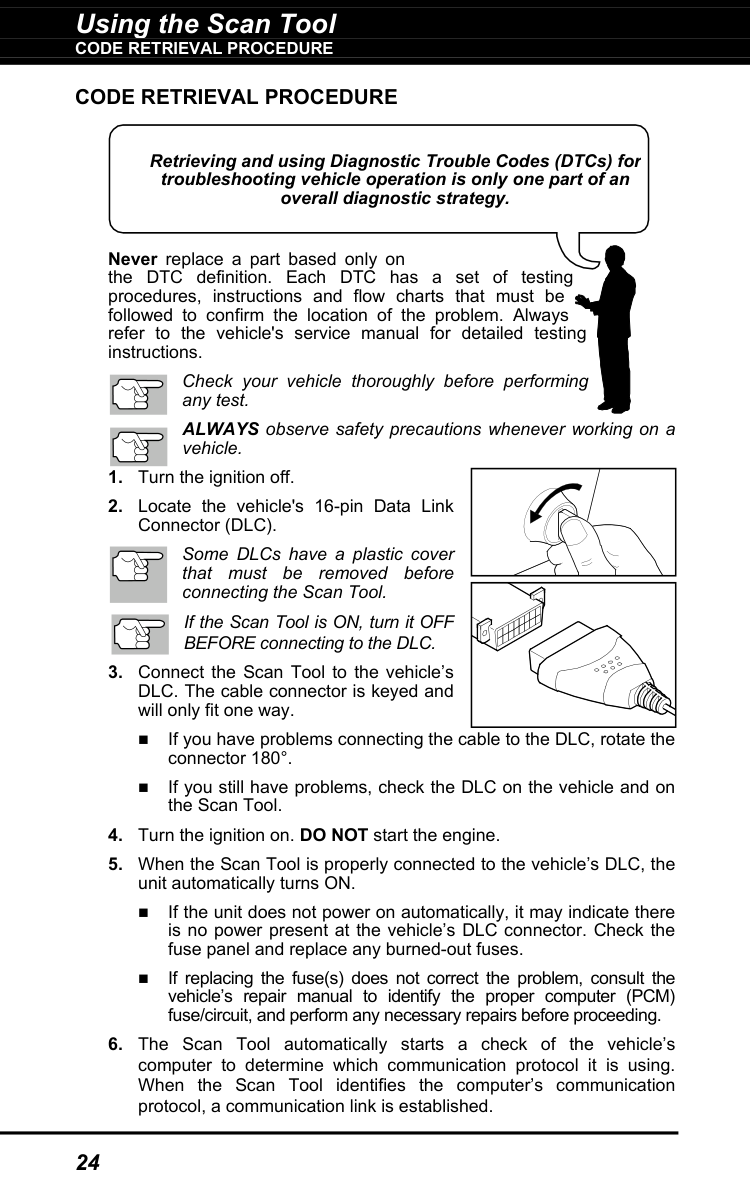
    Never replace a part based only on the DTC definition. Each DTC has a set of testing procedures, instructions and flow charts that must be followed to confirm the location of the problem. Always refer to the vehicle's service manual for detailed testing instructions. Check your vehicle thoroughly before performing any test. ALWAYS observe safety precautions whenever working on a vehicle.
  • Turn the ignition off.
  • Locate the vehicle's 16-pin Data Link
  • Connector (DLC). Some DLCs have a plastic cover that must be removed before connecting the Scan Tool. If the Scan Tool is ON, turn it OFF BEFORE connecting to the DLC.
  • Connect the Scan Tool to the vehicle’s
  • DLC. The cable connector is keyed and will only fit one way.  If you have problems connecting the cable to the DLC, rotate the connector 180°.  If you still have problems, check the DLC on the vehicle and on the Scan Tool.
  • Turn the ignition on. DO NOT start the engine.
  • When the Scan Tool is properly connected to the vehicle’s DLC, the
  • unit automatically turns ON.  If the unit does not power on automatically, it may indicate there is no power present at the vehicle’s DLC connector. Check the fuse panel and replace any burned-out fuses.  If replacing the fuse(s) does not correct the problem, consult the vehicle’s repair manual to identify the proper computer (PCM) fuse/circuit, and perform any necessary repairs before proceeding.
  • The Scan Tool automatically starts a check of the vehicle’s
  • computer to determine which communication protocol it is using. When the Scan Tool identifies the computer’s communication protocol, a communication link is established.

    Page 27

    Using the Scan Tool

    Code Retrieval Procedure

    25

    A PROTOCOL is a set of rules and procedures for regulating data transmission between computers, and between testing equipment and computers. As of this writing, five different types of protocols (ISO 9141, Keyword 2000, J1850 PWM, J1850 VPW and CAN) are in use by vehicle manufacturers.  If the Scan Tool fails to link to the vehicle’s computer, a “Communication Error” message shows.
  • Ensure your vehicle is OBD2 compliant.
  • Verify the connection at the DLC, and verify the ignition is ON.
  • Turn the ignition OFF, wait 5 seconds, then back ON to reset
  • the computer.
  • Choose Relink to try again, or, choose System Menu to
  • return to the System Menu.  If the Scan Tool cannot link to the vehicle’s computer after three attempts, the message “Contact Technical Support” displays.
  • Choose System Menu to return to the System Menu.
  • Turn the ignition off, and disconnect the Scan Tool.
  • Contact Technical Support for
  • assistance.
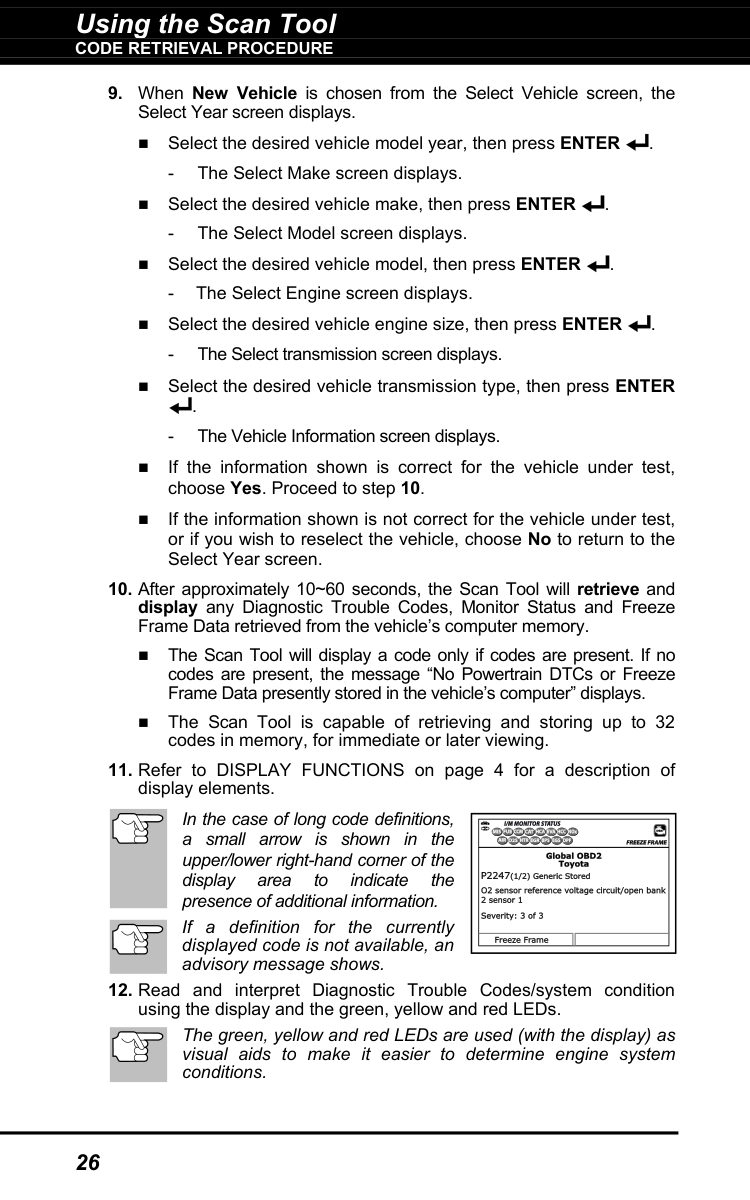
  • If the Scan Tool can decode the Vehicle
  • Identification Number (VIN) for the vehicle under test, the Confirm Vehicle screen displays.  If the information shown is correct for the vehicle under test, choose Yes, then proceed to step 10.  If the information shown is not correct for the vehicle under test, or if you wish to manually select the vehicle, choose No, then proceed to step 9.  If the Scan Tool cannot decode the Vehicle Identification Number (VIN) for the vehicle under test, the Select Vehicle screen displays. Proceed to step 8.
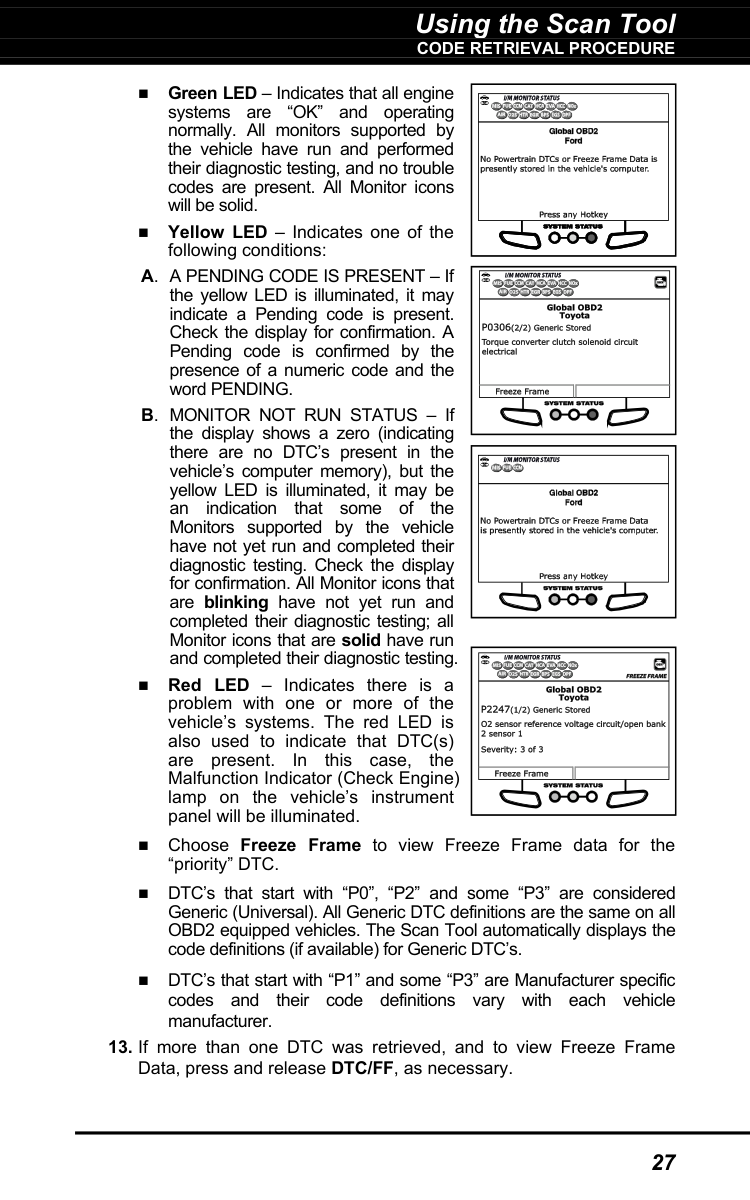
  • When No is selected from the Vehicle
  • information screen, the Select Vehicle screen displays. The Select Vehicle screen lists the three most recently tested vehicles.  To use a previously tested vehicle, select the desired vehicle, then press ENTER . Proceed to step
  • To select a new vehicle, choose New Vehicle. Proceed to step 9.

    Page 28

    Using the Scan Tool

    Code Retrieval Procedure

    26
  • When New Vehicle is chosen from the Select Vehicle screen, the
  • Select Year screen displays.  Select the desired vehicle model year, then press ENTER .
  • The Select Make screen displays.
  •  Select the desired vehicle make, then press ENTER .
  • The Select Model screen displays.
  •  Select the desired vehicle model, then press ENTER .
  • The Select Engine screen displays.
  •  Select the desired vehicle engine size, then press ENTER .
  • The Select transmission screen displays.
  •  Select the desired vehicle transmission type, then press ENTER .
  • The Vehicle Information screen displays.
  •  If the information shown is correct for the vehicle under test, choose Yes. Proceed to step 10.  If the information shown is not correct for the vehicle under test, or if you wish to reselect the vehicle, choose No to return to the Select Year screen.
  • After approximately 10~60 seconds, the Scan Tool will retrieve and
  • display any Diagnostic Trouble Codes, Monitor Status and Freeze Frame Data retrieved from the vehicle’s computer memory.  The Scan Tool will display a code only if codes are present. If no codes are present, the message “No Powertrain DTCs or Freeze Frame Data presently stored in the vehicle’s computer” displays.  The Scan Tool is capable of retrieving and storing up to 32 codes in memory, for immediate or later viewing.
  • Refer to DISPLAY FUNCTIONS on page 4 for a description of
  • display elements. In the case of long code definitions, a small arrow is shown in the upper/lower right-hand corner of the display area to indicate the presence of additional information. If a definition for the currently displayed code is not available, an advisory message shows.
  • Read and interpret Diagnostic Trouble Codes/system condition
  • using the display and the green, yellow and red LEDs. The green, yellow and red LEDs are used (with the display) as visual aids to make it easier to determine engine system conditions.

    Page 29

    Using the Scan Tool

    Code Retrieval Procedure

    27

     Green LED – Indicates that all engine systems are “OK” and operating normally. All monitors supported by the vehicle have run and performed their diagnostic testing, and no trouble codes are present. All Monitor icons will be solid.  Yellow LED – Indicates one of the following conditions: A. A PENDING CODE IS PRESENT – If the yellow LED is illuminated, it may indicate a Pending code is present. Check the display for confirmation. A Pending code is confirmed by the presence of a numeric code and the word PENDING. B. MONITOR NOT RUN STATUS – If the display shows a zero (indicating there are no DTC’s present in the vehicle’s computer memory), but the yellow LED is illuminated, it may be an indication that some of the Monitors supported by the vehicle have not yet run and completed their diagnostic testing. Check the display for confirmation. All Monitor icons that are blinking have not yet run and completed their diagnostic testing; all Monitor icons that are solid have run and completed their diagnostic testing.  Red LED – Indicates there is a problem with one or more of the vehicle’s systems. The red LED is also used to indicate that DTC(s) are present. In this case, the Malfunction Indicator (Check Engine) lamp on the vehicle’s instrument panel will be illuminated.  Choose Freeze Frame to view Freeze Frame data for the “priority” DTC.  DTC’s that start with “P0”, “P2” and some “P3” are considered Generic (Universal). All Generic DTC definitions are the same on all OBD2 equipped vehicles. The Scan Tool automatically displays the code definitions (if available) for Generic DTC’s.  DTC’s that start with “P1” and some “P3” are Manufacturer specific codes and their code definitions vary with each vehicle manufacturer.
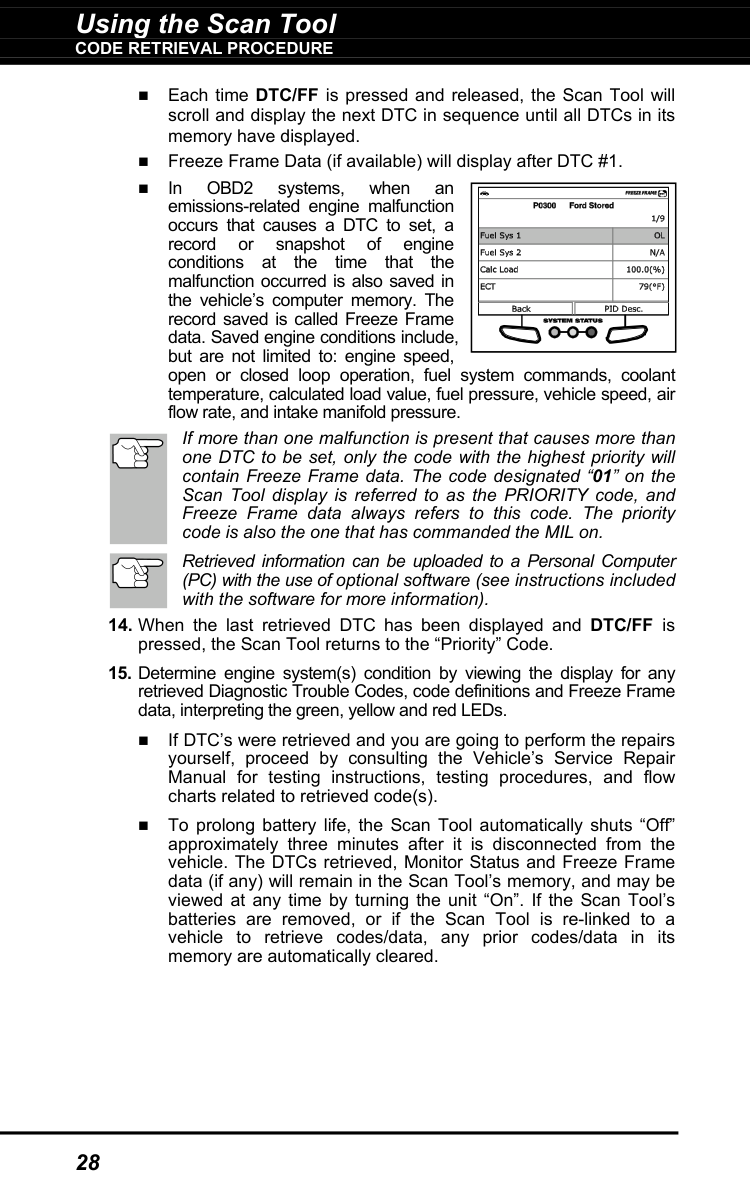
  • If more than one DTC was retrieved, and to view Freeze Frame
  • Data, press and release DTC/FF, as necessary.

    Page 30

    Using the Scan Tool

    Code Retrieval Procedure

    28

     Each time DTC/FF is pressed and released, the Scan Tool will scroll and display the next DTC in sequence until all DTCs in its memory have displayed.  Freeze Frame Data (if available) will display after DTC #1.  In

    Obd2

    systems, when an emissions-related engine malfunction occurs that causes a DTC to set, a record or snapshot of engine conditions at the time that the malfunction occurred is also saved in the vehicle’s computer memory. The record saved is called Freeze Frame data. Saved engine conditions include, but are not limited to: engine speed, open or closed loop operation, fuel system commands, coolant temperature, calculated load value, fuel pressure, vehicle speed, air flow rate, and intake manifold pressure. If more than one malfunction is present that causes more than one DTC to be set, only the code with the highest priority will contain Freeze Frame data. The code designated “01” on the Scan Tool display is referred to as the PRIORITY code, and Freeze Frame data always refers to this code. The priority code is also the one that has commanded the MIL on. Retrieved information can be uploaded to a Personal Computer (PC) with the use of optional software (see instructions included with the software for more information).
  • When the last retrieved DTC has been displayed and DTC/FF is
  • pressed, the Scan Tool returns to the “Priority” Code.
  • Determine engine system(s) condition by viewing the display for any
  • retrieved Diagnostic Trouble Codes, code definitions and Freeze Frame data, interpreting the green, yellow and red LEDs.  If DTC’s were retrieved and you are going to perform the repairs yourself, proceed by consulting the Vehicle’s Service Repair Manual for testing instructions, testing procedures, and flow charts related to retrieved code(s).  To prolong battery life, the Scan Tool automatically shuts “Off” approximately three minutes after it is disconnected from the vehicle. The DTCs retrieved, Monitor Status and Freeze Frame data (if any) will remain in the Scan Tool’s memory, and may be viewed at any time by turning the unit “On”. If the Scan Tool’s batteries are removed, or if the Scan Tool is re-linked to a vehicle to retrieve codes/data, any prior codes/data in its memory are automatically cleared.

    Page 31

    Using the Scan Tool

    THE SYSTEM MENU - VIEWING OEM ENHANCED DTCs

    29

    The System Menu

    The System Menu provides the ability to retrieve “enhanced” DTCs, Anti- Lock Brake System (ABS), Supplemental Restraint System (SRS) DTCs and Tire Pressure Monitoring System (TPMS) DTCs for most BMW, Chrysler/Jeep, Ford/Mazda, GM/Isuzu, Honda/Acura, Hyundai, Mercedes Benz, Nissan, Toyota/Lexus, Volkswagen and Volvo vehicles. The types of enhanced data available depends on the vehicle make. You can also return to the Global OBD2 mode. Depending on the vehicle under test, some features and functions may not be available.  To access the System Menu, press

    System Menu

    . Select the desired option, then press ENTER to view the selected information. To view ABS DTCs: Select ABS. Refer to VIEWING ABS DTCs on page 32 to view ABS DTCs for your vehicle. To view SRS DTCs: Select SRS. Refer to VIEWING SRS DTCs on page 33 to view SRS DTCs for your vehicle. To view TPMS DTCs: Select TPMS from the System Menu. Refer to VIEWING TPMS DTCs on page 34 to view TPMS DTCs for your vehicle. To view OEM enhanced DTCs: Select OEM Enhanced. Refer to VIEWING OEM ENHANCED DTCs on page 29 to view OEM enhanced DTCs for your vehicle. To perform a Network Test: Select Scan all Modules or Select Modules, as desired. Refer to NETWORK TEST on page 36 to view DTCs for other modules. VIEWING OEM ENHANCED DTCs (except Ford/Mazda) When (make) OEM Enhanced is chosen from the System Menu, the Scan Tool retrieves OEM enhanced DTCs from the vehicle’s computer.
  • A “One moment please” message displays while the Scan Tool
  • retrieves the selected DTCs.  If the Scan Tool fails to link to the vehicle’s computer, a “Communication Error” message shows.
  • Ensure your vehicle is OBD2 compliant.
  • Verify the connection at the DLC, and verify the ignition is ON.
  • Turn the ignition OFF, wait 5 seconds, then back ON to reset
  • the computer.
  • Choose Relink to try again, or, choose System Menu to
  • return to the System Menu.  If the Scan Tool cannot link to the vehicle’s computer after three attempts, the message “Contact Technical Support” displays.
  • Choose System Menu to return to the System Menu.
  • Page 32

    Using the Scan Tool

    VIEWING OEM ENHANCED DTCs (Ford/Mazda only)

    30

  • Turn the ignition off, and disconnect the Scan Tool.
  • Contact Technical Support for assistance.
  • Refer to DISPLAY FUNCTIONS on
  • page 4 for a description of LCD display elements. If the definition for the currently displayed code is not available, an advisory message shows. I/M MONITOR STATUS icons are not displayed when viewing enhanced DTCs. In the case of long code definitions, a small arrow is shown in the upper/lower right-hand corner of the code display area to indicate the presence of additional information.  If no codes are present, the message “No OEM Enhanced DTC’s are presently stored in the vehicle’s computer” shows. Choose System Menu to return to the System Menu.
  • If more than one code was retrieved press DTC/FF to display
  • additional codes one at a time.  Whenever the Scroll function is used, the Scan Tool’s communication link with the vehicle’s computer disconnects. To re-establish communication, press POWER/LINK again.
  • When the last retrieved DTC has been displayed and DTC/FF is
  • pressed, the Scan Tool returns to the “Priority” Code.  To exit the enhanced mode, choose System Menu button to return to the System Menu. Select Global OBD, then press

    Enter

    to return to the Global OBD2 mode. VIEWING OEM ENHANCED DTCs (Ford/Mazda only) Mazda Enhanced DTCs are available for Mazda-branded Ford vehicles only. When Ford OEM Enhanced is chosen from the System Menu, the Ford OEM Enhanced menu displays. You may view DTCs for either the “Continuous Memory Test”, “KOEO (Key On Engine Off) Test” or “KOER (Key On Engine Running) Test.”
  • Select the desired option, then press
  • Enter

    .  If KOER is selected, an advisory message shows.
  • Start and warm the engine to normal operating temperature,
  • then choose Continue. Proceed to step 3.
  • If KOEO or Continuous Memory is selected, an “instructional”
  • message shows.

    Page 33

    Using the Scan Tool

    VIEWING OEM ENHANCED DTCs (Ford/Mazda only)

    31

     Turn the ignition OFF, then back ON. Choose Continue. Proceed to step 3.

  • A “One moment please” message displays while the test is in
  • progress.  If the Scan Tool fails to link to the vehicle’s computer, a “Communication Error” message shows.
  • Ensure your vehicle is OBD2 compliant.
  • Verify the connection at the DLC, and verify the ignition is ON.
  • Turn the ignition OFF, wait 5 seconds, then back ON to reset
  • the computer.
  • Choose Relink to try again, or, choose System Menu to
  • return to the System Menu.  If the Scan Tool cannot link to the vehicle’s computer after three attempts, the message “Contact Technical Support” displays.
  • Choose System Menu to return to the System Menu.
  • Turn the ignition off, and disconnect the Scan Tool.
  • Contact Technical Support for assistance.
  •  If the KOER Test was selected, and the vehicle’s engine is not running, an advisory message shows.
  • Start the engine and choose Relink to try again, or, choose
  • System Menu to return to the System Menu.  If the KOEO Test was selected, and the vehicle’s engine is running, an advisory message shows.
  • Turn the ignition OFF then back ON and choose Relink to try
  • again, or, choose System Menu to return to the System Menu.
  • If the KOER test was selected, an “instructional” message shows.
  •  Turn the steering wheel to the right, then release.  Press and release the brake pedal.  Cycle the overdrive switch (if equipped).  A “One moment please” message displays while the test is in progress.
  • Refer to DISPLAY FUNCTIONS on page 4 for a description of LCD
  • display elements. If the definition for the currently displayed code is not available, an advisory message shows. I/M MONITOR STATUS icons are not displayed when viewing enhanced DTCs.

    Page 34

    Using the Scan Tool

    VIEWING ABS DTCs

    32

    In the case of long code definitions, a small arrow is shown in the upper/ lower right-hand corner of the code display area to indicate the presence of additional information.  If no codes are present, a “System Pass” message displays. Choose System Menu to return to the System Menu.

  • If more than one code was retrieved
  • press DTC/FF to display additional codes one at a time.  Whenever the Scroll function is used to view additional codes, the Scan Tool’s communication link with the vehicle’s computer disconnects. To re-establish communication, press

    Power/Link

    again.
  • When the last retrieved DTC has been displayed and DTC/FF is
  • pressed, the Scan Tool returns to the “Priority” Code.  To view additional enhanced DTCs, repeat steps 1 through 5, above.  To exit the enhanced mode, choose System Menu button to return to the System Menu. Select Global OBD, then press

    Enter

    to return to the Global OBD2 mode. VIEWING ABS DTCs Refer to the manufacturer’s website for vehicle makes covered.

  • When ABS is chosen from the System Menu, a "One moment
  • please" message displays while the Scan Tool retrieves the selected DTCs.  If ABS functionality is not supported, an advisory message shows. Press SYSTEM MENU to return to the System Menu.  If the Scan Tool fails to link to the vehicle’s computer, a "Communication Error" message shows.
  • Ensure your vehicle is OBD2 compliant.
  • Verify the connection at the DLC, and verify the ignition is ON.
  • Turn the ignition OFF, wait 5 seconds, then back ON to reset
  • the computer.

    Page 35

    Using the Scan Tool

    VIEWING SRS DTCs

    33

  • Choose Relink to try again, or, choose System Menu to
  • return to the System Menu.  If the Scan Tool cannot link to the vehicle’s computer after three attempts, the message “Contact Technical Support” displays.
  • Choose System Menu to return to the System Menu.
  • Turn the ignition off, and disconnect the Scan Tool.
  • Contact Technical Support for assistance.
  • Refer to DISPLAY FUNCTIONS on page 4 for a description of LCD
  • display elements. If the definition for the currently displayed code is not available, an advisory message shows. I/M MONITOR STATUS icons are not displayed when viewing ABS DTCs. In the case of long code definitions, a small arrow is shown in the upper/lower right-hand corner of the code display area to indicate the presence of additional information.  If no codes are present, the message "No ABS DTC’s are presently stored in the vehicle’s computer" shows. Choose System Menu to return to the System Menu.
  • If more than one code was retrieved press DTC/FF to display
  • additional codes one at a time.  Whenever the Scroll function is used, the Scan Tool’s communication link with the vehicle’s computer disconnects. To re-establish communication, press POWER/LINK again.
  • When the last retrieved DTC has been displayed and DTC/FF is
  • pressed, the Scan Tool returns to the “Priority” Code.  To exit the enhanced mode, choose System Menu button to return to the System Menu. Select Global OBD, then press

    Enter

    to return to the Global OBD2 mode. VIEWING SRS DTCs Refer to the manufacturer’s website for vehicle makes covered.

  • When SRS DTCs is chosen from the System Menu, a "One moment
  • please" message displays while the Scan Tool retrieves the selected DTCs.  If SRS functionality is not supported, an advisory message shows. Press SYSTEM MENU to return to the System Menu.

    Page 36

    Using the Scan Tool

    VIEWING TPMS DTCs

    34

     If the Scan Tool fails to link to the vehicle’s computer, a "Communication Error" message shows.

  • Ensure your vehicle is OBD2 compliant.
  • Verify the connection at the DLC, and verify the ignition is ON.
  • Turn the ignition OFF, wait 5 seconds, then back ON to reset
  • the computer.
  • Choose Relink to try again, or, choose System Menu to
  • return to the System Menu.  If the Scan Tool cannot link to the vehicle’s computer after three attempts, the message “Contact Technical Support” displays.
  • Choose System Menu to return to the System Menu.
  • Turn the ignition off, and disconnect the Scan Tool.
  • Contact Technical Support for assistance.
  • Refer to DISPLAY FUNCTIONS on
  • page 4 for a description of LCD display elements. If the definition for the currently displayed code is not available, an advisory message shows. I/M MONITOR STATUS icons are not displayed when viewing SRS DTCs. In the case of long code definitions, a small arrow is shown in the upper/lower right-hand corner of the code display area to indicate the presence of additional information.  If no codes are present, the message "No SRS DTC’s are presently stored in the vehicle’s computer" shows. Choose System Menu to return to the System Menu.
  • If more than one code was retrieved press DTC/FF to display
  • additional codes one at a time.  Whenever the Scroll function is used, the Scan Tool’s communication link with the vehicle’s computer disconnects. To re-establish communication, press POWER/LINK again.
  • When the last retrieved DTC has been displayed and DTC/FF is
  • pressed, the Scan Tool returns to the “Priority” code.  To exit the enhanced mode, choose System Menu to return to the System Menu. Select Global OBD, then press ENTER

    to return to the Global OBD2 mode. VIEWING TPMS DTCs Refer to the manufacturer’s website for vehicle makes covered.

    Page 37

    Using the Scan Tool

    VIEWING TPMS DTCs

    35

    Reading TPMS DTCs

  • When TPMS DTCs is chosen from the System Menu, a "One
  • moment please" message displays while the Scan Tool retrieves the selected DTCs.  If TPMS functionality is not supported, an advisory message shows. Press SYSTEM MENU to return to the System Menu.  If the Scan Tool fails to link to the vehicle’s computer, a "Communication Error" message shows.
  • Ensure your vehicle is OBD2 compliant.
  • Verify the connection at the DLC, and verify the ignition is ON.
  • Turn the ignition OFF, wait 5 seconds, then back ON to reset
  • the computer.
  • Press POWER/LINK
  • to continue.  If the Scan Tool cannot link to the vehicle’s computer after three attempts, the message “Contact Technical Support” displays.
  • Press SYSTEM MENU
  • to return to the System Menu.
  • Turn the ignition off, and disconnect the Scan Tool.
  • Contact Technical Support for assistance.
  • Refer to DISPLAY FUNCTIONS on page 4 for a description of LCD
  • display elements. If the definition for the currently displayed code is not available, an advisory message shows. I/M MONITOR STATUS icons are not displayed when viewing SRS DTCs. In the case of long code definitions, a small arrow is shown in the upper/lower right-hand corner of the code display area to indicate the presence of additional information.  If no codes are present, the message "No TPMS DTC’s are presently stored in the vehicle’s computer" shows.
  • If more than one code was retrieved press DTC/FF to display
  • additional codes one at a time.  Whenever the Scroll function is used to view additional codes, the Scan Tool’s communication link with the vehicle’s computer disconnects. To re-establish communication, press

    Power/Link

    again.
  • When the last retrieved DTC has been displayed and DTC/FF is
  • pressed, the Scan Tool returns to the “Priority” code.  To exit the enhanced mode, press SYSTEM MENU to return to the System Menu. Select Global OBD, then press ENTER to return to the Global OBD2 mode.

    Page 38

    Using the Scan Tool

    Network Test

    36

    Network Test

    The Network Test lets you perform a scan of all vehicle modules, or of a single selected module, to retrieve DTCs associated with the module(s). To scan all modules:
  • Select Scan All Modules from the System Menu, then press
  • Enter

    .  A “One moment please” message displays while the Scan Tool scans all available modules.  When the scan is complete, the Available Systems screen displays. The screen shows the number of DTCs recorded for each available module.
  • Select the module for which you wish to view DTCs, then press
  • Enter

    . A “One moment please” message displays while the requested DTCs are retrieved.  If the Scan Tool fails to link to the selected module, a “Communication Error” message shows.
  • Ensure your vehicle is OBD2 compliant.
  • Verify the connection at the DLC, and verify the ignition is ON.
  • Turn the ignition OFF, wait 5 seconds, then back ON to reset
  • the computer.
  • Choose Relink to try again, or, choose System Menu to
  • return to the System Menu.  If the selected module does not support the “Read DTC” function, an advisory message displays. Choose System Menu to return to the System Menu, or, choose Main Menu to access the Main Menu.
  • Refer to DISPLAY FUNCTIONS on
  • page 4 for a description of LCD display elements. If the definition for the currently displayed code is not available, an advisory message shows. I/M MONITOR STATUS icons are not displayed when using the Network Test function. In the case of long code definitions, a small arrow is shown in the upper/lower right-hand corner of the code display area to indicate the presence of additional information.  If no codes are present, the message "No (system name) DTC’s are presently stored in the vehicle’s computer" shows. Choose System Menu to return to the System Menu.

    Page 39

    Using the Scan Tool

    Network Test

    37

  • If more than one code was retrieved press DTC/FF to display
  • additional codes one at a time.  Whenever the Scroll function is used, the Scan Tool’s communication link with the vehicle’s computer disconnects. To re-establish communication, press POWER/LINK again.
  • When the last retrieved DTC has been displayed and DTC/FF is
  • pressed, the Scan Tool returns to the first code.  To exit the enhanced mode, choose System Menu to return to the System Menu. Select Global OBD, then press ENTER

    to return to the Global OBD2 mode. To scan a selected module:

  • Choose Select Modules from the System Menu, then press ENTER
  • .  If the Select Group screen displays, select the group (Drive, Chassis, Body, etc.) containing the module you wish to scan, then press ENTER . Proceed to step 2.  If the Select Group screen does not display, proceed to step 2.
  • The Available Systems screen displays.
  • Select the desired module, then press

    Enter

    .  A “One moment please” message displays while the requested DTCs are retrieved.
  • Select the module for which you wish to view DTCs, then press
  • Enter

    . A “One moment please” message displays while the requested DTCs are retrieved.  If the Scan Tool fails to link to the selected module, a “Communication Error” message shows.
  • Ensure your vehicle is OBD2 compliant.
  • Verify the connection at the DLC, and verify the ignition is ON.
  • Turn the ignition OFF, wait 5 seconds, then back ON to reset
  • the computer.
  • Choose Relink to try again, or, choose System Menu to
  • return to the System Menu.  If the selected module does not support the “Read DTC” function, an advisory message displays. Choose System Menu to return to the System Menu, or, choose Main Menu to access the Main Menu.
  • Refer to DISPLAY FUNCTIONS on
  • page 4 for a description of LCD display elements.

    Page 40

    Using the Scan Tool

    ERASING DIAGNOSTIC TROUBLE CODES (DTCs)

    38

    If the definition for the currently displayed code is not available, an advisory message shows. I/M MONITOR STATUS icons are not displayed when using the Network Test function. In the case of long code definitions, a small arrow is shown in the upper/lower right-hand corner of the code display area to indicate the presence of additional information.  If no codes are present, the message "No (system name) DTC’s are presently stored in the vehicle’s computer" shows. Choose System Menu to return to the System Menu.

  • If more than one code was retrieved press DTC/FF to display
  • additional codes one at a time.  Whenever the Scroll function is used, the Scan Tool’s communication link with the vehicle’s computer disconnects. To re-establish communication, press POWER/LINK again.
  • When the last retrieved DTC has been displayed and DTC/FF is
  • pressed, the Scan Tool returns to the first code.  To exit the enhanced mode, choose System Menu to return to the System Menu. Select Global OBD, then press ENTER

    to return to the Global OBD2 mode. ERASING DIAGNOSTIC TROUBLE CODES (DTCs) When the Scan Tool’s ERASE function is used to erase DTCs from the vehicle's on-board computer, "Freeze Frame" data and manufacturer-specific-enhanced data are also erased. "Permanent" DTCs ARE NOT erased by the ERASE function. If you plan to take the vehicle to a Service Center for repair, DO NOT erase the codes from the vehicle's computer. If the codes are erased, valuable information that might help the technician troubleshoot the problem will also be erased. Erase DTCs from the computer's memory as follows: When DTCs are erased, the I/M Readiness Monitor Status program resets the status of all Monitors to a not run condition. To set all Monitors to a DONE status, an OBD2 Drive Cycle must be performed.

  • If not connected already, connect the
  • Scan Tool to the vehicle's DLC, and turn the ignition "On.” (If the Scan Tool is already connected and linked to the vehicle's computer, proceed directly to step 3. If not, continue to step 2.)
  • Perform the Code Retrieval procedure
  • as described on page 24.  To erase OBD2 DTCs: Wait until the codes are displayed, then proceed to step 3.

    Page 41

    Using the Scan Tool

    About Repairsolutions 2®

    39

     To erase enhanced, ABS, SRS, TPMS or Network DTCs: Press SYSTEM MENU to display the System Menu. Select the desired option, then press ENTER . Perform the appropriate Code Retrieval procedure and then proceed to step

  • 3. Press and release ERASE
  • . A

    confirmation message shows.  If you are sure you want to proceed, choose Erase DTCs to continue.  If you do not want to proceed, choose Back to cancel the erase procedure.
  • If you chose to erase DTCs, a “One moment please…” message
  • displays while the erase function is in progress. If the vehicle’s engine is running, an advisory message shows. Turn the engine OFF, then turn the ignition back to ON. DO NOT start the engine. Choose Erase DTCs to continue.  If the erase was successful, a confirmation message shows. The Scan Tool automatically relinks to the vehicle’s computer after 3 seconds. If the erase was not successful and ECU error code $22 is present, an advisory message displays. Start the engine and maintain vehicle speed at 0. Choose Erase DTCs to try again.  If the erase was not successful, an advisory message shows indicating the erase request was sent to the vehicle’s computer. The Scan Tool automatically relinks to the vehicle’s computer after 3 seconds.

    About Repairsolutions 2®

    RepairSolutions 2® is a web-based service created to assist both Do-It- Yourself and Professional technicians in quickly and accurately diagnosing and repairing today’s vehicles. RepairSolutions 2 allows you to view and save the diagnostic data retrieved from a vehicle’s on-board computer(s) using your Code Reader. At the core of RepairSolutions 2 is an extensive knowledge database, developed by compiling and analyzing years worth of “real world” vehicle service data. RepairSolutions 2 builds on manufacturer-recommended diagnostic and repair information by providing verified, vehicle-specific fixes supplied by ASE technicians across the country. RepairSolutions 2 also provides access to an extensive knowledge database including:  Verified Fixes – Find the most likely fixes reported and verified by ASE Technicians for the retrieved DTCs.

    Page 42

    Using the Scan Tool

    Connecting To Bluetooth / Wifi

    40

     Repair Instructions – View available repair instructions to properly perform the fix.  Video Tutorials – Watch repair video tutorials for valuable repair tips.  Technical Service Bulletins – Research known problems reported by vehicle manufacturers.  Safety Recalls – Research known safety concerns applicable to a vehicle. And much more. Please visit www.innova.com for additional information. Hardware Requirements:  Innova Scan Tool with Bluetooth/WiFi  Android or iOS Smart Device Accessing RepairSolutions 2®

  • Download and install the RepairSolutions 2® app from the App
  • Store (for iOS devices) or Google Play (for Android devices).
  • Launch the RepairSolutions 2 app and log in to your account.
  •  If you have not yet established an account, you must register for a FREE RepairSolutions 2 account before proceeding.
  • Connect the Code Reader to a vehicle and establish a Bluetooth or
  • WiFi connection with your Smart Device (refer to CONNECTING TO BLUETOOTH / WIFI, below). Be sure your Smart Device is connected to an available WiFi network.  The RepairSolutions 2 app will store two WiFi configurations only.
  • Retrieve diagnostic data (refer to CODE RETRIEVAL PROCEDURE
  • on page 24 for details).
  • The RepairSolutions 2 app automatically displays a report based on
  • the retrieved diagnostic data.  If the Code Reader is not connected to WiFi or Bluetooth, vehicle data will not be saved.

    Connecting To Bluetooth / Wifi

    Launch the RepairSolutions2 app an follow the prompts to establish Bluetooth and (optionally) WiFi connections, as follows:
  • Launch the RepairSolutions2 app. Select Wifi Tools Settings from
  • the menu. Power on your Code Reader, then select from the list of available devices.
  • When Bluetooth pairing is complete, a confirmation screen displays.
  • Click Continue.  If a Bluetooth connection cannot be established, an advisory message displays. Tap Try Again to repeat the pairing process.

    Page 43

    Using the Scan Tool

    Connecting To Bluetooth / Wifi

    41

  • Follow the on-screen prompts to connect to an available WiFi
  • network.  You can automatically connect to the network your Smart Device is currently connected to, or you can manually connect to another available network.  Note that only 2.4GHz networks are supported.  If you do not wish to connect to a WiFi network at this time, tap

    Skip.

  • When WiFi pairing is complete, a confirmation screen displays. Click
  • Continue to view the “Setup Complete” message, then click Continue to enter RepairSolutions2.  If a WiFi connection cannot be established, an advisory message displays. Tap Try Again to repeat the pairing process.

    Page 44

    Live Data Mode

    Viewing Live Data

    42

    The Scan Tool lets you view and/or record "real-time" Live Data. This information includes values (volts, rpm, temperature, speed etc.) and system status information (open loop, closed loop, fuel system status, etc.) generated by the various vehicle sensors, switches and actuators. These are the same signal values generated by the sensors, actuators, switches and/or vehicle system status information used by the vehicle's computer when calculating and conducting system adjustments and corrections. The real time (Live Data) vehicle operating information (values/status) that the computer supplies to the Scan Tool for each sensor, actuator, switch, etc. is called Parameter Identification (PID) Data. Each PID (sensor, actuator switch, status, etc.) has a set of operating characteristics and features (parameters) that serve to identify it. The Scan Tool displays this information for each sensor, actuator, switch or status that is supported by the vehicle under test. WARNING: If the vehicle must be driven in order to perform a troubleshooting procedure, ALWAYS have a second person help you. One person should drive the vehicle while the other person observes the Scan Tool data. Trying to drive and operate the Scan Tool at the same time is dangerous, and could cause a serious traffic accident.

    Viewing Live Data

  • While linked to the vehicle, start the engine, then press LD.
  • A “One moment please . . .” message displays while the Scan Tool
  • establishes communication with the vehicle.  If the Scan Tool fails to establish communication with the vehicle, a “Communication Error” message displays.
  • Ensure the vehicle is OBD2 compliant.
  • Verify the connection at the DLC, and verify the ignition is ON.
  • Turn the ignition OFF, wait 5 seconds, then back ON to reset
  • the computer.
  • Press ENTER
  • to continue.
  • Real-time Live Data (PID) information
  • supported by the vehicle under test displays.  If Live Data is not supported by the vehicle under test, an advisory message displays. Choose Relink to try again, or, choose System Menu to return to the System Menu. The values for the various PIDS displayed may change as the vehicle's operating conditions change.
  • Only a limited amount of PID data can be displayed on the screen at
  • one time. If additional PID data is available, a small arrow is shown on the display. Press UP and DOWN , as necessary, to view all available PID data.

    Page 45

    Live Data Mode

    CUSTOMIZING LIVE DATA (PIDs)

    43

     If communication with the vehicle is lost while viewing Live Data, an advisory message displays.

  • Choose Graph to view the currently
  • selected PID in “graph” mode. Choose Text View to return to the PID list.  With one PID displayed in “graph” mode, choose 2 Graphs to graph an additional PID.  With two PIDs displayed in “graph” mode, choose 4 Graphs to graph two additional PIDs.  With four PIDs shown in "graph" mode, choose Superimpose to superimpose the graphs.  Choose 1 Graph to return to the first PID selected for “graph” mode display, or, choose Text View to return to the PID list.
  • Press and hold ENTER
  • to view the “expanded” definition for the currently selected PID. Release to return to the PID list. The “expanded” definition functionality is available only when enabled through Tool Settings (see TOOL SETTINGS on page 118 for details).
  • If you experience vehicle problems, view and/or compare the Live
  • Data (PID) information displayed on the Scan Tool to specifications in the vehicle's repair manual. If desired, you can "customize" the Live Data display to show only those PIDs you are interested in viewing. See Customizing Live Data (PIDs) below for details. You may also choose to record Live Data for later viewing. See RECORDING (CAPTURING) LIVE DATA on page 44 for details. CUSTOMIZING LIVE DATA (PIDs) You can customize the Live Data display by placing the Scan Tool in "Custom Live Data" mode and selecting only the PIDs that you wish to display.
  • With the Scan Tool in Live Data mode
  • (see VIEWING LIVE DATA on page 42), choose Custom Live Data, or, press LD to access the Live Data Menu, then select Custom Live Data and press

    Enter.

     If the Scan Tool fails to establish communication with the vehicle, a “Communication Error” message displays.
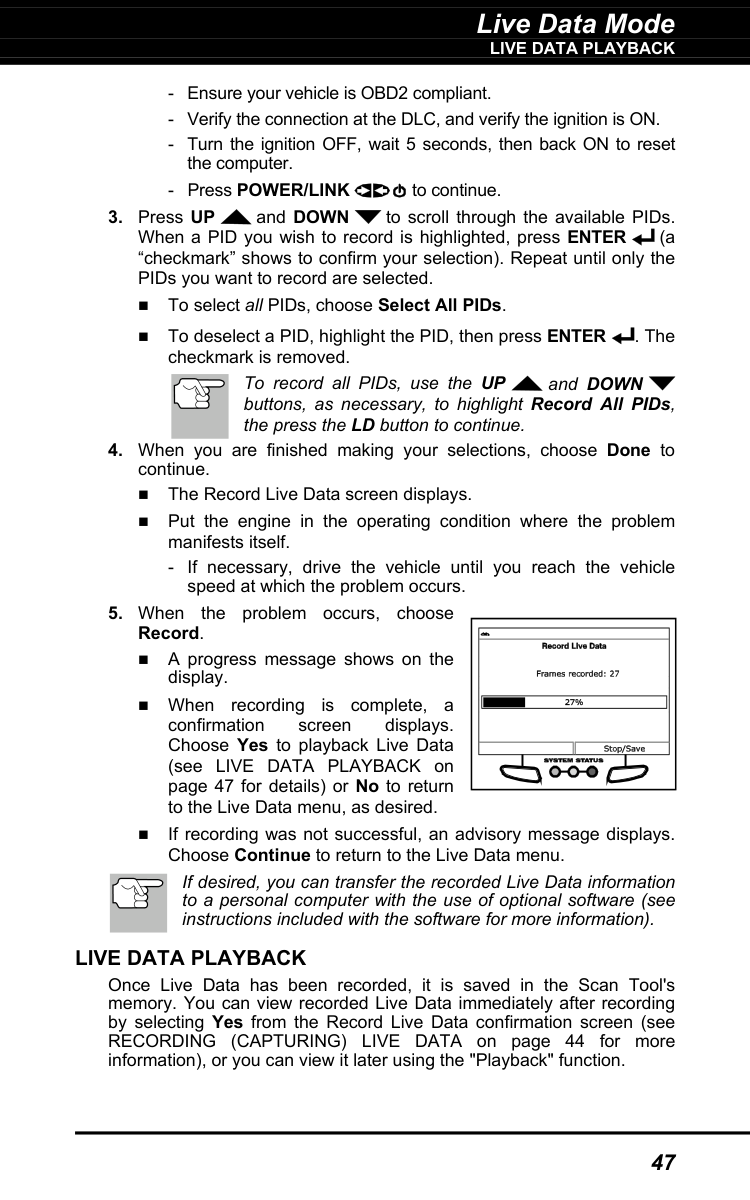
  • Ensure the vehicle is OBD2 compliant.
  • Verify the connection at the DLC, and verify the ignition is ON.
  • Turn the ignition OFF, wait 5 seconds, then back ON to reset
  • the computer.

    Page 46

    Live Data Mode

    Recording (Capturing) Live Data

    44

  • Press POWER/LINK
  • to continue.  If Live Data is not supported by the vehicle under test, an advisory message displays. Choose Relink to try again, or, choose System Menu to return to the System Menu.  If custom Live Data was previously configured, the Select PIDs to Use screen displays.
  • To use the existing custom Live Data selections, select Use
  • existing PIDs, then press ENTER . Proceed to step 5.
  • To configure new custom Live
  • Data, select Select new PIDs, then press ENTER . The Custom Live Data menu displays. Proceed to step 2.  If custom Live Data was not previously selected, the Custom Live Data menu displays. Proceed to step 2.
  • Press UP
  • and DOWN to scroll through the available PIDs. When a PID you wish to display is highlighted, press ENTER (a "checkmark" shows to confirm your selection). Repeat until only the PIDs you want to display are selected.  To select all PIDs, choose Select All PIDs.  To deselect a PID, highlight the PID, then press ENTER . The checkmark is removed.
  • When you are finished making your selection(s), choose Done to
  • continue.
  • The Scan Tool is now in "Custom Live
  • Data" mode. Only the PIDs you selected are shown.  To change the current custom Live Data selections, select Reselect PIDs, then press ENTER to return to the Custom Live Data menu. Repeat step 2.
  • To exit the "Custom Live Data" mode, press M to return to the Live
  • Data Menu.

    Recording (Capturing) Live Data

    You can record and save several frames of Live Data information for each PID supported by the vehicle in the Scan Tool's memory. There are two ways that the Scan Tool can record Live Data:  Record by DTC Trigger

    Page 47

    Live Data Mode

    Recording (Capturing) Live Data

    45

     Record by Manual Trigger If POWER/LINK is pressed at any time while in Live Data mode, any recorded Live Data will be erased from the Scan Tool’s memory. Record by DTC Trigger This function automatically records Live Data information when a DTC sets and saves it in the Scan Tool’s memory. The recorded data can be a valuable troubleshooting aid, particularly if you are experiencing a fault that is causing a DTC to set. The Scan Tool can record approximately 100 frames of Live Data.

  • With the Scan Tool in Live Data mode (see VIEWING LIVE DATA
  • on page 42), press an hold LD until the Live Data Menu displays.
  • Select Record by DTC Trigger, then press ENTER
  • .  The Select PIDs to Record screen displays.  If the Scan Tool fails to establish communication with the vehicle, a “Communication Error” message displays.
  • Ensure the vehicle is OBD2 compliant.
  • Verify the connection at the DLC, and verify the ignition is ON.
  • Turn the ignition OFF, wait 5 seconds, then back ON to reset
  • the computer.
  • Press POWER/LINK
  • to continue.
  • Press UP
  • and DOWN to scroll through the available PIDs. When a PID you wish to display is highlighted, press ENTER (a "checkmark" shows to confirm your selection). Repeat until only the PIDs you want to record are selected.  To select all PIDs, choose Select All PIDs.  To deselect a PID, highlight the PID, then press

    Enter

    . The checkmark is removed.
  • When you are finished making your
  • selections, choose Done to continue.  If DTCs are presently stored in the vehicle’s computer, an advisory message displays.
  • Choose Erase DTCs. A “One moment please…” message
  • displays while DTCs are erased from the vehicle’s computer.  If the erase is not successful, an advisory message displays.
  • To retry the erase process, verify that the Scan Tool is properly
  • connected to the vehicle’s DLC and that the ignition is on. Choose Erase DTCs.

    Page 48

    Live Data Mode

    Recording (Capturing) Live Data

    46
  • To exit the record function, Choose Back to return to the
  • Record Live Data menu.  When the Erase process is complete, the Record Live Data screen displays the message “Ready to record Waiting for DTCs.”
  • Put the engine in the operating condition that causes the DTC to set.
  •  If necessary, drive the vehicle until you reach the vehicle speed at which the problem occurs.
  • When the Scan Tool detects a fault that
  • causes a DTC to set, it automatically records and saves approximately 100 frames of Live Data information in its memory for each PID selected.  A progress message shows on the display.
  • You can stop and save recorded Live Data at any time by
  • choosing Stop/Save.  When recording is complete, a confirmation screen displays. Choose Yes to playback Live Data (see LIVE DATA PLAYBACK on page 47 for details) or No to return to the Live Data menu, as desired.  If recording was not successful, an advisory message displays. Choose Continue to return to the Live Data menu. Record by Manual Trigger This option lets you select the precise time at which the Live Data recording will occur. Record by Manual Trigger can be a very valuable tool when troubleshooting intermittent problems that do not meet the requirements for a DTC to set. The Scan Tool is capable of recording approximately 100 frames of Live Data.
  • With the Scan Tool in Live Data mode (see VIEWING LIVE DATA
  • on page 42), press and hold LD until the Live Data Menu displays.
  • Select Record Manually, then press
  • Enter

    .  The Select PIDs to Record screen displays.  If the Scan Tool fails to establish communication with the vehicle, a “Communication Error” message displays.

    Page 49

    Live Data Mode

    Live Data Playback

    47

  • Ensure your vehicle is OBD2 compliant.
  • Verify the connection at the DLC, and verify the ignition is ON.
  • Turn the ignition OFF, wait 5 seconds, then back ON to reset
  • the computer.
  • Press POWER/LINK
  • to continue.
  • Press UP
  • and DOWN to scroll through the available PIDs. When a PID you wish to record is highlighted, press ENTER (a “checkmark” shows to confirm your selection). Repeat until only the PIDs you want to record are selected.  To select all PIDs, choose Select All PIDs.  To deselect a PID, highlight the PID, then press ENTER . The checkmark is removed. To record all PIDs, use the UP and DOWN

    buttons, as necessary, to highlight Record All PIDs, the press the LD button to continue.

  • When you are finished making your selections, choose Done to
  • continue.  The Record Live Data screen displays.  Put the engine in the operating condition where the problem manifests itself.
  • If necessary, drive the vehicle until you reach the vehicle
  • speed at which the problem occurs.
  • When the problem occurs, choose
  • Record.  A progress message shows on the display.  When recording is complete, a confirmation screen displays. Choose Yes to playback Live Data (see LIVE DATA PLAYBACK on page 47 for details) or No to return to the Live Data menu, as desired.  If recording was not successful, an advisory message displays. Choose Continue to return to the Live Data menu. If desired, you can transfer the recorded Live Data information to a personal computer with the use of optional software (see instructions included with the software for more information).

    Live Data Playback

    Once Live Data has been recorded, it is saved in the Scan Tool's memory. You can view recorded Live Data immediately after recording by selecting Yes from the Record Live Data confirmation screen (see RECORDING (CAPTURING) LIVE DATA on page 44 for more information), or you can view it later using the "Playback" function.

    Page 50

    Live Data Mode

    Live Data Playback

    48

  • With the Scan Tool not connected to a vehicle, press POWER/LINK
  • .  The "To Link" screen displays.
  • Press and hold LD until the Live Data Menu displays.
  • Select Playback Live Data, then press ENTER
  • .  The Playback Live Data menu displays. When you select Yes from the Record Live Data confirmation screen, the Scan Tool enters the "Live Data Playback" mode, and the Playback Live Data menu displays.
  • Select Continuous Playback or Frame by Frame, as desired, then
  • press ENTER .  The display shows the recorded Live Data, beginning with the "trigger" frame.  Only a limited amount of PID data can be displayed on the screen at one time. If additional PID data is available, a small arrow is shown on the display. Press UP and

    Down

    , as necessary, to view all available PID data.  When viewing recorded Live Data, look for any irregularities in any of the PID values/signal information (LTFT %, RPM, MAP, TEMP, etc.). If any PIDs are not within specification, or irregularities are detected, follow the procedures in the vehicle's service repair manual to perform additional troubleshooting and repair.
  • When you select Continuous Playback, the Scan Tool plays
  • recorded data at a rate of one frame / 15 seconds. When playback is finished, a Playback Complete message displays.  To play the data back again, select Continuous Playback or Frame by Frame, as desired, then press ENTER .  To exit Live Data Playback mode, choose Exit.
  • When Frame by Frame is selected, you must scroll the individual
  • frames manually.  When you have viewed all PID information for the current frame of Live Data, choose Next Frame or Previous Frame, as desired.  To exit Live Data Playback mode, select Exit Playback, then press ENTER . If there is no Live Data currently stored in the Scan Tool's memory, an advisory message shows on the display. Choose Main Menu to return to the Main Menu.

    Page 51

    Additional Tests

    The Main Menu

    49

    The Main Menu

    You can use the Scan Tool to perform additional diagnostic tests, view diagnostic and vehicle information stored in the vehicle's on-board computer, and configure the Scan Tool for your particular needs. These functions are accessed through the Main Menu. The following functions are available:  System/Actuator Test – Displays a menu of system/actuator tests for the vehicle under test, which lets you perform active tests for various vehicle actuators and systems.  Service Reset – Lets you reset the Oil Maintenance Light, reset the battery monitor system after battery replacement, perform calibration procedures for the vehicle’s Steering Angle Sensor (SAS), perform Electronic Parking Brake (EPB) cable replacement and reset, perform diesel particulate filter reset, or perform Anti-Lock Brake System (AVS) bleeding.  Service Check – Lets you view the current engine oil level and oil life remaining.  Hybrid Battery Check, Battery/Alternator Test – Performs a check of the vehicle’s battery and alternator system (or hybrid/EV battery system) to ensure the system is operating within acceptable limits.  OBD Mode Test – Displays the System Tests menu, which lets you retrieve and view results for the O2 Sensor Test and OBD Monitor Test, and initiate a test of the vehicle’s EVAP system.  Battery/Alternator Monitor – Performs a check of the vehicle’s battery and alternator system to ensure the system is operating within acceptable limits.  Drive Cycle Procedure – Lets you view drive cycle procedures for a selected vehicle monitor.  DLC Locator – Lets you find the location of the Data Link Connector (DLC) for a specified vehicle.  Vehicle Information – Displays the Vehicle Info menu, which lets you retrieve and view reference information for the vehicle under test.  Firmware Version – Displays the Scan Tool’s firmware version.  Tool Library – Displays the Tool Library menu, which provides access to OBD1 and OBD2 DTC libraries and to definitions for Monitor icons and LED indicators.  Tool Settings – Displays the Tool Settings menu, which lets you make adjustments and settings to configure the Scan Tool to your particular needs. The OBD Mode Test and Vehicle Information options are shown only when the Scan Tool is in Global OBD2 mode.

    Page 52

    Additional Tests

    System/Actuator Tests

    50

    System/Actuator Tests

    System/Actuator Tests let you perform active tests for various vehicle actuators and systems. The specific tests available depend on the vehicle make and model. Chrysler System & Actuator Tests Depending on the vehicle under test, the Special Functions menu provides access to one or more of the following tests:  Set Throttle Blade Position  Throttle Learn Mode  EGR Mass Flow Rate Test Routine Start  Cam Crank Relearn  Idle Up Feature Enable  IMA Rapid Calibration  Learn ETC  Manual DPF Regeneration  Compression Test  Cylinder Performance Test  EGR System Test  ESIM Forced Monitor Test  ETC System Test  ETC Throttle Follower Test  Pedal Follower Mode  NVLD Forced Monitor Test Routine Start  Purge Vapor System Test  Set Engine RPM  Set RPM Test  Set Engine RPM System Test  Leak Detection Pump (LDP) Test  LDP Forced Monitor Test  Injector Kill System Test  VVT System Test  Pedal Follower Mode  Reverse Brake Torque Test  PTO & Idle Up  Minimum Airflow Test Routine Start  EGR Desired Delta Position  Switched Max Operating Speed Enable.

    Page 53

    Additional Tests

    System/Actuator Tests

    51

    If an error occurs while performing any function, an “advisory” message displays. Choose Exit to return to the Special Functions menu. Set Throttle Blade Position

  • Select Set Throttle Blade Position in the Special Functions menu,
  • then press ENTER .  An “instructional” screen displays. Prepare the vehicle for test as directed:
  • Turn the ignition on. DO NOT start the engine.
  • Choose Yes to continue.
  •  A “status” screen displays while a vehicle status check is performed.  The Select Position screen displays.
  • Select Normal, Closed, Open or the
  • desired percentage (from 10% to 90%), then press ENTER .  The Test Results screen displays.  The screen shows the current values for APP 1 Volts, APP 2 Volts, TPS 1 Volts, TPS 2 Volts, TPS 3 Volts, TPS 4 Volts, Throttle Blade 1 Position and Throttle Blade 2 Position.
  • If desired, choose Reselect to return to the Select Position screen,
  • and repeat step 3 to select a new throttle blade position.
  • Choose Finish to return to the Special Functions menu.
  • Throttle Learn Mode
  • Select Throttle Learn Mode in the Special Functions menu, then
  • press ENTER .  An “instructional” screen displays. Prepare the vehicle for test as directed:
  • Turn the ignition on. DO NOT start the engine.
  • Choose Yes to continue.
  •  A “status” screen displays while a vehicle status check is performed.
  • A “confirmation” screen displays when the learn routine begins.
  •  A series of “instructional” screens display while the procedure is in progress. Perform the following when prompted:
  • Press and hold the accelerator pedal.
  • Page 54

    Additional Tests

    System/Actuator Tests

    52

  • Release the accelerator pedal.
  •  A “results” screen displays when the learn procedure has completed.
  • Choose Finish to return to the Special Functions menu.
  • EGR Mass Flow Rate Test Routine Start The EGR Mass Flow Rate Test Routine Start function lets you initiate the Exhaust Gas Recirculation (EGR) mass flow rate test.
  • Select EGR Mass Flow Rate Test Routine Start in the Special
  • Functions menu, then press ENTER .  An “instructional” screen displays. Prepare the vehicle for test as directed:
  • Start and idle the engine.
  • Choose Yes to continue.
  •  A “status” screen displays while a vehicle status check is performed.  The Select Flow Rate screen displays.
  • Select Normal, Closed, Open or the
  • desired flow rate (100 g/s, 200 g/s, 300 g/s), then press ENTER .  The Test Results screen displays.  The screen shows the current values for MAP Vacuum, Engine Speed, EGR Sensed Volts and EGR Duty Cycle.
  • If desired, choose Reselect to return to the Select Flow Rate screen,
  • and repeat step 3 to select a new flow rate.
  • Choose Finish to return to the Special Functions menu.
  • Cam Crank Relearn
  • Select Cam Crank Relearn in the Special Functions menu, then
  • press ENTER .  An “instructional” screen displays. Prepare the vehicle for test as directed:
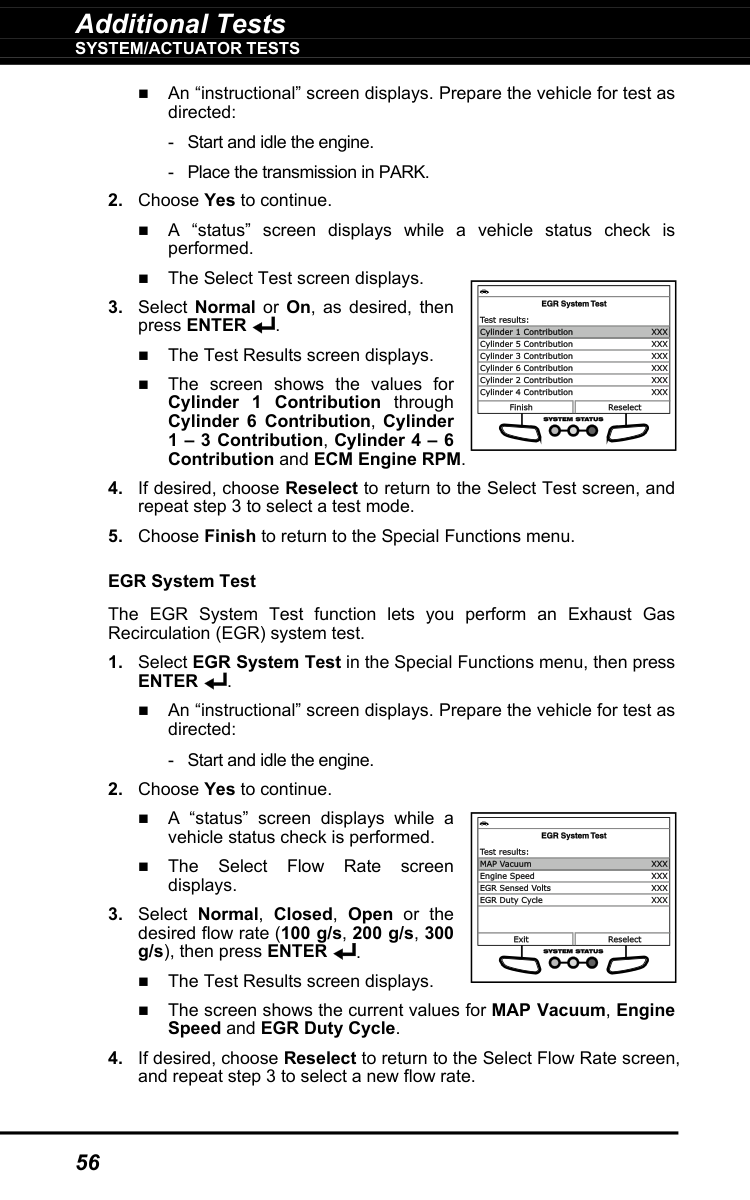
  • Turn the ignition on. DO NOT start the engine.
  • Choose Yes to continue.
  •  A “status” screen displays while a vehicle status check is performed.
  • A “confirmation” screen displays when the learn routine begins.
  •  An “instructional” screen displays while the procedure is in progress. Perform the following when prompted:

    Page 55

    Additional Tests

    System/Actuator Tests

    53

  • Start and run the engine until engine coolant temperature is
  • greater than 70°C (158°F).  A “results” screen displays when the learn procedure has completed.
  • Choose Finish to return to the Special Functions menu.
  • Idle Up Feature Enable The Idle Up Feature Enable function lets you enable or disable the idle up feature.
  • Select Idle Up Feature Enable in the Special Functions menu, then
  • press ENTER .  An “informational” screen displays.
  • Choose Yes to continue.
  •  The Select Mode screen displays.
  • Select Enable or Disable, as desired, then press ENTER
  • .  A “confirmation” screen displays.
  • Choose Finish to return to the Special Functions menu.
  • IMA Rapid Calibration The IMA Rapid Calibration function lets you perform the Integrated Motor Assist (IMA) calibration procedure.
  • Select IMA Rapid Calibration in the Special Functions menu, then
  • press ENTER .  An “instructional” screen displays. Prepare the vehicle for test as directed:
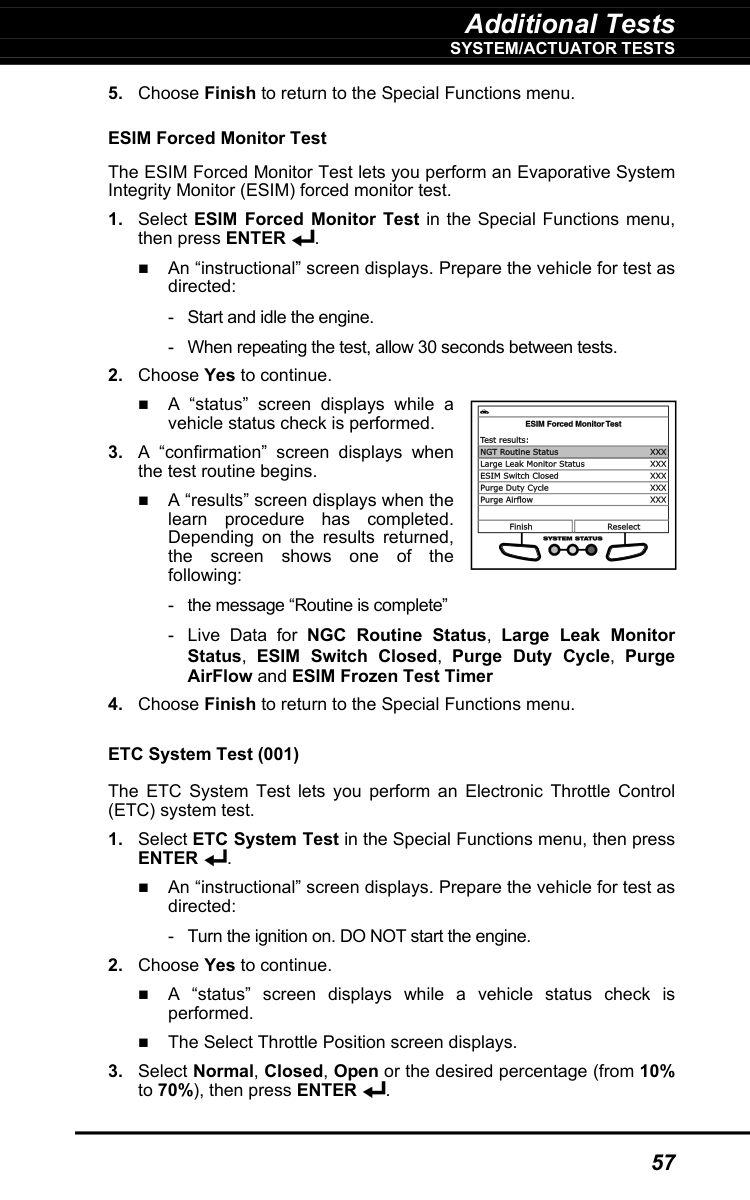
  • Turn the ignition on. DO NOT start the engine.
  • Choose Yes to continue.
  •  A “status” screen displays while a vehicle status check is performed.
  • A “confirmation” screen displays when the calibration routine begins.
  •  A “results” screen displays when the learn procedure has completed.
  • Choose Finish to return to the Special Functions menu.
  • Learn ETC (001 / 002) The Learn ETC function lets you perform the Electronic Throttle Control (ETC) learn procedure.
  • Select Learn ETC in the Special Functions menu, then press
  • Enter

    .

    Page 56

    Additional Tests

    System/Actuator Tests

    54

     An “instructional” screen displays. Prepare the vehicle for test as directed:
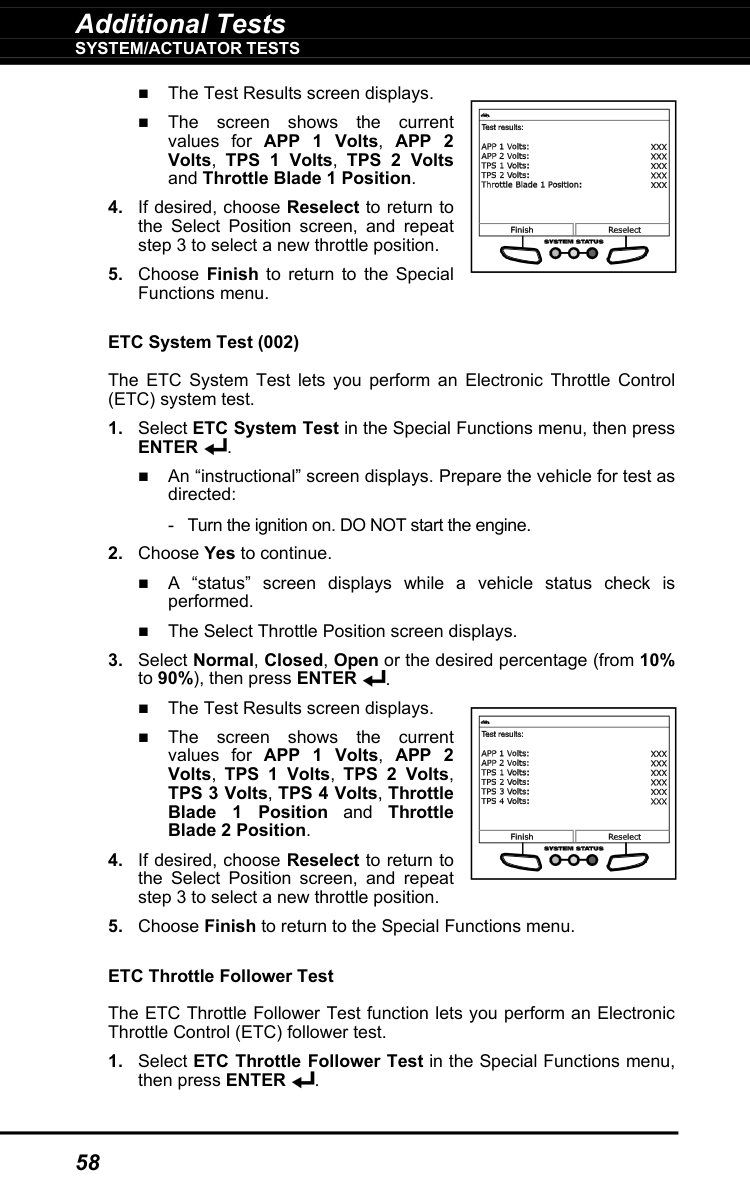
  • Turn the ignition on. DO NOT start the engine.
  • Choose Yes to continue.
  •  A “status” screen displays while a vehicle status check is performed.
  • A “confirmation” screen displays when
  • the learn routine begins.  A series of “instructional” screens display while the procedure is in progress. Perform the following when prompted:
  • Press and hold the accelerator
  • pedal.
  • Release the accelerator pedal.
  •  A “results” screen displays when the learn procedure has completed.
  • Choose Finish to return to the Special
  • Functions menu. Manual DPF Regeneration (001) The Manual DPF Regeneration function lets you perform the Diesel Particulate Filter (DPF) regeneration procedure.
  • Select Manual DPF Regeneration in the Special Functions menu,
  • then press ENTER .  An “instructional” screen displays. Prepare the vehicle for test as directed:
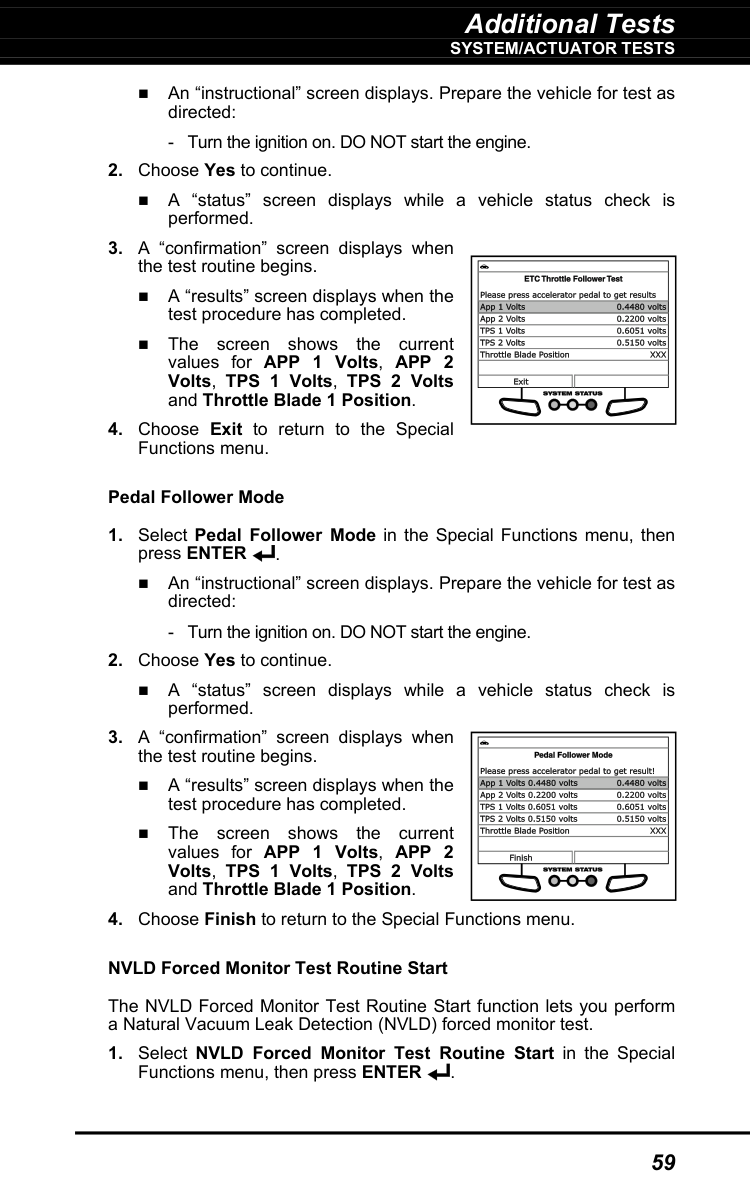
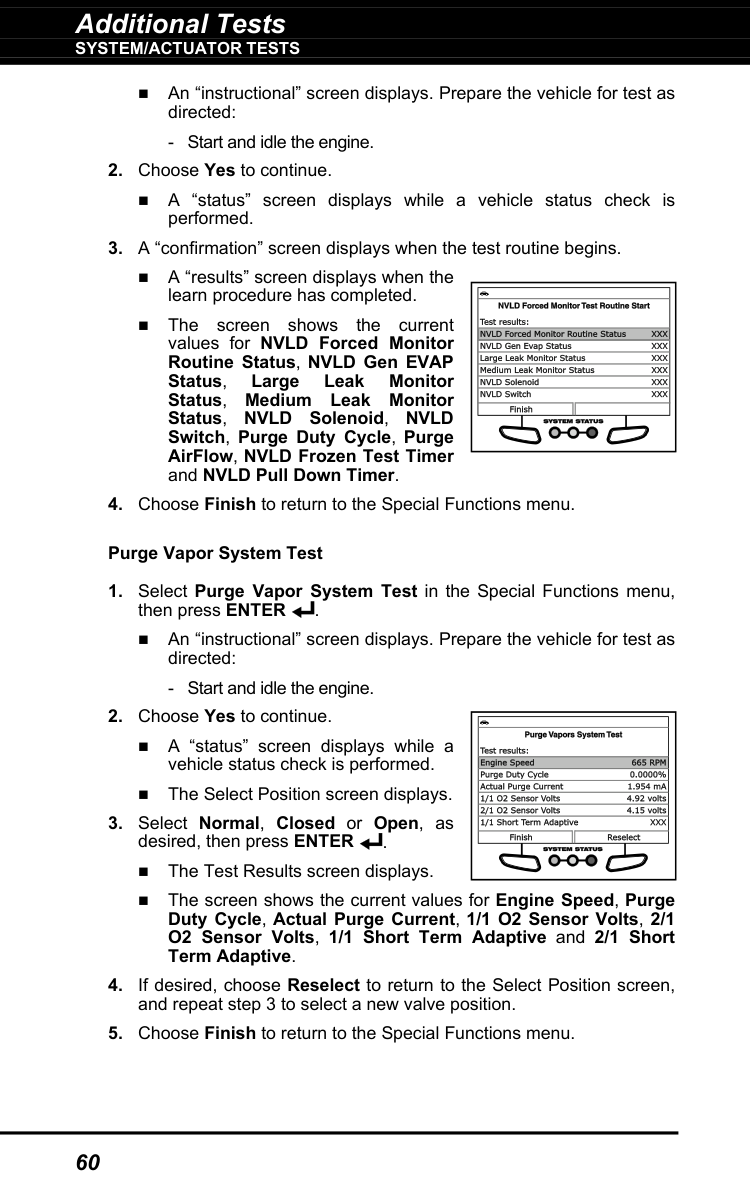
  • Start and idle the engine.
  • Choose Yes to continue.
  •  A “status” screen displays while a vehicle status check is performed.
  • An “informational” screen displays, and
  • engine speed increases.
  • When engine speed returns to normal,
  • choose Finish to return to the Special Functions menu. Manual DPF Regeneration (002) The Manual DPF Regeneration function lets you perform the Diesel Particulate Filter (DPF) regeneration procedure.
  • Select Manual DPF Regeneration in the Special Functions menu,
  • then press ENTER .

    Page 57

    Additional Tests

    System/Actuator Tests

    55

     An “instructional” screen displays. Prepare the vehicle for test as directed:
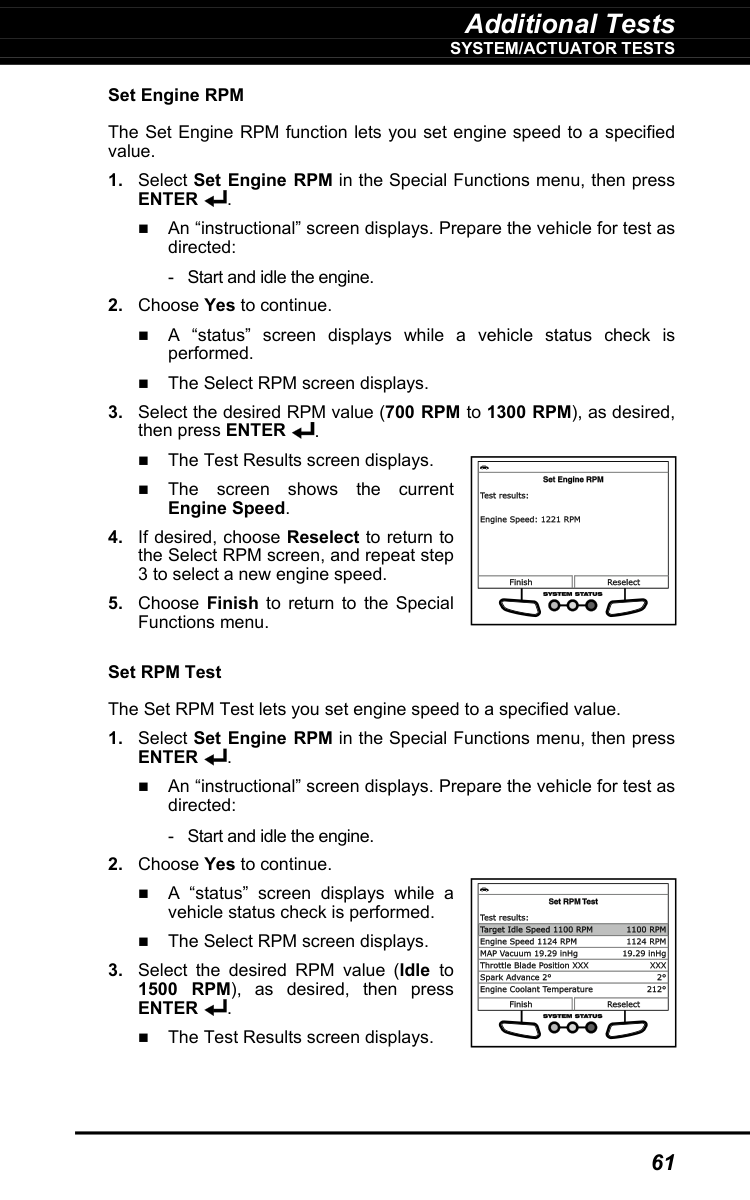
  • Start and idle the engine.
  • Choose Yes to continue.
  •  A “status” screen displays while a vehicle status check is performed.
  • A “confirmation” screen displays when
  • the test routine begins.
  • An “informational” screen displays, and
  • engine speed increases.
  • When engine speed returns to normal,
  • choose Finish to return to the Special Functions menu. Compression Test
  • Select Compression Test in the Special Functions menu, then
  • press ENTER .  An “instructional” screen displays. Prepare the vehicle for test as directed:
  • Make sure the battery is fully charged.
  • Turn the ignition on. DO NOT start the engine.
  • Choose Yes to continue.
  •  A “status” screen displays while a vehicle status check is performed.
  • A “confirmation” screen displays when the compression test begins.
  •  An “instructional” screen displays.
  • Crank the engine.
  •  While the engine is cranked, the screen shows Live Data for the Average Engine RPM, Current Injection Mass, and Engine RPM for Cylinder 1 through Engine RPM for Cylinder 8, as applicable.
  • Choose Finish to return to the Special Functions menu.
  • Cylinder Performance Test The Cylinder Performance Test function lets you perform a cylinder performance test.
  • Select Cylinder Performance Test in the Special Functions menu,
  • then press ENTER .

    Page 58

    Additional Tests

    System/Actuator Tests

    56

     An “instructional” screen displays. Prepare the vehicle for test as directed:

  • Start and idle the engine.
  • Place the transmission in PARK.
  • Choose Yes to continue.
  •  A “status” screen displays while a vehicle status check is performed.  The Select Test screen displays.
  • Select Normal or On, as desired, then
  • press ENTER .  The Test Results screen displays.  The screen shows the values for Cylinder 1 Contribution through Cylinder 6 Contribution, Cylinder 1 – 3 Contribution, Cylinder 4 – 6 Contribution and ECM Engine RPM.
  • If desired, choose Reselect to return to the Select Test screen, and
  • repeat step 3 to select a test mode.
  • Choose Finish to return to the Special Functions menu.
  • EGR System Test The EGR System Test function lets you perform an Exhaust Gas Recirculation (EGR) system test.
  • Select EGR System Test in the Special Functions menu, then press
  • Enter

    .  An “instructional” screen displays. Prepare the vehicle for test as directed:
  • Start and idle the engine.
  • Choose Yes to continue.
  •  A “status” screen displays while a vehicle status check is performed.  The Select Flow Rate screen displays.
  • Select Normal, Closed, Open or the
  • desired flow rate (100 g/s, 200 g/s, 300 g/s), then press ENTER .  The Test Results screen displays.  The screen shows the current values for MAP Vacuum, Engine Speed and EGR Duty Cycle.
  • If desired, choose Reselect to return to the Select Flow Rate screen,
  • and repeat step 3 to select a new flow rate.

    Page 59

    Additional Tests

    System/Actuator Tests

    57

  • Choose Finish to return to the Special Functions menu.
  • ESIM Forced Monitor Test The ESIM Forced Monitor Test lets you perform an Evaporative System Integrity Monitor (ESIM) forced monitor test.
  • Select ESIM Forced Monitor Test in the Special Functions menu,
  • then press ENTER .  An “instructional” screen displays. Prepare the vehicle for test as directed:
  • Start and idle the engine.
  • When repeating the test, allow 30 seconds between tests.
  • Choose Yes to continue.
  •  A “status” screen displays while a vehicle status check is performed.
  • A “confirmation” screen displays when
  • the test routine begins.  A “results” screen displays when the learn procedure has completed. Depending on the results returned, the screen shows one of the following:
  • the message “Routine is complete”
  • Live Data for NGC Routine Status, Large Leak Monitor
  • Status, ESIM Switch Closed, Purge Duty Cycle, Purge AirFlow and ESIM Frozen Test Timer
  • Choose Finish to return to the Special Functions menu.
  • ETC System Test (001) The ETC System Test lets you perform an Electronic Throttle Control (ETC) system test.
  • Select ETC System Test in the Special Functions menu, then press
  • Enter

    .  An “instructional” screen displays. Prepare the vehicle for test as directed:
  • Turn the ignition on. DO NOT start the engine.
  • Choose Yes to continue.
  •  A “status” screen displays while a vehicle status check is performed.  The Select Throttle Position screen displays.
  • Select Normal, Closed, Open or the desired percentage (from 10%
  • to 70%), then press ENTER .

    Page 60

    Additional Tests

    System/Actuator Tests

    58

     The Test Results screen displays.  The screen shows the current values for APP 1 Volts, APP 2 Volts, TPS 1 Volts, TPS 2 Volts and Throttle Blade 1 Position.

  • If desired, choose Reselect to return to
  • the Select Position screen, and repeat step 3 to select a new throttle position.
  • Choose Finish to return to the Special
  • Functions menu. ETC System Test (002) The ETC System Test lets you perform an Electronic Throttle Control (ETC) system test.
  • Select ETC System Test in the Special Functions menu, then press
  • Enter

    .  An “instructional” screen displays. Prepare the vehicle for test as directed:
  • Turn the ignition on. DO NOT start the engine.
  • Choose Yes to continue.
  •  A “status” screen displays while a vehicle status check is performed.  The Select Throttle Position screen displays.
  • Select Normal, Closed, Open or the desired percentage (from 10%
  • to 90%), then press ENTER .  The Test Results screen displays.  The screen shows the current values for APP 1 Volts, APP 2 Volts, TPS 1 Volts, TPS 2 Volts, TPS 3 Volts, TPS 4 Volts, Throttle Blade 1 Position and Throttle Blade 2 Position.
  • If desired, choose Reselect to return to
  • the Select Position screen, and repeat step 3 to select a new throttle position.
  • Choose Finish to return to the Special Functions menu.
  • ETC Throttle Follower Test The ETC Throttle Follower Test function lets you perform an Electronic Throttle Control (ETC) follower test.
  • Select ETC Throttle Follower Test in the Special Functions menu,
  • then press ENTER .

    Page 61

    Additional Tests

    System/Actuator Tests

    59

     An “instructional” screen displays. Prepare the vehicle for test as directed:

  • Turn the ignition on. DO NOT start the engine.
  • Choose Yes to continue.
  •  A “status” screen displays while a vehicle status check is performed.
  • A “confirmation” screen displays when
  • the test routine begins.  A “results” screen displays when the test procedure has completed.  The screen shows the current values for APP 1 Volts, APP 2 Volts, TPS 1 Volts, TPS 2 Volts and Throttle Blade 1 Position.
  • Choose Exit to return to the Special
  • Functions menu. Pedal Follower Mode
  • Select Pedal Follower Mode in the Special Functions menu, then
  • press ENTER .  An “instructional” screen displays. Prepare the vehicle for test as directed:
  • Turn the ignition on. DO NOT start the engine.
  • Choose Yes to continue.
  •  A “status” screen displays while a vehicle status check is performed.
  • A “confirmation” screen displays when
  • the test routine begins.  A “results” screen displays when the test procedure has completed.  The screen shows the current values for APP 1 Volts, APP 2 Volts, TPS 1 Volts, TPS 2 Volts and Throttle Blade 1 Position.
  • Choose Finish to return to the Special Functions menu.
  • NVLD Forced Monitor Test Routine Start The NVLD Forced Monitor Test Routine Start function lets you perform a Natural Vacuum Leak Detection (NVLD) forced monitor test.
  • Select NVLD Forced Monitor Test Routine Start in the Special
  • Functions menu, then press ENTER .

    Page 62

    Additional Tests

    System/Actuator Tests

    60

     An “instructional” screen displays. Prepare the vehicle for test as directed:

  • Start and idle the engine.
  • Choose Yes to continue.
  •  A “status” screen displays while a vehicle status check is performed.
  • A “confirmation” screen displays when the test routine begins.
  •  A “results” screen displays when the learn procedure has completed.  The screen shows the current values for NVLD Forced Monitor Routine Status, NVLD Gen EVAP Status, Large Leak Monitor Status, Medium Leak Monitor Status, NVLD Solenoid, NVLD Switch, Purge Duty Cycle, Purge AirFlow, NVLD Frozen Test Timer and NVLD Pull Down Timer.
  • Choose Finish to return to the Special Functions menu.
  • Purge Vapor System Test
  • Select Purge Vapor System Test in the Special Functions menu,
  • then press ENTER .  An “instructional” screen displays. Prepare the vehicle for test as directed:
  • Start and idle the engine.
  • Choose Yes to continue.
  •  A “status” screen displays while a vehicle status check is performed.  The Select Position screen displays.
  • Select Normal, Closed or Open, as
  • desired, then press ENTER .  The Test Results screen displays.  The screen shows the current values for Engine Speed, Purge Duty Cycle, Actual Purge Current, 1/1 O2 Sensor Volts, 2/1 O2 Sensor Volts, 1/1 Short Term Adaptive and 2/1 Short Term Adaptive.
  • If desired, choose Reselect to return to the Select Position screen,
  • and repeat step 3 to select a new valve position.
  • Choose Finish to return to the Special Functions menu.
  • Page 63

    Additional Tests

    System/Actuator Tests

    61

    Set Engine RPM The Set Engine RPM function lets you set engine speed to a specified value.

  • Select Set Engine RPM in the Special Functions menu, then press
  • Enter

    .  An “instructional” screen displays. Prepare the vehicle for test as directed:
  • Start and idle the engine.
  • Choose Yes to continue.
  •  A “status” screen displays while a vehicle status check is performed.  The Select RPM screen displays.
  • Select the desired RPM value (700 RPM to 1300 RPM), as desired,
  • then press ENTER .  The Test Results screen displays.  The screen shows the current Engine Speed.
  • If desired, choose Reselect to return to
  • the Select RPM screen, and repeat step 3 to select a new engine speed.
  • Choose Finish to return to the Special
  • Functions menu. Set RPM Test The Set RPM Test lets you set engine speed to a specified value.
  • Select Set Engine RPM in the Special Functions menu, then press
  • Enter

    .  An “instructional” screen displays. Prepare the vehicle for test as directed:
  • Start and idle the engine.
  • Choose Yes to continue.
  •  A “status” screen displays while a vehicle status check is performed.  The Select RPM screen displays.
  • Select the desired RPM value (Idle to
  • 1500 RPM), as desired, then press

    Enter

    .  The Test Results screen displays.

    Page 64

    Additional Tests

    System/Actuator Tests

    62

     The screen shows the current Target Idle Speed, Engine Speed, MAP Vacuum, Throttle Blade Position, Spark Advance and Engine Coolant Temperature.
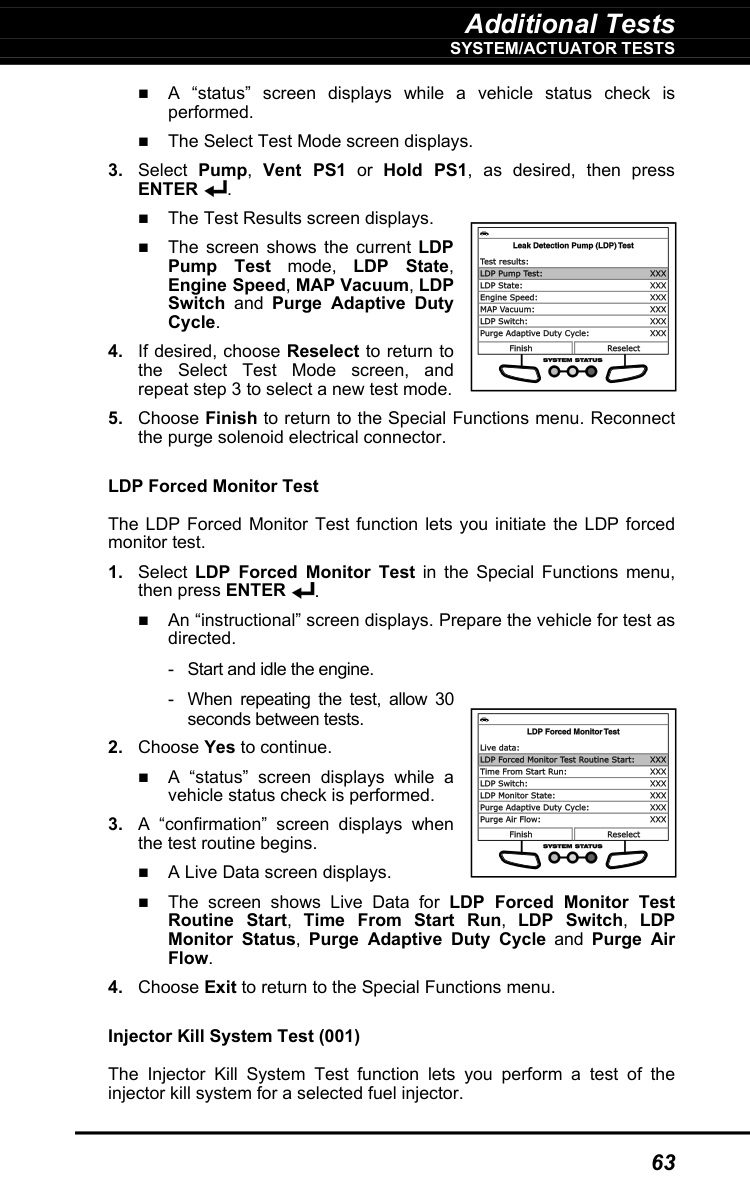
  • If desired, choose Reselect to return to the Select RPM screen, and
  • repeat step 3 to select a new engine speed.
  • Choose Finish to return to the Special Functions menu.
  • Set Engine RPM System Test The Set Engine RPM System Test lets you set engine speed to a specified value.
  • Select Set Engine RPM System Test in the Special Functions
  • menu, then press ENTER .  An “instructional” screen displays. Prepare the vehicle for test as directed:
  • Start and idle the engine.
  • Choose Yes to continue.
  •  A “status” screen displays while a vehicle status check is performed.  The Select RPM screen displays.
  • Select the desired RPM value (Idle to 1200 RPM), as desired, then
  • press ENTER .  The Test Results screen displays.  The screen shows the current Target Idle Speed, Engine Speed, MAP Vacuum, Throttle Blade 1 Position, Throttle Blade 2 Position, Spark Advance and Engine Coolant Temperature.
  • If desired, choose Reselect to return to
  • the Select RPM screen, and repeat step 3 to select a new engine speed.
  • Choose Finish to return to the Special Functions menu.
  • Leak Detection Pump (LDP) Test
  • Select Leak Detection Pump (LDP) Test in the Special Functions
  • menu, then press ENTER .  An “instructional” screen displays. Prepare the vehicle for test as directed.
  • Disconnect the purge solenoid electrical connector.
  • Start and idle the engine.
  • Choose Yes to continue.
  • Page 65

    Additional Tests

    System/Actuator Tests

    63

     A “status” screen displays while a vehicle status check is performed.  The Select Test Mode screen displays.

  • Select Pump, Vent PS1 or Hold PS1, as desired, then press
  • Enter

    .  The Test Results screen displays.  The screen shows the current LDP Pump Test mode, LDP State, Engine Speed, MAP Vacuum, LDP Switch and Purge Adaptive Duty Cycle.
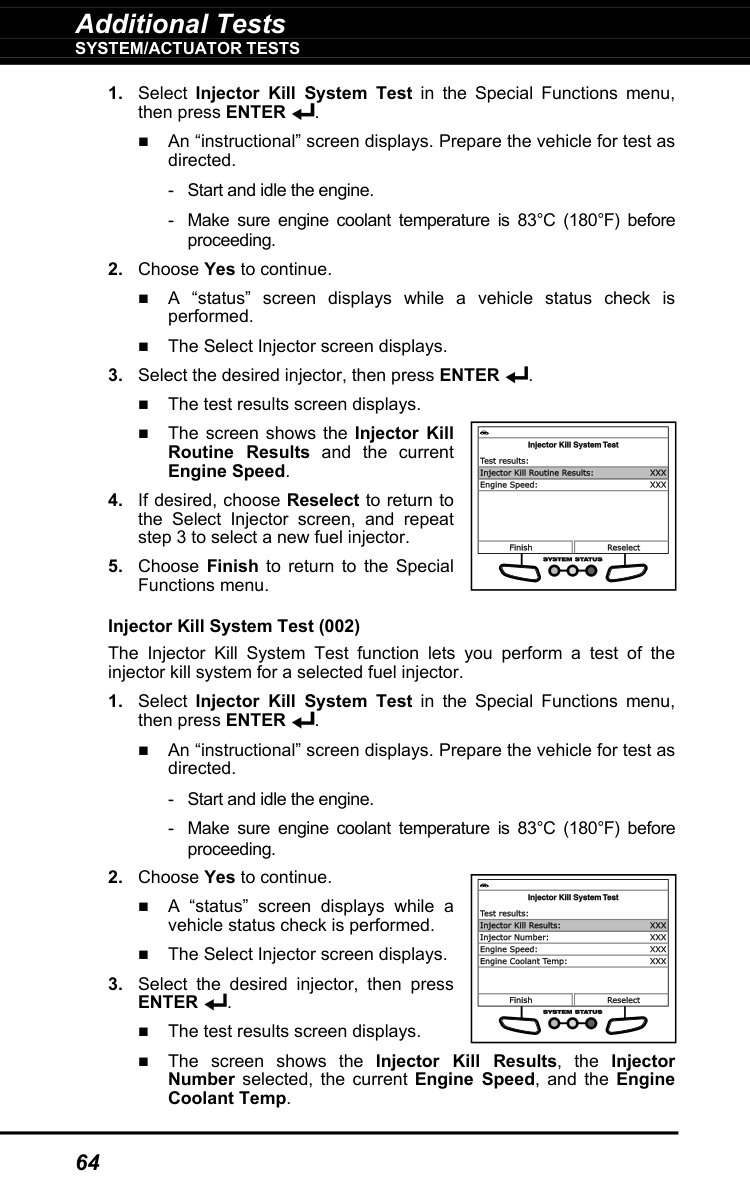
  • If desired, choose Reselect to return to
  • the Select Test Mode screen, and repeat step 3 to select a new test mode.
  • Choose Finish to return to the Special Functions menu. Reconnect
  • the purge solenoid electrical connector. LDP Forced Monitor Test The LDP Forced Monitor Test function lets you initiate the LDP forced monitor test.
  • Select LDP Forced Monitor Test in the Special Functions menu,
  • then press ENTER .  An “instructional” screen displays. Prepare the vehicle for test as directed.
  • Start and idle the engine.
  • When repeating the test, allow 30
  • seconds between tests.
  • Choose Yes to continue.
  •  A “status” screen displays while a vehicle status check is performed.
  • A “confirmation” screen displays when
  • the test routine begins.  A Live Data screen displays.  The screen shows Live Data for LDP Forced Monitor Test Routine Start, Time From Start Run, LDP Switch, LDP Monitor Status, Purge Adaptive Duty Cycle and Purge Air Flow.
  • Choose Exit to return to the Special Functions menu.
  • Injector Kill System Test (001) The Injector Kill System Test function lets you perform a test of the injector kill system for a selected fuel injector.

    Page 66

    Additional Tests

    System/Actuator Tests

    64

  • Select Injector Kill System Test in the Special Functions menu,
  • then press ENTER .  An “instructional” screen displays. Prepare the vehicle for test as directed.
  • Start and idle the engine.
  • Make sure engine coolant temperature is 83°C (180°F) before
  • proceeding.
  • Choose Yes to continue.
  •  A “status” screen displays while a vehicle status check is performed.  The Select Injector screen displays.
  • Select the desired injector, then press ENTER
  • .  The test results screen displays.  The screen shows the Injector Kill Routine Results and the current Engine Speed.
  • If desired, choose Reselect to return to
  • the Select Injector screen, and repeat step 3 to select a new fuel injector.
  • Choose Finish to return to the Special
  • Functions menu. Injector Kill System Test (002) The Injector Kill System Test function lets you perform a test of the injector kill system for a selected fuel injector.
  • Select Injector Kill System Test in the Special Functions menu,
  • then press ENTER .  An “instructional” screen displays. Prepare the vehicle for test as directed.
  • Start and idle the engine.
  • Make sure engine coolant temperature is 83°C (180°F) before
  • proceeding.
  • Choose Yes to continue.
  •  A “status” screen displays while a vehicle status check is performed.  The Select Injector screen displays.
  • Select the desired injector, then press
  • Enter

    .  The test results screen displays.  The screen shows the Injector Kill Results, the Injector Number selected, the current Engine Speed, and the Engine Coolant Temp.
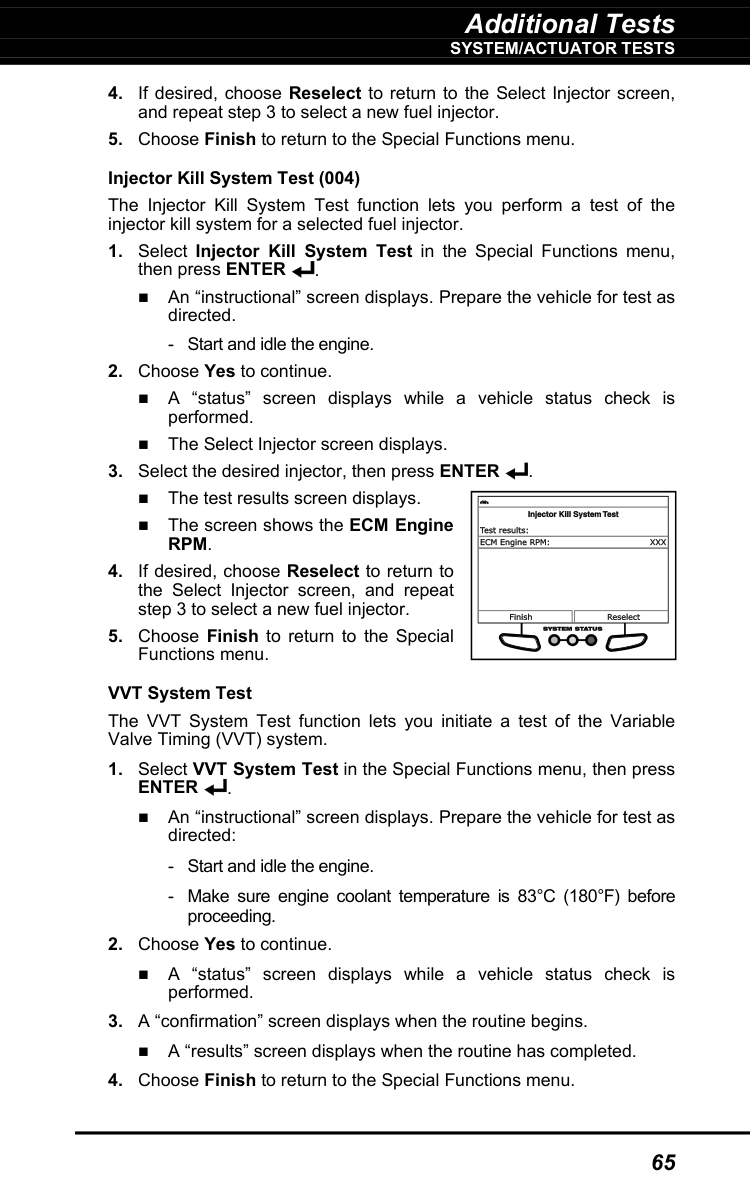
    Page 67

    Additional Tests

    System/Actuator Tests

    65

  • If desired, choose Reselect to return to the Select Injector screen,
  • and repeat step 3 to select a new fuel injector.
  • Choose Finish to return to the Special Functions menu.
  • Injector Kill System Test (004) The Injector Kill System Test function lets you perform a test of the injector kill system for a selected fuel injector.
  • Select Injector Kill System Test in the Special Functions menu,
  • then press ENTER .  An “instructional” screen displays. Prepare the vehicle for test as directed.
  • Start and idle the engine.
  • Choose Yes to continue.
  •  A “status” screen displays while a vehicle status check is performed.  The Select Injector screen displays.
  • Select the desired injector, then press ENTER
  • .  The test results screen displays.  The screen shows the ECM Engine

    Rpm.

  • If desired, choose Reselect to return to
  • the Select Injector screen, and repeat step 3 to select a new fuel injector.
  • Choose Finish to return to the Special
  • Functions menu. VVT System Test The VVT System Test function lets you initiate a test of the Variable Valve Timing (VVT) system.
  • Select VVT System Test in the Special Functions menu, then press
  • Enter

    .  An “instructional” screen displays. Prepare the vehicle for test as directed:
  • Start and idle the engine.
  • Make sure engine coolant temperature is 83°C (180°F) before
  • proceeding.
  • Choose Yes to continue.
  •  A “status” screen displays while a vehicle status check is performed.
  • A “confirmation” screen displays when the routine begins.
  •  A “results” screen displays when the routine has completed.
  • Choose Finish to return to the Special Functions menu.
  • Page 68

    Additional Tests

    System/Actuator Tests

    66

    Reverse Brake Torque Test

  • Select Reverse Brake Torque Test in the Special Functions menu,
  • then press ENTER .  An “instructional” screen displays. Prepare the vehicle for test as directed:
  • Start and idle the engine.
  • Make sure transmission fluid temperature is 27°C (80°F)
  • minimum
  • Set the parking brake.
  • Press and hold the brake pedal.
  • Place the transmission in REVERSE.
  • Choose Yes to continue.
  •  A “status” screen displays while a vehicle status check is performed.
  • A “confirmation” screen displays when
  • the test routine begins.  A “results” screen displays when the test has completed.  The screen shows the current Engine Speed, Turbine Speed and Output Speed, the Throttle Position Sensor Voltage an the Present Gear.
  • Choose Finish to return to the Special Functions menu.
  • PTO & Idle Up The PTO & Idle Up function lets you perform a Power Take-Off (PTO) and Idle Up test.
  • Select PTO & Idle Up in the Special Functions menu, then press
  • Enter

    .  An “instructional” screen displays. Prepare the vehicle for test as directed:
  • Turn the ignition on. DO NOT start the engine.
  • Choose Yes to continue.
  •  A “status” screen displays while a vehicle status check is performed.  The PTO Remote Speed screen displays.
  • Select Next to continue.
  •  The Select Speed screen displays.
  • Select the desired PTO remote speed, then press ENTER
  • .  The Enter Value screen displays.

    Page 69

    Additional Tests

    System/Actuator Tests

    67
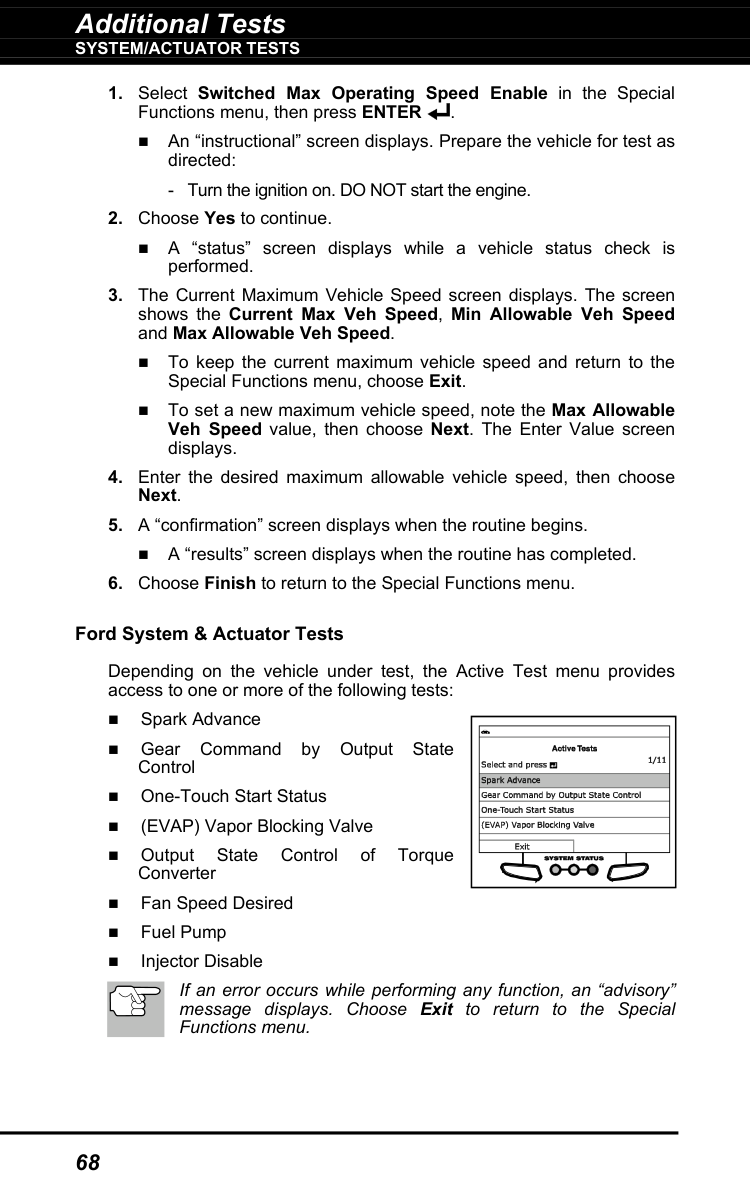
  • Enter the desired RPM value (from 900 to 2000), then choose Next
  • to continue.
  • A “confirmation” screen displays when the test routine begins.
  •  A “results” screen displays when the routine has completed.
  • Choose Finish to return to the Special Functions menu.
  • Minimum Airflow Test Routine Start The Minimum Airflow Test Routine Start function lets you reset the Mass Airflow (MAF) sensor values.
  • Select Minimum Airflow Test Routine Start in the Special
  • Functions menu, then press ENTER .  An “informational” screen displays.
  • Choose Yes to continue.
  • A “confirmation” screen displays when the routine begins.
  •  A “results” screen displays when the routine has completed.
  • Choose Finish to return to the Special Functions menu.
  • EGR Desired Delta Position The EGR Desired Delta Position function lets you reset the Delta position of the Exhaust Gas Recirculation (EGR) valve.
  • Select EGR Desired Delta Position in the Special Functions menu,
  • then press ENTER .  An “instructional” screen displays. Prepare the vehicle for test as directed:
  • Start and idle the engine.
  • Place the transmission in PARK.
  • DO NOT press the accelerator pedal or brake pedal.
  • Make sure engine coolant temperature is 85°C (185°F) before
  • proceeding.
  • Choose Yes to continue.
  •  A “status” screen displays while a vehicle status check is performed.
  • A “confirmation” screen displays when the routine begins.
  •  A “countdown” timer displays.  A “results” screen displays when the routine has completed.
  • Choose Finish to return to the Special Functions menu.
  • Switched Max Operating Speed Enable The Switch Max Operating Speed Enable function lets you set the maximum allowable vehicle speed.

    Page 70

    Additional Tests

    System/Actuator Tests

    68
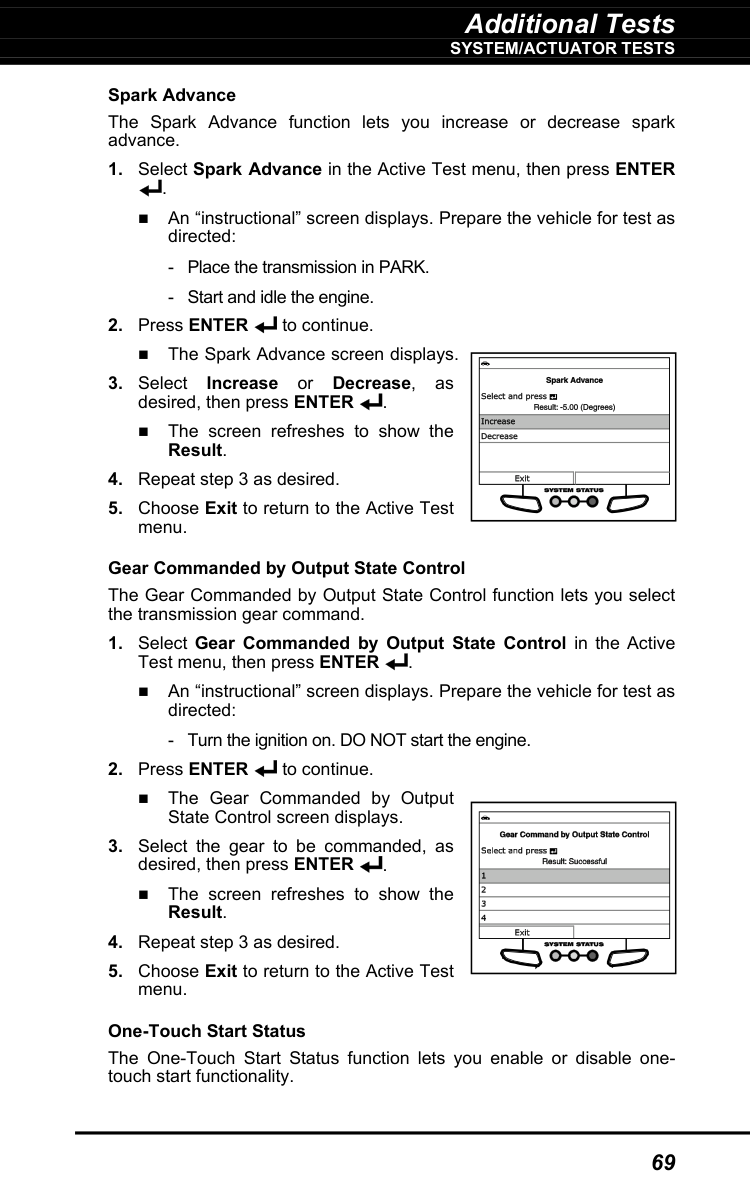
  • Select Switched Max Operating Speed Enable in the Special
  • Functions menu, then press ENTER .  An “instructional” screen displays. Prepare the vehicle for test as directed:
  • Turn the ignition on. DO NOT start the engine.
  • Choose Yes to continue.
  •  A “status” screen displays while a vehicle status check is performed.
  • The Current Maximum Vehicle Speed screen displays. The screen
  • shows the Current Max Veh Speed, Min Allowable Veh Speed and Max Allowable Veh Speed.  To keep the current maximum vehicle speed and return to the Special Functions menu, choose Exit.  To set a new maximum vehicle speed, note the Max Allowable Veh Speed value, then choose Next. The Enter Value screen displays.
  • Enter the desired maximum allowable vehicle speed, then choose
  • Next.
  • A “confirmation” screen displays when the routine begins.
  •  A “results” screen displays when the routine has completed.
  • Choose Finish to return to the Special Functions menu.
  • Ford System & Actuator Tests Depending on the vehicle under test, the Active Test menu provides access to one or more of the following tests:  Spark Advance  Gear Command by Output State Control  One-Touch Start Status  (EVAP) Vapor Blocking Valve  Output State Control of Torque Converter  Fan Speed Desired  Fuel Pump  Injector Disable If an error occurs while performing any function, an “advisory” message displays. Choose Exit to return to the Special Functions menu.

    Page 71

    Additional Tests

    System/Actuator Tests

    69

    Spark Advance The Spark Advance function lets you increase or decrease spark advance.
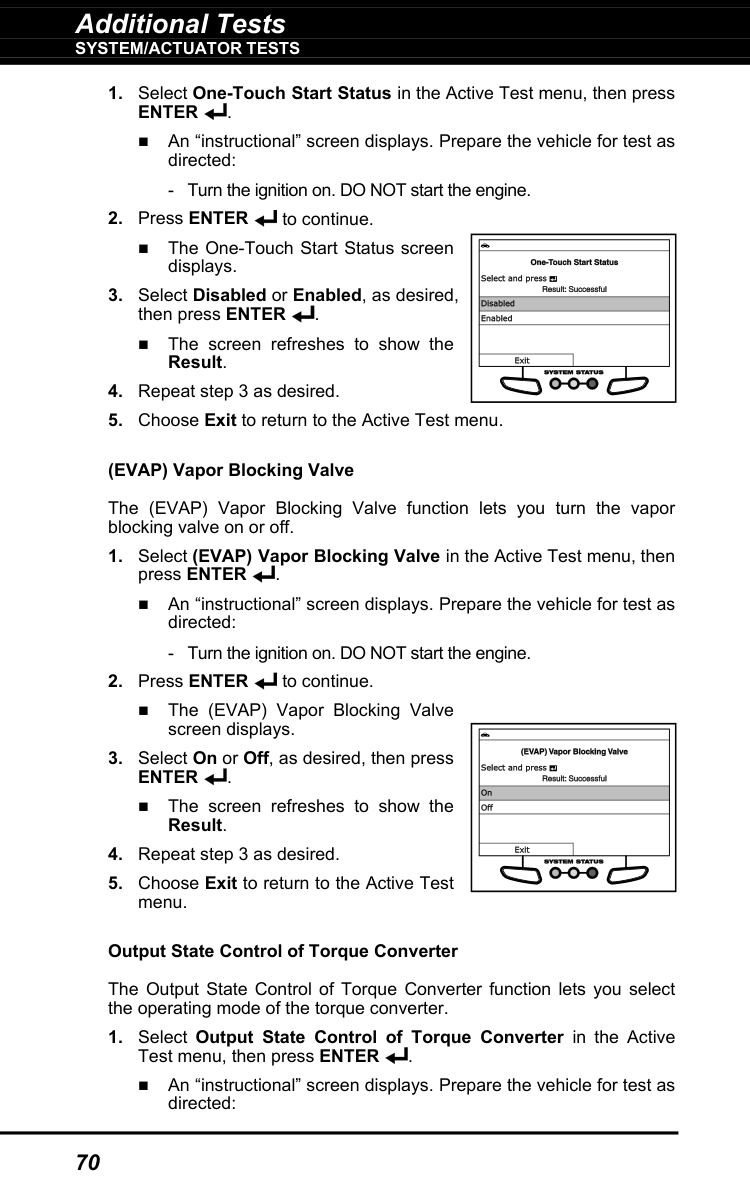
  • Select Spark Advance in the Active Test menu, then press ENTER
  • .  An “instructional” screen displays. Prepare the vehicle for test as directed:
  • Place the transmission in PARK.
  • Start and idle the engine.
  • Press ENTER
  • to continue.  The Spark Advance screen displays.
  • Select
  • Increase or Decrease, as desired, then press ENTER .  The screen refreshes to show the Result.
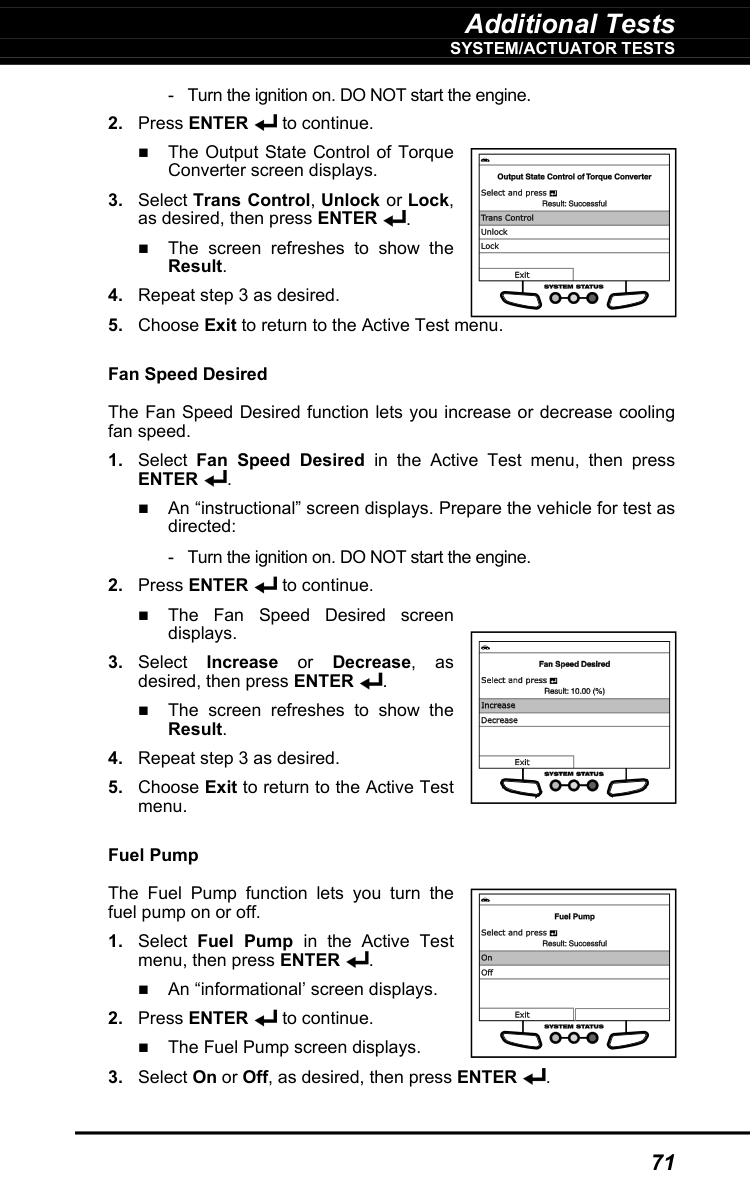
  • Repeat step 3 as desired.
  • Choose Exit to return to the Active Test
  • menu. Gear Commanded by Output State Control The Gear Commanded by Output State Control function lets you select the transmission gear command.
  • Select Gear Commanded by Output State Control in the Active
  • Test menu, then press ENTER .  An “instructional” screen displays. Prepare the vehicle for test as directed:
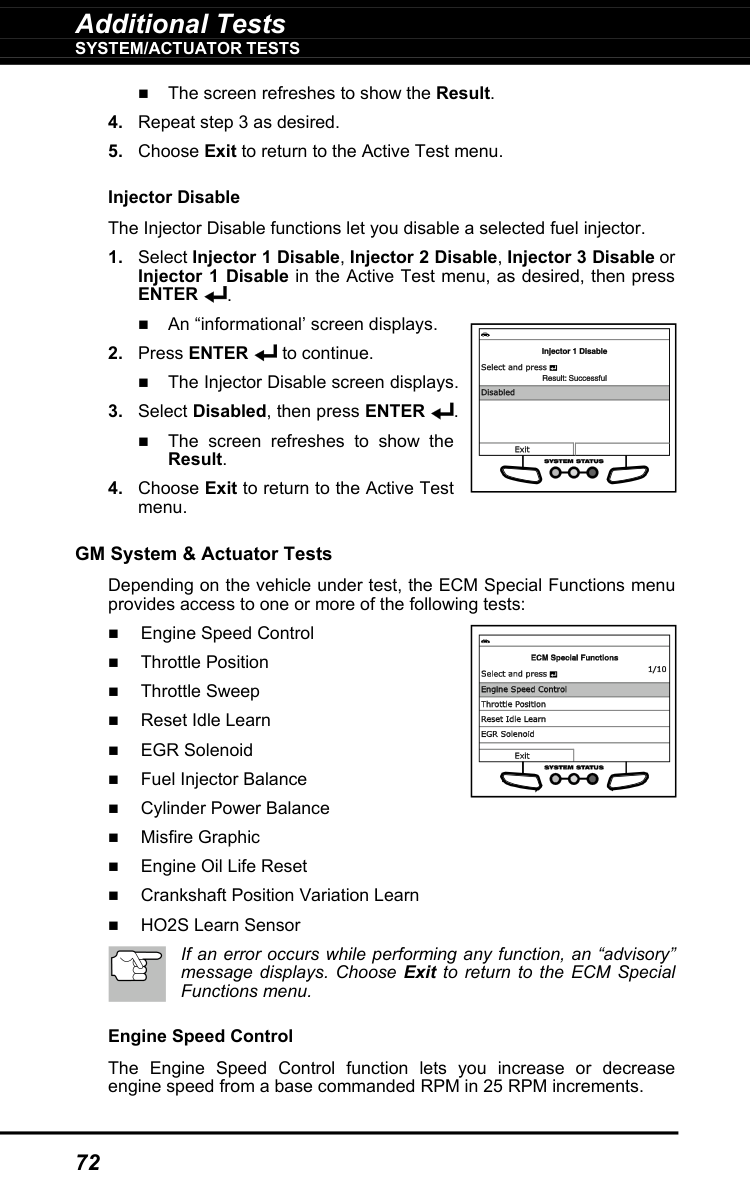
  • Turn the ignition on. DO NOT start the engine.
  • Press ENTER
  • to continue.  The Gear Commanded by Output State Control screen displays.
  • Select the gear to be commanded, as
  • desired, then press ENTER .  The screen refreshes to show the Result.
  • Repeat step 3 as desired.
  • Choose Exit to return to the Active Test
  • menu. One-Touch Start Status The One-Touch Start Status function lets you enable or disable one- touch start functionality.

    Page 72

    Additional Tests

    System/Actuator Tests

    70

  • Select One-Touch Start Status in the Active Test menu, then press
  • Enter

    .  An “instructional” screen displays. Prepare the vehicle for test as directed:
  • Turn the ignition on. DO NOT start the engine.
  • Press ENTER
  • to continue.  The One-Touch Start Status screen displays.
  • Select Disabled or Enabled, as desired,
  • then press ENTER .  The screen refreshes to show the Result.
  • Repeat step 3 as desired.
  • Choose Exit to return to the Active Test menu.
  • (EVAP) Vapor Blocking Valve The (EVAP) Vapor Blocking Valve function lets you turn the vapor blocking valve on or off.
  • Select (EVAP) Vapor Blocking Valve in the Active Test menu, then
  • press ENTER .  An “instructional” screen displays. Prepare the vehicle for test as directed:
  • Turn the ignition on. DO NOT start the engine.
  • Press ENTER
  • to continue.  The (EVAP) Vapor Blocking Valve screen displays.
  • Select On or Off, as desired, then press
  • Enter

    .  The screen refreshes to show the Result.
  • Repeat step 3 as desired.
  • Choose Exit to return to the Active Test
  • menu. Output State Control of Torque Converter The Output State Control of Torque Converter function lets you select the operating mode of the torque converter.
  • Select Output State Control of Torque Converter in the Active
  • Test menu, then press ENTER .  An “instructional” screen displays. Prepare the vehicle for test as directed:

    Page 73

    Additional Tests

    System/Actuator Tests

    71

  • Turn the ignition on. DO NOT start the engine.
  • Press ENTER
  • to continue.  The Output State Control of Torque Converter screen displays.
  • Select Trans Control, Unlock or Lock,
  • as desired, then press ENTER .  The screen refreshes to show the Result.
  • Repeat step 3 as desired.
  • Choose Exit to return to the Active Test menu.
  • Fan Speed Desired The Fan Speed Desired function lets you increase or decrease cooling fan speed.
  • Select Fan Speed Desired in the Active Test menu, then press
  • Enter

    .  An “instructional” screen displays. Prepare the vehicle for test as directed:
  • Turn the ignition on. DO NOT start the engine.
  • Press ENTER
  • to continue.  The Fan Speed Desired screen displays.
  • Select
  • Increase or Decrease, as desired, then press ENTER .  The screen refreshes to show the Result.
  • Repeat step 3 as desired.
  • Choose Exit to return to the Active Test
  • menu. Fuel Pump The Fuel Pump function lets you turn the fuel pump on or off.
  • Select Fuel Pump in the Active Test
  • menu, then press ENTER .  An “informational’ screen displays.
  • Press ENTER
  • to continue.  The Fuel Pump screen displays.
  • Select On or Off, as desired, then press ENTER
  • .

    Page 74

    Additional Tests

    System/Actuator Tests

    72

     The screen refreshes to show the Result.

  • Repeat step 3 as desired.
  • Choose Exit to return to the Active Test menu.
  • Injector Disable The Injector Disable functions let you disable a selected fuel injector.
  • Select Injector 1 Disable, Injector 2 Disable, Injector 3 Disable or
  • Injector 1 Disable in the Active Test menu, as desired, then press

    Enter

    .  An “informational’ screen displays.
  • Press ENTER
  • to continue.  The Injector Disable screen displays.
  • Select Disabled, then press ENTER
  • .  The screen refreshes to show the Result.
  • Choose Exit to return to the Active Test
  • menu. GM System & Actuator Tests Depending on the vehicle under test, the ECM Special Functions menu provides access to one or more of the following tests:  Engine Speed Control  Throttle Position  Throttle Sweep  Reset Idle Learn  EGR Solenoid  Fuel Injector Balance  Cylinder Power Balance  Misfire Graphic  Engine Oil Life Reset  Crankshaft Position Variation Learn  HO2S Learn Sensor If an error occurs while performing any function, an “advisory” message displays. Choose Exit to return to the ECM Special Functions menu. Engine Speed Control The Engine Speed Control function lets you increase or decrease engine speed from a base commanded RPM in 25 RPM increments.

    Page 75

    Additional Tests

    System/Actuator Tests

    73
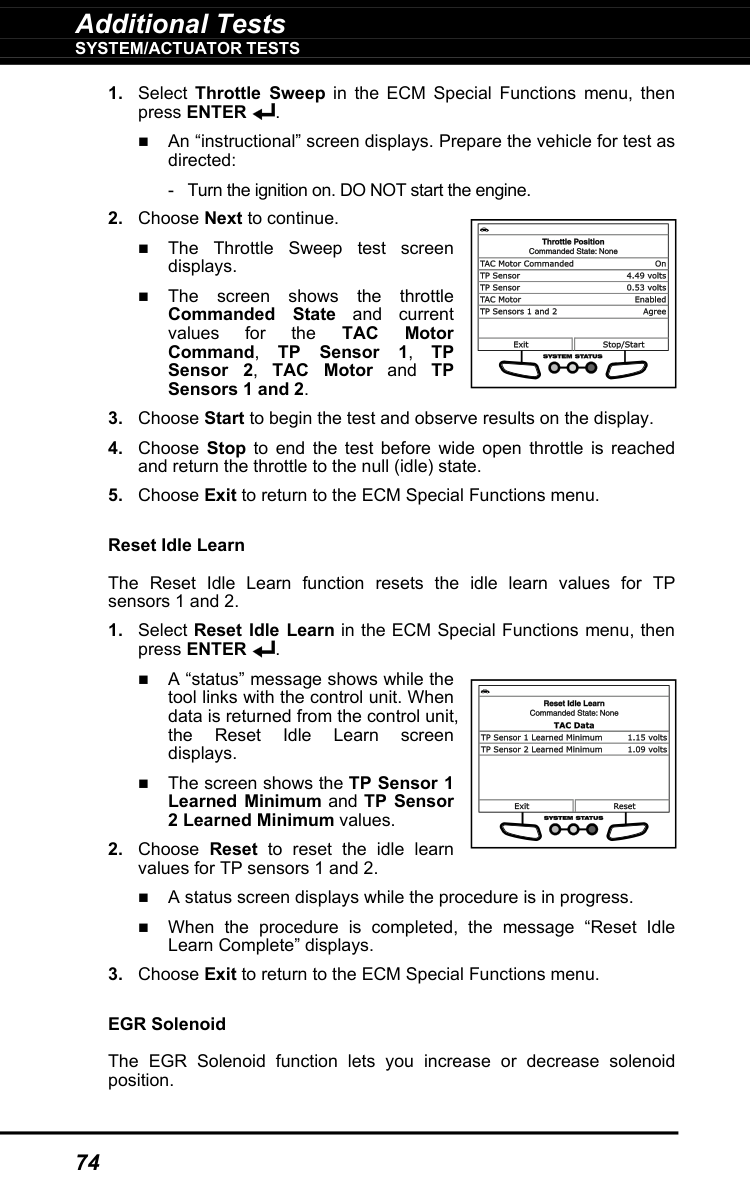
  • Select Engine Speed Control in the ECM Special Functions menu,
  • then press ENTER .  An “instructional” screen displays. Prepare the vehicle for test as directed:
  • Set the parking brake.
  • Block all drive wheels.
  • Start and idle the engine.
  • Choose Next to continue.
  •  Engine speed is commanded to 550 RPM and the RPM Control test screen displays.  The screen shows the Commanded RPM, actual Engine Speed, and the Desired Idle Speed.
  • Choose Decrease 25 RPM or Increase
  • 25 RPM, as desired, to decrease or increase engine speed, and observe results on the display.
  • To exit the test, press ENTER
  • to reduce the commanded engine speed to 0 RPM, then press ENTER again to return to the ECM Special Functions menu. Throttle Position The Throttle Position function lets you increase or decrease throttle position from the null (idle) state.
  • Select Throttle Position in the ECM Special Functions menu, then
  • press ENTER .  A “status” message shows while the tool links with the control unit. When a link is established with the control unit, the Throttle Position test screen displays.  The screen shows the Commanded State of the throttle, the TP Desired Angle, and the TP Indicated Angle.
  • Choose Decrease or Increase, as desired, to decrease or increase
  • the throttle position angle, and observe results on the display.
  • Press ENTER
  • to return to the ECM Special Functions menu. Throttle Sweep The Throttle Sweep function automatically moves the throttle from the null (idle) state to wide open throttle.

    Page 76

    Additional Tests

    System/Actuator Tests

    74

  • Select Throttle Sweep in the ECM Special Functions menu, then
  • press ENTER .  An “instructional” screen displays. Prepare the vehicle for test as directed:
  • Turn the ignition on. DO NOT start the engine.
  • Choose Next to continue.
  •  The Throttle Sweep test screen displays.  The screen shows the throttle Commanded State and current values for the

    Tac

    Motor Command, TP Sensor 1, TP Sensor 2, TAC Motor and TP Sensors 1 and 2.
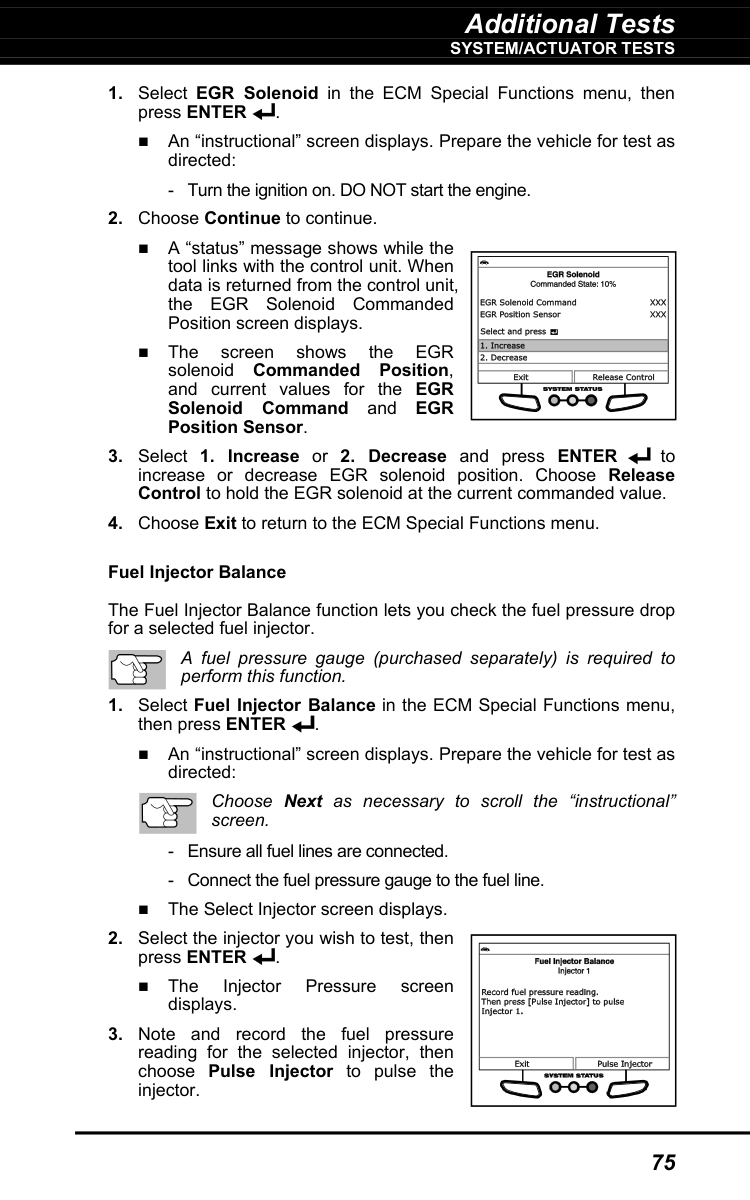
  • Choose Start to begin the test and observe results on the display.
  • Choose Stop to end the test before wide open throttle is reached
  • and return the throttle to the null (idle) state.
  • Choose Exit to return to the ECM Special Functions menu.
  • Reset Idle Learn The Reset Idle Learn function resets the idle learn values for TP sensors 1 and 2.
  • Select Reset Idle Learn in the ECM Special Functions menu, then
  • press ENTER .  A “status” message shows while the tool links with the control unit. When data is returned from the control unit, the Reset Idle Learn screen displays.  The screen shows the TP Sensor 1 Learned Minimum and TP Sensor 2 Learned Minimum values.
  • Choose Reset to reset the idle learn
  • values for TP sensors 1 and 2.  A status screen displays while the procedure is in progress.  When the procedure is completed, the message “Reset Idle Learn Complete” displays.
  • Choose Exit to return to the ECM Special Functions menu.
  • EGR Solenoid The EGR Solenoid function lets you increase or decrease solenoid position.

    Page 77

    Additional Tests

    System/Actuator Tests

    75

  • Select EGR Solenoid in the ECM Special Functions menu, then
  • press ENTER .  An “instructional” screen displays. Prepare the vehicle for test as directed:
  • Turn the ignition on. DO NOT start the engine.
  • Choose Continue to continue.
  •  A “status” message shows while the tool links with the control unit. When data is returned from the control unit, the EGR Solenoid Commanded Position screen displays.  The screen shows the

    Egr

    solenoid Commanded Position, and current values for the EGR Solenoid Command and EGR Position Sensor.
  • Select 1. Increase or 2. Decrease and press ENTER
  • to increase or decrease EGR solenoid position. Choose Release Control to hold the EGR solenoid at the current commanded value.
  • Choose Exit to return to the ECM Special Functions menu.
  • Fuel Injector Balance The Fuel Injector Balance function lets you check the fuel pressure drop for a selected fuel injector. A fuel pressure gauge (purchased separately) is required to perform this function.
  • Select Fuel Injector Balance in the ECM Special Functions menu,
  • then press ENTER .  An “instructional” screen displays. Prepare the vehicle for test as directed: Choose Next as necessary to scroll the “instructional” screen.
  • Ensure all fuel lines are connected.
  • Connect the fuel pressure gauge to the fuel line.
  •  The Select Injector screen displays.
  • Select the injector you wish to test, then
  • press ENTER .  The Injector Pressure screen displays.
  • Note and record the fuel pressure
  • reading for the selected injector, then choose Pulse Injector to pulse the injector.

    Page 78

    Additional Tests

    System/Actuator Tests

    76

     The Injector Pressure Drop screen displays.

  • Note and record the fuel pressure drop
  • for the selected injector, then choose Continue to return to the Select Injector screen.  Repeat steps 2 through 4 for additional injectors, as desired.
  • Choose Exit to return to the ECM
  • Special Functions menu. Cylinder Power Balance The Cylinder Power Balance function lets you disable a selected fuel injector to note the resulting power drop.
  • Select Cylinder Power Balance in the ECM Special Functions
  • menu, then press ENTER .  An “instructional” screen displays. Prepare the vehicle for test as directed:
  • Set the parking brake.
  • Block all drive wheels.
  • Start and idle the engine.
  • Make sure the A/C system is off.
  • Choose Next to continue.
  •  The Select Injector screen displays.
  • Select the injector you wish to test, then press ENTER
  • .  The Cylinder Power Balance screen displays.  The screen shows the current Engine Speed.
  • Choose Disable to disable the selected
  • fuel injector, and observe the change in Engine Speed.
  • Choose Enable to enable the selected
  • fuel injector.
  • Press ENTER
  • to return to the Select Injector screen.  Repeat steps 3 through 6 for additional injectors, as desired.
  • Choose Exit to return to the ECM Special Functions menu.
  • Misfire Graphic The Misfire Graphic function lets you reset the misfire counters for the vehicle.

    Page 79

    Additional Tests

    System/Actuator Tests

    77

  • Select Misfire Graphic in the ECM Special Functions menu, then
  • press ENTER .  The Misfire Graphic screen displays.  The screen shows the Accumulated Current Counters for Cyl. 1 through Cyl. 8, Cycles of Misfire Data and Engine Load.
  • Select the counter you wish to reset,
  • then choose Reset.  The selected counter is reset to “0.”
  • Repeat step 2 to reset additional counters.
  • Choose Exit to return to the ECM Special Functions menu.
  • Engine Oil Life Reset The Engine Oil Life Reset function lets you enter a new value (percentage) for the engine oil life parameter.
  • Select Engine Oil Life Reset in the
  • ECM Special Functions menu, then press ENTER .  The Engine Oil Life Reset screen displays. The screen shows the current Engine Oil Life value.
  • Choose Input New Value to continue.
  •  The Enter Value screen displays.
  • Use the UP
  • and DOWN

    buttons to specify the desired percentage of remaining engine oil life.

  • Choose Perform Reset to continue.
  •  A “confirmation” screen shows the new Engine Oil Life Value
  • Choose Exit to return to the ECM
  • Special Functions menu. Crankshaft Position Variation Learn The Crankshaft Position Variation Learn function lets you perform the “learning” procedure for crankshaft position variation.
  • Select Crankshaft Position Variation Learn in the ECM Special
  • Functions menu, then press ENTER .  An “instructional” screen displays. Prepare the vehicle for test as directed: Choose Next as necessary to scroll the “instructional” screen.

    Page 80

    Additional Tests

    System/Actuator Tests

    78

  • Block all drive wheels.
  • Set the parking brake. (DO NOT apply the brake pedal at this
  • time.)
  • Turn the ignition on. DO NOT start the engine at this time.
  • Press and hold the brake pedal.
  • Start and idle the engine.
  • Make sure the A/C system is off.
  • Place the transmission in PARK or NEUTRAL.
  • Choose Next to continue.
  •  If engine coolant temperature is less than 70°C, a status screen displays.  When engine coolant temperature is greater than 70°C, an “instructional” screen displays.
  • Cycle the ignition off then back on.
  • Start and idle the engine.
  • Choose Next to continue.
  •  A “status” screen displays.  The screen shows the current values for Engine Speed, TP Indicated Angle, ECT Sensor, A/C Relay Command, and

    App

    Indicated Angle.
  • Accelerate to wide open throttle,
  • and hold until fuel cutoff occurs, then release the accelerator.  The message “Test in progress…” shows while the “learn” procedure is in progress.  When the procedure is complete, the message “Learn Status: Success” shows.
  • Choose Exit to return to the ECM
  • Special Functions menu. HO2S Learn Sensor The HO2S Learn Sensor function lets you perform the “learning” procedure for a selected oxygen sensor heater.
  • Select HO2S Learn Sensor in the ECM Special Functions menu,
  • then press ENTER .  The Select Sensor screen displays.
  • Select the oxygen sensor you wish to reset, then choose Reset.
  • Page 81

    Additional Tests

    System/Actuator Tests

    79

     A “status” screen displays the Commanded State as Reset while the reset is in progress.

  • When the reset is complete, the
  • Commanded State returns to None.  Repeat step 2 to reset additional oxygen sensors.
  • Choose Exit to return to the ECM
  • Special Functions menu. Honda System & Actuator Tests Depending on the vehicle under test, the Active Test menu provides access to one or more of the following tests:  O2 Test  EGR Test  VTC Test  IACV Test  EVAP Test If an error occurs while performing any function, an “advisory” message displays. Choose Exit to return to the ECM Special Functions menu. O2 Test The O2 Test function lets you perform a check of the vehicle’s oxygen sensors.
  • Select O2 Test in the Active Test menu, then press ENTER
  • .  A series of “informational/instructional” screens display. Choose Continue as necessary to scroll the screens. Prepare the vehicle for test as directed:
  • Make sure the battery is fully charged.
  • Make sure all vehicle electrical devices are OFF.
  • Make sure the steering wheel is in the center position, and DO
  • NOT move during testing.
  • Turn the ignition on. DO NOT start the engine at this time.
  • Choose Continue to proceed.
  •  An “instructional” screen displays.
  • Start and idle the engine.
  • If DTCs are present in the vehicle’s computer, an “advisory” screen displays. Clear DTCs before proceeding.  The Throttle Snap screen displays.
  • Switch engine speed from 1000 RPM to 3000 RPM three times. The
  • Snap Counter increments for each throttle snap.

    Page 82

    Additional Tests

    System/Actuator Tests

    80

     An “instructional” screen displays. Perform the following:

  • Press and hold the accelerator to maintain engine speed
  • between 2000-3000 RPM.
  • Hold the accelerator steady for 5
  • seconds.
  • A “status” screen displays while the test
  • is in progress.  The screen shows the Elapsed Time, Engine Speed and O2S (oxygen sensor) voltage.
  • Hold the accelerator steady for 30
  • seconds.  A “results” screen displays when testing is complete.  The screen shows the maximum and minimum O2 sensor voltage (VO2MAX, VO2MIN) and switching voltage count (CLH).
  • Choose Back to return to the Active Test menu.
  • EGR Test The EGR Test function lets you perform a check of the vehicle’s Exhaust Gas Recirculation (EGR) system. The test is performed in two phases.
  • Select EGR Test in the Active Test menu, then press ENTER
  • .  An “informational” screen displays.
  • Choose Continue to proceed.
  • If DTCs are present in the vehicle’s computer, an “advisory” screen displays. Clear DTCs before proceeding.  A series of “instructional” screens display. Choose Continue as necessary to scroll the screens. Perform the following as directed:
  • Start and idle the engine.
  • Maintain engine speed below 1500 RPM.
  • A “status” screen displays while test
  • phase 1 is in progress.  The Status screen shows the EGR valve lift voltage (EGR V L S).
  • If conditions are out-of-range for
  • Egr

    control, an “advisory” message displays. Choose Back to return to the Active Test menu.

    Page 83

    Additional Tests

    System/Actuator Tests

    81

  • If the EGR system fails test phase 1, an “advisory” message
  • displays. Choose Back to return to the Active Test menu.  If the EGR system passes test phase 1, an “instructional” screen displays. Prepare the vehicle for test as directed:
  • Warm the engine to normal operating temperature.
  • Make sure all vehicle electrical devices are OFF.
  • Make sure the steering wheel is in the center position, and DO
  • NOT move during testing.
  • Choose Continue to proceed.
  • If DTCs are present in the vehicle’s computer, an “advisory” screen displays. Clear DTCs before proceeding.  An “instructional” screen displays. Perform the following.
  • Press and hold the accelerator to maintain engine speed
  • between 2400-3500 RPM.
  • A “status” screen displays while the test
  • is in progress.  The screen shows EGR

    Lift

    SENSOR voltage, and may show

    Engine Speed.

  • Release the accelerator pedal when
  • prompted.
  • If the EGR system passes test phase 2,
  • a “confirmation” screen displays. Choose Back to return to the Active Test menu.  If the EGR system fails test phase 2, an “advisory” screen displays. Choose Back to return to the Active Test menu. VTC Test The VTC Test function lets you perform a check of the vehicle’s Variable Timing Control (VTC) system.
  • Select VTC Test in the Active Test menu, then press ENTER
  • .  An “instructional” screen displays. Prepare the vehicle for test as directed:
  • Make sure all vehicle electrical devices are OFF.
  • Make sure the steering wheel is in the center position, and DO
  • NOT move during testing.
  • Start and idle the engine.
  • Set the parking brake.
  • Page 84

    Additional Tests

    System/Actuator Tests

    82

  • Place the transmission in neutral.
  • Choose Continue to proceed.
  • If DTCs are present in the vehicle’s computer, an “advisory” screen displays. Clear DTCs before proceeding.  An “instructional” screen displays. Perform the following:
  • Press and hold the accelerator to maintain engine speed
  • between 3500-4000 RPM.
  • Maintain engine speed above
  • 3000 RPM for the duration of the test.  A “status” screen displays while the test is in progress. The screen shows Engine Speed and Valve Timing.
  • Maintain engine speed above 3000
  • RPM for the duration of the test.
  • If the VTC system passes the test, a
  • “confirmation” screen displays. Choose Back to return to the Active Test menu.  If conditions are out-of-range for VTC control, or if the VTC system fails test phase 2, an “advisory” screen displays. Choose Back to return to the Active Test menu. IACV Test The IACV Test function lets you perform a test of the vehicle’s Idle Air Control Valve (IACV).
  • Select IACV Test in the Active Test menu, then press ENTER
  • .  A series of “informational/instructional” screens display. Choose Continue as necessary to scroll the screens. Prepare the vehicle for test as directed: If DTCs are present in the vehicle’s computer, an “advisory” screen displays. Clear DTCs before proceeding.
  • Make sure battery voltage is between 10.5V – 15.5V.
  • Start the engine and allow to warm up. Make sure engine coolant
  • temperature does not exceed 100°F. Turn the ignition off. Turn the ignition back on. DO NOT start the engine.
  • Set the parking brake.
  • Place the transmission in PARK or NEUTRAL.
  • Make sure all vehicle electrical devices are OFF.
  • Page 85

    Additional Tests

    System/Actuator Tests

    83

  • Make sure the steering wheel is in the center position, and DO
  • NOT move during testing.
  • Choose Continue to proceed.
  •  An “instructional” screen displays.
  • Start and idle the engine.
  •  A “status” screen displays while Stage 1 of the test is in progress. The screen shows the current Engine Speed and

    Iac

    Command.

     A “confirmation” screen displays when testing is complete.
  • If conditions are out-of-range for
  • idle air control, an “advisory” message displays. Choose Back to return to the Active Test menu.
  • Choose Continue to proceed.
  •  The test repeats through a total of 4 stages.  A “confirmation” screen displays when each testing stage is complete. Choose Continue to proceed.
  • If conditions are out-of-range for idle
  • air control, or if a possible failure is detected for any stage, an “advisory” message displays. Choose Back to return to the Active Test menu.
  • When all stages of the test are complete,
  • a final “confirmation” screen displays.  Choose Back to return to the Active Test menu. EVAP Test The EVAP Test function lets you test the vehicle’s Evaporative (EVAP) Emissions System. You may choose to perform a SINGLE SOLENOID test, MULTI SOLENOID test, or FUNCTION TEST. To access the EVAP Test function:  Select EVAP Test in the Active Test menu, then press ENTER .
  • The EVAP TEST menu displays.
  • Page 86

    Additional Tests

    System/Actuator Tests

    84

    To perform the SINGLE SOLENOID test:

  • Select SINGLE SOLENOID in the EVAP TEST menu, then press
  • Enter

    .  An “instructional” screen displays. Prepare the vehicle for test as directed:
  • Make sure the battery is fully charged.
  • Turn the ignition on. DO NOT start the engine.
  • Choose Continue to proceed.
  •  The Select Test screen displays.
  • Select the desired test, then choose
  • Continue.  A “status” screen displays while the test is in progress.  The screen shows the EVAP TEST selected, the FPT Sensor pressure, the EVAP PC Duty cycle, and the EVAP CVS Valve status.
  • Choose Back to exit the test.
  •  A “Test is complete” message displays.
  • Choose Exit to return to the EVAP
  • TEST menu. To perform the MULTI SOLENOID test:
  • Select MULTI SOLENOID in the EVAP TEST menu, then press
  • Enter

    .  An “instructional” screen displays. Prepare the vehicle for test as directed:
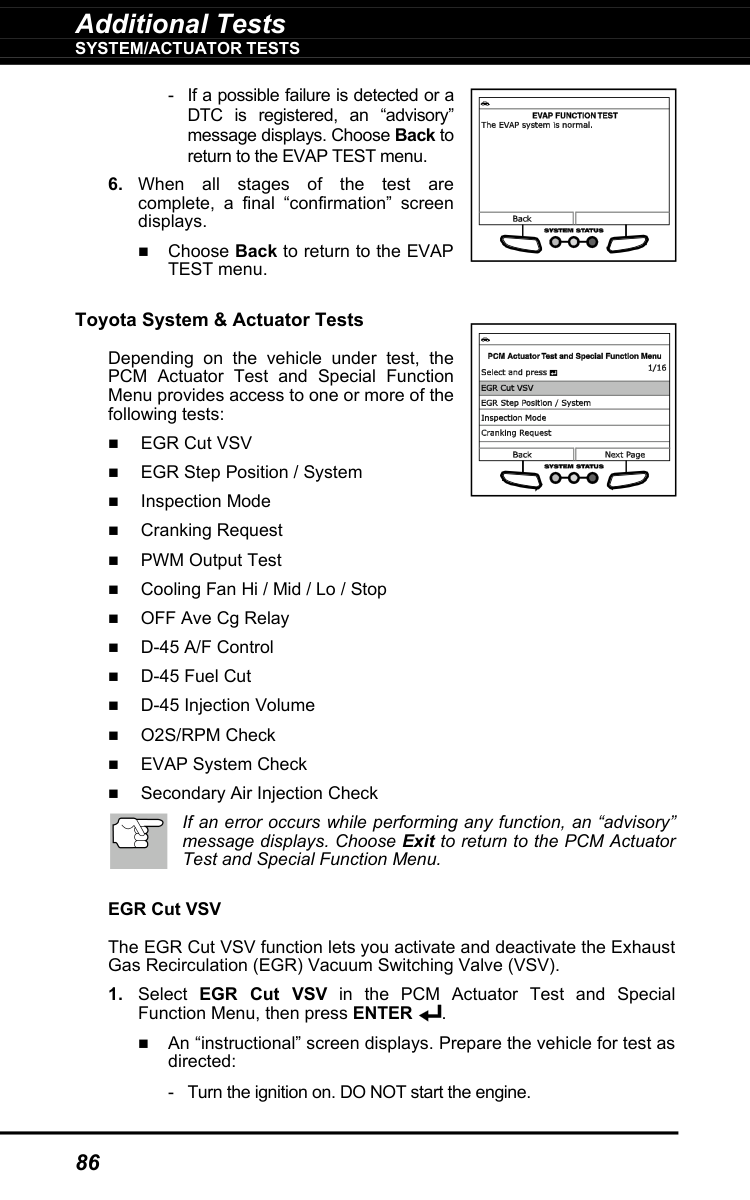
  • Make sure the battery is fully charged.
  • Turn the ignition on. DO NOT start the engine.
  • Choose Continue to proceed.
  •  The Select Test screen displays.
  • Select the desired test, then choose
  • Continue.  A “status” screen displays while the test is in progress.  The screen shows the EVAP TEST selected, the FPT Sensor pressure, the EVAP PC Duty cycle, and the EVAP CVS Valve status.

    Page 87

    Additional Tests

    System/Actuator Tests

    85

  • Choose Back to exit the test.
  •  A “Test is complete” message displays.
  • Choose Exit to return to the EVAP
  • TEST menu. To perform the FUNCTION TEST:
  • Select FUNCTION TEST in the EVAP TEST menu, then press
  • Enter

    .  An “instructional” screen displays. Prepare the vehicle for test as directed:
  • Make sure the battery is fully charged.
  • Turn the ignition on. DO NOT start the engine.
  • Choose Continue to proceed.
  •  The Confirm Fuel Level screen displays.
  • If the fuel tank IS NOT empty, choose No and proceed to step 4.
  •  If the fuel tank IS empty, choose Yes. An “advisory” message displays. Choose Exit to exit the test.
  • A series of “instructional” screens display. Choose Continue as
  • necessary to scroll the screens. Perform the following as directed:  Remove the fuel filler cap.  Replace the fuel filler cap.
  • If a possible failure is detected or a DTC is registered, an
  • “advisory” message displays. Choose Back to return to the EVAP TEST menu.  A “status” screen displays while the first stage of the test is in progress.  The screen shows the FPT Sensor pressure, the EVAP PC Duty cycle, and the EVAP CVS Valve status.
  • If a possible failure is detected or a
  • DTC is registered, an “advisory” message displays. Choose Back to return to the EVAP TEST menu.
  • When the current stage of the test is completed, a series of
  • “instructional” screens display, based on the test results. Follow the instructions as directed.  A “status” screen displays while the first stage of the test is in progress.  The screen shows the FPT Sensor pressure, the EVAP PC Duty cycle, and the EVAP CVS Valve status.

    Page 88

    Additional Tests

    System/Actuator Tests

    86
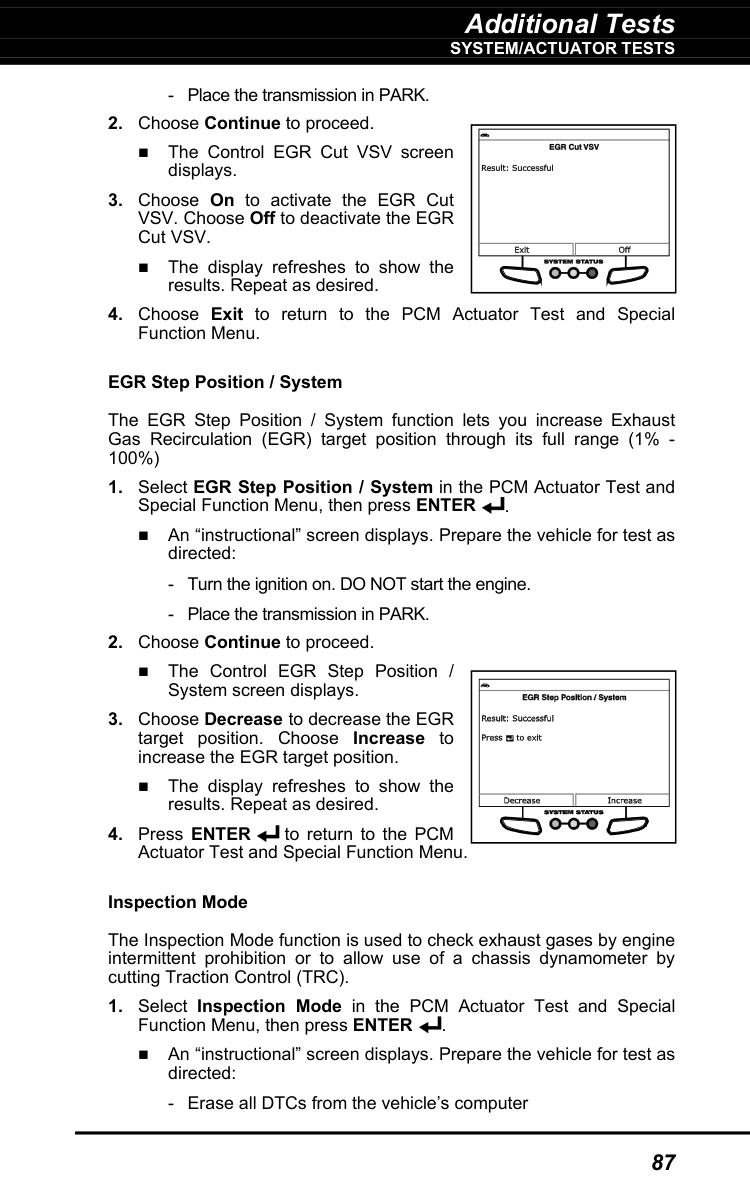
  • If a possible failure is detected or a
  • DTC is registered, an “advisory” message displays. Choose Back to return to the EVAP TEST menu.
  • When all stages of the test are
  • complete, a final “confirmation” screen displays.  Choose Back to return to the EVAP TEST menu. Toyota System & Actuator Tests Depending on the vehicle under test, the PCM Actuator Test and Special Function Menu provides access to one or more of the following tests:  EGR Cut VSV  EGR Step Position / System  Inspection Mode  Cranking Request  PWM Output Test  Cooling Fan Hi / Mid / Lo / Stop  OFF Ave Cg Relay  D-45 A/F Control  D-45 Fuel Cut  D-45 Injection Volume  O2S/RPM Check  EVAP System Check  Secondary Air Injection Check If an error occurs while performing any function, an “advisory” message displays. Choose Exit to return to the PCM Actuator Test and Special Function Menu. EGR Cut VSV The EGR Cut VSV function lets you activate and deactivate the Exhaust Gas Recirculation (EGR) Vacuum Switching Valve (VSV).
  • Select EGR Cut VSV in the PCM Actuator Test and Special
  • Function Menu, then press ENTER .  An “instructional” screen displays. Prepare the vehicle for test as directed:
  • Turn the ignition on. DO NOT start the engine.
  • Page 89

    Additional Tests

    System/Actuator Tests

    87

  • Place the transmission in PARK.
  • Choose Continue to proceed.
  •  The Control EGR Cut VSV screen displays.
  • Choose On to activate the EGR Cut
  • VSV. Choose Off to deactivate the EGR Cut VSV.  The display refreshes to show the results. Repeat as desired.
  • Choose Exit to return to the PCM Actuator Test and Special
  • Function Menu. EGR Step Position / System The EGR Step Position / System function lets you increase Exhaust Gas Recirculation (EGR) target position through its full range (1% - 100%)
  • Select EGR Step Position / System in the PCM Actuator Test and
  • Special Function Menu, then press ENTER .  An “instructional” screen displays. Prepare the vehicle for test as directed:
  • Turn the ignition on. DO NOT start the engine.
  • Place the transmission in PARK.
  • Choose Continue to proceed.
  •  The Control EGR Step Position / System screen displays.
  • Choose Decrease to decrease the EGR
  • target position. Choose Increase to increase the EGR target position.  The display refreshes to show the results. Repeat as desired.
  • Press ENTER
  • to return to the PCM Actuator Test and Special Function Menu. Inspection Mode The Inspection Mode function is used to check exhaust gases by engine intermittent prohibition or to allow use of a chassis dynamometer by cutting Traction Control (TRC).
  • Select Inspection Mode in the PCM Actuator Test and Special
  • Function Menu, then press ENTER .  An “instructional” screen displays. Prepare the vehicle for test as directed:
  • Erase all DTCs from the vehicle’s computer
  • Page 90

    Additional Tests

    System/Actuator Tests

    88

  • Turn the ignition on. DO NOT start the engine.
  • Verify the Ready Light is OFF.
  • Choose Next to continue.
  •  The Select Inspection Mode screen displays.
  • Select the desired inspection mode; 2WD for cutting TRC, 2WD for
  • measuring Exhaust Gas, 4WD for cutting TRC or 4WD for measuring Exhaust Gas.  A “confirmation” screen displays.
  • Choose Exit to return to the PCM
  • Actuator Test and Special Function Menu.
  • Turn the ignition off to exit the
  • inspection mode. Cranking Request The Cranking Request function lets you toggle the ECU mode from “normal” to “compression test” mode for performing a compression test or other maintenance functions.
  • Select Cranking Request in the PCM Actuator Test and Special
  • Function Menu, then press ENTER .  An “instructional” screen displays. Prepare the vehicle for test as directed:
  • Turn the ignition on. DO NOT start the engine.
  • Verify the Ready Light is OFF.
  • Choose Continue to proceed.
  •  The Set Mode screen displays.
  • Choose On to place the ECU in
  • “compression test” mod. Choose Off to place the ECU in “normal” mode.  The display refreshes to show the results. Repeat as desired.
  • Choose Exit to return to the PCM
  • Actuator Test and Special Function Menu. PWM Output Test The PWM Output Test function lets you turn off current within the inverter when performing inverter maintenance.
  • Select PWM Output Test in the PCM Actuator Test and Special
  • Function Menu, then press ENTER .

    Page 91

    Additional Tests

    System/Actuator Tests

    89

     An “instructional” screen displays. Prepare the vehicle for test as directed:

  • Turn the ignition on. DO NOT start the engine.
  • Place the transmission in PARK.
  • Verify the Ready Light is OFF.
  • Choose Continue to proceed.
  •  The Control PWM Output screen displays.
  • Choose On to stop inverter current.
  • Choose Off to return to normal mode.  The display refreshes to show the results. Repeat as desired.
  • Choose Exit to return to the PCM
  • Actuator Test and Special Function Menu. Cooling Fan The Cooling Fan functions let you control operation of the battery cooling fan motor.
  • Select Cooling Fan Hi, Cooling Fan Mid, Cooling Fan Lo or
  • Cooling Fan Stop, in the PCM Actuator Test and Special Function Menu, as desired, then press ENTER .  An “instructional” screen displays. Prepare the vehicle for test as directed:
  • Place the transmission in NEUTRAL.
  • Verify the Ready Light is ON.
  • Choose Continue to proceed.
  •  The Control Cooling Fan screen displays.
  • Choose On to turn the cooling fan On. Choose Off to turn the
  • cooling fan off. It may take from 3 to 10 seconds for cooling fan speed to change.  The display refreshes to show the results. Repeat as desired.
  • Choose Exit to return to the PCM
  • Actuator Test and Special Function Menu. OFF Ave Cg Relay The OFF Ave Cg Relay function lets you activate and deactivate the THS charger adapter relay.

    Page 92

    Additional Tests

    System/Actuator Tests

    90

  • Select OFF Ave Cg Relay in the PCM Actuator Test and Special
  • Function Menu, then press ENTER .  An “instructional” screen displays. Prepare the vehicle for test as directed:
  • Place the transmission in NEUTRAL.
  • Verify the Ready Light is ON.
  • Choose Continue to proceed.
  •  The Control Relay screen displays.
  • Choose On to activate the relay.
  • Choose Off to deactivate the relay.  The display refreshes to show the results. Repeat as desired.
  • Choose Exit to return to the PCM
  • Actuator Test and Special Function Menu. D-4S A/F Control The D-4S A/F Control function lets you modify the fuel injection process and fuel injection volume.
  • Select D-4S A/F Control in the PCM Actuator Test and Special
  • Function Menu, then press ENTER .  An “instructional” screen displays. Prepare the vehicle for test as directed:
  • Start and run the engine at 3000 RPM maximum.
  • Place the transmission in PARK.
  • Make sure engine coolant temperature is 80°C before proceeding.
  • Choose Continue to proceed.
  •  The Select Injection Type screen displays.
  • Select PORT (Port Injection), DIRECT
  • (Direct Injection, or EITHER (Engine control dependency), as appropriate, then press ENTER .  The display refreshes to show the results.
  • Choose Exit to return to the PCM
  • Actuator Test and Special Function Menu. D-4S Fuel Cut The D-4S Fuel Cut function lets you modify the fuel injection process and enable or disable a selected fuel injector.

    Page 93

    Additional Tests

    System/Actuator Tests

    91

  • Select D-4S Fuel Cut in the PCM Actuator Test and Special
  • Function Menu, then press ENTER .  An “instructional” screen displays. Prepare the vehicle for test as directed:
  • Start and run the engine at 3000 RPM maximum.
  • Place the transmission in PARK.
  • Make sure engine coolant temperature is 80°C before proceeding.
  • Choose Continue to proceed.
  •  The Select Injection Type screen displays.
  • Select PORT (Port Injection), DIRECT (Direct Injection, or EITHER
  • (Engine control dependency), as appropriate, then press ENTER .  The Select Injector screen displays.
  • Select the desired fuel injector, then press ENTER
  • .  The Injector Control screen displays.
  • Choose Off to disable the selected fuel
  • injector. Choose On to enable the selected fuel injector.  The display refreshes to show the results. Repeat as desired.
  • Choose Exit to return to the PCM
  • Actuator Test and Special Function Menu. D-4S Injection Volume The D-4S Injection Volume function lets you modify the fuel injection process and increase or decrease fuel injection volume.
  • Select D-4S Injector in the PCM Actuator Test and Special
  • Function Menu, then press ENTER .  An “instructional” screen displays. Prepare the vehicle for test as directed:
  • Start and run the engine at 3000 RPM maximum.
  • Place the transmission in PARK.
  • Make sure engine coolant temperature is 80°C before proceeding.
  • Choose Continue to proceed.
  •  The Select Injection Type screen displays.
  • Select PORT (Port Injection), DIRECT (Direct Injection, or EITHER
  • (Engine control dependency), as appropriate, then press ENTER .  The Control Injection Volume screen displays.

    Page 94

    Additional Tests

    System/Actuator Tests

    92

  • Choose Decrease to decrease injection
  • volume. Choose Increase to increase injection volume.  The display refreshes to show the results. Repeat as desired.
  • Press Enter
  • to return to the PCM Actuator Test and Special Function Menu. O2S/RPM Check The O2S RPM Check lets you perform an O2 sensor / engine speed check.
  • Start and run the engine.
  • Select O2S/RPM Check in the PCM Actuator Test and Special
  • Function Menu, then press ENTER .  The Select Sensor screen displays.
  • Select the desired O2 sensor, then press ENTER
  • .  Repeat as desired to select additional sensors.
  • Choose Next to continue.
  •  A “results” screen displays.  The screen shows the current Engine speed and the list of selected sensors.
  • Choose Back to return to the Select
  • Sensor screen, or, choose Exit to return to the PCM Actuator Test and Special Function Menu. EVAP System Check The EVAP System Check function lets you initiate a check of the vehicle’s Evaporative Emissions System. Depending on model, the vehicle will support one of four system types. 

    Evap Vsv Check

  • Select EVAP System Check in the PCM Actuator Test and Special
  • Function Menu, then press ENTER .  A series of “informational” screens display.
  • Choose Continue as needed to scroll to subsequent screens.
  •  An “instructional” screen displays. Prepare the vehicle for test as directed:
  • Make sure fuel level is between 1/4 and 3/4.
  • Make sure fuel temperature is below 35°C.
  • Page 95

    Additional Tests

    System/Actuator Tests

    93

  • Start and run the engine.
  • Place the transmission in PARK.
  • Choose Continue to proceed.
  •  The vehicle’s computer performs an initial vapor pressure sensor check to determine if a leak may be present. A “results” screen displays when the check is complete.
  • Choose Continue to proceed, or,
  • choose Exit to return to the PCM Actuator Test and Special Function Menu.  The vehicle’s computer performs an 11-step check of the EVAP system. A “status” screen displays the name and number of the current Step, the Vapor Pressure, and the status of the Purge VSV, Tank Bypass VSV and Canister Control VSV.
  • Choose Continue as needed to scroll
  • to the next stage of the test.  When the test is completed, a “confirmation” screen displays.
  • Choose Exit to return to the PCM
  • Actuator Test and Special Function Menu. 

    Lev Ii Sys Check

  • Select EVAP System Check in the PCM Actuator Test and Special
  • Function Menu, then press ENTER .  A series of “informational” screens display.
  • Choose Continue as needed to scroll to subsequent screens.
  •  An “instructional” screen displays. Prepare the vehicle for test as directed:
  • Make sure fuel level is between 1/4 and 3/4.
  • Make sure fuel temperature is below 35°C.
  • Start and run the engine.
  • Place the transmission in PARK.
  • Choose Continue to proceed.
  •  The vehicle’s computer performs a 6-step check of the EVAP system. A “status” screen displays the name and number of the current Step, the Vapor Pressure, and the status of the Purge VSV and Canister Control VSV.

    Page 96

    Additional Tests

    System/Actuator Tests

    94

  • Choose Next Step as needed to scroll
  • to the next stage of the test.  When the test is completed, a “confirmation” screen displays.
  • Choose Exit to return to the PCM
  • Actuator Test and Special Function Menu. 

    Evap

    Vsv

    Check

    Key-Off

    MONITOR SYSTEM – Closed Tank
  • Select EVAP System Check in the PCM Actuator Test and Special
  • Function Menu, then press ENTER .  A series of “informational” screens display.
  • Choose Continue as needed to scroll to subsequent screens.
  •  An “instructional” screen displays. Prepare the vehicle for test as directed:
  • Make sure fuel level is less than 9/10.
  • Make sure fuel temperature is below 35°C (95°F).
  • Make sure the fuel door is closed (and remains closed for the
  • duration of the test)
  • Turn the ignition on. DO NOT start
  • the engine.
  • Choose Continue to proceed.
  •  The vehicle’s computer performs a 9-step check of the EVAP system. A “status” screen displays the name and number of the current Step, the Vapor Pressure, and the status of the Purge

    Vsv,

    Vent Valve, Vacuum Pump and Fuel VCV.
  • Choose Next Step as needed to scroll
  • to the next stage of the test.  When the test is completed, a “confirmation” screen displays.
  • Choose Exit to return to the PCM
  • Actuator Test and Special Function Menu.  EVAP VSV CHECK KEY-OFF MONITOR SYSTEM – One Way Valve
  • Select EVAP System Check in the PCM Actuator Test and Special
  • Function Menu, then press ENTER .  A series of “informational” screens display.
  • Choose Continue as needed to scroll to subsequent screens.
  • Page 97

    Additional Tests

    System/Actuator Tests

    95

     An “instructional” screen displays. Prepare the vehicle for test as directed:
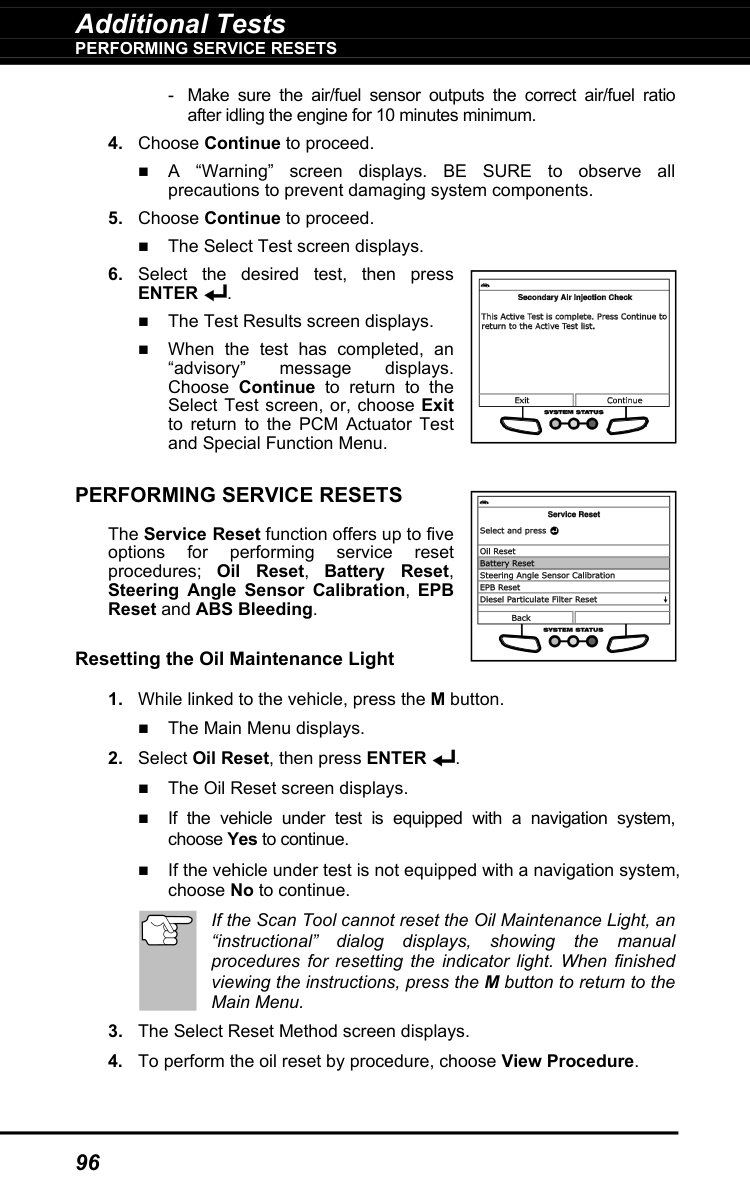
  • Make sure fuel level is less than 9/10.
  • Make sure fuel temperature is below 35°C.
  • Turn the ignition on. DO NOT start the engine.
  • Place the transmission in PARK.
  • Choose Continue to proceed.
  •  The vehicle’s computer performs a 9-step check of the EVAP system. A “status” screen displays the name and number of the current Step, the Vapor Pressure, and the status of the Purge VSV, Vent Valve and Vacuum Pump.
  • Choose Next Step as needed to scroll
  • to the next stage of the test.  When the test is completed, a “confirmation” screen displays.
  • Choose Exit to return to the PCM
  • Actuator Test and Special Function Menu. Secondary Air Injection Check The Secondary Air Injection Check function lets you test components of the vehicle’s secondary air injection system.
  • Select Secondary Air Injection Check in the PCM Actuator Test
  • and Special Function Menu, then press ENTER .  An “informational” screen displays.
  • Choose Continue to proceed.
  •  An “instructional” screen displays. Prepare the vehicle for test as directed:
  • Make sure no DTCs related to throttle, air flow, or misfire are
  • present.
  • Make sure 2nd Air System Status of Data List is OFF.
  • Turn the ignition on. DO NOT start the engine.
  • Set the parking brake.
  • Choose Continue to proceed.
  •  A “countdown” timer displays, followed by an “instructional” screen. Prepare the vehicle for test as directed:
  • Start and idle the engine.
  • Page 98

    Additional Tests

    Performing Service Resets

    96

  • Make sure the air/fuel sensor outputs the correct air/fuel ratio
  • after idling the engine for 10 minutes minimum.
  • Choose Continue to proceed.
  •  A “Warning” screen displays. BE SURE to observe all precautions to prevent damaging system components.
  • Choose Continue to proceed.
  •  The Select Test screen displays.
  • Select the desired test, then press
  • Enter

    .  The Test Results screen displays.  When the test has completed, an “advisory” message displays. Choose Continue to return to the Select Test screen, or, choose Exit to return to the PCM Actuator Test and Special Function Menu.

    Performing Service Resets

    The Service Reset function offers up to five options for performing service reset procedures; Oil Reset, Battery Reset, Steering Angle Sensor Calibration, EPB Reset and ABS Bleeding. Resetting the Oil Maintenance Light
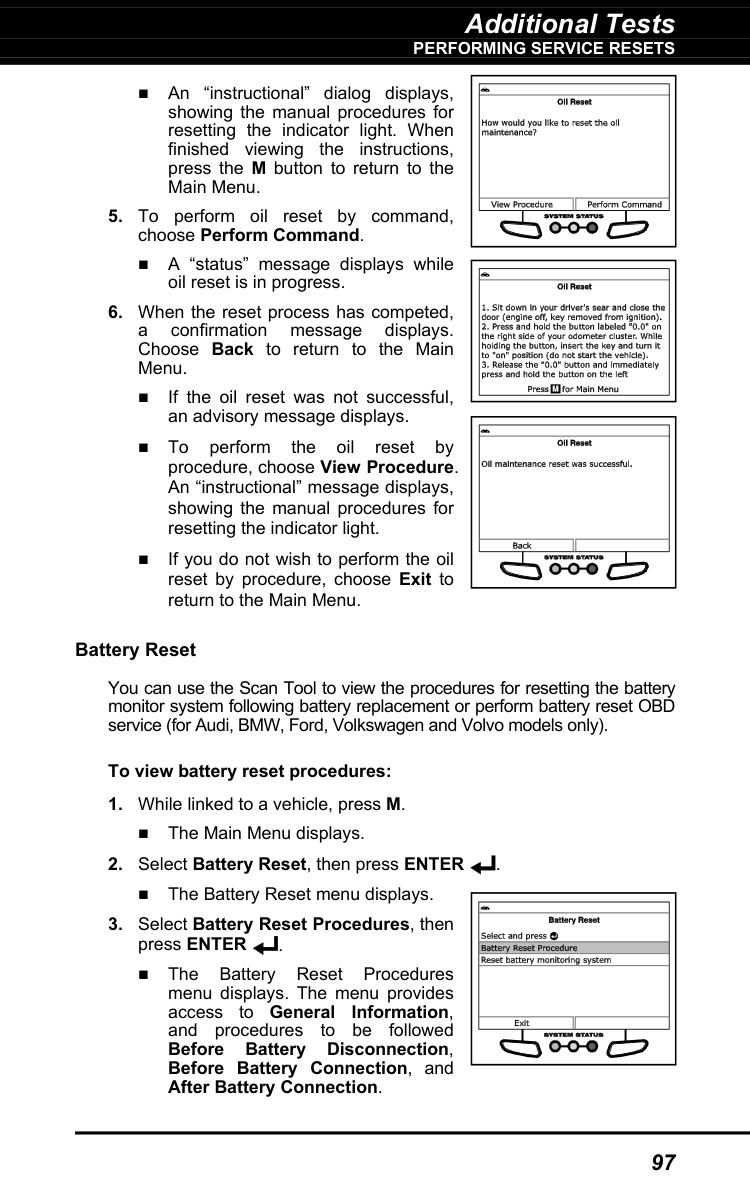
  • While linked to the vehicle, press the M button.
  •  The Main Menu displays.
  • Select Oil Reset, then press ENTER
  • .  The Oil Reset screen displays.  If the vehicle under test is equipped with a navigation system, choose Yes to continue.  If the vehicle under test is not equipped with a navigation system, choose No to continue. If the Scan Tool cannot reset the Oil Maintenance Light, an “instructional” dialog displays, showing the manual procedures for resetting the indicator light. When finished viewing the instructions, press the M button to return to the Main Menu.
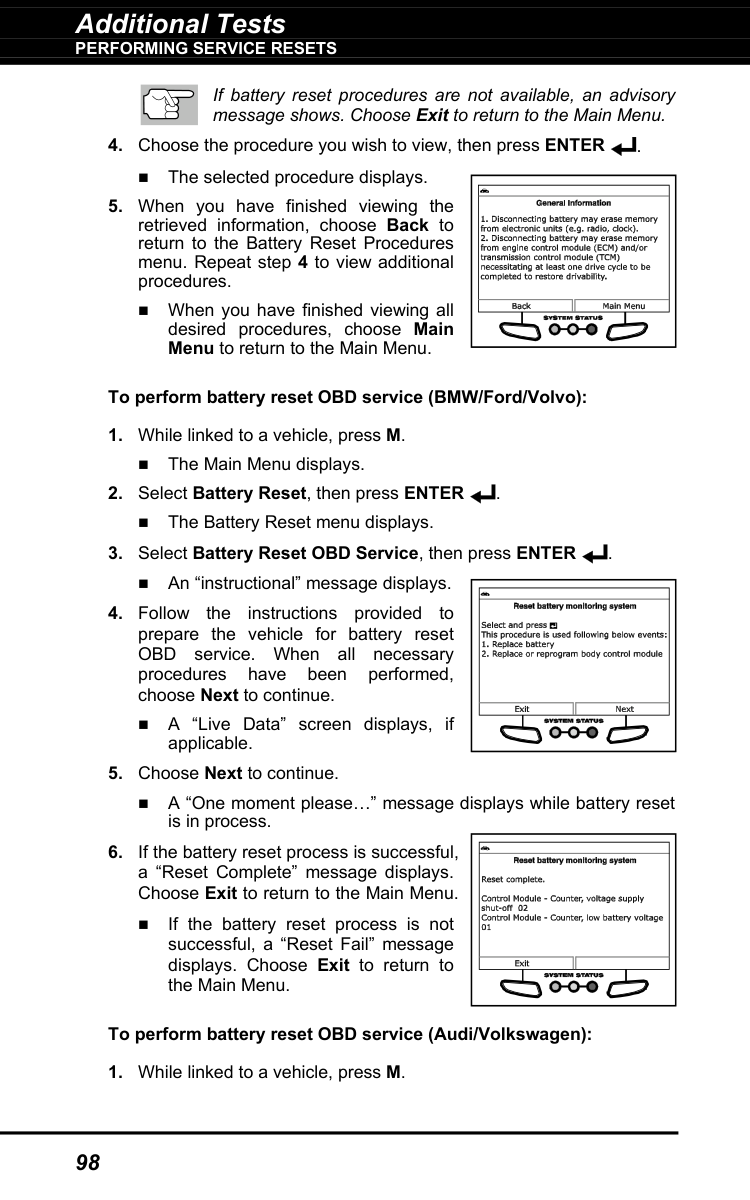
  • The Select Reset Method screen displays.
  • To perform the oil reset by procedure, choose View Procedure.
  • Page 99

    Additional Tests

    Performing Service Resets

    97

     An “instructional” dialog displays, showing the manual procedures for resetting the indicator light. When finished viewing the instructions, press the M button to return to the Main Menu.

  • To perform oil reset by command,
  • choose Perform Command.  A “status” message displays while oil reset is in progress.
  • When the reset process has competed,
  • a confirmation message displays. Choose Back to return to the Main Menu.  If the oil reset was not successful, an advisory message displays.  To perform the oil reset by procedure, choose View Procedure. An “instructional” message displays, showing the manual procedures for resetting the indicator light.  If you do not wish to perform the oil reset by procedure, choose Exit to return to the Main Menu. Battery Reset You can use the Scan Tool to view the procedures for resetting the battery monitor system following battery replacement or perform battery reset OBD service (for Audi, BMW, Ford, Volkswagen and Volvo models only). To view battery reset procedures:
  • While linked to a vehicle, press M.
  •  The Main Menu displays.
  • Select Battery Reset, then press ENTER
  • .  The Battery Reset menu displays.
  • Select Battery Reset Procedures, then
  • press ENTER .  The Battery Reset Procedures menu displays. The menu provides access to General Information, and procedures to be followed Before Battery Disconnection, Before Battery Connection, and After Battery Connection.

    Page 100

    Additional Tests

    Performing Service Resets

    98

    If battery reset procedures are not available, an advisory message shows. Choose Exit to return to the Main Menu.
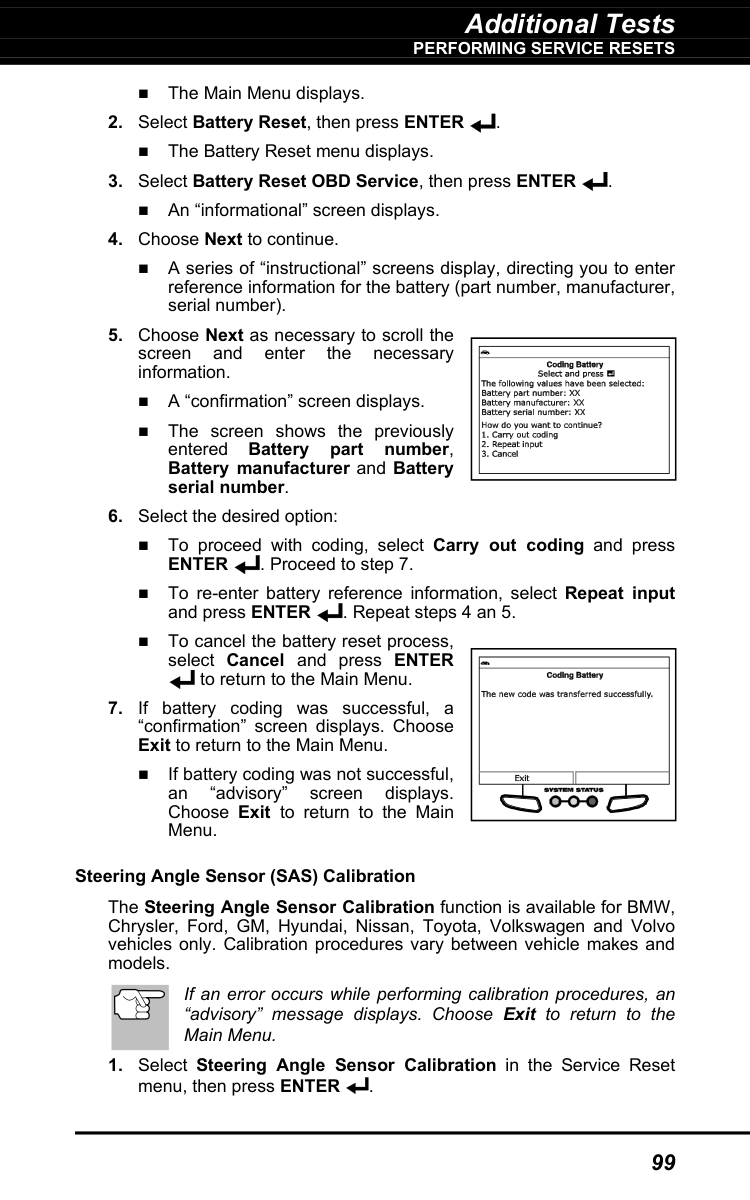
  • Choose the procedure you wish to view, then press ENTER
  • .  The selected procedure displays.
  • When you have finished viewing the
  • retrieved information, choose Back to return to the Battery Reset Procedures menu. Repeat step 4 to view additional procedures.  When you have finished viewing all desired procedures, choose Main Menu to return to the Main Menu. To perform battery reset OBD service (BMW/Ford/Volvo):
  • While linked to a vehicle, press M.
  •  The Main Menu displays.
  • Select Battery Reset, then press ENTER
  • .  The Battery Reset menu displays.
  • Select Battery Reset OBD Service, then press ENTER
  • .  An “instructional” message displays.
  • Follow the instructions provided to
  • prepare the vehicle for battery reset OBD service. When all necessary procedures have been performed, choose Next to continue.  A “Live Data” screen displays, if applicable.
  • Choose Next to continue.
  •  A “One moment please…” message displays while battery reset is in process.
  • If the battery reset process is successful,
  • a “Reset Complete” message displays. Choose Exit to return to the Main Menu.  If the battery reset process is not successful, a “Reset Fail” message displays. Choose Exit to return to the Main Menu. To perform battery reset OBD service (Audi/Volkswagen):
  • While linked to a vehicle, press M.
  • Page 101

    Additional Tests

    Performing Service Resets

    99

     The Main Menu displays.

  • Select Battery Reset, then press ENTER
  • .  The Battery Reset menu displays.
  • Select Battery Reset OBD Service, then press ENTER
  • .  An “informational” screen displays.
  • Choose Next to continue.
  •  A series of “instructional” screens display, directing you to enter reference information for the battery (part number, manufacturer, serial number).
  • Choose Next as necessary to scroll the
  • screen and enter the necessary information.  A “confirmation” screen displays.  The screen shows the previously entered Battery part number, Battery manufacturer and Battery serial number.
  • Select the desired option:
  •  To proceed with coding, select Carry out coding and press

    Enter

    . Proceed to step 7.  To re-enter battery reference information, select Repeat input and press ENTER . Repeat steps 4 an 5.  To cancel the battery reset process, select Cancel and press ENTER to return to the Main Menu.
  • If battery coding was successful, a
  • “confirmation” screen displays. Choose Exit to return to the Main Menu.  If battery coding was not successful, an “advisory” screen displays. Choose Exit to return to the Main Menu. Steering Angle Sensor (SAS) Calibration The Steering Angle Sensor Calibration function is available for BMW, Chrysler, Ford, GM, Hyundai, Nissan, Toyota, Volkswagen and Volvo vehicles only. Calibration procedures vary between vehicle makes and models. If an error occurs while performing calibration procedures, an “advisory” message displays. Choose Exit to return to the Main Menu.
  • Select Steering Angle Sensor Calibration in the Service Reset
  • menu, then press ENTER .

    Page 102

    Additional Tests

    Performing Service Resets

    100

     For some vehicles, a submenu displays. Select the desired option, then press ENTER . Proceed to step 2. If SAS calibration is not supported by the vehicle under test, an “advisory” message displays. Choose Exit to return to the Main Menu.

  • A “One moment” message displays, followed by one or more
  • “informational/ instructional” screens.  Perform test procedures as directed. Choose Next, as appropriate, to scroll to the next screen.
  • For some vehicles, “status” screens display as each phase of the
  • calibration procedure is successfully completed. Choose Next, as appropriate, to scroll to the next screen.  A “results” screen displays when the calibration procedure has completed.
  • Choose Exit to return to the Main Menu.
  • EPB Reset EPB Reset procedures vary between vehicle makes and models. If an error occurs while performing calibration procedures, an “advisory” message displays. Choose Exit to return to the Main Menu.
  • Select EPB Reset in the Service Reset menu, then press ENTER
  • .  A “One moment” message displays.  For some vehicles, one or more submenus display. Select the desired module and/or option, as appropriate, then press

    Enter

    . Proceed to step 2. If EPB reset is not supported by the vehicle under test, an “advisory” message displays. Choose Exit to return to the Main Menu.
  • One or more “informational/instructional” screens display.
  •  Perform test procedures as directed. Choose Next, as appropriate, to scroll to the next screen.
  • For some vehicles, “status” screens display as each phase of the
  • calibration procedure is successfully completed. Choose Next, as appropriate, to scroll to the next screen.  A “One moment” message displays while the procedure is in process.  A “results” screen displays when the calibration procedure has completed. If the procedure is stopped due to a communication error, an “advisory” message displays. Choose Exit to return to the Main Menu.

    Page 103

    Additional Tests

    Performing Service Resets

    101

  • Choose Exit to return to the Main Menu.
  • Diesel Particulate Filter Reset (except Chrysler, General Motors, Nissan or Volkswagen) If the vehicle under test is not a diesel vehicle, an “advisory” message displays. Choose Back to return to the Service Reset menu. Diesel Particulate Filter Reset is not available for your vehicle.
  • Select Diesel Particulate Filter Reset in the Service Reset menu,
  • then press ENTER .  A “One moment” message displays, followed by the DPF Reset Menu.
  • Select DPF Regeneration Procedure, then press ENTER
  • .  The DPF Regeneration Live Data screen displays. If the vehicle under test does not support DPF Regeneration Live Data, an “informational” screen displays the procedures for “passive” DPF regeneration. Choose Back to return to the DPF Reset Menu.
  • Choose Next to continue.
  •  An “informational” screen displays the procedures for “passive” or “active” DPF regeneration, as applicable. Choose Back to return to the DPF Reset Menu.
  • Choose Back to return to the DPF Reset Menu, then choose Back
  • to return to the Service Reset menu. Diesel Particulate Filter Reset (Chrysler)
  • Select Diesel Particulate Filter Reset in the Service Reset menu,
  • then press ENTER .  A “One moment” message displays, followed by the Diesel Particulate Filter Reset menu.
  • Select the desired option, then press ENTER
  • .  An “instructional” screen displays. Prepare the vehicle for test as directed.
  • Choose Yes to continue.
  •  A series of “status” screens display while the routine is in process.  A “confirmation” screen displays when the routine is completed. If the routine does not complete successfully, an “advisory” message displays. Choose Close to return to the Diesel Particulate Filter Reset menu.
  • Choose Finish to return to the Diesel Particulate Filter Reset menu,
  • then choose Back to return to the Service Reset menu.

    Page 104

    Additional Tests

    Performing Service Resets

    102

    Diesel Particulate Filter Reset (General Motors)

  • Select Diesel Particulate Filter Reset in the Service Reset menu,
  • then press ENTER .  A “One moment” message displays, followed by the Diesel Particulate Filter Reset menu.
  • Select the desired option, then press ENTER
  • .  One or more “informational/instructional” screens display.
  • Choose Next, as appropriate, to scroll to the next screen.
  •  For some vehicles, a “confirmation” screen displays.
  • Select On or Reset, as appropriate.
  •  A “confirmation” or “results” screen displays when the routine is completed. If the routine does not complete successfully, an “advisory” message may display. Choose End to return to the Diesel Particulate Filter Reset menu.
  • Choose Exit to return to the Diesel Particulate Filter Reset menu,
  • then choose Back to return to the Service Reset menu. Diesel Particulate Filter Reset (Nissan)
  • Select Diesel Particulate Filter Reset in the Service Reset menu,
  • then press ENTER .  An “instructional” screen displays. Prepare the vehicle for test as directed.
  • Choose Next to continue.
  •  A “status” screen displays while the routine is in process.  A “confirmation” screen displays when the routine is completed. If the routine does not complete successfully, an “advisory” message displays. Choose Exit to return to the Service Reset menu.
  • Choose End to return to the Service Reset menu.
  • Diesel Particulate Filter Reset (Volkswagen)
  • Select Diesel Particulate Filter Reset in the Service Reset menu,
  • then press ENTER .  A “One moment” message displays, followed by the Diesel Particulate Filter Reset menu.
  • Select the desired option, then press ENTER
  • .  A series of “informational/instructional” screens display. Prepare the vehicle for test as directed.

    Page 105

    Additional Tests

    Performing Service Resets

    103

    If the selected function is not supported by the vehicle under test, an “advisory” message may display. Choose End to return to the Diesel Particulate Filter Reset menu.

  • Choose Next, Continue, or Start, as appropriate, to continue.
  •  One or more “status” screens may display while the routine is in process.  A “confirmation” or “results” screen displays when the routine is completed. If the routine does not complete successfully, an “advisory” message may display. Choose End to return to the Diesel Particulate Filter Reset menu.
  • Choose End to return to the Diesel Particulate Filter Reset menu,
  • then choose Back to return to the Service Reset menu. ABS Bleeding The ABS Bleeding function is available for Chrysler, GM, Hyundai/Kia, Mazda and Toyota vehicles only. Procedures vary between vehicle makes and models. If an error occurs while performing ABS bleeding procedures, an “advisory” message displays. Choose Exit or Back, as necessary, to return to the Service Reset menu.

  • Select ABS Bleeding in the Service Reset menu, then press
  • Enter

    .  A “One moment” message may display.  A submenu displays. Select the desired option, then press

    Enter

    . Proceed to step 2.
  • One or more “informational/ instructional” screens display.
  •  Perform test procedures as directed. Choose Next or Continue, as appropriate, to scroll to the next screen.
  • For some vehicles, “status” screens display as each phase of the
  • calibration procedure is successfully completed. Choose Next or Continue, as appropriate, to scroll to the next screen.  A “results” screen displays when the procedure has completed. If the procedure is stopped due to a communication error, an “advisory” message displays. Choose Exit or Back, as necessary, to return to the Service Reset menu.
  • Choose Exit or Back, as necessary, to return to the Service Reset
  • menu.

    Page 106

    Additional Tests

    Service Check - Hybrid Battery Check, Battery Alternator Test

    104

    Performing A Service Check

    The Service Check function lets you check brake pad status, current oil level and oil life, and transmission fluid temperature.
  • While linked to the vehicle, press M.
  •  The Main Menu displays.
  • Select Service Check, then press
  • Enter

    .  The Service Check screen displays.  The screen shows the current Brake Pads status, Engine Oil Level, Oil Life Remaining and Transmission Fluid Temperature.
  • When you have finished viewing the
  • information, choose Back to return to the Main Menu.

    Hybrid Battery Check, Battery Alternator Test

    The Scan Tool can perform a check of the vehicle’s battery and alternator system (or hybrid/EV battery system) to ensure the system is operating within acceptable limits.
  • Press M and release.
  •  The Main Menu displays.
  • Select
  • Hybrid Battery Check, Battery/Alternator Test, then press

    Enter

    .  If the vehicle is an electric or hybrid vehicle, the Hybrid Battery Monitor screen shows a graphic display of the current state of charge for all cells in the battery pack displays. If the Hybrid Battery Monitor is not supported by the vehicle under test, an “advisory” message displays. Choose Back to return to the Main Menu.  If the vehicle is not an electric or hybrid vehicle, the Battery/Alternator Monitor menu displays (see BATTERY/ALTERNATOR MONITOR on page 108 for details).
  • When you have finished viewing the retrieved information, choose
  • Back to return to the Main Menu.

    Page 107

    Additional Tests

    System Test Menu

    105

    System Test Menu

    Additional tests are accessed through the System Tests menu. The following functions are available:  O2 Sensor Test - Retrieves and displays O2 sensor monitor test results from your vehicle's on-board computer.  OBD Monitor Test - Retrieves and displays test results for emission-related powertrain components and systems that are not continuously monitored.  EVAP Test - Performs a leak test for the vehicle's EVAP system.
  • While linked to the vehicle, press the M button.
  •  The Main Menu displays.
  • Select OBD Mode Tests, then press
  • Enter

    .  The System Test menu displays. If OBD Mode Tests is not shown on the Main Menu, the System Tests functions are not available for the vehicle under test. O2 Sensor Test OBD2 regulations require that applicable vehicles monitor and test operation of the oxygen (O2) sensors to identify problems that can affect fuel efficiency and vehicle emissions. These tests are performed automatically when engine operating conditions are within predefined limits. Results of these tests are stored in the on-board computer's memory. The O2 Sensor Test function lets you retrieve and view O2 sensor monitor test results for the most recently completed tests from the vehicle's on-board computer. The Scan Tool does not perform O2 sensor tests, but retrieves results from the most recently performed O2 sensor tests from the on-board computer's memory. You may retrieve O2 sensor test results for only one test of one sensor at any given time.
  • From the System Test menu, select O2 Sensor Test, then press
  • Enter

    .
  • A "One moment please..." message
  • displays, followed by the Select Sensor screen. If O2 sensor test data is not presently stored in the vehicle’s computer, an advisory message displays. Choose Back (to return to the System Tests menu) or Main Menu, as desired.

    Page 108

    Additional Tests

    System Test Menu

    106

    If O2 sensor tests are not supported by the vehicle under test, an advisory message displays. Choose Back (to return to the System Tests menu) or Main Menu, as desired.

  • Select the O2 sensor for which you wish
  • to view test results, then press ENTER to display the test results.
  • When you have finished viewing the re-
  • trieved test data, choose Next to view test results for the next sensor, or choose Back to return to the Select Sensor screen.
  • When you have finished viewing test data
  • for all desired sensors, choose Back from the Select Sensor screen to return to the System Test menu; or, press M to return to the Main Menu. OBD Monitor Test The OBD Monitor Test function retrieves and displays test results for emission-related powertrain components and systems that are not continuously monitored. The tests available are determined by the vehicle manufacturer. The Scan Tool does not perform the OBD monitor test, but retrieves results from the most recently performed tests from the on-board computer’s memory. You may retrieve OBD monitor test results for only one test at any given time.
  • From the System Test menu, select
  • OBD Monitor Test, then press ENTER .
  • A “One moment please. . .” message
  • displays, followed by the Select Test screen. (Refer to the vehicle’s service repair manual for information related to non-continuous tests.) If OBD monitor test data is not presently stored in the vehicle’s computer, an advisory message displays. Choose Back (to return to the System Tests menu) or Main Menu, as desired. If OBD monitor tests are not supported by the vehicle under test, an advisory message displays. Choose Back (to return to the System Tests menu) or Main Menu, as desired.
  • Select the desired test, then press
  • Enter

    to display the test results. The display shows the following information:  Test ID number  Module ID number

    Page 109

    Additional Tests

    System Test Menu

    107

     Component ID number  Min or Max test limit (Only one test limit, either Min or Max, is shown for any given test)  Test Value and status Status is calculated by the Scan Tool by comparing the Test Value against the displayed test limit (either Min or Max). Status is shown as either Low, High or OK.

  • When you have finished viewing the retrieved test data, choose
  • Next to view results for the next test, or choose Back to return to the Select Test screen.
  • When you have finished viewing test data for all desired tests,
  • choose Back from the Select Test screen to return to the System Test menu; or, choose Main Menu to return to the Main Menu. EVAP Test The EVAP Test function lets you initiate a leak test for the vehicle's EVAP system. The Scan Tool does not perform the leak test, but signals to vehicle's on-board computer to initiate the test. The vehicle manufacturer determines the criteria and method for stopping the test once it has been started. Refer to the vehicle's service repair manual to determine the procedures necessary to stop the test.
  • From the System Test menu, select EVAP Test, then press ENTER
  • .
  • A "One moment please..." message
  • displays.
  • When the EVAP leak test has been
  • initiated by the vehicle's on-board computer, a confirmation message displays. Choose Back to return to the System Test menu; or, choose Main Menu to return to the Main Menu. Some vehicle manufacturers do not allow Scan Tools or other external devices to control vehicle systems. If the EVAP Test is not supported by the vehicle under test, an advisory message displays. Choose Back (to return to the System Tests menu) or Main Menu, as desired. I/M Monitor Test A Drive Cycle for a Monitor requires that the vehicle is driven in such a way that all the required “Enabling Criteria” for the Monitor to run and complete its diagnostic testing are met. You can use the Scan Tool to view the Drive Cycle procedures for a selected Monitor. You can also view a description of a selected Monitor.

    Page 110

    Additional Tests

    Battery/Alternator Monitor

    108

  • From the System Test menu, select I/M Monitor Test, then press
  • Enter

    .
  • A “One moment please. . .” message
  • displays, followed by the Select Monitor screen. The Select Monitor screen lists all Monitors supported by the vehicle.
  • To view a Monitor description, select
  • the desired Monitor, then choose Description.  A description for the selected Monitor displays.
  • To view Drive Cycle procedures for a Monitor, select the desired
  • Monitor, then choose Drive Cycle. If Drive Cycle Procedures are not available for the vehicle, an advisory message shows. Choose Back to return to the Main Menu.  The Drive Cycle Procedures screen for the Monitor display.
  • The Trip Cycle Procedure screen shows the specific set of operating
  • procedures that ensure the vehicle is driven in such a way that all the required “Enabling Criteria” for the Monitor to run and complete its diagnostic testing are met.
  • When you are finished viewing the Trip Cycle Procedures, choose Back
  • to return to the System Test menu, or, press M to return to the Main Menu.

    Battery/Alternator Monitor

    The Scan Tool can perform a check of the vehicle’s battery and alternator system to ensure the system is operating within acceptable limits. You can perform a battery check only, or an alternator system (battery and alternator) check. To perform a battery check ONLY: When Hybrid Battery Check, Battery/Alternator Test is selected from the Main Menu and the vehicle is not an electric or hybrid vehicle, the Battery/Alternator Monitor menu displays. Proceed to step 3.
  • Press M and release.
  •  The Main Menu displays.
  • Select
  • Battery/Alternator Monitor, then press ENTER .  The Battery/Alternator Monitor Menu displays.
  • Select Battery Monitor, then press
  • Enter

    .

    Page 111

    Additional Tests

    Battery/Alternator Monitor

    109

     An “instructional” message displays, showing the procedures to prepare the vehicle for the battery check.

  • Prepare the vehicle for the battery check:
  •  Turn the engine off.  Place the transmission in PARK or NEUTRAL, and set the parking brake.  Make a visual check of the battery’s condition. If the battery terminals are corroded or other damage is present, clean or replace the battery as appropriate.  For “unsealed” batteries, make sure the water level in each cell is above the battery plates.  Turn the ignition on. DO NOT start the engine.
  • Choose Continue to proceed.
  • If the engine is running, an advisory message shows. Turn the engine off, then turn the ignition on. DO NOT start the engine. Press ENTER to continue.  An “instructional” message displays.
  • Turn the vehicle’s headlights on, then choose Continue to proceed.
  •  A “countdown” message shows while the battery check is in process.  If battery voltage is less than 12.1 volts, an advisory message shows. Choose Main Menu to return to the Main Menu. Turn the ignition off and disconnect the Scan Tool from the vehicle. Fully charge the battery, then repeat the battery check.  If battery voltage is greater than 12.1 volts, an “instructional” message shows.
  • Turn the vehicle’s headlights off, then choose Continue to proceed.
  •  An “instructional” message shows.
  • Start the vehicle’s engine. Allow the engine to run for several
  • seconds, then turn the engine off. Repeat for a total of three “start/stop” cycles. If the Scan Tool did not detect “cranking status” for the vehicle’s engine, an advisory message shows. Choose Retest to repeat the battery check, or, choose Exit to return to the Main Menu.
  • When the battery check is complete, a
  • results screen displays the battery status. The System Status LEDs provide a PASS/FAIL indication, as follows:

    Page 112

    Additional Tests

    Battery/Alternator Monitor

    110

     Green = Good  Yellow = Normal  Red = Warning/Bad

  • Choose Main Menu to return to the Main Menu.
  • To perform a charging system check: When Hybrid Battery Check, Battery/Alternator Test is selected from the Main Menu and the vehicle is not an electric or hybrid vehicle, the Battery/Alternator Monitor menu displays. Proceed to step 3.
  • Press M and release.
  •  The Main Menu displays.
  • Select Battery/Alternator Monitor, then press ENTER
  • .  The Battery/Alternator Monitor Menu displays.
  • Select Alternator Monitor, then press
  • Enter

    .  An “instructional” message shows.
  • Start and warm the engine to normal
  • operating temperature. Turn on the headlights. Choose Continue to proceed.  An “instructional” message shows.
  • Press the accelerator pedal to raise engine speed to 2000 RPM,
  • and maintain the engine speed.  When engine speed is within the required range, the alternator test begins. A progress screen shows.  When the “countdown” timer expires, an “instructional” message shows.
  • Turn the vehicle’s headlights off, and
  • return the engine to idle speed.  A “One moment please…” message displays while the test results are retrieved.
  • When the alternator check is complete,
  • a results screen shows charging system voltage and indicates whether or not the charging system is within acceptable limits. The System Status LEDs provide a PASS/FAIL indication, as follows:  Green = System within limits  Yellow = Over charging or under charging

    Page 113

    Additional Tests

    Viewing Drive Cycle Procedures

    111

     Red = Excessive over charging or under charging  If the alternator voltage is less than 9 V, the red, yellow and green SYSTEM STATUS LEDs will flash on and off.

  • Choose Main Menu to return to the Main Menu.
  • Viewing Drive Cycle Procedures

    A Drive Cycle for a Monitor requires that the vehicle is driven in such a way that all the required “Enabling Criteria” for the Monitor to run and complete its diagnostic testing are met. You can use the Scan Tool to view the Drive Cycle procedures for a selected Monitor.
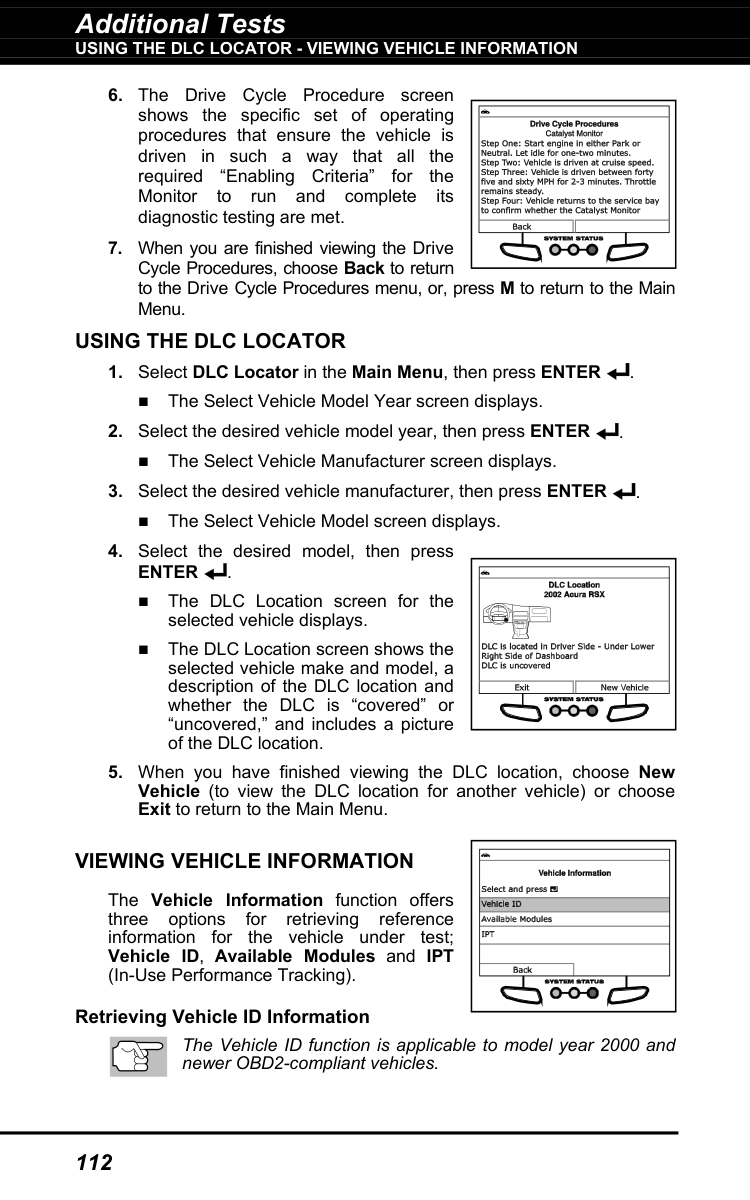
  • While linked to a vehicle, press M.
  •  The Main Menu displays.
  • Select Drive Cycle Procedures, then press ENTER
  • .  A “One moment please…” message displays while the Scan Tool retrieves Monitor status.
  • When Monitor status has been retrieved, the Drive Cycle
  • Procedures menu displays. Depending on Monitor status, you can view Drive Cycle procedures for Monitors Incomplete or Monitors Complete. If Drive Cycle Procedures are not available for the vehicle, an advisory message shows. Choose Back to return to the Main Menu.
  • Select
  • Monitors Incomplete or Monitors Complete, as desired, then press ENTER .  A list of the available Monitors for the selected status displays. If no Monitors for the selected status are detected, an advisory message shows. Choose Back to return to the Main Menu.
  • Select the Monitor for which you wish to
  • view Drive Cycle Procedures, then press ENTER .  A “One moment please…” message displays while the Scan Tool retrieves the requested Drive Cycle Procedure. The Drive Cycle Procedures screen for the Monitor displays when the procedure has been retrieved. If a Drive Cycle Procedure for the selected Monitor is not available, an advisory message shows. Choose Back to return to the Main Menu.

    Page 114

    Additional Tests

    Using The Dlc Locator - Viewing Vehicle Information

    112

  • The Drive Cycle Procedure screen
  • shows the specific set of operating procedures that ensure the vehicle is driven in such a way that all the required “Enabling Criteria” for the Monitor to run and complete its diagnostic testing are met.
  • When you are finished viewing the Drive
  • Cycle Procedures, choose Back to return to the Drive Cycle Procedures menu, or, press M to return to the Main Menu.

    Using The Dlc Locator

  • Select DLC Locator in the Main Menu, then press ENTER
  • .  The Select Vehicle Model Year screen displays.
  • Select the desired vehicle model year, then press ENTER
  • .  The Select Vehicle Manufacturer screen displays.
  • Select the desired vehicle manufacturer, then press ENTER
  • .  The Select Vehicle Model screen displays.
  • Select the desired model, then press
  • Enter

    .  The DLC Location screen for the selected vehicle displays.  The DLC Location screen shows the selected vehicle make and model, a description of the DLC location and whether the DLC is “covered” or “uncovered,” and includes a picture of the DLC location.
  • When you have finished viewing the DLC location, choose New
  • Vehicle (to view the DLC location for another vehicle) or choose Exit to return to the Main Menu.

    Viewing Vehicle Information

    The Vehicle Information function offers three options for retrieving reference information for the vehicle under test; Vehicle ID, Available Modules and IPT (In-Use Performance Tracking). Retrieving Vehicle ID Information The Vehicle ID function is applicable to model year 2000 and newer OBD2-compliant vehicles.
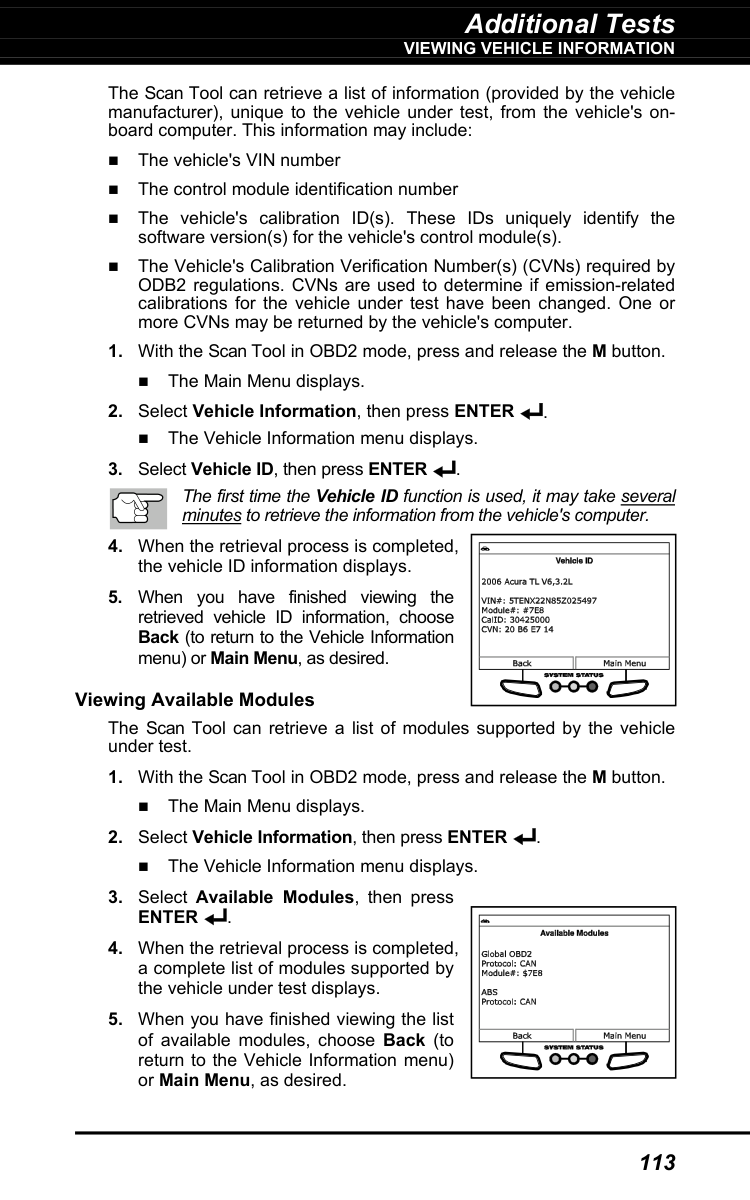
    Page 115

    Additional Tests

    Viewing Vehicle Information

    113

    The Scan Tool can retrieve a list of information (provided by the vehicle manufacturer), unique to the vehicle under test, from the vehicle's on- board computer. This information may include:  The vehicle's VIN number  The control module identification number  The vehicle's calibration ID(s). These IDs uniquely identify the software version(s) for the vehicle's control module(s).  The Vehicle's Calibration Verification Number(s) (CVNs) required by ODB2 regulations. CVNs are used to determine if emission-related calibrations for the vehicle under test have been changed. One or more CVNs may be returned by the vehicle's computer.

  • With the Scan Tool in OBD2 mode, press and release the M button.
  •  The Main Menu displays.
  • Select Vehicle Information, then press ENTER
  • .  The Vehicle Information menu displays.
  • Select Vehicle ID, then press ENTER
  • . The first time the Vehicle ID function is used, it may take several minutes to retrieve the information from the vehicle's computer.
  • When the retrieval process is completed,
  • the vehicle ID information displays.
  • When you have finished viewing the
  • retrieved vehicle ID information, choose Back (to return to the Vehicle Information menu) or Main Menu, as desired. Viewing Available Modules The Scan Tool can retrieve a list of modules supported by the vehicle under test.
  • With the Scan Tool in OBD2 mode, press and release the M button.
  •  The Main Menu displays.
  • Select Vehicle Information, then press ENTER
  • .  The Vehicle Information menu displays.
  • Select Available Modules, then press
  • Enter

    .
  • When the retrieval process is completed,
  • a complete list of modules supported by the vehicle under test displays.
  • When you have finished viewing the list
  • of available modules, choose Back (to return to the Vehicle Information menu) or Main Menu, as desired.

    Page 116

    Additional Tests

    Viewing The Firmware Version - The Tool Library

    114

    Viewing In-use Performance Tracking (IPT) The Scan Tool can retrieve In-use Performance Tracking (IPT) statistics for monitors supported by the vehicle under test. Two values are returned for each monitor; the number of times that all conditions necessary for a specific monitor to detect a malfunction have been encountered (XXXCOND), and the number of times that the vehicle has been operated under the specific conditions for the monitor (XXXCOMP). Statistics are also provided for the number of times the vehicle has been operated in OBD monitoring conditions (OBDCOND), and the number of times the vehicle’s engine has been started (IGNCNTR).

  • With the Scan Tool in OBD2 mode, press and release the M button.
  •  The Main Menu displays.
  • Select Vehicle Information, then press the ENTER
  • button.  The Vehicle Information menu displays.
  • Select IPT, then press ENTER
  • .
  • When the retrieval process is completed,
  • the In-use Performance Tracking statistics for the vehicle under test display.  If In-use Performance Tracking is not available for the vehicle, an advisory message displays. Choose Back (to return to the System Tests menu) or Main Menu, as desired.
  • When you have finished viewing the statistics, choose Back (to
  • return to the Vehicle Information menu) or Main Menu, as desired.

    Viewing The Firmware Version

  • Select Firmware Version in the Main
  • Menu, then press ENTER .  The Firmware Version screen displays.  The screen shows the Scan Tool’s current firmware version, bootloader version and database version.
  • Press M to return to the Main Menu.
  • The Tool Library

    The Tool Library contains valuable reference information for the Scan Tool. The following functions are available:

    Page 117

    Additional Tests

    The Tool Library

    115

     Icon Meaning – Shows the full names for the I/M MONITOR STATUS icons shown and descriptions of informational icons on the Scan Tool’s display.  DTC Library – Provides access to libraries of OBD1 and OBD2 DTC definitions.  Hotkey Legend - Shows functional descriptions for the Scan Tool’s hotkeys.  LED Meaning – Provides descriptions of the meaning of the Scan Tool SYSTEM STATUS LEDs.

  • While linked to the vehicle, press M.
  •  The Main Menu displays.
  • Select Tool Library, then press ENTER
  • .  The Tool Library menu displays. Viewing Tool Icon Meanings The I/M MONITOR STATUS icons on the Scan Tool’s LCD display provide an indication of the “Completed / Not Complete” status for all I/M Monitors supported by the vehicle under test. The Icon Meaning function displays the full name for each Monitor icon, as well as descriptions of the meanings of other informational icons shown on the Scan Tool’s display.
  • From the Tool Library menu, select
  • Icon Meaning, then press ENTER .  The Icon Meaning menu displays.
  • Select the type of icons you wish to view,
  • Spark Ignition Monitors, Compression Ignition Monitors or Tool Icons, the press

    Enter

    .  The screen shows a list of Monitor for the selected category.  Choose Back to return to the Icon Meaning menu. If desired, repeat step 2 to view additional Icon Meanings.
  • When you have finished viewing the descriptions, choose Back to
  • return to the Main Menu. Using the DTC Library (OBD1)
  • From the Tool Library menu, select
  • DTC Library, then press ENTER .  The Select Library screen displays.
  • Select
  • Obd1

    Library, then press

    Enter

    .

    Page 118

    Additional Tests

    The Tool Library

    116

     The Select Manufacturer screen displays.

  • Select the desired vehicle manufacturer, then press ENTER
  • .  A confirmation message shows.
  • If the correct manufacturer is not shown, choose No to return to
  • the list of vehicle manufacturers.
  • If the correct manufacturer is shown, choose Yes.
  • The Enter DTC screen displays.
  •  The screen shows the code “001,” with the first character highlighted. Press UP or DOWN , as necessary, to scroll to the first digit of the DTC, then choose Next Digit.  The selected character displays solid, and the next character is highlighted.
  • Select the remaining digits in the DTC
  • in the same way. When you have selected all the DTC digits, press

    Enter

    to view the DTC definition.
  • When you have finished viewing the DTC
  • definition, choose Back to return to the Enter DTC screen and enter additional DTCs; or, press M to return to the Main Menu. If a definition for the DTC you entered is not available, an advisory message shows. Choose Back to return to the Enter DTC screen and enter additional DTCs; or, press M to return to the Main Menu. Using the DTC Library (OBD2)
  • From the Tool Library menu, select DTC Library, then press
  • Enter

    .  The Select Library screen displays.
  • Select
  • Obd2

    Library, then press

    Enter

    .  The Select Manufacturer screen displays.
  • Select the desired vehicle manufacturer,
  • then press ENTER .  A confirmation message shows.
  • If the correct manufacturer is not shown, choose No to return to
  • the list of vehicle manufacturers.
  • If the correct manufacturer is shown, choose Yes.
  • Page 119

    Additional Tests

    The Tool Library

    117

  • The Enter DTC screen displays.
  •  The screen shows the code “P0001,” with the “P” highlighted. Press UP or DOWN , as necessary, to scroll to the desired

    Dtc

    type (P=Powertrain, U=Network, B=Body, C=Chassis), then choose Next Digit.  The selected character displays solid, and the next character is highlighted.
  • Select the remaining digits in the DTC
  • in the same way. When you have selected all the DTC digits, press

    Enter

    to view the DTC definition.
  • When you have finished viewing the
  • DTC definition, choose Back, to return to the Enter DTC screen and enter additional DTCs; or, press M to return to the Main Menu. If a definition for the DTC you entered is not available, an advisory message shows. Choose Back to return to the Enter DTC screen and enter additional DTCs; or, press M to return to the Main Menu. Viewing the Hotkey Legend
  • From the Tool Library menu, select
  • Hotkey Legend, then press ENTER .  The Hotkey Legend screen displays.  The screen shows a functional description of each of the Scan Tool’s hotkeys.
  • When you have finished viewing the Hotkey Legend, choose Back
  • to return to the Tool Settings menu, or, choose Main Menu to return to the Main Menu. Viewing LED Definitions The SYSTEM STATUS LEDs on the Scan Tool provide a visual indication of the I/M Readiness status of the vehicle under test. The LED Definitions function provides a description of the meanings of the green, yellow and red SYSTEM STATUS LEDs.
  • From the Tool Library menu, select LED Definitions, then press
  • Enter

    .  The LED Definitions screen displays.

    Page 120

    Additional Tests

    Tool Settings

    118

    Tool Settings

    The Scan Tool lets you make several adjustments and settings to configure the tool to your particular needs. The following functions can be performed:  Adjust Brightness: Adjusts the brightness of the display screen.  Audible Tone: Turns the Scan Tool’s audible tone “on” and “off.” When turned “on,” a tone sounds each time a button is pressed.  Live Data Description: Enables “expanded” definition functionality for the Live Data mode.  Language Selection: Sets the display language for the Scan Tool to English, French or Spanish.  Unit of Measurement: Sets the Unit of Measurement for the Scan Tool’s display to USA or metric. To enter the Tool Settings mode:
  • While linked to the vehicle, press and release the M button.
  •  The Main Menu displays.
  • Select Tool
  • Settings, then press

    Enter

    .  The Tool Setting menu displays.
  • Make adjustments and settings as
  • follows. Adjusting Display Brightness
  • Select Adjust Brightness in the Tool
  • Settings menu, then press ENTER .  The Adjust Brightness screen displays.
  • Press UP
  • and DOWN to make the display lighter or darker, then choose Save to save your changes. To return to the Tool Settings menu without making changes, choose Back. Enabling/Disabling the Audible Tone
  • Select Audible Tone in the Tool
  • Settings menu, then press the ENTER button.  The Audible Tone screen displays.
  • Select On or Off as desired, then
  • choose Save to save your changes.

    Page 121

    Additional Tests

    Tool Settings

    119

    To return to the Tool Settings menu without making changes, choose Back. Enabling/Disabling Live data Descriptions

  • Select Live data Descriptions in the
  • Tool Settings menu, then press ENTER .  The Footer Messages screen displays.
  • Select On of Off as desired, then
  • choose Save to save your changes. To return to the Tool Settings menu without making changes, choose Back. Selecting the Display Language
  • Select Language Selection in the Tool
  • Settings menu, then press ENTER .  The Language Selection screen dis- plays.
  • Select the desired display language,
  • then choose Save to save your changes. To return to the Tool Settings menu without making changes, choose Back. Setting the Unit of Measurement
  • Select Unit of Measurement in the
  • Tool Settings menu, then press ENTER .  The Unit of Measurement screen displays.
  • Select the desired unit of measurement,
  • then choose Save to save your changes. To return to the Tool Settings menu without making changes, choose Back. Exiting the MENU Mode  From the Tool Settings Menu, choose Back to return to the Main Menu.

    Page 122

    Using Scan Tool Memory

    Viewing Data In Memory

    120

    When you retrieve DTCs from a vehicle, the data is saved to the Scan Tool’s memory. The Scan Tool stores data for the three most recent vehicle’s tested. Each time you retrieve DTCs from a new vehicle, existing data for the oldest vehicle in the Scan Tool's memory is overwritten with the new data.

    Viewing Data In Memory

    When you turn the Scan Tool on while NOT connected to a vehicle, and data is currently saved in the Scan Tool’s memory, the Scan Tool enters Memory mode. You can view DTCs and Live Data stored in the Scan Tool’s memory.
  • With the Scan Tool NOT connected to a vehicle, press and release
  • Power/Link

    to turn the Scan Tool on.  If the Scan Tool’s batteries are low, a warning message displays. Replace the batteries before con- tinuing.
  • If more than one vehicle is stored in the
  • Scan Tool’s memory, the Vehicle Selection menu displays. Select the desired vehicle, then press ENTER . If there are no vehicles currently stored in the Scan Tool, an advisory message displays. Press M to return to the Main Menu.  The Memory System Menu displays.
  • Select the DTCs you wish to view, then
  • press ENTER .  The Scan Tool displays the "priority"

    Dtc.

    If there are no DTCs currently stored in the Scan Tool’s memory, an advisory message shows on the display.  Press DTC/FF to scroll through all stored DTCs, and to view Freeze Frame data for the priority DTC.  When all DTCs have been displayed and DTC/FF is pressed, the Scan Tool displays the first enhanced DTC stored in memory. Press DTC/FF to scroll through all stored enhanced DTCs.  Choose FixAssist to view FixAssist information for the “priority”

    Dtc.

     Choose Freeze Frame to view Freeze Frame data for the “priority” DTC.
  • When you have finished viewing data in the Scan Tool's memory,
  • press and release POWER/LINK to turn the Scan Tool off.

    Page 123

    Warranty and Servicing

    121

    Limited One Year Warranty

    The Manufacturer warrants to the original purchaser that this unit is free of defects in materials and workmanship under normal use and maintenance for a period of one (1) year from the date of original purchase. If the unit fails within the one (1) year period, it will be repaired or replaced, at the Manufacturer’s option, at no charge, when returned prepaid to the Service Center with Proof of Purchase. The sales receipt may be used for this purpose. Installation labor is not covered under this warranty. All replacement parts, whether new or remanufactured, assume as their warranty period only the remaining time of this warranty. This warranty does not apply to damage caused by improper use, accident, abuse, improper voltage, service, fire, flood, lightning, or other acts of God, or if the product was altered or repaired by anyone other than the Manufacturer’s Service Center. The Manufacturer, under no circumstances shall be liable for any consequential damages for breach of any written warranty of this unit. This warranty gives you specific legal rights, and you may also have rights, which vary from state to state. This manual is copyrighted with all rights reserved. No portion of this document may be copied or reproduced by any means without the express written permission of the Manufacturer. THIS WARRANTY IS NOT TRANSFERABLE. For service, send via U.P.S. (if possible) prepaid to Manufacturer. Allow 3-4 weeks for service/repair.

    Service Procedures

    If you have any questions, require technical support or information on UPDATES and OPTIONAL ACCESSORIES, please contact your local store, distributor or the Service Center. USA & Canada: (800) 544-4124 (6:00 AM-6:00 PM PST, Monday through Saturday) All others: (714) 241-6802 (6:00 AM-6:00 PM PST, Monday through Saturday) FAX: (714) 241-3979 (24 hr.) Web: www.innova.com

    More from Innova