Ask AI
— answers from the official manualAnswers from the official manual.
Common questions
Common Questions
10 totalHow do I set the temperature controls on my GE refrigerator?
Initially, set the FRESH FOOD control at 5 and the FREEZER control at C. For colder or warmer temperatures, adjust the desired compartment control one letter or number at a time. Allow 24 hours for temperatures to stabilize before making further adjustments. You can use the milk test for the fresh food compartment and the ice cream test for the freezer compartment to verify proper temperatures. (Page 8)
What should I do before using my new refrigerator's icemaker?
Make sure the icemaker feeler arm is in the STOP (up) position if you use the refrigerator before the water connection is made. Once water supply is connected, move the feeler arm to ON (down) position. Depress the water dispenser cradle for about two minutes to remove trapped air from the water line. Allow about 24 hours for the freezer compartment to cool down to proper ice-making temperature, and the first cubes normally freeze after several hours. (Page 5)
Why is my refrigerator motor running for long periods?
Modern refrigerators with more storage space and larger freezer compartments require more operating time than older models. Additionally, the motor may run longer during hot weather, when doors are frequently opened, or when large amounts of food are being cooled or frozen. This is normal operation. (Page 15)
How do I clean the inside of my GE refrigerator?
Unplug the refrigerator before cleaning, or wring excess moisture from sponges when cleaning around switches and controls. Use a warm water and baking soda solution (about one tablespoon of baking soda per quart of water) to clean the interior, which both cleans and neutralizes odors. Rinse thoroughly with water and wipe dry. Do not use powdered or abrasive cleaners on any interior parts. (Page 13)
What are the proper clearances needed to install my GE refrigerator?
Allow 5/8 inch on the sides, 1 inch at the top, and 1 inch at the back for proper air circulation and ease of installation. If the refrigerator is against a wall on either side, allow 3/4 inch for door clearance. Do not install the refrigerator where temperatures will go below 60°F, as it will not run often enough to maintain proper temperatures. (Page 4)
Why is the divider between my fresh food and freezer compartments warm?
It is normal for the divider to feel warm because the automatic energy saver system circulates warm liquid from the refrigerator's condenser around the front edge of the freezer compartment. This helps prevent moisture and condensation from forming on the outside of the refrigerator during hot, humid weather. (Page 17)
Full Manual
20 pages
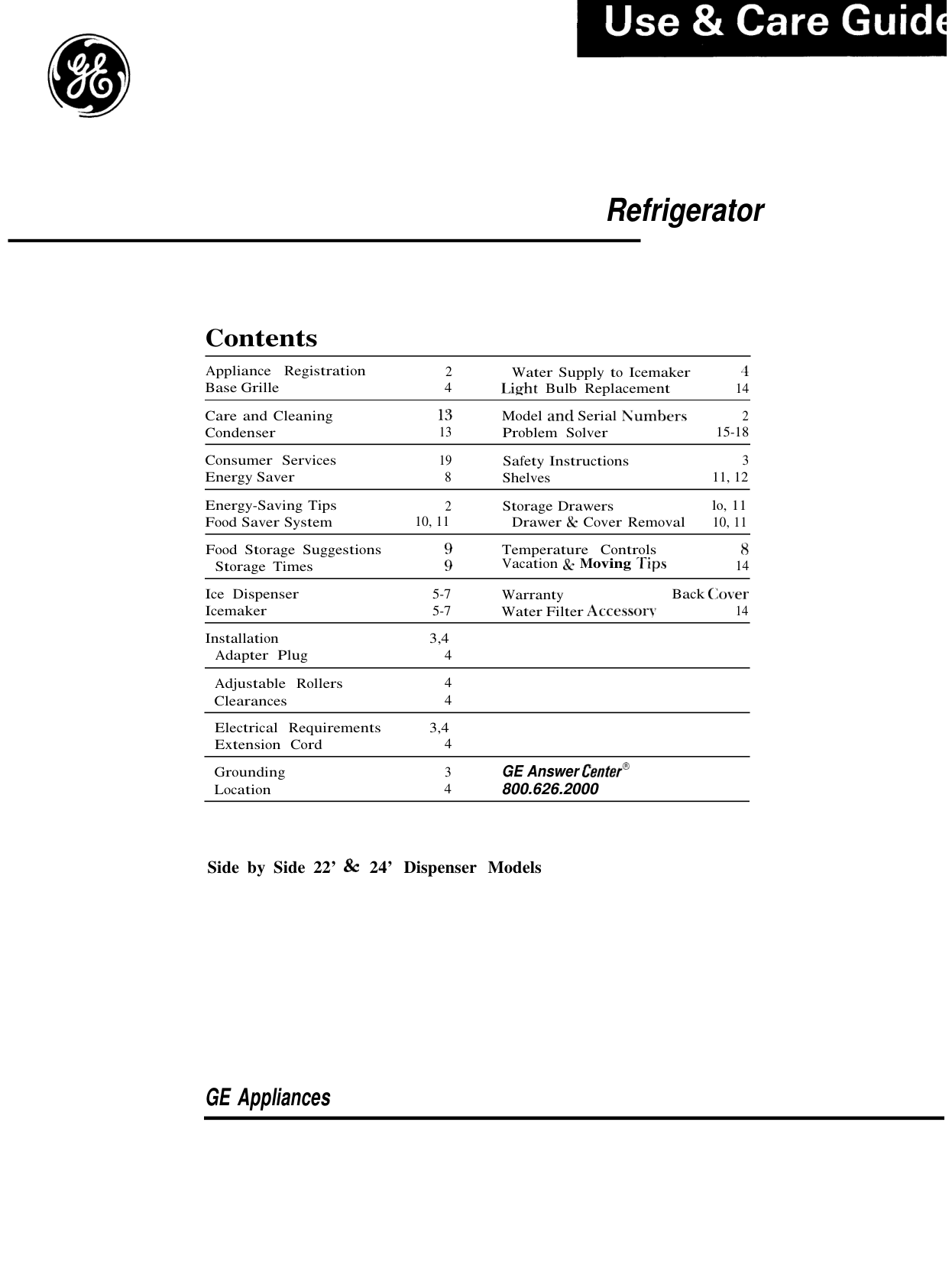
Refrigerator Contents Appliance Registration 2 Water Supply to Icemaker 4 Base Grille 4 Light Bulb Replacement 14 Care and Cleaning 13 Model anci Serial h’umbers 2 Condenser 13 Problem Solver 15-18 Consumer Services 19 Safety Instructions 3 Energy Saver 8 Shelves 11, 12 Energy-Saving Tips 2 Storage Drawers lo, 11 Food Saver System 10, 11 Drawer & Cover Removal 10, 11 Food Storage Suggestions 9 Temperature Controls 8 Storage Times 9 Vacation & Moving ‘r@S 14 Ice Dispenser 5-7 Warranty Back Coler Icemaker 5-7 Water Filter Accessor~7 14 Installation 3,4 Adapter Plug 4 Adjustable Rollers 4 Clearances 4 Electrical Requirements 3,4 Extension Cord 4 Grounding 3 GE Answer Centera Location 4 800.626.2000 Side by Side 22’ & 24’ Dispenser Models GE Appliances
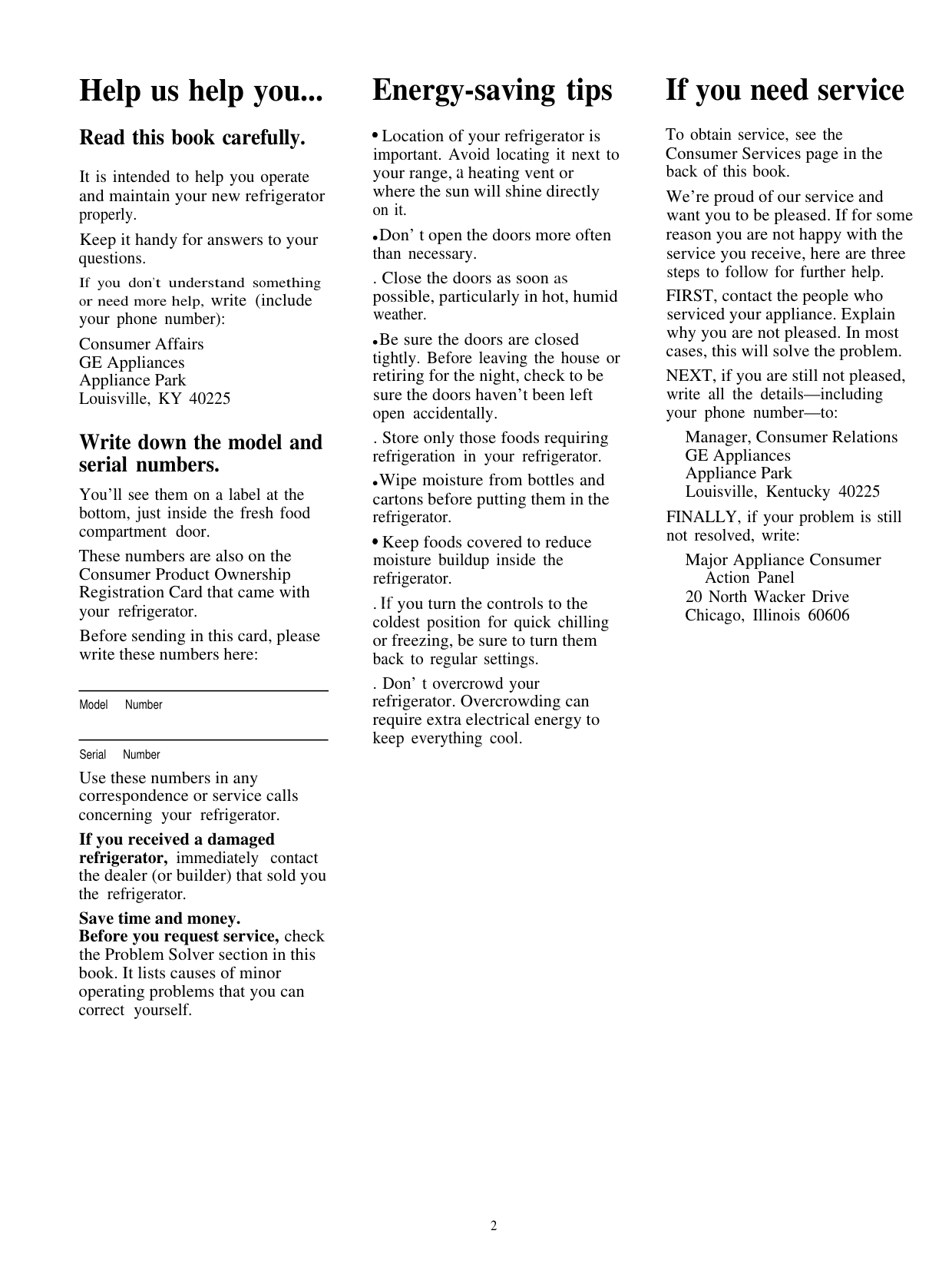
Help us help you... Read this book carefully. It is intended to help you operate and maintain your new refrigerator properly. Keep it handy for answers to your questions. If you don’t understand something or need more help, write (include your phone number): Consumer Affairs GE Appliances Appliance Park Louisville, KY 40225 Write down the model and serial numbers. You’ll see them on a label at the bottom, just inside the fresh food compartment door. These numbers are also on the Consumer Product Ownership Registration Card that came with your refrigerator. Before sending in this card, please write these numbers here: Model Number Serial Number Use these numbers in any correspondence or service calls concerning your refrigerator. If you received a damaged refrigerator, immediately contact the dealer (or builder) that sold you the refrigerator. Energy-saving tips c Location of your refrigerator is important. Avoid locating it next to your range, a heating vent or where the sun will shine directly on it. G Don’ t open the doors more often than necessary. . Close the doors as soon as possible, particularly in hot, humid weather. G Be sure the doors are closed tightly. Before leaving the house or retiring for the night, check to be sure the doors haven’t been left open accidentally. . Store only those foods requiring refrigeration in your refrigerator. G Wipe moisture from bottles and cartons before putting them in the refrigerator. Q Keep foods covered to reduce moisture buildup inside the refrigerator. . If you turn the controls to the coldest position for quick chilling or freezing, be sure to turn them back to regular settings. . Don’ t overcrowd your refrigerator. Overcrowding can require extra electrical energy to keep everything cool. If you need service To obtain service, see the Consumer Services page in the back of this book. We’re proud of our service and want you to be pleased. If for some reason you are not happy with the service you receive, here are three steps to follow for further help. FIRST, contact the people who serviced your appliance. Explain why you are not pleased. In most cases, this will solve the problem. NEXT, if you are still not pleased, write all the details—including your phone number—to: Manager, Consumer Relations GE Appliances Appliance Park Louisville, Kentucky 40225 FINALLY, if your problem is still not resolved, write: Major Appliance Consumer Action Panel 20 North Wacker Drive Chicago, Illinois 60606 Save time and money. Before you request service, check the Problem Solver section in this book. It lists causes of minor operating problems that you can correct yourself. 2
Important
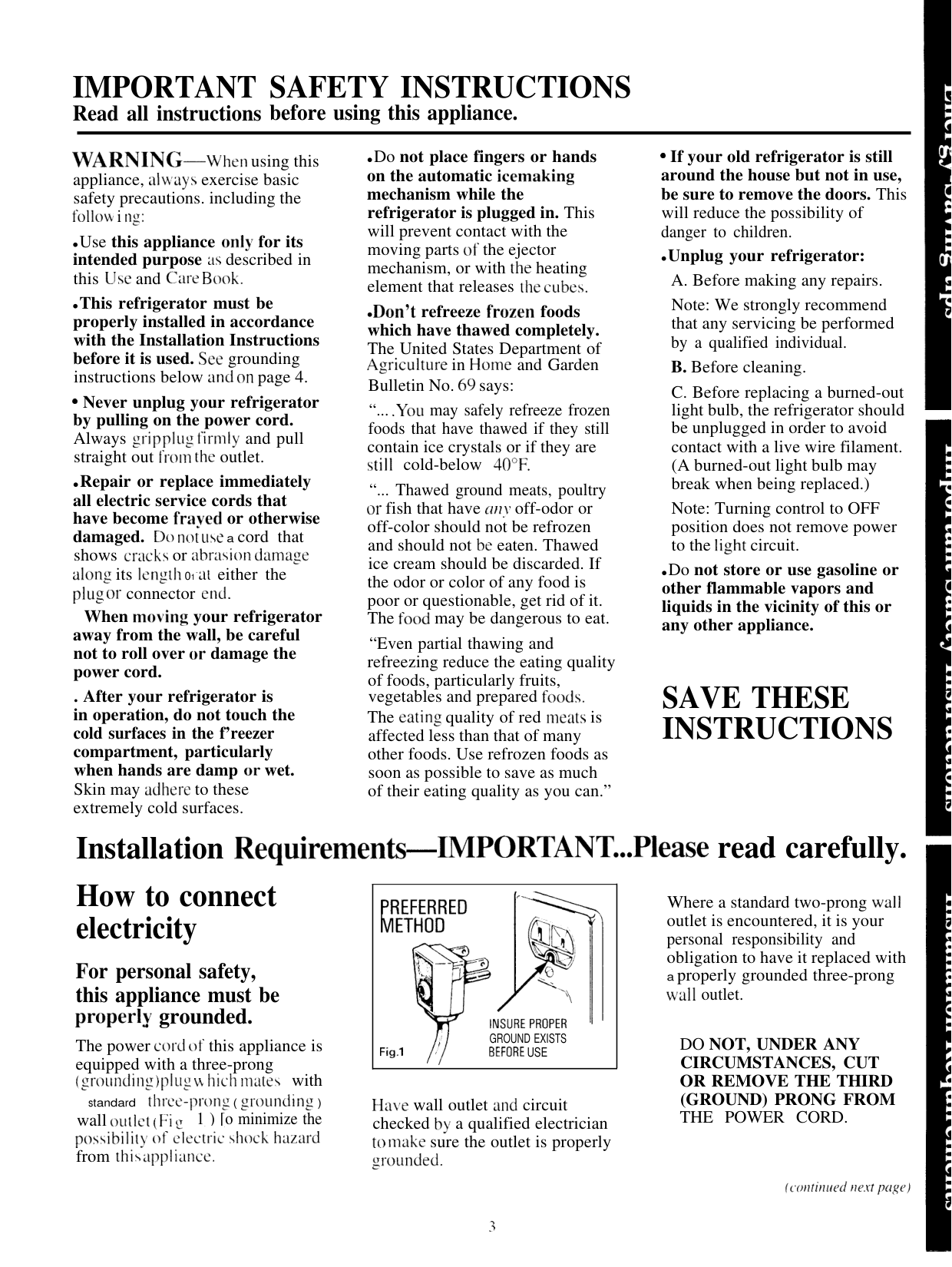
Read all instructions SAFETY INSTRUCTIONS before using this appliance. WARNING—wh~n using this appliance, always exercise basic safety precautions. including the follow i ng: G Use this appliance onl}T for its intended purpose as described in this Use and Cat-e Book. G This refrigerator must be properly installed in accordance with the Installation Instructions before it is used. See grounding instructions below and on page 4. s Never unplug your refrigerator by pulling on the power cord. Always grip plLIg firmly and pull straight out from the outlet. G Repair or replace immediately all electric service cords that have become frayed or otherwise damaged. Do n~~t LISe a cord that shows cracks or abra$ion damage along its length 01Save These
Instructions
Installation Requirements— IMPORTANT...Please read carefully. How to connect electricity For personal safety, this appliance must be properlv grounded. . The power cord of this appliance is equipped with a three-prong (gl-ollnding) plLI: w hiuh mate~ with //Ground Exists
Fig.1 ‘Befdre Use
standard thl”w-pron: ( groLlndlng ) Ha\e wall outlet and circuit wall outlet ~ Fi Q. 1 ) [o minimize the checked b)’ a qualified electrician pos~ibi]it) of ;lectric S11OCL hazard to make sure the outlet is properly from thi~ applimce. groLmded. Where a standard two-prong wall outlet is encountered, it is your personal responsibility and obligation to have it replaced with a properly grounded three-prong wall outlet.Do Not, Under Any
Circumstances, Cut
Or Remove The Third
(Ground) Prong From
The Power Cord.
3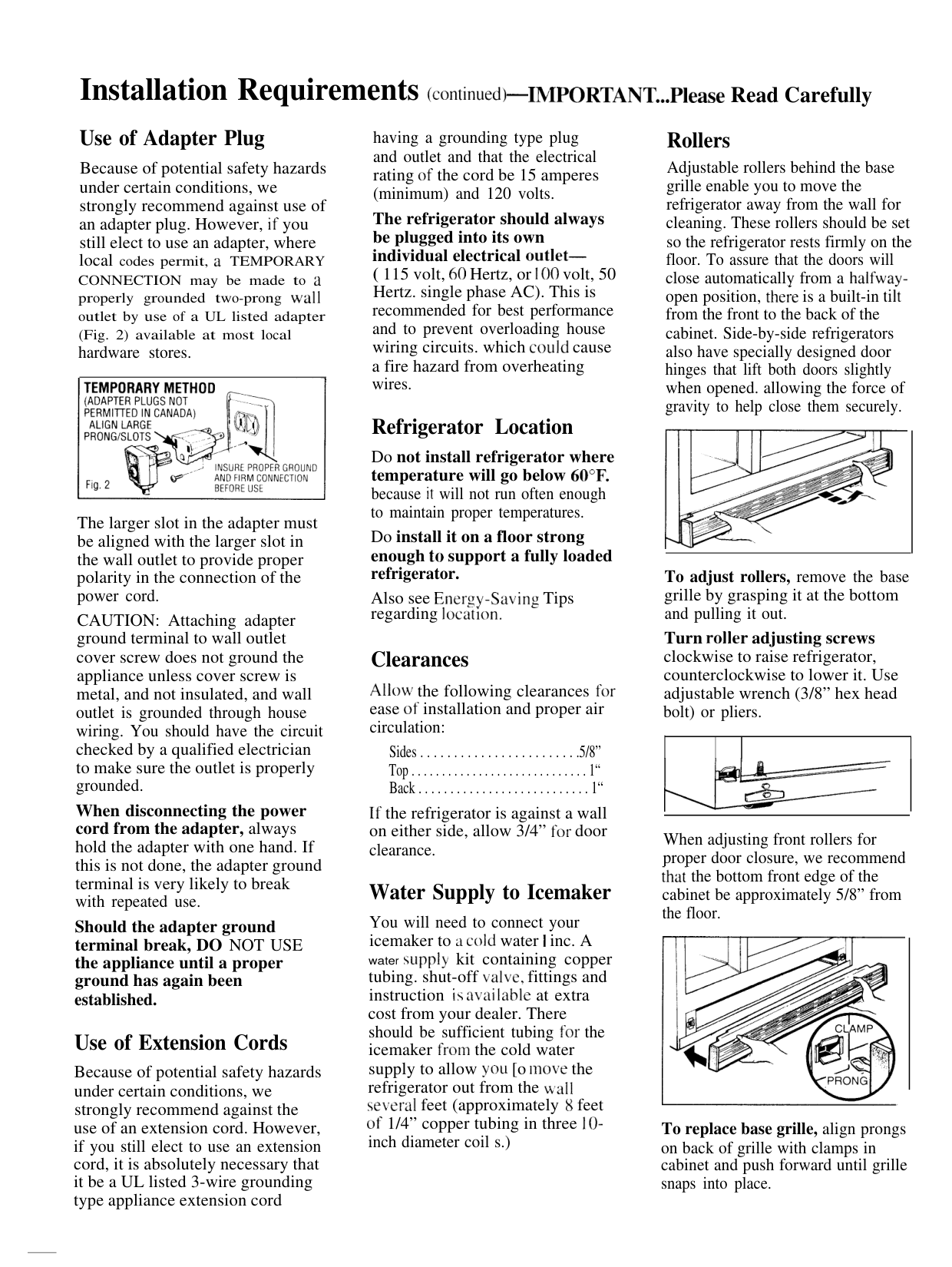
Installation Requirements (continued)—IMPORTANT...Please Read Carefully Use of Adapter Plug Because of potential safety hazards under certain conditions, we strongly recommend against use of an adapter plug. However, if you still elect to use an adapter, where local codes permit, a TEMPORARY CONNECTION may be made to a properly grounded two-prong wall outlet by use of a UL listed adapter (Fig. 2) available at most local hardware stores. The larger slot in the adapter must be aligned with the larger slot in the wall outlet to provide proper polarity in the connection of the power cord. CAUTION: Attaching adapter ground terminal to wall outlet cover screw does not ground the appliance unless cover screw is metal, and not insulated, and wall outlet is grounded through house wiring. You should have the circuit checked by a qualified electrician to make sure the outlet is properly grounded. When disconnecting the power cord from the adapter, always hold the adapter with one hand. If this is not done, the adapter ground terminal is very likely to break with repeated use. Should the adapter ground terminal break, DO NOT USE the appliance until a proper ground has again been established. Use of Extension Cords Because of potential safety hazards under certain conditions, we strongly recommend against the use of an extension cord. However, if you still elect to use an extension cord, it is absolutely necessary that it be a UL listed 3-wire grounding type appliance extension cord having a grounding type plug and outlet and that the electrical rating of the cord be 15 amperes (minimum) and 120 volts. The refrigerator should always be plugged into its own individual electrical outlet— ( 115 volt, 60 Hertz, or 100 volt, 50 Hertz. single phase AC). This is recommended for best performance and to prevent overloading house wiring circuits. which cou]d cause a fire hazard from overheating wires. Refrigerator Location Do not install refrigerator where temperature will go below 60°F. because it will not run often enough to maintain proper temperatures. Do install it on a floor strong enough to support a fully loaded refrigerator. Also see Ener,gy-Saving Tips regarding l~cation. Clearances AI1OW the following clearances for ease of installation and proper air circulation: Sides . . . . . . . . . . . . . . . . . . . . . . . .5/8” Top . . . . . . . . . . . . . . . . . . . . . . . . . . . . . 1“ Back . . . . . . . . . . . . . . . . . . . . . . . . . . . 1“ If the refrigerator is against a wall on either side, allow 3/4” for door clearance. Water Supply to Icemaker You will need to connect your icemaker to a cold water 1 inc. A water sLIpply kit containing copper tubing. shut-off valve, fittings and instruction is avai Iable at extra cost from your dealer. There should be sufficient tubing for the icemaker from the cold water supply to allow you [o mo~~e the refrigerator out from the wall se~eral feet (approximately 8 feet of 1/4” copper tubing in three 1()- inch diameter coil s.) Rollers Adjustable rollers behind the base grille enable you to move the refrigerator away from the wall for cleaning. These rollers should be set so the refrigerator rests firmly on the floor. To assure that the doors will close automatically from a halfway- open position, the;e is a built-in tiit from the front to the back of the cabinet. Side-by-side refrigerators also have specially designed door hinges that lift both doors slightly when opened. allowing the force of gravity to help close them securely. To adjust rollers, remove the base grille by grasping it at the bottom and pulling it out. Turn roller adjusting screws clockwise to raise refrigerator, counterclockwise to lower it. Use adjustable wrench (3/8” hex head bolt) or pliers. When adjusting front rollers for proper door closure, we recommend that the bottom front edge of the cabinet be approximately 5/8” from the floor. To replace base grille, align prongs on back of grille with clamps in cabinet and push forward until grille snaps into place.
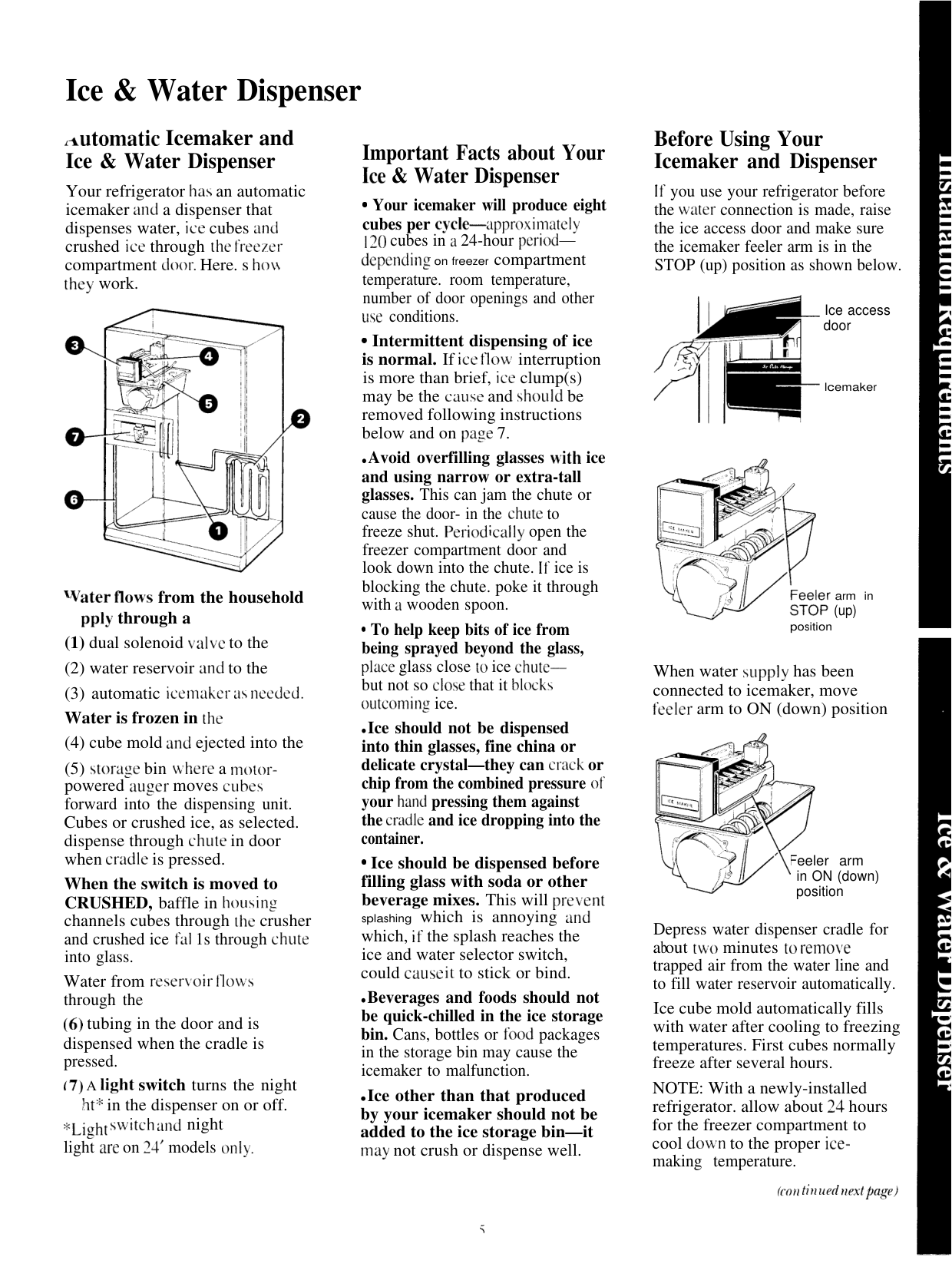
Ice & Water Dispenser .~utomatic Icemaker and Ice & Water Dispenser Your refrigerator has an automatic icemaker and a dispenser that dispenses water, ice cubes and crushed ice through the freezer compartment doot-. Here. s ho~~ they work. ~Vater flows from the household pply through a (1) dual solenoid valve to the (2) water reservoir and to the (3) automatic icemakcr as nculed. Water is frozen in the (4) cube mold and ejected into the (5) stm-age bin where a nlotor- powered auger moves cubes forward into the dispensing unit. Cubes or crushed ice, as selected. dispense through chute in door when cradle is pressed. When the switch is moved to CRUSHED, baffle in housin: channels cubes through the crusher and crushed ice fal 1s through chute into glass. Water from reser}oir flows through the (6) tubing in the door and is dispensed when the cradle is pressed. (7) A light switch turns the night ht’~ in the dispenser on or off. >kL1ght sW1tch and night light are on 24’ models onl}. Important Facts about Your Ice & Water Dispenser “ Your icemaker will produce eight cubes per cycle—approxiln:ltel~ ] z() cubes in a 24-hour perit>d— depending on freezer compartment temperature. room temperature, number of door openings and other use conditions. c Intermittent dispensing of ice is normal. If ice flow interruption is more than brief, ice clump(s) may be the CLLLISe and shou]d be removed following instructions below and on page 7. G Avoid overfilling glasses writh ice and using narrow or extra-tall glasses. This can jam the chute or cause the door- in the chute to freeze shut. Period~ca]ly open the freezer compartment door and look down into the chute. If ice is blocking the chute. poke it through with a wooden spoon. c To help keep bits of ice from being sprayed beyond the glass, place glass close to ice chute— but not so close that it blocks outcorning ice. G Ice should not be dispensed into thin glasses, fine china or delicate crystal—they can crack or chip from the combined pressure of your hand pressing them against the cradle and ice dropping into the container. c Ice should be dispensed before filling glass with soda or other beverage mixes. This will pre~ent splashing which is annoying and which, if the splash reaches the ice and water selector switch, could caLIse it to stick or bind. G Beverages and foods should not be quick-chilled in the ice storage bin. Cans, bottles or food packages in the storage bin may cause the icemaker to malfunction. G Ice other than that produced by your icemaker should not be added to the ice storage bin—it may not crush or dispense well. Before Using Your Icemaker and Dispenser If you use your refrigerator before the water connection is made, raise the ice access door and make sure the icemaker feeler arm is in the STOP (up) position as shown below. Ice access door Icemaker arm in (up) position When water sLlpply has been connected to icemaker, move feeler arm to ON (down) position ~ ‘ Feeler arm ~i ; in ON (down) position Depress water dispenser cradle for b a out two minutes to remo}re trapped air from the water line and to fill water reservoir automatically. Ice cube mold automatically fills with water after cooling to freezing temperatures. First cubes normally freeze after several hours. NOTE: With a newly-installed refrigerator. allow about 24 hours for the freezer compartment to cool do~n to the proper ice- making temperature. (cott tin ued nextpage) i
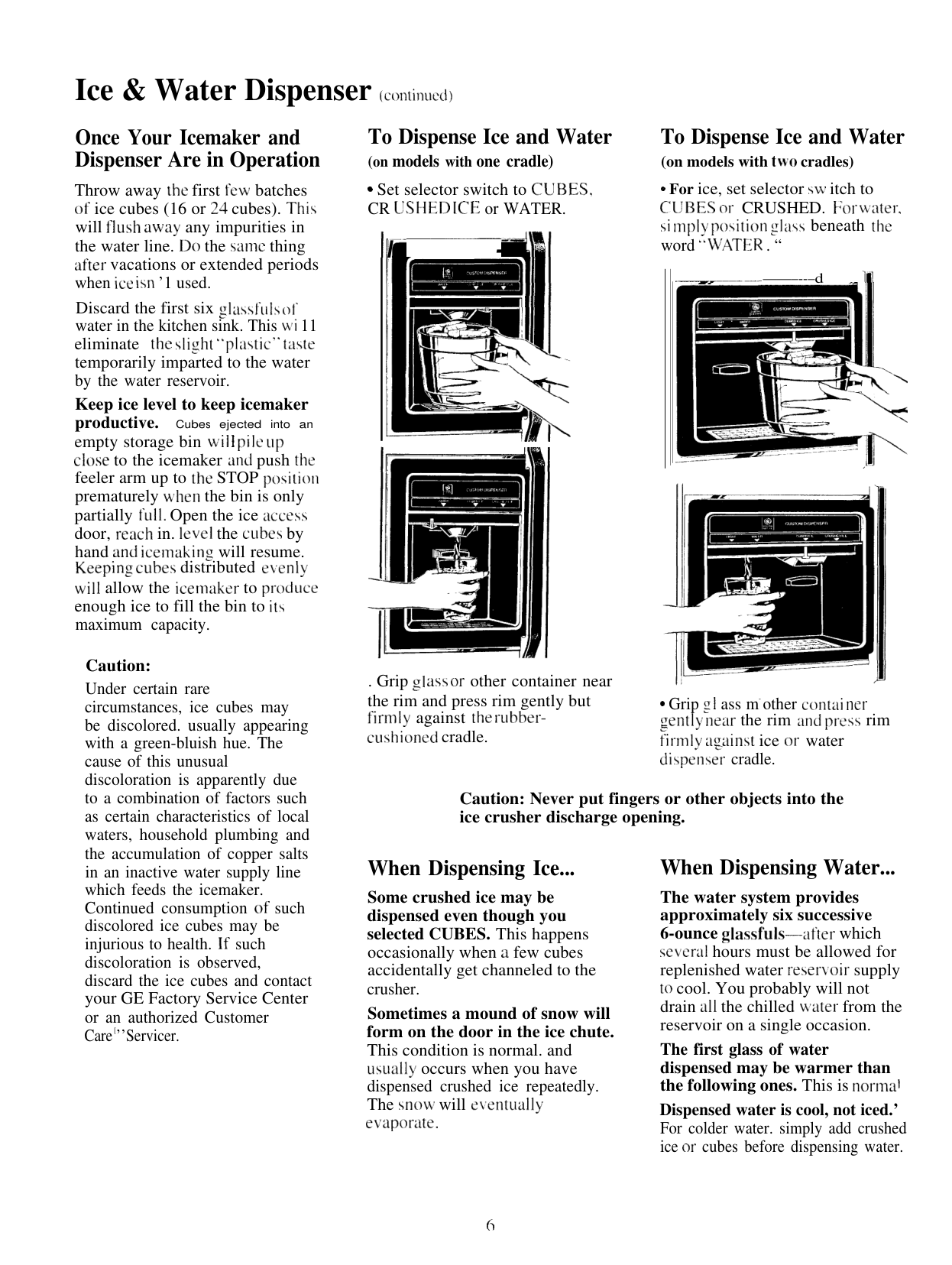
Ice & Water Dispenser (eontinucd, Once Your Icemaker and Dispenser Are in Operation Throw away the first few batches of ice cubes (16 or 24 cubes). Thi\ will flush away any impurities in the water line. DO the same thing after vacations or extended periods when ice isn ’1 used. Discard the first six glassfu]s of water in the kitchen sink. This wi 11 eliminate the slight ‘Lplajtic.’ taste temporarily imparted to the water by the water reservoir. Keep ice level to keep icemaker productive. Cubes ejected into an empty storage bin wil 1 pile Llp close to the icemaker und push the feeler arm up to the STOP positit~n prematurely when the bin is only partially full. Open the ice access door, reach in. level the cubes by hand and icemaking will resume. Keeping cubes distributed e~’enl~ will allow the icernaker to prodLIce enough ice to fill the bin to it~ maximum capacity. Caution: Under certain rare circumstances, ice cubes may be discolored. usually appearing with a green-bluish hue. The cause of this unusual discoloration is apparently due to a combination of factors such as certain characteristics of local waters, household plumbing and the accumulation of copper salts in an inactive water supply line which feeds the icemaker. Continued consumption of such discolored ice cubes may be injurious to health. If such discoloration is observed, discard the ice cubes and contact your GE Factory Service Center or an authorized Customer Care [’’Servicer. To Dispense Ice and Water (on models with one cradle) s Set selector switch to CUBES, CR USIHED ICE or WATER. ,1--
I
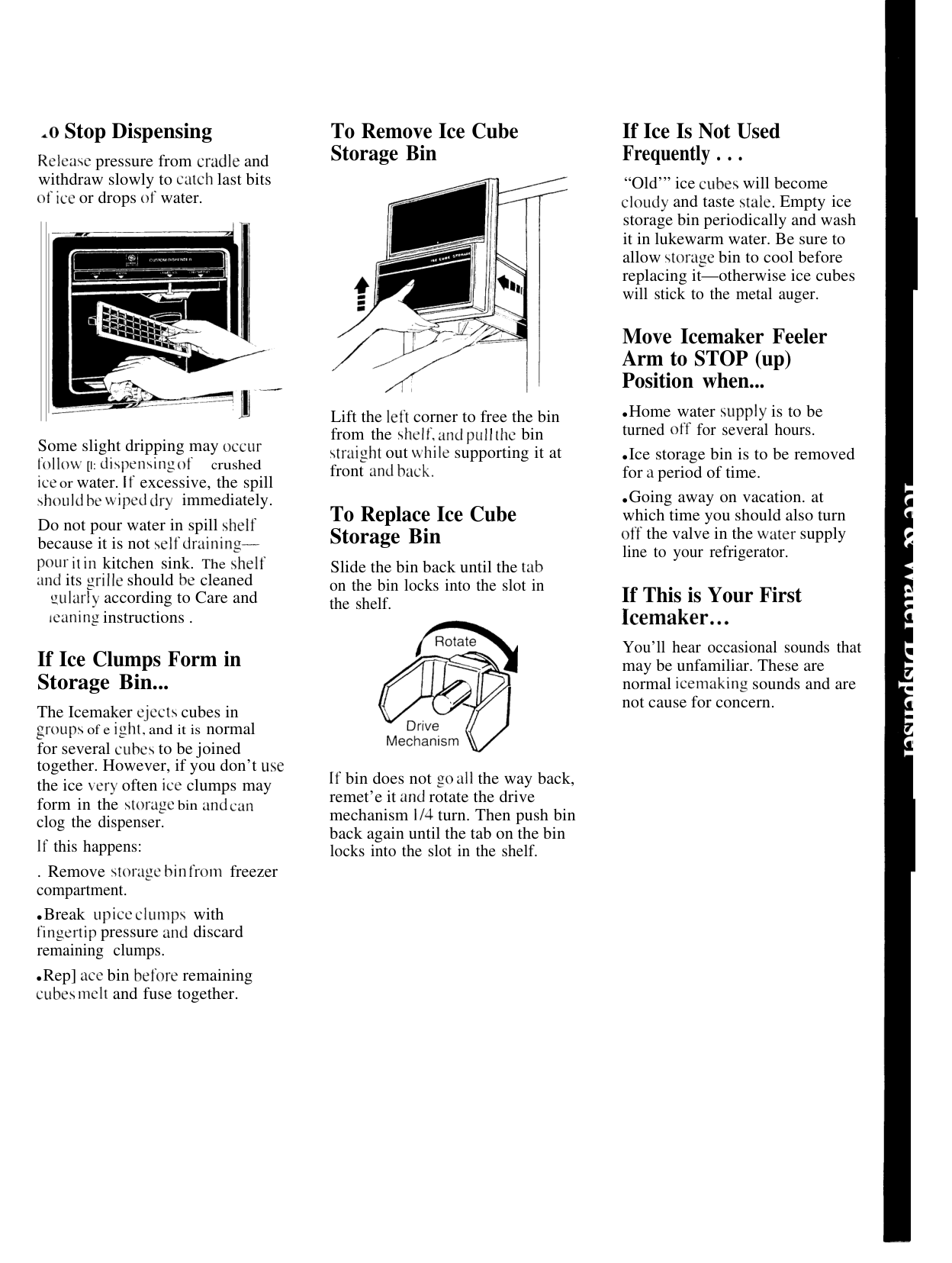
.O Stop Dispensing Releuse pressure from cradle and withdraw slowly to catch last bits of ice or drops of water. Some slight dripping may occur fo]lOWi [l: dispensing of crushed ice or water. If excessive, the spill shou]d be wJiped Ciry immediately. Do not pour water in spill shelf because it is not self clraining— pour it in kitchen sink. The shelf und its grille should be cleaned qular] y according to Care and leaning instructions . If Ice Clumps Form in Storage Bin... The Icemaker ejects cubes in oroups of e i:ht. and it is normal e for several cubes to be joined together. However, if you don’t USe the ice very often ice clumps may form in the stortige bin and cm clog the dispenser. If this happens: . Remove storage bin ~“rom freezer compartment. G Break LIp ice clLInlps with lingertip pressure and discard remaining clumps. G Rep] ace bin before remaining cubes melt and fuse together. To Remove Ice Cube Storage Bin — Lift the left corner to free the bin from the shelf, and pull the bin \traight out while supporting it at front and back. To Replace Ice Cube Storage Bin Slide the bin back until the tub on the bin locks into the slot in the shelf. If bin does not go all the way back, remet’e it and rotate the drive mechanism 1/4 turn. Then push bin back again until the tab on the bin locks into the slot in the shelf. If Ice Is Not Used Frequently . . . “Old’” ice cubes will become c]oLldy and taste stale. Empty ice storage bin periodically and wash it in lukewarm water. Be sure to allow ~torage bin to cool before replacing it—otherwise ice cubes will stick to the metal auger. Move Icemaker Feeler Arm to STOP (up) Position when... G Home water sLlpply is to be turned off for several hours. G Ice storage bin is to be removed for a period of time. G Going away on vacation. at which time you should also turn off the valve in the water supply line to your refrigerator. If This is Your First Icemaker... You’ll hear occasional sounds that may be unfamiliar. These are normal icemaking sounds and are not cause for concern.
Operating Your Refrigerator Set the Temperature Controls
I
Freezer
C
Initial
Setting
E
Coldest
I
Initial
Setting
5 ~RESHFooDColdest
9I
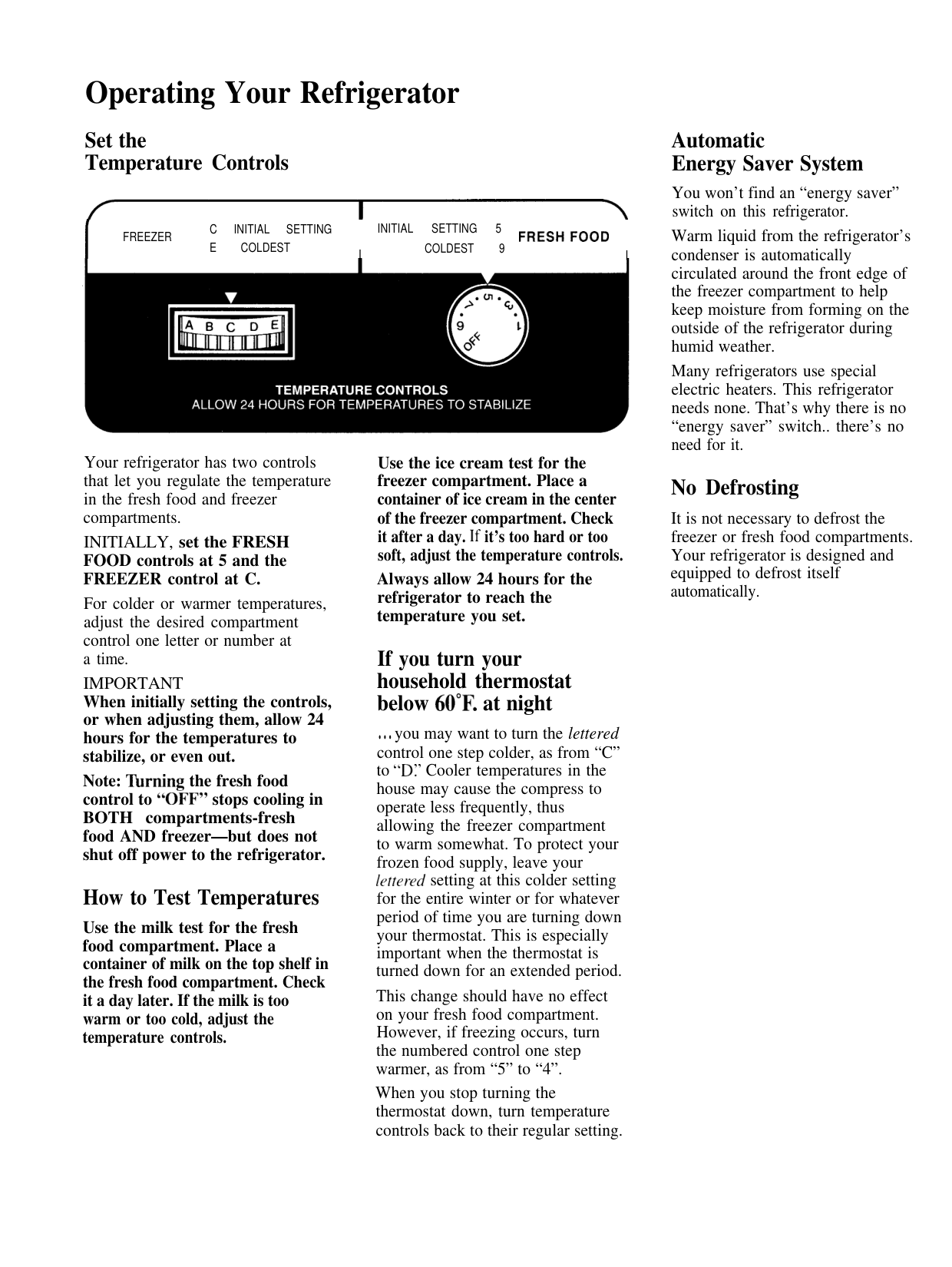
Your refrigerator has two controls that let you regulate the temperature in the fresh food and freezer compartments. INITIALLY, set the FRESH FOOD controls at 5 and the FREEZER control at C. For colder or warmer temperatures, adjust the desired compartment control one letter or number at a time.Important
When initially setting the controls, or when adjusting them, allow 24 hours for the temperatures to stabilize, or even out. Note: lkmning the fresh food control to “OFF>> stops cooling in BOTH compartments-fresh food AND freezer—but does not shut off power to the refrigerator. How to Test Temperatures Use the milk test for the fresh food compartment. Place a container of milk on the top shelf in the fresh food compartment. Check it a day later. If the milk is too warm or too cold, adjust the temperature controls. Use the ice cream test for the freezer compartment. Place a container of ice cream in the center of the freezer compartment. Check it after a day. If it’s too hard or too soft, adjust the temperature controls. Always allow 24 hours for the refrigerator to reach the temperature you set. If you turn your household thermostat below 60°F. at night . . . you may want to turn the lettered control one step colder, as from “C” to “D?’ Cooler temperatures in the house may cause the compress to operate less frequently, thus allowing the freezer compartment to warm somewhat. To protect your frozen food supply, leave your lettered setting at this colder setting for the entire winter or for whatever period of time you are turning down your thermostat. This is especially important when the thermostat is turned down for an extended period. This change should have no effect on your fresh food compartment. However, if freezing occurs, turn the numbered control one step warmer, as from “5” to “4”. When you stop turning the thermostat down, turn temperature controls back to their regular setting. Automatic Energy Saver System You won’t find an “energy saver” switch on this refrigerator. Warm liquid from the refrigerator’s condenser is automatically circulated around the front edge of the freezer compartment to help keep moisture from forming on the outside of the refrigerator during humid weather. Many refrigerators use special electric heaters. This refrigerator needs none. That’s why there is no “energy saver” switch.. there’s no need for it. No Defrosting It is not necessary to defrost the freezer or fresh food compartments. Your refrigerator is designed and equipped to defrost itself automatically.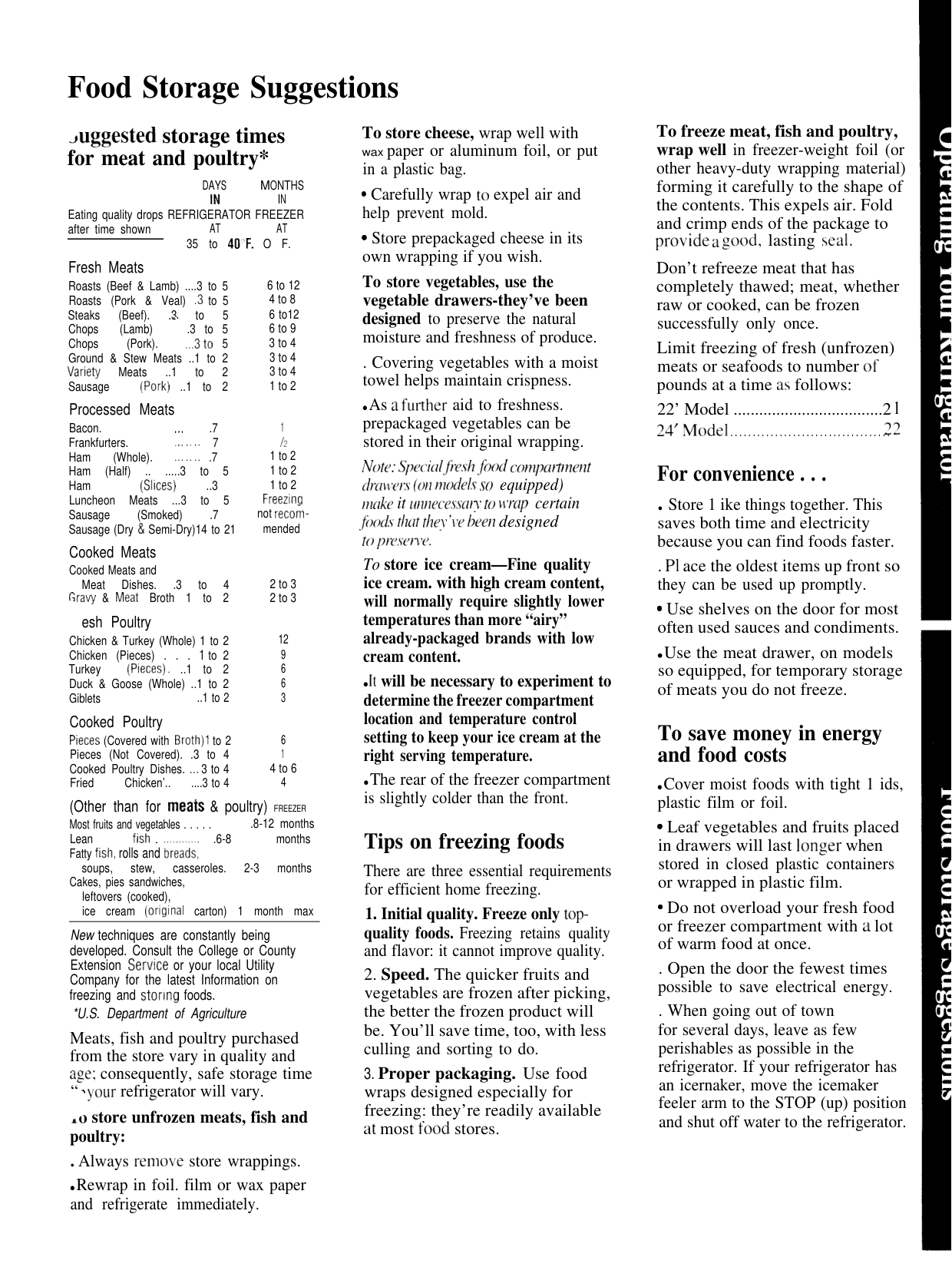
Food Storage Suggestions ~uggested storage times for meat and poultry*
Days
Months
ItiIn
Eating quality drops REFRIGERATOR FREEZER after time shownAt
At
35 to 40’F. O F. Fresh Meats Roasts (Beef & Lamb) ....3 to 5 Roasts (Pork & Veal) .3 to 5 Steaks (Beef). .3 to 5 Chops (Lamb) ““ .3 to 5 Chops (Pork). ...3to 5 Ground & Stew Meats ..1 to 2 Var!ety Meats ..1 to 2 Sausage (Pork) ..1 to 2 Processed Meats Bacon. ,., .7 Frankfurters. 7 Ham (Whole). .:: :. ‘ .7 Ham (Half) .. .....3 to 5 Ham (Sllces) ..3 Luncheon Meats ...3 to 5 6 to 12 4 to 8 6 to12 6 to 9 3 to 4 3 to 4 3 to 4 1 to 2 1 /2 1 to 2 1 to 2 1 to 2 Freezlnq Sausage (Smoked) .7 not recorn- Sausage (Dry & Semi-Dry)14 to 21 mended Cooked Meats Cooked Meats and Meat Dishes. .3 to 4 2 to 3 Gravy & Meat Broth 1 to 2 2 to 3 esh Poultry Chicken & Turkey (Whole) 1 to 2 12 Chicken (Pieces) . . . 1 to 2 9 Turkey (P!eces). ..1 to 2 6 Duck & Goose (Whole) ..1 to 2 6 Giblets ..1 to 2 3 Cooked Poultry Pieces (Covered with Broth)l to 2 6 Pieces (Not Covered). .3 to 4 1 Cooked Poultry Dishes. ,,, 3 to 4 4 to 6 Fried Chicken’.. ....3 to 4 4 (Other than for meats & poultry) FREEZER Most fruits and vegetables . . . . . .8-12 months Lean fish : :. .6-8 months Fatty fish, rolls and breads soups, stew, casseroles. 2-3 months Cakes, pies sandwiches, leftovers (cooked), ice cream (orlglnal carton) 1 month max New techniques are constantly being developed. Consult the College or County Extension Serwce or your local Utility Company for the latest Information on freezing and storing foods. *U.S. Department of Agriculture Meats, fish and poultry purchased from the store vary in quality and age; consequently, safe storage time “ A your refrigerator will vary. .O store unfrozen meats, fish and poultry: . Always remo\re store wrappings. G Rewrap in foil. film or wax paper and refrigerate immediately. To store cheese, wrap well with wax paper or aluminum foil, or put in a plastic bag. c Carefully wrap to expel air and help prevent mold. c Store prepackaged cheese in its own wrapping if you wish. To store vegetables, use the vegetable drawers-they’ve been designed to preserve the natural moisture and freshness of produce. . Covering vegetables with a moist towel helps maintain crispness. G As a fu~~her aid to freshness. prepackaged vegetables can be stored in their original wrapping. Note: Sp.xidfk.sh food mnpa~%nemt drab~vrs< (on mmkls so equipped) make it unnece.w.v> to wrap certain .fixxls that the>’ie been designed to prv.smv. To store ice cream—Fine quality ice cream. with high cream content, will normally require slightly lower temperatures than more “airy” already-packaged brands with low cream content. G lt will be necessary to experiment to determine the freezer compartment location and temperature control setting to keep your ice cream at the right serving temperature. G The rear of the freezer compartment is slightly colder than the front. Tips on freezing foods There are three essential requirements for efficient home freezing.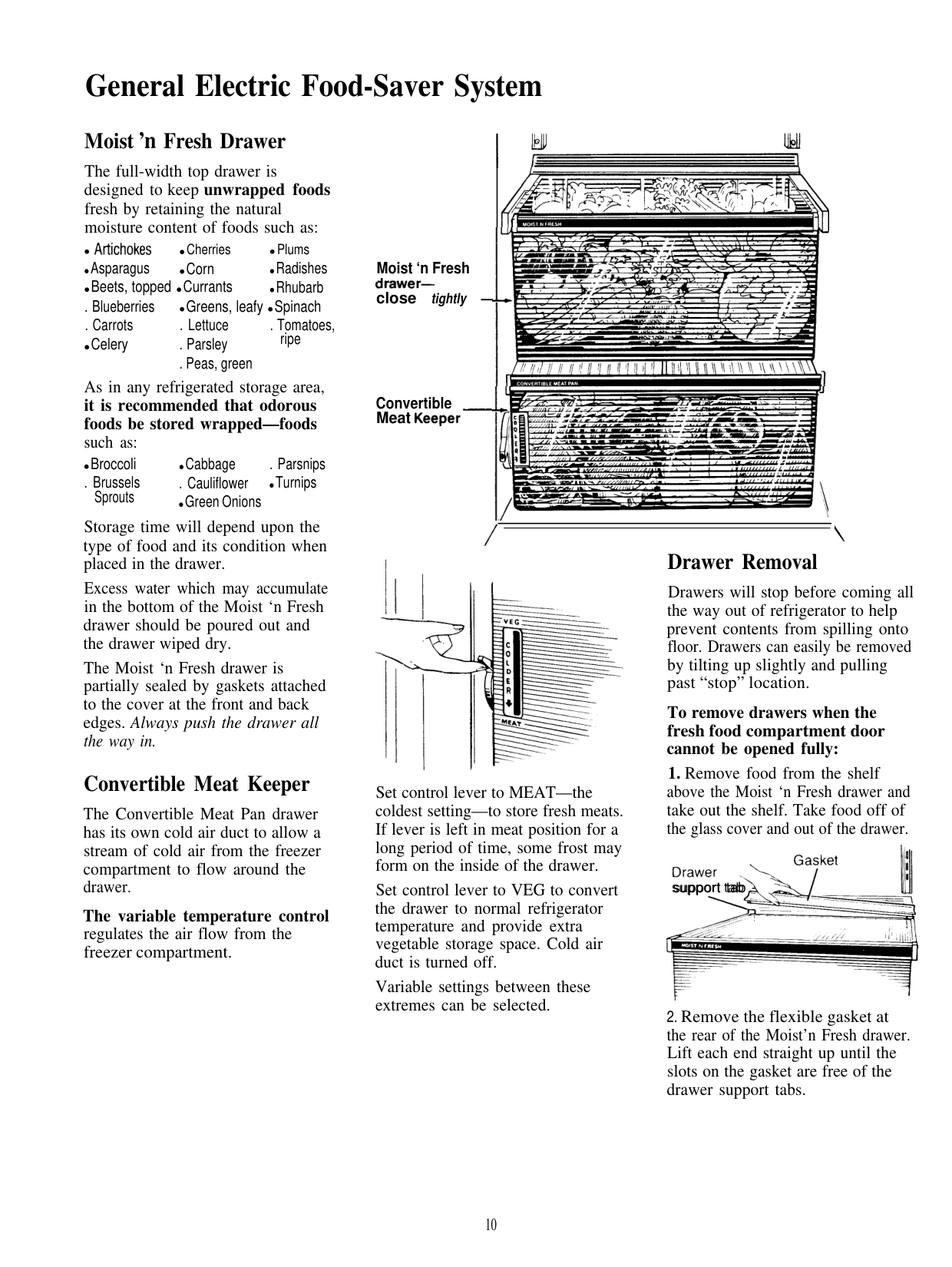
General Electric Food-Saver System Moist ‘n Fresh Drawer The full-width top drawer is designed to keep unwrapped foods fresh by retaining the natural moisture content of foods such as: G Artichokes G Cherries G Plums G Asparagus G Corn G Radishes G Beets, topped G Currants G Rhubarb . Blueberries G Greens, leafy G Spinach . Carrots . Lettuce . Tomatoes, G Celery . Parsley ripe . Peas, green As in any refrigerated storage area, it is recommended that odorous foods be stored wrapped—foods such as: G Broccoli G Cabbage . Parsnips . Brussels . Cauliflower G Turnips Sprouts G Green Onions Storage time will depend upon the type of food and its condition when placed in the drawer. Excess water which may accumulate in the bottom of the Moist ‘n Fresh drawer should be poured out and the drawer wiped dry. The Moist ‘n Fresh drawer is partially sealed by gaskets attached to the cover at the front and back edges. Always push the drawer all the way in. Convertible Meat Keeper The Convertible Meat Pan drawer has its own cold air duct to allow a stream of cold air from the freezer compartment to flow around the drawer. The variable temperature control regulates the air flow from the freezer compartment. Moist ‘n Fresh drawer— close tightly — Convertible Meat Keeper— / Set control lever to MEAT—the coldest setting—to store fresh meats. If lever is left in meat position for a long period of time, some frost may form on the inside of the drawer. Set control lever to VEG to convert the drawer to normal refrigerator temperature and provide extra vegetable storage space. Cold air duct is turned off. Variable settings between these extremes can be selected. \ Drawer Removal Drawers will stop before coming all the way out of refrigerator to help prevent contents from spilling onto floor. Drawers can easily be removed by tilting up slightly and pulling past “stop” location. To remove drawers when the fresh food compartment door cannot be opened fully:
F
I
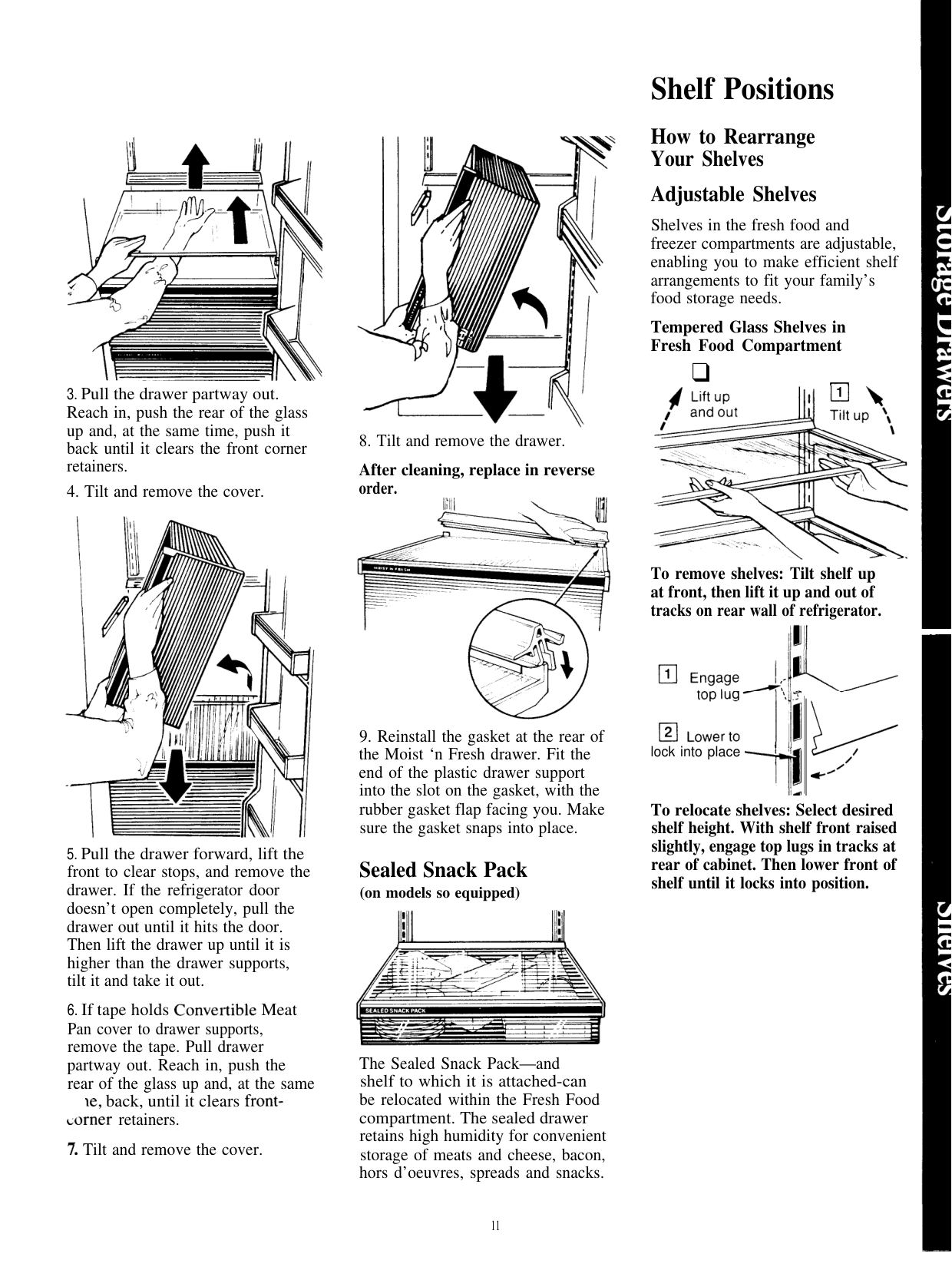
Shelf Positions
K
—I
Ii
3 114 To relocate shelves: Select desired shelf height. With shelf front raised slightly, engage top lugs in tracks at rear of cabinet. Then lower front of shelf until it locks into position. 11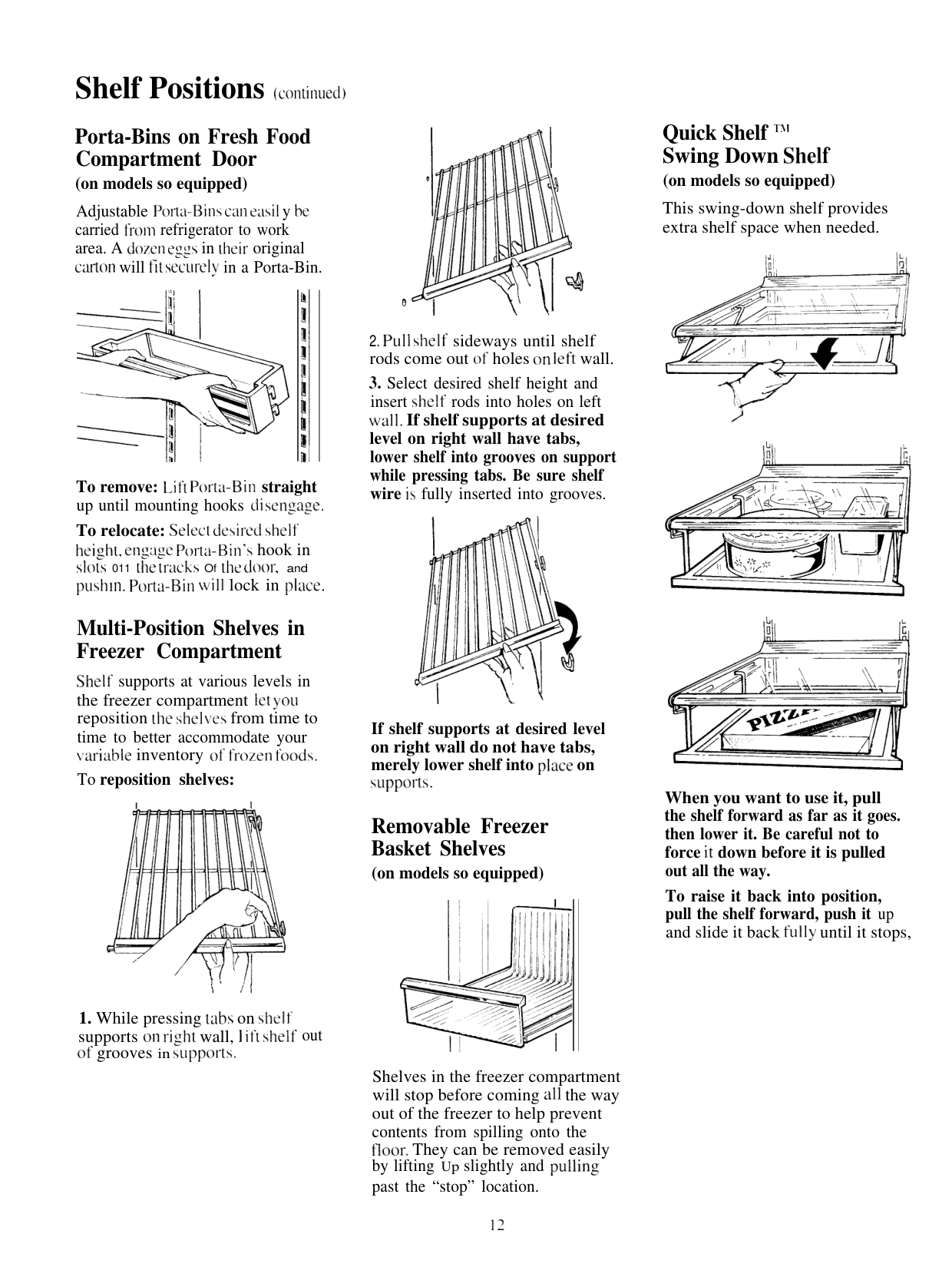
Shelf Positions (mtin..~) Porta-Bins on Fresh Food Compartment Door (on models so equipped) Adjustable Polt~-Bin\ can easi] y be carried fi-om refrigerator to work area. A dozen eggs in [heir original carton will fit securely in a Porta-Bin. To remove: l.if’t Port~i-Bin straight up until mounting hooks cii sengage. To relocate: Select desired shelf height, eng:lge Porta-Bin’s hook in s]ots 011 the tI”aCkS Of the door, and pLIsh m. Porta-Bin wi]] lock in place. Multi-Position Shelves in Freezer Compartment Shelf supports at various levels in the freezer compartment iet yOLi reposition the shel~’cs from time to time to better accommodate your \’ariable inventory of frozen foods. To reposition shelves: \
Ii
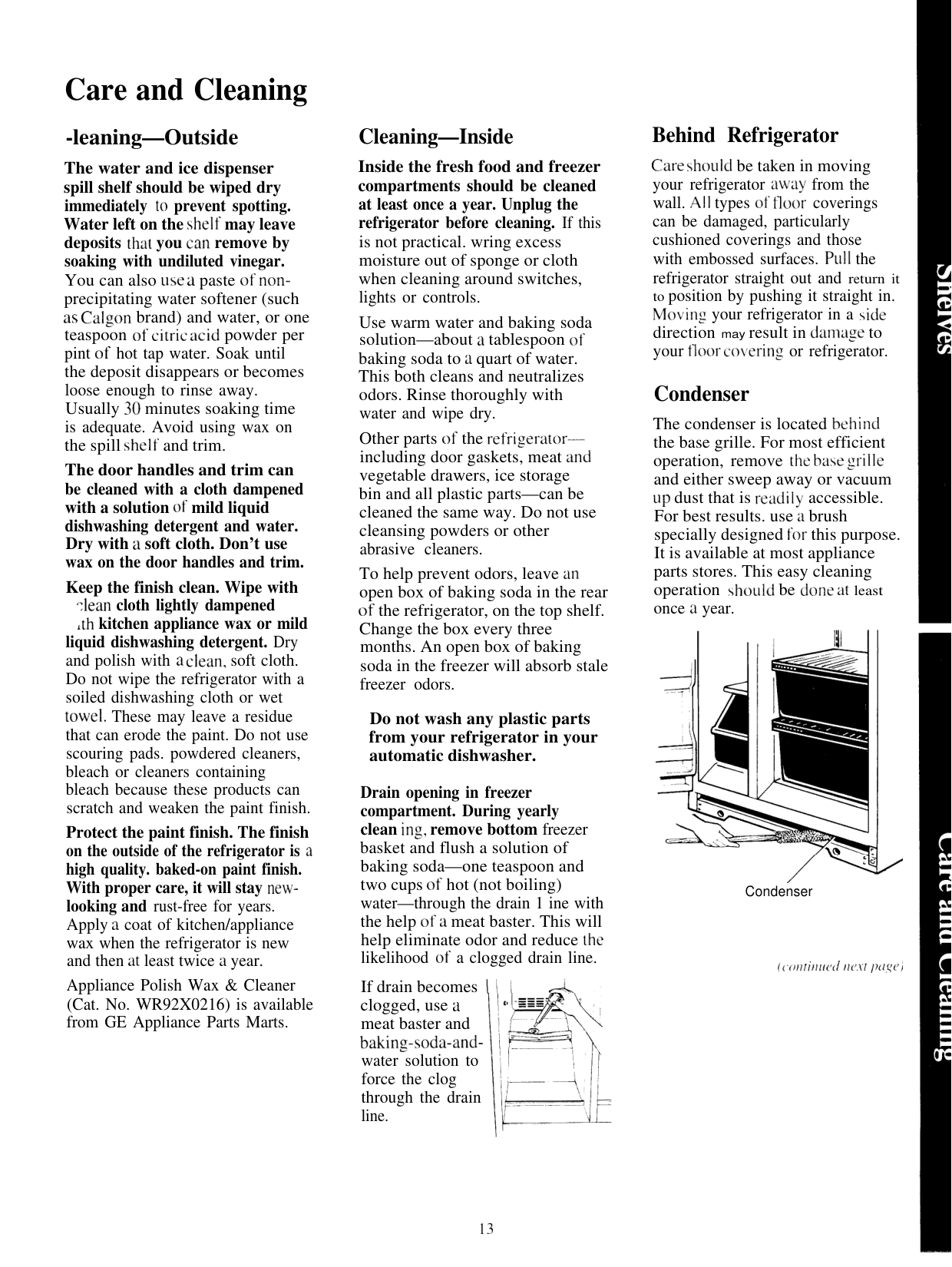
Care and Cleaning -leaning—Outside The water and ice dispenser spill shelf should be wiped dry immediately to prevent spotting. Water left on the shelf may leave deposits that you can remove by soaking with undiluted vinegar. You can also Lux a paste of non- precipitating water softener (such as Calgon brand) and water, or one teaspoon of citric acid powder per pint of hot tap water. Soak until the deposit disappears or becomes loose enough to rinse away. Usually 30 minutes soaking time is adequate. Avoid using wax on the spill shelf and trim. The door handles and trim can be cleaned with a cloth dampened with a solution of mild liquid dishwashing detergent and water. Dry with a soft cloth. Don’t use wax on the door handles and trim. Keep the finish clean. Wipe with clean cloth lightly dampened ,th kitchen appliance wax or mild liquid dishwashing detergent. Dry and polish with a clean, soft cloth. Do not wipe the refrigerator with a soiled dishwashing cloth or wet towel. These may leave a residue that can erode the paint. Do not use scouring pads. powdered cleaners, bleach or cleaners containing bleach because these products can scratch and weaken the paint finish. Protect the paint finish. The finish on the outside of the refrigerator is a high quality. baked-on paint finish. With proper care, it will stay new- looking and rust-free for years. Apply a coat of kitchen/appliance wax when the refrigerator is new and then at least twice a year. Appliance Polish Wax & Cleaner (Cat. No. WR92X0216) is available from GE Appliance Parts Marts. Cleaning—Inside Inside the fresh food and freezer compartments should be cleaned at least once a year. Unplug the refrigerator before cleaning. If this is not practical. wring excess moisture out of sponge or cloth when cleaning around switches, lights or controls. Use warm water and baking soda solution—about a tablespoon of baking soda to a quart of water. This both cleans and neutralizes odors. Rinse thoroughly with water and wipe dry. Other parts of the refrigerator- including door gaskets, meat and vegetable drawers, ice storage bin and all plastic parts—can be cleaned the same way. Do not use cleansing powders or other abrasive cleaners. To help prevent odors, leave an open box of baking soda in the rear of the refrigerator, on the top shelf. Change the box every three months. An open box of baking soda in the freezer will absorb stale freezer odors. Do not wash any plastic parts from your refrigerator in your automatic dishwasher. Drain opening in freezer compartment. During yearly clean ing, remove bottom freezer basket and flush a solution of baking soda—one teaspoon and two cups of hot (not boiling) water—through the drain 1 ine with the help of a meat baster. This will help eliminate odor and reduce the likelihood of a clogged drain line. If drain becomes clogged, use a meat baster and baking-soda-and- water solution to force the clog through the drain line. Behind Refrigerator Care shoulcl be taken in moving your refrigerator awtiy from the wall. All types of floor coverings can be damaged, particularly cushioned coverings and those with embossed surfaces. PL~ll the refrigerator straight out and return it to position by pushing it straight in. Mo\ing your refrigerator in a \ide direction may result in damage to your tloor co\ering or refrigerator. Condenser The condenser is located behind the base grille. For most efficient operation, remove the base grille and either sweep away or vacuum LIp dust that is readily accessible. For best results. use a brush specially designed for this purpose. It is available at most appliance parts stores. This easy cleaning operation \hould be done at least once a year. /=$-’ Condenser 13
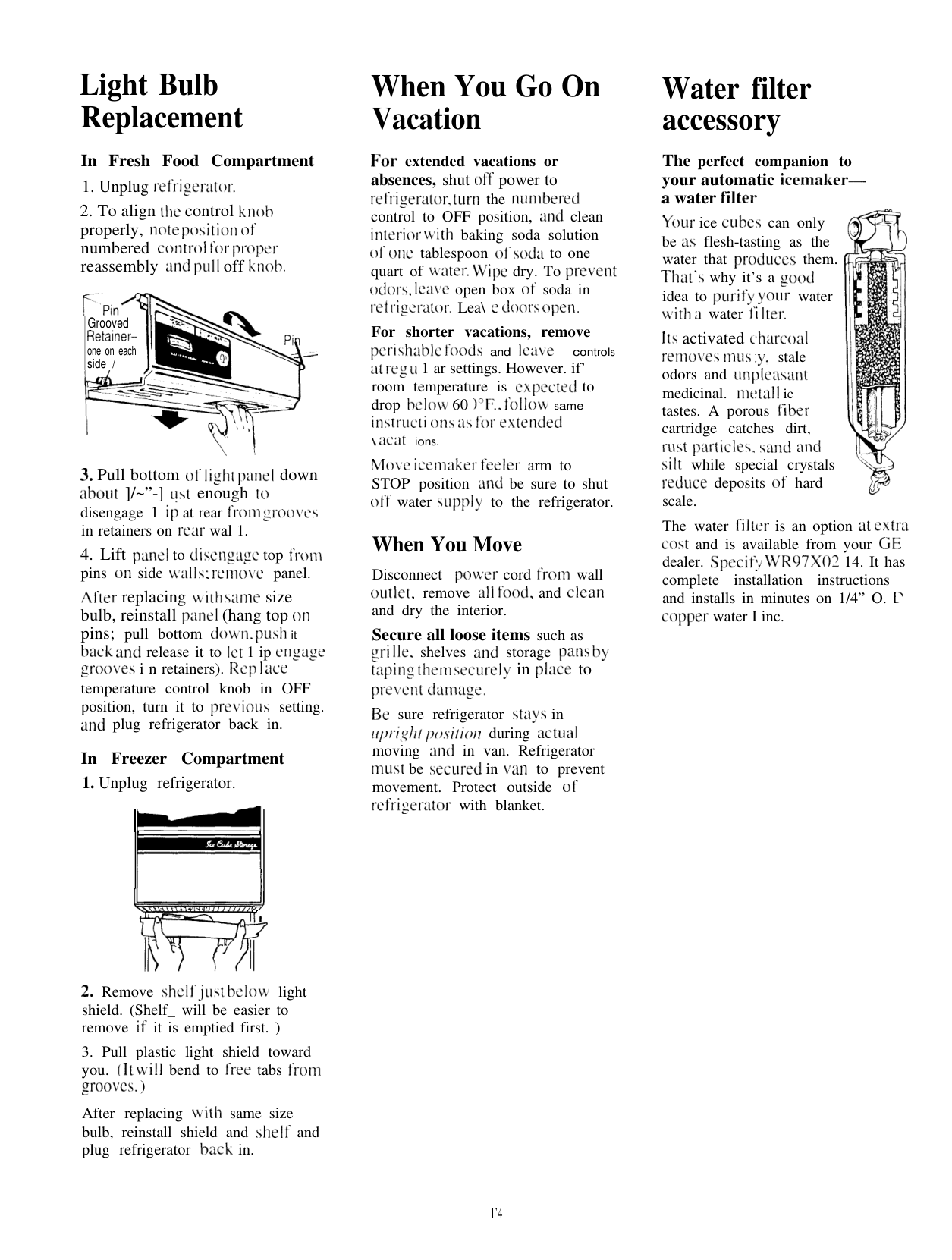
Light Bulb Replacement In Fresh Food Compartment
I
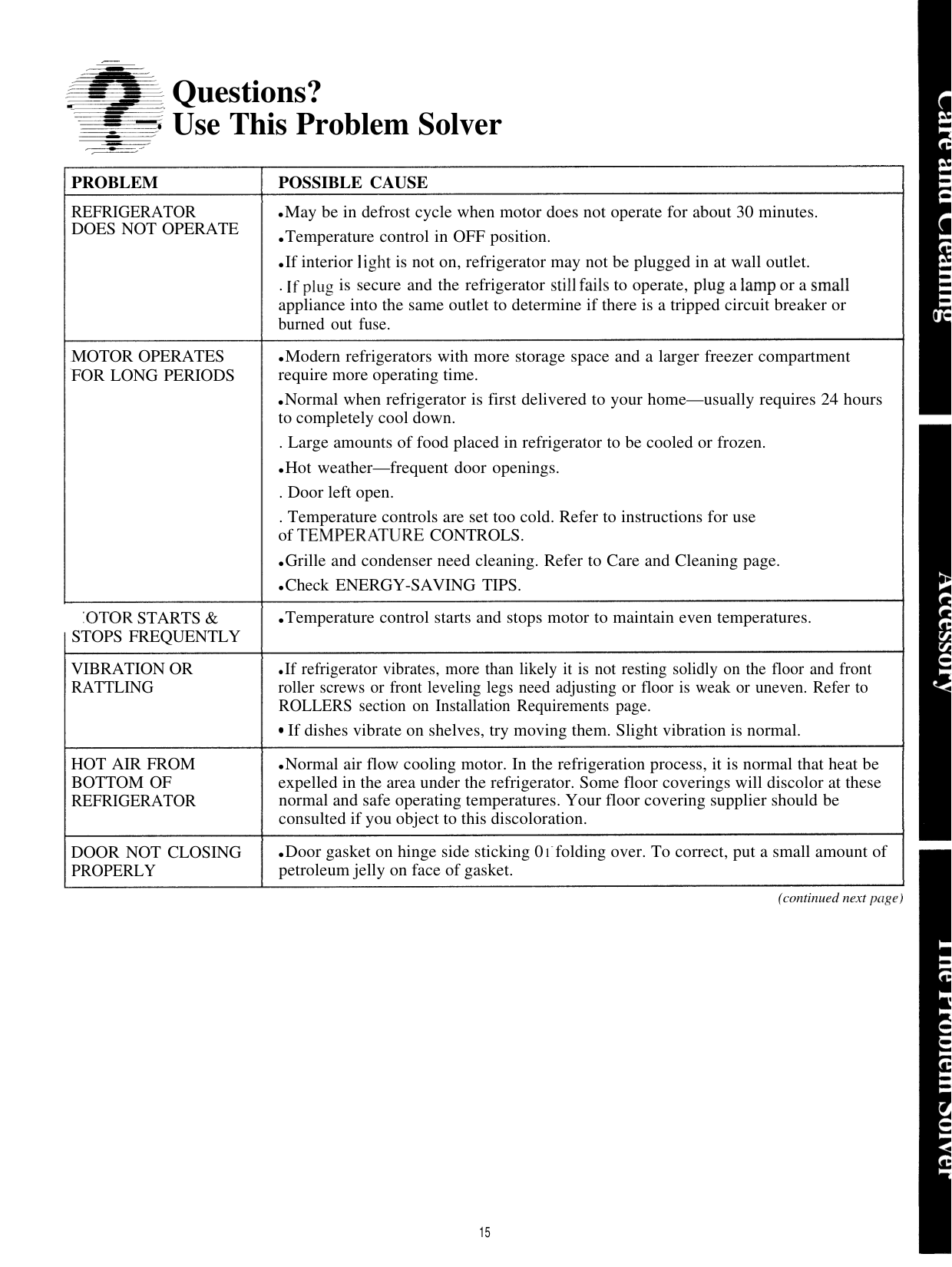
— .—~- —— :—~~ Questions? ——— —— —‘z~:-” Use This Problem Solver —. .—-— - ——’
Problem
Refrigerator
Does Not Operate
Motor Operates
For Long Periods
Otor Starts &
Stops Frequently
Vibration Or
Rattling
Hot Air From
Bottom Of
Refrigerator
Door Not Closing
Properly
Possible Cause
G May be in defrost cycle when motor does not operate for about 30 minutes. G Temperature control in OFF position. G If interior 1 ight is not on, refrigerator may not be plugged in at wall outlet. . If plug is secure and the refrigerator still fails to operate, p]ug a lamp or a small appliance into the same outlet to determine if there is a tripped circuit breaker or burned out fuse. G Modern refrigerators with more storage space and a larger freezer compartment require more operating time. G Normal when refrigerator is first delivered to your home—usually requires 24 hours to completely cool down. . Large amounts of food placed in refrigerator to be cooled or frozen. G Hot weather—frequent door openings. . Door left open. . Temperature controls are set too cold. Refer to instructions for use of T’EMPERATIJRE CONTROLS. G Grille and condenser need cleaning. Refer to Care and Cleaning page. G Check ENERGY-SAVING TIPS. G Temperature control starts and stops motor to maintain even temperatures. G If refrigerator vibrates, more than likely it is not resting solidly on the floor and front roller screws or front leveling legs need adjusting or floor is weak or uneven. Refer to ROLLERS section on Installation Requirements page. Q If dishes vibrate on shelves, try moving them. Slight vibration is normal. G Normal air flow cooling motor. In the refrigeration process, it is normal that heat be expelled in the area under the refrigerator. Some floor coverings will discolor at these normal and safe operating temperatures. Your floor covering supplier should be consulted if you object to this discoloration. G Door gasket on hinge side sticking 01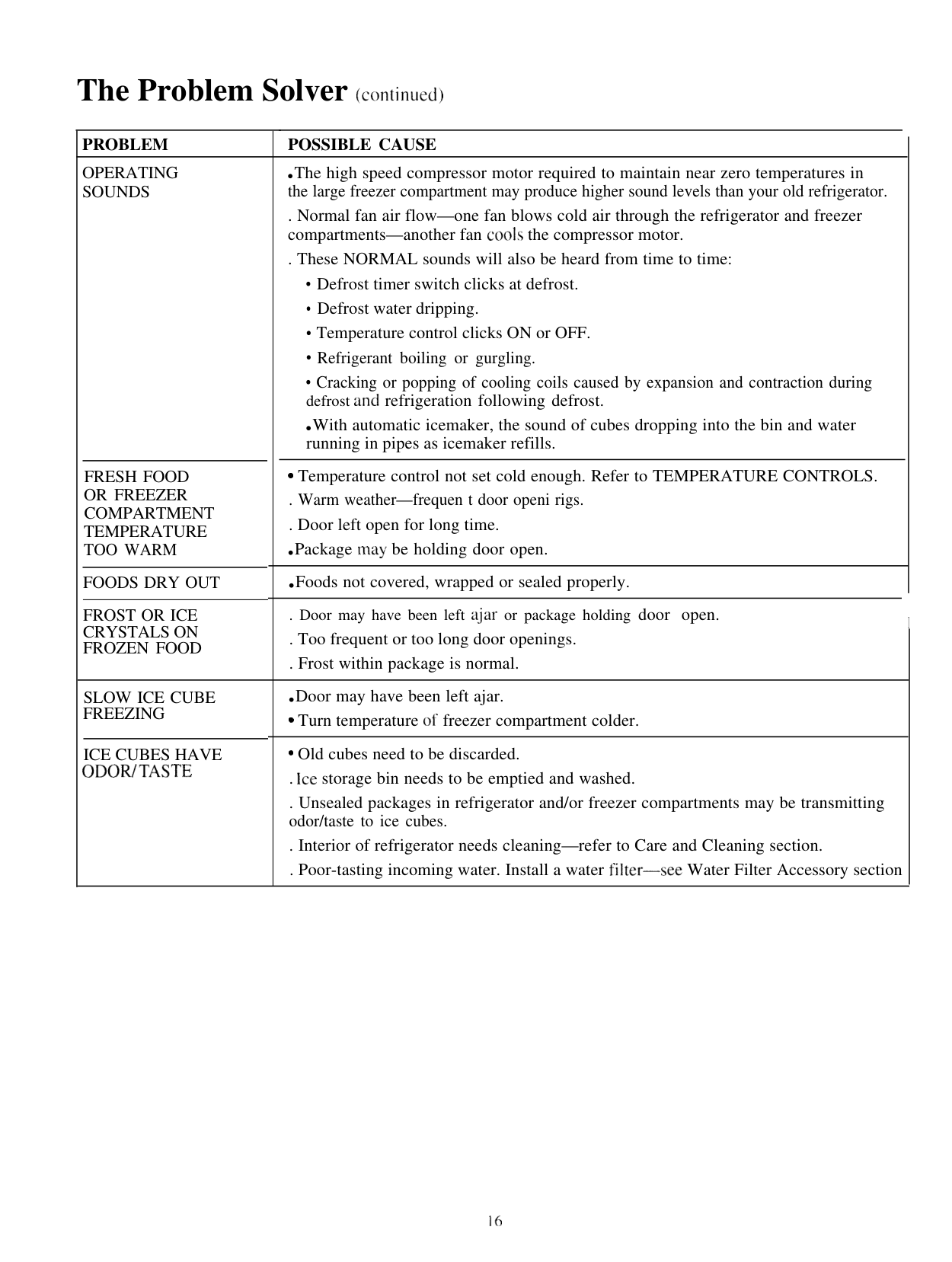
The Problem Solver (continued,
Problem
Operating
Sounds
Fresh Food
Or Freezer
Compartment
Temperature
Too Warm
Foods Dry Out
Frost Or Ice
Crystals On
Frozen Food
Slow Ice Cube
Freezing
Ice Cubes Have
Odowtaste
Possible Cause
G The high speed compressor motor required to maintain near zero temperatures in the large freezer compartment may produce higher sound levels than your old refrigerator. . Normal fan air flow—one fan blows cold air through the refrigerator and freezer compartments—another fan cools the compressor motor. . These NORMAL sounds will also be heard from time to time:G
G
G
G
G
Defrost timer switch clicks at defrost. Defrost water dripping. Temperature control clicks ON or OFF. Refrigerant boiling or gurgling. Cracking or popping of cooling coils caused by expansion and contraction during defrost and refrigeration following defrost. G With automatic icemaker, the sound of cubes dropping into the bin and water running in pipes as icemaker refills. s Temperature control not set cold enough. Refer to TEMPERATURE CONTROLS. . Warm weather—frequen t door openi rigs. . Door left open for long time. G Package may be holding door open. G Foods not covered, wrapped or sealed properly. . Door may have been left ajar or package holding door open.I
. Too frequent or too long door openings. . Frost within package is normal. G Door may have been left ajar. c Turn temperature of freezer compartment colder. Q Old cubes need to be discarded. . lce storage bin needs to be emptied and washed. . Unsealed packages in refrigerator and/or freezer compartments may be transmitting odor/taste to ice cubes. . Interior of refrigerator needs cleaning—refer to Care and Cleaning section. . Poor-tasting incoming water. Install a water f’ilter-see Water Filter Accessory section 16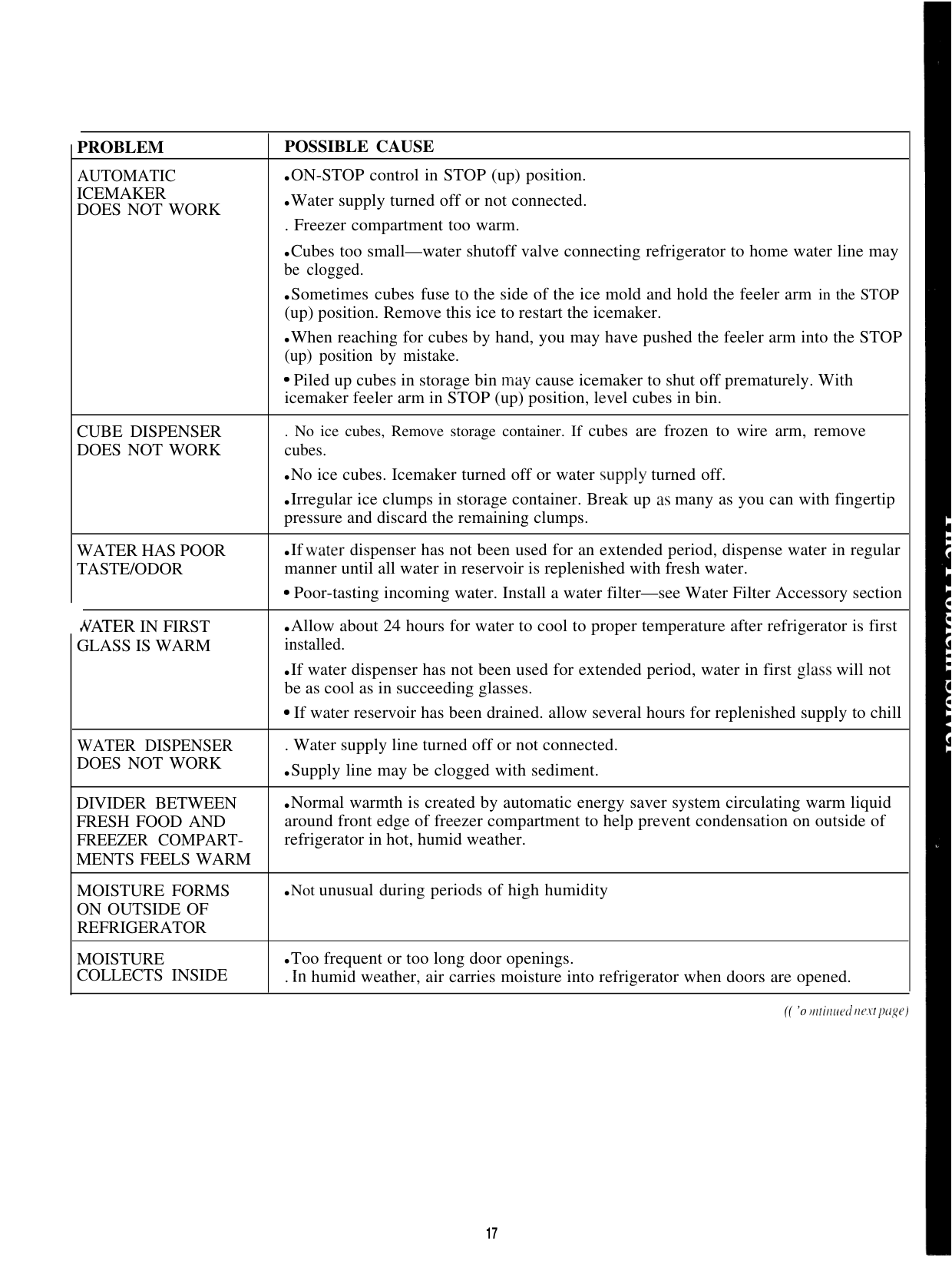
Problem
Automatic
Icemaker
Does Not Work
Cube Dispenser
Does Not Work
Water Has Poor
Taste/Odor
Nater In First
Glass Is Warm
Water Dispenser
Does Not Work
Divider Between
Fresh Food And
Freezer Compart-
Ments Feels Warm
Moisture Forms
On Outside Of
Refrigerator
Moisture
Collects Inside
Possible Cause
G ON-STOP control in STOP (up) position. G Water supply turned off or not connected. . Freezer compartment too warm. G Cubes too small—water shutoff valve connecting refrigerator to home water line may be clogged. G Sometimes cubes fuse to the side of the ice mold and hold the feeler arm in the STOP (up) position. Remove this ice to restart the icemaker. G When reaching for cubes by hand, you may have pushed the feeler arm into the STOP (up) position by mistake. “ Piled up cubes in storage bin miay cause icemaker to shut off prematurely. With icemaker feeler arm in STOP (up) position, level cubes in bin. . No ice cubes, Remove storage container. If cubes are frozen to wire arm, remove cubes. G No ice cubes. Icemaker turned off or water sLlpply turned off. G Irregular ice clumps in storage container. Break up as many as you can with fingertip pressure and discard the remaining clumps. G If water dispenser has not been used for an extended period, dispense water in regular manner until all water in reservoir is replenished with fresh water. c Poor-tasting incoming water. Install a water filter—see Water Filter Accessory section G Allow about 24 hours for water to cool to proper temperature after refrigerator is first installed. G If water dispenser has not been used for extended period, water in first glass will not be as cool as in succeeding glasses. “ If water reservoir has been drained. allow several hours for replenished supply to chill . Water supply line turned off or not connected. G Supply line may be clogged with sediment. G Normal warmth is created by automatic energy saver system circulating warm liquid around front edge of freezer compartment to help prevent condensation on outside of refrigerator in hot, humid weather. G Not unusual during periods of high humidity G Too frequent or too long door openings. . In humid weather, air carries moisture into refrigerator when doors are opened. (( ’o fllillui’d Ilt’.tt p(ige’) 17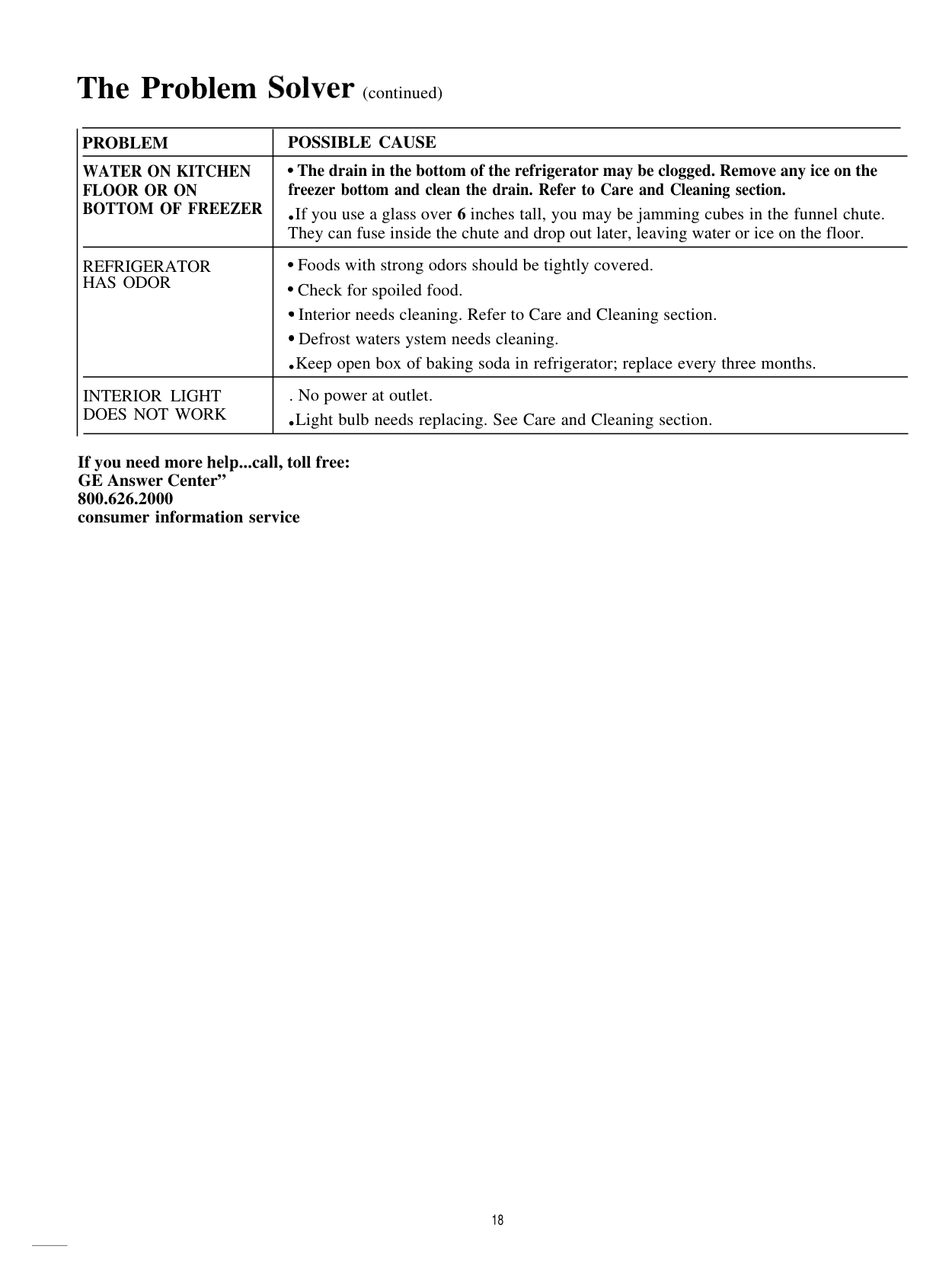
The Problem Solver (continued)
Problem
Possible Cause
Water On Kitchen
c The drain in the bottom of the refrigerator may be clogged. Remove any ice on theFloor Or On
freezer bottom and clean the drain. Refer to Care and Cleaning section.Bottom Of Freezer
G If you use a glass over 6 inches tall, you may be jamming cubes in the funnel chute. They can fuse inside the chute and drop out later, leaving water or ice on the floor.Refrigerator
c Foods with strong odors should be tightly covered.Has Odor
Q Check for spoiled food. Q Interior needs cleaning. Refer to Care and Cleaning section. c Defrost waters ystem needs cleaning. G Keep open box of baking soda in refrigerator; replace every three months.Interior Light
. No power at outlet.Does Not Work
G Light bulb needs replacing. See Care and Cleaning section. If you need more help...call, toll free: GE Answer Center” 800.626.2000 consumer information service 18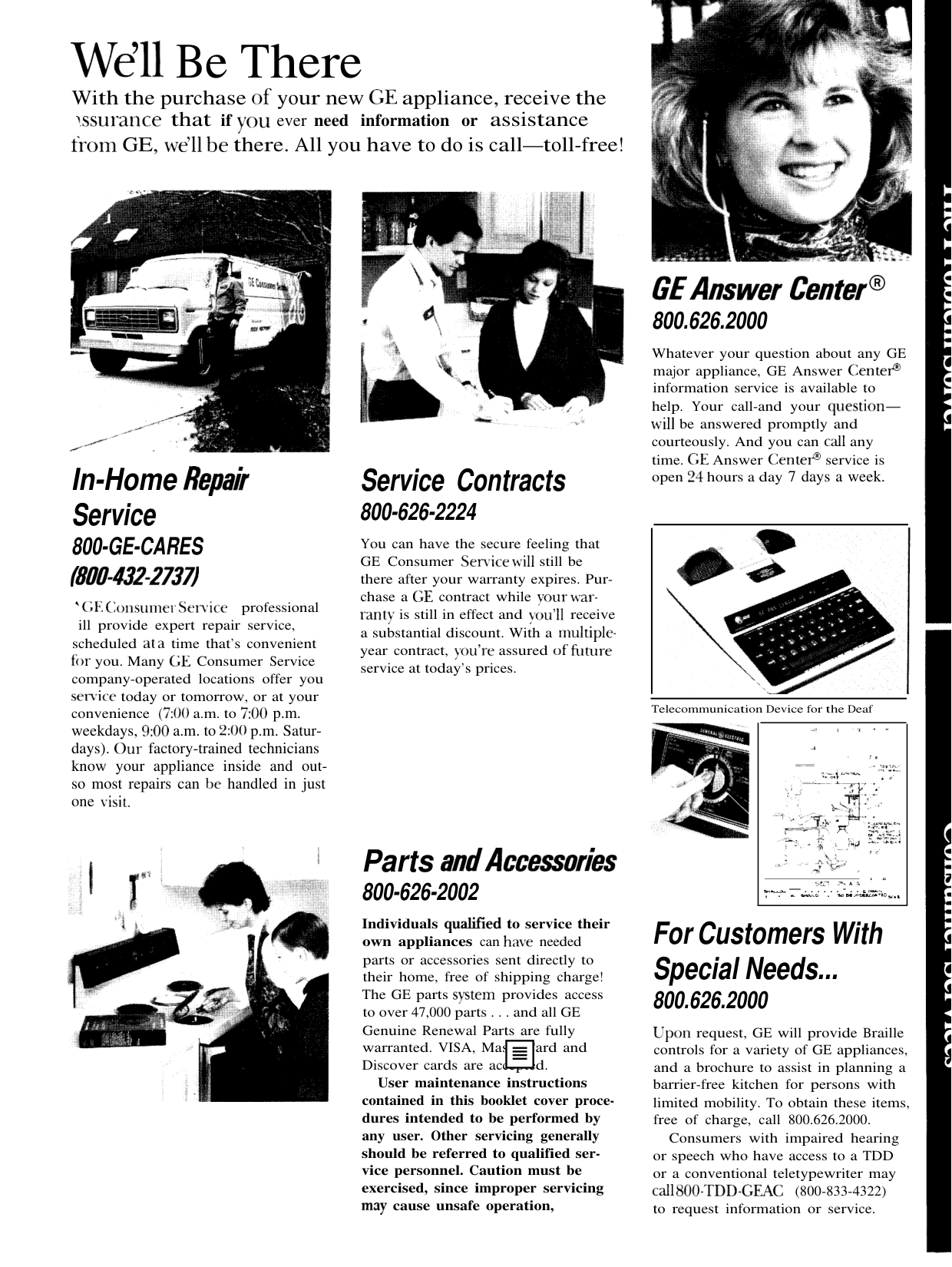
Wdll Be There With the purchase of’ your new GE appliance, receive the Tssurance that if you ever need information or assistance from GE, we’ll be there. All you have to do is call—toll-free! GEAnswer Center@ 800.626.2000 In-Home Repak Service
800-Ge-Cares
f800-432-273Y ‘ LJE Consumel SeIx’ice professional ill provide expert repair service, scheduled at a time that’s convenient for you. Many GE Consumer Service company-operated locations offer you sem’ice today or tomorrow, or at your convenience (7:00 a.m. to 7:00 p.m. weekdays, 9:00 a.m. to 2:00 p.m. Satur- days). Our factory-trained technicians know your appliance inside and out- so most repairs can be handled in just one l’isit. Service Contracts 800-626-2224 Whatever your question about any GE major appliance, GE Answer Cente~ information service is available to help. Your call-and your question— will be answered promptly and courteously. And you can cafl any time. GE Answer Cente@ service is open 24 hours a day 7 days a week. You can have the secure feeling that GE Consumer Sen’ice will still be there after your warranty expires. Pur- chase a GF. contract while ~our war- ranty’ is still in effect and you’ll receive a substantial discount. With a multiple- year contract, you’re assured of fiture service at today’s prices. Parts andAccessories 800-626-2002 Telecommunication Device for the Deaf 4 %t.- .- A i ‘ “ -— — . . . . . . - . . . -. , . . —.. . - e.. ..-u-... ~. , Individuals qualifled to service their own appliances can hate needed parts or accessories sent directly to their home, free of shipping charge! The GE parts systeIn provides access to over 47,000 parts . . . and all GE Genuine Renewal Parts are fully warranted. VISA, MasterCard and Discover cards are accepted. User maintenance instructions contained in this booklet cover proce- dures intended to be performed by any user. Other servicing generally should be referred to qualified ser- vice personnel. Caution must be exercised, since improper servicing may cause unsafe operation, For Customers With Special Needs... 800.626.2000 L’pon request, GE will provide Braille controls for a variety of GE appliances, and a brochure to assist in planning a barrier-free kitchen for persons with limited mobility. To obtain these items, free of charge, call 800.626.2000. Consumers with impaired hearing or speech who have access to a TDD or a conventional teletypewriter may cdl 800-TDD-GEAC (800-833-4322) to request information or service.