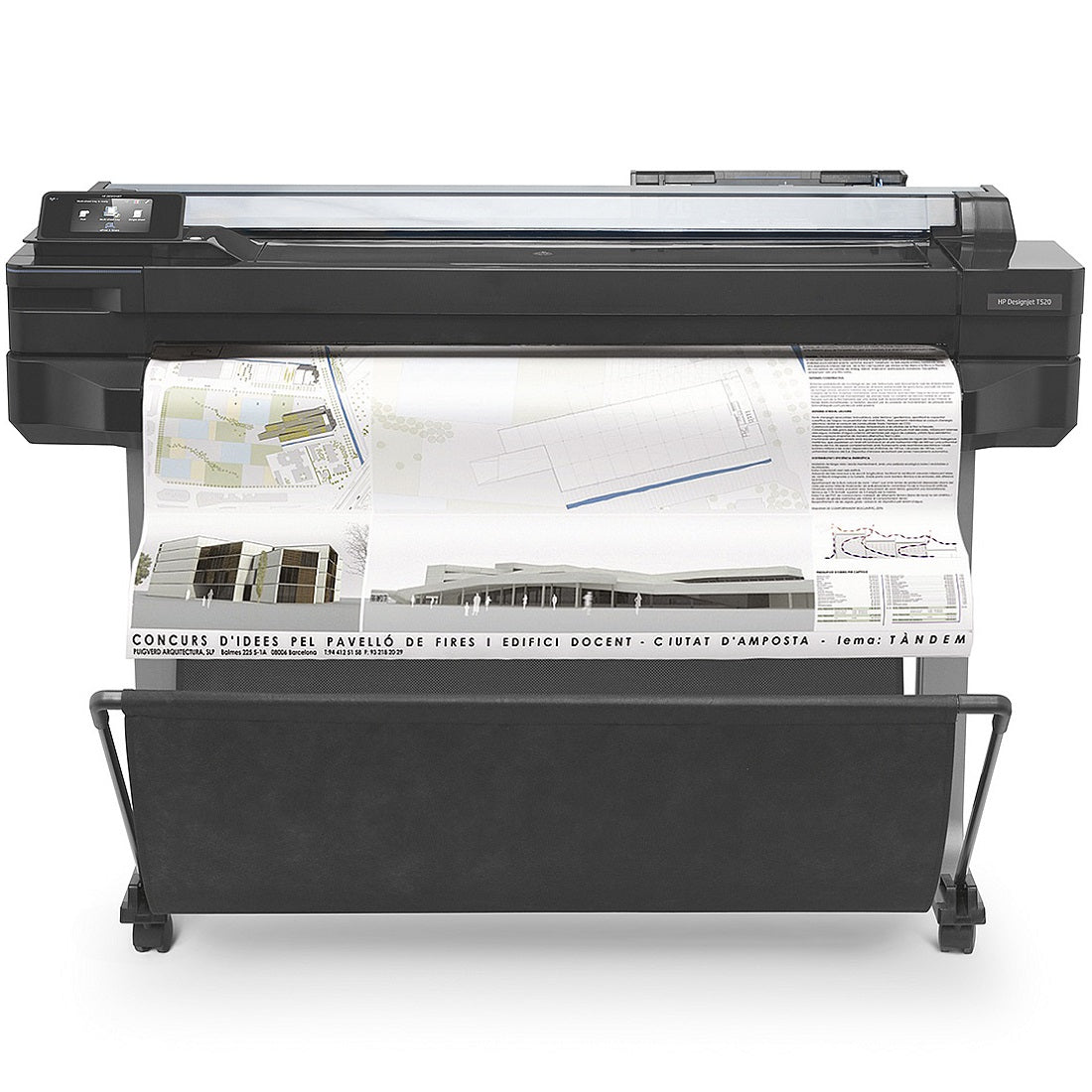
Ask AI
— answers from the official manualAnswers from the official manual.
Common questions
Common Questions
43 totalHow do I load a roll of paper onto the spindle and into the printer?
First, remove the blue paper stop from the spindle, slide the new roll onto the spindle ensuring correct orientation as shown by the labels, then push the blue stop back on until there is no space between the roll and the stops at both ends. To load it into the printer, open the roll cover (T520), insert the spindle with the blue hub on the left as viewed from the front, then insert the edge of the paper until the printer beeps and feeds it in automatically. The front panel will then prompt you to select the paper category and type.
What are the safety precautions I should follow when using the HP DesignJet T520?
You should use only the power supply voltage specified on the label and never disassemble or repair the printer yourself. Always power off the printer and unplug the power cord if there is smoke, an unusual smell, unusual noise, if metal or liquid touches internal parts, during an electrical storm, or during a power failure. Only use the electrical cord supplied by HP, and never damage, cut, or repair the power cord as a damaged cord can cause fire or electric shock. (Page 10)
How do I connect my HP DesignJet T520 to a wireless network?
The easiest way to connect to a wireless network is to go to the front panel and tap the connectivity icon, then select Connectivity > Wireless setup wizard. The printer is able to configure itself automatically for most networks, similar to any computer on the same network. Note that it is not possible to use wireless and wired network connections simultaneously. (Page 21)
What are the disadvantages of connecting the T520 via USB cable instead of a network?
When using a USB connection, the cable is of limited length and it is more difficult to share the printer with other users. Additionally, you cannot use Web Services or automatic firmware updates when connected via USB. Only cables certified by the USB Implementor's Forum (http://www.usb.org/) should be used, as non-certified USB cables can lead to connectivity problems.
How do I set up Web Services and Mobile Printing on the HP DesignJet T520?
First, make sure your printer is correctly connected to the Internet, then enable Web Services during initial setup or later by tapping the Web Services icon on the home screen and following the instructions on the front panel. Optionally, activate your account by clicking the activation link sent by email, and log in at HP Connected (http://www.hpconnected.com) to customize your printer's email address and manage printer security. (Page 21)
What print resolution does the HP DesignJet T520 support?
The HP DesignJet T520 supports a print resolution of up to 2400 × 1200 dpi when using the Best print-quality option, the Maximum Detail option, and photo paper. The T120 model supports up to 1200 × 1200 dpi under the same conditions. (Page 4)
Show 37 more questions
What should I do if a roll of paper jams in the HP DesignJet T520?
How do I access the Embedded Web Server on the HP DesignJet T520?
What safety precautions should I follow when using the HP DesignJet T520?
How do I connect the HP DesignJet T520 to a wireless network?
How do I load a roll of paper onto the spindle on the HP DesignJet T520?
What paper width restrictions apply when loading paper into the HP DesignJet T520?
What is the maximum print resolution of the HP DesignJet T520?
How do I set up Mobile Printing and Web Services on the HP DesignJet T520?
How do I replace an ink cartridge on the HP DesignJet T520?
What should I do if the printer displays 'out of paper' when paper is actually loaded?
How do I turn the printer on and off?
What should I do before requesting an internal print?
How do I connect the printer to a wireless network?
What are the disadvantages of using a USB connection instead of a network connection?
How do I access the Embedded Web Server?
How do I change the sleep mode time on the printer?
What is the minimum paper width requirement for the printer?
How do I load a roll onto the spindle?
What should I do if I cannot find my paper type in the printer's list?
How do I set up Web Services and Mobile Printing?
How do I change the sleep mode setting on the HP DesignJet T520?
How do I clean the printhead on the HP DesignJet T520?
Can I connect the HP DesignJet T520 to my network wirelessly?
What are the main connection options available for the HP DesignJet T520?
Is the HP DesignJet T520 compatible with mobile printing?
Can I change the language settings on the HP DesignJet T520?
How can I control access to the Embedded Web Server?
What are the key features of the HP DesignJet T520?
How do I enable or disable email notifications and alerts on the T520?
How do I turn the HP DesignJet T520 printer on and off?
What power management options are available on the T520?
How do I access the Embedded Web Server on the T520?
How do I adjust the sleep mode and auto-off settings on the HP DesignJet T520?
What are the system requirements for connecting the HP DesignJet T520 to a computer?
What should I do to set up the HP DesignJet T520 printer initially?
Is there an automatic firmware update feature for the T520?
What connection methods are available for the HP DesignJet T520?
Full Manual
140 pages
HP DesignJet T120 and T520 Printer Series User Guide

© Copyright 2012, 2018 HP Development Company, L.P. Edition 5 Legal notices The information contained herein is subject to change without notice. The only warranties for HP products and services are set forth in the express warranty statement accompanying such products and services. Nothing herein should be construed as constituting an additional warranty. HP shall not be liable for technical or editorial errors or omissions contained herein. Hi-Speed USB certified IPv6-ready Wi-Fi certified Trademarks Adobe®, Acrobat®, and Adobe Photoshop® are trademarks of Adobe Systems Incorporated. Corel® is a trademark or registered trademark of Corel Corporation or Corel Corporation Limited. ENERGY STAR and the ENERGY STAR mark are registered U.S. trademarks. Microsoft® and Windows® are U.S. registered trademarks of Microsoft Corporation.

Table of contents 1 Introduction ............................................................................................................................................................................................... 1 Safety precautions ................................................................................................................................................................... 2 Using this guide ........................................................................................................................................................................ 2 Printer models .......................................................................................................................................................................... 3 Main features ............................................................................................................................................................................. 4 Main components ..................................................................................................................................................................... 5 Front panel ................................................................................................................................................................................ 7 Printer software ........................................................................................................................................................................ 8 Mobile Printing .......................................................................................................................................................................... 9 Turn the printer on and off ................................................................................................................................................... 10 The printer’s internal prints .................................................................................................................................................. 11 2 Connecting the printer ........................................................................................................................................................................... 12 Choose which connection method to use .......................................................................................................................... 13 Connect the printer to your network ................................................................................................................................... 13 Connect a computer to the printer by network (Windows) ............................................................................................. 13 Connect a computer to the printer by USB cable (Windows) .......................................................................................... 14 Connect a computer to the printer by network (Mac OS X) ............................................................................................. 15 Connect a computer to the printer by USB cable (Mac OS X) .......................................................................................... 16 3 Setting up the printer ............................................................................................................................................................................. 18 Introduction ............................................................................................................................................................................. 19 Automatic firmware update ................................................................................................................................................. 19 Turn email notifications on and off ..................................................................................................................................... 19 Turn alerts on and off ............................................................................................................................................................ 19 Control access to the Embedded Web Server ................................................................................................................... 20 Set Windows driver preferences .......................................................................................................................................... 20 Set up Web Services and Mobile Printing ........................................................................................................................... 21 4 Personalizing the printer ....................................................................................................................................................................... 22 Change the language of the front-panel display .............................................................................................................. 23 Access the Embedded Web Server ...................................................................................................................................... 23 Change the language of the Embedded Web Server ....................................................................................................... 23 Access the HP Utility .............................................................................................................................................................. 23
Enww
iii
Change the language of the HP Utility ................................................................................................................................ 24 Change the sleep mode setting ........................................................................................................................................... 24 Change the auto-off setting ................................................................................................................................................. 24 Change the front-panel display brightness ....................................................................................................................... 24 Configure network settings .................................................................................................................................................. 25 Manage printer security ........................................................................................................................................................ 27 Change your printer’s email address .................................................................................................................................. 27 5 Paper handling ........................................................................................................................................................................................ 28 General paper-loading advice .............................................................................................................................................. 29 Load a roll onto the spindle .................................................................................................................................................. 29 Load a roll into the printer .................................................................................................................................................... 31 Unload a roll ............................................................................................................................................................................ 33 Load a single sheet ................................................................................................................................................................ 33 Unload a single sheet ............................................................................................................................................................ 34 Use the multi-sheet tray ....................................................................................................................................................... 34 View information about the paper ...................................................................................................................................... 36 Maintain paper ........................................................................................................................................................................ 36 Change the drying time ......................................................................................................................................................... 36 Turn the automatic cutter on and off .................................................................................................................................. 36 Form feed with or without cutting ...................................................................................................................................... 37 6 Printing ..................................................................................................................................................................................................... 38 Mobile Printing ........................................................................................................................................................................ 39 Print with HP Click .................................................................................................................................................................. 40 Printing from a computer using a printer driver ............................................................................................................... 40 7 Practical printing examples .................................................................................................................................................................. 47 Print from Adobe Acrobat ..................................................................................................................................................... 48 Print from Autodesk AutoCAD .............................................................................................................................................. 50 Print from Adobe Photoshop ............................................................................................................................................... 54 Print and scale from Microsoft Office .................................................................................................................................. 56 8 Handling ink cartridges and printhead ................................................................................................................................................ 63 About the ink cartridges ........................................................................................................................................................ 64 Storage of anonymous usage information ........................................................................................................................ 64 Check ink cartridge status .................................................................................................................................................... 64 Replace an ink cartridge ........................................................................................................................................................ 64 About the printhead ............................................................................................................................................................... 66 9 Maintaining the printer .......................................................................................................................................................................... 67 Check printer status ............................................................................................................................................................... 68 Take care of the printer ......................................................................................................................................................... 68 iv
Enww

Clean the exterior of the printer .......................................................................................................................................... 68 Print Quality Diagnostic Report ............................................................................................................................................ 68 Clean the printhead ................................................................................................................................................................ 69 Align the printhead ................................................................................................................................................................ 70 Replace the printhead ........................................................................................................................................................... 70 Clean the encoder strip ......................................................................................................................................................... 75 Recalibrate the paper advance ............................................................................................................................................ 75 Move or store the printer ...................................................................................................................................................... 76 Firmware update .................................................................................................................................................................... 76 Software update ..................................................................................................................................................................... 77 Printer maintenance kits ....................................................................................................................................................... 77 10 Accessories ............................................................................................................................................................................................ 78 How to order supplies and accessories .............................................................................................................................. 79 Introduction to the accessories ............................................................................................................................................ 82 11 Troubleshooting paper issues ............................................................................................................................................................ 83 Paper cannot be loaded successfully .................................................................................................................................. 84 Paper type is not in the driver .............................................................................................................................................. 86 Printer printed on the wrong paper type ........................................................................................................................... 87 Paper mismatch ..................................................................................................................................................................... 87 Roll has jammed ..................................................................................................................................................................... 87 Multi-sheet tray has jammed ............................................................................................................................................... 89 A strip stays on the output tray and generates jams ....................................................................................................... 91 Printer displays out of paper when paper is available ..................................................................................................... 91 Prints do not fall neatly into the bin .................................................................................................................................... 91 Sheet stays in the printer when the print has been completed ..................................................................................... 91 Paper is cut when the print has been completed ............................................................................................................. 92 Cutter does not cut well ........................................................................................................................................................ 92 Roll is loose on the spindle ................................................................................................................................................... 92 12 Troubleshooting print-quality issues ................................................................................................................................................ 93 General printing advice ......................................................................................................................................................... 94 Horizontal lines across the image (banding) ..................................................................................................................... 94 Lines are too thick, too thin or missing ............................................................................................................................... 95 Lines appear stepped or jagged .......................................................................................................................................... 95 Lines print double or in the wrong colors ........................................................................................................................... 96 Lines are discontinuous ........................................................................................................................................................ 96 Lines are blurred ..................................................................................................................................................................... 97 Line lengths are inaccurate ................................................................................................................................................... 97 Whole image is blurry or grainy ........................................................................................................................................... 98 Paper is not flat ...................................................................................................................................................................... 98 Print is scuffed or scratched ................................................................................................................................................. 99
Enww
v
Ink marks on the paper ......................................................................................................................................................... 99 Black ink comes off when you touch the print ................................................................................................................ 100 Edges of objects are stepped or not sharp ...................................................................................................................... 100 Edges of objects are darker than expected ..................................................................................................................... 100 Vertical lines of different colors ......................................................................................................................................... 101 White spots on the print ..................................................................................................................................................... 101 Colors are inaccurate ........................................................................................................................................................... 101 Colors are fading .................................................................................................................................................................. 101 Image is incomplete (clipped at the bottom) .................................................................................................................. 102 Image is clipped ................................................................................................................................................................... 102 Some objects are missing from the printed image ........................................................................................................ 102 A PDF file is clipped or objects are missing ...................................................................................................................... 103 If you still have a problem .................................................................................................................................................. 103 13 Troubleshooting ink cartridge and printhead issues ................................................................................................................... 104 Cannot insert an ink cartridge ........................................................................................................................................... 105 Ink cartridge status messages .......................................................................................................................................... 105 Cannot insert the printhead ............................................................................................................................................... 105 14 Troubleshooting data communication issues ............................................................................................................................... 106 Communication failures between computer and printer .............................................................................................. 107 Wired network issues .......................................................................................................................................................... 108 Wireless network issues ..................................................................................................................................................... 108 Mobile Printing issues ......................................................................................................................................................... 111 Network configuration page .............................................................................................................................................. 111 15 Troubleshooting general printer issues ......................................................................................................................................... 113 Printer does not start .......................................................................................................................................................... 114 Printer does not print .......................................................................................................................................................... 114 Printer seems slow .............................................................................................................................................................. 114 Front panel is frozen ........................................................................................................................................................... 115 Cannot access the Embedded Web Server ...................................................................................................................... 115 Alerts ...................................................................................................................................................................................... 115 16 Front-panel error messages ............................................................................................................................................................ 116 17 HP Customer Care .............................................................................................................................................................................. 118 Introduction .......................................................................................................................................................................... 119 HP Professional Services .................................................................................................................................................... 119 HP Proactive Support .......................................................................................................................................................... 120 Customer Self Repair .......................................................................................................................................................... 120 Contact HP Support ............................................................................................................................................................. 121 vi
Enww

18 Printer specifications ......................................................................................................................................................................... 122 Functional specifications .................................................................................................................................................... 123 Mobile Printing specifications ............................................................................................................................................ 124 Physical specifications ........................................................................................................................................................ 125 Memory specifications ........................................................................................................................................................ 125 Power specifications ........................................................................................................................................................... 125 Ecological specifications ..................................................................................................................................................... 125 Environmental specifications ............................................................................................................................................. 126 Acoustic specifications ........................................................................................................................................................ 126 Glossary ..................................................................................................................................................................................................... 127 Index ........................................................................................................................................................................................................... 130
Enww
vii
viii
Enww

1 Introduction ● Safety precautions ● Using this guide ● Printer models ● Main features ● Main components ● Front panel ● Printer software ● Mobile Printing ● Turn the printer on and off ● The printer’s internal prints
Enww
1
Safety precautions The following precautions ensure the proper use of the printer and prevent the printer from being damaged. Follow these precautions at all times: ● Use the power supply voltage specified on the label. Avoid overloading the printer's electrical outlet with multiple devices. ● Do not disassemble or repair the printer yourself. Contact your local HP Service Representative for service, see Contact HP Support on page 121. ● Use only the electrical cord supplied by HP with the printer. Do not damage, cut, or repair the power cord. A damaged power cord can cause fire or electric shock. Replace a damaged power cord with an HP-approved power cord. ● Do not allow metal or liquids (except those used in HP Cleaning Kits) to touch the internal parts of the printer. Doing so may cause fire, electric shock, or other serious hazards. ● Power off the printer and unplug the power cord from the power outlet in any of the following cases: ● When placing your hands inside the printer ● If there is smoke or an unusual smell coming from the printer ● If the printer is making an unusual noise not heard during normal operation ● A piece of metal or a liquid (not part of cleaning and maintenance routines) touches internal parts of the printer ● During an electrical storm (thunder and lightning) ● During a power failure Using this guide Introduction This chapter provides a brief introduction to the printer and its documentation for new users. Use and maintenance These chapters help you carry out normal printer procedures; they include the following topics: ● Connecting the printer on page 12 ● Setting up the printer on page 18 ● Personalizing the printer on page 22 ● Paper handling on page 28 ● Printing on page 38 ● Mobile Printing on page 39 ● Practical printing examples on page 47 ● Handling ink cartridges and printhead on page 63 ● Maintaining the printer on page 67 2 Chapter 1 Introduction
Enww

Troubleshooting These chapters help you solve problems that may occur while printing; they include the following topics: ● Troubleshooting paper issues on page 83 ● Troubleshooting print-quality issues on page 93 ● Troubleshooting ink cartridge and printhead issues on page 104 ● Troubleshooting data communication issues on page 106 ● Troubleshooting general printer issues on page 113 ● Front-panel error messages on page 116 Accessories, support and specifications These chapters, Accessories on page 78, HP Customer Care on page 118, and Printer specifications
on page 122, contain reference information, including customer care, the printer specifications, and part numbers for paper types, ink supplies, and accessories. Glossary The Glossary on page 127 contains definitions of printing and HP terms used in this documentation. Index In addition to the table of contents, there is an alphabetical index to help you to find topics quickly. Warnings and cautions The following symbols are used in this manual to ensure the proper use of the printer and to prevent the printer from being damaged. Follow the instructions marked with these symbols.
Warning!
Failure to follow the guidelines marked with this symbol could result in serious personal injury or death.Caution:
Failure to follow the guidelines marked with this symbol could result in minor personal injury or damage to the printer. Printer models This guide covers the following printer models, normally referring to them by their short names for brevity. Full name Short name HP DesignJet T120 24-in PrinterT120
HP DesignJet T520 24-in Tabletop PrinterT520-24T
HP DesignJet T520 24-in PrinterT520-24
HP DesignJet T520 36-in PrinterT520-36
Enww
Printer models 3
Main features Your printer is a color inkjet printer designed for printing high-quality images on paper up to 610 mm (24 in) or 914 mm (36 in) wide. Some major features of the printer are shown below: ● Print resolution of up to 2400 × 1200 dpi (T520) or 1200 × 1200 dpi (T120), using the Best print-quality option, the Maximum Detail option and photo paper ● The printer can be controlled from its front panel or from a remote computer using the Embedded Web Server or the HP Utility
Note:
Throughout this manual, “HP Utility” refers to the HP Utility for Mac OS X and the HP DesignJet Utility for Windows. ● Touch-sensitive front panel in color, with an intuitive graphical user interface ● Supports USB, Ethernet, or Wi-Fi connection ● Includes Mobile Printing and Web-connected features such as automatic firmware upgrades and HP ePrint ● Handles roll and cut-sheet paper, with a multi-sheet tray ● Color emulations, see Printer emulation on page 45 ● Economode for printing economically ● Ink and paper usage information available from the Embedded Web Server, see Access the Embedded Web Server on page 23 ● Supplies information, troubleshooting, and firmware updates available from the HP Utility, see Access the HP Utility on page 23 ● Access to the online HP Support Center (see HP Support Center on page 119) 4 Chapter 1 IntroductionEnww

Main components Front view (T520 except T520-24T)
Enww
Main components 5
Rear view (T520 except T520-24T)
Enww

Communication ports
Enww
Front panel 7
● Tap to go to the previous item. ● Tap to go to the next item. ● Tap to go back to the previous screen. ● Tap to cancel the current process. Home screen dynamic icons The following items are displayed only on the home screen: ● At the top left of the home screen is a message telling you which paper source is active. ● Tap to view Web Services status and display your printer’s email address. ● Tap to view connectivity status information and to perform network configuration. If a network cable is connected, is displayed instead.
Note:
It is not possible to use wireless and wired network connections simultaneously. ● Tap to view ink information. ● Tap to change printer settings. ● Tap to load, unload, and change options for roll paper. ● Tap to change options for the multi-sheet tray, or to activate it. ● Tap to load, unload, and change options for single sheets.Note:
The active paper source is indicated by a slightly larger icon, with a white tick in a green circle: . If the printer is left idle for some time, it goes into sleep mode and switches off the front-panel display. To change the time that elapses before sleep mode, tap , then Printer preferences > Sleep. You can set a time between 5 and 240 minutes. The printer wakes from sleep mode and switches on the front-panel display whenever there is some external interaction with it. Information about specific uses of the front panel can be found throughout this guide. Printer software The following software is provided with your printer: ● The HP-GL/2 and HP RTL driver for Windows (T520 only) ● The PCL3GUI raster driver for Windows (T120 only) ● The PCL3GUI raster driver for Mac OS X ● HP DesignJet Preview 8 Chapter 1 IntroductionEnww

● The Embedded Web Server allows you to: ● Manage the printer from a remote computer ● View the status of the ink cartridges, the printhead, and the paper ● Access the HP Support Center, see HP Support Center on page 119 ● Update the printer's firmware, see Firmware update on page 76 ● Perform alignments and troubleshooting ● Change various printer settings ● Manage e-mail notifications See Access the Embedded Web Server on page 23. ● The HP Utility allows you to: ● Manage the printer from a remote computer ● View the status of the ink cartridges, the printhead, and the paper ● Access the HP Support Center, see HP Support Center on page 119 ● Update the printer's firmware, see Firmware update on page 76 ● Launch the Embedded Web Server See Access the HP Utility on page 23.
Note:
New versions of all printer software can be expected to appear from time to time. In some cases, when you receive your printer there may already be later versions available on HP's website of some of the software provided with it. Mobile Printing Your printer can be connected to the Internet and the Web, providing various benefits: ● Automatic firmware updates (see Firmware update on page 76) ● Print on HP printers from almost anywhere ● Print on HP printers from almost any device, including smartphones and tablet computers To take advantage of these benefits, your printer must be connected to the Internet. For the latest information, see http://www.hpconnected.com. With HP Mobile Printing Solutions you can print straight from your smartphone or tablet in just a few simple steps wherever you are, by using your mobile device OS or sending an email to your printer with a PDF attachment. ● iOS-Apple printing is enabled through Airprint. ● For Android printing, install the HP Print Service App from Google Play (if you do not have it already pre- installed in your mobile device). For more information, see Mobile Printing on page 39 and http://www.hp.com/go/designjetmobility.Enww
Mobile Printing 9
Turn the printer on and off If you wish to turn the printer on or off, the normal and recommended method is to use the power key on the front panel. However, if you plan to store the printer for a long period or the power key does not seem to work, you are recommended to unplug the power cord. To turn it back on, plug in the power cord. When the printer is powered back on, it takes about three minutes to initialize and check and prepare the printhead. Preparing the printhead takes about 75 seconds.
Note:
When the printer has not been used for a certain period of time (the default time is determined by Energy Star), it saves power by going into sleep mode. However, any interaction with the printer's front-panel display, or sending a new job to print, returns it to active mode, and it can resume printing immediately. To change the sleep mode time, see Change the sleep mode setting on page 24. 10 Chapter 1 IntroductionEnww

The printer’s internal prints The internal prints give various kinds of information about your printer. They can be requested from the front panel. Before requesting any internal print, check that the printer and the paper are ready for printing. The loaded paper should be at least A4 portrait—210 mm (8.27 in) wide—otherwise the print may be clipped. To print any internal print, tap , then scroll down to Internal prints and tap it, then select the internal print you want. The following internal prints are available: ● Demo prints show some of the capabilities of the printer: ● Print drawing demo ● Print rendering demo ● Print GIS map ● User info prints ● Print printer-status report ● Print print-quality report ● Print network report
Enww
The printer’s internal prints 11
2 Connecting the printer ● Choose which connection method to use ● Connect the printer to your network ● Connect a computer to the printer by network (Windows) ● Connect a computer to the printer by USB cable (Windows) ● Connect a computer to the printer by network (Mac OS X) ● Connect a computer to the printer by USB cable (Mac OS X) 12 Chapter 2 Connecting the printer
Enww

Choose which connection method to use The following methods can be used to connect your printer. Connection type Speed Cable length Other factors Wireless Moderate; varies according to conditions (distance to router, interference, number of wireless clients, network topology, etc.)
N/A
Sensitive to interference over longer distances; requires extra equipment (wireless access point or wireless router) Fast Ethernet Fast; varies according to network traffic Long: 100 m (328 ft) Requires extra equipment (switches) Hi-Speed USB Very fast Short: 3 m (10 ft) A certified Hi-Speed USB cable is necessary for reliable communication.Note:
The speed of any network connection depends on all components used in the network, which can include network interface cards, routers, switches and cables. If any one of these components cannot operate at high speed, you will have a low-speed connection. The speed of your network connection can also be affected by the total amount of traffic from other devices on the network. Connect the printer to your network The printer is able to configure itself automatically for most networks, in a similar way to any computer in the same network. The first time you connect it to a network, this process may take a few minutes. Once the printer has a working network configuration, you can check its network address from the front panel: tap or . To connect to a wireless network, the easiest way is to go to the front panel and tap , then Connectivity > Wireless setup wizard. When a network device automatically configures itself by receiving an IP address from the DHCP service, this IP address may change from the last time the device is powered off to the next time it is powered on, which may lead to the device being shown as "offline" when driver port settings are configured with the original IP address. There are at least three possible ways to avoid this: ● Increase the lease time of your DHCP server device. ● Set a fixed IP address for your printer that will not be changed by DHCP (see Communication failures between computer and printer on page 107). ● Configure the printer and driver to refer to the hostname instead of the numeric IP address (see Communication failures between computer and printer on page 107). See the Assembly Instructions for more details about Internet setup, and how to connect to and register with the cloud to enable Web Services. Connect a computer to the printer by network (Windows) The following instructions apply if you intend to print from software applications using a printer driver. See Printing on page 38 for alternative ways of printing.Enww
Choose which connection method to use 13
Before you begin, check your equipment: ● The printer should be set up and on. ● The Ethernet switch or router should be on and functioning correctly. ● The printer and the computer should be connected to the network (see Connect the printer to your network on page 13). The printer can be connected by Ethernet or Wi-Fi. Now you can proceed to install the printer software and connect to your printer. Printer software installation
Note:
The use of non-certified USB cables can lead to connectivity problems. Only cables certified by the USB Implementor's Forum (http://www.usb.org/) should be used with this printer. Printer software installation The following instructions apply if you intend to print from software applications using a printer driver. See Printing on page 38 for alternative ways of printing.Enww

Note:
You can connect your printer and complete the installation later if you prefer. To do so, check the box marked I want to connect my printer after completing the setup wizard.Tip:
The best way to share the printer over a network is to connect the printer not to any computer, but to the network. See Connect a computer to the printer by network (Windows) on page 13. Connect a computer to the printer by network (Mac OS X) You can connect your printer to a network under Mac OS X by using the following methods: ● Bonjour ●Tcp/Ip
The following instructions apply if you intend to print from software applications using a printer driver. See Printing on page 38 for alternative ways of printing. Before you begin, check your equipment: ● The printer should be set up and on. ● The Ethernet switch or router should be on and functioning correctly. ● The printer and the computer should be connected to the (wired or wireless) network. See Connect the printer to your network on page 13. Now you can proceed to install the printer software and connect to your printer. Bonjour connectionsoftware you want to install (by default, all of it).
Enww
Connect a computer to the printer by network (Mac OS X) 15
● If you find the right name, scroll sideways if necessary to see the Connection Type column, and check that it shows Bonjour. Then highlight that line. Otherwise, continue searching further down the list. ● If you cannot find your printer's name with a Bonjour connection type, check the box My printer is not in the list. Click Continue.
Note:
The use of non-certified USB cables can lead to connectivity problems. Only cables certified by the USB Implementor's Forum (http://www.usb.org/) should be used with this printer. 16 Chapter 2 Connecting the printerEnww

Printer software installation The following instructions apply if you intend to print from software applications using a printer driver. See Printing on page 38 for alternative ways of printing.
Note:
The use of non-certified USB cables can lead to connectivity problems. Only cables certified by the USB Implementor's Forum (http://www.usb.org/) should be used with this printer.Tip:
The best way to share the printer over a network is to connect the printer not to any computer, but to the network. See Connect a computer to the printer by network (Mac OS X) on page 15.Enww
Connect a computer to the printer by USB cable (Mac OS X) 17
3 Setting up the printer ● Introduction ● Automatic firmware update ● Turn email notifications on and off ● Turn alerts on and off ● Control access to the Embedded Web Server ● Set Windows driver preferences ● Set up Web Services and Mobile Printing 18 Chapter 3 Setting up the printer
Enww

Introduction This chapter describes various printer settings that the printer administrator may wish to control as soon as a new printer is assembled and ready for use. Automatic firmware update The printer can automatically check for a firmware update periodically (see Firmware update on page 76). Without an update, some Web Services may not be available. The Enable Web Services process includes the option to turn on automatic firmware updates from the printer's front panel or Embedded Web Server. Turn email notifications on and off In order to receive email notifications from the printer, you must have configured the email server. To configure
the email server using the Embedded Web Server, click Settings > Email server, and fill in the following fields: ● SMTP server: The IP address or hostname of the outgoing mail server (SMTP) that will process all email messages from the printer. If the mail server requires authentication, email notifications will not work. ● Printer email address: Each email message sent by the printer must include a return address, which does not need to be a real, functional email address, but it should be unique, so that recipients of the message can identify the printer that sent it. You can turn specific email notifications on or off by clicking Notifications from the Tools tab of the Embedded Web Server. Turn alerts on and off Printer alerts warn you when there is a printer problem that you can correct by taking action, or when one of your printing jobs changes its status. The alerts are displayed by the printer's front panel, by the HP Utility, by the printer driver and by the Embedded Web Server. You can change the alert settings in various ways to display all, some, or none of the available alerts. To access alert settings under Windows ● Click Alert Settings in the Tools menu of the HP DesignJet Utility. ● Click Alert Settings in any alert page displayed by the HP DesignJet Utility. ● Right-click the system tray icon of the HP DesignJet Utility, and click Alert Settings. In the Alert Settings window, you can use the Alerting slider to turn off alerts completely. Alternatively, you can choose when, if ever, to display critical or non-critical alerts.
Enww
Introduction 19
To access alert settings under Mac OS X ● Open HP Printer Monitor preferences, select your printer, and then Customize Alerts, so that you can set each individual alert to appear in specific cases and with a specific time interval. You can turn off alerts completely by unchecking the “Show monitor status in menu bar” box in the Notifications
tab of the HP Printer Monitor preferences. If you leave that box checked but uncheck the “Notify me when alert appears” box (as below), the alerts will be available in the HP Printer Monitor, but will not pop up in the Dock screen. Control access to the Embedded Web Server To prevent users from modifying important device settings, you can set a password in the Embedded Web Server, so that users without the password can see only the Information tabs. Once set, the password is required to view or change any parameters in the other tabs. Set Windows driver preferences You can change some default settings in your printer driver according to your own preferences, for instance to set color emulation or paper-saving options. To do this under Windows 7, for example, click the Start button on your computer's screen, then click Devices and printers, then right-click your printer's icon and click Printing preferences. Any settings you change in the Printing Preferences window will be saved as default values. 20 Chapter 3 Setting up the printer
Enww

Set up Web Services and Mobile Printing
Enww
Set up Web Services and Mobile Printing 21
4 Personalizing the printer ● Change the language of the front-panel display ● Access the Embedded Web Server ● Change the language of the Embedded Web Server ● Access the HP Utility ● Change the language of the HP Utility ● Change the sleep mode setting ● Change the auto-off setting ● Change the front-panel display brightness ● Configure network settings ● Manage printer security ● Change your printer’s email address 22 Chapter 4 Personalizing the printer
Enww

Change the language of the front-panel display There are two possible ways to change the language of the front-panel menus and messages: ● If you can understand the current front-panel display language, tap , then Printer preferences > Select language. ● If you cannot understand the current front-panel display language, start with the printer powered off. Press the power key to turn it on. When you see icons appear on the front panel, tap , then , then , then . If you cannot see those icons on the front panel, tap where they should appear (see Front panel on page 7). Whichever method you used, the language selection menu should now appear on the front-panel display. Tap your preferred language. Access the Embedded Web Server The Embedded Web Server enables you to manage your printer remotely using an ordinary Web browser running on any computer. To access the Embedded Web Server, you must have a TCP/IP connection to your printer. You can access the Embedded Web Server indirectly through the HP Utility, if you connect to your printer with a TCP/IP connection (wired or wireless). The following browsers are known to be compatible with the Embedded Web Server: ● Internet Explorer 7 and later ● Opera 8 and later ● Mozilla Firefox 2 and later ● Safari 3 and later ● Google Chrome 3 and later To access the Embedded Web Server on any computer, open your Web browser and type the IP address of your printer. You can see your printer's IP address on the front panel by tapping or . If you have followed these instructions but failed to get through to the Embedded Web Server, see Cannot access the Embedded Web Server on page 115. Change the language of the Embedded Web Server The default language in which the Embedded Web Server first appears is the language you have selected for your browser. If this language is not supported by the Embedded Web Server, the Embedded Web Server will appear in English; however, you can change it to any supported language. The languages supported by the Embedded Web Server are English, Portuguese, Spanish, French, Italian, German, Polish, Russian, Simplified Chinese, Traditional Chinese, Korean, and Japanese. There is a tab at the top right of the window to select language. Access the HP Utility The HP Utility enables you to manage your printer from a computer with a USB, TCP/IP, or Wi-Fi connection.
Enww
Change the language of the front-panel display 23
● Under Windows, start the HP Utility from your desktop shortcut or from Start > All Programs > HP > HP DesignJet Utility > HP DesignJet Utility. This launches the HP DesignJet Utility, showing the HP DesignJet printers installed on your computer. ● Under Mac OS X, launch the HP Utility from your dock shortcut or by clicking STARTUP_DISK > Library > Printers > HP > Utilities > HP Utility. This launches the HP Utility, showing the HP DesignJet printers installed on your computer. When you select your printer in the left pane, everything that appears in the right pane is specific to that printer. Change the language of the HP Utility The HP Utility can work in the following languages: English, Portuguese, Spanish, Catalan (Windows only), French, Italian, German, Russian, Simplified Chinese, Traditional Chinese, Korean, and Japanese. ● Under Windows, the language will be adjusted to your regional language settings as defined in the Windows Control Panel. ● Under Mac OS X, the language is changed as for any other application. In System Preferences, click International and re-launch the application. Change the sleep mode setting If the printer is left switched on but unused for a certain period of time, it goes automatically into sleep mode to save power. To change the time the printer waits before it goes into sleep mode, go to the front panel and tap , then Printer preferences > Sleep. Select the wait time you want and then tap OK; you can set the time from 5 to 240 minutes. The default time is 30 minutes. Change the auto-off setting You can use the printer's auto-off feature to turn the printer off automatically. For example, setting it to 2 hours would turn the printer off after 2 hours of inactivity. In this way, you can save more energy. However, the auto-off
feature is automatically disabled when the printer is connected to a network, to avoid inconveniencing network users. If you are using a USB connection, you can set the printer to turn itself off completely after 2 to 12 hours of inactivity. At the front panel, tap , then Printer preferences > Auto-off. Change the front-panel display brightness To change the brightness of the front-panel display, tap , then Printer preferences > Display brightness, and select a value you want. Tap OK to set the value. The default brightness is set to 50. 24 Chapter 4 Personalizing the printer
Enww

Configure network settings You can view and configure the network settings from the Embedded Web Server, the HP Utility or the front panel: ● From the Embedded Web Server: Click the Setup tab, then Networking. ● From the HP Utility: You can access the Embedded Web Server through the HP Utility. ● From the front panel: Tap , then Connectivity. The following options are available: ● Enable/Disable wireless turns the wireless connection on or off. ● Wireless setup wizard provides an easy way to connect to a wireless network. ● Wi-Fi protected setup allows you to set up a connection with a wireless network using WPS (pushbutton or pin) encryption. ● Network summary displays information about the wired or wireless network ● Print wireless network test runs diagnostic tests of wireless connectivity ● Print network configuration ● Advanced setup ● Select I/O timeout sets the time that the printer will wait for the driver to send a job to the printer once the connection has been opened. Values range from half a minute to half an hour. ● Link speed sets the speed at which data are transmitted over the network. The default is Automatic. ● IP settings allows you to view or change the IP address, subnet mask, default gateway, and DNS address. ● Hostname allows you to change the hostname. ● Restore network defaults Configure firewall settings Firewall features provide network-layer security on both IPv4 and IPv6 networks. The firewall provides simple control of IP addresses that are allowed access.
Note:
In addition to firewall protection at the network layer, the printer also supports open secure sockets layer (SSL) standards at the transport layer for secure client-server applications, such as client-server authentication or HTTPS Web browsing. For firewall operation on the printer, you must configure a firewall policy to apply to specified IP traffic. Firewall policy pages are accessed through the Embedded Web Server and displayed by your Web browser. After a policy is configured, it is not activated until you click Apply in the Embedded Web Server. Creating and using firewall rules Firewall rules allow you to control IP traffic. Use firewall rules to allow or drop IP traffic based on IP addresses and services. Enter up to ten rules, each rule specifying the host addresses, services, and the action to take for those addresses and services.Enww
Configure network settings 25
Create a firewall rule
Note:
After you click Apply, the connection to the Embedded Web Server might be temporarily disrupted for a short period of time. If the IP address was unchanged, the Embedded Web Server connection will be enabled again. However, if the IP address was changed, use the new IP address to open the Embedded Web Server. Change the priority of firewall rulesNote:
After you click Apply, the connection to the Embedded Web Server might be temporarily disrupted for a short period of time. If the IP address was unchanged, the Embedded Web Server connection will be enabled again. However, if the IP address was changed, use the new IP address to open the Embedded Web Server. Reset firewall settings To reset the firewall settings to the factory defaults, restore the printer’s network settings. Limitations to rules, templates, and services When creating firewall rules, note the following limitations to rules, templates, and services. Item Limit Maximum number of rules 10 (one default rule) Maximum number of Address Templates 12 Maximum number of user-defined address templates 5 Maximum number of services you can add to a user-defined service templateNote:
The predefined All Services template is not subject to this limitation and includes all services supported by the print server. 40 Maximum number of services you can add to the policyNote:
For a given rule, only one address template and one service template can be added. 40 Maximum number of service templates in the policy 10 Maximum number of user-defined custom service templates 5 26 Chapter 4 Personalizing the printerEnww

Reset network settings To reset the administrator password and network settings, go to the front panel and tap , then Connectivity > Restore network defaults.
Note:
Print the network configuration page and check that the network settings have been reset.Note:
Resetting the printer’s network settings also resets the printer’s firewall settings. Manage printer security When you have set up Web Services, the printer is in unlock mode. In unlock mode, anyone who knows your printer's email address can print to your printer by just sending a file to it. Although HP provides a spam filteringservice, you should be careful about giving out your printer's email address, as everything sent to that address may be printed on your printer. If you are the printer administrator, you can manage printer security or change your printer status to lock mode by visiting HP Connected at http://www.hpconnected.com (availability varies by product, country, and region). You can also customize your printer's e-mail address and manage print jobs from there. On your first visit, you will need to create an account at HP Connected. Change your printer’s email address You can change your printer's email address at HP Connected: http://www.hpconnected.com (availability varies by product, country, and region).
Enww
Manage printer security 27
5 Paper handling ● General paper-loading advice ● Load a roll onto the spindle ● Load a roll into the printer ● Unload a roll ● Load a single sheet ● Unload a single sheet ● Use the multi-sheet tray ● View information about the paper ● Maintain paper ● Change the drying time ● Turn the automatic cutter on and off ● Form feed with or without cutting 28 Chapter 5 Paper handling
Enww

General paper-loading advice You can load paper into the printer in three different ways: from a roll, as a single sheet, or as a stack of single sheets from the multi-sheet tray. Only one of these methods can be used at a time, and switching from one to another is manual: it is not done automatically.
Caution:
Make sure the printer wheels are locked (the brake lever is pressed down) to prevent the printer from moving.Caution:
All paper must be 280 mm (11 in) or wider. A4 and letter paper should not be loaded in landscape orientation.Tip:
For photo paper wear cotton gloves to avoid transferring oils onto the paper.Caution:
Keep the bin closed throughout the loading process. Load a roll onto the spindleEnww
General paper-loading advice 29
Warning!
Do not insert your fingers into the spindle supports during the removal process.Note:
From the back of the printer, the blue stopper is inserted into the right-side holder. Ensure both ends of the roll are as close to the spindle stops as possible. 30 Chapter 5 Paper handlingEnww

Enww
Load a roll into the printer 31
Warning!
Do not push your fingers inside the printer's paper path.Note:
If you have an unexpected issue at any stage of the paper loading process, see Paper cannot be loaded successfully on page 84. 32 Chapter 5 Paper handlingEnww

Unload a roll If there is paper on the roll, you can unload it from the front panel: tap , then Unload roll. Afterwards, the multi-sheet tray will become the default active paper source. If the end of the paper is no longer attached to the core, the front panel asks you to unload the roll manually. After unloading, the multi-sheet tray is the default active paper source. Load a single sheet
Note:
Roll paper and single sheets use the same input slot in the printer.Note:
Sheets of width 329 mm (12.95 in) or less should be loaded from the multi-sheet tray.Warning!
Do not push your fingers inside the printer's paper path.Enww
Unload a roll 33
Note:
Depending on the width of the sheet, it feeds out the front of the printer.Note:
If you have an unexpected problem at any stage of the paper loading process, see Paper cannot be loaded successfully on page 84. Unload a single sheet To unload a sheet, go to the front panel and tap , then Unload single sheet. The sheet unloads out of the front of the printer; either catch it manually or allow it to fall into the bin. After unloading, the multi-sheet tray is the default active paper source. Use the multi-sheet trayEnww

Enww
Use the multi-sheet tray 35
View information about the paper To view the loaded paper information, tap the icon of the active paper source. The following information is displayed on the front panel: ● Paper type you have selected ● Roll or sheet status ● Width of the paper in millimeters (estimated) If no roll and no single-sheet paper is loaded, the message Out of paper is displayed. Maintain paper To maintain paper quality, follow the recommendations below: ● Store rolls covered by another piece of paper or cloth ● Store cut sheets covered and clean or brush them before loading them in the printer ● Clean input and output platens ● Always keep the top cover of your printer closed
Note:
Photo and coated paper requires careful handling, see Print is scuffed or scratched on page 99. Change the drying time You may wish to change the drying time setting to suit special printing conditions such as multiple prints where time is of higher importance or when you need to be sure ink is dry before handling. Tap , then Printer preferences > Print retrieval > Select drying time. You can select: ● Extended, to set a longer than recommended time to ensure ink is completely dry ● Optimized, to set the default and recommended time for your selected paper (this is the default setting) ● None, to disable the drying time and remove your print as soon as it finishes printingCaution:
If the ink is not dry when the print is removed it could leave ink in the output tray and marks on the print.Note:
If you cancel the drying time during a print, the printer may not feed and cut the paper right away due to the printhead maintenance, which runs in parallel. If the dry time is zero, the printer cuts the paper and then performs the printhead maintenance. However, if the dry time is greater than zero, the printer does not cut the paper until after the printhead maintenance has completed. Turn the automatic cutter on and off To turn the printer's paper cutter on or off, go to the front panel and tap , then Printer preferences > Print retrieval > Enable cutter and change the cutter option. The default setting is On.Note:
If the cutter is turned off, it will not cut the paper between jobs, but it will continue to cut the paper on loading and unloading rolls. 36 Chapter 5 Paper handlingEnww

Tip:
To cut roll paper while the automatic cutter is disabled, see Form feed with or without cutting on page 37. Form feed with or without cutting If you go to the front panel and tap , then Form feed and cut, the printer advances the paper and makes a straight cut across the front edge. There are at least two possible reasons why you might want to do this: ● To trim the leading edge of the paper if it is damaged or not straight. ● To feed and cut the paper when the automatic cutter has been disabled.Note:
The printhead is serviced after each print, and the paper cannot be cut until the process completes, so you may notice a delay.Caution:
Remove the cut piece from the output platen. If strips or short prints are left on the output platen, the printer could jam. Check also that there are no pieces of paper in the cutter guide.Note:
Photo and coated paper requires careful handling, see Print is scuffed or scratched on page 99. To advance the paper without cutting it, go to the front panel and tap , then Form feed.Enww
Form feed with or without cutting 37
6 Printing ● Mobile Printing – Print from mobile devices – Print by email (HP ePrint) ● Print with HP Click ● Printing from a computer using a printer driver – Advanced print settings – Color management 38 Chapter 6 Printing
Enww

Mobile Printing You can print to your printer from many mobile devices and from almost any location. There are two main methods of Mobile Printing: ● Direct printing by connection to the same network ● Printing by e-mail Print from mobile devices You can print directly from the operating system of your mobile device, if your mobile device and printer are connected to the same network. For more information, see http://www.hp.com/go/designjetmobility. Print from Apple iOS iOS printing is enabled through Airprint. You must have iOS 7.0 or later.
Enww
Mobile Printing 39
In this way, you can print from anywhere with an Internet connection and email capability, without needing any printer driver. There are a few constraints that you should bear in mind: ● The attached files to be printed must be in PDF, JPEG, or TIFF formats. ● The maximum file size is 10 MB, but your email server may have a lower limit. ● Files are printed in the original document size (at 100% scale), in normal quality, in color, and normally in portrait orientation (some printers may offer autorotation).. For more information, see https://www.hpconnected.com. Print with HP Click You can use HP Click to print a TIFF, JPEG, HP-GL/2, or PDF file directly from a computer connected to the printer. See http://www.hp.com/go/clickDesignJet. Printing from a computer using a printer driver This is the traditional way of printing from a computer. The correct printer driver must be installed on the computer (see Connecting the printer on page 12), and the computer must be connected to the printer by network or USB cable. When the printer driver has been installed and the computer is connected to the printer, you can print from a software application by using the application's own Print command and selecting the correct printer. Advanced print settings The rest of this chapter explains the various print settings that you can use. These methods offer a relatively large number of settings in order to satisfy all requirements.
Tip:
In general you are recommended to use the default settings unless you know that they do not meet your requirements.Tip:
If you intend to reuse a particular group of settings repeatedly, you can save those settings under a name of your own choice and recall them later. A saved group of settings is known as a 'quick set' in the Windows printer driver. Select print quality The printer has various print-quality options because best-quality printing requires some loss of speed, while fast printing implies some reduction in print quality. Therefore, the standard print-quality selector is a slider that allows you to choose between quality and speed. With some paper types, you can choose a compromise position between the two. Alternatively, you can select from the custom options: Best, Normal, and Fast. If you select Fast, you can also select Economode, which uses a lower rendering resolution and consumes less ink. It therefore increases printing speed even further, but reduces print quality. Economode can be selected only from the custom options (not from the slider). There is also a supplementary custom option that may have an effect on print quality: Maximum detail. See High-quality printing on page 44.Note:
In the Windows driver dialog, the rendering resolution for your job is displayed in the Custom Print Quality Options dialog box (click Custom options and then Settings). In the Mac OS X Print dialog, it is displayed in the Summary panel. 40 Chapter 6 PrintingEnww

You can select print-quality options in the following ways: ● In the Windows driver dialog: Click the Paper/Quality tab and look at the Print Quality section. If you click Standard Options, you will see a simple slider with which you can select speed or quality. If you select Custom Options, you will see the more specific options described above. ● In the Mac OS X Print dialog: Click the Paper/Quality panel and look at the Quality Options section. If you select Standard quality options, you will see a simple slider with which you can select speed or quality. If you select Custom quality options, you will see the more specific options described above.
Note:
You cannot change the print quality of pages that the printer is already receiving or has already received (even if they have not started to print yet). Select paper size The paper size can be specified in the following ways.Note:
The paper size specified here should be the paper size in which the document was created. It is possible to rescale the document to a different size for printing. See Rescale a print on page 43. ● In the Windows driver dialog: Click the Paper/Quality tab, then select your paper size from the Document Size list. ● In the Mac OS X Page Setup dialog: Select your printer from the Printer list, then select your paper size from the Paper Size list.Note:
If your application offers no Page Setup dialog, use the Print dialog. Custom paper sizes If you want to choose a paper size that is not included in the list of standard paper sizes, there are various different ways to specify it. Use the Windows printer driverEnww
Printing from a computer using a printer driver 41
Use Windows forms
Note:
If your application offers no Page Setup dialog, use the Print dialog.Note:
Under Mac OS X, the available margins options depend on the paper size selected. 42 Chapter 6 PrintingEnww

● Standard. Your image will be printed on a page of the size you have selected, with the default margin between the edges of the image and the edges of the paper. The image should be small enough to fit
between the margins. ● Oversize. You should load paper that is larger than the size you selected in the application or driver. If you cut off the margins after printing, you will be left with a page of the size you selected, with no margins remaining between your image and the edges of the paper. This is useful when you want your image to cover the whole area of the paper. ● Clip Contents By Margins. Your image will be printed on a page of the size you have selected, with the default margin between the edges of the image and the edges of the paper. In this case, if the image is the same size as the page, the printer assumes that the extreme edges of the image are either white or unimportant, and do not need to be printed. This may be useful when your image already contains a border. Print on loaded paper To print a job on whichever paper is loaded in the printer, select Any in the Paper Type option of your printer driver. ● In the Windows driver dialog: Click the Paper/Quality tab, then select Any in the Paper Type drop-down list. ● In the Mac OS X Print dialog: Click the Paper/Quality panel, then select Any in the Paper Type drop-down list.
Note:
Any is the default Paper Type selection. Rescale a print You can send an image to the printer at a certain size but tell the printer to rescale it to a different size (normally larger). This may be useful: ● If your software does not support large formats ● If your file is too large for the printer's memory—in this case, you can reduce the paper size in your software and then scale it up again using the front-panel option You can rescale an image in the following ways: ● In the Windows driver dialog: Click the Features tab and look at the Resizing Options section. ● The Print document on option adjusts the image size to the paper size you have selected. For example, if you have selected ISO A2 as the paper size and you print an A3-sized image, it is enlarged to fit the A2 paper. If the ISO A4 paper size is selected, the printer reduces a larger image to fit the A4 size. ● The % of actual size option enlarges the printable area of the original paper size (the page minus the margins) by the percentage indicated, then adds the margins to create the output paper size. ● In the Mac OS X Print dialog: Click the Paper Handling panel, then Scale to fit paper size, and select the paper size to which you want to scale the image. If you want to increase the size of the image, make sure that the Scale down only box is unchecked. If you are printing to a single sheet, you must ensure that the image can actually fit onto the sheet, otherwise the image will be clipped.Enww
Printing from a computer using a printer driver 43
Print a draft You can specify fast draft-quality printing in the following ways: ● In the Windows driver dialog: Click the Paper/Quality tab and look at the Print Quality section. Move the print-quality slider to the extreme left ('Speed'). ● In the Mac OS X Print dialog: Click the Paper/Quality panel and move the print-quality slider to the extreme left ('Speed'). You can specify even faster draft-quality printing by using Economode, as follows. This is intended mainly for documents containing only text and line drawings: ● In the Windows driver dialog: Click the Paper/Quality tab and look at the Print Quality section. Click Custom Options, then set the quality level to Fast and check the Economode box. ● In the Mac OS X Print dialog: Click the Paper/Quality panel and set the quality options to Custom, then set quality to Fast and check the Economode box. High-quality printing You can specify high-quality printing in the following ways: ● In the Windows driver dialog: Click the Paper/Quality tab and look at the Print Quality section. Move the print-quality slider to the extreme right ('Quality'). ● In the Mac OS X Print dialog: Click the Paper/Quality panel and move the print-quality slider to the extreme right ('Quality'). If you have a high-resolution image If your image has a resolution greater than the rendering resolution (which you can see in the Custom Print Quality Options box under Windows), print sharpness may be improved by selecting the Maximum Detail option. This option is available only if you are printing on glossy paper and you have selected Best print quality. ● In the driver dialog (Mac OS X Print dialog): Select Custom instead of Standard print-quality options, then check the Maximum Detail box.
Note:
The Maximum Detail option results in slower printing with photo papers, but it does not increase the amount of ink used. Use paper economically You may be able to save some roll paper by using the following options: ● In the Windows driver dialog: Click the Features tab and then Remove top/bottom blank areas and/or Rotate by 90 degrees or Autorotate. ● In the Mac OS X Print dialog: Click the Finishing panel, then Remove Top/Bottom Blank Areas. Use ink economically Here are some recommendations for making economical use of ink: ● For draft prints, use plain paper and move the print-quality slider to the left end of the scale ('Speed'). For further economy, select custom print quality options, then select Fast and Economode. ● Clean the printhead only when needed. Cleaning the printhead can be useful, but it uses a small amount of ink. 44 Chapter 6 PrintingEnww

● Leave the printer permanently turned on so that it can maintain the printhead in good condition automatically. This regular printhead maintenance uses a small amount of ink. However, if it is not done, the printer may need to use much more ink later to restore the health of the printhead. ● Wide prints make more efficient use of ink than narrow prints, because printhead maintenance uses some ink, and its frequency is related to the number of passes made by the printhead. Color management Your printer has been engineered with advanced hardware and software features to ensure predictable and dependable color results: ● State-of-the-art HP printheads and HP inks ● Dedicated color resources for most available paper types ● Color emulation of other HP DesignJet printers Color management options The aim of color management is to reproduce colors as accurately as possible on all devices: so that, when you print an image, you see very similar colors as when you view the same image on your monitor. Color management is highly dependent on the paper type loaded at the printer, so take care to select the correct preset for the paper type you are using. The color management options for your printer can be selected from the Color menu in the Windows driver dialog or from the Color Options panel in the Mac OS X Print dialog. In some applications you can make the choice in the application itself. Consult the HP Support Center for guidance on how to use the color management options of your particular application. ● Application-Managed Colors: In this case your application program must convert the colors of your image to the color space of your printer and paper type, using the ICC profile embedded in the image and the ICC profile of your printer and paper type. ● Printer-Managed Colors: In this case your application program sends your image to the printer without any color conversion, and the printer converts the colors to its own color space. The color management in the printer is done using a set of stored color tables. ICC profiles are not used. This method can produce very good results with supported HP paper types. There are two color spaces that the printer can convert to its own color space using the stored color tables: sRGB and Adobe RGB. ● sRGB emulates the characteristics of the average computer monitor. This standard space is endorsed by many hardware and software manufacturers, and has become the default color space for many scanners, cameras, printers, and software applications. ● Adobe RGB provides a larger color gamut than sRGB. Use this space if you need to do print production work with a wide range of colors. Printer emulation If you want to print a particular job and to see approximately the same colors that you would get from printing the same job on a different HP DesignJet printer, you can use the emulation mode provided by your printer.
Note:
Printer emulation is available only when printing an HP-GL/2 job on plain or coated paper. It is not available from Mac OS X. In the Windows HP-GL/2 driver dialog, click the Color tab, then Printer Managed Colors, then select Printer Emulation from the Source Profile list. You can then select from the Emulated Printer list.Enww
Printing from a computer using a printer driver 45
Printing in grayscale or black-and-white You can convert all colors in your image to shades of gray in the following ways: ● In your application program: Many applications provide this option. ● In the Windows driver dialog: Click the Color tab and look at the Color Options section. Click Print in Grayscale. Only the black ink will be used for printing, except if the paper loaded is glossy, in which case colored inks are used to compose the gray shades. You can also select Print in pure black and white if you want only black and white output with no gray shades. In this case, only black ink will be used for printing. The Print in pure black and white option is not supported when printing on glossy paper. ● In the Mac OS X Print dialog: Click the Color Options panel and select Grayscale from the Mode drop-down list. Only the black ink will be used for printing, except if the paper loaded is glossy, in which case colored inks are used to compose the gray shades. You can also select Print in pure black and white if you want only black and white output with no gray shades. In this case, only black ink will be used for printing. The Print in pure black and white option is not supported when printing on glossy paper. 46 Chapter 6 Printing
Enww

7 Practical printing examples ● Print from Adobe Acrobat ● Print from Autodesk AutoCAD – Using printer emulation (T520 only) – Using clip contents by margins ● Print from Adobe Photoshop ● Print and scale from Microsoft Office – Using PowerPoint – Using Project – Using Excel
Enww
47
Print from Adobe Acrobat
Note:
The page size will not be automatically selected according to the document size. 48 Chapter 7 Practical printing examplesEnww

Enww
Print from Adobe Acrobat 49
Enww

Note:
The Quality option here does not refer to the final print quality but to the quality of AutoCAD viewport objects that are sent for printing.Enww
Print from Autodesk AutoCAD 51
Enww

Enww
Print from Autodesk AutoCAD 53
Enww

Enww
Print from Adobe Photoshop 55
Enww

Enww
Print and scale from Microsoft Office 57
Enww

Enww
Print and scale from Microsoft Office 59
Enww

Enww
Print and scale from Microsoft Office 61
Enww

8 Handling ink cartridges and printhead ● About the ink cartridges ● Storage of anonymous usage information ● Check ink cartridge status ● Replace an ink cartridge ● About the printhead
Enww
63
About the ink cartridges Ink cartridges store the ink and are connected to the printhead, which distributes the ink on the paper. To purchase additional cartridges, see Accessories on page 78.
Caution:
Observe precautions when handling ink cartridges because they are ESD-sensitive devices (see the Glossary on page 127). Avoid touching pins, leads and circuitry. Storage of anonymous usage information Each ink cartridge contains a memory chip that assists in the operation of the printer. In addition, this memory chip stores a limited set of anonymous information about the usage of the printer, which can include the following: the date when the cartridge was first installed, the date when the cartridge was last used, the number of pages printed using the cartridge, the page coverage, the frequency of printing, the printing modes used, any printing errors that may have occurred, and the product model. This information helps HP to design future products to meet our customers' printing needs. The data collected by the memory chip does not include information that could be used to identify a customer or user of the cartridge or printer. HP collects a sample of the memory chips from ink cartridges returned to HP's free return and recycling program (HP Planet Partners: http://www.hp.com/hpinfo/globalcitizenship/environment/recycle/). The sampled memory chips are read and studied in order to improve future HP products. HP partners who assist in recycling ink cartridges may also have access to the data. Any third party possessing the cartridge may be able to access the anonymous information on the memory chip. If you prefer to not allow access to this information, you can render the chip inoperable. However, after you render the memory chip inoperable, the cartridge cannot be used in an HP printer. If you are concerned about providing this anonymous information, you can turn off the memory chip's ability to collect printer usage information. To do so, access the Embedded Web Server, and click Settings > Anonymous Usage Information Storage. This does not prevent the cartridge from working normally in other respects. However, if you change your mind later, you can restore the factory defaults to resume collecting printer usage information. Check ink cartridge status To view the ink levels of your ink cartridges, tap on the front panel. For more information, tap More. You can also get this information from the HP Utility: ● In the HP DesignJet Utility for Windows, go to the Supplies tab to see each cartridge's status. ● In the HP Utility for Mac OS X, click Supplies Status in the Information group. For an explanation of the ink cartridge status messages, see Ink cartridge status messages on page 105. Replace an ink cartridge There are two occasions when you need to replace an ink cartridge: ● The ink cartridge is very low and you want to replace it with a full cartridge for unattended printing (you can use up the remaining ink in the first cartridge at a more convenient time). ● The ink cartridge is empty or faulty, and you must replace it to continue printing. 64 Chapter 8 Handling ink cartridges and printheadEnww

Caution:
Do not try to remove an ink cartridge while printing.Caution:
Remove an ink cartridge only if you are ready to insert another one.Note:
When a cartridge runs out of ink, the current job is cancelled.Enww
Replace an ink cartridge 65
Caution:
Observe precautions when handling the printhead, because it is an ESD-sensitive device (see the Glossary on page 127). Avoid touching pins, leads, and circuitry. 66 Chapter 8 Handling ink cartridges and printheadEnww

9 Maintaining the printer ● Check printer status ● Take care of the printer ● Clean the exterior of the printer ● Print Quality Diagnostic Report ● Clean the printhead ● Align the printhead ● Replace the printhead ● Clean the encoder strip ● Recalibrate the paper advance ● Move or store the printer ● Firmware update ● Software update ● Printer maintenance kits
Enww
67
Check printer status You can check the current status of the printer in various ways: ● If you start the HP Utility and select your printer, you see a page of information describing the status of the printer and its paper and ink supplies. ● If you access the Embedded Web Server, you see information about the general status of the printer. The Supplies page in the Main tab describes the status of the paper and ink supplies. ● From the front panel, you can get information about the loaded paper and the ink levels. Take care of the printer The printer is not designed for any purpose other than printing, and you are not recommended to use it as a table, for two reasons: ● The surface can easily be damaged. ● Anything that falls into the printer can cause more serious damage. Clean the exterior of the printer Clean the outside of the printer and all other parts of the printer that you regularly touch as part of normal operation with a damp sponge or a soft cloth and a mild household cleaner such as non-abrasive liquid soap.
Warning!
To avoid an electric shock, make sure that the printer is turned off and unplugged before you clean it. Do not let water get inside the printer.Caution:
Do not use abrasive cleaners on the printer. Print Quality Diagnostic Report The Print Quality Diagnostic Report consists of two test patterns designed to highlight printhead reliability problems. It helps you to check the performance of the printhead that is currently installed in your printer, and whether it suffers from clogging or alignment problems. To print the Print Quality Diagnostic Report:Note:
The report can also be requested from the Embedded Web Server. It takes about two minutes to print the Print Quality Diagnostic Report. 68 Chapter 9 Maintaining the printerEnww

Corrective actions
Note:
Cleaning uses ink, so clean the printhead only when necessary.Note:
Failing to turn off the printer correctly can cause print-quality problems. Clean the printhead from the front panelEnww
Clean the printhead 69
Clean the printhead from the HP Utility
Caution:
Do not use transparent or semi-transparent paper to align the printhead.Note:
Printhead alignment can also be started from the Embedded Web Server (Tools > Print Quality Toolbox > Align Printhead), or from the HP Utility (Windows: Support > Printhead Alignment; Mac OS X: Information and Print Quality > Align).Tip:
When the printhead has been replaced, the printer will automatically perform a printhead alignment on the loaded paper. If you would like to perform the printhead alignment on a different paper (perhaps from the multi-sheet tray), you could change the paper before starting this procedure. Plain white paper is recommended.Enww

Enww
Replace the printhead 71
Enww

Enww
Replace the printhead 73
Important:
If the printhead is new, install new ink cartridges. New ink cartridges are required for successful printhead replacement.Enww

Clean the encoder strip
Note:
Do not move the carriage away from the service station.Note:
The recalibration procedure takes approximately three minutes. Do not worry about the paper advance calibration image. The front-panel display shows any errors in the process.Enww
Clean the encoder strip 75
If you are satisfied with your print continue using this calibration for your paper type. If you see improvement in your print, continue with step three. If you are dissatisfied with the recalibration, return to the default calibration, see Return to default calibration on page 76. Return to default calibration Returning to the default calibration sets all the corrections made by the paper advance calibration to zero. To return to the default paper advance calibration value, you must reset the calibration.
Caution:
If you turn the printer upside down, ink could escape into the printer and cause serious damage. When the printer is turned back on, it takes about three minutes to initialize itself and to check and prepare the printhead. Preparing the printhead normally takes just over a minute. However, if the printer has been off for a six weeks or more, preparing the printhead could take up to 45 minutes.Caution:
If the printer remains off for a long period of time, the printhead may become unusable. In this case, you need to replace the printhead with a new one.Tip:
Because preparing and purging the printhead uses both time and ink, you are strongly recommended to leave the printer always on or in sleep mode, whenever possible, to maintain the health of the printhead. In both cases, the printer wakes up from time to time to maintain the printhead. Thus you can avoid going through lengthy preparation processes before using your printer. Firmware update There are various ways of downloading and installing firmware updates, as described below; you can choose whichever you find most convenient.Note:
A firmware update package can be large; you may want to consider whether there are any implications for your network or Internet connection. You can configure the printer to download firmware updates automatically whenever they become available: see Automatic firmware update on page 19. 76 Chapter 9 Maintaining the printerEnww

The following options are available if you choose manual firmware updates: ● Using the front panel, tap , then Web Services > Product update. Tap Check now to check whether new firmware is available. If new firmware is available, you are given the opportunity to download and install it. ● Using the Embedded Web Server, click Firmware Update. ● Using the HP DesignJet Utility under Windows, select your printer, the Support tab, then Firmware Update. ● Using the HP Utility under Mac OS X, click Update Firmware in the Support group. The firmware includes a set of the most commonly used paper presets. Software update Under Windows or Mac OS X, you are normally offered software updates automatically. For manual updates of printer drivers and other software for your printer, go to http://www.hp.com/go/T120/ software or http://www.hp.com/go/T520/software. Printer maintenance kits Three maintenance kits are available for your printer, containing components that may need to be replaced after long use. When one of them is needed, a message is displayed on the front panel and by the HP Utility. When you see the message, you should contact HP Support (see Contact HP Support on page 121) and request the maintenance kit. The kits are installed by service engineers only.
Enww
Software update 77
10 Accessories ● How to order supplies and accessories – Order ink supplies – Order paper – Order accessories ● Introduction to the accessories – Stand – Spindle 78 Chapter 10 Accessories
Enww

How to order supplies and accessories There are two alternative ways to order supplies or accessories for your printer: ● Visit http://www.hp.com/go/T120/accessories or http://www.hp.com/go/T520/accessories on the Web. ● Contact HP Support (see Contact HP Support on page 121). The rest of this chapter lists the available supplies and accessories, and their part numbers. Order ink supplies The following ink supplies can be ordered for your printer. Table 10-1 Ink cartridges Cartridge Part number HP 711 38 ml Black Ink Cartridge
Cz129A
HP 711 29 ml Cyan Ink CartridgeCz130A
HP 711 29 ml Magenta Ink CartridgeCz131A
HP 711 29 ml Yellow Ink CartridgeCz132A
HP 711 80 ml Black Ink CartridgeCz133A
Table 10-2 Printhead Printhead Part number HP 711 DesignJet Printhead Replacement KitC1Q10A
Order paper The following paper types are currently provided for use with your printer.Note:
This list is likely to change over the course of time. For the latest information, see http://www.hp.com/go/LFPrintingMaterials.Note:
Paper types that HP does not support may nevertheless be compatible with your printer. Key to availability ● (A) indicates papers available in Asia (excluding Japan) ● (C) indicates papers available in China ● (E) indicates papers available in Europe, the Middle East and Africa ● (J) indicates papers available in Japan ● (L) indicates papers available in Latin America ● (N) indicates papers available in North America If the part number is not followed by parentheses, the paper is available in all regions.Enww
How to order supplies and accessories 79
Table 10-3 Roll paper Paper type g/m² Length Width Part numbers HP Bond and Coated Paper HP Recycled Bond Paper 80 45.7 m (150 ft) 420 mm (16.54 in) (A2)
Cg892A (E)
610 mm (24 in)Cg889A (En)
914 mm (36 in)Cg890A (En)
HP Universal Bond Paper 80 45.7 m (150 ft) 594 mm (23.39 in) (A1)Q8003A (Aj)
610 mm (24 in)Q1396A
914 mm (36 in)Q1397A
HP Bright White Inkjet Paper 90 45.7 m (150 ft) 420 mm (16.54 in) (A2)Q1446A (Ej)
594 mm (23.39 in) (A1)Q1445A (Ej)
610 mm (24 in)C1860A (Ln),
C6035A (Aej)
841 mm (33.11 in) (A0)Q1444A (Ej)
914 mm (36 in)C1861A (Ln),
C6036A (Aej)
HP Universal Coated Paper 95 45.7 m (150 ft) 610 mm (24 in)Q1404A (Aejn)
914 mm (36 in)Q1405A (Aejn)
HP Coated Paper 90 45.7 m (150 ft) 420 mm (16.54 in) (A2)Q1443A (J)
457 mm (18 in)Q7897A (Ejn)
594 mm (23.39 in) (A1)Q1442A (Ej)
610 mm (24 in)C6019B
841 mm (33.11 in) (A0)Q1441A (Ej)
914 mm (36 in)C6020B
HP Universal Heavyweight Coated Paper 120 30.5 m (100 ft) 610 mm (24 in)Q1412A (Aejn)
914 mm (36 in)Q1413A
HP Heavyweight Coated Paper 131 30.5 m (100 ft) 610 mm (24 in)C6029C (Aejn)
914 mm (36 in)C6030C
HP Yellow Colored Paper 92 45.7 m (150 ft) 914 mm (36 in)Q1760A (En)
HP Technical Paper HP Natural Tracing Paper 90 45.7 m (150 ft) 594 mm (23.39 in) (A1)Q1439A (J)
610 mm (24 in)C3869A
914 mm (36 in)C3868A
HP Translucent Bond Paper 67 45.7 m (150 ft) 610 mm (24 in)C3860A (Ajn)
914 mm (36 in)C3859A (Ln)
HP Vellum Paper 75 45.7 m (150 ft) 610 mm (24 in)C3862A (N)
914 mm (36 in)C3861A (Ln)
HP Film (Technical and Graphic) HP Clear Film 174 22.9 m (75 ft) 610 mm (24 in)C3876A (Aejn)
80 Chapter 10 AccessoriesEnww

Table 10-3 Roll paper (continued) Paper type g/m² Length Width Part numbers 914 mm (36 in)
C3875A
HP Matte Film 160 38.1 m (125 ft) 610 mm (24 in)51642A (Aejn)
914 mm (36 in)51642B
HP Photographic Paper HP Premium Gloss Photo Paper 240 15.2 m (50 ft) 610 mm (24 in)Cz984A
22.9 m (75 ft) 914 mm (36 in)Q8806A
HP Premium Satin Photo Paper 240 15.2 m (50 ft) 610 mm (24 in)Cz987A
22.9 m (75 ft) 914 mm (36 in)Q8808A
HP Universal Gloss Photo Paper 190 30.5 m (100 ft) 610 mm (24 in)Q1426A (Aejn)
914 mm (36 in)Q1427A (Aejn)
HP Universal Satin Photo Paper 190 30.5 m (100 ft) 610 mm (24 in)Q1420A (Aejn)
914 mm (36 in)Q1421A (Aejn)
HP Universal Instant-dry Gloss Photo Paper 200 30.5 m (100 ft) 610 mm (24 in)Q6574A
914 mm (36 in)Q6575A
HP Universal Instant-dry Satin Photo Paper 200 30.5 m (100 ft) 610 mm (24 in)Q6579A
914 mm (36 in)Q6580A
Tip:
The dye inks used by your printer will fade very quickly on instant-dry photo papers. If you plan to display the prints for more than two weeks, you should laminate them to achieve longer life. HP Self-Adhesive Material HP Everyday Adhesive Matte Polypropylene 180 22.9 m (75 ft) 610 mm (24 in)Cg843A
914 mm (36 in)Cg824A
HP Banner and Sign Material HP Everyday Matte Polypropylene 120 30.5 m (100 ft) 610 mm (24 in)Ch022A
914 mm (36 in)Ch023A
Table 10-4 Sheet paper Paper type g/m² Length Width Part numbers HP Bond and Coated Paper HP Coated Paper 90 610 mm (24 in) 457 mm (18 in)Q1961A (Aejn)
914 mm (36 in) 610 mm (24 in)Q1962A (Aen)
HP Photographic Paper HP Premium Gloss Photo Paper 240 483 mm (19 in) 330 mm (13 in)Cz985A
610 mm (24 in) 457 mm (18 in)Cz986A
HP Premium Satin Photo Paper 240 483 mm (19 in) 330 mm (13 in)Cz988A
610 mm (24 in) 457 mm (18 in)Cz989A
Enww
How to order supplies and accessories 81
Order accessories The following accessories can be ordered for your printer. Name Product number HP DesignJet T120 24-in Stand
B3Q35A
HP DesignJet T120 and T520 24-in SpindleB3Q36A
HP DesignJet T520 36-in SpindleB3Q37A
Introduction to the accessories Stand The stand is provided with the T520, except for the T520-24T. It is not provided with the T120 or T520-24T, but may be purchased as an accessory. Spindle With extra spindles, you can change rapidly from one paper type to another. 82 Chapter 10 AccessoriesEnww

11 Troubleshooting paper issues ● Paper cannot be loaded successfully ● Paper type is not in the driver ● Printer printed on the wrong paper type ● Paper mismatch ● Roll has jammed ● Multi-sheet tray has jammed ● A strip stays on the output tray and generates jams ● Printer displays out of paper when paper is available ● Prints do not fall neatly into the bin ● Sheet stays in the printer when the print has been completed ● Paper is cut when the print has been completed ● Cutter does not cut well ● Roll is loose on the spindle
Enww
83
Paper cannot be loaded successfully ● Ensure that no paper is already loaded. ● Ensure that the paper is far enough inside the printer, you should feel the printer grab the paper. ● Do not attempt to straighten the paper during the aligning process, unless instructed to do so by the front- panel display. The printer automatically attempts to straighten the paper. ● The paper may be crumpled, or warped, or may have irregular edges. Unsuccessful roll load ● Check that the roll is at least 280 mm (11 in) wide: narrower rolls are not supported. ● Check the leading edge of the paper: if it is not straight or clean, it should be trimmed. Remove the initial 20 mm (1 in) from the roll and try again. This may be necessary even with a new roll of paper. ● Check that the roll ends are tight against the spindle ends. ● Check that the spindle is correctly inserted. ● Check that the output tray is closed. The roll will not load when it is open. ● Check that the paper is correctly loaded on the spindle, and that it loads over the roll towards you. ● Check that all roll end plugs have been removed. ● Check that the paper is wound tightly on the roll. ● Do not touch the roll or paper at during the alignment process. If the paper has not been inserted straight, follow the instructions on the front panel. If you would like to start the load process again, cancel the process on the front panel and rewind the roll from the end of the spindle until the edge is removed from the printer.
Note:
If the roll has become loose around the core, the printer cannot load the paper. Unsuccessful sheet load ● Check that the sheet is more than 329 mm (12.95 in) wide (A3+). If it is that width or less, load it from the multi-sheet tray. ● Guide the sheet, especially thick papers, when the printer initially feeds the sheet. ● Ensure that the sheet is aligned with the reference line on the roll cover. ● Do not attempt to straighten the sheet during the loading process, unless instructed to by the front-panel display. ● Do not use hand-cut sheets, which may be of irregular shapes. Use only purchased sheets. In case of any problem, follow the instructions given on the front-panel display. If you would like to start the load process again, cancel the process on the front panel; the printer ejects the sheet from the front of the printer. 84 Chapter 11 Troubleshooting paper issuesEnww

Unsuccessful load from the multi-sheet tray ● Check that you have not loaded too many sheets into the tray. The maximum number of sheets depends on the paper thickness: around 50 sheets of plain, standard paper. ● Check that the sheets are correctly loaded into the tray. ● Check that the sheets are correctly adjusted and centered in the tray. ● Check that you have extended the input and output trays correctly: the first extension for A4, the second for A3 paper. If the paper is hanging over the back of the input tray as shown, it may fail to load.
Note:
Try to avoid leaving sheets of paper loaded in the printer for a significant length of time, because they will deform. Paper loading error messages Here is a list of front-panel messages related to paper loading, with the suggested corrective action. Front-panel message Suggested action Paper loaded with too much skew During the paper load process the printer detected that the paper had too much skew. Tap OK to unload the roll automatically, then restart the process. Paper not detected During the paper load process the printer did not detect any paper. Ensure the paper is inserted fully and is not transparent. Paper too far from lateral edge Reload the cut sheet, aligning the right edge against the black stop on the spindle.Enww
Paper cannot be loaded successfully 85
Front-panel message Suggested action Paper load failed. Paper width is smaller than the minimum size supported by the selected paper source. Cut sheets smaller than ISO A3 must be loaded using the multi-sheet tray. Sheet too big During the load process the printer has detected that the sheet of paper is either too wide or too long to be loaded correctly. Tap to stop the load process. See Functional specifications on page 123. Sheet too small During the load process the printer detected that the sheet of paper is too narrow or too short to be loaded in the printer. Tap to stop the load process. See Functional specifications on page 123. Paper type is not in the driver To work with a paper not in the driver, you can use your paper as one of the presets already in the driver, however, you must identify whether your paper is transparent or translucent, photo or bond, coated or technical.
Note:
For glossy paper, it is important to select a glossy paper type, as the printer adjusts its use of ink for glossy paper. Transparent or translucent film If your paper is a transparent film (for example, a transparency), select paper type Film > Transparent/Clear film. If your paper is a translucent paper or film (for example, technical paper), select paper type Film > Matte film. Photo paper If your paper is a photo paper, use the Photo Paper category. For glossy or high-gloss paper select paper type Photo Gloss Paper. For Semi-gloss, Satin, Pearl, or Luster finishes, select paper type Photo Semi-gloss/Satin Paper. To increase gamut on photo paper, select paper type HP Universal Gloss Photo Paper or HP Universal Satin Photo Paper, depending on the finish. Bond and coated or technical paper Your paper type selection for generic paper depends on the paper’s ink absorption capacity: ● For natural tracing papers, select paper type Natural Tracing Paper < 65 g/m2 or Natural Tracing Paper > 65 g/m2, depending on the weight of the paper. ● For thin papers (< 90 g/m2) or uncoated papers (for example plain paper or bright white paper), select paper type Bond and Coated Paper > Plain Paper. You can also select Recycled Bond Paper. ● For light coated papers (< 110 g/m2), select paper type Bond and Coated Paper > HP Coated Paper. ● For heavyweight coated papers (< 200 g/m2), select paper type Bond and Coated Paper > Heavyweight Coated Paper. Black ink is easily removed when touched This happens when your paper is incompatible with matte black ink. To use an optimized ink combination, select paper type Photo Paper > Photo Gloss Paper. 86 Chapter 11 Troubleshooting paper issuesEnww

After printing, the paper has wrinkles or there is too much ink This happens when too much ink is used. To use less ink, select a thinner category. Matte paper categories from thinnest to thickest are: ● Plain Paper ● Coated Paper ● Heavyweight Coated Paper For other print-quality problems, see Troubleshooting print-quality issues on page 93. Printer printed on the wrong paper type If the printer prints your job before you were able to load your desired paper, you may have Any selected for the Paper Type in the printer driver. When Any is selected the printer will print immediately on whichever paper is loaded. Load your desired paper, see Paper handling on page 28, and select your paper type specifically in the driver. ● In the Windows driver dialog: Click the Paper/Quality tab, then select your paper type from the Paper Type list. ● In the Mac OS X Print dialog: Click the Paper/Quality panel, then select your paper type from the Paper Type list.
Note:
Any is the driver default. Paper mismatch If the paper currently loaded in the printer is not suitable for a particular job, the printer stops and waits for you to decide what to do. There are several ways in which the loaded paper may be considered unsuitable: ● The paper type is not as specified for the job. ● The paper source (roll, multi-sheet tray, or manual feed) is not as specified for the job. ● The paper size is smaller than specified for the job. If you do not specify these things for a particular job, the printer will print on whatever paper is loaded. If the printer stops for a paper mismatch, you can decide among the following alternatives: ● Load the correct paper and resume printing. ● Print the job on the already-loaded paper. The print may be clipped if the paper is not large enough. ● Cancel the job. Roll has jammed When a paper jam occurs, you normally see a message about it in the front-panel display.Enww
Printer printed on the wrong paper type 87
Caution:
Do not move the paper sideways, as it could damage the printer. 88 Chapter 11 Troubleshooting paper issuesEnww

Note:
If you find that there is still some paper causing an obstruction within the printer, restart the procedure and carefully remove all pieces of paper. You may need to remove the multi-sheet tray (see Multi-sheet tray has jammed on page 89). Multi-sheet tray has jammed If the paper in the multi-sheet tray has jammed, proceed as follows:Enww
Multi-sheet tray has jammed 89
Enww

Enww
A strip stays on the output tray and generates jams 91
Paper is cut when the print has been completed By default the printer cuts the paper after the drying time has been completed, see Change the drying time on page 36. You can disable the cutter, see Turn the automatic cutter on and off on page 36. Cutter does not cut well By default, the printer is set to cut the paper automatically after the drying time has been completed. If the cutter is turned on but not cutting correctly, check that the cutter rail is clean and clear of any obstacles, and check that there are no pieces of paper in the cutter groove. Roll is loose on the spindle The roll may need to be replaced or reloaded. 92 Chapter 11 Troubleshooting paper issues
Enww

12 Troubleshooting print-quality issues ● General printing advice ● Horizontal lines across the image (banding) ● Lines are too thick, too thin or missing ● Lines appear stepped or jagged ● Lines print double or in the wrong colors ● Lines are discontinuous ● Lines are blurred ● Line lengths are inaccurate ● Whole image is blurry or grainy ● Paper is not flat ● Print is scuffed or scratched ● Ink marks on the paper ● Black ink comes off when you touch the print ● Edges of objects are stepped or not sharp ● Edges of objects are darker than expected ● Vertical lines of different colors ● White spots on the print ● Colors are inaccurate ● Colors are fading ● Image is incomplete (clipped at the bottom) ● Image is clipped ● Some objects are missing from the printed image ● A PDF file is clipped or objects are missing ● If you still have a problem
Enww
93
General printing advice When you have any print-quality problem: ● To achieve the best performance from your printer, use only genuine manufacturer's supplies and accessories, whose reliability and performance have been thoroughly tested to give trouble-free performance and best-quality prints. For details of recommended papers, see Order paper on page 79. ● Make sure that the paper type selected in the front panel is the same as the paper type loaded into the printer (see View information about the paper on page 36). Also make sure that the paper type selected in your software is the same as the paper type loaded into the printer.
Caution:
If you have the wrong paper type selected, you could experience poor print quality and incorrect colors, and perhaps even damage to the printhead. ● Check that you are using the most appropriate print-quality settings for your purposes (see Printing on page 38). You are likely to see lower print quality if you have moved the print-quality slider to the 'Speed' end of the scale, or set the custom quality level to Fast. ● Check that your environmental conditions (temperature, humidity) are in the recommended range. See Environmental specifications on page 126. Horizontal lines across the image (banding) If your printed image suffers from added horizontal lines as shown (the color may vary):Enww

Lines are too thick, too thin or missing
Enww
Lines are too thick, too thin or missing 95
Lines print double or in the wrong colors This problem can have various visible symptoms: ● Colored lines are printed double, in different colors. ● The borders of colored blocks are wrongly colored. To correct this kind of problem, print the Print Quality Diagnostic Report, and align the printhead if recommended in the report. See Print Quality Diagnostic Report on page 68. Lines are discontinuous If your lines are broken in the following way:
Enww

Lines are blurred Humidity can cause ink to soak into the paper, making the lines blurred and fuzzy. Try the following:
Enww
Lines are blurred 97
Whole image is blurry or grainy
Enww

Print is scuffed or scratched The black ink pigment can be scuffed or scratched when touched by a finger, a pen or some other object. This is particularly noticeable on coated paper. Glossy paper may be extremely sensitive to the bin or to anything else that it contacts soon after printing, depending on the amount of ink used and the environmental conditions at the time of printing. To reduce the risk of scuffs and scratches: ● Handle prints carefully. ● Avoid stacking prints on top of each other. ● Catch your prints as they are cut from the roll and do not let them fall into the bin. Alternatively, leave a sheet of paper in the bin so that freshly printed sheets do not make direct contact with the bin. ● Increase the drying time. At the front panel, tap , then Printer Preferences > Print Retrieval > Select drying time > Extended. Ink marks on the paper This problem can occur for several different reasons. Horizontal smears on the front of coated paper If a lot of ink is used on plain or coated paper, the paper absorbs the ink quickly and expands. As the printhead moves over the paper, the printhead may come into contact with the paper and smear the printed image. This problem is normally seen only on cut sheets of paper (not on roll paper). Whenever you notice this problem, cancel the printing job immediately. Tap and also cancel the job from your computer application. Soaked paper can damage the printhead. If you notice poor print quality after this has happened, clean the printhead. See Clean the printhead on page 69. Try the following suggestions to avoid this problem:
performance.
Enww
Print is scuffed or scratched 99
Enww

Vertical lines of different colors If your print has vertical bands of different colors along it:
Enww
Vertical lines of different colors 101
Image is incomplete (clipped at the bottom) ● Did you tap before all the data were received by the printer? If so, you have ended the data transmission and will have to print the page again. ● The I/O timeout setting may be too short. This setting determines how long the printer waits for the computer to send more data, before deciding that the job is finished. From the front panel, increase the I/O timeout setting to a longer period and then send the print again. Tap , then Connectivity > Advanced setup > Select I/O timeout. ● There may be a communications problem between your computer and the printer. Check your USB or network cable, or your Wi-Fi connection. ● Check to make sure that your software settings are correct for your current page size (for example, long- axis prints). ● If you are using network software, make sure it has not timed out. Image is clipped Clipping normally indicates a discrepancy between the actual printable area on the loaded paper and the printable area as understood by your software. ● Check the actual printable area for the paper size you have loaded. printable area = paper size – margins ● Check what your software understands to be the printable area (which it may call "printing area" or "imageable area"). For example, some software applications assume standard printable areas that are larger than those used in this printer. ● If you have defined a custom page size with very narrow margins, the printer may impose its own minimal margins, clipping your image slightly. You may want to consider using a larger paper size. ● If your image contains its own margins, you may be able to print it successfully by using the Clip Contents by Margins option (see Select margins options on page 42). ● If you are trying to print a very long image on a roll, check that your software is capable of printing an image of that size. ● You may have asked to rotate the page from portrait to landscape on a paper size that is not wide enough. ● If necessary, reduce the size of the image or document in your software application, so it fits between the margins. Some objects are missing from the printed image Large quantities of data may be necessary to print a high-quality large-format print job, and in some specific
workflows there may be issues that can lead to some objects missing from the output. Here are some suggestions to help you to avoid this problem: ● Tell the HP-GL/2 driver to send the image as a bitmap. ● Select a smaller page size and scale to the desired final page size in the driver or in the front panel. ● Save the file in another format, such as TIFF or EPS, and open it with another application. ● Use a RIP to print the file. 102 Chapter 12 Troubleshooting print-quality issues
Enww

● Reduce the resolution of bitmap images in your application software. ● Select a lower print quality in order to reduce the resolution of the printed image.
Note:
If you are working under Mac OS X, not all of these options are available. These options are suggested for troubleshooting purposes and may adversely affect the final output quality or the time necessary to generate the print job. Therefore, they should be cancelled if they do not help to solve the problem. A PDF file is clipped or objects are missing In older versions of Adobe Acrobat or Adobe Reader, large PDF files could be clipped or lose some objects when printing with the HP-GL/2 and HP RTL driver at high resolution. In order to avoid such problems, upgrade your Adobe Acrobat or Adobe Reader software to the latest version. From version 7 onwards, these problems should be solved. If you still have a problem If you still experience print-quality problems after applying the advice in this chapter, here are some further things that you can do: ● Try using a higher print-quality option. See Printing on page 38. ● Check the driver you are using to print with. If it is a non-HP driver, consult the driver vendor about the problem. You could also try using the correct HP driver, if feasible. The latest HP drivers can be downloaded from http://www.hp.com/go/T120/software or http://www.hp.com/go/T520/software. ● Check that your printer's firmware is up to date. See Firmware update on page 76. ● Check that you have the right settings in your software application.Enww
A PDF file is clipped or objects are missing 103
13 Troubleshooting ink cartridge and printhead issues ● Cannot insert an ink cartridge ● Ink cartridge status messages ● Cannot insert the printhead 104 Chapter 13 Troubleshooting ink cartridge and printhead issues
Enww

Cannot insert an ink cartridge
Caution:
Never clean inside the ink cartridge slots. Ink cartridge status messages These are the possible ink cartridge status messages: ● OK: The cartridge is working normally, with no known problems. ● Missing or Damaged: There is no cartridge present, or it is not correctly connected to the printer (shown with an X on the status screen). ● Low: The ink level is low. ● Out of ink: The cartridge is empty. ● Not genuine HP: The cartridge is not a genuine HP cartridge. ● Wrong slot: The cartridge has been inserted into the wrong slot. ● Incompatible: The cartridge is incompatible with this printer. Cannot insert the printheadEnww
Cannot insert an ink cartridge 105
14 Troubleshooting data communication issues ● Communication failures between computer and printer ● Wired network issues – Network port created does not match printer IP address (Windows) ● Wireless network issues – Advanced wireless network troubleshooting – Add hardware addresses to a wireless access point (WAP) ● Mobile Printing issues ● Network configuration page 106 Chapter 14 Troubleshooting data communication issues
Enww

Communication failures between computer and printer Some symptoms are: ● The front-panel display does not show the Printing message when you have sent an image to the printer. ● Your computer displays an error message when you are trying to print. ● Your computer or printer hangs (stays idle), while communication is taking place. ● Your printed output shows random or inexplicable errors (misplaced lines, partial graphics etc.) To solve a communication problem: ● Ensure that you have selected the correct printer in your application, see Printing on page 38. ● Ensure that the printer works correctly when printing from other applications. ● Remember that very large prints may take some time to receive, process and print. ● If the printer is connected to a network, check the printer connectivity status: the printer should have an IP address and it should match the IP address specified in the printing computer. If the addresses do not match, then configure it correctly; if the issue persists, check your network configuration or try connecting to the printer by USB cable. ● Try another interface cable. ● If the printer is connected by USB cable, try disconnecting and reconnecting the USB cable. Also try using a different USB port on the computer. ● If the printer is connected to a wireless network, you can request a diagnostic report from the front panel: tap , then Settings > Print Wireless Network Test. Alternatively, try moving the printer closer to the wireless router, or try connecting the printer by wired network or USB cable. When a network device automatically configures itself by receiving an IP address from the DHCP service, this IP address may change from the last time the device is powered off to the next time it is powered on, which may lead to the device being shown as "offline" when driver port settings are configured with the original IP address. There are at least three possible ways to avoid this: ● Increase the lease time of your DHCP server device. ● Set a fixed IP address for your printer that will not be changed by DHCP. ● Configure the printer and driver to refer to the hostname instead of the numeric IP address. To set a fixed IP address for the printer:
Enww
Communication failures between computer and printer 107
Wired network issues If you are unable to install the HP software provided with the printer, check that: ● All cable connections to the computer and the printer are secure. ● The network is operational and the network hub is turned on. ● All applications, including virus protection programs, spyware protection programs, and firewalls, are closed or disabled for computers running Windows. ● The printer is installed on the same subnet as the computers that use the printer. If the installation program cannot discover the printer, print the network configuration page, and enter the IP address manually in the installation program. For more information, see Network configuration page on page 111. Though it is not recommended that you assign a static IP address to the printer, you might resolve some installation problems (such as a conflict with a personal firewall) by doing so. See Communication failures between computer and printer on page 107 Network port created does not match printer IP address (Windows) If you are using a computer running Windows, make sure that the network ports created in the printer driver match the printer's IP address.
Enww

Tip:
For more detailed information about your AirPort connection, click System Preferences in the Dock, then click Network. If the wireless connection is working correctly, a green dot appears next to AirPort in the list of connections. For more information, click the Help button in the window. If you are unable to get your computer connected to your network, contact the person who set up your network or the router manufacturer as there may be a hardware issue with your router or computer. If you are able to access the Internet and are using a computer running Windows, you can also access HP Network Assistant at http://www.hp.com/sbso/wireless/tools-setup.html? jumpid=reg_R1002_USEN for help in setting up a network (this website is available in English only).Enww
Wireless network issues 109
Enww

c. On the Ports tab, look for a port in the list with a checkmark. The version of the printer driver that is connected wirelessly has Standard TCP/IP Port as the Port description, next to the checkmark. d. Right-click the printer icon for the version of the printer driver that is connected wirelessly, and click Set as Default Printer.
Enww
Mobile Printing issues 111
Note:
The LPD functionality can be used with any host implementation of LPD that complies with the RFC 1179 document. The process for configuring printer spoolers, however, might differ. See your system documentation for information about configuring these systems. ● Bonjour: Bonjour services (which use mDNS, or Multicast Domain Name System) are typically used on small networks for IP address and name resolution (through UDP port 5353), where a conventional DNS server is not used. ● SLP: Service Location Protocol (SLP) is an Internet standard network protocol that provides a framework to allow networking applications to discover the existence, location, and configuration of networked services in enterprise networks. This protocol simplifies discovery and use of network resources such as printers, Web servers, fax machines, video cameras, file systems, backup devices (tape drives), databases, directories, mail servers, and calendars. ● Microsoft Web Services: Enable or disable the Microsoft Web Services Dynamic Discovery (WS Discovery) protocols or Microsoft Web Services for Devices (WSD) Print services supported on the printer. Disable unused print services to prevent access through those services.Note:
For more information about WS Discovery and WSD Print, visit http://www.microsoft.com/. ● SNMP: SNMP (Simple Network Management Protocol) is used by network management applications for device management. The printer supports SNMPv1 protocol on IP networks. ● WINS: If you have a Dynamic Host Configuration Protocol (DHCP) server on your network, the printer automatically obtains its IP address from that server and registers its name with any RFC 1001 and 1002-compliant dynamic name services as long as a WINS server IP address has been specified.Enww

15 Troubleshooting general printer issues ● Printer does not start ● Printer does not print ● Printer seems slow ● Front panel is frozen ● Cannot access the Embedded Web Server ● Alerts
Enww
113
Printer does not start If the printer does not start (the front panel is blank), hold down the Power key for a few seconds and check whether the Power LED turns orange while the key is held down. ● If you see no orange light, no power is reaching the printer; check that the power cord is correctly plugged in. If the problem persists, call HP Support (see HP Customer Care on page 118) and explain that you have a problem with the power supply. ● If you see the orange light, wait for the printer to make a beeping sound. ● Three beeps or no beeps means that the front panel is broken; call HP Support and explain. ● One long beep means an electronic problem; call HP Support and explain. Printer does not print If all is in order (paper loaded, all ink components installed and no file errors), there are still reasons why a file
you have sent from your computer may not start printing when expected: ● You may have an electrical power problem. If there is no activity at all from the printer, and the front panel does not respond, check that the power cord is connected correctly and that there is power available at the socket. ● You may be experiencing unusual electromagnetic phenomena, such as strong electromagnetic fields or severe electrical disturbances, which can cause the printer to behave strangely or even stop working. In this case, turn off the printer using the Power key on the front panel and unplug the power cord, wait until the electromagnetic environment has returned to normal, then turn it on again. If you still experience problems, contact your customer service representative. ● You may not have installed in your computer the correct driver for your printer, see the Assembly instructions. ● If you are printing on a sheet, you must specify Printer Autoselect or Single-Sheet or Multi-Sheet Tray as the paper source in your printer driver. Printer seems slow Here are some possible explanations: ● Did you set the print-quality to Best or Max Detail? Best-quality and maximum detail prints take longer. ● Did you specify the correct paper type when loading the paper? Some paper types require more time for printing; for example, photo and coated papers require more drying time between passes. To find out the printer's current paper type setting, see View information about the paper on page 36. ● If your printer is connected by network, check that all components used in the network (network interface cards, hubs, routers, switches, cables) are capable of high-speed operation. Is there a lot of traffic from other devices on the network? ● If your printer is connected by USB, make sure that the USB host controller and the USB hubs used (if any) are USB 2.0; and check that the USB cables are USB 2.0 certified. ● If your printer is using a wireless network connection, try using a wired network or USB connection. ● Did you specify Extended drying time in the front panel? Try changing the drying time to Optimal. 114 Chapter 15 Troubleshooting general printer issues
Enww

Front panel is frozen If the front panel displays a fixed image and you are unable to use it, call HP Support (see HP Customer Care on page 118). Cannot access the Embedded Web Server If you have not done so already, please read Access the Embedded Web Server on page 23.
Note:
If you connect directly to your printer with a USB cable, you cannot access the Embedded Web Server. If you are using a proxy server, try bypassing the server and accessing the Web server directly: ● In Internet Explorer 6 for Windows, go to Tools > Internet Options > Connections > LAN Settings, and check the Bypass proxy server for local addresses box. Alternatively, for more precise control, click the Advanced button and add the printer's IP address to the list of exceptions, for which the proxy server is not used. ● In Safari for Mac OS X, go to Safari > Preferences > Advanced and click the Proxies: Change Settings button. Add the printer's IP address or its domain name to the list of exceptions, for which the proxy server is not used. If you still cannot connect, switch the printer off and back on with the Power key on the front panel. Alerts Your printer can communicate two types of alerts: ● Errors: Mainly alerting you to the fact that the printer is unable to work normally. However, in the printer driver, errors can also alert you to conditions that could ruin the print, such as clipping, even if the printer is able to print. ● Warnings: Alert you when the printer needs attention either for an adjustment, such as a calibration or for a possible unprintable situation, such as a preventive maintenance or low ink. There are four different alerts communicators within your printer's system: ● Front-panel display: The front panel shows only the most relevant alert at a time. In the case of a warning, it disappears after a timeout. There are permanent alerts, such as "ink cartridge low on ink", that reappear when the printer becomes idle and there is not another more severe alert. ● Embedded Web Server: The upper-right corner of the Embedded Web Server window shows the printer status. If there is an alert in the printer, the status shows the alert text. ● Driver: The driver shows alerts. The driver warns about job configuration settings that may produce a problem in the final output. If the printer is not ready to print, it displays a warning. ● HP Utility: If the HP Utility is installed, alerts can be automatically displayed under Windows and Mac OS X: a new panel opens on your screen with a list of alerts for each printer. This display of alerts can be activated under Mac OS X through the HP Printer Monitor, on under Windows by the Alerts Settings in the HP DesignJet Utility. You can also see the list of active alerts in the Overview tab of the HP DesignJet Utility for Windows. By default, error alerts (critical alerts) are always displayed and warning alerts (non-critical alerts) as displayed only when you are printing. If alerts are enabled and there is a problem that prevents a job from completing, you see a pop-up window, which explains the reason for the problem. Follow the instructions to achieve your required result.Note:
There are environments that do not support bidirectional communication. In those cases, alerts do not reach the job owner.Enww
Front panel is frozen 115
16 Front-panel error messages Occasionally you may see one of the following messages appear on the front-panel display. If so, follow the advice in the Recommendation column. If you see an error message that does not appear here, and you feel in doubt about the correct response, or if the recommended action does not seem to solve the problem, contact HP Support. See Contact HP Support on page 121. Table 16-1 Text messages Message Recommendation [Color] cartridge has expired Replace the cartridge. See Replace an ink cartridge on page 64. [Color] cartridge is low on ink Ensure that you have a new cartridge of the same color ready. [Color] cartridge is very low on ink Ensure that you have a new cartridge of the same color ready. Depleted cartridges must be replaced to resume printing Replace the cartridges as needed. See Replace an ink cartridge on page 64. Ink system failure Contact HP Support. See Contact HP Support on page 121. Maintenance 1 advised Contact HP Support. See Contact HP Support on page 121. Maintenance 2 advised Contact HP Support. See Contact HP Support on page 121. Maintenance 3 advised Contact HP Support. See Contact HP Support on page 121. One or more cartridges appear to be missing or damaged Insert cartridges of the correct color as needed. See Replace an ink cartridge on page 64. Paper jam See Roll has jammed on page 87 or Multi-sheet tray has jammed on page 89. Paper width is smaller than the minimum size supported by the selected paper source. Load cancelled. Remove the paper and load paper of the correct size. Loaded paper is too wide. Manual unload required. Remove the paper manually and load paper of the correct size. Paper too far from lateral load line. Please try again. Remove and reload the paper. Please manually unload roll paper and try again. Rewind the roll manually. Single sheet is loaded with too much skew. Press Eject to unload paper. Remove and reload the paper. The current job has been cancelled because the roll is out of paper. Load the roll and send the job again. Load a new roll. You are printing a multipage job. Load another sheet to continue printing or cancel the job. Load another single sheet. Multi-sheet tray is out of paper. Load paper in multi-sheet tray and press OK to continue printing or cancel the job. Load paper into the multi-sheet tray. End of roll has been reached. It is not possible to load the roll. Load a new roll. 116 Chapter 16 Front-panel error messages
Enww

Table 16-1 Text messages (continued) Message Recommendation Missing or failed printhead. Remove and reinsert the same printhead, or try cleaning the electrical connections. If necessary, insert a new printhead. See Replace the printhead on page 70.
Note:
The error message does not permit returning to the home screen to start the printhead replacement. Instead, press Show more. Refilled or depleted cartridge detected Check the cartridge. Used cartridges might not have enough ink to complete startup. Open ink door to replace the cartridges. A new printhead has been inserted without a new set of ink cartridges. Replace the cartridges not marked as new. See Replace an ink cartridge on page 64. Wrong file format. The file format is incorrect or not supported. The printer cannot process the job, which will be discarded. Out of memory. The printer cannot complete the job. Resend the job, selecting Send job as bitmap in the driver: go to the Advanced tab, then Document options > Printer features. Table 16-2 Numerical error codes Error code Recommendation 01.1:10 Restart the printer. 02:10 There may be a paper or carriage jam. Check and clear the paper path if necessary. 03.0:10 The battery of the real-time clock has expired; contact HP Support. See Contact HP Support on page 121. 08:10, 11:10, 17:10 Restart the printer. 21:10 There may be a paper or carriage jam. Check and clear the paper path if necessary. 21.1:10 Restart the printer. 41:10, 41.1:10, 42:10, 42.1:10, 45:10 There may be a paper or carriage jam. Check and clear the paper path if necessary. 51.1:10, 55:10 Restart the printer. 79:04 Restart the printer. If the problem persists, update the firmware. See Firmware update on page 76. 85.1:10, 85.2:10 Restart the printer. 87:10 There may be a paper or carriage jam. Check and clear the paper path if necessary. Also clean the carriage encoder strip; see Clean the encoder strip on page 75.Enww
117
17 HP Customer Care ● Introduction ● HP Professional Services ● HP Proactive Support ● Customer Self Repair ● Contact HP Support 118 Chapter 17 HP Customer Care
Enww

Introduction HP Customer Care offers award-winning support to ensure you get the most from your HP DesignJet, providing comprehensive, proven support expertise and new technologies to give you unique end-to-end support. Services include setup and installation, troubleshooting tools, warranty upgrades, repair and exchange services, phone and Web support, software updates and self-maintenance services. To find out more about HP Customer Care, please visit us at http://www.hp.com/go/graphic-arts or call us on the telephone (see Contact HP Support on page 121).
Tip:
By taking just a few minutes to register, you can improve your experience with HP and enjoy more efficientsupport. Click http://register.hp.com/ to start. Also click http://www.hp.com/go/alerts to get connected with DesignJet updates, including product fixes and enhancements. HP Professional Services HP Support Center Enjoy a world of dedicated services and resources to ensure you always get the best performance from your HP DesignJet printers and solutions. Join the HP community at the HP Support Center, your large-format printing community, for 24×7 access to: ● Multimedia tutorials ● Step-by-step how-to guides ● Downloads: the latest printer firmware, drivers, software, etc. ● Technical support: online troubleshooting, customer care contacts and more ● Workflows and detailed advice for completing various printing tasks from particular software applications ● Forums for direct contact with the experts, both HP and your colleagues ● Warranty tracking online, for your peace of mind ● Latest product information: printers, supplies, accessories, software, etc. ● Supplies Center for all you need to know about ink and paper The HP Support Center can be found at http://www.hp.com/go/T120/support or http://www.hp.com/go/T520/ support. By customizing your registration for the products you have purchased and your type of business, and by setting your communication preferences, you decide the information you need. HP Care Packs and Warranty Extensions HP Care Packs and Warranty Extensions allow you to extend your printer's warranty beyond the standard period. They include remote support. On-site service is also provided if necessary, with two alternative response-time options: ● Next business day ● Same business day, within four hours (may not be available in all countries) For more information on HP Care Packs, visit http://www.hp.com/go/printservices.
Enww
Introduction 119
HP Installation The HP Installation service unpacks, sets up and connects the printer for you. This is one of the HP Care Pack services; for more information, visit http://www.hp.com/go/printservices. HP Proactive Support HP Proactive Support helps reduce costly printer downtime by preemptively identifying, diagnosing and resolving printer issues before they become problems for you. HP's Proactive Support tool is designed to help businesses of all sizes reduce support costs and maximize productivity—all with the click of a mouse. A component of the HP Imaging and Printing suite of services, Proactive Support helps you gain control of your printing environment—with a clear focus on maximizing the value of your investment, increasing printer uptime and reducing printer management costs. HP recommends that you enable Proactive Support right away to save you time and prevent problems before they occur, reducing costly downtime. Proactive Support runs diagnostics and checks for software and firmware
updates. You can enable Proactive Support in the HP DesignJet Utility for Windows or the HP Printer Monitor for Mac OS X, where you can specify the frequency of connections between your computer and HP's Web server, and the frequency of diagnostic checks. You can also choose to run the diagnostic checks at any time. To change these settings: ● In the HP DesignJet Utility for Windows, click the Tools menu, then HP Proactive Support (not available in HP DesignJet Utility 1.0). ● In the HP Printer Monitor for Mac OS X, click Preferences > Monitoring > Enable HP Proactive Support. If Proactive Support finds any potential problem, it notifies you with an alert, which will explain the problem and recommend a solution. In some cases, the solution may be applied automatically; in other cases, you may be asked to perform some procedure to solve the problem. Customer Self Repair HP's Customer Self Repair program offers our customers the fastest service under either warranty or contract. It enables HP to ship replacement parts directly to you (the end user) so that you can replace them. Using this program, you can replace parts at your own convenience. Convenient, easy to use ● An HP Support Specialist will diagnose and assess whether a replacement part is required to address a defective hardware component. ● Replacement parts are express-shipped; most in-stock parts are shipped the very same day you contact
Hp.
● Available for most HP products currently under warranty or contract. ● Available in most countries. For more information about Customer Self Repair, see http://www.hp.com/go/selfrepair. 120 Chapter 17 HP Customer CareEnww

Contact HP Support HP Support is available to you by telephone. What to do before you call: ● Review the troubleshooting suggestions in this guide. ● Review the relevant driver documentation. ● If you have installed third-party software drivers and RIPs, see their documentation. ● If you call one of the HP offices, please have the following information available to help us answer your questions more quickly: ● The product you are using (the product number and the serial number, found on the label at the back of the product) ● If there is an error code on the front panel, note it down; see Front-panel error messages on page 116 ● The computer you are using ● Any special equipment or software you are using (for example, spoolers, networks, switch-boxes, modems or special software drivers) ● The cable you are using (by part number) and where you purchased it ● The type of interface used on your product (USB, network, or Wi-Fi) ● The software name and version you are currently using ● If possible, print out the following reports; you may be asked to fax them to the support center helping you: Configuration, Usage Report and “all pages above” from Service Information (see The printer’s internal prints on page 11) Telephone number Your HP Support telephone number is available on the Web: visit http://welcome.hp.com/country/us/en/ wwcontact_us.html.
Enww
Contact HP Support 121
18 Printer specifications ● Functional specifications ● Mobile Printing specifications ● Physical specifications ● Memory specifications ● Power specifications ● Ecological specifications ● Environmental specifications ● Acoustic specifications 122 Chapter 18 Printer specifications
Enww

Functional specifications Table 18-1 HP 72 ink supplies Printhead One printhead Ink cartridges Cartridges containing 29 ml of ink: yellow, magenta, and cyan Cartridges containing 38 ml of ink: black Cartridges containing 80 ml of ink: black Table 18-2 Paper sizes Minimum Maximum Roll width 279 mm (11 in) 610 mm (24 in) or 914 mm (36 in) Roll length 46 m (150 feet) Roll diameter
100 mm (3.9 in) 610 mm (24 in) roll weight
4.1 kg (9 lb) 914 mm (36 in) roll weight
6.2 kg (14 lb) Sheet width 210 mm (8.27 in) 610 mm (24 in) or 914 mm (36 in) Sheet length 279 mm (11 in) 1676 mm (66 in) Paper thickness
0.3 mm (0.01 in) Paper weight 60 g/m² 280 g/m² (220 g/m² in multi-sheet tray) Table 18-3 Printing resolutions (T120) Print quality Maximum detail Rendering resolution (ppi) Printing resolution (dpi) Best (glossy paper*) On Off 600 × 600 600 × 600 1200 × 1200 1200 × 1200 Best (other papers) Off 600 × 600 1200 × 1200 Normal Off 600 × 600 1200 × 1200 Fast Off 300 × 300 1200 × 1200 Econofast Off 300 × 300 1200 × 1200 Table 18-4 Printing resolutions (T520) Print quality Maximum detail Rendering resolution (ppi) Printing resolution (dpi) Best (glossy paper*) On Off 1200 × 1200 600 × 600 2400 × 1200 1200 × 1200 Best (other papers) Off 600 × 600 1200 × 1200 Normal Off 600 × 600 1200 × 1200
Enww
Functional specifications 123
Table 18-4 Printing resolutions (T520) (continued) Print quality Maximum detail Rendering resolution (ppi) Printing resolution (dpi) Fast Off 600 × 600 1200 × 1200 Econofast Off 600 × 600 1200 × 1200
T120
Hp Pcl3Gui
T520
HP PCL3GUI (Mac OS X), HP-GL/2 and HP RTL (Windows) Mobile Printing specifications Table 18-8 Mobile direct printing Software iOS with AirPrint, or Android with HP Print Service Plugin Mobile devices supported Smartphones and tablets Operating systems supported iOS from 7.0, Android from 4.4, any version of Windows Connectivity requirements Printer and mobile device must use the same network File formats supportedPdf, Jpeg
Table 18-9 Email printing Software HP ePrint Mobile devices supported Smartphones, tablets, computers Operating systems supported Any system with email capability Connectivity requirements Cloud connection Cloud features Remote printing through email File formats supportedPdf, Jpeg, Tiff
Maximum file size10 Mb
124 Chapter 18 Printer specificationsEnww

Table 18-10 HP All-in-One Remote printing Software HP All-in-One Printer Remote Mobile devices supported Smartphones, tablets Operating systems supported iOS from 7.0, Android from 4.4 Connectivity requirements Printer and mobile device must use the same network File formats supported PDF, JPEG, webpages, email attachments, Microsoft Office documents Physical specifications Table 18-11 Printer physical specifications HP DesignJet T120 HP DesignJet T520 24-in HP DesignJet T520 36-in Weight 25.5 kg (56.2 lb) 35 kg (77.2 lb) 39 kg (86.0 lb) Width 987.2 mm (38.87 in) 987.2 mm (38.87 in) 1287 mm (50.67 in) Depth Minimum: 527 mm (20.7 in) Maximum: 896 mm (35.3 in) Minimum: 527 mm (20.7 in) Maximum: 896 mm (35.3 in) Minimum: 527 mm (20.7 in) Maximum: 896 mm (35.3 in) Height Minimum: 275 mm (10.8 in) Maximum: 502 mm (19.8 in) Minimum: 936 mm (36.9 in) with stand Maximum: 1155 mm (45.47 in) with stand and multi-sheet tray extended Minimum: 936 mm (36.9 in) with stand Maximum: 1155 mm (45.47 in) with stand and multi-sheet tray extended Memory specifications Table 18-12 Memory specifications HP DesignJet Memory
T120
256 Mb
T520
1 Gb
Power specifications Table 18-13 Printer power specifications Source 100–240 V ac ±10%, auto-ranging Frequency 50/60 Hz Maximum current 1200 mA Average consumption35 W
Ecological specifications This product complies with the WEEE Directive 2002/96/EC and RoHS Directive 2002/95/EC. To determine the ENERGY STAR qualification status of these product models, see http://www.hp.com/go/energystar.Enww
Physical specifications 125
Environmental specifications Table 18-14 Printer environmental specifications Operating temperature 5 to 40°C (41 to 104°F) Recommended operating temperature 15 to 35°C (59 to 95°F), depending on paper type Storage temperature –25 to 55°C (–13 to 131°F) Recommended operating humidity 20 to 80% RH, depending on paper type Storage humidity 0 to 95% RH Acoustic specifications Printer acoustic specifications (declared according to ISO 9296). Table 18-15 Printer acoustic specifications Idle sound power level
< 3.4 B (A)
Operating sound power level6.5 B (A)
Idle sound pressure at bystander position < 16 dB (A) Operating sound pressure at bystander position 48 dB (A) 126 Chapter 18 Printer specificationsEnww

Glossary Bonjour Apple Computer's trade name for its implementation of the IETF Zeroconf specification framework, a computer network technology used in Apple's Mac OS X from version 10.2 onwards. It is used to discover services available on a local area network. It was originally known as Rendezvous. Color accuracy The ability to print colors that match the original image as closely as possible, bearing in mind that all devices have a limited color gamut and may not be physically capable of matching certain colors precisely. Color consistency The ability to print the same colors from a particular print job from print to print and from printer to printer. Color model A system of representing colors by numbers, such as RGB or CMYK. Color space A color model in which each color is represented by a specific set of numbers. Many different color spaces can use the same color model: for instance, monitors generally use the RGB color model, but they have different color spaces, because a particular set of RGB numbers results in different colors on different monitors. Cutter A printer component that slides back and forth across the platen to cut the paper.
Esd
ElectroStatic Discharge. Static electricity is common in daily life. It is the spark when touching the car door, or the cling of clothing. Although controlled static electricity has some useful applications, uncontrolled electrostatic discharges are one of the main hazards to electronic products. Therefore, to prevent damage some precautions are needed when setting up the printer, or handling ESD sensitive devices. This type of damage may reduce the life expectancy of the device. One way to minimize uncontrolled ESDs, and therefore reduce this type of damage is by touching any exposed grounded part of the printer (mainly metal parts) before handling ESD sensitive devices (such as the printhead or ink cartridges). Additionally, to reduce the generation of electrostatic charge in your body try to avoid working in a carpeted area, and keep your body movements to a minimum when handling ESD sensitive devices. Also, avoid working in low humidity environments. Ethernet A popular computer networking technology for local area networks. Fast Ethernet An Ethernet network capable of transferring data at up to 100,000,000 bits/second. Fast Ethernet interfaces are capable of negotiating slower speeds when required for compatibility with older Ethernet devices. Firmware Software that controls your printer's functionality and is stored semi-permanently in the printer (it can be updated). Gamut The range of colors and density values reproducible on an output device, such as a printer or monitor. Hi-Speed USB A version of USB, sometimes called USB 2.0, that can run 40 times faster than original USB, but is otherwise compatible with original USB. Most personal computers today use Hi-Speed USB.Enww
Glossary 127
Hp-Gl/2
HP Graphics Language 2: a language defined by HP to describe vector graphics.Hp Rtl
HP Raster Transfer Language: a language defined by HP to describe raster (bitmap) graphics.I/O
Input/Output: this term describes the passing of data between one device and another.Icc
The International Color Consortium, a group of companies that have agreed on a common standard for color profiles. Ink cartridge A removable printer component that stores ink of a particular color and provides it to the printhead. IP address May mean an IPv4 address (most likely) or an IPv6 address. IPSec A sophisticated mechanism for providing network security by authenticating and encrypting IP packets sent between nodes on a network. Each network node (computer or device) has an IPSec configuration. Applications are usually unaware whether IPSec is being used or not. IPv4 address A unique identifier that identifies a particular node on an IPv4 network. An IPv4 address consists of four integers separated by full stops. Most networks in the world use IPv4 addresses. IPv6 address A unique identifier that identifies a particular node on an IPv6 network. An IPv6 address consists of up to 8 groups of hexadecimal digits separated by colons. Each groups contains up to 4 hexadecimal digits. Only a few new networks in the world use IPv6 addresses.Led
Light-Emitting Diode: a semiconductor device that emits light when electrically stimulated. MAC address Media Access Control address: a unique identifier used to identify a particular device on a network. It is a lower-level identifierthan the IP address. Thus, a device may have both a MAC address and an IP address. Network A network is a set of connections that pass data between computers and devices. Every device is able to communicate with every other device in the same network. This allows data to be moved between computers and devices, and allows devices such as printers to be shared between many computers. Nozzle One of many tiny holes in a printhead through which ink is deposited onto the paper. Paper A thin, flat material made to be written or printed on; most commonly made from fibers of some kind which are pulped, dried and pressed. Platen The flat surface within the printer over which the paper passes while it is being printed on. Printer driver Software that converts a print job in a generalized format into data suitable for a particular printer. Printhead A removable printer component that takes ink of one or more colors from the corresponding ink cartridge(s) and deposits it on the paper, through a cluster of nozzles. Spindle A rod that supports a roll of paper while it is being used for printing. 128 Glossary
Enww

Tcp/Ip
Transmission Control Protocol/Internet Protocol: the communications protocols on which the Internet is based.Usb
Universal Serial Bus: a standard serial bus designed to connect devices to computers. Your printer supports Hi-Speed USB (sometimes called USB 2.0). USB device port A square USB socket found on USB devices, though which a computer can control the device. For a computer to print to your printer using a USB connection, the computer must be connected to the printer's USB device port. USB host port A rectangular USB socket such as those on found on computers. A printer can control USB devices that are connected to such a port. Your printer has two USB host ports, which it uses to control accessories and USB flash drives. WiFi This term is used for any wireless local area network products that are based on the Institute of Electrical and Electronics Engineers' (IEEE) 802.11 standards.Enww
Glossary 129
Index
A
access control 20 accessories order 82 acoustic specifications 126 Acrobat, print from 48 alerts errors 115 turn on and off 19 warnings 115 auto-off 24 AutoCAD, print from 50 automatic firmware update, configure 19B
banding problems 75 bin output problems 91 black and white 46 blurred lines 97 brightness in front panel 24C
cannot load paper 84 care of the printer 68 clean the platen 100 clean the printer 68 clipped at bottom 102 clipped image 102 color fading 101 inaccurate 101 communication ports 7 components of printer 5 computer communication printer/computer communications issues 107 connect the printer choose a method 13 general 13 Mac OS X network 15 Mac OS X USB 16 Windows network 13 Windows USB 14 Customer Care 119 Customer Self Repair 120 cutter on/off 36D
draft printing 44 driver preferences 20 drying time change 36E
ecological specifications 125 economize on ink 44 on paper 44 email notifications 19 email printing 39 Embedded Web Server access 23 cannot access 115 language 23 encoder strip clean 75 environmental specifications 126 error messages front panel 116F
fading colors 101 features of printer 4 firmware update 76 configure automatic 19 front panel 7 brightness 24 language 23 front panel option align printhead 70 auto-off 24 calibrate ready paper 75 clean printhead 69 display brightness 24 enable cutter 36 firmware update 77 form feed 37 form feed and cut 37 print diagnostic image 68 replace printhead 70 reset ready paper calibration 76 select drying time 36 select I/O timeout 102 select language 23 sleep 24 unload roll 33 front view T520 5 functional specifications 123G
graininess 98 graphic languages 124 gray shades 46 grayscale 46H
hard disk specification 125 HP Care Packs 119 HP Click 40 HP Customer Care 119 HP ePrint 39 HP Installation 120 HP Proactive Support 120 HP Support 121 HP Support Center 119 HP Utility access 23 language 24I
image problems clipped at bottom 102 clipped image 102 missing objects 102 PDF problems 103 130 IndexEnww

ink economical use of 44 ink cartridge about 64 cannot insert 105 memory chip 64 order 79 replace 64 specification 123 status 64 status messages 105 ink cartridge; usage information 64 internal prints 11 IP address 23 static 107 use hostname 107
L
language 23 line length accuracy 97 line thickness 95 load paper cannot load 84 general advice 29 multi-sheet tray 34 paper not in driver 86 roll cannot load 84 roll into printer 31 roll onto spindle 29 sheet 33 sheet cannot load 84 sheet cannot load from tray 85 loading paper problems 84M
maintenance kits 77 margins 42 specification 124 mechanical accuracy 124 memory specifications 125 Microsoft Office, print from 56 misaligned colors 96 mobile printing 39 introduction 9 setup 21 troubleshooting 111 mobile specifications 124 models, printer 3 move the printer 76N
network configuration page 111 network settings 25 network troubleshooting, wired 108 network troubleshooting, wireless 108O
order accessories 82 ink cartridges 79 paper 79 printhead 79P
page size 41 paper advance 37 calibrate the paper advance 75 cannot load 84 cut after printing 92 economical use of 44 form feed 37 form feed and cut 37 incorrect out of paper 91 jam due to cut strip 91 loading error messages 85 maintenance 36 mismatch 87 not cut well 92 not flat 98 output problems in bin 91 paper not in driver 86 print on loaded paper 43, 87 printed on wrong paper 87 retained by printer 91 roll jammed 87 roll loose on spindle 92 select type 43 size 41 sizes (max and min) 123 tray jammed 89 view information 36 paper not in driver 86 paper types 79 PDF clipped 103 PDF missing objects 103 Photoshop, print from 54 physical specifications 125 platen cleaning 100 ports 7 power on/off 10 power specifications 125 preferences, Windows driver 20 print by email 39 print from printer driver 40 print from mobile 39 print quality select 40 print quality diagnostic report 68 print-quality problems banding 94 black ink comes off 100 blurred lines 97 discontinuous lines 96 edges darker than expected 100 edges stepped or not sharp 100 general 94 graininess 98 horizontal lines 94 inaccurate line lengths 97 ink marks 99 line thickness 95 misaligned colors 96 paper not flat 98 scratching 99 scuffing 99 stepped lines 95 vertical lines of different colors 101 white spots 101 printer does not print 114 printer does not start 114 printer emulation 45 printer models 3 printer security 27 printer software 8 printer status 68 printer's main components 5 printer's main features 4 printhead about 66 align 70 cannot insert 105 clean; purge 69 order 79 replace 70 specification 123 printhead cleaner specification 123 printing 38 printing resolutions 123 Proactive Support 120Q
quality, high 44R
rear view T120, T520-24T 6 rear view T520 6Enww
Index 131
rescale a print 43 roll paper load 31 spindle load 29 unload 33