Ask AI
— answers from the official manualAnswers from the official manual.
Common questions
Common Questions
20 totalWhat does a solid red Power LED mean on the CAX80?
A solid red Power LED indicates the modem router is in thermal cutoff mode. You should power off the modem router, let it cool, and move it away from heat sources such as a TV, DVD player, or speakers. Keep it vertical in open air to allow proper ventilation. (Page 11)
How do I set up and activate my CAX80 modem router for the first time?
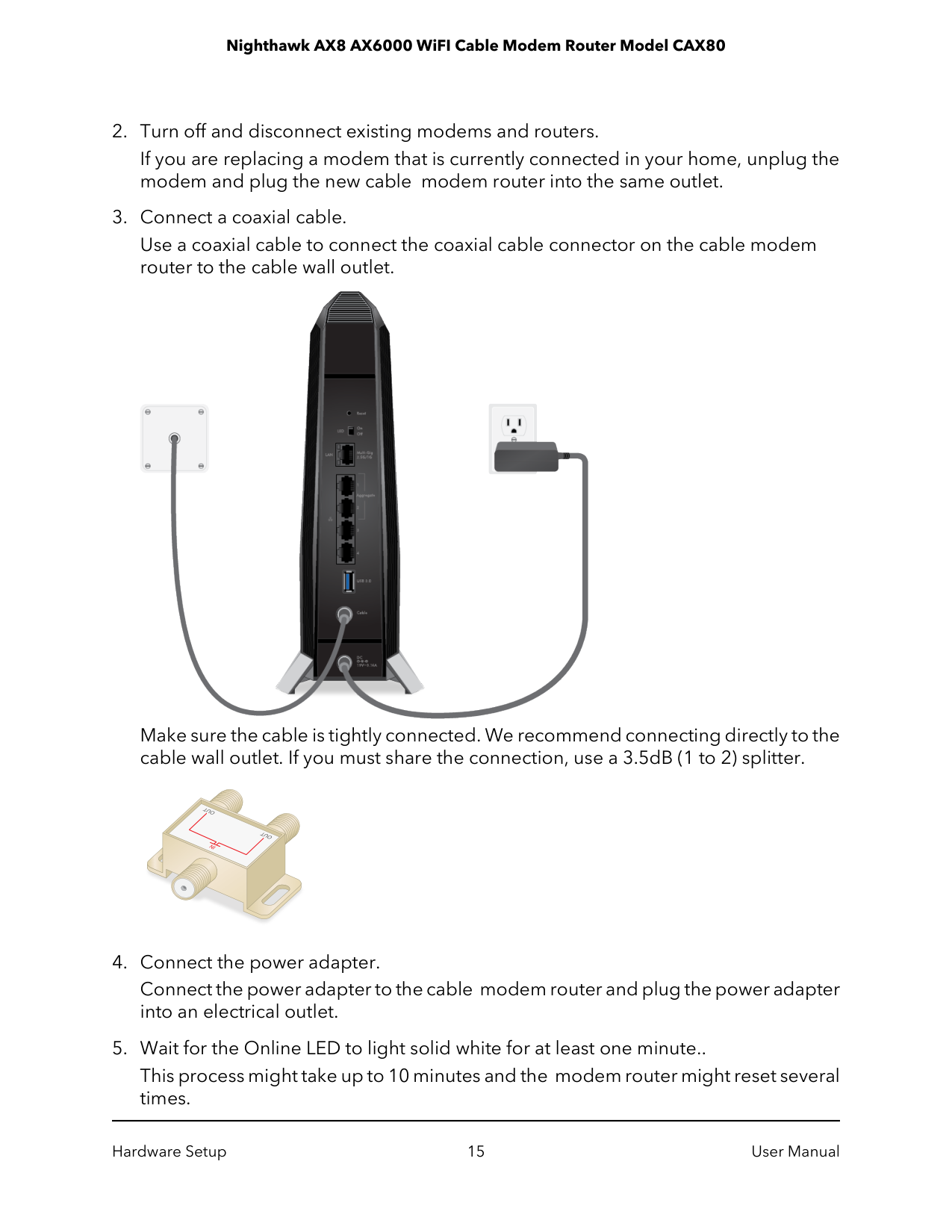
Connect a coaxial cable to the cable wall outlet, then connect the power adapter and wait for the Online LED to light solid white for at least one minute — this process may take up to 10 minutes. Connect your computer via Ethernet or WiFi, then launch a browser and navigate to routerlogin.net or 192.168.1.1 to complete setup. Finally, contact your ISP to activate your internet service using your modem router's model number (CAX80), serial number, and MAC address from the product label. (Pages 15-16)
What do the Downstream LED colors mean on the CAX80?
A solid amber Downstream LED means one downstream channel is locked, while solid white means two or more downstream channels are locked. Blinking white means the modem router is actively scanning for a downstream channel, and off means no downstream channel is locked. (Page 11)
How do I log in to the CAX80 modem router admin interface?
Launch a web browser and type http://routerlogin.net or http://192.168.1.1 in the address bar. Enter the username 'admin' and the default password 'password' — both are case-sensitive. The first time you log in, you will be prompted to change the admin password and set up security questions before you can access the Internet. (Page 26)
How do I factory reset the CAX80 to its default settings?
You can return the router to factory default settings using the Reset button on the rear panel or by using the Erase Settings option in the router's web interface. Both methods will clear all custom settings and restore the device to its original factory configuration. (Page 81)
Where should I place the CAX80 modem router for best WiFi performance?
Place the modem router near the center of the area where your computers and devices operate, in an elevated location to minimize walls and ceilings between it and your devices. Keep it away from electrical devices such as ceiling fans, microwaves, cordless phones, and home security systems, as well as large metal surfaces, mirrors, fish tanks, and concrete walls. Make sure it is within reach of an AC power outlet and near Ethernet cables for wired computers. (Pages 13-14)
Show 14 more questions
How do I connect to the CAX80 using WPS without typing the WiFi password?
How do I set up a guest WiFi network on the CAX80?
What should I do if the Online LED never turns solid white during setup?
How do I block specific websites or keywords on the CAX80?
How do I set up and activate my CAX80 modem router?
What should I do if the Power LED on my modem router is solid red?
How do I change the WiFi password on my CAX80?
What does it mean when the Online LED is blinking white?
How do I reset my modem router to factory default settings?
How do I connect to the WiFi network using WPS?
What is the default admin username and password for the CAX80?
How do I disable the DHCP server on my modem router?
What MTU size should I use for my internet connection?
How do I set up a guest WiFi network on my CAX80?
Full Manual
136 pages
User Manual Nighthawk AX8 AX6000 WiFI Cable Modem Router Model CAX80 NETGEAR, Inc. 350 E. Plumeria Drive June 2020 San Jose, CA 95134, USA 202-11989-01
Support and Community Visit netgear.com/support to get your questions answered and access the latest downloads. You can also check out our NETGEAR Community for helpful advice at community.netgear.com. Contact your Internet service provider for technical support. Regulatory and Legal Si ce produit est vendu au Canada, vous pouvez accéder à ce document en français canadien à https://www.netgear.com/support/download/. (If this product is sold in Canada, you can access this document in Canadian French at https://www.netgear.com/support/download/.) For regulatory compliance information including the EU Declaration of Conformity, visit https://www.netgear.com/about/regulatory/. See the regulatory compliance document before connecting the power supply. For NETGEAR’s Privacy Policy, visit https://www.netgear.com/about/privacy-policy. By using this device, you are agreeing to NETGEAR’s Terms and Conditions at https://www.netgear.com/about/terms-and-conditions. If you do not agree, return the device to your place of purchase within your return period. Trademarks ©NETGEAR, Inc. NETGEAR and the NETGEAR Logo are trademarks of NETGEAR, Inc. Any non-NETGEAR trademarks are used for reference purposes only. 2 Nighthawk AX8 AX6000 WiFI Cable Modem Router Model CAX80
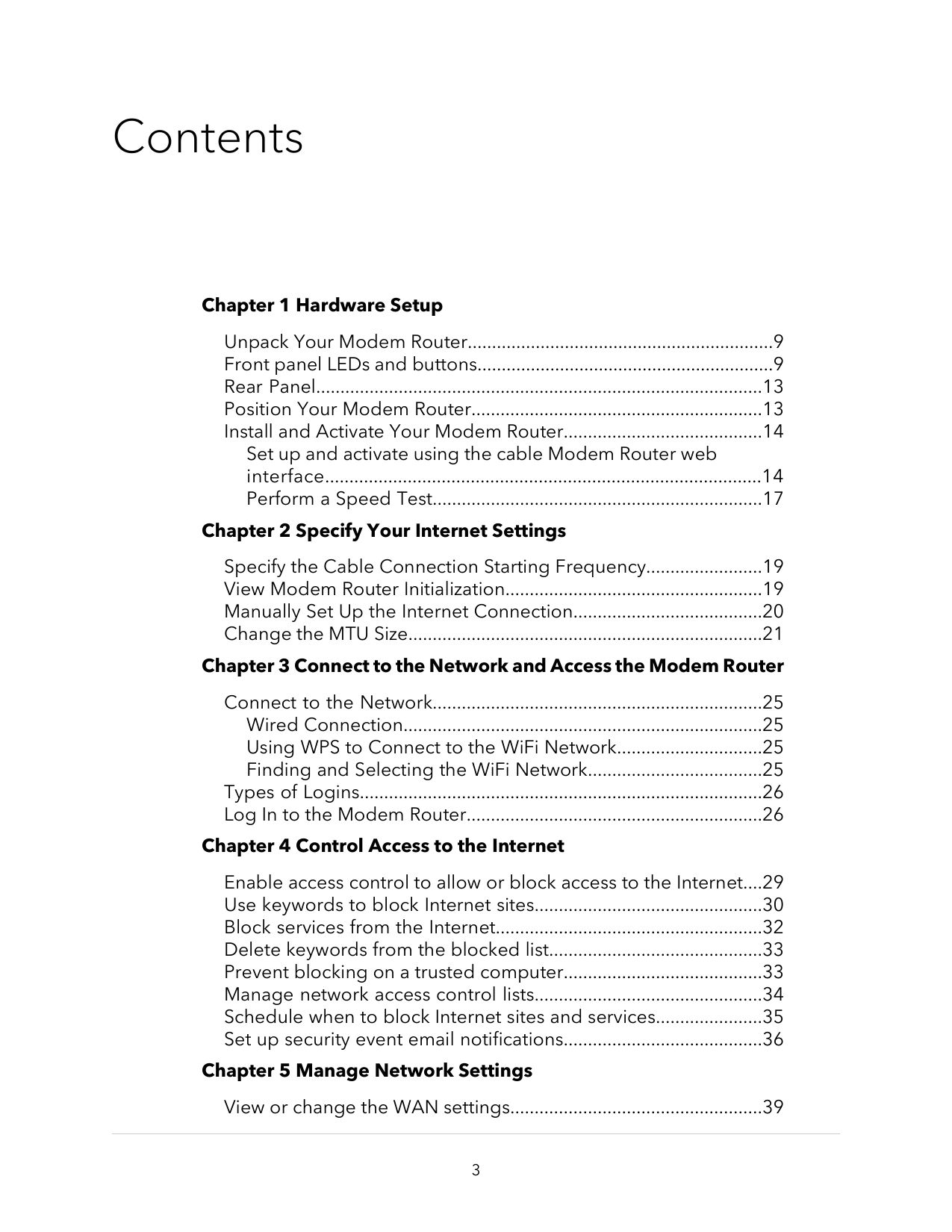
Contents Chapter 1 Hardware Setup Unpack Your Modem Router...............................................................9 Front panel LEDs and buttons.............................................................9 Rear Panel............................................................................................13 Position Your Modem Router............................................................13 Install and Activate Your Modem Router.........................................14 Set up and activate using the cable Modem Router web interface..........................................................................................14 Perform a Speed Test....................................................................17 Chapter 2 Specify Your Internet Settings Specify the Cable Connection Starting Frequency........................19 View Modem Router Initialization.....................................................19 Manually Set Up the Internet Connection.......................................20 Change the MTU Size.........................................................................21 Chapter 3 Connect to the Network and Access the Modem Router Connect to the Network....................................................................25 Wired Connection..........................................................................25 Using WPS to Connect to the WiFi Network..............................25 Finding and Selecting the WiFi Network....................................25 Types of Logins...................................................................................26 Log In to the Modem Router.............................................................26 Chapter 4 Control Access to the Internet Enable access control to allow or block access to the Internet....29 Use keywords to block Internet sites...............................................30 Block services from the Internet.......................................................32 Delete keywords from the blocked list............................................33 Prevent blocking on a trusted computer.........................................33 Manage network access control lists...............................................34 Schedule when to block Internet sites and services......................35 Set up security event email notifications.........................................36 Chapter 5 Manage Network Settings View or change the WAN settings....................................................39 3
Set up a default DMZ server..............................................................40 Change the Router’s Device Name..................................................41 Change the LAN TCP/IP settings......................................................41 Specify the IP addresses that the modem router assigns..............42 Disable the DHCP server feature in the modem router.................44 Manage reserved LAN IP addresses................................................44 Reserve an IP address....................................................................45 Edit a reserved IP address............................................................45 Delete a reserved IP address entry..............................................46 Use the WPS Wizard for WiFi connections......................................47 Specify Basic WiFi Settings................................................................47 Change the WiFi Mode......................................................................49 Change the Transmission Power Control........................................50 Change the WiFi password or the WiFi security.............................51 Set up a guest WiFi network.............................................................52 Control the WiFi radios......................................................................54 Use the WiFi On/Off button..........................................................55 Enable or disable the WiFi radios................................................55 Set up a WiFi schedule.......................................................................56 Specify WPS settings..........................................................................56 Enable or disable implicit beamforming.........................................57 Enable or disable airtime fairness....................................................58 Ethernet Port Aggregation................................................................59 Set Up Ethernet Port Aggregation...............................................60 View or Change the Modem Router Ethernet Port Aggregation Mode...............................................................................................61 Chapter 6 Manage Your Modem Router Update the router firmware...............................................................63 Check for new firmware and update the router.........................63 Manually upload firmware to the router.....................................64 Change the admin password............................................................65 Enable admin password recovery....................................................65 Recover the admin password............................................................66 View information about the router and the Internet and WiFi settings.................................................................................................67 Display the statistics of the Internet port.........................................68 Check the Internet connection status..............................................69 View and manage logs of router activity.........................................70 View devices currently on the network............................................71 View event logs...................................................................................71 Monitor Internet traffic.......................................................................72 Manage the router configuration file...............................................73 Back up the settings.......................................................................74 4 Nighthawk AX8 AX6000 WiFI Cable Modem Router Model CAX80
Erase the settings...........................................................................74 Restore the settings.......................................................................75 Remote access....................................................................................75 Set up remote management........................................................76 Use remote access.........................................................................77 Remotely access your router using the Nighthawk app................77 Disable LED blinking or turn off LEDs..............................................77 Set your time zone..............................................................................78 Set the NTP Server..............................................................................78 Specify ReadyDLNA media server settings.....................................80 Return the router to its factory default settings..............................81 Use the Reset button.....................................................................81 Erase the settings...........................................................................81 Chapter 7 Share USB Storage Devices Attached to the Modem Router USB device requirements..................................................................84 Connect a USB storage device to the router..................................84 Access a storage device connected to the router from a Windows-based computer................................................................85 Map a USB device to a Windows network drive.............................85 Access a storage device that is connected to the router from a Mac.......................................................................................................86 Back up Windows-based computers with ReadySHARE Vault.....87 Back up Mac computers with Time Machine..................................87 Set up a USB hard drive on a Mac...............................................88 Prepare to back up a large amount of data................................89 Use Time Machine to back up onto a USB hard disk................89 Enable FTP access within your network...........................................91 View network folders on a storage device......................................91 Add a network folder on a USB storage device.............................92 Edit a network folder on a USB storage device..............................93 Safely remove a USB storage device...............................................94 Chapter 8 Use Dynamic DNS to Access USB Storage Devices Through the Internet Set up and manage Dynamic DNS...................................................96 Set up FTP access through the Internet...........................................96 Your personal FTP server...................................................................97 Set up your personal FTP server..................................................97 Set up a new Dynamic DNS account...........................................98 Specify a DNS account that you already created.......................98 Change the Dynamic DNS settings.............................................99 Access USB storage devices through the Internet.......................100 5 Nighthawk AX8 AX6000 WiFI Cable Modem Router Model CAX80
Chapter 9 Use VPN to Access Your Network Set up a VPN connection.................................................................102 Specify VPN Service in the Router..................................................102 Install OpenVPN Software...............................................................103 Install OpenVPN Software on Your Windows Computer.......103 Install OpenVPN Software on Your Mac Computer................106 Install OpenVPN Software on an iOS Device...........................107 Install OpenVPN Software on an Android Device...................107 Use a VPN Tunnel on Your Windows Computer..........................108 Use VPN to Access the Router’s USB Device and Media............110 Use VPN to Access Your Internet Service at Home......................110 Set Up VPN Client Internet Access in the Modem Router......111 Block VPN Client Internet Access in the Router.......................111 Use a VPN Tunnel to Access Your Internet Service at Home..112 Chapter 10 Manage Port Forwarding and Port Triggering Manage Port Forwarding to a Local Server..................................115 Set Up Port Forwarding to a Local Server.................................115 Add a Custom Port Forwarding Service...................................116 Edit a Port Forwarding Service...................................................117 Delete a Port Forwarding Entry..................................................118 Application Example: Make a Local Web Server Public.........118 How the Router Implements the Port Forwarding Rule..........119 Port Triggering.................................................................................119 Add a Port Triggering Service....................................................120 Enable Port Triggering................................................................121 Application Example: Port Triggering for Internet Relay Chat port triggering......................................................................................121 Chapter 11 Troubleshooting Quick tips...........................................................................................124 Sequence to restart your network.............................................124 Check the power adapter and Ethernet cable connections...124 Check the WiFi settings..............................................................124 Check the network settings........................................................124 Troubleshoot with the LEDs............................................................125 Standard LED behavior when the router is powered on........125 Power LED is off or blinking.......................................................125 LEDs never turn off......................................................................126 Online LED is Off.........................................................................126 Ethernet LAN port LEDs are off..................................................126 WiFi LED is off..............................................................................126 You cannot log in to the router.......................................................127 6 Nighthawk AX8 AX6000 WiFI Cable Modem Router Model CAX80
You cannot access the Internet.......................................................128 Troubleshoot Internet browsing.....................................................129 Changes are not saved....................................................................130 Troubleshoot WiFi connectivity......................................................130 Troubleshoot your network using the ping utility........................131 Test the LAN path to your router...............................................131 Test the path from a Windows-based computer to a remote device............................................................................................132 Chapter 12 Supplemental Information Factory Settings................................................................................134 Technical Specifications..................................................................135 7 Nighthawk AX8 AX6000 WiFI Cable Modem Router Model CAX80

1 Hardware Setup This chapter covers the following topics: • Unpack Your Modem Router • Front panel LEDs and buttons • Rear Panel • Position Your Modem Router • Install and Activate Your Modem Router For more information about the topics covered in this manual, visit the support website at support.netgear.com. 8

Unpack Your Modem Router Your package contains the modem router, Ethernet cable, and power adapter. Figure 1. Package contents Front panel LEDs and buttons Status LEDs are located on the front of the modem router. The WiFi and WPS buttons are also located on the front. User Manual 9 Hardware Setup Nighthawk AX8 AX6000 WiFI Cable Modem Router Model CAX80
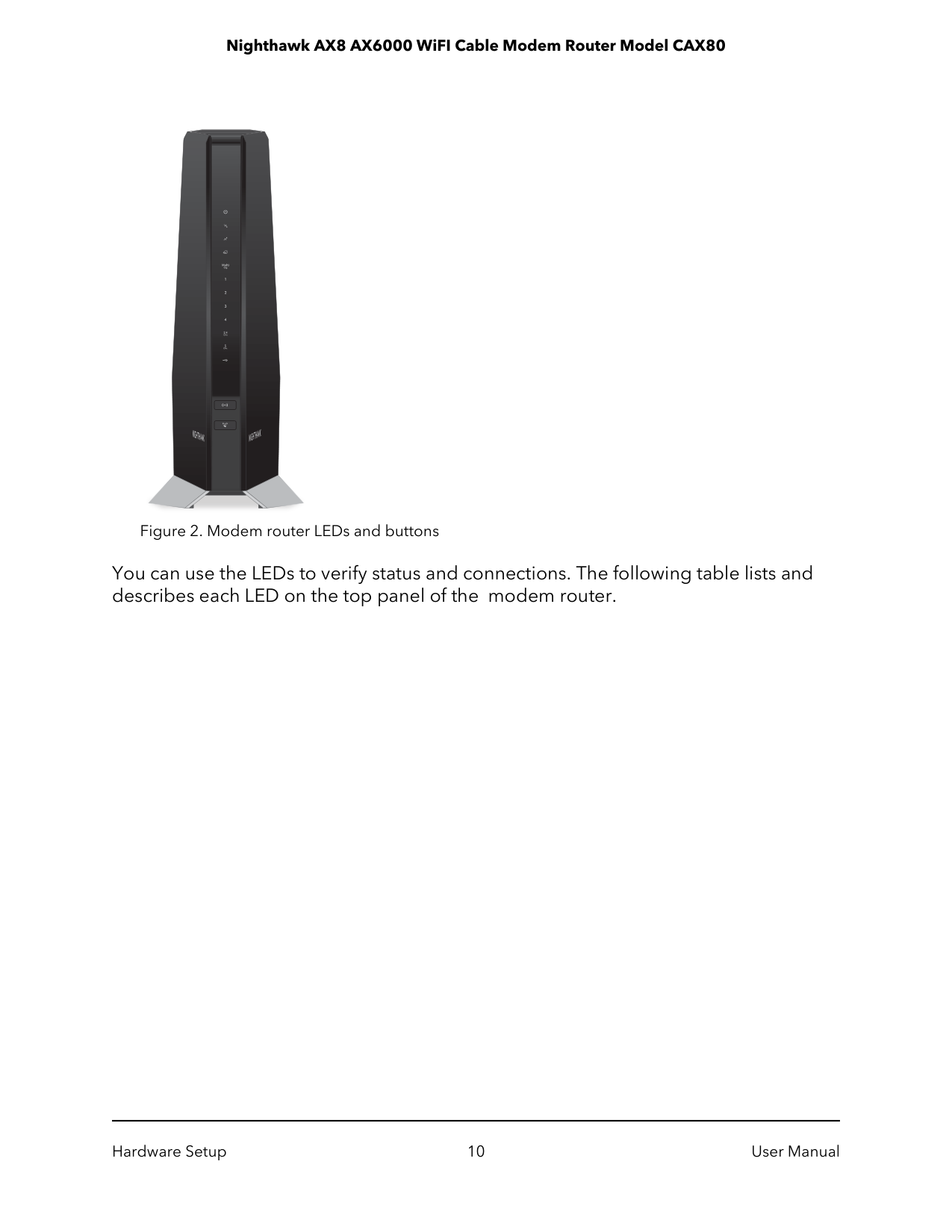
Figure 2. Modem router LEDs and buttons You can use the LEDs to verify status and connections. The following table lists and describes each LED on the top panel of the modem router. User Manual 10 Hardware Setup Nighthawk AX8 AX6000 WiFI Cable Modem Router Model CAX80
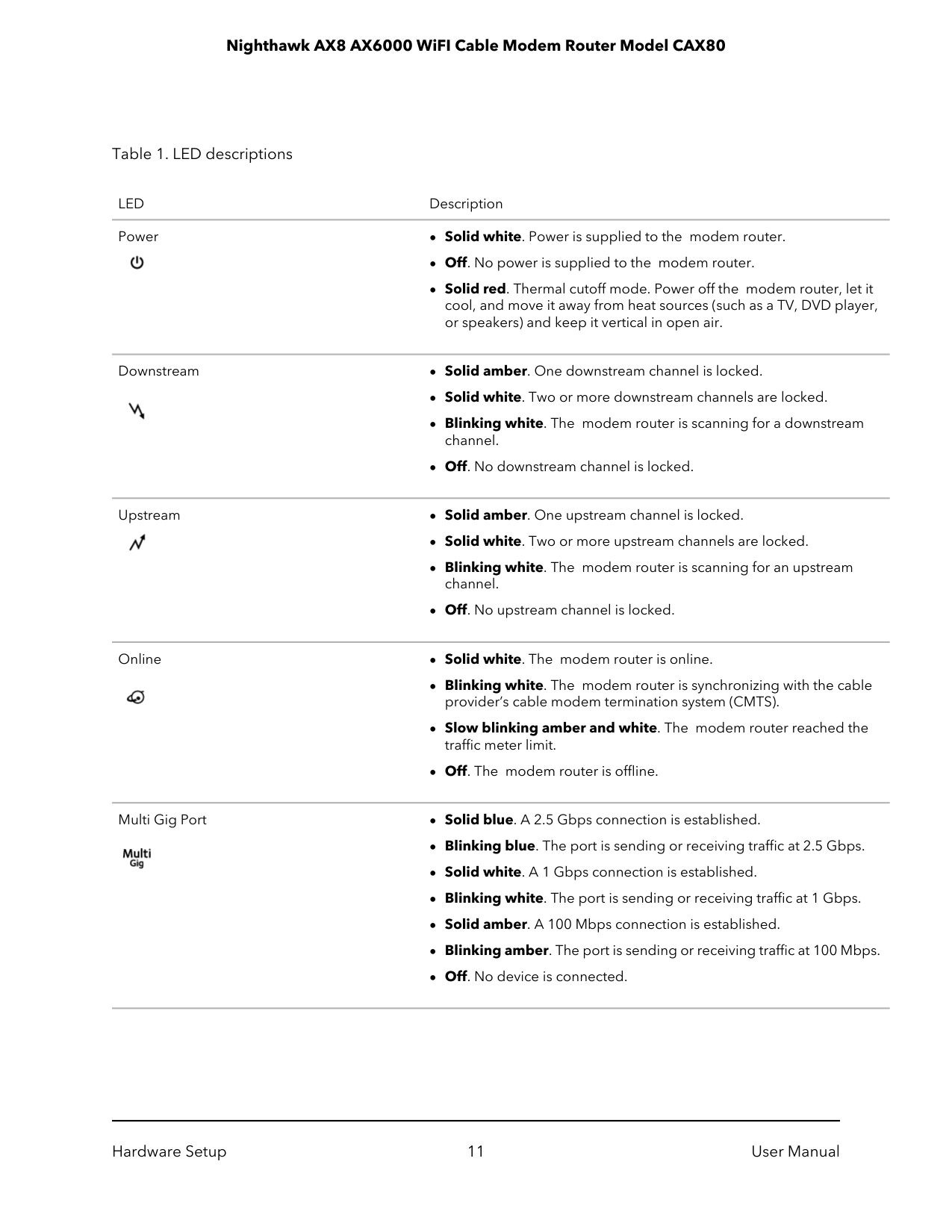
Table 1. LED descriptions Description
Led
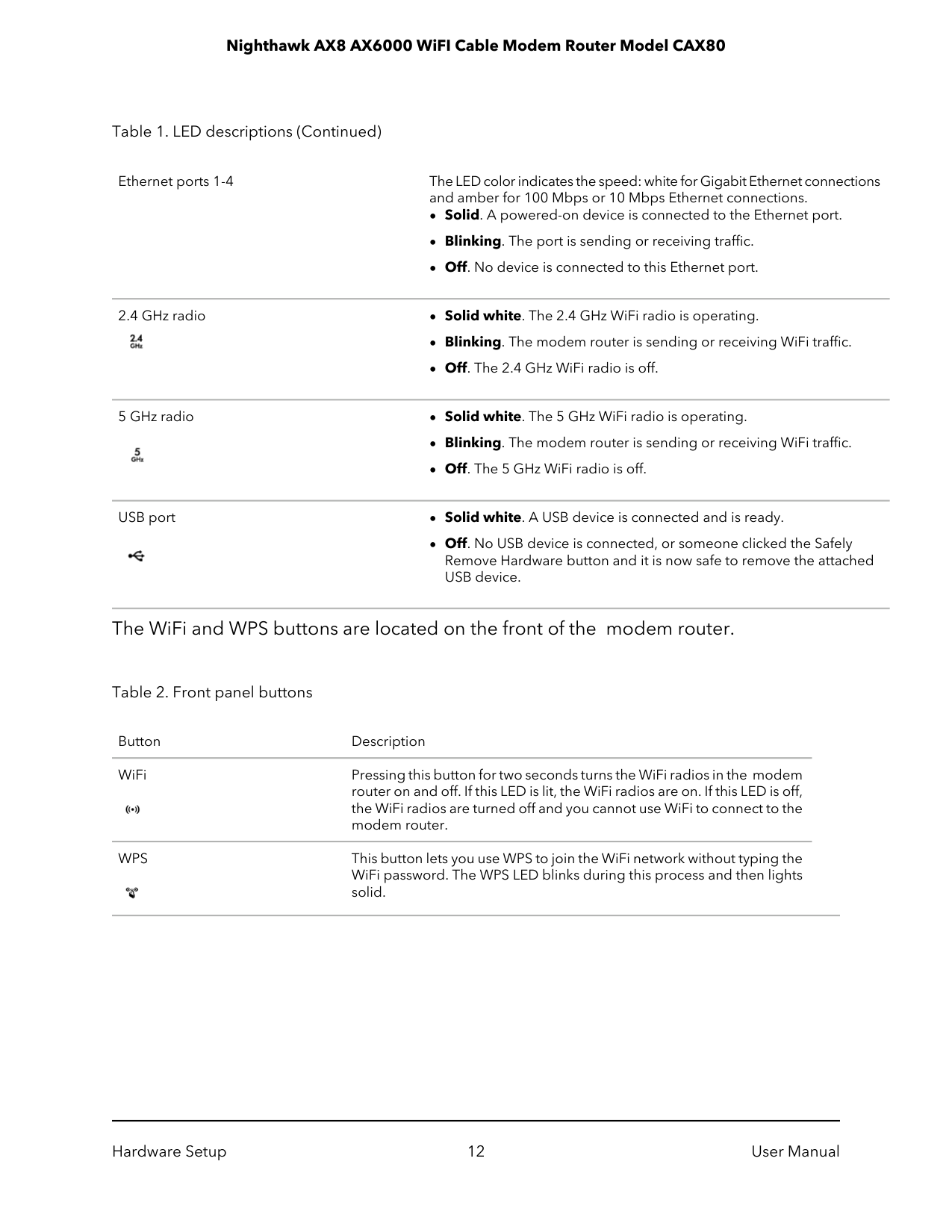
Table 1. LED descriptions (Continued) The LED color indicates the speed: white for Gigabit Ethernet connections and amber for 100 Mbps or 10 Mbps Ethernet connections.
Wps
User Manual 12 Hardware Setup Nighthawk AX8 AX6000 WiFI Cable Modem Router Model CAX80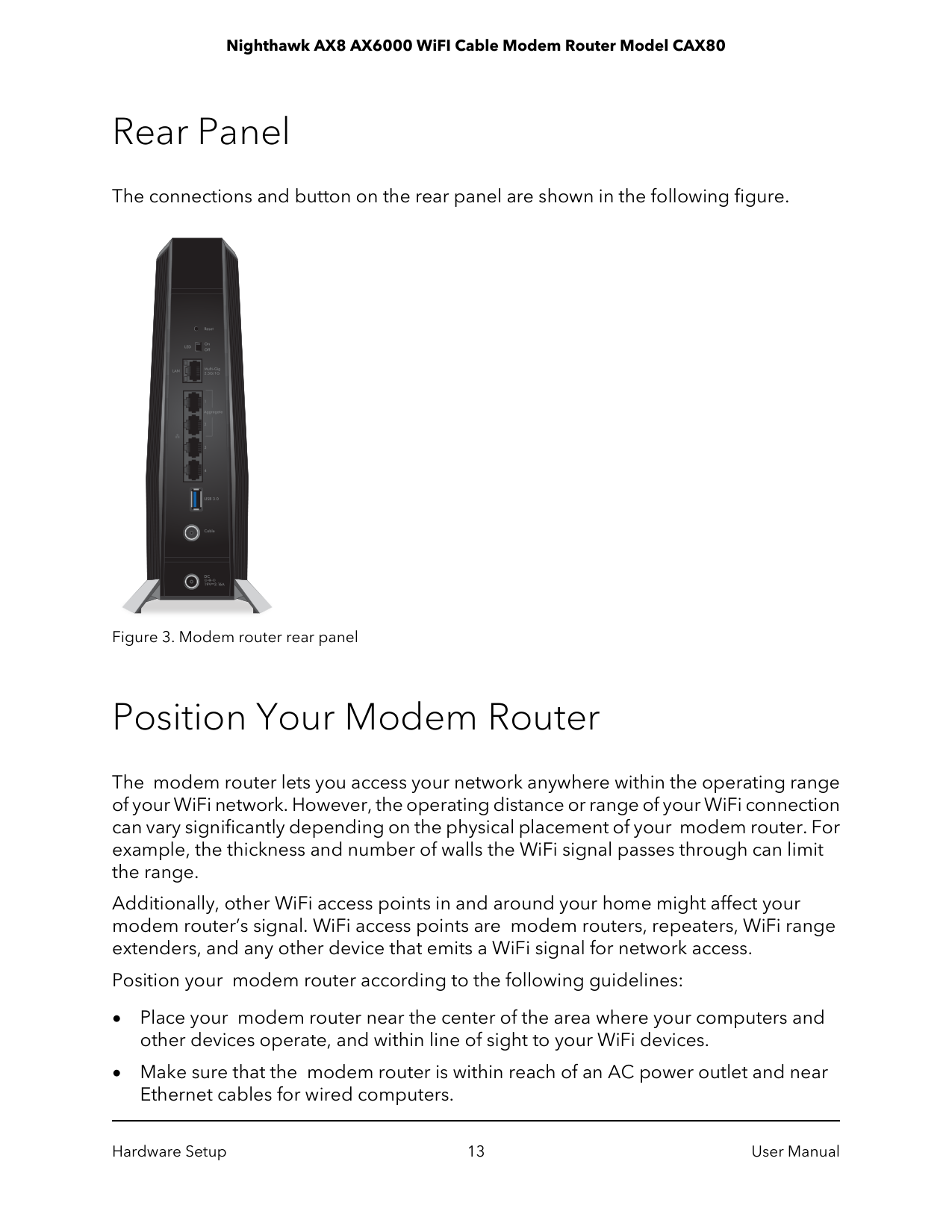
Rear Panel The connections and button on the rear panel are shown in the following figure. Figure 3. Modem router rear panel Position Your Modem Router The modem router lets you access your network anywhere within the operating range of your WiFi network. However, the operating distance or range of your WiFi connection can vary significantly depending on the physical placement of your modem router. For example, the thickness and number of walls the WiFi signal passes through can limit the range. Additionally, other WiFi access points in and around your home might affect your modem router’s signal. WiFi access points are modem routers, repeaters, WiFi range extenders, and any other device that emits a WiFi signal for network access. Position your modem router according to the following guidelines: • Place your modem router near the center of the area where your computers and other devices operate, and within line of sight to your WiFi devices. • Make sure that the modem router is within reach of an AC power outlet and near Ethernet cables for wired computers. User Manual 13 Hardware Setup Nighthawk AX8 AX6000 WiFI Cable Modem Router Model CAX80
• Place the modem router in an elevated location, minimizing the number walls and ceilings between the modem router and your other devices. • Place the modem router away from electrical devices such as these:
Note: When the Online LED lights, your cable modem router is still not connected to the Internet. You must activate your cable modem router with your ISP. If after 10 minutes the LED is still not solid white, verify the cable outlet is working or call your ISP to make sure you have a connection.
Table 3. Activation contact information (Continued) 1-877-692-2253 Sparklight 1-833-267-6094 Spectrum http://xfinity.com/activate (Follow the prompts to activate) Xfinity Note: Your ISP’s contact information might change. You can also find the contact information in your monthly Internet service billing statement. Perform a Speed Test To determine the accurate Internet speed, visit your cable Internet provider's speed test website and perform a speed test. If your actual speed is lower than your subscribed speed, contact your cable Internet provider. User Manual 17 Hardware Setup Nighthawk AX8 AX6000 WiFI Cable Modem Router Model CAX80

2 Specify Your Internet Settings Usually, the quickest way to set up the modem router to use your Internet connection is to allow the modem router to detect the Internet connection when you first access the modem router with an Internet browser. You can also customize or specify your Internet settings. This chapter contains the following sections: • Specify the Cable Connection Starting Frequency • View Modem Router Initialization • Manually Set Up the Internet Connection • Change the MTU Size 18

Specify the Cable Connection Starting Frequency The starting frequency is automatically generated. For most Internet connections, you do not need to specify this information. If you must enter a starting frequency, contact your Internet provider. To change the starting frequency:

To view the status of the modem router initialization:

For the other sections in this page, the default settings usually work, but you can change them.

The best MTU setting for NETGEAR equipment is often the default value. In some situations, changing the value fixes one problem but causes another. Leave the MTU unchanged unless one of these situations occurs: • You experience problems connecting to your ISP or other Internet service, and the technical support of either the ISP or NETGEAR recommends changing the MTU setting. These web-based applications might require an MTU change:

Table 4. Common MTU sizes Application
Mtu
The largest Ethernet packet size. This setting is typical for connections that do not use VPN, and is the default value for NETGEAR routers, adapters, and switches. 1500 Maximum size to use for pinging. (Larger packets are fragmented.) 1472 Used in some DHCP environments. 1468 Usable by AOL if you do not send or receive large email attachments, for example. 1460 User Manual 23 Specify Your Internet Settings Nighthawk AX8 AX6000 WiFI Cable Modem Router Model CAX80
3 Connect to the Network and Access the Modem Router This chapter contains the following sections: • Connect to the Network • Types of Logins • Log In to the Modem Router 24

Connect to the Network You can connect to the modem router’s network through a wired or WiFi connection. If you set up your computer to use a static IP address, change the settings so that it uses Dynamic Host Configuration Protocol (DHCP). Wired Connection You can connect your computer to the modem router using an Ethernet cable and join the modem router’s local area network (LAN). To connect your computer to the modem router with an Ethernet cable:


The first time you log in to the modem router, you are prompted to change the admin password and set up security questions. You must enter these settings before you can access the Internet.
4 Control Access to the Internet The router comes with a built-in firewall that helps protect your home network from unwanted intrusions from the Internet. This chapter contains the following sections: • Enable access control to allow or block access to the Internet • Use keywords to block Internet sites • Manage network access control lists • Schedule when to block Internet sites and services • Set up security event email notifications 28
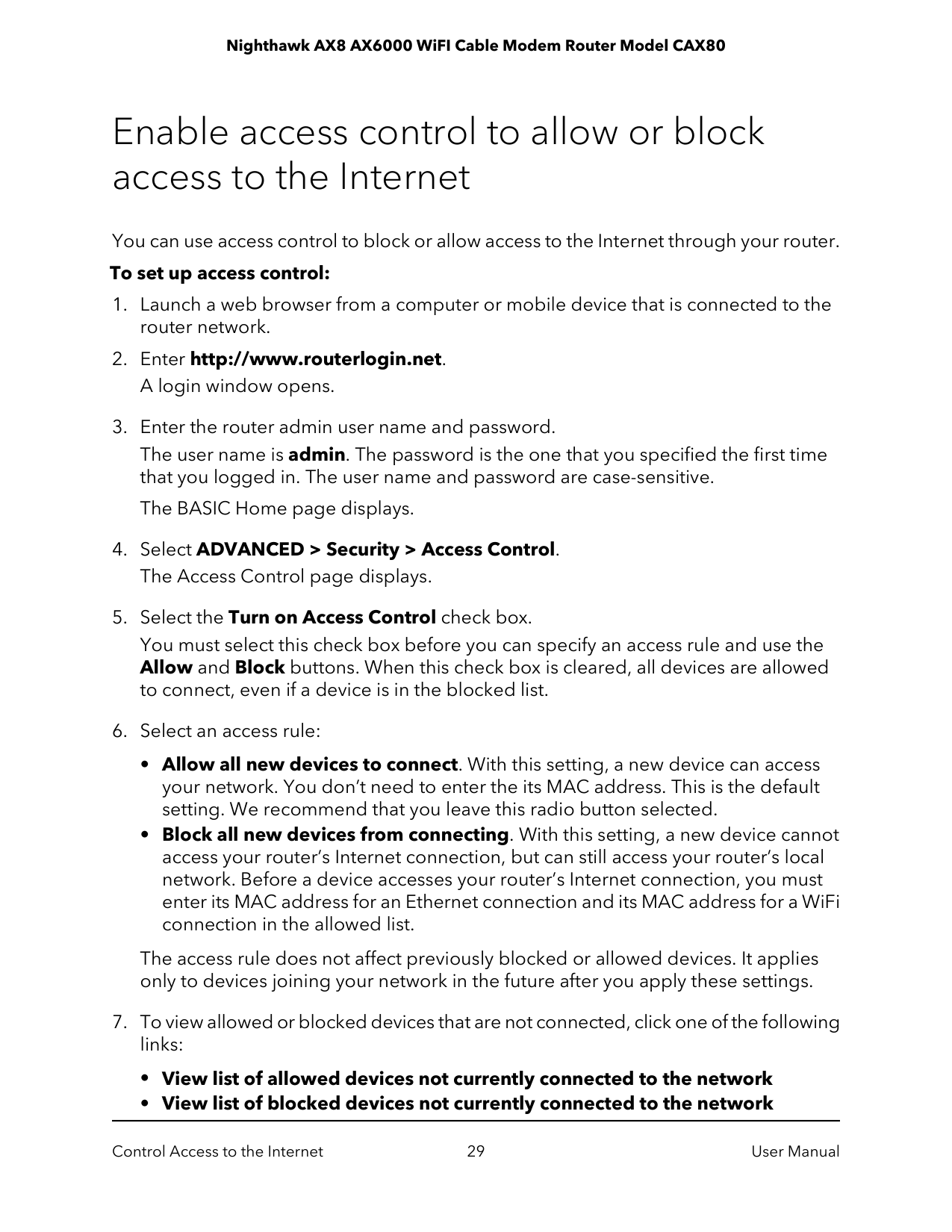
Enable access control to allow or block access to the Internet You can use access control to block or allow access to the Internet through your router. To set up access control:

The list displays.

• Specify .com if you want to allow only sites with domain suffixes such as .edu or .gov. • Enter a period (.) to block all Internet browsing access.

Block services from the Internet You can block Internet services on your network based on the type of service. You can block the services all the time or based on a schedule. To block services:


To specify a trusted computer:


Your settings are saved. Set up security event email notifications The router can email you its logs of router activity. The log records router activity and security events such as attempts to access blocked sites or services. To set up email notifications:

5 Manage Network Settings The router comes ready for WiFi, Ethernet, and USB connections. You can customize the router’s network settings. We recommend that you install the router and connect it to the Internet before you change its network settings. This chapter contains the following sections: • View or change the WAN settings • Set up a default DMZ server • Change the Router’s Device Name • Change the LAN TCP/IP settings • Specify the IP addresses that the modem router assigns • Disable the DHCP server feature in the modem router • Manage reserved LAN IP addresses • Use the WPS Wizard for WiFi connections • Specify Basic WiFi Settings • Change the WiFi Mode • Change the Transmission Power Control • Change the WiFi password or the WiFi security • Set up a guest WiFi network • Control the WiFi radios • Set up a WiFi schedule • Specify WPS settings • Enable or disable implicit beamforming • Enable or disable airtime fairness • Ethernet Port Aggregation 38
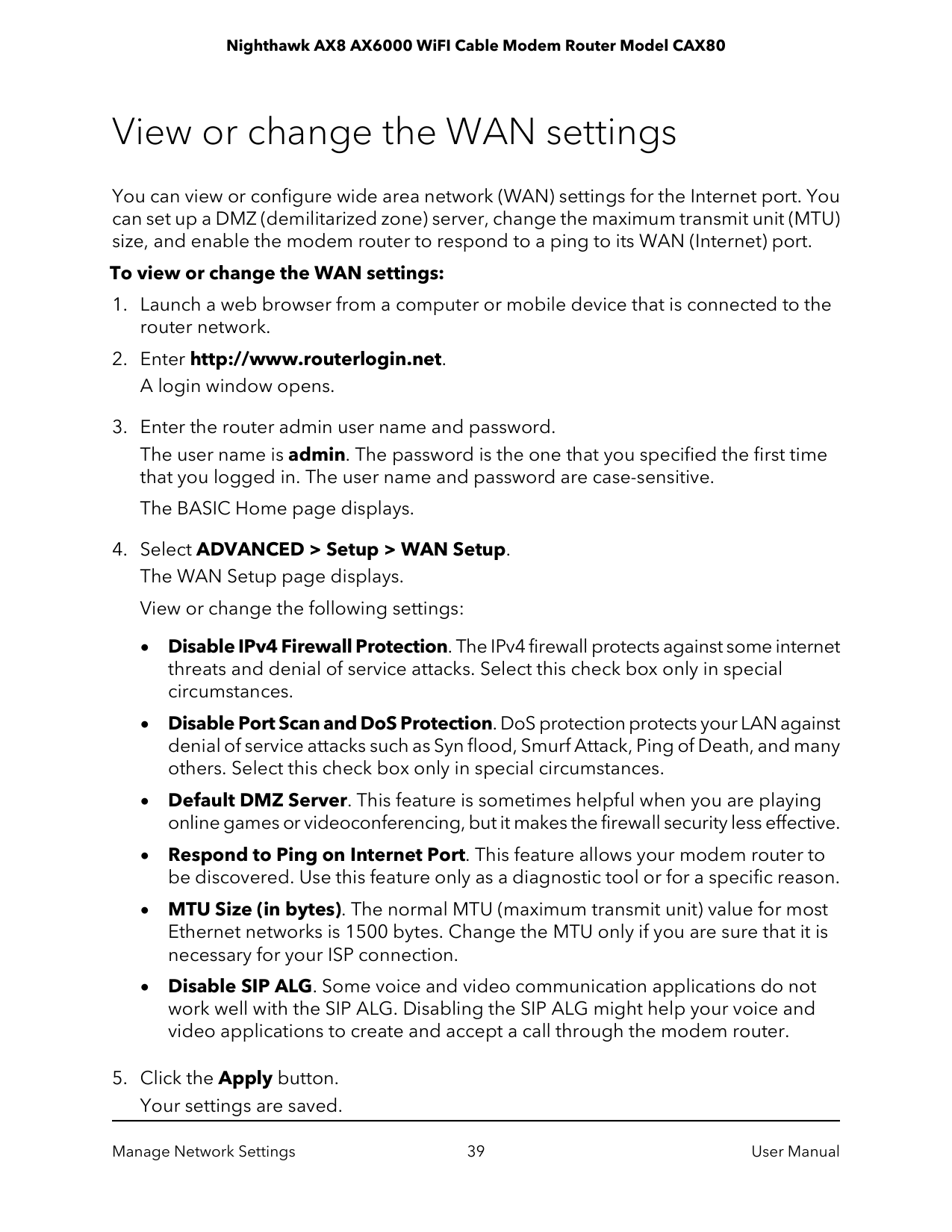
View or change the WAN settings You can view or configure wide area network (WAN) settings for the Internet port. You can set up a DMZ (demilitarized zone) server, change the maximum transmit unit (MTU) size, and enable the modem router to respond to a ping to its WAN (Internet) port. To view or change the WAN settings:

Set up a default DMZ server The default DMZ server feature is helpful when you are using some online games and videoconferencing applications that are incompatible with Network Address Translation (NAT). The modem router is programmed to recognize some of these applications and to work correctly with them, but other applications might not function well. In some cases, one local computer can run the application correctly if the IP address for that computer is entered as the default DMZ server. WARNING: DMZ servers pose a security risk. A computer designated as the default DMZ server loses much of the protection of the firewall and is exposed to exploits from the Internet. If compromised, the DMZ server computer can be used to attack other computers on your network. The modem router usually detects and discards incoming traffic from the Internet that is not a response to one of your local computers or a service that you configured on the Port Forwarding/Port Triggering page. Instead of discarding this traffic, you can specify that the router forwards the traffic to one computer on your network. This computer is called the default DMZ server. To set up a default DMZ server:

Change the Router’s Device Name The modem router’s default device name is based on its model number. This device name displays in the file manager when you browse your network. To change the modem router’s device name:

To change the LAN TCP/IP settings:

To specify the pool of IP addresses that the modem router assigns:

Disable the DHCP server feature in the modem router By default, the modem router acts as a DHCP server. The router assigns IP, DNS server, and default gateway addresses to all computers connected to the LAN. The assigned default gateway address is the LAN address of the modem router. You can use another device on your network as the DHCP server or specify the network settings of all your computers. To disable the DHCP server feature in the modem router:

Reserve an IP address To reserve an IP address:

The user name is admin. The password is the one that you specified the first time that you logged in. The user name and password are case-sensitive. The BASIC Home page displays.

Use the WPS Wizard for WiFi connections The WPS Wizard helps you add a WPS-enabled device to your WiFi network without typing the WiFi password. To use the WPS Wizard:

Note: The preset SSID and password are uniquely generated for every device to protect and maximize your WiFi security. If you change your preset security settings, make a note of the new settings and store it in a safe place where you can easily find it. If your computer is connected with WiFi when you change the SSID or other WiFi security settings, you are disconnected when you click the Apply button. To avoid this problem, use a computer with a wired connection to access the modem router. To specify basic WiFi settings:

When you use multiple access points, it is better if adjacent access points use different channels to reduce interference. The recommended channel spacing between adjacent access points is four channels (for example, use Channels 1 and 5, or 6 and 10).

• Up to 600 Mbps. This mode allows 802.11ax, 802.11n, 802.11g, and 802.11b devices to join the network but limits the devices to functioning at up to 600 Mbps. • Up to 1200 Mbps. This mode allows 802.11ax, 802.11n, 802.11g, and 802.11b devices to join the network and allows the devices to function at up to 1200 Mbps. This mode is the default mode.

The user name is admin. The password is the one that you specified the first time you logged in. The user name and password are case-sensitive. The BASIC Home page displays.

You must enter a phrase of 8 to 63 characters. The Password (Network Key) field displays if the WPA2-PSK [AES] or WPA-PSK [TKIP] + WPA2-PSK [AES] security radio button is selected.

The router provides two default guest networks with the following names (SSIDs): • 2.4 GHz guest WiFi network SSID. NETGEAR_Guest • 5 GHz guest WiFi network SSID. NETGEAR-5G_Guest By default, these networks are configured as open networks without security but are disabled. You can enable one or both networks. You can also change the SSIDs for these networks. To set up a guest network:


When the WiFi radios are off, you can still use an Ethernet cable for a LAN connection to the modem router. You can turn the WiFi radios on and off with the WiFi On/Off button on the modem router, or you can log in to the modem router and enable or disable the WiFi radios. If you are close to the modem router, it might be easier to press its WiFi On/Off button. If you are away from the modem router or already logged in, it might be easier to enable or disable them. Use the WiFi On/Off button To turn the WiFi radios off and on with the WiFi On/Off button: Press the WiFi On/Off button on the top of the modem router for two seconds. If you turned off the WiFi radios, the WiFi On/Off LED and the WPS LED turn off. If you turned on the WiFi radios, the WiFi On/Off LED and the WPS LED light. Enable or disable the WiFi radios If you used the WiFi On/Off button to turn off the WiFi radios, you can’t log in to the modem router to turn them back on. You must press the WiFi On/Off button again for two seconds to turn the WiFi radios back on. To enable or disable the WiFi radios:

Your settings are saved. Set up a WiFi schedule You can turn off the WiFi signal from your modem router at times when you do not need a WiFi connection. For example, you might turn it off for the weekend if you leave town. To set up the WiFi schedule:

To specify WPS settings:

To enable or disable implicit beamforming:

The user name is admin. The password is the one that you specified the first time that you logged in. The user name and password are case-sensitive. The BASIC Home page displays.

Set Up Ethernet Port Aggregation If you are connecting a switch, make sure that your switch supports 802.3ad LACP. To set up Ethernet port aggregation:

Note: You must enable static mode before you connect your device to Ethernet ports 1 and 2 on the router. f. Click the Apply button. Your settings are saved. View or Change the Modem Router Ethernet Port Aggregation Mode To view or change your modem router's Ethernet port aggregation mode:

6 Manage Your Modem Router This chapter describes the modem router settings for administering and maintaining your modem router and home network. The chapter contains the following sections: • Update the router firmware • Change the admin password • Enable admin password recovery • Recover the admin password • View information about the router and the Internet and WiFi settings • Display the statistics of the Internet port • Check the Internet connection status • View and manage logs of router activity • View devices currently on the network • View event logs • Monitor Internet traffic • Manage the router configuration file • Remote access • Remotely access your router using the Nighthawk app • Disable LED blinking or turn off LEDs • Set your time zone • Set the NTP Server • Specify ReadyDLNA media server settings • Return the router to its factory default settings 62

Update the router firmware You can log in to the modem router and check if new firmware is available, or you can manually load a specific firmware version to your modem router. Check for new firmware and update the router The modem router firmware (routing software) is stored in flash memory. You might see a message at the top of the modem router pages when new firmware is available. You can respond to that message to update the firmware or you can check to see if new firmware is available and update your product. Note: We recommend that you connect a computer to the modem router using an Ethernet connection to update the firmware. To check for new firmware and update your modem router:

When the upload is complete, your modem router restarts. The update process typically takes about one minute. Read the new firmware release notes to find out if you must reconfigure the modem router after updating. Manually upload firmware to the router If you want to upload a specific firmware version, or your modem router fails to update its firmware automatically, follow these instructions. Note: We recommend that you connect a computer to the modem router using an Ethernet connection to upload the firmware. To manually upload a firmware file to your modem router:

Change the admin password The admin password is the one you specified the first time you logged in. You can change this password. Note: The ideal password contains no dictionary words from any language and contains uppercase and lowercase letters, numbers, and symbols. It can be up to 30 characters. To change the password for the admin user name:
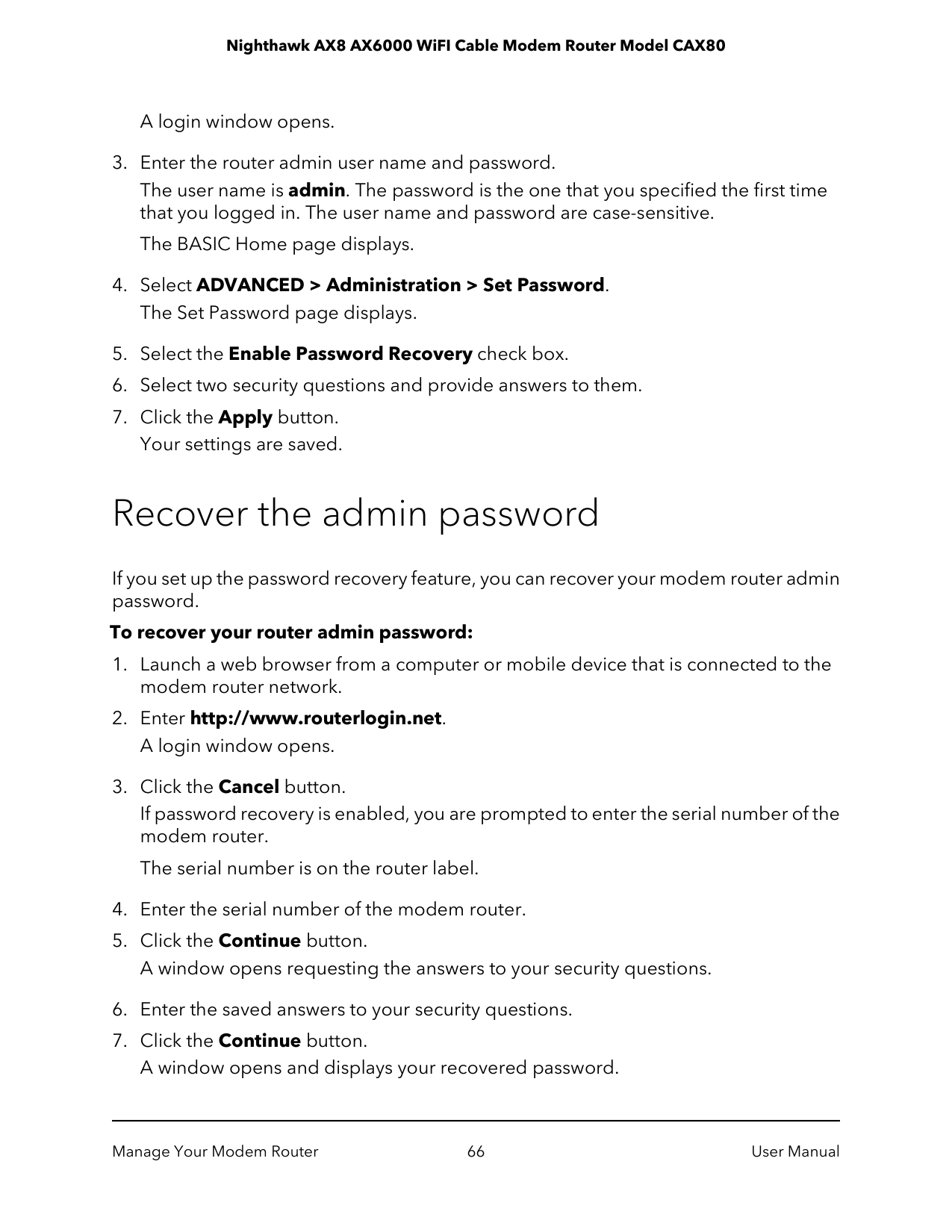
A login window opens.
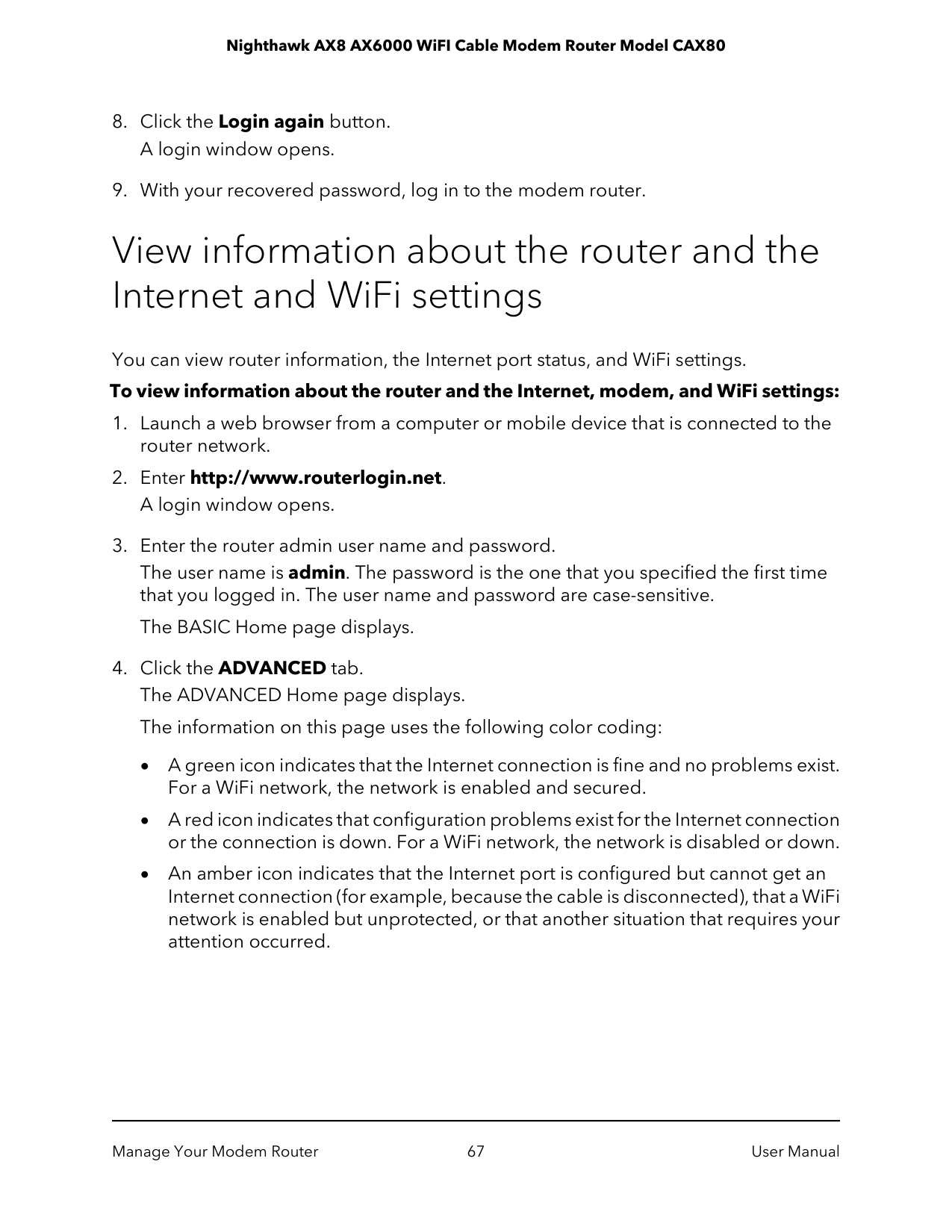

Display the statistics of the Internet port To display the statistics of the Internet port:


You must set up email notifications in order to receive the logs. The router to emails the logs to the address that you specified when you set up email notifications. For more information, see Set up security event email notifications on page 36.
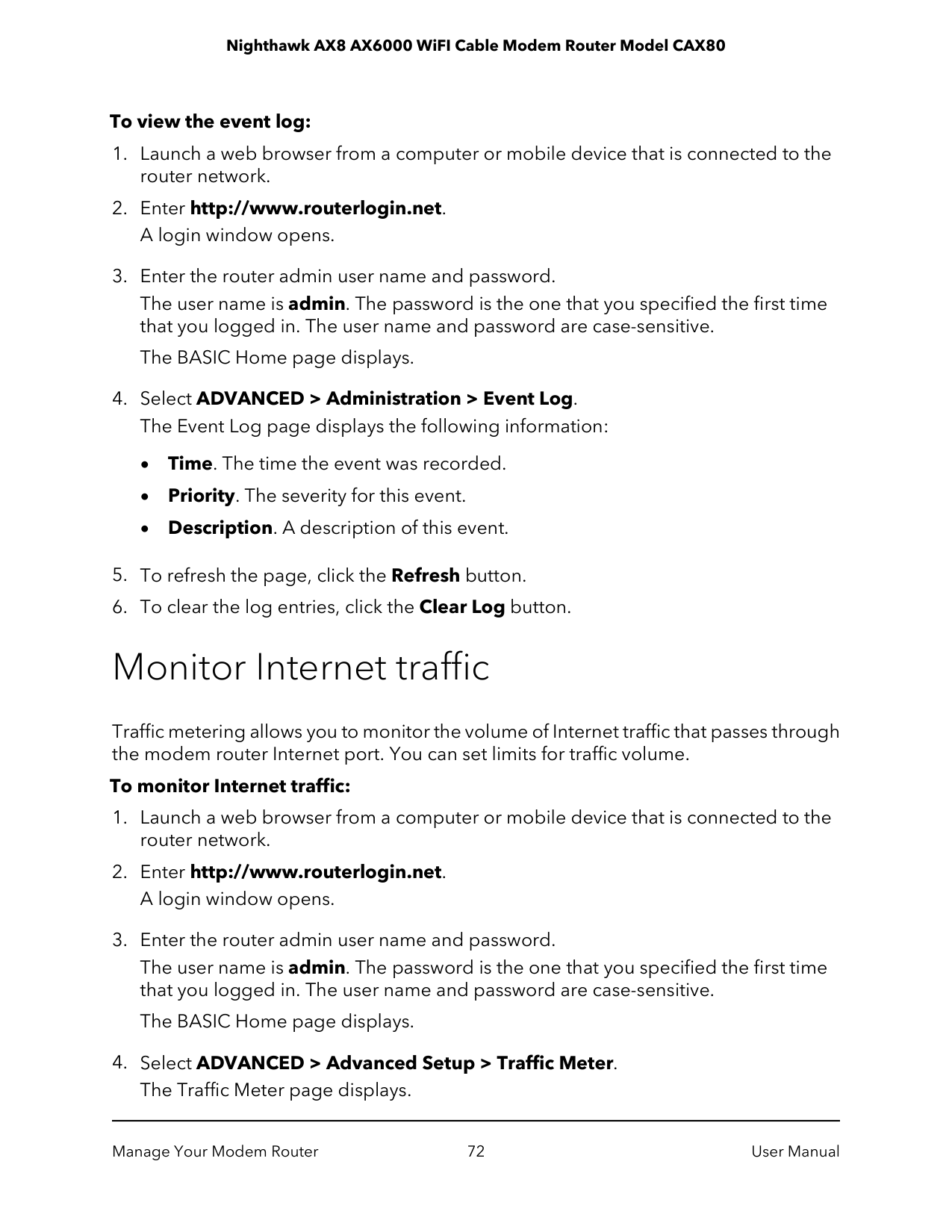
To view the event log:
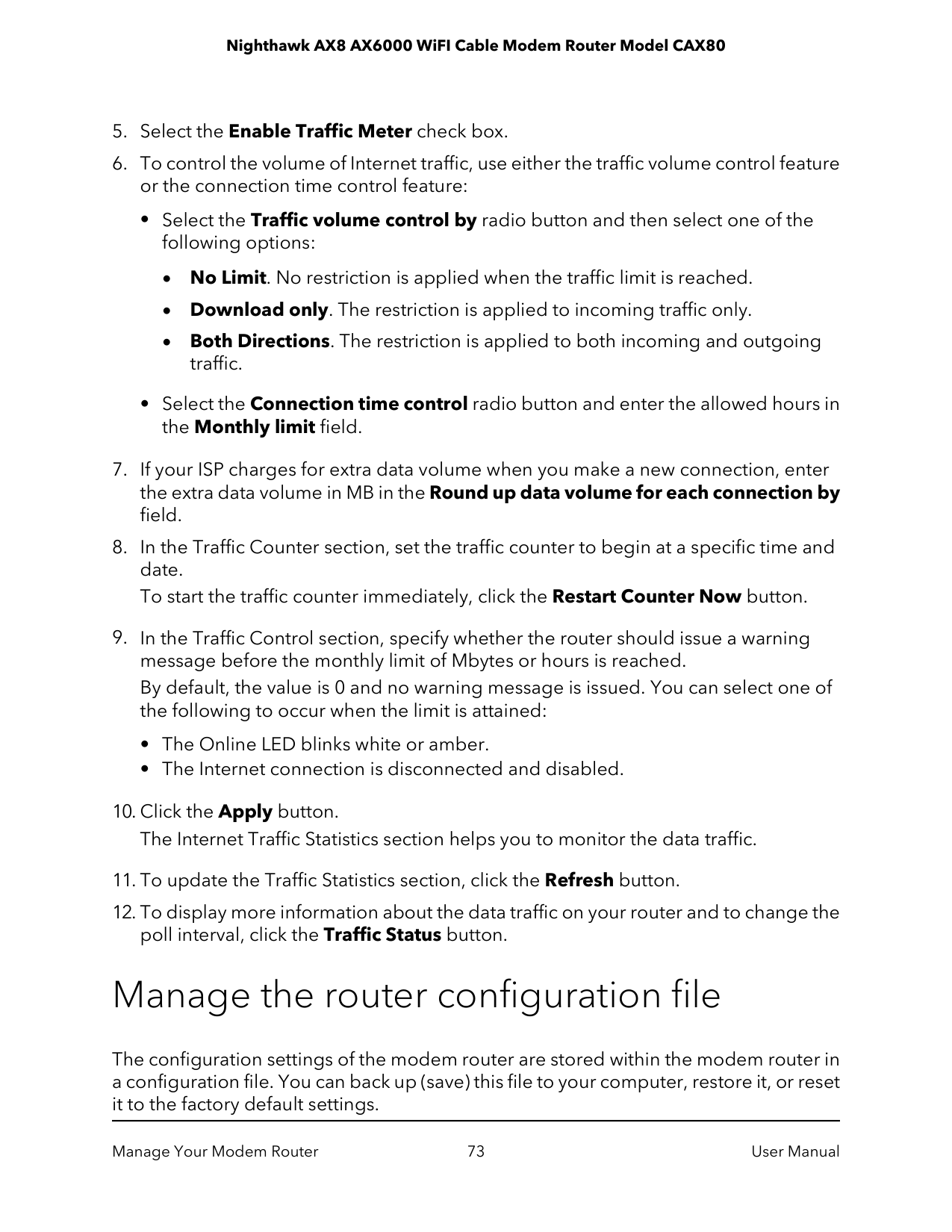

Back up the settings To back up the modem router’s configuration settings:

The configuration is reset to factory default settings. When the reset is complete, the router restarts. This process takes about two minutes. WARNING: To avoid the risk of corrupting the firmware, do not interrupt the reset. For example, do not close the browser, click a link, or load a new page. Do not turn off the router. Wait until the router finishes restarting. Restore the settings To restore configuration settings that you backed up:

Set up remote management To set up remote management:

Use remote access To use remote access:


To set the NTP server:

Specify ReadyDLNA media server settings By default, the router acts as a ReadyDLNA media server, which lets you view movies and photos on DLNA/UPnP AV-compliant media players, such as Xbox360, Playstation, and NETGEAR media players. To specify media server settings:

Return the router to its factory default settings Under some circumstances (for example, if you lost track of the changes that you made to the router settings or you move the router to a different network), you might want to erase the configuration and reset the router to factory default settings. To reset the router to factory default settings, you can use either the Reset button on the back of the router or the Erase function. After you reset the router to factory default settings, the user name is admin, the password is password, the LAN IP address is 192.168.1.1 (which is the same as www.routerlogin.net), and the DHCP server is enabled. Tip: If the router is in bridge mode, you can access it by LAN IP address 192.168.100.1. Use the Reset button CAUTION: This process erases all settings that you configured in the router. To reset the router to factory default settings:

To erase the settings:

7 Share USB Storage Devices Attached to the Modem Router This chapter describes how to access and manage storage devices attached to your modem router. ReadySHARE lets you access and share USB storage devices connected to the router. (If your storage device uses special drivers, it is not compatible.) Note: You can use a USB port on the modem router to connect a USB storage device like a flash drive or hard drive. Do not connect a computer, USB modem, CD drive, or DVD drive to a USB port on the modem router. The chapter contains the following sections: • USB device requirements • Connect a USB storage device to the router • Access a storage device connected to the router from a Windows-based computer • Map a USB device to a Windows network drive • Access a storage device that is connected to the router from a Mac • Back up Windows-based computers with ReadySHARE Vault • Back up Mac computers with Time Machine • Enable FTP access within your network • View network folders on a storage device • Add a network folder on a USB storage device • Edit a network folder on a USB storage device • Safely remove a USB storage device For more information about ReadySHARE features, visit netgear.com/readyshare. 83

USB device requirements The modem router works with most USB-compliant external flash and hard drives. For the most up-to-date list of USB devices that the modem router supports, visit kb.netgear.com/app/answers/detail/a_id/18985/~/readyshare-usb-drives-compatibility-list. Some USB external hard drives and flash drives require you to load the drivers onto the computer before the computer can access the USB storage device. Such USB storage devices do not work with the modem router. The modem router supports the following file system types for full read/write access: •
Fat16
•Fat32
•Ntfs
• NTFS with compression format enabled • Ext2 • Ext3 • Ext4 •Hfs
•Hfs+
Connect a USB storage device to the router ReadySHARE lets you access and share USB storage devices that are connected to a USB port on the modem router. (If your USB storage device uses special drivers, it is not compatible.) To connect a USB device:
Access a storage device connected to the router from a Windows-based computer To access the USB storage device from a Windows-based computer:


Note: The following instructions might be different depending on the macOS your computer is using. For more instructions about backing up your computer with Time Machine, see the Apple support site. Set up a USB hard drive on a Mac We recommend that you use a new USB HDD or format your old USB HDD to do the Time Machine backup for the first time. Use a blank partition to prevent some issues during backup using Time Machine. The modem router supports GUID or MBR partitions. To format your USB hard disk drive and specify partitions:

Prepare to back up a large amount of data Before you back up a large amount of data with Time Machine, we recommend that you follow this procedure. To prepare to back up a large amount of data:


Enable FTP access within your network File Transfer Protocol (FTP) lets you download (receive) and upload (send) large files faster. To enable FTP access within your network:


If a single device is attached to the USB port, the radio button is selected automatically.


8 Use Dynamic DNS to Access USB Storage Devices Through the Internet With Dynamic DNS, you can use the Internet to access USB devices attached to the router’s USB ports when you’re not home. This chapter contains the following sections: • Set up and manage Dynamic DNS • Set up FTP access through the Internet • Your personal FTP server • Access USB storage devices through the Internet 95

Set up and manage Dynamic DNS Internet service providers (ISPs) assign numbers called IP addresses to identify each Internet account. Most ISPs use dynamically assigned IP addresses. This means that the IP address can change at any time. You can use the IP address to access your network remotely, but most people don’t know what their IP addresses are or when this number changes. To make it easier to connect, you can get a free account with a Dynamic DNS service that lets you use a domain name to access your home network. To use this account, you must set up the router to use Dynamic DNS. Then the router notifies the Dynamic DNS service provider whenever its IP address changes. When you access your Dynamic DNS account, the service finds the current IP address of your home network and automatically connects you. If your ISP assigns a private WAN IP address (such as 192.168.x.x or 10.x.x.x), the Dynamic DNS service does not work because private addresses are not routed on the Internet. Set up FTP access through the Internet To set up FTP access:

To set up Dynamic DNS if you already created an account:

To change your settings:

9 Use VPN to Access Your Network You can use OpenVPN software to remotely access your router using virtual private networking (VPN). This chapter explains how to set up and use VPN access. The chapter contains the following sections: • Set up a VPN connection • Specify VPN Service in the Router • Install OpenVPN Software • Use a VPN Tunnel on Your Windows Computer • Use VPN to Access the Router’s USB Device and Media • Use VPN to Access Your Internet Service at Home 101

Set up a VPN connection A virtual private network (VPN) lets you use the Internet to securely access your network when you aren’t home. This type of VPN access is called a client-to-gateway tunnel. The computer is the client, and the router is the gateway. To use the VPN feature, you must log in to the modem router and enable VPN, and you must install and run VPN client software on the computer. VPN uses DDNS or a static IP address to connect with your modem router. To use a DDNS service, register for an account with a host name (sometimes called a domain name). You use the host name to access your network. The modem router supports these accounts: NETGEAR, No-IP, and Dyn. If your Internet service provider (ISP) assigned a static WAN IP address (such as 50.196.x.x or 10.x.x.x) that never changes to your Internet account, the VPN can use that IP address to connect to your home network. Specify VPN Service in the Router You must specify the VPN service settings in the router before you can use a VPN connection. To specify the VPN service:


c. Select the local area connection and change its name (not its device name) to
Netgear-Vpn.
If you do not change the VPN interface name, the VPN tunnel connection will fail. For more information about using OpenVPN on your Windows computer, visit https://openvpn.net/index.php/open-source/documentation/howto.html#quick. Install OpenVPN Software on Your Mac Computer You must install this software on each Mac computer that you plan to use for VPN connections to your modem router. To install VPN client software on your Mac computer:
Install OpenVPN Software on an iOS Device You must install this software on each iOS device that you plan to use for VPN connections to your router. To install VPN client software on an iOS device:
To install VPN client software on an Android device:
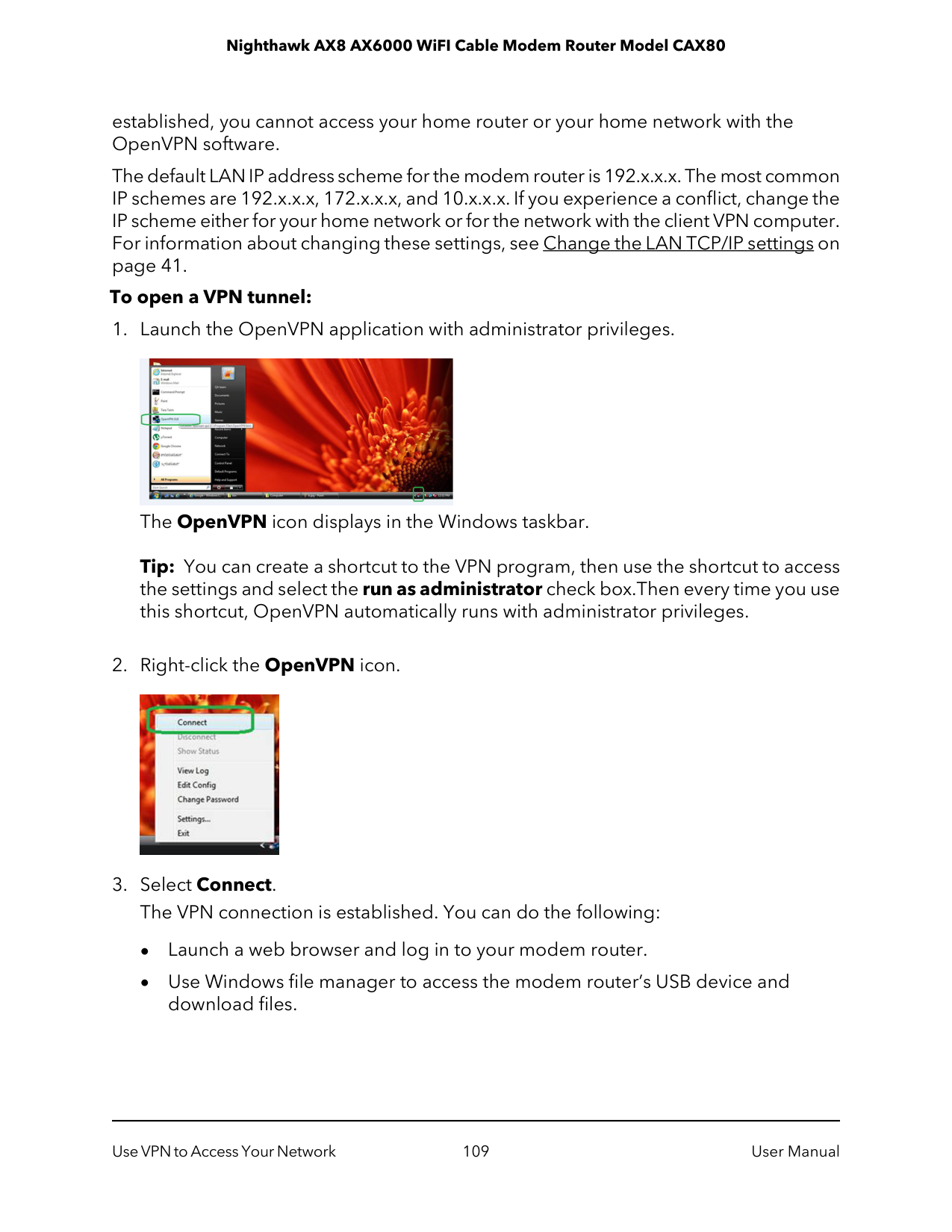
established, you cannot access your home router or your home network with the OpenVPN software. The default LAN IP address scheme for the modem router is 192.x.x.x. The most common IP schemes are 192.x.x.x, 172.x.x.x, and 10.x.x.x. If you experience a conflict, change the IP scheme either for your home network or for the network with the client VPN computer. For information about changing these settings, see Change the LAN TCP/IP settings on page 41. To open a VPN tunnel:

Use VPN to Access the Router’s USB Device and Media To access a USB device and download files from your Windows-based computer using VPN:

Set Up VPN Client Internet Access in the Modem Router By default, the router is set up to allow VPN connections only to your home network, but you can change the settings to allow Internet access. Accessing the Internet remotely through a VPN might be slower than accessing the Internet directly. To allow VPN clients to use your home Internet service:

To allow VPN clients to access only your home network:


10 Manage Port Forwarding and Port Triggering You can use port forwarding and port triggering to set up rules for Internet traffic. You need networking knowledge to set up these features. This chapter contains the following sections: • Manage Port Forwarding to a Local Server • Port Triggering 114

Manage Port Forwarding to a Local Server If your home network includes a server, you can allow certain types of incoming traffic to reach the server. For example, you might want to make a local web server, FTP server, or game server visible and available to the Internet. The router can forward incoming traffic with specific protocols to computers on your local network.You can specify the servers for applications and you can also specify a default DMZ server to which the router forwards all other incoming protocols. Set Up Port Forwarding to a Local Server To forward specific incoming protocols:


You can enter a port range and fixed ports in one rule, for example, external (30–50, 78, 100–102), internal (40–60, 99, 200–202). With this rule, external ports 30–50 are forwarded to internal ports 40–60.
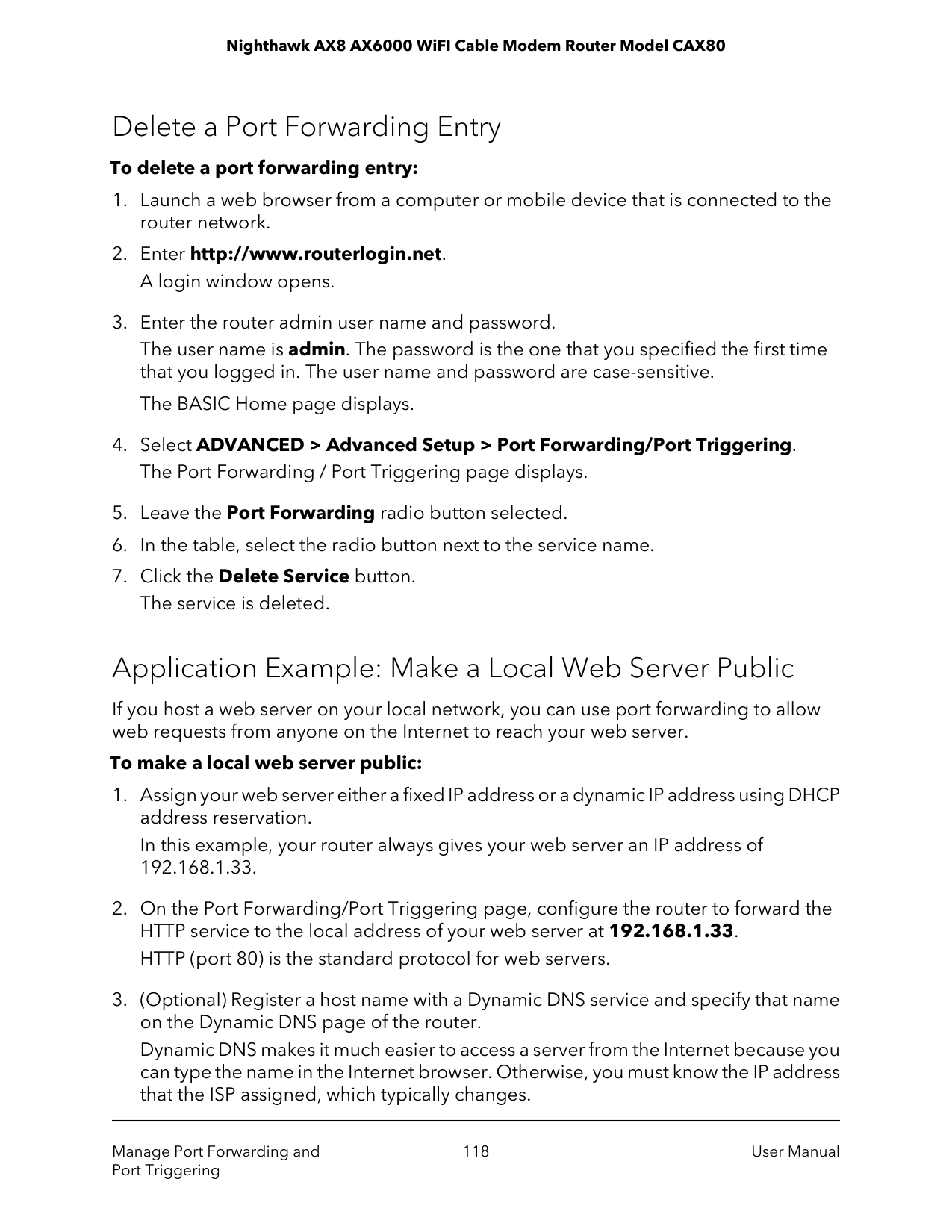
Delete a Port Forwarding Entry To delete a port forwarding entry:
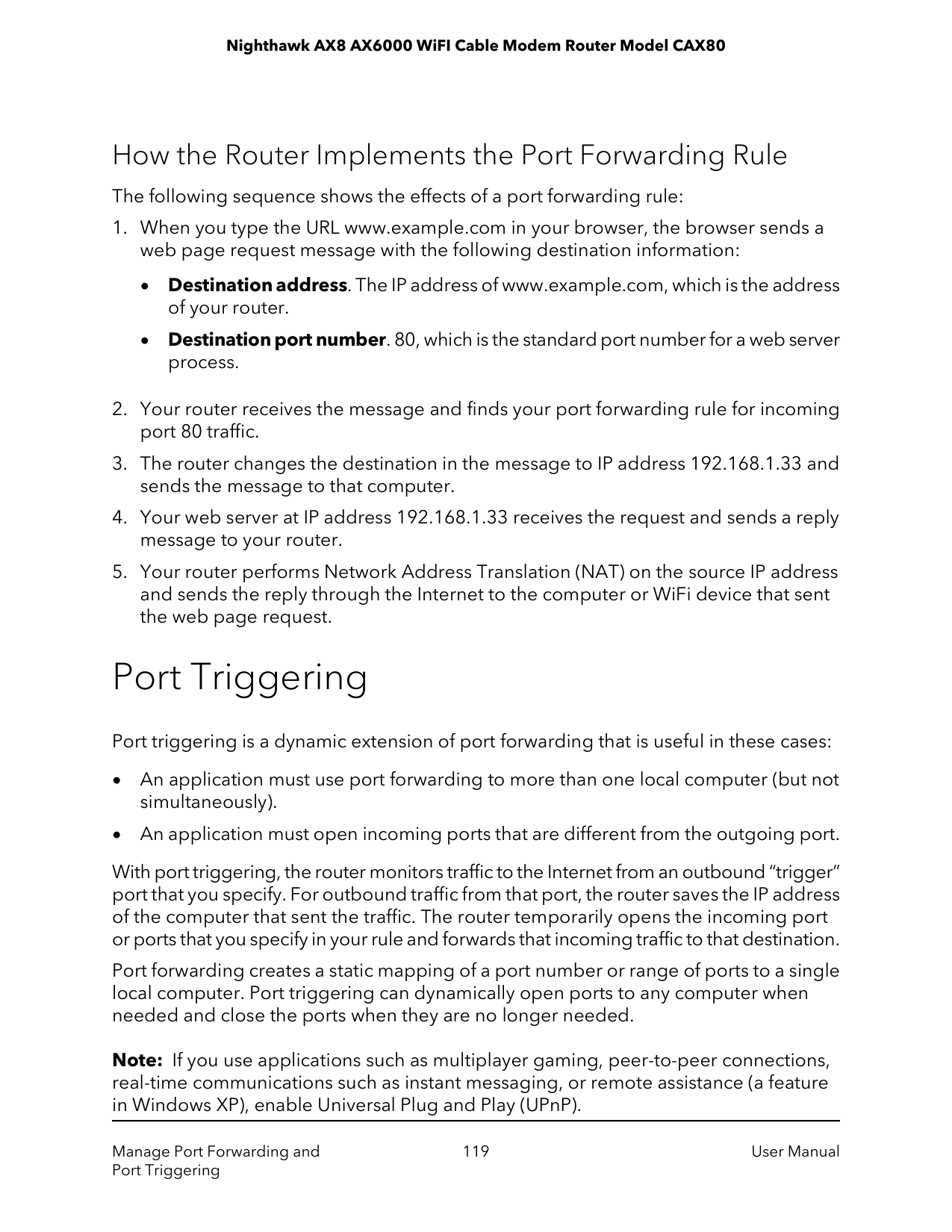
How the Router Implements the Port Forwarding Rule The following sequence shows the effects of a port forwarding rule:
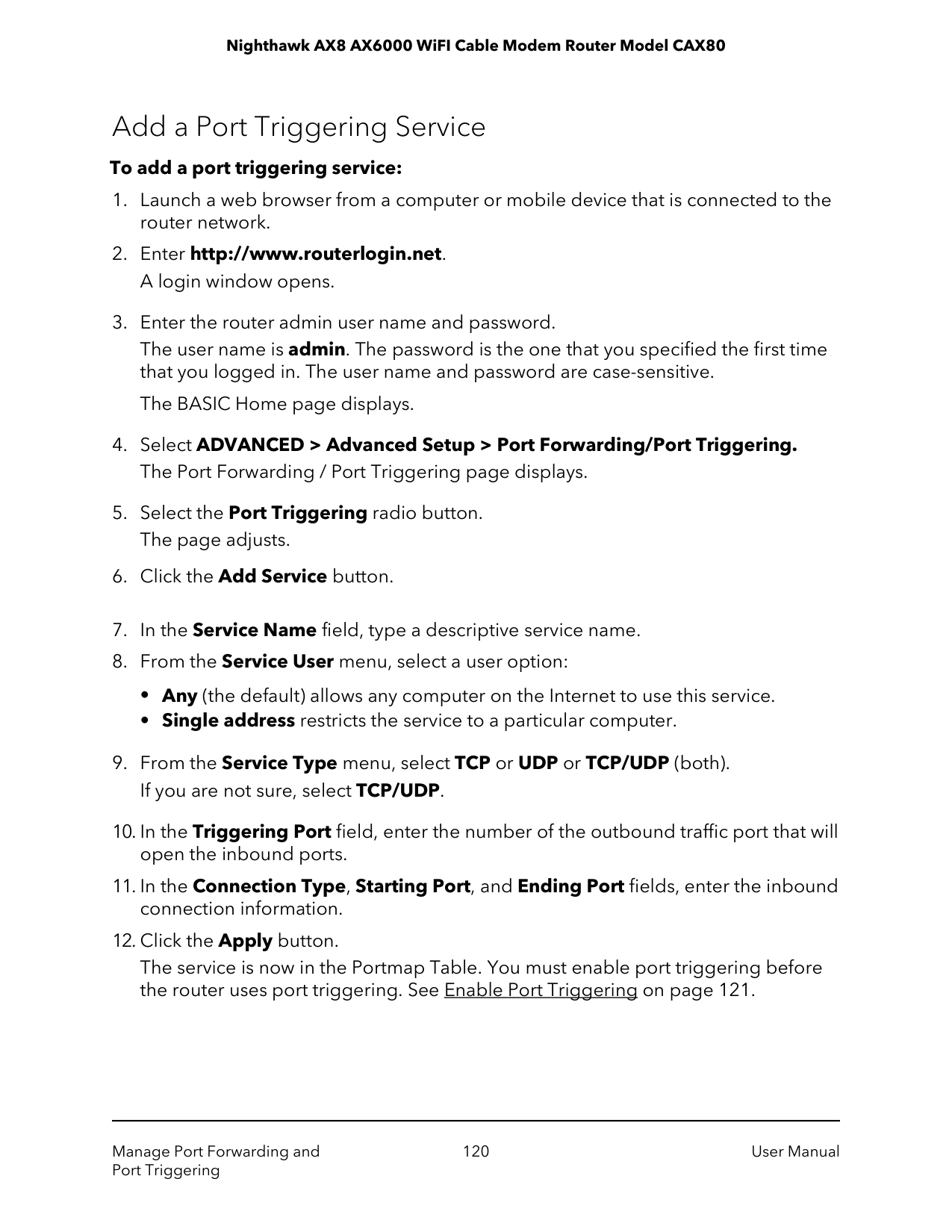
Add a Port Triggering Service To add a port triggering service:
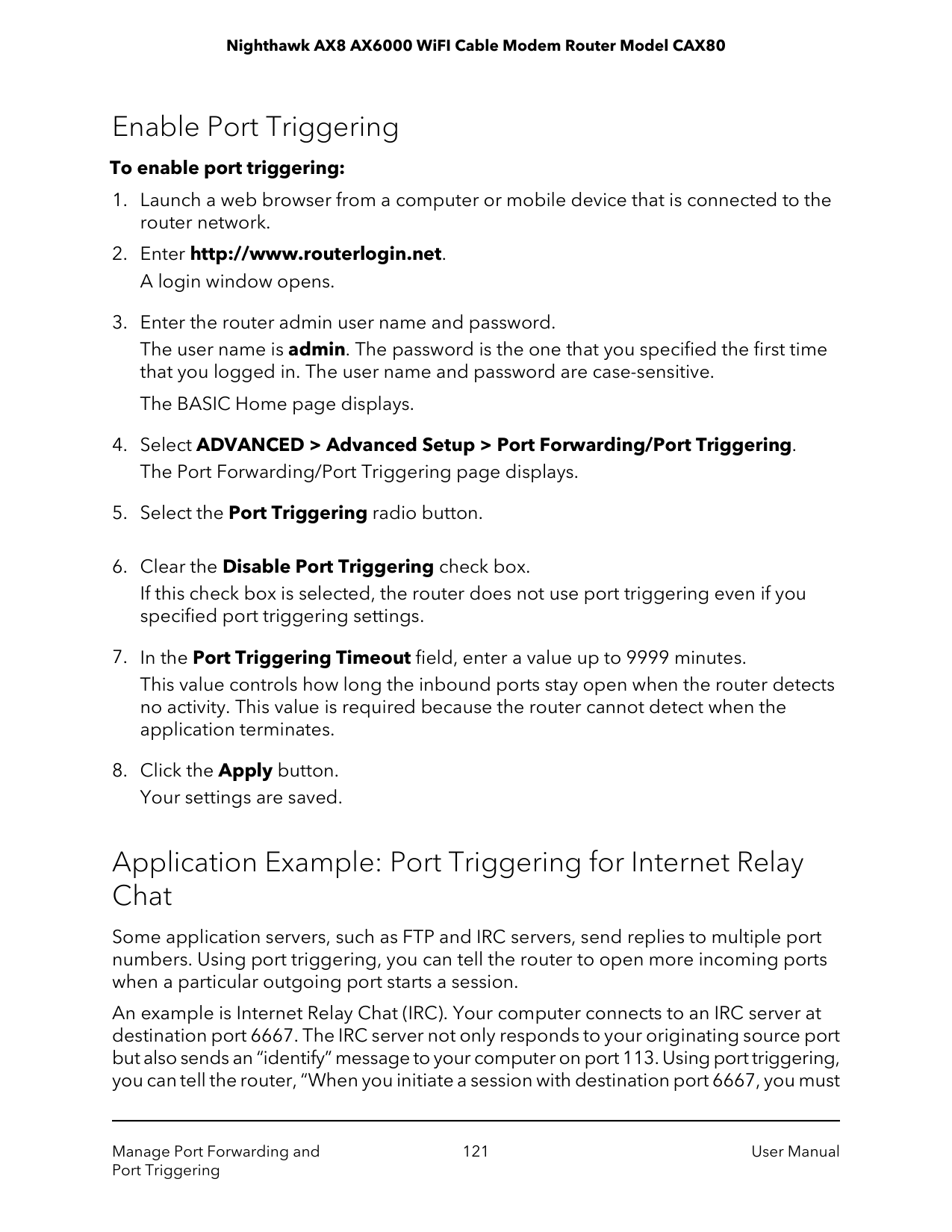
Enable Port Triggering To enable port triggering:
also allow incoming traffic on port 113 to reach the originating computer.” The following sequence shows the effects of this port triggering rule:
11 Troubleshooting This chapter provides information to help you diagnose and solve problems you might experience with your modem router. If you do not find the solution here, check the NETGEAR support site at netgear.com/support for product and contact information. The chapter contains the following sections: • Quick tips • Troubleshoot with the LEDs • You cannot log in to the router • You cannot access the Internet • Troubleshoot Internet browsing • Changes are not saved • Troubleshoot WiFi connectivity • Troubleshoot your network using the ping utility 123
Quick tips This section describes tips for troubleshooting some common problems. Sequence to restart your network If you must restart your network, follow this sequence:
Some Internet service providers require you to use the MAC address of the computer initially registered on the account, but this is an unusual situation. You can view the MAC address on the Attached Devices page of the router web interface. Troubleshoot with the LEDs By default, the modem router uses standard LED settings. Standard LED behavior when the router is powered on After you turn on power to the modem router, verify that the following sequence of events occurs:
LEDs never turn off When the modem router is turned on, the LEDs light for about 10 seconds and then turn off. If all the LEDs stay on, this indicates a fault within the modem router. If all LEDs are still lit one minute after power-up, do the following: • Cycle the power to see if the modem router recovers. • Press and hold the Reset button for at least 5 seconds to return the modem router to its factory settings. If the error persists, a hardware problem might be the cause. Contact Technical Support at netgear.com/support. Online LED is Off If the Online LED is off and the modem router is connected to the coax cable, try the following: • Make sure that the coax cable connections are secure at the modem router and at the wall jack. • Make sure that your cable Internet provider provisioned your cable Internet service. Your provider can verify that the signal quality is good enough for modem router service. • Remove any excess splitters that are on your cable line. Ethernet LAN port LEDs are off If the Ethernet port LEDs do not light when an Ethernet connection is made, check the following: • Make sure that the Ethernet cable connections are secure at the modem router and computer. • Make sure that power is turned on to the connected modem router or computer. • Be sure that you are using the correct cable. WiFi LED is off If the WiFi LED stays off, check to see if someone pressed the WiFi On/Off button on the modem router. This button turns the WiFi radios in the modem router on and off. If someone disabled the WiFi radios by using the router web interface, the WiFi LED also stays off. The WiFi LED is lit when the WiFi radios are turned on. User Manual 126 Troubleshooting Nighthawk AX8 AX6000 WiFI Cable Modem Router Model CAX80
Note: if the LED On/Off button is in the off position, all LEDs are off except the Power
Led.
You cannot log in to the router If you are unable to log in to the modem router from a computer or mobile device on your local network, check the following: • If you are using an Ethernet-connected computer, check the cable connection between the computer and the modem router. • If you are using a WiFi-enabled computer or mobile device, check the WiFi connection between the computer or mobile device and the modem router. • Make sure that you are using the correct login information. The user name is admin. The password is the one that you specified the first time that you logged in. (The default password is password.) The user name and password are case-sensitive. Make sure that Caps Lock is off when you enter this information. • Try quitting the browser and launching it again. • Make sure that Java, JavaScript, or ActiveX is enabled in your browser. If you are using Internet Explorer, click the Refresh button to be sure that the Java applet is loaded. • Make sure that the IP address of your computer or mobile device is in the same subnet as the modem router. If you are using the recommended addressing scheme, the IP address of your computer or mobile device is in the range of 192.168.1.2 to 192.168.1.254. • If the IP address of your computer or mobile device is shown as 169.254.x.x, the computer or mobile device could not reach the modem router’s DHCP server and the Windows or Mac operating system generated and assigned an IP address. Such an autogenerated IP address is in the range of 169.254.x.x. If your IP address is in this range, check the connection from the computer or mobile device to the modem router, and reboot your computer or mobile device. • If your modem router’s IP address was changed and you do not know the current IP address, clear the modem router’s configuration to factory defaults. This sets the modem router’s IP address to 192.168.1.1. Tip: If the router is in access point mode or bridge mode and you do not know the IP address that is assigned to it, first try to use an IP scanner application to detect the IP address. (IP scanner applications are available online free of charge.) If you can detect the IP address, you don’t need to reset the router to factory default settings. User Manual 127 Troubleshooting Nighthawk AX8 AX6000 WiFI Cable Modem Router Model CAX80
• If you are attempting to set up your NETGEAR modem router as a replacement for an ADSL gateway in your network, the modem router cannot perform many gateway services. For example, the router cannot convert ADSL or cable data into Ethernet networking information. NETGEAR does not support such a configuration. You cannot access the Internet When your modem router cannot access the Internet and your Online LED is on, activate your modem router by registering the cable MAC address of your modem router with your cable Internet provider. For instructions for registering, see Install and Activate Your Modem Router on page 14. If you already activated the modem router and can access it, but not the Internet, check to see if the modem router can obtain a WAN IP address from your Internet service provider (ISP). Unless your ISP provides a fixed IP address, your router requests an IP address from the ISP. You can determine whether the request was successful using the modem router web interface. To check your IP address:

If your modem router obtained an IP address, but your computer does not load any web pages from the Internet, it might be for one or more of the following reasons: • Your computer might not recognize any DNS server addresses. Typically, your ISP provides the addresses of one or two DNS servers for your use. If you entered a DNS address during the modem router’s configuration, reboot your computer, and verify the DNS address. You can configure your computer manually with DNS addresses, as explained in your operating system documentation. • The modem router might not be configured as the TCP/IP gateway on your computer. If your computer obtains its information from the modem router by DHCP, reboot the computer and verify the gateway address. • You might be running login software that is no longer needed. If your ISP provided a program to log you in to the Internet, you no longer need to run that software after installing your modem router. Troubleshoot Internet browsing If your modem router can obtain an IP address but your computer is unable to load any web pages from the Internet, it might be for the following reasons: • The traffic meter is enabled, and the limit was reached. By configuring the traffic meter not to block Internet access when the traffic limit is reached, you can resume Internet access. If your Internet service provider (ISP) sets a usage limit, they might charge you for the overage. • Your computer might not recognize any DNS server addresses. A DNS server is a host on the Internet that translates Internet names (such as www addresses) to numeric IP addresses. Typically, your ISP provides the addresses of one or two DNS servers for your use. If you entered a DNS address during the modem router’s configuration, restart your computer. Alternatively, you can configure your computer manually with a DNS address, as explained in the documentation for your computer. • The modem router might not be configured as the default gateway on your computer. Restart the computer and verify that the modem router address (www.routerlogin.net) is listed by your computer as the default gateway address. User Manual 129 Troubleshooting Nighthawk AX8 AX6000 WiFI Cable Modem Router Model CAX80
Changes are not saved If the modem router does not save the changes that you make in the modem router web interface, do the following: • When entering configuration settings, always click the Apply button before moving to another page or tab, or your changes are lost. • Click the Refresh or Reload button in the web browser. It is possible that the changes occurred, but the old settings might be in the web browser’s cache. Troubleshoot WiFi connectivity If you are experiencing trouble connecting over WiFi to the modem router, try to isolate the problem: • Does the WiFi device or computer that you are using find your WiFi network? If not, check the WiFi LED on the modem router. If it is off, you can press the WiFi On/Off button on the modem router to turn the modem router WiFi radios back on. If you disabled the modem router’s SSID broadcast, then your WiFi network is hidden and does not display in your WiFi client’s scanning list. (By default, SSID broadcast is enabled.) • Does your WiFi device support the security that you are using for your WiFi network (WPA or WPA2)? • If you want to view the WiFi settings for the modem router, use an Ethernet cable to connect a computer to a LAN port on the modem router. Then log in to the modem router, and select BASIC > Wireless. Note: Be sure to click the Apply button if you change settings. If your WiFi device finds your network but the signal strength is weak, check these conditions: • Is your modem router too far from your computer or too close? Place your computer near the modem router but at least 6 feet (1.8 meters) away and see whether the signal strength improves. • Are objects between the modem router and your computer blocking the WiFi signal? User Manual 130 Troubleshooting Nighthawk AX8 AX6000 WiFI Cable Modem Router Model CAX80
Troubleshoot your network using the ping utility Most network devices and routers contain a ping utility that sends an echo request packet to the designated device. The device then responds with an echo reply. You can easily troubleshoot a network using the ping utility in your computer or workstation. Test the LAN path to your router You can ping the modem router from your computer to verify that the LAN path to your modem router is set up correctly. To ping the modem router from a Windows-based computer:
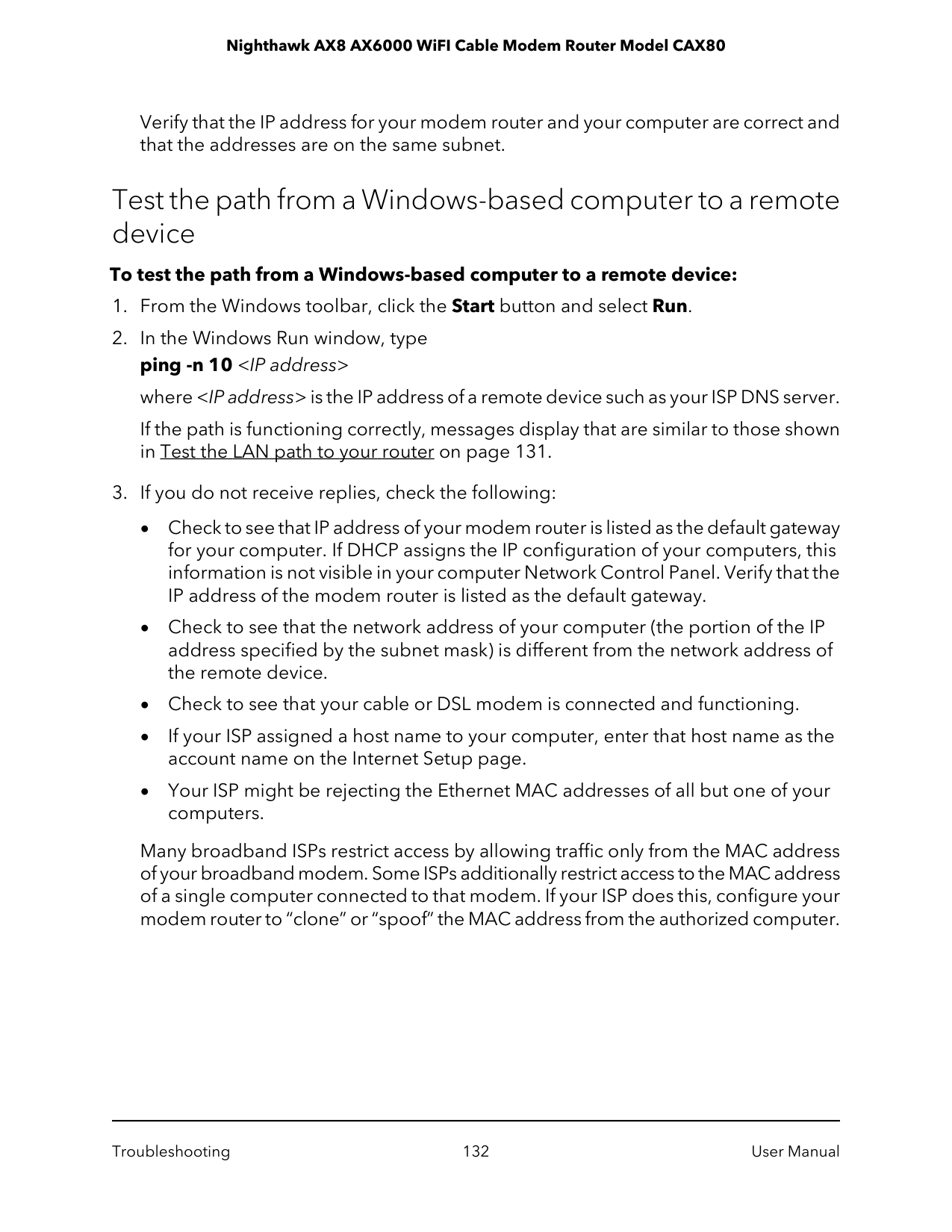
Verify that the IP address for your modem router and your computer are correct and that the addresses are on the same subnet. Test the path from a Windows-based computer to a remote device To test the path from a Windows-based computer to a remote device:
12 Supplemental Information This appendix covers the following topics: • Factory Settings • Technical Specifications 133
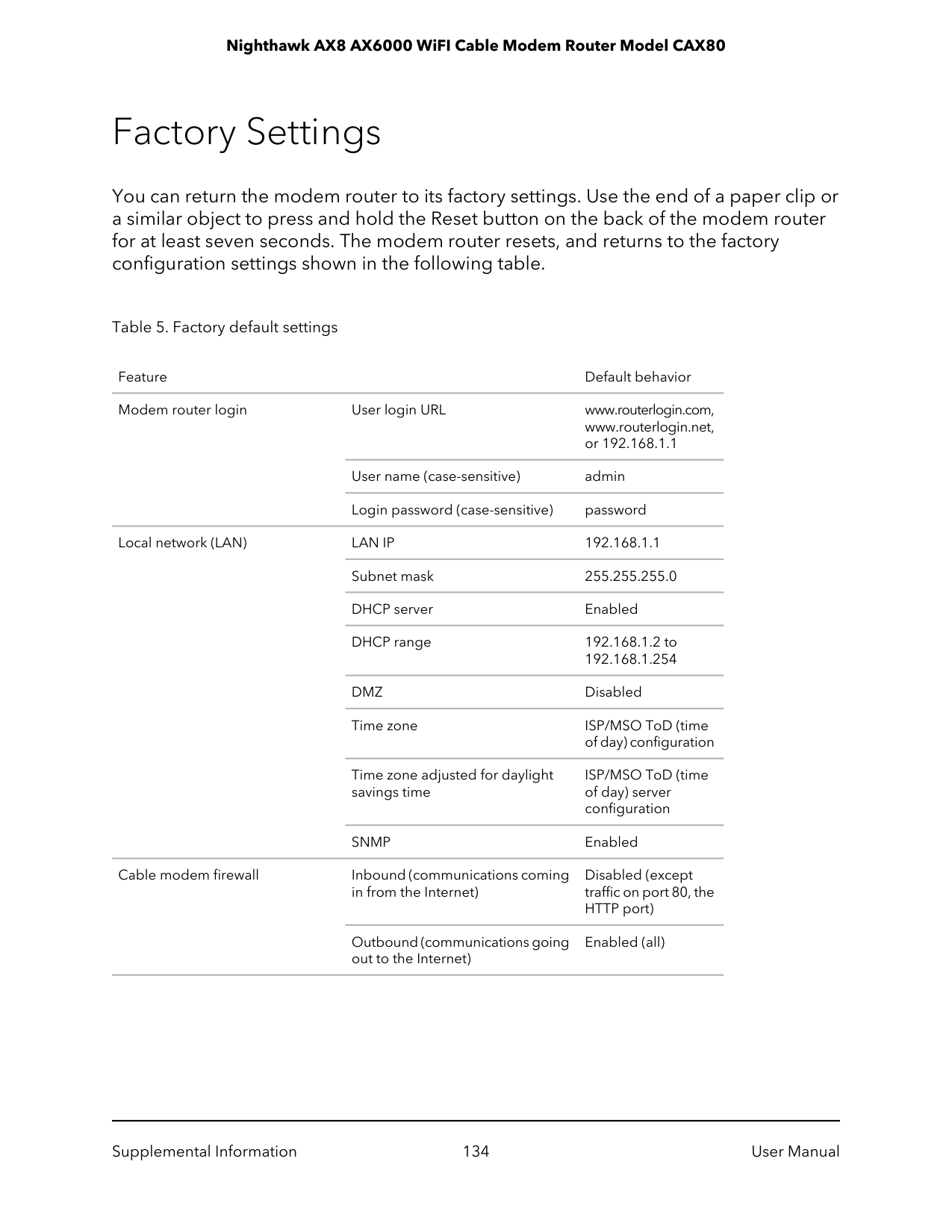
Factory Settings You can return the modem router to its factory settings. Use the end of a paper clip or a similar object to press and hold the Reset button on the back of the modem router for at least seven seconds. The modem router resets, and returns to the factory configuration settings shown in the following table. Table 5. Factory default settings Default behavior Feature www.routerlogin.com, www.routerlogin.net, or 192.168.1.1 User login URL Modem router login admin User name (case-sensitive) password Login password (case-sensitive) 192.168.1.1
Lan Ip
Local network (LAN) 255.255.255.0 Subnet mask Enabled DHCP server 192.168.1.2 to 192.168.1.254 DHCP range DisabledDmz
ISP/MSO ToD (time of day) configuration Time zone ISP/MSO ToD (time of day) server configuration Time zone adjusted for daylight savings time EnabledSnmp
Disabled (except traffic on port 80, the HTTP port) Inbound (communications coming in from the Internet) Cable modem firewall Enabled (all) Outbound (communications going out to the Internet) User Manual 134 Supplemental Information Nighthawk AX8 AX6000 WiFI Cable Modem Router Model CAX80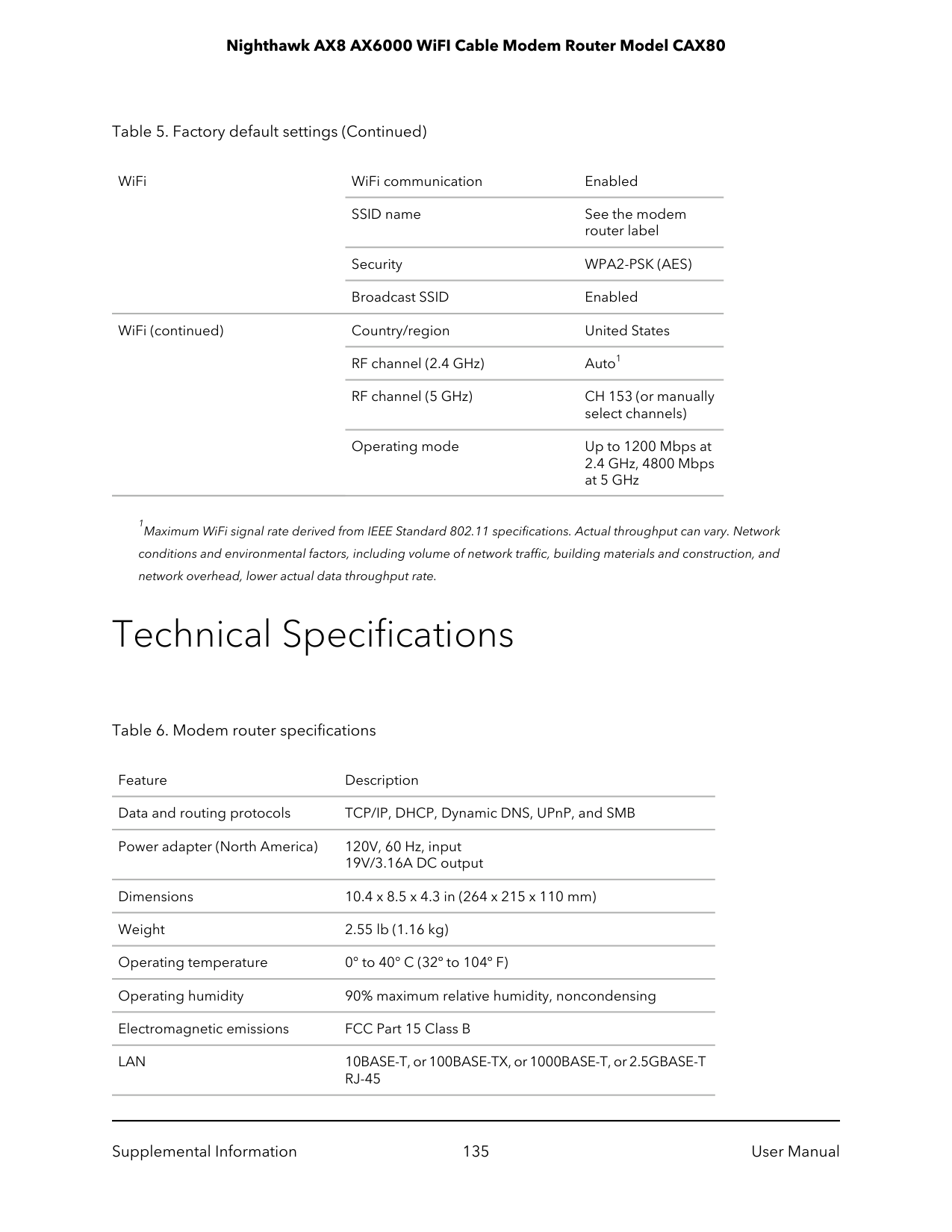
Table 5. Factory default settings (Continued) Enabled WiFi communication WiFi See the modem router label SSID name
Wpa2-Psk (Aes)
Security Enabled Broadcast SSID United States Country/region WiFi (continued) Auto1 RF channel (2.4 GHz) CH 153 (or manually select channels) RF channel (5 GHz) Up to 1200 Mbps at 2.4 GHz, 4800 Mbps at 5 GHz Operating mode 1Maximum WiFi signal rate derived from IEEE Standard 802.11 specifications. Actual throughput can vary. Network conditions and environmental factors, including volume of network traffic, building materials and construction, and network overhead, lower actual data throughput rate. Technical Specifications Table 6. Modem router specifications Description Feature TCP/IP, DHCP, Dynamic DNS, UPnP, and SMB Data and routing protocols 120V, 60 Hz, input 19V/3.16A DC output Power adapter (North America) 10.4 x 8.5 x 4.3 in (264 x 215 x 110 mm) Dimensions 2.55 lb (1.16 kg) Weight 0° to 40° C (32º to 104º F) Operating temperature 90% maximum relative humidity, noncondensing Operating humidity FCC Part 15 Class B Electromagnetic emissions 10BASE-T, or 100BASE-TX, or 1000BASE-T, or 2.5GBASE-TRj-45
Lan
User Manual 135 Supplemental Information Nighthawk AX8 AX6000 WiFI Cable Modem Router Model CAX80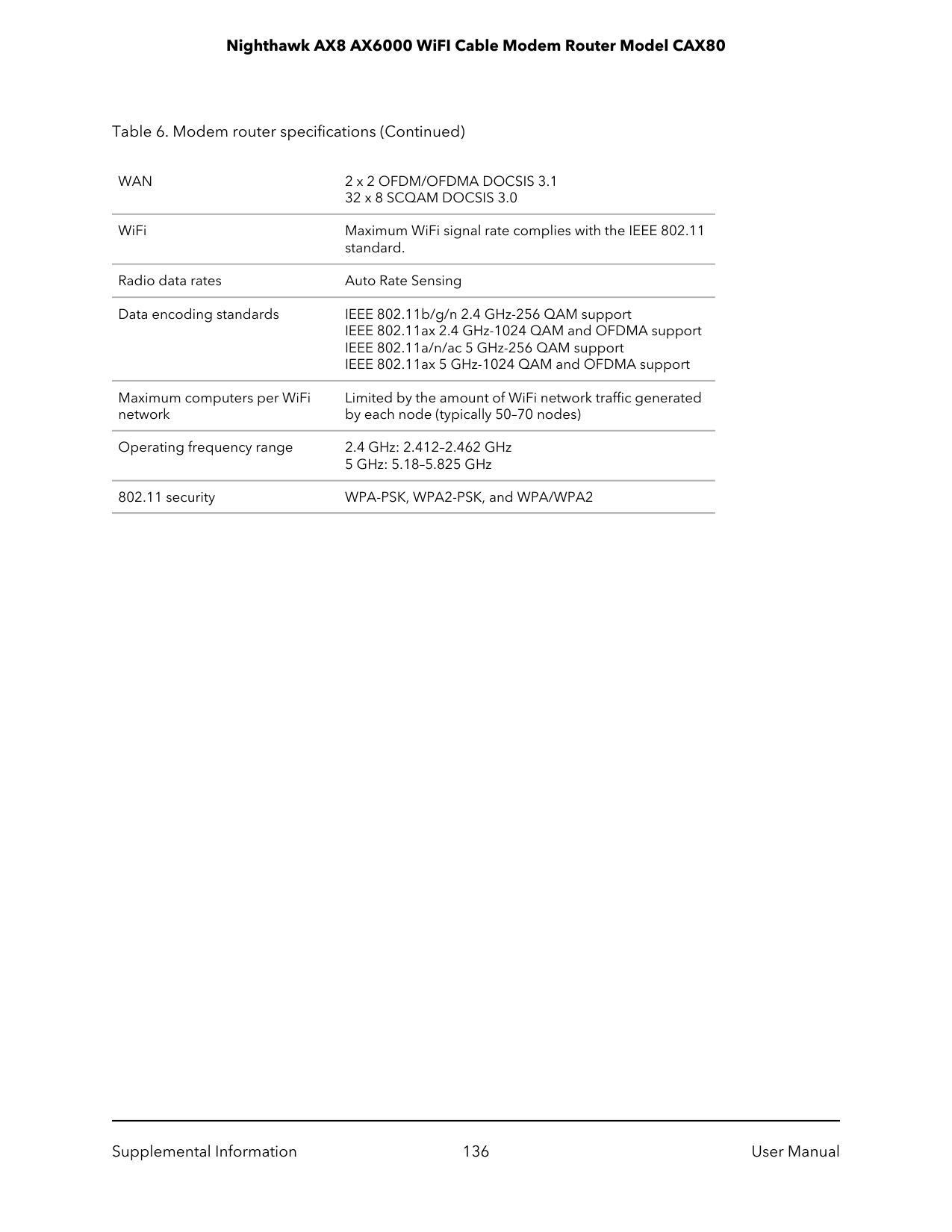
Table 6. Modem router specifications (Continued) 2 x 2 OFDM/OFDMA DOCSIS 3.1 32 x 8 SCQAM DOCSIS 3.0